Tag Archives: theoretical physics

More Travel

I’m visiting the Niels Bohr Institute this week, on my way back from Amplitudes.
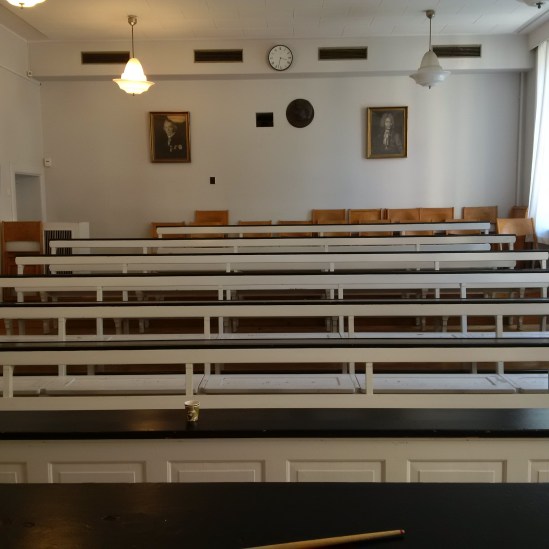
IMG_20170719_152906

You might recognize the place from old conference photos.

Amplitudes itself was nice. There weren’t any surprising new developments, but a lot of little “aha” moments when one of the speakers explained something I’d heard vague rumors about. I figured I’d mention a few of the things that stood out. Be warned, this is going to be long and comparatively jargon-heavy.

The conference organizers were rather daring in scheduling Nima Arkani-Hamed for the first talk, as Nima has a tendency to arrive at the last minute and talk for twice as long as you ask him to. Miraculously, though, things worked out, if only barely: Nima arrived at the wrong campus and ran most of the way back, showing up within five minutes of the start of the conference. He also stuck to his allotted time, possibly out of courtesy to his student, Yuntao Bai, who was speaking next.

Between the two of them, Nima and Yuntao covered an interesting development, tying the Amplituhedron together with the string theory-esque picture of scattering amplitudes pioneered by Freddy Cachazo, Song He, and Ellis Ye Yuan (or CHY). There’s a simpler (and older) Amplituhedron-like object called the associahedron that can be thought of as what the Amplituhedron looks like on the surface of a string, and CHY’s setup can be thought of as a sophisticated map that takes this object and turns it into the Amplituhedron. It was nice to hear from both Nima and his student on this topic, because Nima’s talks are often high on motivation but low on detail, so it was great that Yuntao was up next to fill in the blanks.

Anastasia Volovich talked about Landau singularities, a topic I’ve mentioned before. What I hadn’t appreciated was how much they can do with them at this point. Originally, Juan Maldacena had suggested that these singularities, mathematical points that determine the behavior of amplitudes first investigated by Landau in the 60’s, might explain some of the simplicity we’ve observed in N=4 super Yang-Mills. They ended up not being enough by themselves, but what Volovich and collaborators are discovering is that with a bit of help from the Amplithedron they explain quite a lot. In particular, if they start with the Amplituhedron and do a procedure similar to Landau’s, they can find the simpler set of singularities allowed by N=4 super Yang-Mills, at least for the examples they’ve calculated. It’s still a bit unclear how this links to their previous investigations of these things in terms of cluster algebras, but it sounds like they’re making progress.

Dmitry Chicherin gave me one of those minor “aha” moments. One big useful fact about scattering amplitudes in N=4 super Yang-Mills is that they’re “dual” to different mathematical objects called Wilson loops, a fact which allows us to compare to the “POPE” approach of Basso, Sever, and Vieira. Chicherin asks the question: “What if you’re not calculating a scattering amplitude or a Wilson loop, but something halfway in between?” Interestingly, this has an answer, with the “halfway between” objects having a similar duality among themselves.

Yorgos Papathansiou talked about work I’ve been involved with. I’ll probably cover it in detail in another post, so now I’ll just mention that we’re up to six loops!

Andy Strominger talked about soft theorems. It’s always interesting seeing people who don’t traditionally work on amplitudes giving talks at Amplitudes. There’s a range of responses, from integrability people (who are basically welcomed like family) to work on fairly unrelated areas that have some “amplitudes” connection (met with yawns except from the few people interested in the connection). The response to Strominger was neither welcome nor boredom, but lively debate. He’s clearly doing something interesting, but many specialists worried he was ignorant of important no-go results in the field that could hamstring some of his bolder conjectures.

The second day focused on methods for more practical calculations, and had the overall effect of making me really want to clean up my code. Tiziano Peraro’s finite field methods in particular look like they could be quite useful. There were two competing bases of integrals on display, Von Manteuffel’s finite integrals and Rutger Boels’s uniform transcendental integrals later in the conference. Both seem to have their own virtues, and I ended up asking Rob Schabinger if it was possible to combine the two, with the result that he’s apparently now looking into it.

The more practical talks that day had a clear focus on calculations with two loops, which are becoming increasingly viable for LHC-relevant calculations. From talking to people who work on this, I get the impression that the goal of these calculations isn’t so much to find new physics as to confirm and investigate new physics found via other methods. Things are complicated enough at two loops that for the moment it isn’t feasible to describe what all the possible new particles might do at that order, and instead the goal is to understand the standard model well enough that if new physics is noticed (likely based on one-loop calculations) then the details can be pinned down by two-loop data. But this picture could conceivably change as methods improve.

Wednesday was math-focused. We had a talk by Francis Brown on his conjecture of a cosmic Galois group. This is a topic I knew a bit about already, since it’s involved in something I’ve been working on. Brown’s talk cleared up some things, but also shed light on the vagueness of the proposal. As with Yorgos’s talk, I’ll probably cover more about this in a future post, so I’ll skip the details for now.

There was also a talk by Samuel Abreu on a much more physical picture of the “symbols” we calculate with. This is something I’ve seen presented before by Ruth Britto, and it’s a setup I haven’t looked into as much as I ought to. It does seem at the moment that they’re limited to one loop, which is a definite downside. Other talks discussed elliptic integrals, the bogeyman that we still can’t deal with by our favored means but that people are at least understanding better.

The last talk on Wednesday before the hike was by David Broadhurst, who’s quite a character in his own right. Broadhurst sat in the front row and asked a question after nearly every talk, usually bringing up papers at least fifty years old, if not one hundred and fifty. At the conference dinner he was exactly the right person to read the Address to the Haggis, resurrecting a thick Scottish accent from his youth. Broadhurst’s techniques for handling high-loop elliptic integrals are quite impressively powerful, leaving me wondering if the approach can be generalized.

Thursday focused on gravity. Radu Roiban gave a better idea of where he and his collaborators are on the road to seven-loop supergravity and what the next bottlenecks are along the way. Oliver Schlotterer’s talk was another one of those “aha” moments, helping me understand a key difference between two senses in which gravity is Yang-Mills squared ( the Kawai-Lewellen-Tye relations and BCJ). In particular, the latter is much more dependent on specifics of how you write the scattering amplitude, so to the extent that you can prove something more like the former at higher loops (the original was only for trees, unlike BCJ) it’s quite valuable. Schlotterer has managed to do this at one loop, using the “Q-cut” method I’ve (briefly) mentioned before. The next day’s talk by Emil Bjerrum-Bohr focused more heavily on these Q-cuts, including a more detailed example at two loops than I’d seen that group present before.

There was also a talk by Walter Goldberger about using amplitudes methods for classical gravity, a subject I’ve looked into before. It was nice to see a more thorough presentation of those ideas, including a more honest appraisal of which amplitudes techniques are really helpful there.

There were other interesting topics, but I’m already way over my usual post length, so I’ll sign off for now. Videos from all but a few of the talks are now online, so if you’re interested you should watch them on the conference page.


Amplitudes 2017

I’ve been at Amplitudes this week, in Edinburgh. There have been a lot of great talks, most of which should already have slides online. (They’ve been surprisingly quick about getting slides up this year, with many uploaded before the corresponding talks!) Recordings of the talks should also be up soon.

IMG_20170712_172014

We also hiked up local hill Arthur’s Seat on Wednesday, which was a nice change of pace.

I’ll have more time to write about the talks later, a few of them were quite interesting. For now, take a look at some of the slides if you’re curious.

Bootstrapping in the Real World

I’ll be at Amplitudes, my subfield’s big yearly conference, next week, so I don’t have a lot to talk about. That said, I wanted to give a shout-out to my collaborator and future colleague Andrew McLeod, who is a co-author (along with Øyvind Almelid, Claude Duhr, Einan Gardi, and Chris White) on a rather cool paper that went up on arXiv this week.

Andrew and I work on “bootstrapping” calculations in quantum field theory. In particular, we start with a guess for what the result will be based on a specific set of mathematical functions (in my case, “hexagon functions” involving interactions of six particles). We then narrow things down, using other calculations that by themselves only predict part of the result, until we know the right answer. The metaphor here is that we’re “pulling ourselves up by our own bootstraps”, skipping a long calculation by essentially just guessing the answer.

This method has worked pretty well…in a toy model anyway. The calculations I’ve done with it use N=4 super Yang-Mills, a simpler cousin of the theories that describe the real world. There, fewer functions can show up, so our guess is much less unwieldy than it would be otherwise.

What’s impressive about Andrew and co.’s new paper is that they apply this method, not to N=4 super Yang-Mills, but to QCD, the theory that describes quarks and gluons in the real world. This is exactly the sort of thing I’ve been hoping to see more of, these methods built into something that can help with real, useful calculations.

Currently, what they can do is still fairly limited. For the particular problem they’re looking at, the functions required ended up being relatively simple, involving interactions between at most four particles. So far, they’ve just reproduced a calculation done by other means. Going further (more “loops”) would involve interactions between more particles, as well as mixing different types of functions (different “transcendental weight”), either of which make the problem much more complicated.

That said, the simplicity of their current calculation is also a reason to be optimistic.  Their starting “guess” had just thirteen parameters, while the one Andrew and I are working on right now (in N=4 super Yang-Mills) has over a thousand. Even if things get a lot more complicated for them at the next loop, we’ve shown that “a lot more complicated” can still be quite doable.

So overall, I’m excited. It looks like there are contexts in which one really can “bootstrap” up calculations in a realistic theory, and that’s a method that could end up really useful.

An Amplitudes Flurry

Now that we’re finally done with flurries of snow here in Canada, in the last week arXiv has been hit with a flurry of amplitudes papers.

kitchener-construction

We’re also seeing a flurry of construction, but that’s less welcome.

Andrea Guerrieri, Yu-tin Huang, Zhizhong Li, and Congkao Wen have a paper on what are known as soft theorems. Most famously studied by Weinberg, soft theorems are proofs about what happens when a particle in an amplitude becomes “soft”, or when its momentum becomes very small. Recently, these theorems have gained renewed interest, as new amplitudes techniques have allowed researchers to go beyond Weinberg’s initial results (to “sub-leading” order) in a variety of theories.

Guerrieri, Huang, Li, and Wen’s contribution to the topic looks like it clarifies things quite a bit. Previously, most of the papers I’d seen about this had been isolated examples. This paper ties the various cases together in a very clean way, and does important work in making some older observations more rigorous.


Vittorio Del Duca, Claude Duhr, Robin Marzucca, and Bram Verbeek wrote about transcendental weight in something known as the multi-Regge limit. I’ve talked about transcendental weight before: loosely, it’s counting the power of pi that shows up in formulas. The multi-Regge limit concerns amplitudes with very high energies, in which we have a much better understanding of how the amplitudes should behave. I’ve used this limit before, to calculate amplitudes in N=4 super Yang-Mills.

One slogan I love to repeat is that N=4 super Yang-Mills isn’t just a toy model, it’s the most transcendental part of QCD. I’m usually fairly vague about this, because it’s not always true: while often a calculation in N=4 super Yang-Mills will give the part of the same calculation in QCD with the highest power of pi, this isn’t always the case, and it’s hard to propose a systematic principle for when it should happen. Del Duca, Duhr, Marzucca, and Verbeek’s work is a big step in that direction. While some descriptions of the multi-Regge limit obey this property, others don’t, and in looking at the ones that don’t the authors gain a better understanding of what sorts of theories only have a “maximally transcendental part”. What they find is that even when such theories aren’t restricted to N=4 super Yang-Mills, they have shared properties, like supersymmetry and conformal symmetry. Somehow these properties are tied to the transcendentality of functions in the amplitude, in a way that’s still not fully understood.


My colleagues at Perimeter released two papers over the last week: one, by Freddy Cachazo and Alfredo Guevara, uses amplitudes techniques to look at classical gravity, while the other, by Sebastian Mizera and Guojun Zhang, looks at one of the “pieces” inside string theory amplitudes.

I worked with Freddy and Alfredo on an early version of their result, back at the PSI Winter School. While I was off lazing about in Santa Barbara, they were hard at work trying to understand how the quantum-looking “loops” one can use to make predictions for potential energy in classical gravity are secretly classical. What they ended up finding was a trick to figure out whether a given amplitude was going to have a classical part or be purely quantum. So far, the trick works for amplitudes with one loop, and a few special cases at higher loops. It’s still not clear if it works for the general case, and there’s a lot of work still to do to understand what it means, but it definitely seems like an idea with potential. (Pun mostly not intended.)

I’ve talked before about “Z theory”, the weird thing you get when you isolate the “stringy” part of string theory amplitudes. What Sebastian and Guojun have carved out isn’t quite the same piece, but it’s related. I’m still not sure of the significance of cutting string amplitudes up in this way, I’ll have to read the paper more thoroughly (or chat with the authors) to find out.

The Many Worlds of Condensed Matter

Physics is the science of the very big and the very small. We study the smallest scales, the fundamental particles that make up the universe, and the largest, stars on up to the universe as a whole.

We also study the world in between, though.

That’s the domain of condensed matter, the study of solids, liquids, and other medium-sized arrangements of stuff. And while it doesn’t make the news as often, it’s arguably the biggest field in physics today.

(In case you’d like some numbers, the American Physical Society has divisions dedicated to different sub-fields. Condensed Matter Physics is almost twice the size of the next biggest division, Particles & Fields. Add in other sub-fields that focus on medium-sized-stuff, like those who work on solid state physics, optics, or biophysics, and you get a majority of physicists focused on the middle of the distance scale.)

When I started grad school, I didn’t pay much attention to condensed matter and related fields. Beyond the courses in quantum field theory and string theory, my “breadth” courses were on astrophysics and particle physics. But over and over again, from people in every sub-field, I kept hearing the same recommendation:

“You should take Solid State Physics. It’s a really great course!”

At the time, I never understood why. It was only later, once I had some research under my belt, that I realized:

Condensed matter uses quantum field theory!

The same basic framework, describing the world in terms of rippling quantum fields, doesn’t just work for fundamental particles. It also works for materials. Rather than describing the material in terms of its fundamental parts, condensed matter physicists “zoom out” and talk about overall properties, like sound waves and electric currents, treating them as if they were the particles of quantum field theory.

This tends to confuse the heck out of journalists. Not used to covering condensed matter (and sometimes egged on by hype from the physicists), they mix up the metaphorical particles of these systems with the sort of particles made by the LHC, with predictably dumb results.

Once you get past the clumsy journalism, though, this kind of analogy has a lot of value.

Occasionally, you’ll see an article about string theory providing useful tools for condensed matter. This happens, but it’s less widespread than some of the articles make it out to be: condensed matter is a huge and varied field, and string theory applications tend to be of interest to only a small piece of it.

It doesn’t get talked about much, but the dominant trend is actually in the other direction: increasingly, string theorists need to have at least a basic background in condensed matter.

String theory’s curse/triumph is that it can give rise not just to one quantum field theory, but many: a vast array of different worlds obtained by twisting extra dimensions in different ways. Particle physicists tend to study a fairly small range of such theories, looking for worlds close enough to ours that they still fit the evidence.

Condensed matter, in contrast, creates its own worlds. Pick the right material, take the right slice, and you get quantum field theories of almost any sort you like. While you can’t go to higher dimensions than our usual four, you can certainly look at lower ones, at the behavior of currents on a sheet of metal or atoms arranged in a line. This has led some condensed matter theorists to examine a wide range of quantum field theories with one strange behavior or another, theories that wouldn’t have occurred to particle physicists but that, in many cases, are part of the cornucopia of theories you can get out of string theory.

So if you want to explore the many worlds of string theory, the many worlds of condensed matter offer a useful guide. Increasingly, tools from that community, like integrability and tensor networks, are migrating over to ours.

It’s gotten to the point where I genuinely regret ignoring condensed matter in grad school. Parts of it are ubiquitous enough, and useful enough, that some of it is an expected part of a string theorist’s background. The many worlds of condensed matter, as it turned out, were well worth a look.

What Space Can Tell Us about Fundamental Physics

Back when LIGO announced its detection of gravitational waves, there was one question people kept asking me: “what does this say about quantum gravity?”

The answer, each time, was “nothing”. LIGO’s success told us nothing about quantum gravity, and very likely LIGO will never tell us anything about quantum gravity.

The sheer volume of questions made me think, though. Astronomy, astrophysics, and cosmology fascinate people. They capture the public’s imagination in a way that makes them expect breakthroughs about fundamental questions. Especially now, with the LHC so far seeing nothing new since the Higgs, people are turning to space for answers.

Is that a fair expectation? Well, yes and no.

Most astrophysicists aren’t concerned with finding new fundamental laws of nature. They’re interested in big systems like stars and galaxies, where we know most of the basic rules but can’t possibly calculate all their consequences. Like most physicists, they’re doing the vital work of “physics of decimals”.

At the same time, there’s a decent chunk of astrophysics and cosmology that does matter for fundamental physics. Just not all of it. Here are some of the key areas where space has something important to say about the fundamental rules that govern our world:


1. Dark Matter:

Galaxies rotate at different speeds than their stars would alone. Clusters of galaxies bend light that passes by, and do so more than their visible mass would suggest. And when scientists try to model the evolution of the universe, from early images to its current form, the models require an additional piece: extra matter that cannot interact with light. All of this suggests that there is some extra “dark” matter in the universe, not described by our standard model of particle physics.

If we want to understand this dark matter, we need to know more about its properties, and much of that can be learned from astronomy. If it turns out dark matter isn’t really matter after all, if it can be explained by a modification of gravity or better calculations of gravity’s effects, then it still will have important implications for fundamental physics, and astronomical evidence will still be key to finding those implications.

2. Dark Energy (/Cosmological Constant/Inflation/…):

The universe is expanding, and its expansion appears to be accelerating. It also seems more smooth and uniform than expected, suggesting that it had a period of much greater acceleration early on. Both of these suggest some extra quantity: a changing acceleration, a “dark energy”, the sort of thing that can often be explained by a new scalar field like the Higgs.

Again, the specifics: how (and perhaps if) the universe is expanding now, what kinds of early expansion (if any) the shape of the universe suggests, these will almost certainly have implications for fundamental physics.

3. Limits on stable stuff:

Let’s say you have a new proposal for particle physics. You’ve predicted a new particle, but it can’t interact with anything else, or interacts so weakly we’d never detect it. If your new particle is stable, then you can still say something about it, because its mass would have an effect on the early universe. Too many such particles and they would throw off cosmologists’ models, ruling them out.

Alternatively, you might predict something that could be detected, but hasn’t, like a magnetic monopole. Then cosmologists can tell you how many such particles would have been produced in the early universe, and thus how likely we would be to detect them today. If you predict too many particles and we don’t see them, then that becomes evidence against your proposal.

4. “Cosmological Collider Physics”:

A few years back, Nima Arkani-Hamed and Juan Maldacena suggested that the early universe could be viewed as an extremely high energy particle collider. While this collider performed only one experiment, the results from that experiment are spread across the sky, and observed patterns in the early universe should tell us something about the particles produced by the cosmic collider.

People are still teasing out the implications of this idea, but it looks promising, and could mean we have a lot more to learn from examining the structure of the universe.

5. Big Weird Space Stuff:

If you suspect we live in a multiverse, you might want to look for signs of other universes brushing up against our own. If your model of the early universe predicts vast cosmic strings, maybe a gravitational wave detector like LIGO will be able to see them.

6. Unexpected weirdness:

In all likelihood, nothing visibly “quantum” happens at the event horizons of astrophysical black holes. If you think there’s something to see though, the Event Horizon Telescope might be able to see it. There’s a grab bag of other predictions like this: situations where we probably won’t see anything, but where at least one person thinks there’s a question worth asking.


I’ve probably left something out here, but this should give you a general idea. There is a lot that fundamental physics can learn from astronomy, from the overall structure and origins of the universe to unexplained phenomena like dark matter. But not everything in astronomy has these sorts of implications: for the most part, astronomy is interesting not because it tells us something about the fundamental laws of nature, but because it tells us how the vast space above us actually happens to work.

PSI Winter School 2017

It’s that time of year again! Perimeter Scholars International, Perimeter’s Master’s program in theoretical physics, is holding its Winter School up in Ontario’s copious backwoods.

img_20170125_161426

Ominous antlered snowmen included

Like last year, the students are spending mornings and evenings doing research supervised by PI grad students, postdocs, and faculty, and the afternoons on a variety of winter activities, including skiing and snowshoeing.

Last year, my group worked on the “POPE”, a proposal by Basso, Sever, and Vieira, and we ended up getting a paper out of it. This year, I’ve teamed up with Freddy Cachazo on a gravity-related project. We’ve got a group of enthusiastic students and are making decent progress, I’ll have more to say about it next week.

Digging up Variations

The best parts of physics research are when I get a chance to push out into the unknown, doing calculations no-one has done before. Sometimes, though, research is more…archeological.

2016-05-441-134ap_archeologyexcavation_loropc3a9ni_ruins_nr-loropc3a9niponi_prv-bf_sun15may2016-1119h

Pictured: not what I signed up for

Recently, I’ve been digging through a tangle of papers, each of which calculates roughly the same thing in a slightly different way. Like any good archeologist, I need to figure out not just what the authors of these papers were doing, but also why.

(As a physicist, why do I care about “why”? In this case, it’s because I want to know which of the authors’ choices are worth building on. If I can figure out why they made the choices they did, I can decide whether I share their motivations, and thus which aspects of their calculations are useful for mine.)

My first guess at “why” was a deeply cynical one. Why would someone publish slight variations on an old calculation? To get more publications!

This is a real problem in science. In certain countries in particular, promotions and tenure are based not on honestly assessing someone’s work but on quick and dirty calculations based on how many papers they’ve published. This motivates scientists to do the smallest amount possible in order to get a paper out.

That wasn’t what was happening in these papers, though. None of the authors lived in those kinds of countries, and most were pretty well established people: not the sort who worry about keeping up with publications.

So I put aside my cynical first-guess, and actually looked at the papers. Doing that, I found a more optimistic explanation.

These authors were in the process of building research programs. Each had their own long-term goal, a set of concepts and methods they were building towards. And each stopped along the way, to do another variation on this well-trod calculation. They weren’t doing this just because they needed a paper, or just because they could. They were trying to sift out insights, to debug their nascent research program in a well-understood case.

Thinking about it this way helped untwist the tangle of papers. The confusion of different choices suddenly made sense, as the result of different programs with different goals. And in turn, understanding which goals contributed to which papers helped me sort out which goals I shared, and which ideas would turn out to be helpful.

Would it have been less confusing if some of these people had sat on their calculations, and not published? Maybe at first. But in the end, the variations help, giving me a clearer understanding of the whole.

Popularization as News, Popularization as Signpost

Lubos Motl has responded to my post from last week about the recent Caltech short, Quantum is Calling. His response is pretty much exactly what you’d expect, including the cameos by Salma Hayek and Kaley Cuoco.

The only surprise was his lack of concern for accuracy. Quantum is Calling got the conjecture it was trying to popularize almost precisely backwards. I was expecting that to bother him, at least a little.

Should it bother you?

That depends on what you think Quantum is Calling is trying to do.

Science popularization, even good science popularization, tends to get things wrong. Some of that is inevitable, a result of translating complex concepts to a wider audience.

Sometimes, though, you can’t really chalk it up to translation. Interstellar had some extremely accurate visualizations of black holes, but it also had an extremely silly love-powered tesseract. That wasn’t their attempt to convey some subtle scientific truth, it was just meant to sound cool.

And the thing is, that’s not a bad thing to do. For a certain kind of piece, sounding cool really is the point.

Imagine being an explorer. You travel out into the wilderness and find a beautiful waterfall.

south_falls_silver_falls_state_park

Example:

How do you tell people about it?

One option is the press. The news can cover your travels, so people can stay up to date with the latest in waterfall discoveries. In general, you’d prefer this sort of thing to be fairly accurate: the goal here is to inform people, to give them a better idea of the world around them.

Alternatively, you can advertise. You put signposts up around town pointing toward the waterfall, complete with vivid pictures. Here, accuracy matters a lot less: you’re trying to get people excited, knowing that as they get closer they can get more detailed information.

In science popularization, the “news” here isn’t just news. It’s also blog posts, press releases, and public lectures. It’s the part of science popularization that’s supposed to keep people informed, and it’s one that we hope is mostly accurate, at least as far as possible.

The “signposts”, meanwhile, are things like Interstellar. Their audience is as wide as it can possibly be, and we don’t expect them to get things right. They’re meant to excite people, to get them interested in science. The expectation is that a few students will find the imagery interesting enough to go further, at which point they can learn the full story and clear up any remaining misconceptions.

Quantum is Calling is pretty clearly meant to be a signpost. The inaccuracy is one way to tell, but it should be clear just from the context. We’re talking about a piece with Hollywood stars here. The relative star-dom of Zoe Saldana and Keanu Reeves doesn’t matter, the presence of any mainstream film stars whatsoever means they’re going for the broadest possible audience.

(Of course, the fact that it’s set up to look like an official tie-in to the Star Trek films doesn’t hurt matters either.)

They’re also quite explicit about their goals. The piece’s predecessor has Keanu Reeves send a message back in time, with the goal of inspiring a generation of young scientists to build a future paradise. They’re not subtle about this.

Ok, so what’s the problem? Signposts are allowed to be inaccurate, so the inaccuracy shouldn’t matter. Eventually people will climb up to the waterfall and see it for themselves, right?

What if the waterfall isn’t there?

wonder_mountain_dry_backside_waterfall

Like so:

The evidence for ER=EPR (the conjecture that Quantum is Calling is popularizing) isn’t like seeing a waterfall. It’s more like finding it via surveying. By looking at the slope of nearby terrain and following the rivers, you can get fairly confident that there should be a waterfall there, even if you can’t yet see it over the next ridge. You can then start sending scouts, laying in supplies, and getting ready for a push to the waterfall. You can alert the news, telling journalists of the magnificent waterfall you expect to find, so the public can appreciate the majesty of your achievement.

What you probably shouldn’t do is put up a sign for tourists.

As I hope I made clear in my last post, ER=EPR has some decent evidence. It hasn’t shown that it can handle “foot traffic”, though. The number of researchers working on it is still small. (For a fun but not especially rigorous exercise, try typing “ER=EPR” and “AdS/CFT” into physics database INSPIRE.) Conjectures at this stage are frequently successful, but they often fail, and ER=EPR still has a decent chance of doing so. Tying your inspiring signpost to something that may well not be there risks sending tourists up to an empty waterfall. They won’t come down happy.

As such, I’m fine with “news-style” popularizations of ER=EPR. And I’m fine with “signposts” for conjectures that have shown they can handle some foot traffic. (A piece that sends Zoe Saldana to the holodeck to learn about holography could be fun, for example.) But making this sort of high-profile signpost for ER=EPR feels irresponsible and premature. There will be plenty of time for a Star Trek tie-in to ER=EPR once it’s clear the idea is here to stay.

What’s in a Conjecture? An ER=EPR Example

A few weeks back, Caltech’s Institute of Quantum Information and Matter released a short film titled Quantum is Calling. It’s the second in what looks like will become a series of pieces featuring Hollywood actors popularizing ideas in physics. The first used the game of Quantum Chess to talk about superposition and entanglement. This one, featuring Zoe Saldana, is about a conjecture by Juan Maldacena and Leonard Susskind called ER=EPR. The conjecture speculates that pairs of entangled particles (as investigated by Einstein, Podolsky, and Rosen) are in some sense secretly connected by wormholes (or Einstein-Rosen bridges).

The film is fun, but I’m not sure ER=EPR is established well enough to deserve this kind of treatment.

At this point, some of you are nodding your heads for the wrong reason. You’re thinking I’m saying this because ER=EPR is a conjecture.

I’m not saying that.

The fact of the matter is, conjectures play a very important role in theoretical physics, and “conjecture” covers a wide range. Some conjectures are supported by incredibly strong evidence, just short of mathematical proof. Others are wild speculations, “wouldn’t it be convenient if…” ER=EPR is, well…somewhere in the middle.

Most popularizers don’t spend much effort distinguishing things in this middle ground. I’d like to talk a bit about the different sorts of evidence conjectures can have, using ER=EPR as an example.

octopuswormhole_v1

Our friendly neighborhood space octopus

The first level of evidence is motivation.

At its weakest, motivation is the “wouldn’t it be convenient if…” line of reasoning. Some conjectures never get past this point. Hawking’s chronology protection conjecture, for instance, points out that physics (and to some extent logic) has a hard time dealing with time travel, and wouldn’t it be convenient if time travel was impossible?

For ER=EPR, this kind of motivation comes from the black hole firewall paradox. Without going into it in detail, arguments suggested that the event horizons of older black holes would resemble walls of fire, incinerating anything that fell in, in contrast with Einstein’s picture in which passing the horizon has no obvious effect at the time. ER=EPR provides one way to avoid this argument, making event horizons subtle and smooth once more.

Motivation isn’t just “wouldn’t it be convenient if…” though. It can also include stronger arguments: suggestive comparisons that, while they could be coincidental, when put together draw a stronger picture.

In ER=EPR, this comes from certain similarities between the type of wormhole Maldacena and Susskind were considering, and pairs of entangled particles. Both connect two different places, but both do so in an unusually limited way. The wormholes of ER=EPR are non-traversable: you cannot travel through them. Entangled particles can’t be traveled through (as you would expect), but more generally can’t be communicated through: there are theorems to prove it. This is the kind of suggestive similarity that can begin to motivate a conjecture.

(Amusingly, the plot of the film breaks this in both directions. Keanu Reeves can neither steal your cat through a wormhole, nor send you coded messages with entangled particles.)

rjxhfqj

Nor live forever as the portrait in his attic withers away

Motivation is a good reason to investigate something, but a bad reason to believe it. Luckily, conjectures can have stronger forms of evidence. Many of the strongest conjectures are correspondences, supported by a wealth of non-trivial examples.

In science, the gold standard has always been experimental evidence. There’s a reason for that: when you do an experiment, you’re taking a risk. Doing an experiment gives reality a chance to prove you wrong. In a good experiment (a non-trivial one) the result isn’t obvious from the beginning, so that success or failure tells you something new about the universe.

In theoretical physics, there are things we can’t test with experiments, either because they’re far beyond our capabilities or because the claims are mathematical. Despite this, the overall philosophy of experiments is still relevant, especially when we’re studying a correspondence.

“Correspondence” is a word we use to refer to situations where two different theories are unexpectedly computing the same thing. Often, these are very different theories, living in different dimensions with different sorts of particles. With the right “dictionary”, though, you can translate between them, doing a calculation in one theory that matches a calculation in the other one.

Even when we can’t do non-trivial experiments, then, we can still have non-trivial examples. When the result of a calculation isn’t obvious from the beginning, showing that it matches on both sides of a correspondence takes the same sort of risk as doing an experiment, and gives the same sort of evidence.

Some of the best-supported conjectures in theoretical physics have this form. AdS/CFT is technically a conjecture: a correspondence between string theory in a hyperbola-shaped space and my favorite theory, N=4 super Yang-Mills. Despite being a conjecture, the wealth of nontrivial examples is so strong that it would be extremely surprising if it turned out to be false.

ER=EPR is also a correspondence, between entangled particles on the one hand and wormholes on the other. Does it have nontrivial examples?

Some, but not enough. Originally, it was based on one core example, an entangled state that could be cleanly matched to the simplest wormhole. Now, new examples have been added, covering wormholes with electric fields and higher spins. The full “dictionary” is still unclear, with some pairs of entangled particles being harder to describe in terms of wormholes. So while this kind of evidence is being built, it isn’t as solid as our best conjectures yet.

I’m fine with people popularizing this kind of conjecture. It deserves blog posts and press articles, and it’s a fine idea to have fun with. I wouldn’t be uncomfortable with the Bohemian Gravity guy doing a piece on it, for example. But for the second installment of a star-studded series like the one Caltech is doing…it’s not really there yet, and putting it there gives people the wrong idea.

I hope I’ve given you a better idea of the different types of conjectures, from the most fuzzy to those just shy of certain. I’d like to do this kind of piece more often, though in future I’ll probably stick with topics in my sub-field (where I actually know what I’m talking about 😉 ). If there’s a particular conjecture you’re curious about, ask in the comments!