Tag Archives: particle physics

Of Snowmass and SAGEX

arXiv-watchers might have noticed an avalanche of papers with the word Snowmass in the title. (I contributed to one of them.)

Snowmass is a place, an area in Colorado known for its skiing. It’s also an event in that place, the Snowmass Community Planning Exercise for the American Physical Society’s Division of Particles and Fields. In plain terms, it’s what happens when particle physicists from across the US get together in a ski resort to plan their future.

Usually someone like me wouldn’t be involved in that. (And not because it’s a ski resort.) In the past, these meetings focused on plans for new colliders and detectors. They got contributions from experimentalists, and a few theorists heavily focused on their work, but not the more “formal” theorists beyond.

This Snowmass is different. It’s different because of Corona, which changed it from a big meeting in a resort to a spread-out series of meetings and online activities. It’s also different because they invited theorists to contribute, and not just those interested in particle colliders. The theorists involved study everything from black holes and quantum gravity to supersymmetry and the mathematics of quantum field theory. Groups focused on each topic submit “white papers” summarizing the state of their area. These white papers in turn get organized and summarized into a few subfields, which in turn contribute to the planning exercise. No-one I’ve talked to is entirely clear on how this works, how much the white papers will actually be taken into account or by whom. But it seems like a good chance to influence US funding agencies, like the Department of Energy, and see if we can get them to prioritize our type of research.

Europe has something similar to Snowmass, called the European Strategy for Particle Physics. It also has smaller-scale groups, with their own purposes, goals, and funding sources. One such group is called SAGEX: Scattering Amplitudes: from Geometry to EXperiment. SAGEX is an Innovative Training Network, an organization funded by the EU to train young researchers, in this case in scattering amplitudes. Its fifteen students are finishing their PhDs and ready to take the field by storm. Along the way, they spent a little time in industry internships (mostly at Maple and Mathematica), and quite a bit of time working on outreach.

They have now summed up that outreach work in an online exhibition. I’ve had fun exploring it over the last couple days. They’ve got a lot of good content there, from basic explanations of relativity and quantum mechanics, to detailed games involving Feynman diagrams and associahedra, to a section that uses solitons as a gentle introduction to integrability. If you’re in the target audience, you should check it out!

Geometry and Geometry

Last week, I gave the opening lectures for a course on scattering amplitudes, the things we compute to find probabilities in particle physics. After the first class, one of the students asked me if two different descriptions of these amplitudes, one called CHY and the other called the amplituhedron, were related. There does happen to be a connection, but it’s a bit subtle and indirect, not the sort of thing the student would have been thinking of. Why then, did he think they might be related? Well, he explained, both descriptions are geometric.

If you’ve been following this blog for a while, you’ve seen me talk about misunderstandings. There are a lot of subtle ways a smart student can misunderstand something, ways that can be hard for a teacher to recognize. The right question, or the right explanation, can reveal what’s going on. Here, I think the problem was that there are multiple meanings of geometry.

One of the descriptions the student asked about, CHY, is related to string theory. It describes scattering particles in terms of the path of a length of string through space and time. That path draws out a surface called a world-sheet, showing all the places the string touches on its journey. And that picture, of a wiggly surface drawn in space and time, looks like what most people think of as geometry: a “shape” in a pretty normal sense, which here describes the physics of scattering particles.

The other description, the amplituhedron, also uses geometric objects to describe scattering particles. But the “geometric objects” here are much more abstract. A few of them are familiar: straight lines, the area between them forming shapes on a plane. Most of them, though are generalizations of this: instead of lines on a plane, they have higher dimensional planes in higher dimensional spaces. These too get described as geometry, even though they aren’t the “everyday” geometry you might be familiar with. Instead, they’re a “natural generalization”, something that, once you know the math, is close enough to that “everyday” geometry that it deserves the same name.

This week, two papers presented a totally different kind of geometric description of particle physics. In those papers, “geometric” has to do with differential geometry, the mathematics behind Einstein’s theory of general relativity. The descriptions are geometric because they use the same kinds of building-blocks of that theory, a metric that bends space and time. Once again, this kind of geometry is a natural generalization of the everyday notion, but now in once again a different way.

All of these notions of geometry do have some things in common, of course. Maybe you could even write down a definition of “geometry” that includes all of them. But they’re different enough that if I tell you that two descriptions are “geometric”, it doesn’t tell you all that much. It definitely doesn’t tell you the two descriptions are related.

It’s a reasonable misunderstanding, though. It comes from a place where, used to “everyday” geometry, you expect two “geometric descriptions” of something to be similar: shapes moving in everyday space, things you can directly compare. Instead, a geometric description can be many sorts of shape, in many sorts of spaces, emphasizing many sorts of properties. “Geometry” is just a really broad term.

Book Review: The Joy of Insight

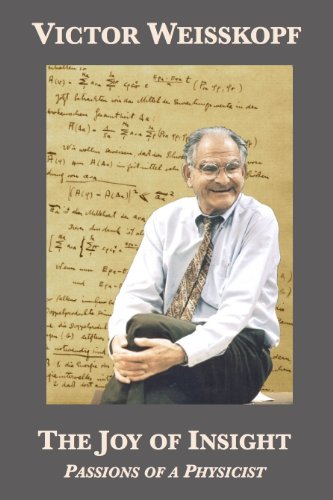
There’s something endlessly fascinating about the early days of quantum physics. In a century, we went from a few odd, inexplicable experiments to a practically complete understanding of the fundamental constituents of matter. Along the way the new ideas ended a world war, almost fueled another, and touched almost every field of inquiry. The people lucky enough to be part of this went from familiarly dorky grad students to architects of a new reality. Victor Weisskopf was one of those people, and The Joy of Insight: Passions of a Physicist is his autobiography.

Less well-known today than his contemporaries, Weisskopf made up for it with a front-row seat to basically everything that happened in particle physics. In the late 20’s and early 30’s he went from studying in Göttingen (including a crush on Maria Göppert before a car-owning Joe Mayer snatched her up) to a series of postdoctoral positions that would exhaust even a modern-day physicist, working in Leipzig, Berlin, Copenhagen, Cambridge, Zurich, and Copenhagen again, before fleeing Europe for a faculty position in Rochester, New York. During that time he worked for, studied under, collaborated or partied with basically everyone you might have heard of from that period. As a result, this section of the autobiography was my favorite, chock-full of stories, from the well-known (Pauli’s rudeness and mythical tendency to break experimental equipment) to the less-well known (a lab in Milan planned to prank Pauli with a door that would trigger a fake explosion when opened, which worked every time they tested it…and failed when Pauli showed up), to the more personal (including an in retrospect terrifying visit to the Soviet Union, where they asked him to critique a farming collective!) That era also saw his “almost Nobel”, in his case almost discovering the Lamb Shift.

Despite an “almost Nobel”, Weisskopf was paid pretty poorly when he arrived in Rochester. His story there puts something I’d learned before about another refugee physicist, Hertha Sponer, in a new light. Sponer’s university also didn’t treat her well, and it seemed reminiscent of modern academia. Weisskopf, though, thinks his treatment was tied to his refugee status: that, aware that they had nowhere else to go, universities gave the scientists who fled Europe worse deals than they would have in a Nazi-less world, snapping up talent for cheap. I could imagine this was true for Sponer as well.

Like almost everyone with the relevant expertise, Weisskopf was swept up in the Manhattan project at Los Alamos. There he rose in importance, both in the scientific effort (becoming deputy leader of the theoretical division) and the local community (spending some time on and chairing the project’s “town council”). Like the first sections, this surreal time leads to a wealth of anecdotes, all fascinating. In his descriptions of the life there I can see the beginnings of the kinds of “hiking retreats” physicists would build in later years, like the one at Aspen, that almost seem like attempts to recreate that kind of intense collaboration in an isolated natural place.

After the war, Weisskopf worked at MIT before a stint as director of CERN. He shepherded the facility’s early days, when they were building their first accelerators and deciding what kinds of experiments to pursue. I’d always thought that the “nuclear” in CERN’s name was an artifact of the times, when “nuclear” and “particle” physics were thought of as the same field, but according to Weisskopf the fields were separate and it was already a misnomer when the place was founded. Here the book’s supply of anecdotes becomes a bit more thin, and instead he spends pages on glowing descriptions of people he befriended. The pattern continues after the directorship as his duties get more administrative, spending time as head of the physics department at MIT and working on arms control, some of the latter while a member of the Pontifical Academy of Sciences (which apparently even a Jewish atheist can join). He does work on some science, though, collaborating on the “bag of quarks” model of protons and neutrons. He lives to see the fall of the Berlin wall, and the end of the book has a bit of 90’s optimism to it, the feeling that finally the conflicts of his life would be resolved. Finally, the last chapter abandons chronology altogether, and is mostly a list of his opinions of famous composers, capped off with a Bohr-inspired musing on the complementary nature of science and the arts, humanities, and religion.

One of the things I found most interesting in this book was actually something that went unsaid. Weisskopf’s most famous student was Murray Gell-Mann, a key player in the development of the theory of quarks (including coining the name). Gell-Mann was famously cultured (in contrast to the boorish-almost-as-affectation Feynman) with wide interests in the humanities, and he seems like exactly the sort of person Weisskopf would have gotten along with. Surprisingly though, he gets no anecdotes in this book, and no glowing descriptions: just a few paragraphs, mostly emphasizing how smart he was. I have to wonder if there was some coldness between them. Maybe Weisskopf had difficulty with a student who became so famous in his own right, or maybe they just never connected. Maybe Weisskopf was just trying to be generous: the other anecdotes in that part of the book are of much less famous people, and maybe Weisskopf wanted to prioritize promoting them, feeling that they were underappreciated.

Weisskopf keeps the physics light to try to reach a broad audience. This means he opts for short explanations, and often these are whatever is easiest to reach for. It creates some interesting contradictions: the way he describes his “almost Nobel” work in quantum electrodynamics is very much the way someone would have described it at the time, but very much not how it would be understood later, and by the time he talks about the bag of quarks model his more modern descriptions don’t cleanly link with what he said earlier. Overall, his goal isn’t really to explain the physics, but to explain the physicists. I enjoyed the book for that: people do it far too rarely, and the result was a really fun read.

The arXiv SciComm Challenge

Fellow science communicators, think you can explain everything that goes on in your field? If so, I have a challenge for you. Pick a day, and go through all the new papers on arXiv.org in a single area. For each one, try to give a general-audience explanation of what the paper is about. To make it easier, you can ignore cross-listed papers. If your field doesn’t use arXiv, consider if you can do the challenge with another appropriate site.

I’ll start. I’m looking at papers in the “High Energy Physics – Theory” area, announced 6 Jan, 2022. I’ll warn you in advance that I haven’t read these papers, just their abstracts, so apologies if I get your paper wrong!

arXiv:2201.01303 : Holographic State Complexity from Group Cohomology

This paper says it is a contribution to a Proceedings. That means it is based on a talk given at a conference. In my field, a talk like this usually won’t be presenting new results, but instead summarizes results in a previous paper. So keep that in mind.

There is an idea in physics called holography, where two theories are secretly the same even though they describe the world with different numbers of dimensions. Usually this involves a gravitational theory in a “box”, and a theory without gravity that describes the sides of the box. The sides turn out to fully describe the inside of the box, much like a hologram looks 3D but can be printed on a flat sheet of paper. Using this idea, physicists have connected some properties of gravity to properties of the theory on the sides of the box. One of those properties is complexity: the complexity of the theory on the sides of the box says something about gravity inside the box, in particular about the size of wormholes. The trouble is, “complexity” is a bit subjective: it’s not clear how to give a good definition for it for this type of theory. In this paper, the author studies a theory with a precise mathematical definition, called a topological theory. This theory turns out to have mathematical properties that suggest a well-defined notion of complexity for it.

arXiv:2201.01393 : Nonrelativistic effective field theories with enhanced symmetries and soft behavior

We sometimes describe quantum field theory as quantum mechanics plus relativity. That’s not quite true though, because it is possible to define a quantum field theory that doesn’t obey special relativity, a non-relativistic theory. Physicists do this if they want to describe a system moving much slower than the speed of light: it gets used sometimes for nuclear physics, and sometimes for modeling colliding black holes.

In particle physics, a “soft” particle is one with almost no momentum. We can classify theories based on how they behave when a particle becomes more and more soft. In normal quantum field theories, if they have special behavior when a particle becomes soft it’s often due to a symmetry of the theory, where the theory looks the same even if something changes. This paper shows that this is not true for non-relativistic theories: they have more requirements to have special soft behavior, not just symmetry. They “bootstrap” a few theories, using some general restrictions to find them without first knowing how they work (“pulling them up by their own bootstraps”), and show that the theories they find are in a certain sense unique, the only theories of that kind.

arXiv:2201.01552 : Transmutation operators and expansions for 1-loop Feynman integrands

In recent years, physicists in my sub-field have found new ways to calculate the probability that particles collide. One of these methods describes ordinary particles in a way resembling string theory, and from this discovered a whole “web” of theories that were linked together by small modifications of the method. This method originally worked only for the simplest Feynman diagrams, the “tree” diagrams that correspond to classical physics, but was extended to the next-simplest diagrams, diagrams with one “loop” that start incorporating quantum effects.

This paper concerns a particular spinoff of this method, that can find relationships between certain one-loop calculations in a particularly efficient way. It lets you express calculations of particle collisions in a variety of theories in terms of collisions in a very simple theory. Unlike the original method, it doesn’t rely on any particular picture of how these collisions work, either Feynman diagrams or strings.

arXiv:2201.01624 : Moduli and Hidden Matter in Heterotic M-Theory with an Anomalous U(1) Hidden Sector

In string theory (and its more sophisticated cousin M theory), our four-dimensional world is described as a world with more dimensions, where the extra dimensions are twisted up so that they cannot be detected. The shape of the extra dimensions influences the kinds of particles we can observe in our world. That shape is described by variables called “moduli”. If those moduli are stable, then the properties of particles we observe would be fixed, otherwise they would not be. In general it is a challenge in string theory to stabilize these moduli and get a world like what we observe.

This paper discusses shapes that give rise to a “hidden sector”, a set of particles that are disconnected from the particles we know so that they are hard to observe. Such particles are often proposed as a possible explanation for dark matter. This paper calculates, for a particular kind of shape, what the masses of different particles are, as well as how different kinds of particles can decay into each other. For example, a particle that causes inflation (the accelerating expansion of the universe) can decay into effects on the moduli and dark matter. The paper also shows how some of the moduli are made stable in this picture.

arXiv:2201.01630 : Chaos in Celestial CFT

One variant of the holography idea I mentioned earlier is called “celestial” holography. In this picture, the sides of the box are an infinite distance away: a “celestial sphere” depicting the angles particles go after they collide, in the same way a star chart depicts the angles between stars. Recent work has shown that there is something like a sensible theory that describes physics on this celestial sphere, that contains all the information about what happens inside.

This paper shows that the celestial theory has a property called quantum chaos. In physics, a theory is said to be chaotic if it depends very precisely on its initial conditions, so that even a small change will result in a large change later (the usual metaphor is a butterfly flapping its wings and causing a hurricane). This kind of behavior appears to be present in this theory.

arXiv:2201.01657 : Calculations of Delbrück scattering to all orders in αZ

Delbrück scattering is an effect where the nuclei of heavy elements like lead can deflect high-energy photons, as a consequence of quantum field theory. This effect is apparently tricky to calculate, and previous calculations have involved approximations. This paper finds a way to calculate the effect without those approximations, which should let it match better with experiments.

(As an aside, I’m a little confused by the claim that they’re going to all orders in αZ when it looks like they just consider one-loop diagrams…but this is probably just my ignorance, this is a corner of the field quite distant from my own.)

arXiv:2201.01674 : On Unfolded Approach To Off-Shell Supersymmetric Models

Supersymmetry is a relationship between two types of particles: fermions, which typically make up matter, and bosons, which are usually associated with forces. In realistic theories this relationship is “broken” and the two types of particles have different properties, but theoretical physicists often study models where supersymmetry is “unbroken” and the two types of particles have the same mass and charge. This paper finds a new way of describing some theories of this kind that reorganizes them in an interesting way, using an “unfolded” approach in which aspects of the particles that would normally be combined are given their own separate variables.

(This is another one I don’t know much about, this is the first time I’d heard of the unfolded approach.)

arXiv:2201.01679 : Geometric Flow of Bubbles

String theorists have conjectured that only some types of theories can be consistently combined with a full theory of quantum gravity, others live in a “swampland” of non-viable theories. One set of conjectures characterizes this swampland in terms of “flows” in which theories with different geometry can flow in to each other. The properties of these flows are supposed to be related to which theories are or are not in the swampland.

This paper writes down equations describing these flows, and applies them to some toy model “bubble” universes.

arXiv:2201.01697 : Graviton scattering amplitudes in first quantisation

This paper is a pedagogical one, introducing graduate students to a topic rather than presenting new research.

Usually in quantum field theory we do something called “second quantization”, thinking about the world not in terms of particles but in terms of fields that fill all of space and time. However, sometimes one can instead use “first quantization”, which is much more similar to ordinary quantum mechanics. There you think of a single particle traveling along a “world-line”, and calculate the probability it interacts with other particles in particular ways. This approach has recently been used to calculate interactions of gravitons, particles related to the gravitational field in the same way photons are related to the electromagnetic field. The approach has some advantages in terms of simplifying the results, which are described in this paper.

Calculations of the Past

Last week was a birthday conference for one of the pioneers of my sub-field, Ettore Remiddi. I wasn’t there, but someone who was pointed me to some of the slides, including a talk by Stefano Laporta. For those of you who didn’t see my post a few weeks back, Laporta was one of Remiddi’s students, who developed one of the most important methods in our field and then vanished, spending ten years on an amazingly detailed calculation. Laporta’s talk covers more of the story, about what it was like to do precision calculations in that era.

“That era”, the 90’s through 2000’s, witnessed an enormous speedup in computers, and a corresponding speedup in what was possible. Laporta worked with Remiddi on the three-loop electron anomalous magnetic moment, something Remiddi had been working on since 1969. When Laporta joined in 1989, twenty-one of the seventy-two diagrams needed had still not been computed. They would polish them off over the next seven years, before Laporta dove in to four loops. Twenty years later, he had that four-loop result to over a thousand digits.

One fascinating part of the talk is seeing how the computational techniques change over time, as language replaces language and computer clusters get involved. As a student, Laporta learns a lesson we all often need: that to avoid mistakes, we need to do as little by hand as possible, even for something as simple as copying a one-line formula. Looking at his review of others’ calculations, it’s remarkable how many theoretical results had to be dramatically corrected a few years down the line, and how much still might depend on theoretical precision.

Another theme was one of Remiddi suggesting something and Laporta doing something entirely different, and often much more productive. Whether it was using the arithmetic-geometric mean for an elliptic integral instead of Gaussian quadrature, or coming up with his namesake method, Laporta spent a lot of time going his own way, and Remiddi quickly learned to trust him.

There’s a lot more in the slides that’s worth reading, including a mention of one of this year’s Physics Nobelists. The whole thing is an interesting look at what it takes to press precision to the utmost, and dedicate years to getting something right.

Of p and sigma

Ask a doctor or a psychologist if they’re sure about something, and they might say “it has p<0.05”. Ask a physicist, and they’ll say it’s a “5 sigma result”. On the surface, they sound like they’re talking about completely different things. As it turns out, they’re not quite that different.

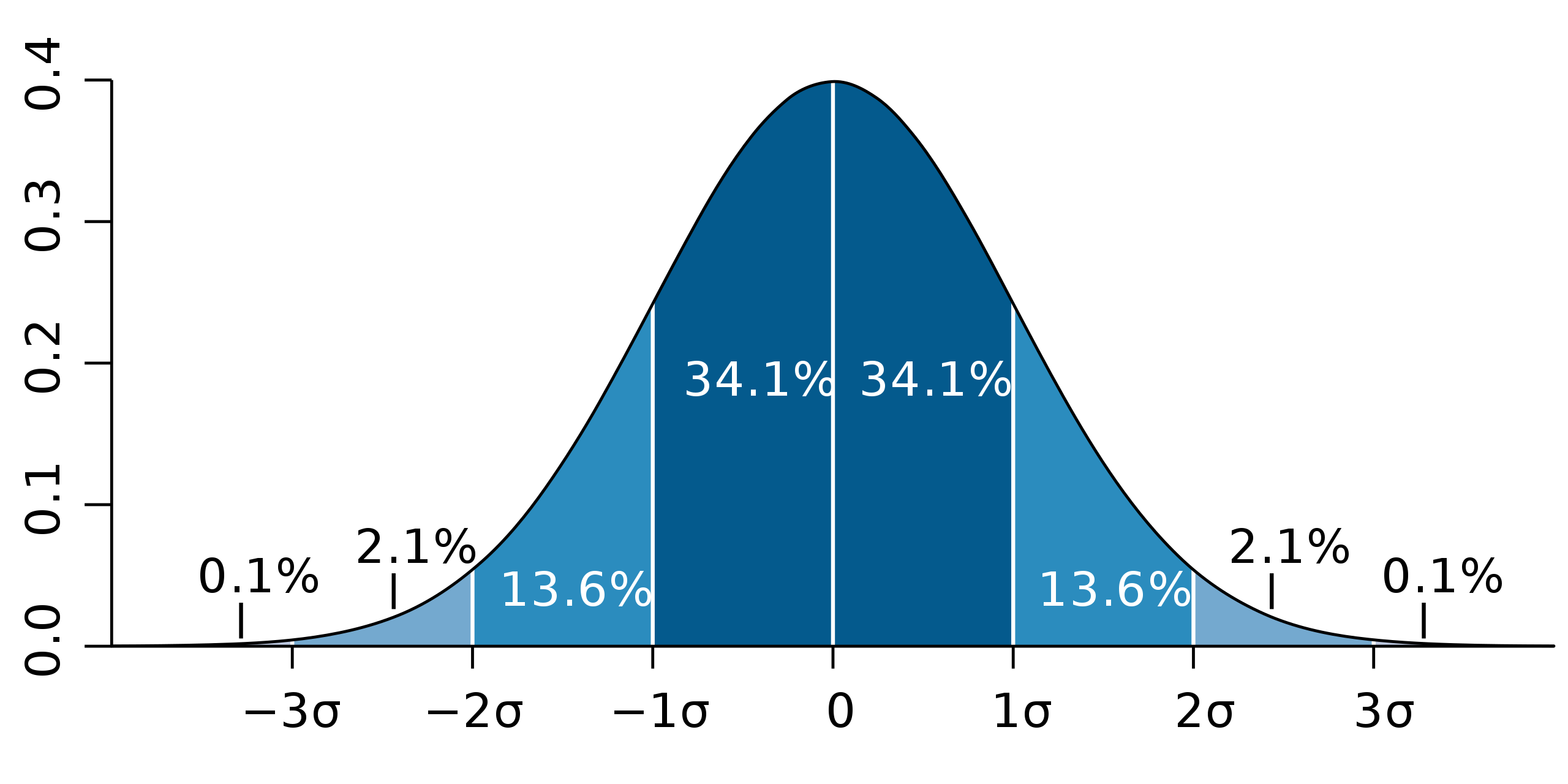
Whether it’s a p-value or a sigma, what scientists are giving you is shorthand for a probability. The p-value is the probability itself, while sigma tells you how many standard deviations something is away from the mean on a normal distribution. For people not used to statistics this might sound very complicated, but it’s not so tricky in the end. There’s a graph, called a normal distribution, and you can look at how much of it is above a certain point, measured in units called standard deviations, or “sigmas”. That gives you your probability.

Give it a try: how much of this graph is past the 1\sigma line? How about 2\sigma?

What are these numbers a probability of? At first, you might think they’re a probability of the scientist being right: of the medicine working, or the Higgs boson being there.

That would be reasonable, but it’s not how it works. Scientists can’t measure the chance they’re right. All they can do is compare models. When a scientist reports a p-value, what they’re doing is comparing to a kind of default model, called a “null hypothesis”. There are different null hypotheses for different experiments, depending on what the scientists want to test. For the Higgs, scientists looked at pairs of photons detected by the LHC. The null hypothesis was that these photons were created by other parts of the Standard Model, like the strong force, and not by a Higgs boson. For medicine, the null hypothesis might be that people get better on their own after a certain amount of time. That’s hard to estimate, which is why medical experiments use a control group: a similar group without the medicine, to see how much they get better on their own.

Once we have a null hypothesis, we can use it to estimate how likely it is that it produced the result of the experiment. If there was no Higgs, and all those photons just came from other particles, what’s the chance there would still be a giant pile of them at one specific energy? If the medicine didn’t do anything, what’s the chance the control group did that much worse than the treatment group?

Ideally, you want a small probability here. In medicine and psychology, you’re looking for a 5% probability, for p<0.05. In physics, you need 5 sigma to make a discovery, which corresponds to a one in 3.5 million probability. If the probability is low, then you can say that it would be quite unlikely for your result to happen if the null hypothesis was true. If you’ve got a better hypothesis (the Higgs exists, the medicine works), then you should pick that instead.

Note that this probability still uses a model: it’s the probability of the result given that the model is true. It isn’t the probability that the model is true, given the result. That probability is more important to know, but trickier to calculate. To get from one to the other, you need to include more assumptions: about how likely your model was to begin with, given everything else you know about the world. Depending on those assumptions, even the tiniest p-value might not show that your null hypothesis is wrong.

In practice, unfortunately, we usually can’t estimate all of those assumptions in detail. The best we can do is guess their effect, in a very broad way. That usually just means accepting a threshold for p-values, declaring some a discovery and others not. That limitation is part of why medicine and psychology demand p-values of 0.05, while physicists demand 5 sigma results. Medicine and psychology have some assumptions they can rely on: that people function like people, that biology and physics keep working. Physicists don’t have those assumptions, so we have to be extra-strict.

Ultimately, though, we’re all asking the same kind of question. And now you know how to understand it when we do.

Discovering New Elements, Discovering New Particles

In school, you learn that the world around you is made up of chemical elements. There’s oxygen and nitrogen in the air, hydrogen and oxygen in water, sodium and chlorine in salt, and carbon in all living things. Other elements are more rare. Often, that’s because they’re unstable, due to radioactivity, like the plutonium in a bomb or americium in a smoke detector. The heaviest elements are artificial, produced in tiny amounts by massive experiments. In 2002, the heaviest element yet was found at the Joint Institute for Nuclear Research near Moscow. It was later named Oganesson, after the scientist who figured out how to make these heavy elements, Yuri Oganessian. To keep track of the different elements, we organize them in the periodic table like this:

In that same school, you probably also learn that the elements aren’t quite so elementary. Unlike the atoms imagined by the ancient Greeks, our atoms are made of smaller parts: protons and neutrons, surrounded by a cloud of electrons. They’re what give the periodic table its periodic structure, the way it repeats from row to row, with each different element having a different number of protons.

If your school is a bit more daring, you also learn that protons and neutrons themselves aren’t elementary. Each one is made of smaller particles called quarks: a proton of two “up quarks” and one “down quark”, and a neutron of two “down” and one “up”. Up quarks, down quarks, and electrons are all what physicists call fundamental particles, and they make up everything you see around you. Just like the chemical elements, some fundamental particles are more obscure than others, and the heaviest ones are all very unstable, produced temporarily by particle collider experiments. The most recent particle to be discovered was in 2012, when the Large Hadron Collider near Geneva found the Higgs boson. The Higgs boson is named after Peter Higgs, one of those who predicted it back in the 60’s. All the fundamental particles we know are part of something called the Standard Model, which we sometimes organize in a table like this:

So far, these stories probably sound similar. The experiments might not even sound that different: the Moscow experiment shoots a beam of high-energy calcium atoms at a target of heavy radioactive elements, while the Geneva one shoots a beam of high-energy protons at another beam of high-energy protons. With all those high-energy beams, what’s the difference really?

In fact there is a big different between chemical elements and fundamental particles, and between the periodic table and the Standard Model. The latter are fundamental, the former are not.

When they made new chemical elements, scientists needed to start with a lot of protons and neutrons. That’s why they used calcium atoms in their beam, and even heavier elements as their target. We know that heavy elements are heavy because they contain more protons and neutrons, and we can use the arrangement of those protons and neutrons to try to predict their properties. That’s why, even though only five or six oganesson atoms have been detected, scientists have some idea what kind of material it would make. Oganesson is a noble gas, like helium, neon, and radon. But calculations predict it is actually a solid at room temperature. What’s more, it’s expected to be able to react with other elements, something the other noble gases are very reluctant to do.

The Standard Model has patterns, just like the chemical elements. Each matter particle is one of three “generations”, each heavier and more unstable: for example, electrons have heavier relatives called muons, and still heavier ones called tauons. But unlike with the elements, we don’t know where these patterns come from. We can’t explain them with smaller particles, like we could explain the elements with protons and neutrons. We think the Standard Model particles might actually be fundamental, not made of anything smaller.

That’s why when we make them, we don’t need a lot of other particles: just two protons, each made of three quarks, is enough. With that, we can make not just new arrangements of quarks, but new particles altogether. Some are even heavier than the protons we started with: the Higgs boson is more than a hundred times as heavy as a proton! We can do this because, in particle physics, mass isn’t conserved: mass is just another type of energy, and you can turn one type of energy into another.

Discovering new elements is hard work, but discovering new particles is on another level. It’s hard to calculate which elements are stable or unstable, and what their properties might be. But we know the rules, and with enough skill and time we could figure it out. In particle physics, we don’t know the rules. We have some good guesses, simple models to solve specific problems, and sometimes, like with the Higgs, we’re right. But despite making many more than five or six Higgs bosons, we still aren’t sure it has the properties we expect. We don’t know the rules. Even with skill and time, we can’t just calculate what to expect. We have to discover it.

Searching for Stefano

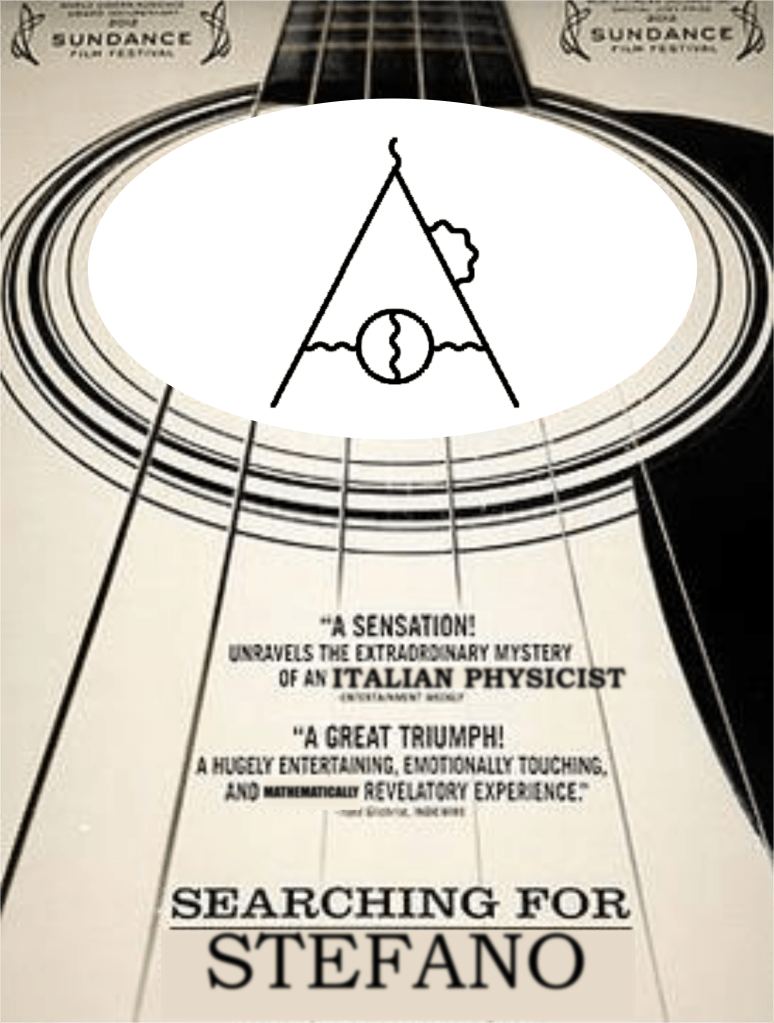
On Monday, Quanta magazine released an article on a man who transformed the way we do particle physics: Stefano Laporta. I’d tipped them off that Laporta would make a good story: someone who came up with the bread-and-butter algorithm that fuels all of our computations, then vanished from the field for ten years, returning at the end with an 1,100 digit masterpiece. There’s a resemblance to Searching for Sugar Man, fans and supporters baffled that their hero is living in obscurity.

If anything, I worry I under-sold the story. When Quanta interviewed me, it was clear they were looking for ties to well-known particle physics results: was Laporta’s work necessary for the Higgs boson discovery, or linked to the controversy over the magnetic moment of the muon? I was careful, perhaps too careful, in answering. The Higgs, to my understanding, didn’t require so much precision for its discovery. As for the muon, the controversial part is a kind of calculation that wouldn’t use Laporta’s methods, while the un-controversial part was found numerically by a group that doesn’t use his algorithm either.

With more time now, I can make a stronger case. I can trace Laporta’s impact, show who uses his work and for what.

In particle physics, we have a lovely database called INSPIRE that lists all our papers. Here is Laporta’s page, his work sorted by number of citations. When I look today, I find his most cited paper, the one that first presented his algorithm, at the top, with a delightfully apt 1,001 citations. Let’s listen to a few of those 1,001 tales, and see what they tell us.

Once again, we’ll sort by citations. The top paper, “Higgs boson production at hadron colliders in NNLO QCD“, is from 2002. It computes the chance that a particle collider like the LHC could produce a Higgs boson. It in turn has over a thousand citations, headlined by two from the ATLAS and CMS collaborations: “Observation of a new particle in the search for the Standard Model Higgs boson with the ATLAS detector at the LHC” and “Observation of a New Boson at a Mass of 125 GeV with the CMS Experiment at the LHC“. Those are the papers that announced the discovery of the Higgs, each with more than twelve thousand citations. Later in the list, there are design reports: discussions of why the collider experiments are built a certain way. So while it’s true that the Higgs boson could be seen clearly from the data, Laporta’s work still had a crucial role: with his algorithm, we could reassure experimenters that they really found the Higgs (not something else), and even more importantly, help them design the experiment so that they could detect it.

The next paper tells a similar story. A different calculation, with almost as many citations, feeding again into planning and prediction for collider physics.

The next few touch on my own corner of the field. “New Relations for Gauge-Theory Amplitudes” triggered a major research topic in its own right, one with its own conference series. Meanwhile, “Iteration of planar amplitudes in maximally supersymmetric Yang-Mills theory at three loops and beyond” served as a foundation for my own career, among many others. None of this would have happened without Laporta’s algorithm.

After that, more applications: fundamental quantities for collider physics, pieces of math that are used again and again. In particular, they are referenced again and again by the Particle Data Group, who collect everything we know about particle physics.

Further down still, and we get to specific code: FIRE and Reduze, programs made by others to implement Laporta’s algorithm, each with many uses in its own right.

All that, just from one of Laporta’s papers.

His ten-year magnum opus is more recent, and has fewer citations: checking now, just 139. Still, there are stories to tell there too.

I mentioned earlier 1,100 digits, and this might confuse some of you. The most precise prediction in particle physics has ten digits of precision, the magnetic behavior of the electron. Laporta’s calculation didn’t change that, because what he calculated isn’t the only contribution: he calculated Feynman diagrams with four “loops”, which is its own approximation, one limited in precision by what might be contributed by more loops. The current result has Feynman diagrams with five loops as well (known to much less than 1,100 digits), but the diagrams with six or more are unknown, and can only be estimated. The result also depends on measurements, which themselves can’t reach 1,100 digits of precision.

So why would you want 1,100 digits, then? In a word, mathematics. The calculation involves exotic types of numbers called periods, more complicated cousins of numbers like pi. These numbers are related to each other, often in complicated and surprising ways, ways which are hard to verify without such extreme precision. An older result of Laporta’s inspired the physicist David Broadhurst and mathematician Anton Mellit to conjecture new relations between this type of numbers, relations that were only later proven using cutting-edge mathematics. The new result has inspired mathematicians too: Oliver Schnetz found hints of a kind of “numerical footprint”, special types of numbers tied to the physics of electrons. It’s a topic I’ve investigated myself, something I think could lead to much more efficient particle physics calculations.

In addition to being inspired by Laporta’s work, Broadhurst has advocated for it. He was the one who first brought my attention to Laporta’s story, with a moving description of welcoming him back to the community after his ten-year silence, writing a letter to help him get funding. I don’t have all the details of the situation, but the impression I get is that Laporta had virtually no academic support for those ten years: no salary, no students, having to ask friends elsewhere for access to computer clusters.

When I ask why someone with such an impact didn’t have a professorship, the answer I keep hearing is that he didn’t want to move away from his home town in Bologna. If you aren’t an academic, that won’t sound like much of an explanation: Bologna has a university after all, the oldest in the world. But that isn’t actually a guarantee of anything. Universities hire rarely, according to their own mysterious agenda. I remember another colleague whose wife worked for a big company. They offered her positions in several cities, including New York. They told her that, since New York has many universities, surely her husband could find a job at one of them? We all had a sad chuckle at that.

For almost any profession, a contribution like Laporta’s would let you live anywhere you wanted. That’s not true for academia, and it’s to our loss. By demanding that each scientist be able to pick up and move, we’re cutting talented people out of the field, filtering by traits that have nothing to do with our contributions to knowledge. I don’t know Laporta’s full story. But I do know that doing the work you love in the town you love isn’t some kind of unreasonable request. It’s a request academia should be better at fulfilling.

Don’t Trust the Experiments, Trust the Science

I was chatting with an astronomer recently, and this quote by Arthur Eddington came up:

“Never trust an experimental result until it has been confirmed by theory.”

Arthur Eddington

At first, this sounds like just typical theorist arrogance, thinking we’re better than all those experimentalists. It’s not that, though, or at least not just that. Instead, it’s commenting on a trend that shows up again and again in science, but rarely makes the history books. Again and again an experiment or observation comes through with something fantastical, something that seems like it breaks the laws of physics or throws our best models into disarray. And after a few months, when everyone has checked, it turns out there was a mistake, and the experiment agrees with existing theories after all.

You might remember a recent example, when a lab claimed to have measured neutrinos moving faster than the speed of light, only for it to turn out to be due to a loose cable. Experiments like this aren’t just a result of modern hype: as Eddington’s quote shows, they were also common in his day. In general, Eddington’s advice is good: when an experiment contradicts theory, theory tends to win in the end.

This may sound unscientific: surely we should care only about what we actually observe? If we defer to theory, aren’t we putting dogma ahead of the evidence of our senses? Isn’t that the opposite of good science?

To understand what’s going on here, we can use an old philosophical argument: David Hume’s argument against miracles. David Hume wanted to understand how we use evidence to reason about the world. He argued that, for miracles in particular, we can never have good evidence. In Hume’s definition, a miracle was something that broke the established laws of science. Hume argued that, if you believe you observed a miracle, there are two possibilities: either the laws of science really were broken, or you made a mistake. The thing is, laws of science don’t just come from a textbook: they come from observations as well, many many observations in many different conditions over a long period of time. Some of those observations establish the laws in the first place, others come from the communities that successfully apply them again and again over the years. If your miracle was real, then it would throw into doubt many, if not all, of those observations. So the question you have to ask is: it it more likely those observations were wrong? Or that you made a mistake? Put another way, your evidence is only good enough for a miracle if it would be a bigger miracle if you were wrong.

Hume’s argument always struck me as a little bit too strict: if you rule out miracles like this, you also rule out new theories of science! A more modern approach would use numbers and statistics, weighing the past evidence for a theory against the precision of the new result. Most of the time you’d reach the same conclusion, but sometimes an experiment can be good enough to overthrow a theory.

Still, theory should always sit in the background, a kind of safety net for when your experiments screw up. It does mean that when you don’t have that safety net you need to be extra-careful. Physics is an interesting case of this: while we have “the laws of physics”, we don’t have any established theory that tells us what kinds of particles should exist. That puts physics in an unusual position, and it’s probably part of why we have such strict standards of statistical proof. If you’re going to be operating without the safety net of theory, you need that kind of proof.

This post was also inspired by some biological examples. The examples are politically controversial, so since this is a no-politics blog I won’t discuss them in detail. (I’ll also moderate out any comments that do.) All I’ll say is that I wonder if in that case the right heuristic is this kind of thing: not to “trust scientists” or “trust experts” or even “trust statisticians”, but just to trust the basic, cartoon-level biological theory.

In Uppsala for Elliptics 2021

I’m in Uppsala in Sweden this week, at an actual in-person conference.

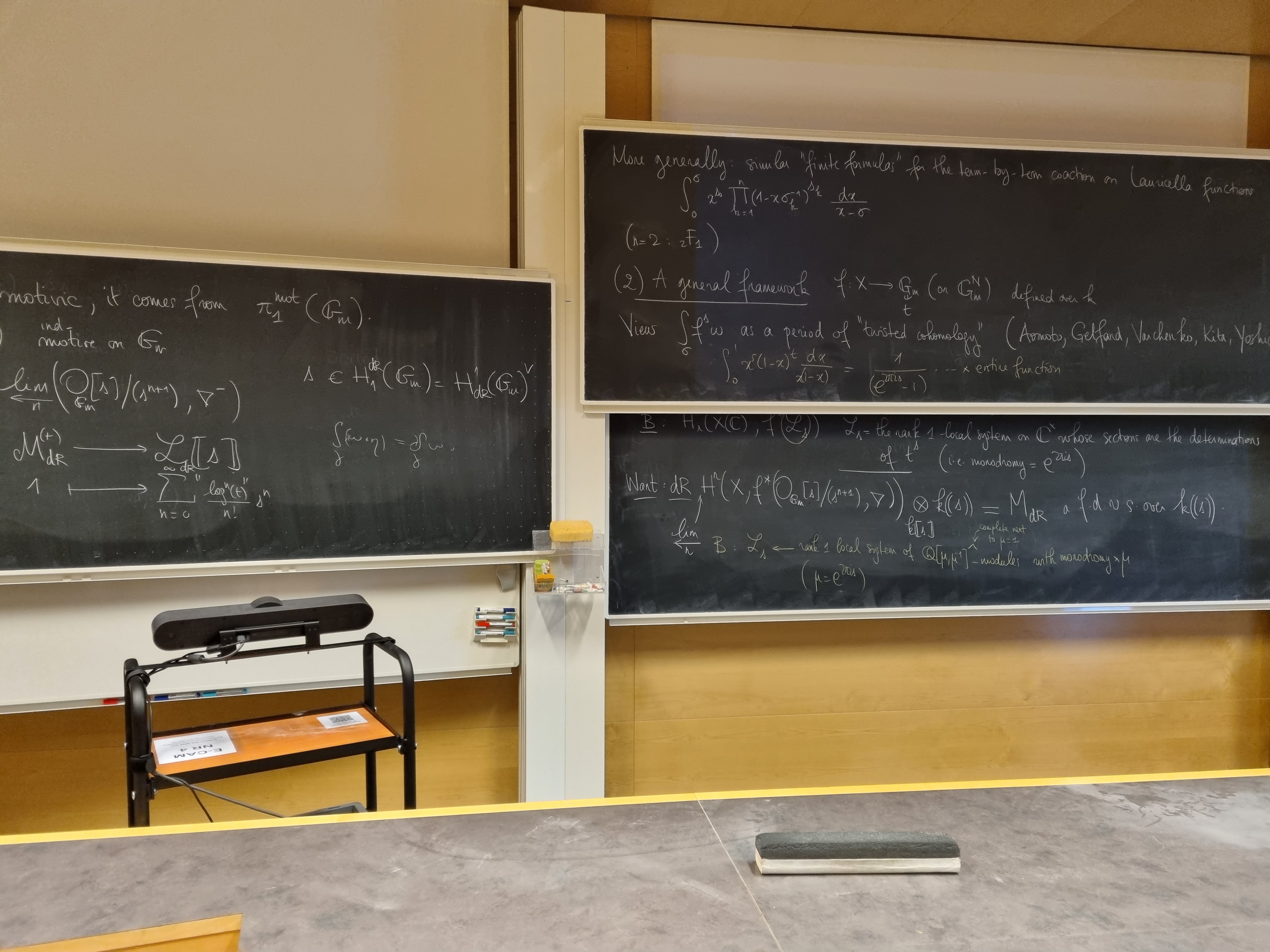
With actual blackboards!

Elliptics started out as a series of small meetings of physicists trying to understand how to make sense of elliptic integrals in calculations of colliding particles. It grew into a full-fledged yearly conference series. I organized last year, which naturally was an online conference. This year though, the stage was set for Uppsala University to host in person.

I should say mostly in person. It’s a hybrid conference, with some speakers and attendees joining on Zoom. Some couldn’t make it because of travel restrictions, or just wanted to be cautious about COVID. But seemingly just as many had other reasons, like teaching schedules or just long distances, that kept them from coming in person. We’re all wondering if this will become a long-term trend, where the flexibility of hybrid conferences lets people attend no matter their constraints.

The hybrid format worked better than expected, but there were still a few kinks. The audio was particularly tricky, it seemed like each day the organizers needed a new microphone setup to take questions. It’s always a little harder to understand someone on Zoom, especially when you’re sitting in an auditorium rather than focused on your own screen. Still, technological experience should make this work better in future.

Content-wise, the conference began with a “mini-school” of pedagogical talks on particle physics, string theory, and mathematics. I found the mathematical talks by Erik Panzer particularly nice, it’s a topic I still feel quite weak on and he laid everything out in a very clear way. It seemed like a nice touch to include a “school” element in the conference, though I worry it ate too much into the time.

The rest of the content skewed more mathematical, and more string-theoretic, than these conferences have in the past. The mathematical content ranged from intriguing (including an interesting window into what it takes to get high-quality numerics) to intimidatingly obscure (large commutative diagrams, category theory on the first slide). String theory was arguably under-covered in prior years, but it felt over-covered this year. With the particle physics talks focusing on either general properties with perhaps some connections to elliptics, or to N=4 super Yang-Mills, it felt like we were missing the more “practical” talks from past conferences, where someone was computing something concrete in QCD and told us what they needed. Next year is in Mainz, so maybe those talks will reappear.