A Physicist New Year

Happy New Year to all!

Physicists celebrate the new year by trying to sneak one last paper in before the year is over. Looking at Facebook last night I saw three different friends preview the papers they just submitted. The site where these papers appear, arXiv, had seventy new papers this morning, just in the category of theoretical high-energy physics. Of those, nine of them were in my, or a closely related sub–field.

I’d love to tell you all about these papers (some exciting! some long-awaited!), but I’m still tired from last night and haven’t read them yet. So I’ll just close by wishing you all, once again, a happy new year.

Newtonmas in Uncertain Times

Three hundred and eighty-two years ago today (depending on which calendars you use), Isaac Newton was born. For a scientist, that’s a pretty good reason to celebrate.

Reason’s Greetings Everyone!

Last month, our local nest of science historians at the Niels Bohr Archive hosted a Zoom talk by Jed Z. Buchwald, a Newton scholar at Caltech. Buchwald had a story to tell about experimental uncertainty, one where Newton had an important role.

If you’ve ever had a lab course in school, you know experiments never quite go like they’re supposed to. Set a room of twenty students to find Newton’s constant, and you’ll get forty different answers. Whether you’re reading a ruler or clicking a stopwatch, you can never measure anything with perfect accuracy. Each time you measure, you introduce a little random error.

Textbooks worth of statistical know-how has cropped up over the centuries to compensate for this error and get closer to the truth. The simplest trick though, is just to average over multiple experiments. It’s so obvious a choice, taking a thousand little errors and smoothing them out, that you might think people have been averaging in this way through history.

They haven’t though. As far as Buchwald had found, the first person to average experiments in this way was Isaac Newton.

What did people do before Newton?

Well, what might you do, if you didn’t have a concept of random error? You can still see that each time you measure you get a different result. But you would blame yourself: if you were more careful with the ruler, quicker with the stopwatch, you’d get it right. So you practice, you do the experiment many times, just as you would if you were averaging. But instead of averaging, you just take one result, the one you feel you did carefully enough to count.

Before Newton, this was almost always what scientists did. If you were an astronomer mapping the stars, the positions you published would be the last of a long line of measurements, not an average of the rest. Some other tricks existed. Tycho Brahe for example folded numbers together pair by pair, averaging the first two and then averaging that average with the next one, getting a final result weighted to the later measurements. But, according to Buchwald, Newton was the first to just add everything together.

Even Newton didn’t yet know why this worked. It would take later research, theorems of statistics, to establish the full justification. It seems Newton and his later contemporaries had a vague physics analogy in mind, finding a sort of “center of mass” of different experiments. This doesn’t make much sense – but it worked, well enough for physics as we know it to begin.

So this Newtonmas, let’s thank the scientists of the past. Working piece by piece, concept by concept, they gave use the tools to navigate our uncertain times.

Inevitably Arbitrary

Physics is universal…or at least, it aspires to be. Drop an apple anywhere on Earth, at any point in history, and it will accelerate at roughly the same rate. When we call something a law of physics, we expect it to hold everywhere in the universe. It shouldn’t depend on anything arbitrary.

Sometimes, though, something arbitrary manages to sneak in. Even if the laws of physics are universal, the questions we want to answer are not: they depend on our situation, on what we want to know.

The simplest example is when we have to use units. The mass of an electron is the same here as it is on Alpha Centauri, the same now as it was when the first galaxies formed. But what is that mass? We could write it as 9.1093837015×10⁻³¹ kilograms, if we wanted to, but kilograms aren’t exactly universal. Their modern definition is at least based on physical constants, but with some pretty arbitrary numbers. It defines the Planck constant as 6.62607015×10⁻³⁴ Joule-seconds. Chase that number back, and you’ll find references to the Earth’s circumference and the time it takes to turn round on its axis. The mass of the electron may be the same on Alpha Centauri, but they’d never write it as 9.1093837015×10⁻³¹ kilograms.

Units aren’t the only time physics includes something arbitrary. Sometimes, like with units, we make a choice of how we measure or calculate something. We choose coordinates for a plot, a reference frame for relativity, a zero for potential energy, a gauge for gauge theories and regularization and subtraction schemes for quantum field theory. Sometimes, the choice we make is instead what we measure. To do thermodynamics we must choose what we mean by a state, to call two substances water even if their atoms are in different places. Some argue a perspective like this is the best way to think about quantum mechanics. In a different context, I’d argue it’s why we say coupling constants vary with energy.

So what do we do, when something arbitrary sneaks in? We have a few options. I’ll illustrate each with the mass of the electron:

  • Make an arbitrary choice, and stick with it: There’s nothing wrong with measuring an electron in kilograms, if you’re consistent about it. You could even use ounces. You just have to make sure that everyone else you compare with is using the same units, or be careful to convert.
  • Make a “natural” choice: Why not set the speed of light and Planck’s constant to one? They come up a lot in particle physics, and all they do is convert between length and time, or time and energy. That way you can use the same units for all of them, and use something convenient, like electron-Volts. They even have electron in the name! Of course they also have “Volt” in the name, and Volts are as arbitrary as any other metric unit. A “natural” choice might make your life easier, but you should always remember it’s still arbitrary.
  • Make an efficient choice: This isn’t always the same as the “natural” choice. The units you choose have an effect on how difficult your calculation is. Sometimes, the best choice for the mass of an electron is “one electron-mass”, because it lets you calculate something else more easily. This is easier to illustrate with other choices: for example, if you have to pick a reference frame for a collision, picking one in which one of the objects is at rest, or where they move symmetrically, might make your job easier.
  • Stick to questions that aren’t arbitrary: No matter what units we use, the electron’s mass will be arbitrary. Its ratios to other masses won’t be though. No matter where we measure, dimensionless ratios like the mass of the muon divided by the mass of the electron, or the mass of the electron divided by the value of the Higgs field, will be the same. If we can make sure to ask only this kind of question, we can avoid arbitrariness. Note that we can think of even a mass in “kilograms” as this kind of question: what’s the ratio of the mass of the electron to “this arbitrary thing we’ve chosen”? In practice though, you want to compare things in the same theory, without the historical baggage of metric.

This problem may seem silly, and if we just cared about units it might be. But at the cutting-edge of physics there are still areas where the arbitrary shows up. Our choices of how to handle it, or how to avoid it, can be crucial to further progress.

QCD Meets Gravity 2020, Retrospective

I was at a Zoomference last week, called QCD Meets Gravity, about the many ways gravity can be thought of as the “square” of other fundamental forces. I didn’t have time to write much about the actual content of the conference, so I figured I’d say a bit more this week.

A big theme of this conference, as in the past few years, was gravitational waves. From LIGO’s first announcement of a successful detection, amplitudeologists have been developing new methods to make predictions for gravitational waves more efficient. It’s a field I’ve dabbled in a bit myself. Last year’s QCD Meets Gravity left me impressed by how much progress had been made, with amplitudeologists already solidly part of the conversation and able to produce competitive results. This year felt like another milestone, in that the amplitudeologists weren’t just catching up with other gravitational wave researchers on the same kinds of problems. Instead, they found new questions that amplitudes are especially well-suited to answer. These included combining two pieces of these calculations (“potential” and “radiation”) that the older community typically has to calculate separately, using an old quantum field theory trick, finding the gravitational wave directly from amplitudes, and finding a few nice calculations that can be used to “generate” the rest.

A large chunk of the talks focused on different “squaring” tricks (or as we actually call them, double-copies). There were double-copies for cosmology and conformal field theory, for the celestial sphere, and even some version of M theory. There were new perspectives on the double-copy, new building blocks and algebraic structures that lie behind it. There were talks on the so-called classical double-copy for space-times, where there have been some strange discoveries (an extra dimension made an appearance) but also a more rigorous picture of where the whole thing comes from, using twistor space. There were not one, but two talks linking the double-copy to the Navier-Stokes equation describing fluids, from two different groups. (I’m really curious whether these perspectives are actually useful for practical calculations about fluids, or just fun to think about.) Finally, while there wasn’t a talk scheduled on this paper, the authors were roped in by popular demand to talk about their work. They claim to have made progress on a longstanding puzzle, how to show that double-copy works at the level of the Lagrangian, and the community was eager to dig into the details.

From there, a grab-bag of talks covered other advancements. There were talks from string theorists and ambitwistor string theorists, from Effective Field Theorists working on gravity and the Standard Model, from calculations in N=4 super Yang-Mills, QCD, and scalar theories. Simon Caron-Huot delved into how causality constrains the theories we can write down, showing an interesting case where the common assumption that all parameters are close to one is actually justified. Nima Arkani-Hamed began his talk by saying he’d surprise us, which he certainly did (and not by keeping on time). It’s tricky to explain why his talk was exciting. Comparing to his earlier discovery of the Amplituhedron, which worked for a toy model, this is a toy calculation in a toy model. While the Amplituhedron wasn’t based on Feynman diagrams, this can’t even be compared with Feynman diagrams. Instead of expanding in a small coupling constant, this expands in a parameter that by all rights should be equal to one. And instead of positivity conditions, there are negativity conditions. All I can say is that with all of that in mind, it looks like real progress on an important and difficult problem from a totally unanticipated direction. In a speech summing up the conference, Zvi Bern mentioned a few exciting words from Nima’s talk: “nonplanar”, “integrated”, “nonperturbative”. I’d add “differential equations” and “infinite sums of ladder diagrams”. Nima and collaborators are trying to figure out what happens when you sum up all of the Feynman diagrams in a theory. I’ve made progress in the past for diagrams with one “direction”, a ladder that grows as you add more loops, but I didn’t know how to add “another direction” to the ladder. In very rough terms, Nima and collaborators figured out how to add that direction.

I’ve probably left things out here, it was a packed conference! It’s been really fun seeing what the community has cooked up, and I can’t wait to see what happens next.

QCD Meets Gravity 2020

I’m at another Zoom conference this week, QCD Meets Gravity. This year it’s hosted by Northwestern.

The view of the campus from wonder.me

QCD Meets Gravity is a conference series focused on the often-surprising links between quantum chromodynamics on the one hand and gravity on the other. By thinking of gravity as the “square” of forces like the strong nuclear force, researchers have unlocked new calculation techniques and deep insights.

Last year’s conference was very focused on one particular topic, trying to predict the gravitational waves observed by LIGO and VIRGO. That’s still a core topic of the conference, but it feels like there is a bit more diversity in topics this year. We’ve seen a variety of talks on different “squares”: new theories that square to other theories, and new calculations that benefit from “squaring” (even surprising applications to the Navier-Stokes equation!) There are talks on subjects from String Theory to Effective Field Theory, and even a talk on a very different way that “QCD meets gravity”, in collisions of neutron stars.

With still a few more talks to go, expect me to say a bit more next week, probably discussing a few in more detail. (Several people presented exciting work in progress!) Until then, I should get back to watching!

A Taste of Normal

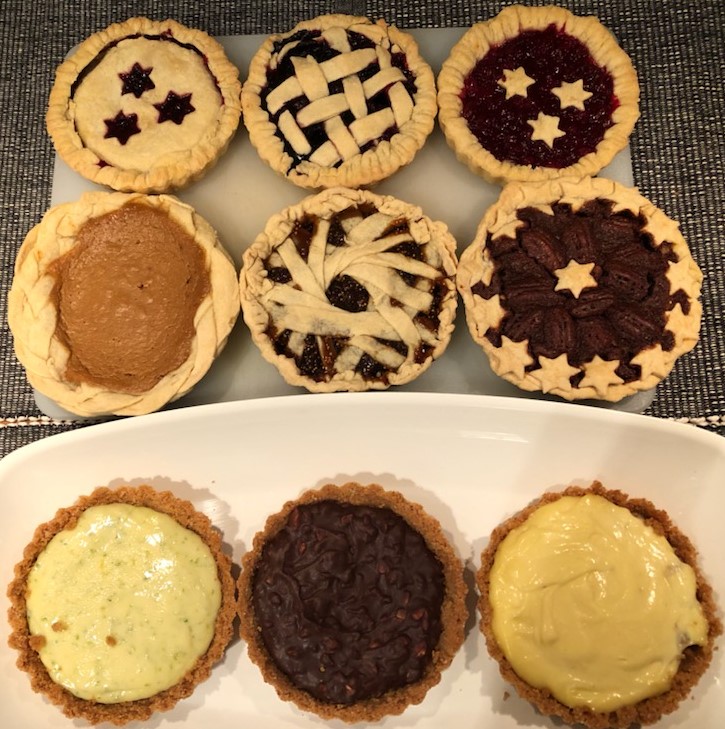
I grew up in the US. I’ve roamed over the years, but each year I’ve managed to come back around this time. My folks throw the kind of Thanksgiving you see in movies, a table overflowing with turkey and nine kinds of pie.

This year, obviously, is different. No travel, no big party. Still, I wanted to capture some of the feeling here in my cozy Copenhagen apartment. My wife and I baked mini-pies instead, a little feast just for us two.

In these weird times, it’s good to have the occasional taste of normal, a dose of tradition to feel more at home. That doesn’t just apply to personal life, but to academic life as well.

One tradition among academics is the birthday conference. Often timed around a 60th birthday, birthday conferences are a way to celebrate the achievements of professors who have made major contributions to a field. There are talks by their students and close collaborators, filled with stories of the person being celebrated.

Last week was one such conference, in honor of one of the pioneers of my field, Dirk Kreimer. The conference was Zoom-based, and it was interesting to compare with the other Zoom conferences I’ve seen this year. One thing that impressed me was how they handled the “social side” of the conference. Instead of a Slack space like the other conferences, they used a platform called Gather. Gather gives people avatars on a 2D map, mocked up to look like an old-school RPG. Walk close to a group of people, and it lets you video chat with them. There are chairs and tables for private conversations, whiteboards to write on, and in this case even a birthday card to sign.

I didn’t get a chance to try Gather. My guess is it’s a bit worse than Slack for some kinds of discussion. Start a conversation in a Slack channel and people can tune in later from other time zones, each posting new insights and links to references. It’s a good way to hash out an idea.

But a birthday conference isn’t really about hashing out ideas. It’s about community and familiarity, celebrating people we care about. And for that purpose, Gather seems great. You want that little taste of normalcy, of walking across the room and seeing a familiar face, chatting with the folks you keep seeing year after year.

I’ve mused a bit about what it takes to do science when we can’t meet in person. Part of that is a question of efficiency: what does it take it get research done? But if we focus too much on that, we might forget the role of culture. Scientists are people, we form a community, and part of what we value is comfort and familiarity. Keeping that community alive means not just good research discussions, but traditions as well, ways of referencing things we’ve done to carry forward to new circumstances. We will keep changing, our practices will keep evolving. But if we want those changes to stick, we should tie them to the past too. We should keep giving people those comforting tastes of normal.

Science and Its Customers

In most jobs, you know who you’re working for.

A chef cooks food, and people eat it. A tailor makes clothes, and people wear them. An artist has an audience, an engineer has end users, a teacher has students. Someone out there benefits directly from what you do. Make them happy, and they’ll let you know. Piss them off, and they’ll stop hiring you.

Science benefits people too…but most of its benefits are long-term. The first person to magnetize a needle couldn’t have imagined worldwide electronic communication, and the scientists who uncovered quantum mechanics couldn’t have foreseen transistors, or personal computers. The world benefits just by having more expertise in it, more people who spend their lives understanding difficult things, and train others to understand difficult things. But those benefits aren’t easy to see for each individual scientist. As a scientist, you typically don’t know who your work will help, or how much. You might not know for years, or even decades, what impact your work will have. Even then, it will be difficult to tease out your contribution from the other scientists of your time.

We can’t ask the customers of the future to pay for the scientists of today. (At least, not straightforwardly.) In practice, scientists are paid by governments and foundations, groups trying on some level to make the future a better place. Instead of feedback from customers we get feedback from each other. If our ideas get other scientists excited, maybe they’ll matter down the road.

This is a risky thing to do, of course. Governments, foundations, and scientists can’t tell the future. They can try to act in the interests of future generations, but they might just act for themselves instead. Trying to plan ahead like this makes us prey to all the cognitive biases that flesh is heir to.

But we don’t really have an alternative. If we want to have a future at all, if we want a happier and more successful world, we need science. And if we want science, we can’t ask its real customers, the future generations, to choose whether to pay for it. We need to work for the smiles on our colleagues faces and the checks from government grant agencies. And we need to do it carefully enough that at the end of the day, we still make a positive difference.

Truth Doesn’t Have to Break the (Word) Budget

Imagine you saw this headline:

Scientists Say They’ve Found the Missing 40 Percent of the Universe’s Matter

It probably sounds like they’re talking about dark matter, right? And if scientists found dark matter, that could be a huge discovery: figuring out what dark matter is made of is one of the biggest outstanding mysteries in physics. Still, maybe that 40% number makes you a bit suspicious…

Now, read this headline instead:

Astronomers Have Finally Found Most of The Universe’s Missing Visible Matter

Visible matter! Ah, what a difference a single word makes!

These are two articles, the first from this year and the second from 2017, talking about the same thing. Leave out dark matter and dark energy, and the rest of the universe is made of ordinary protons, neutrons, and electrons. We sometimes call that “visible matter”, but that doesn’t mean it’s easy to spot. Much of it lingers in threads of gas and dust between galaxies, making it difficult to detect. These two articles are about astronomers who managed to detect this matter in different ways. But while the articles cover the same sort of matter, one headline is a lot more misleading.

Now, I know science writing is hard work. You can’t avoid misleading your readers, if only a little, because you can never include every detail. Introduce too many new words and you’ll use up your “vocabulary budget” and lose your audience. I also know that headlines get tweaked by editors at the last minute to maximize “clicks”, and that news that doesn’t get enough “clicks” dies out, replaced by news that does.

But that second headline? It’s shorter than the first. They were able to fit that crucial word “visible” in, without breaking the budget. And while I don’t have the data, I doubt the first headline was that much more viral. They could have afforded to get this right, if they wanted to.

Read each article further, and you see the same pattern. The 2020 article does mention visible matter in the first sentence at least, so they don’t screw that one up completely. But another important detail never gets mentioned.

See, you might be wondering, if one of these articles is from 2017 and the other is from 2020, how are they talking about the same thing? If astronomers found this matter already in 2017, how did they find it again in 2020?

There’s a key detail that the 2017 article mentions and the 2020 article leaves out. Here’s a quote from the 2017 article, emphasis mine:

We now have our first solid piece of evidence that this matter has been hiding in the delicate threads of cosmic webbing bridging neighbouring galaxies, right where the models predicted.

This “missing” matter was expected to exist, was predicted by models to exist. It just hadn’t been observed yet. In 2017, astronomers detected some of this matter indirectly, through its effect on the Cosmic Microwave Background. In 2020, they found it more directly, through X-rays shot out from the gases themselves.

Once again, the difference is just a short phrase. By saying “right where the models predicted”, the 2017 article clears up an important point, that this matter wasn’t a surprise. And all it took was five words.

These little words and phrases make a big difference. If you’re writing about science, you will always face misunderstandings. But if you’re careful and clever, you can clear up the most obvious ones. With just a few well-chosen words, you can have a much better piece.

Discovering the Rules, Discovering the Consequences

Two big physics experiments consistently make the news. The Large Hadron Collider, or LHC, and the Laser Interferometer Gravitational-Wave Observatory, or LIGO. One collides protons, the other watches colliding black holes and neutron stars. But while this may make the experiments sound quite similar, their goals couldn’t be more different.

The goal of the LHC, put simply, is to discover the rules that govern reality. Should the LHC find a new fundamental particle, it will tell us something we didn’t know about the laws of physics, a newly discovered fact that holds true everywhere in the universe. So far, it has discovered the Higgs boson, and while that particular rule was expected we didn’t know the details until they were tested. Now physicists hope to find something more, a deviation from the Standard Model that hints at a new law of nature altogether.

LIGO, in contrast, isn’t really for discovering the rules of the universe. Instead, it discovers the consequences of those rules, on a grand scale. Even if we knew the laws of physics completely, we can’t calculate everything from those first principles. We can simulate some things, and approximate others, but we need experiments to tweak those simulations and test those approximations. LIGO fills that role. We can try to estimate how common black holes are, and how large, but LIGO’s results were still a surprise, suggesting medium-sized black holes are more common than researchers expected. In the future, gravitational wave telescopes might discover more of these kinds of consequences, from the shape of neutron stars to the aftermath of cosmic inflation.

There are a few exceptions for both experiments. The LHC can also discover the consequences of the laws of physics, especially when those consequences are very difficult to calculate, finding complicated arrangements of known particles, like pentaquarks and glueballs. And it’s possible, though perhaps not likely, that LIGO could discover something about quantum gravity. Quantum gravity’s effects are expected to be so small that these experiments won’t see them, but some have speculated that an unusually large effect could be detected by a gravitational wave telescope.

As scientists, we want to know everything we can about everything we find. We want to know the basic laws that govern the universe, but we also want to know the consequences of those laws, the story of how our particular universe came to be the way it is today. And luckily, we have experiments for both.

Halloween Post: Superstimuli for Physicists

For Halloween, this blog has a tradition of covering “the spooky side” of physics. This year, I’m bringing in a concept from biology to ask a spooky physics “what if?”

In the 1950’s, biologists discovered that birds were susceptible to a worryingly effective trick. By giving them artificial eggs larger and brighter than their actual babies, they found that the birds focused on the new eggs to the exclusion of their own. They couldn’t help trying to hatch the fake eggs, even if they were so large that they would fall off when they tried to sit on them. The effect, since observed in other species, became known as a supernormal stimulus, or superstimulus.

Can this happen to humans? Some think so. They worry about junk food we crave more than actual nutrients, or social media that eclipses our real relationships. Naturally, this idea inspires horror writers, who write about haunting music you can’t stop listening to, or holes in a wall that “fit” so well you’re compelled to climb in.

(And yes, it shows up in porn as well.)

But this is a physics blog, not a biology blog. What kind of superstimulus would work on physicists?

Abstruse goose knows what’s up

Well for one, this sounds a lot like some criticisms of string theory. Instead of a theory that just unifies some forces, why not unify all the forces? Instead of just learning some advanced mathematics, why not learn more, and more? And if you can’t be falsified by any experiment, well, all that would do is spoil the fun, right?

But it’s not just string theory you could apply this logic to. Astrophysicists study not just one world but many. Cosmologists study the birth and death of the entire universe. Particle physicists study the fundamental pieces that make up the fundamental pieces. We all partake in the euphoria of problem-solving, a perpetual rush where each solution leads to yet another question.

Do I actually think that string theory is a superstimulus, that astrophysics or particle physics is a superstimulus? In a word, no. Much as it might look that way from the news coverage, most physicists don’t work on these big, flashy questions. Far from being lured in by irresistible super-scale problems, most physicists work with tabletop experiments and useful materials. For those of us who do look up at the sky or down at the roots of the world, we do it not just because it’s compelling but because it has a good track record: physics wouldn’t exist if Newton hadn’t cared about the orbits of the planets. We study extremes because they advance our understanding of everything else, because they give us steam engines and transistors and change everyone’s lives for the better.

Then again, if I had fallen victim to a superstimulus, I’d say that anyway, right?

*cue spooky music*