“Inreach”

This is, first and foremost, an outreach blog. I try to make my writing as accessible as possible, so that anyone from high school students to my grandparents can learn something. My goal is to get the general public to know a bit more about physics, and about the people who do it, both to better understand the world and to view us in a better light.

However, as I am occasionally reminded, my readers aren’t exactly the general public. I’ve done polls, and over 60% of you either have a PhD in physics, or are on your way to one. The rest include people with what one might call an unusually strong interest in physics: engineers with a fondness for the (2,0) theory, or retired lawyers who like to debate dark matter.

With that in mind, am I really doing outreach? Or am I doing some sort of “inreach” instead?

First, it’s important to remember that just because someone is a physicist doesn’t mean they’re an expert in everything. This is especially relevant when I talk about my own sub-field, but it matters for other topics too: experts in one part of physics can still find something to learn, and it’s still worth getting on their good side. Still, if that was my main audience, I’d probably want to strike a different tone, more like the colloquium talks we give for our fellow physicists.

Second, I like to think that outreach “trickles down”. I write for a general audience, and get read by “physics fans”, but they will go on to talk about physics to anyone who will listen: to parents who want to understand what they do, to people they’re trying to impress at parties, to friends they share articles with. If I write good metaphors and clear analogies, they will get passed on to those friends and parents, and the “inreach” will become outreach. I know that’s why I read other physicists’ outreach blogs: I’m looking for new tricks to make ideas clearer.

Third, active readers are not all readers. The people who answer a poll are more likely to be regulars, people who come back to the blog again and again, and those people are pretty obviously interested in physics. (Interested doesn’t mean expert, of course…but in practice, far more non-experts read blogs on, say, military history, than on physics.) But I suspect most of my readers aren’t regulars. My most popular post, “The Way You Think Everything Is Connected Isn’t the Way Everything Is Connected”, gets a trickle of new views every day. WordPress lets me see some of the search terms people use to find it, and there are people who literally google “is everything connected?” These aren’t physics PhDs looking for content, these are members of the general public who hear something strange and confusing and want to check it out. Being that check, the source someone googles to clear things up, that’s an honor. Knowing I’m serving that role, I know I’m not doing “just inreach”: I’m reaching out too.

Reality as an Algebra of Observables

Listen to a physicist talk about quantum mechanics, and you’ll hear the word “observable”. Observables are, intuitively enough, things that can be observed. They’re properties that, in principle, one could measure in an experiment, like the position of a particle or its momentum. They’re the kinds of things linked by uncertainty principles, where the better you know one, the worse you know the other.

Some physicists get frustrated by this focus on measurements alone. They think we ought to treat quantum mechanics, not like a black box that produces results, but as information about some underlying reality. Instead of just observables, they want us to look for “beables“: not just things that can be observed, but things that something can be. From their perspective, the way other physicists focus on observables feels like giving up, like those physicists are abandoning their sacred duty to understand the world. Others, like the Quantum Bayesians or QBists, disagree, arguing that quantum mechanics really is, and ought to be, a theory of how individuals get evidence about the world.

I’m not really going to weigh in on that debate, I still don’t feel like I know enough to even write a decent summary. But I do think that one of the instincts on the “beables” side is wrong. If we focus on observables in quantum mechanics, I don’t think we’re doing anything all that unusual. Even in other parts of physics, we can think about reality purely in terms of observations. Doing so isn’t a dereliction of duty: often, it’s the most useful way to understand the world.

When we try to comprehend the world, we always start alone. From our time in the womb, we have only our senses and emotions to go on. With a combination of instinct and inference we start assembling a consistent picture of reality. Philosophers called phenomenologists (not to be confused with the physicists called phenomenologists) study this process in detail, trying to characterize how different things present themselves to an individual consciousness.

For my point here, these details don’t matter so much. That’s because in practice, we aren’t alone in understanding the world. Based on what others say about the world, we conclude they perceive much like we do, and we learn by their observations just as we learn by our own. We can make things abstract: instead of the specifics of how individuals perceive, we think about groups of scientists making measurements. At the end of this train lie observables: things that we as a community could in principle learn, and share with each other, ignoring the details of how exactly we measure them.

If each of these observables was unrelated, just scattered points of data, then we couldn’t learn much. Luckily, they are related. In quantum mechanics, some of these relationships are the uncertainty principles I mentioned earlier. Others relate measurements at different places, or at different times. The fancy way to refer to all these relationships is as an algebra: loosely, it’s something you can “do algebra with”, like you did with numbers and variables in high school. When physicists and mathematicians want to do quantum mechanics or quantum field theory seriously, they often talk about an “algebra of observables”, a formal way of thinking about all of these relationships.

Focusing on those two things, observables and how they are related, isn’t just useful in the quantum world. It’s an important way to think in other areas of physics too. If you’ve heard people talk about relativity, the focus on measurement screams out, in thought experiments full of abstract clocks and abstract yardsticks. Without this discipline, you find paradoxes, only to resolve them when you carefully track what each person can observe. More recently, physicists in my field have had success computing the chance particles collide by focusing on the end result, the actual measurements people can make, ignoring what might happen in between to cause that measurement. We can then break measurements down into simpler measurements, or use the structure of simpler measurements to guess more complicated ones. While we typically have done this in quantum theories, that’s not really a limitation: the same techniques make sense for problems in classical physics, like computing the gravitational waves emitted by colliding black holes.

With this in mind, we really can think of reality in those terms: not as a set of beable objects, but as a set of observable facts, linked together in an algebra of observables. Paring things down to what we can know in this way is more honest, and it’s also more powerful and useful. Far from a betrayal of physics, it’s the best advantage we physicists have in our quest to understand the world.

Poll: How Do You Get Here?

I’ve been digging through the WordPress “stats” page for this blog. One thing WordPress tells me is what links people follow to get here. It tells me how many times people come from Google or Facebook or Twitter, and how many come from seeing a link on another blog. One thing that surprised me is that some of the blogs people come here from haven’t updated in years.

The way I see it there are two possible explanations. It could be that new people keep checking the old blogs, see a link on their blogroll, and come on over here to check it out. But it could also be the same people over and over, who find it more convenient to start on an old blog and click on links from there.

WordPress doesn’t tell me the difference. But I realized, I can just ask. So in this post, I’m asking all my readers to tell me how you get here. I’m not asking how you found this blog to begin with, but rather how, on a typical day, you navigate to the site. Do you subscribe by email? Do you google the blog’s name every time? RSS reader? Let me know below! And if you don’t see an option that fits you, let me know in the comments!

The Grant-Writing Moment

When a scientist applies for a grant to fund their research, there’s a way it’s supposed to go. The scientist starts out with a clear idea, a detailed plan for an experiment or calculation they’d like to do, and an expectation of what they could learn from it. Then they get the grant, do their experiment or calculation, and make their discovery. The world smiles upon them.

There’s also a famous way it actually goes. Like the other way, the scientist has a clear idea and detailed plan. Then they do their experiment, or calculation, and see what they get, making their discovery. Finally, they write their grant application, proposing to do the experiment they already did. Getting the grant, they then spend the money on their next idea instead, which they will propose only in the next grant application, and so on.

This is pretty shady behavior. But there’s yet another way things can go, one that flips the previous method on its head. And after considering it, you might find the shady method more understandable.

What happens if a scientist is going to run out of funding, but doesn’t yet have a clear idea? Maybe they don’t know enough yet to have a detailed plan for their experiment or their calculation. Maybe they have an idea, but they’re still foggy about what they can learn from it.

Well, they’re still running out of funding. They still have to write that grant. So they start writing. Along the way, they’ll manage to find some of that clarity: they’ll have to write a detailed plan, they’ll have to describe some expected discovery. If all goes well, they tell a plausible story, and they get that funding.

When they actually go do that research, though, there’s no guarantee it sticks to the plan. In fact, it’s almost guaranteed not to: neither the scientist nor the grant committee typically knows what experiment or calculation needs to be done: that’s what makes the proposal novel science in the first place. The result is that once again, the grant proposal wasn’t exactly honest: it didn’t really describe what was actually going to be done.

You can think of these different stories as falling on a sliding scale. On the one end, the scientist may just have the first glimmer of an idea, and their funded research won’t look anything like their application. On the other, the scientist has already done the research, and the funded research again looks nothing like the application. In between there’s a sweet spot, the intended system: late enough that the scientist has a good idea of what they need to do, early enough that they haven’t done it yet.

How big that sweet spot is depends on the pace of the field. If you’re a field with big, complicated experiments, like randomized controlled trials, you can mostly make this work. Your work takes a long time to plan, and requires sticking to that plan, so you can, at least sometimes, do grants “the right way”. The smaller your experiments are though, the more the details can change, and the smaller the window gets. For a field like theoretical physics, if you know exactly what calculation to do, or what proof to write, with no worries or uncertainty…well, you’ve basically done the calculation already. The sweet spot for ethical grant-writing shrinks down to almost a single moment.

In practice, some grant committees understand this. There are grants where you are expected to present preliminary evidence from work you’ve already started, and to discuss the risks your vaguer ideas might face. Grants of this kind recognize that science is a process, and that catching people at that perfect moment is next-to-impossible. They try to assess what the scientist is doing as a whole, not just a single idea.

Scientists ought to be honest about what they’re doing. But grant agencies need to be honest too, about how science in a given field actually works. Hopefully, one enables the other, and we reach a more honest world.

Valentine’s Day Physics Poem 2021

It’s Valentine’s Day this weekend, so time for another physics poem. If you’d like to read the poems from past years, they’re archived with the tag Valentine’s Day Physics Poem, accessible here.

Passion Project

Passion is passion.
  
If you find yourself writing letter after letter,
be they “love”,
or “Physical Review”
  
Or if you are the quiet sort
and notice only in your mind
those questions, time after time
whenever silence reigns:
“how do I make things right?”
  
If you look ahead
and your branching,
             uncertain, 
                   futures,
each so different
still have one
               thing
                      in common.
  
If you could share that desert island, that jail cell,
and count yourself free.
  
You’ve found your star. Now it’s straight on till morning.

A Tale of Two Donuts

I’ve got a new paper up this week, with Hjalte Frellesvig, Cristian Vergu, and Matthias Volk, about the elliptic integrals that show up in Feynman diagrams.

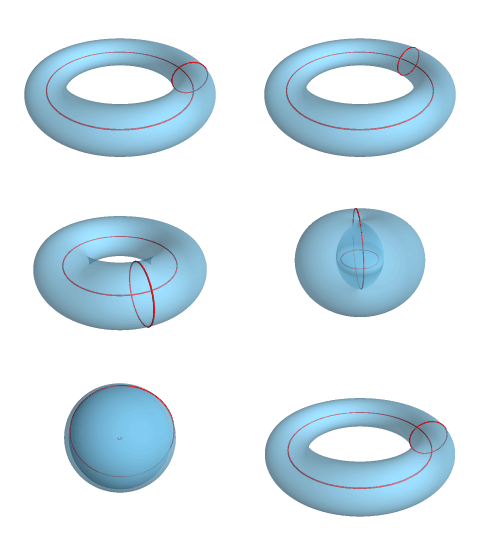
You can think of elliptic integrals as integrals over a torus, a curve shaped like the outer crust of a donut.

Do you prefer your integrals glazed, or with powdered sugar?

Integrals like these are showing up more and more in our field, the subject of bigger and bigger conferences. By now, we think we have a pretty good idea of how to handle them, but there are still some outstanding mysteries to solve.

One such mystery came up in a paper in 2017, by Luise Adams and Stefan Weinzierl. They were working with one of the favorite examples of this community, the so-called sunrise diagram (sunrise being a good time to eat donuts). And they noticed something surprising: if they looked at the sunrise diagram in different ways, it was described by different donuts.

What do I mean, different donuts?

The integrals we know best in this field aren’t integrals on a torus, but rather integrals on a sphere. In some sense, all spheres are the same: you can make them bigger or smaller, but they don’t have different shapes, they’re all “sphere-shaped”. In contrast, integrals on a torus are trickier, because toruses can have different shapes. Think about different donuts: some might have a thin ring, others a thicker one, even if the overall donut is the same size. You can’t just scale up one donut and get the other.

This donut even has a marked point

My colleague, Cristian Vergu, was annoyed by this. He’s the kind of person who trusts mathematics like an old friend, one who would never lead him astray. He thought that there must be one answer, one correct donut, one natural way to represent the sunrise diagram mathematically. I was skeptical, I don’t trust mathematics nearly as much as Cristian does. To sort it out, we brought in Hjalte Frellesvig and Matthias Volk, and started trying to write the sunrise diagram every way we possibly could. (Along the way, we threw in another “donut diagram”, the double-box, just to see what would happen.)

Rather than getting a zoo of different donuts, we got a surprise: we kept seeing the same two. And in the end, we stumbled upon the answer Cristian was hoping for: one of these two is, in a meaningful sense, the “correct donut”.

What was wrong with the other donut? It turns out when the original two donuts were found, one of them involved a move that is a bit risky mathematically, namely, combining square roots.

For readers who don’t know what I mean, or why this is risky, let me give a simple example. Everyone else can skip to after the torus gif.

Suppose I am solving a problem, and I find a product of two square roots:

\sqrt{x}\sqrt{x}

I could try combining them under the same square root sign, like so:

\sqrt{x^2}

That works, if x is positive. But now suppose x=-1. Plug in negative one to the first expression, and you get,

\sqrt{-1}\sqrt{-1}=i\times i=-1

while in the second,

\sqrt{(-1)^2}=\sqrt{1}=1

Torus transforming, please stand by

In this case, it wasn’t as obvious that combining roots would change the donut. It might have been perfectly safe. It took some work to show that indeed, this was the root of the problem. If the roots are instead combined more carefully, then one of the donuts goes away, leaving only the one, true donut.

I’m interested in seeing where this goes, how many different donuts we have to understand and how they might be related. But I’ve also been writing about donuts for the last hour or so, so I’m getting hungry. See you next week!

This Week, at Scattering-Amplitudes.com

I did a guest post this week, on an outreach site for the Max Planck Institute for Physics. The new Director of their Quantum Field Theory Department, Johannes Henn, has been behind a lot of major developments in scattering amplitudes. He was one of the first to notice just how symmetric N=4 super Yang-Mills is, as well as the first to build the “hexagon functions” that would become my stock-in-trade. He’s also done what we all strive to do, and applied what he learned to the real world, coming up with an approach to differential equations that has become the gold standard for many different amplitudes calculations.

Now in his new position, he has a swanky new outreach site, reached at the conveniently memorable scattering-amplitudes.com and managed by outreach-ologist Sorana Scholtes. They started a fun series recently called “Talking Terms” as a kind of glossary, explaining words that physicists use over and over again. My guest post for them is part of that series. It hearkens all the way back to one of my first posts, defining what “theory” means to a theoretical physicist. It covers something new as well, a phrase I don’t think I’ve ever explained on this blog: “working in a theory”. You can check it out on their site!

Physical Intuition From Physics Experience

One of the most mysterious powers physicists claim is physical intuition. Let the mathematicians have their rigorous proofs and careful calculations. We just need to ask ourselves, “Does this make sense physically?”

It’s tempting to chalk this up to bluster, or physicist arrogance. Sometimes, though, a physicist manages to figure out something that stumps the mathematicians. Edward Witten’s work on knot theory is a classic example, where he used ideas from physics, not rigorous proof, to win one of mathematics’ highest honors.

So what is physical intuition? And what is its relationship to proof?

Let me walk you through an example. I recently saw a talk by someone in my field who might be a master of physical intuition. He was trying to learn about what we call Effective Field Theories, theories that are “effectively” true at some energy but don’t include the details of higher-energy particles. He calculated that there are limits to the effect these higher-energy particles can have, just based on simple cause and effect. To explain the calculation to us, he gave a physical example, of coupled oscillators.

Oscillators are familiar problems for first-year physics students. Objects that go back and forth, like springs and pendulums, tend to obey similar equations. Link two of them together (couple them), and the equations get more complicated, work for a second-year student instead of a first-year one. Such a student will notice that coupled oscillators “repel” each other: their frequencies get father apart than they would be if they weren’t coupled.

Our seminar speaker wanted us to revisit those second-year-student days, in order to understand how different particles behave in Effective Field Theory. Just as the frequencies of the oscillators repel each other, the energies of particles repel each other: the unknown high-energy particles could only push the energies of the lighter particles we can detect lower, not higher.

This is an example of physical intuition. Examine it, and you can learn a few things about how physical intuition works.

First, physical intuition comes from experience. Using physical intuition wasn’t just a matter of imagining the particles and trying to see what “makes sense”. Instead, it required thinking about similar problems from our experience as physicists: problems that don’t just seem similar on the surface, but are mathematically similar.

Second, physical intuition doesn’t replace calculation. Our speaker had done the math, he hadn’t just made a physical argument. Instead, physical intuition serves two roles: to inspire, and to help remember. Physical intuition can inspire new solutions, suggesting ideas that you go on to check with calculation. In addition to that, it can help your mind sort out what you already know. Without the physical story, we might not have remembered that the low-energy particles have their energies pushed down. With the story though, we had a similar problem to compare, and it made the whole thing more memorable. Human minds aren’t good at holding a giant pile of facts. What they are good at is holding narratives. “Physical intuition” ties what we know into a narrative, building on past problems to understand new ones.

Finally, physical intuition can be risky. If the problem is too different then the intuition can lead you astray. The mathematics of coupled oscillators and Effective Field Theories was similar enough for this argument to work, but if it turned out to be different in an important way then the intuition would have backfired, making it harder to find the answer and harder to keep track once it was found.

Physical intuition may seem mysterious. But deep down, it’s just physicists using our experience, comparing similar problems to help keep track of what we need to know. I’m sure chemists, biologists, and mathematicians all have similar stories to tell.

Physics Acculturation

We all agree physics is awesome, right?

Me, I chose physics as a career, so I’d better like it. And you, right now you’re reading a physics blog for fun, so you probably like physics too.

Ok, so we agree, physics is awesome. But it isn’t always awesome.

Read a blog like this, or the news, and you’ll hear about the more awesome parts of physics: the black holes and big bangs, quantum mysteries and elegant mathematics. As freshman physics majors learn every year, most of physics isn’t like that. It’s careful calculation and repetitive coding, incremental improvements to a piece of a piece of a piece of something that might eventually answer a Big Question. Even if intellectually you can see the line from what you’re doing to the big flashy stuff, emotionally the two won’t feel connected, and you might struggle to feel motivated.

Physics solves this through acculturation. Physicists don’t just work on their own, they’re part of a shared worldwide culture of physicists. They spend time with other physicists, and not just working time but social time: they eat lunch together, drink coffee together, travel to conferences together. Spending that time together gives physics more emotional weight: as humans, we care a bit about Big Questions, but we care a lot more about our community.

This isn’t unique to physics, of course, or even to academics. Programmers who have lunch together, philanthropists who pat each other on the back for their donations, these people are trying to harness the same forces. By building a culture around something, you can get people more motivated to do it.

There’s a risk here, of course, that the culture takes over, and we lose track of the real reasons to do science. It’s easy to care about something because your friends care about it because their friends care about it, looping around until it loses contact with reality. In science we try to keep ourselves grounded, to respect those who puncture our bubbles with a good argument or a clever experiment. But we don’t always succeed.

The pandemic has made acculturation more difficult. As a scientist working from home, that extra bit of social motivation is much harder to get. It’s perhaps even harder for new students, who haven’t had the chance to hang out and make friends with other researchers. People’s behavior, what they research and how and when, has changed, and I suspect changing social ties are a big part of it.

In the long run, I don’t think we can do without the culture of physics. We can’t be lone geniuses motivated only by our curiosity, that’s just not how people work. We have to meld the two, mix the social with the intellectual…and hope that when we do, we keep the engines of discovery moving.

What Tells Your Story

I watched Hamilton on Disney+ recently. With GIFs and songs from the show all over social media for the last few years, there weren’t many surprises. One thing that nonetheless struck me was the focus on historical evidence. The musical Hamilton is based on Ron Chernow’s biography of Alexander Hamilton, and it preserves a surprising amount of the historian’s care for how we know what we know, hidden within the show’s other themes. From the refrain of “who tells your story”, to the importance of Eliza burning her letters with Hamilton (not just the emotional gesture but the “gap in the narrative” it created for historians), to the song “The Room Where It Happens” (which looked from GIFsets like it was about Burr’s desire for power, but is mostly about how much of history is hidden in conversations we can only partly reconstruct), the show keeps the puzzle of reasoning from incomplete evidence front-and-center.

Any time we try to reason about the past, we are faced with these kinds of questions. They don’t just apply to history, but to the so-called historical sciences as well, sciences that study the past. Instead of asking “who” told the story, such scientists must keep in mind “what” is telling the story. For example, paleontologists reason from fossils, and thus are limited by what does and doesn’t get preserved. As a result after a century of studying dinosaurs, only in the last twenty years did it become clear they had feathers.

Astronomy, too, is a historical science. Whenever astronomers look out at distant stars, they are looking at the past. And just like historians and paleontologists, they are limited by what evidence happened to be preserved, and what part of that evidence they can access.

These limitations lead to mysteries, and often controversies. Before LIGO, astronomers had an idea of what the typical mass of a black hole was. After LIGO, a new slate of black holes has been observed, with much higher mass. It’s still unclear why.

Try to reason about the whole universe, and you end up asking similar questions. When we see the movement of “standard candle” stars, is that because the universe’s expansion is accelerating, or are the stars moving as a group?

Push far enough back and the evidence doesn’t just lead to controversy, but to hard limits on what we can know. No matter how good our telescopes are, we won’t see light older than the cosmic microwave background: before that background was emitted the universe was filled with plasma, which would have absorbed any earlier light, erasing anything we could learn from it. Gravitational waves may one day let us probe earlier, and make discoveries as surprising as feathered dinosaurs. But there is yet a stronger limit to how far back we can go, beyond which any evidence has been so diluted that it is indistinguishable from random noise. We can never quite see into “the room where it happened”.

It’s gratifying to see questions of historical evidence in a Broadway musical, in the same way it was gratifying to hear fractals mentioned in a Disney movie. It’s important to think about who, and what, is telling the stories we learn. Spreading that lesson helps all of us reason better.