Author Archives: 4gravitons

A Question of Audience

I’ve been thinking a bit about science communication recently.

One of the most important parts of communicating science (or indeed, communicating anything) is knowing your audience. Much of the time if a piece is flawed, it’s flawed because the author didn’t have a clear idea of who they’re talking to.

A persistent worry among people who communicate science to the public is that we’re really just talking to ourselves. If all the people praising you for your clear language are scientists, then maybe it’s time to take a step back and think about whether you’re actually being understood by anyone else.

This blog’s goal has always been to communicate science to the general public, and most of my posts are written with as little background assumed as possible. That said, I sometimes wonder whether that’s actually the audience I’m reaching.
Wordpress has a handy feature to let me track which links people click on to get to my blog, which gives me a rough way to gauge my audience.

When a new post goes up, I get around ten to twenty clicks from Facebook. Those are people I know, which for the most part these days means physicists. I get a couple clicks from Twitter, where my followers are a mix of young scientists, science journalists, and amateurs interested in science. On WordPress, my followers are also a mix of specialists and enthusiasts. Most interesting, to me at least, are the followers who get to my blog via Google searches. Naturally, they come in regardless of whether I have a new post or not, adding an extra twenty-five or so views every day. Judging by the sites (google.fr, google.ca) these people come from all over the world, and judging by their queries they run from physics PhD students to people with no physics knowledge whatsoever.

Overall then, I think I’m doing a pretty good job getting the word out. As my site’s Google rankings improve, more non-physicists will read what I have to say. It’s a diverse audience, but I think I’m up to the challenge.

Numerics, or, Why can’t you just tell the computer to do it?

When most people think of math, they think of the math they did in school: repeated arithmetic until your brain goes numb, followed by basic algebra and trig. You weren’t allowed to use calculators on most tests for the simple reason that almost everything you did could be done by a calculator in a fraction of the time.

Real math isn’t like that. Mathematicians handle proofs and abstract concepts, definitions and constructions and functions and generally not a single actual number in sight. That much, at least, shouldn’t be surprising.

What might be surprising is that even tasks which seem very much like things computers could do easily take a fair bit of human ingenuity.

In physics, I do a lot of integrals. For those of you unfamiliar with calculus, integrals can be thought of as the area between a curve and the x-axis.

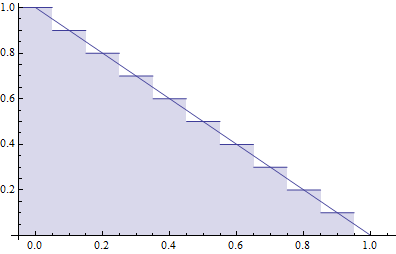
Areas seem like the sort of thing it would be easy for a computer to find. Chop the space into little rectangles, add up all the rectangles under the curve, and if your rectangles are small enough you should get the right answer. Broadly, this is the method of numerical integration. Since computers can do billions of calculations per second, you can chop things up into billions of rectangles and get as close as you’d like, right?

Heck, ten is a lot. Can we just do ten?

Heck, ten is a lot. Can we just do ten?

For some curves, this works fine. For others, though…

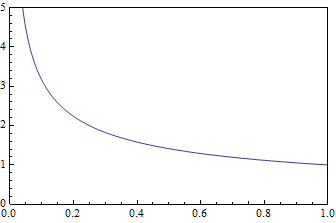
Ten might not be enough for this one.

Ten might not be enough for this one.

See how the left side of that plot goes off the chart? That curve goes to infinity. No matter how many rectangles you put on that side, you still won’t have any that are infinitely tall, so you’ll still miss that part of the curve.

Surprisingly enough, the area under this curve isn’t infinite. Do the integral correctly, and you get a result of 2. Set a computer to calculate this integral via the sort of naïve numerical integration discussed above though, and you’ll never find that answer. You need smarter methods: smart humans doing the math, or smart humans programming the computer.

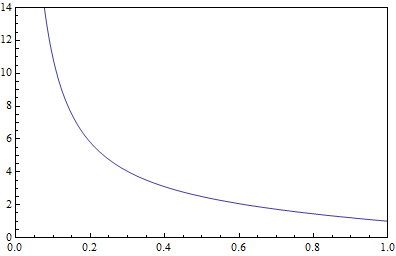
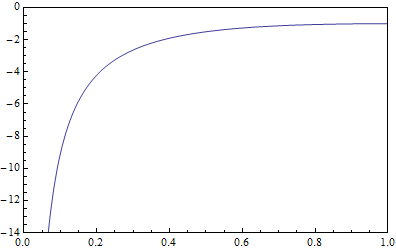
Another way this can come up is if you’re adding up two parts of something that go to infinity in opposite directions. Try to integrate each part by itself and you’ll be stuck.

firstplot

secondplot

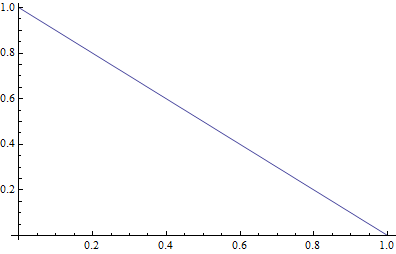
But add them together, and you get something quite a bit more tractable.

Yeah, definitely a ten-rectangle job.

Yeah, definitely a ten-rectangle job.

Numerical integration, and computers in general, are a very important tool in a scientist’s arsenal. But in order to use them, we have to be smart, and know what we’re doing. Knowing how to use our tools right can take almost as much expertise and care as working without tools.

So no, I can’t just tell the computer to do it.

Gravity is Yang-Mills Squared

There’s a concept that I’ve wanted to present for quite some time. It’s one of the coolest accomplishments in my subfield, but I thought that explaining it would involve too much technical detail. However, the recent BICEP2 results have brought one aspect of it to the public eye, so I’ve decided that people are ready.

If you’ve been following the recent announcements by the BICEP2 telescope of their indirect observation of primordial gravitational waves, you’ve probably seen the phrases “E-mode polarization” and “B-mode polarization” thrown around. You may even have seen pictures, showing that light in the cosmic microwave background is polarized differently by quantum fluctuations in the inflaton field and by quantum fluctuations in gravity.

But why is there a difference? What’s unique about gravitational waves that makes them different from the other waves in nature?

As it turns out, the difference all boils down to one statement:

Gravity is Yang-Mills squared.

This is both a very simple claim and a very subtle one, and it comes up in many many places in physics.

Yang-Mills, for those who haven’t read my older posts, is a general category that contains most of the fundamental forces. Electromagnetism, the strong nuclear force, and the weak nuclear force are all variants of Yang-Mills forces.

Yang-Mills forces have “spin 1”. Another way to say this is that Yang-Mills forces are vector forces. If you remember vectors from math class, you might remember that a vector has a direction and a strength. This hopefully makes sense: forces point in a direction, and have a strength. You may also remember that vectors can also be described in terms of components. A vector in four space-time dimensions has four components: x, y, z, and time, like so:

\left( \begin{array}{c} x \\ y \\ z \\ t \end{array} \right)

Gravity has “spin 2”.

As I’ve talked about before, gravity bends space and time, which means that it modifies the way you calculate distances. In practice, that means it needs to be something that can couple two vectors together: a matrix, or more precisely, a tensor, like so:

\left( \begin{array}{cccc} xx & xy & xz & xt\\ yx & yy & yz & yt\\ zx & zy & zz & zt\\ tx & ty & tz & tt\end{array} \right)

So while a Yang-Mills force has four components, gravity has sixteen. Gravity is Yang-Mills squared.

(Technical note: gravity actually doesn’t use all sixteen components, because it’s traceless and symmetric. However, often when studying gravity’s quantum properties theorists often add on extra fields to “complete the square” and fill in the remaining components.)

There’s much more to the connection than that, though. For one, it appears in the kinds of waves the two types of forces can create.

In order to create an electromagnetic wave you need a dipole, a negative charge and a positive charge at opposite ends of a line, and you need that dipole to change over time.

Change over time, of course, is a property of Gifs.

Gravity doesn’t have negative and positive charges, it just has one type of charge. Thus, to create gravitational waves you need not a dipole, but a quadrupole: instead of a line between two opposite charges, you have four gravitational charges (masses) arranged in a square. This creates a “breathing” sort of motion, instead of the back-and-forth motion of electromagnetic waves.

This is your brain on gravitational waves.

This is why gravitational waves have a different shape than electromagnetic waves, and why they have a unique effect on the cosmic microwave background, allowing them to be spotted by BICEP2. Gravity, once again, is Yang-Mills squared.

But wait there’s more!

So far, I’ve shown you that gravity is the square of Yang-Mills, but not in a very literal way. Yes, there are lots of similarities, but it’s not like you can just square a calculation in Yang-Mills and get a calculation in gravity, right?

Well actually…

In quantum field theory, calculations are traditionally done using tools called Feynman diagrams, organized by how many loops the diagram contains. The simplest diagrams have no loops, and are called tree diagrams.

Fascinatingly, for tree diagrams the message of this post is as literal as it can be. Using something called the Kawai-Lewellen-Tye relations, the result of a tree diagram calculation in gravity can be found just by taking a similar calculation in Yang-Mills and squaring it.

(Interestingly enough, these relations were originally discovered using string theory, but they don’t require string theory to work. It’s yet another example of how string theory functions as a laboratory to make discoveries about quantum field theory.)

Does this hold beyond tree diagrams? As it turns out, the answer is again yes!
The calculation involved is a little more complicated, but as discovered by Zvi Bern, John Joseph Carrasco, and Henrik Johansson, if you can get your calculation in Yang-Mills into the right format then all you need to do is square the right thing at the right step to get gravity, even for diagrams with loops!

zvi-bern-350

carrasco

This trick, called BCJ duality after its discoverers, has allowed calculations in quantum gravity that far outpace what would be possible without it. In N=8 supergravity, the gravity analogue of N=4 super Yang-Mills, calculations have progressed up to four loops, and have revealed tantalizing hints that the uncontrolled infinities that usually plague gravity theories are absent in N=8 supergravity, even without adding in string theory. Results like these are why BCJ duality is viewed as one of the “foundational miracles” of the field for those of us who study scattering amplitudes.

Gravity is Yang-Mills squared, in more ways than one. And because gravity is Yang-Mills squared, gravity may just be tame-able after all.

Flexing the BICEP2 Results

The physicsverse has been abuzz this week with news of the BICEP2 experiment’s observations of B-mode polarization in the Cosmic Microwave Background.

There are lots of good sources on this, and it’s not really my field, so I’m just going to give a quick summary before talking about a few aspects I find interesting.

BICEP2 is a telescope in Antarctica that observes the Cosmic Microwave Background, light left over from the first time that the universe was clear enough for light to travel. (If you’re interested in a background on what we know about how the universe began, Of Particular Significance has an article here that should be fairly detailed, and I have a take on some more speculative aspects here.) Earlier experiments that observed the Cosmic Microwave Background discovered a surprising amount of uniformity. This led to the proposal of a concept called inflation: the idea that at some point the early universe expanded exponentially, smearing any non-uniformities across the sky and smoothing everything out. Since the rate the universe expands is a number, if that number is to vary it naturally should be a scalar field, which in this case is called the inflaton.

During inflation, distances themselves get stretched out. Think about inflation like enlarging an image. As you’ve probably noticed (maybe even in early posts on this blog), enlarging an image doesn’t always work out well. The resulting image is often pixelated or distorted. Some of the distortion comes from glitches in the program that enlarges the image, while some of it is just what happens when the pixels of the original image get enlarged to the point that you can see them.

Enlarging the Cosmic Microwave Background

Quantum fluctuations in the inflaton field itself are the glitches in the program, enlarging some areas more than others. The pattern they create in the Cosmic Microwave Background is called E-mode polarization, and several other experiments have been able to detect it.

Much weaker are the effect of the “pixels” of the original image. Since the original image is spacetime itself, the pixels are the quantum fluctuations of spacetime: quantum gravity waves. Inflation enlarged them to the point that they were visible on a large-distance scale, fundamental non-uniformity in the world blown up big enough to affect the distribution of light. The effect this had on light is detectably different: it’s called B-mode polarization, and this is the first experiment to detect it on the right scale for it to be caused by gravity waves.

Measuring this polarization, in particular how strong it is, tells us a lot about how inflation occurred. It’s enough to rule out several models, and lend support to several others. If the results are corroborated this will be real, useful evidence, the sort physicists love to get, and folks are happily crunching numbers on it all over the world.

All that said, this site is called four gravitons and a grad student, and I’m betting that some of you want to ask this grad student: is this evidence for gravitons, or for gravity waves?

Sort of.

We already had good indirect evidence for gravity waves: pairs of neutron stars release gravity waves as they orbit each other, which causes them to slow down. Since we’ve observed them slowing down at the right rates, we were already confident gravity waves exist. And if you’ve got gravity waves, gravitons follow as a natural consequence of quantum mechanics.

The data from BICEP2 is also indirect. The gravity waves “observed” by BICEP2 were present in the early universe. It is their effect on the light that would become the Cosmic Microwave Background that is being observed, not the gravity waves directly. We still have yet to directly detect gravity waves, with a gravity telescope like LIGO.

On the other hand, a “gravity telescope” isn’t exactly direct either. In order to detect gravity waves, LIGO and other gravity telescopes attempt to measure their effect on the distances between objects. How do they do that? By looking at interference patterns of light.

In both cases, we’re looking at light, present in the environment of a gravity wave, and examining its properties. Of course, in a gravity telescope the light is from a nearby environment under tight control, while the Cosmic Microwave Background is light from as far away and long ago as anything within the reach of science today. In both cases, though, it’s not nearly as simple as “observing” an effect. “Seeing” anything in high energy physics or astrophysics is always a matter of interpreting data based on science we already know.

Alright, that’s evidence for gravity waves. Does that mean evidence for gravitons?

I’ve seen a few people describe BICEP2’s results as evidence for quantum gravity/quantum gravity effects. I felt a little uncomfortable with that claim, so I asked Matt Strassler what he thought. I think his perspective on this is the right one. Quantum gravity is just what happens when gravity exists in a quantum world. As I’ve said on this site before, quantum gravity is easy. The hard part is making a theory of quantum gravity that has real predictive power, and that’s something these results don’t shed any light on at all.

That said, I’m a bit conflicted. They really are seeing a quantum effect in gravity, and as far as I’m aware this really is the first time such an effect has been observed. Gravity is so weak, and quantum gravity effects so small, that it takes inflation blowing them up across the sky for them to be visible. Now, I don’t think there was anyone out there who thought gravity didn’t have quantum fluctuations (or at least, anyone with a serious scientific case). But seeing into a new regime, even if it doesn’t tell us much…that’s important, isn’t it? (After writing this, I read Matt Strassler’s more recent post, where he has a paragraph professing similar sentiments).

On yet another hand, I’ve heard it asserted in another context that loop quantum gravity researchers don’t know how to get gravitons. I know nothing about the technical details of loop quantum gravity, so I don’t know if that actually has any relevance here…but it does amuse me.

“Super” Computers: Using a Cluster

When I join a new department or institute, the first thing I ask is “do we have a cluster?”

Most of what I do, I do on a computer. Gone are the days when theorists would always do all their work on notepads and chalkboards (though many still do!). Instead, we use specialized computer programs like Mathematica and Maple. Using a program helps keep us from forgetting pesky minus signs, and it allows working with equations far too long to fit on a sheet of paper.

Now if computers help, more computer should help more. Since physicists like to add “super” to things, what about a supercomputer?

The Jaguars of the computing world.

Supercomputers are great, but they’re also expensive. The people who use supercomputers are the ones who model large, complicated systems, like the weather, or supernovae. For most theorists, you still want power, but you don’t need quite that much. That’s where computer clusters come in.

A computer cluster is pretty much what it sounds like: several computers wired together. Different clusters contain different numbers of computers. For example, my department has a ten-node cluster. Sure, that doesn’t stack up to a supercomputer, but it’s still ten times as fast as an ordinary computer, right?

The power of ten computers!

The power of ten computers!

Well, not exactly. As several of my friends have been surprised to learn, the computers on our cluster are actually slower than most of our laptops.

The power of ten old computers!

The power of ten old computers!

Still, ten older computers is still faster than one new one, yes?

Even then, it depends how you use it.

Run a normal task on a cluster, and it’s just going to run on one of the computers, which, as I’ve said, are slower than a modern laptop. You need to get smarter.

There are two big advantages of clusters: time, and parallelization.

Sometimes, you want to do a calculation that will take a long time. Your computer is going to be busy for a day or two, and that’s inconvenient when you want to do…well, pretty much anything else. A cluster is a space to run those long calculations. You put the calculation on one of the nodes, you go back to doing your work, and you check back in a day or two to see if it’s finished.

Clusters are at their most powerful when you can parallelize. If you need to do ten versions of the same calculation, each slightly different, then rather than doing them one at a time a cluster lets you do them all at once. At that point, it really is making you ten times faster.

If you ever program, I’d encourage you to look into the resources you have available. A cluster is a very handy thing to have access to, no matter what you’re doing!

A Wild Infinity Appears! Or, Renormalization

Back when Numberphile’s silly video about the zeta function came up, I wrote a post explaining the process of regularization, where physicists take an incorrect infinite result and patch it over to get something finite. At the end of that post I mentioned a particular variant of regularization, called renormalization, which was especially important in quantum field theory.

Renormalization has to do with how we do calculations and make predictions in particle physics. If you haven’t read my post “What’s so hard about Quantum Field Theory anyway?” you should read it before trying to tackle this one. The important concepts there are that probabilities in particle physics are calculated using Feynman Diagrams, that those diagrams consist of lines representing particles and points representing the ways they interact, that each line and point in the diagram gives a number that must be plugged in to the calculation, and that to do the full calculation you have to add up all the possible diagrams you can draw.

Let’s say you’re interested in finding out the mass of a particle. How about the Higgs?

You can’t weigh it, or otherwise see how gravity affects it: it’s much too light, and decays into other particles much too fast. Luckily, there is another way. As I mentioned in this post, a particle’s mass and its kinetic energy (energy of motion) both contribute to its total energy, which in turn affects what particles it can turn into if it decays. So if you want to find a particle’s mass, you need the relationship between its motion and its energy.

Suppose we’ve got a Higgs particle moving along. We know it was created out of some collision, and we know what it decays into at the end. With that, we can figure out its mass.

higgstree

There’s a problem here, though: we only know what happens at the beginning and the end of this diagram. We can’t be certain what happens in the middle. That means we need to add in all of the other diagrams, every possible diagram with that beginning and that end.

Just to look at one example, suppose the Higgs particle splits into a quark and an anti-quark (the antimatter version of the quark). If they come back together later into a Higgs, the process would look the same from the outside. Here’s the diagram for it:

higgsloop

When we’re “measuring the Higgs mass”, what we’re actually measuring is the sum of every single diagram that begins with the creation of a Higgs and ends with it decaying.

Surprisingly, that’s not the problem!

The problem comes when you try to calculate the number that comes out of that diagram, when the Higgs splits into a quark-antiquark pair. According to the rules of quantum field theory, those quarks don’t have to obey the normal relationship between total energy, kinetic energy, and mass. They can have any kinetic energy at all, from zero all the way up to infinity. And because it’s quantum field theory, you have to add up all of those possible kinetic energies, all the way up. In this case, the diagram actually gives you infinity.

(Note that not every diagram with unlimited kinetic energy is going to be infinite. The first time theorists calculated infinite diagrams, they were surprised.

For those of you who know calculus, the problem here comes after you integrate over momentum. The two quarks each give a factor of one over the momentum, and then you integrate the result four times (for three dimensions of space plus time), which gives an infinite result. If you had different particles arranged in a different way you might divide by more factors of momentum and get a finite value.)

The modern understanding of infinite results like this is that they arise from our ignorance. The mass of the Higgs isn’t actually infinity, because we can’t just add up every kinetic energy up to infinity. Instead, at some point before we get to infinity “something else” happens.

We don’t know what that “something else” is. It might be supersymmetry, it might be something else altogether. Whatever it is, we don’t know enough about it now to include it in the calculations as anything more than a cutoff, a point beyond which “something” happens. A theory with a cutoff like this, one that is only “effective” below a certain energy, is called an Effective Field Theory.

While we don’t know what happens at higher energies, we still need a way to complete our calculations if we want to use them in the real world. That’s where renormalization comes in.

When we use renormalization, we bring in experimental observations. We know that, no matter what is contributing to the Higgs particle’s mass, what we observe in the real world is finite. “Something” must be canceling the divergence, so we simply assume that “something” does, and that the final result agrees with the experiment!

"Something"

“Something”

In order to do this, we accepted the experimental result for the mass of the Higgs. That means that we’ve lost any ability to predict the mass from our theory. This is a general rule for renormalization: we trade ignorance (of the “something” that happens at high energy) for a loss of predictability.

If we had to do this for every calculation, we couldn’t predict anything at all. Luckily, for many theories (called renormalizable theories) there are theorems proving that you only need to do this a few times to fix the entire theory. You give up the ability to predict the results of a few experiments, but you gain the ability to predict the rest.

Luckily for us, the Standard Model is a renormalizable theory. Unfortunately, some important theories are not. In particular, quantum gravity is non-renormalizable. In order to fix the infinities in quantum gravity, you need to do the renormalization trick an infinite number of times, losing an infinite amount of predictability. Thus, while making a theory of quantum gravity is not difficult in principle, in practice the most obvious way to create the theory results in a “theory” that can never make any predictions.

One of the biggest virtues of string theory (some would say its greatest virtue) is that these infinities never appear. You never need to renormalize string theory in this way, which is what lets it work as a theory of quantum gravity. N=8 supergravity, the gravity cousin of N=4 super Yang-Mills, might also have this handy property, which is why many people are so eager to study it.

Why we Physics

There are a lot of good reasons to study theories in theoretical physics, even the ones that aren’t true. They teach us how to do calculations in other theories, including those that do describe reality, which lets us find out fundamental facts about nature. They let us hone our techniques, developing novel methods that often find use later, in some cases even spinoff technology. (Mathematica came out of the theoretical physics community, while experimental high energy physics led to the birth of the modern internet.)

Of course, none of this is why physicists actually do physics. Sure, Nima Arkani-Hamed might need to tell himself that space-time is doomed to get up in the morning, but for a lot of us, it isn’t about proving any wide-ranging point about the universe. It’s not even all about the awesome, as some would have it: most of what we do on a day-to-day basis isn’t especially awesome. It goes a bit deeper than that.

Science, in the end, is about solving puzzles. And solving puzzles is immensely satisfying, on a deep, fundamental level.

There’s a unique feeling that you get when all the pieces come together, when you’re calculating something and everything cancels and you’re left with a simple answer, and for some people that’s the best thing in existence.

It’s especially true when you’re working with an ansatz or using some other method where you fix parameters and fill in uncertainties, one by one. You can see how close you are to the answer, which means each step gives you that little thrill of getting just that much closer. One of my colleagues describes the calculations he does in supergravity as not tedious but “delightful” for precisely this reason: a calculation where every step puts another piece in the right place just feels good.

Theoretical physicists are the kind of people who would get a Lego set for their birthday, build it up to completion, and then never play with it again (unless it was to take it apart and make something else). We do it for the pure joy of seeing something come together and become complete. Save what it’s “for” for the grant committees, we’ve got a different rush in mind.

The Royal We of Theoretical Physics

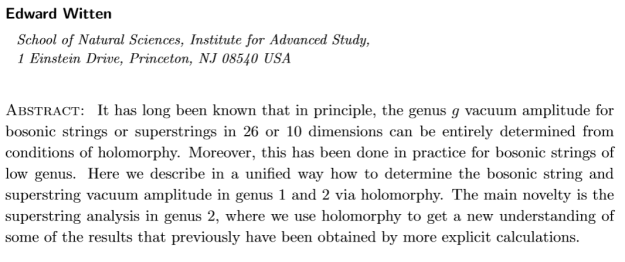
I’m about to show you an abstract from a theoretical physics paper. Don’t worry about what it says, just observe the grammar.

wittenabstract

Notice anything? Here, I’ll zoom in:

wittenwe

This paper has one author, Edward Witten. So who’s “we”?

As it turns out, it is actually quite common in theoretical physics for a paper to use the word “we”, even when it is written by a single author. While this tradition has been called stilted, pompous, and just plain bad writing, there is a legitimate reason behind it. “We” is convenient, because it represents several different important things.

While the paper I quoted was written by only one author, many papers are collaborative efforts. For a collaboration, depending on collaboration style, it is often hard to distinguish who did what in a consistent way. As such, “we” helps smooth over different collaboration styles in a consistent way.

What about single-authored papers, though? For a single author, and often even for multiple authors, “we” means the author plus the reader.

In principle, anyone reading a paper in theoretical physics should be able to follow along, doing the calculations on their own, and replicate the paper’s results. In practice this can often be difficult to impossible, but it’s still true that if you want to really retain what you read in theoretical physics, you need to follow along and do some of the calculation yourself. As a nod to this, it is conventional to write theoretical physics papers as if the reader was directly participating, leading them through the results point by point like exercises in a textbook. “We” do one calculation, then “we” use the result to derive the next point, and so on.

There are other meanings that “we” can occasionally serve, such as referring to everyone in a particular field, or a group in a hypothetical example.

While each of these meanings of “we” could potentially use a different word, that tends to make a paper feel cluttered, with jarring transitions between different subjects. Using “we” for everything gives the paper a consistent voice and feel, though it does come at the cost of obscuring some of the specific details of who did what. Especially for collaborations, the “we the collaborators” and “we the author plus reader” meanings can overlap and blur together. This usually isn’t a problem, but as I’ve been finding out recently it does make things tricky when writing for people who aren’t theoretical physicists, such as universities with guidelines that require a thesis to clearly specify who in a collaboration did what.

On an unrelated note, two papers went up this week pushing the hexagon function story to new and impressive heights. I wasn’t directly involved in either, I’ve been attacking a somewhat different part of the problem, and you can look forward to something on that in a few months.

Caltech Amplitudes Workshop, and Valentines Poem 2014

This week’s post will be a short one. I’m at a small workshop for young amplitudes-folks at Caltech, so I’m somewhat busy.

(What we call a workshop is a small conference focused on fostering discussion and collaboration. While there are a few talks to give the workshop structure, most of the time is spent in more informal discussions between the participants.)

There have been a lot of great talks, and a lot of great opportunities to bond with fellow young amplitudeologists. Also, great workshop swag!

Yes, that is a Hot Wheels Mars Rover

Yes, that is a Hot Wheels Mars Rover

Unrelatedly, to continue a tradition from last year, and since it’s Valentine’s Day, allow me to present a short physics-themed poem I wrote a long time ago, this one about the sometimes counter-intuitive laws of thermodynamics:

Thermodynamic Hypothesis

A cold object, like a hot one, must be insulated

Cut off from interaction

Immerse the subject in a bath of warmth

And I reach equilibrium

What’s in a Thesis?

As I’ve mentioned before, I’m graduating this spring, which means I need to write that most foreboding of documents, the thesis. As I work on it, I’ve been thinking about how the nature of the thesis varies from field to field.

If you don’t have much experience with academics, you probably think of a thesis as a single, overarching achievement that structures a grad student’s career. A student enters grad school, designs an experiment, performs it, collects data, analyzes the data, draws some conclusion, then writes a thesis about it and graduates.

In some fields, the thesis really does work that way. In biology for example, the process of planning an experiment, setting it up, and analyzing and writing up the data can be just the right size so that, a reasonable percentage of the time, it really can all be done over the course of a PhD.

Other fields tend more towards smaller, faster-paced projects. In theoretical physics, mathematics, and computer science, most projects don’t have the same sort of large experimental overhead that psychologists or biologists have to deal with. The projects I’ve worked on are large-scale for theoretical physics, and I’ll still likely have worked on three distinct things before I graduate. Others, with smaller projects, will often have covered more.

In this situation, a thesis isn’t one overarching idea. Rather, it’s a compilation of work from past projects, sewed together with a pretense of an overall theme. It’s a bit messy, but because it’s the way things are expected to be done in these fields, no-one minds particularly much.

The other end of the spectrum is potentially much harder to deal with. For those who work on especially big experiments, the payoff might take longer to arrive than any reasonable degree. Big machines like colliders and particle detectors can take well over a decade before they start producing data, while longitudinal studies that follow a population as they grow and age take a long time no matter how fast you work.

In cases like this, the challenge is to chop off a small enough part of the project to make it feel like a thesis. A thesis could be written about designing one component for the eventual machine, or analyzing one part of the vast sea of data it produces. Preliminary data from a longitudinal study could be analyzed, even when the final results are many years down the line.

People in these fields have to be flexible and creative when it comes to creating a thesis, but usually the thesis committee is reasonable. In the end, a thesis is what you need to graduate, whatever that actually is for you.