What RIBs Could Look Like

The journal Nature recently published an opinion piece about a new concept for science funding called Research Impact Bonds (or RIBs).

Normally, when a government funds something, they can’t be sure it will work. They pay in advance, and have to guess whether a program will do what they expect, or whether a project will finish on time. Impact bonds are a way for them to pay afterwards, so they only pay for projects that actually deliver. Instead, the projects are funded by private investors, who buy “impact bonds” that guarantee them a share of government funding if the project is successful. Here’s an example given in the Nature piece:

For instance, say the Swiss government promises to pay up to one million Swiss francs (US$1.1 million) to service providers that achieve a measurable outcome, such as reducing illiteracy in a certain population by 5%, within a specified number of years. A broker finds one or more service providers that think they can achieve this at a cost of, say, 900,000 francs, as well as investors who agree to pay these costs up front — thus taking on the risk of the project — for a potential 10% gain if successful. If the providers achieve their goals, the government pays 990,000 francs: 900,000 francs for the work and a 90,000-franc investment return. If the project does not succeed, the investors lose their money, but the government does not.

The author of the piece, Michael Hill, thinks that this could be a new way for governments to fund science. In his model, scientists would apply to the government to propose new RIBs. The projects would have to have specific goals and time-frames: “measure the power of this cancer treatment to this accuracy in five years”, for example. If the government thinks the goal is valuable, they commit to paying some amount of money if the goal is reached. Then investors can decide whether the investment is worthwhile. The projects they expect to work get investor money, and if they do end up working the investors get government money. The government only has to pay if the projects work, but the scientists get paid regardless.

Ok, what’s the catch?

One criticism I’ve seen is that this kind of model could only work for very predictable research, maybe even just for applied research. While the author admits RIBs would only be suitable for certain sorts of projects, I think the range is wider than you might think. The project just has to have a measurable goal by a specified end date. Many particle physics experiments work that way: a dark matter detector, for instance, is trying to either rule out or detect dark matter to a certain level of statistical power within a certain run time. Even “discovery” machines, that we build to try to discover the unexpected, usually have this kind of goal: a bigger version of the LHC, for instance, might try to measure the coupling of Higgs bosons to a certain accuracy.

There are a few bigger issues with this model, though. If you go through the math in Hill’s example, you’ll notice that if the project works, the government ends up paying one million Swiss francs for a service that only cost the provider 900,000 Swiss francs. Under a normal system, the government would only have had to pay 900,000. This gets compensated by the fact that not every project works, so the government only pays for some projects and not others. But investors will be aware of this, and that means the government can’t offer too many unrealistic RIBs: the greater the risk investors are going to take, the more return they’ll expect. On average then, the government would have to pay about as much as they would normally: the cost of the projects that succeed, plus enough money to cover the risk that some fail. (In fact, they’d probably pay a bit more, to give the investors a return on the investment.)

So the government typically won’t save money, at least not if they want to fund the same amount of research. Instead, the idea is that they will avoid risk. But it’s not at all clear to me that the type of risk they avoid is one they want to.

RIBs might appeal to voters: it might sound only fair that a government only funds the research that actually works. That’s not really a problem for the government itself, though: because governments usually pay for many small projects, they still get roughly as much success overall as they want, they just don’t get to pick where. Instead, RIBS put the government agency in a much bigger risk, the risk of unexpected success. As part of offering RIBs, the government would have to estimate how much money they would be able to pay when the projects end. They would want to fund enough projects so that, on average, they pay that amount of money. (Otherwise, they’d end up funding science much less than they do now!) But if the projects work out better than expected, then they’d have to pay much more than they planned. And government science agencies usually can’t do this. In many countries, they can’t plan far in advance at all: their budgets get decided by legislators year to year, and delays in decisions mean delays in funding. If an agency offered RIBs that were more successful than expected, they’d either have to cut funding somewhere else (probably firing a lot of people), or just default on their RIBs, weakening the concept for the next time they used them. These risks, unlike the risk of individual experiments not working, are risks that can really hurt government agencies.

Impact bonds typically have another advantage, in that they spread out decision-making. The Swiss government in Hill’s example doesn’t have to figure out which service providers can increase literacy, or how much it will cost them: it just puts up a budget, and lets investors and service providers figure out if they can make it work. This also serves as a hedge against corruption. If the government made the decisions, they might distribute funding for unrelated political reasons or even out of straight-up bribery. They’d also have to pay evaluators to figure things out. Investors won’t take bribes to lose money, so in theory would be better at choosing projects that will actually work, and would have a vested interest in paying for a good investigation.

This advantage doesn’t apply to Hill’s model of RIBs, though. In Hill’s model, scientists still need to apply to the government to decide which of their projects get offered as RIBs, so the government still needs to decide which projects are worth investing in. Then the scientists or the government need to take another step, and convince investors. The scientists in this equation effectively have to apply twice, which anyone who has applied for a government grant will realize is quite a lot of extra time and effort.

So overall, I don’t think Hills’ model of RIBs is useful, even for the purpose he imagines. It’s too risky for government science agencies to commit to payments like that, and it generates more, not less, work for scientists and the agency.

Hill’s model, though, isn’t the only way RIBs can work. And “avoiding risk” isn’t the only reason we might want them. There are two other reasons one might want RIBs, with very different-sounding motivations.

First, you might be pessimistic about mainstream science. Maybe you think scientists are making bad decisions, choosing ideas that either won’t pan out or won’t have sufficient impact, based more on fashion than on careful thought. You want to incentivize them to do better, to try to work out what impact they might have with some actual numbers and stand by their judgement. If that’s your perspective, you might be interested in RIBs for the same reason other people are interested in prediction markets: by getting investors involved, you have people willing to pay for an accurate estimate.

Second, you might instead be optimistic about mainstream science. You think scientists are doing great work, work that could have an enormous impact, but they don’t get to “capture that value”. Some projects might be essential to important, well-funded goals, but languish unrewarded. Others won’t see their value until long in the future, or will do so in unexpected ways. If scientists could fund projects based on their future impact, with RIBs, maybe they could fund more of this kind of work.

(I first started thinking about this perspective due to a talk by Sabrina Pasterski. The talk itself offended a lot of people, and had some pretty impractical ideas, like selling NFTs of important physics papers. But I think one part of the perspective, that scientists have more impact than we think, is worth holding on to.)

If you have either of those motivations, Hill’s model won’t help. But another kind of model perhaps could. Unlike Hill’s, it could fund much more speculative research, ideas where we don’t know the impact until decades down the line. To demonstrate, I’ll show how it could fund some very speculative research: the work of Peter van Nieuwenhuizen.

Peter van Nieuwenhuizen is one of the pioneers of the theory of supergravity, a theory that augments gravity with supersymmetric partner particles. From its beginnings in the 1970’s, the theory ended up having a major impact on string theory, and today they are largely thought of as part of the same picture of how the universe might work.

His work has, over time, had more practical consequences though. In the 2000’s, researchers working with supergravity noticed a calculational shortcut: they could do a complicated supergravity calculation as the “square” of a much simpler calculation in another theory, called Yang-Mills. Over time, they realized the shortcut worked not just for supergravity, but for ordinary gravity as well, and not just for particle physics calculations but for gravitational wave calculations. Now, their method may make an important contribution to calculations for future gravitational wave telescopes like the Einstein telescope, letting them measure properties of neutron stars.

With that in mind, imagine the following:

In 1967, Jocelyn Bell Burnell and Antony Hewish detected a pulsar, in one of the first direct pieces of evidence for the existence of neutron stars. Suppose that in the early 1970’s NASA decided to announce a future purchase of RIBs: in 2050, they would pay a certain amount to whoever was responsible for finding the equation of state of a neutron star, the formula that describes how its matter moves under pressure. They compute based on estimates of economic growth and inflation, and arrive at some suitably substantial number.

At the same time, but unrelatedly, van Nieuwenhuizen and collaborators sell RIBs. Maybe they use the proceeds to buy more computer time for their calculations, or to refund travel so they can more easily meet and discuss. They tell the buyers that, if some government later decides to reward their discoveries, the holders of the RIB would get a predetermined cut of the rewards.

The years roll by, and barring some unexpected medical advances the discoverers of supergravity die. In the meantime, researchers use their discovery to figure out how to make accurate predictions of gravitational waves from merging neutron stars. When the Einstein telescope turns out, it detects such a merger, and the accurate predictions let them compute the neutron star’s equation of state.

In 2050, then, NASA looks back. They make a list of everyone who contributed to the discovery of the neutron star’s equation of state, every result that was needed for the discovery, and try to estimate how important each contribution was. Then they spend the money they promised buying RIBs, up to the value for each contributor. This includes RIBs originally held by the investors in van Nieuwenhuizen and collaborators. Their current holders make some money, justifying whatever value they paid from their previous owners.

Imagine a world in which government agencies do this kind of thing all the time. Scientists could sell RIBs in their projects, without knowing exactly which agency would ultimately pay for them. Rather than long grant applications, they could write short summaries for investors, guessing at the range of their potential impact, and it would be up to the investors to decide whether the estimate made sense. Scientists could get some of the value of their discoveries, even when that value is quite unpredictable. And they would be incentivized to pick discoveries that could have high impact, and to put a bit of thought and math into what kind of impact that could be.

(Should I still be calling these things bonds, when the buyers don’t know how much they’ll be worth at the end? Probably not. These are more like research impact shares, on a research impact stock market.)

Are there problems with this model, then? Oh sure, loads!

I already mentioned that it’s hard for government agencies to commit to spending money five years down the line. A seventy-year commitment, from that perspective, sounds completely ridiculous.

But we don’t actually need that in the model. All we need is a good reason for investors to think that, eventually, NASA will buy some research impact shares. If government agencies do this regularly, then they would have that reason. They could buy a variety of theoretical developments, a diversified pool to make it more likely some government agency would reward them. This version of the model would be riskier, though, so they’d want more return in exchange.

Another problem is the decision-making aspect. Government agencies wouldn’t have to predict the future, but they would have to accurately assess the past, fairly estimating who contributed to a project, and they would have to do it predictably enough that it could give rise to worthwhile investments. This is itself both controversial and a lot of work. If we figure out the neutron star equation of state, I’m not sure I trust NASA to reward van Nieuwenhuizen’s contribution to it.

This leads to the last modification of the model, and the most speculative one. Over time, government agencies will get better and better at assigning credit. Maybe they’ll have better models of how scientific progress works, maybe they’ll even have advanced AI. A future government (or benevolent AI, if you’re into that) might decide to buy research impact shares in order to validate important past work.

If you believe that might happen, then you don’t need a track record of government agencies buying research impact shares. As a scientist, you can find a sufficiently futuristically inclined investor, and tell them this story. You can sell them some shares, and tell them that, when the AI comes, they will have the right to whatever benefit it bestows upon your research.

I could imagine some people doing this. If you have an image of your work saving humanity in the distant future, you should be able to use that image to sell something to investors. It would be insanely speculative, a giant pile of what-ifs with no guarantee of any of it cashing out. But at least it’s better than NFTs.

Not Made of Photons Either

If you know a bit about quantum physics, you might have heard that everything is made out of particles. Mass comes from Higgs particles, gravity from graviton particles, and light and electricity and magnetism from photon particles. The particles are the “quanta”, the smallest possible units of stuff.

This is not really how quantum physics works.

You might have heard (instead, or in addition), that light is both particle and wave. Maybe you’ve heard it said that it is both at the same time, or that it is one or the other, depending on how you look at it.

This is also not really how quantum physics works.

If you think that light is both a particle and a wave, you might get the impression there are only two options. This is better than thinking there is only one option, but still not really the truth. The truth is there are many options. It all depends on what you measure.

Suppose you have a particle collider, like the Large Hadron Collider at CERN. Sometimes, the particles you collide release photons. You surround the collision with particle detectors. When a photon hits them, these particle detectors amplify it, turning it into an electrical signal in a computer.

If you want to predict what those particle detectors see, you might put together a theory of photons. You’ll try to calculate the chance that you see some specific photon with some specific energy to some reasonable approximation…and you’ll get infinity.

You might think you’ve heard this story before. Maybe you’ve heard people talk about calculations in quantum field theory that give infinity, with buzzwords like divergences and renormalization. You may remember them saying that this is a sign that our theories are incomplete, that there are parameters we can’t predict or that the theory is just a low-energy approximation to a deeper theory.

This is not that story. That story is about “ultraviolet divergences”, infinities that come from high-energy particles. This story is about “infrared divergences” from low-energy particles. Infrared divergences don’t mean our theory is incomplete. Our theory is fine. We’re just using it wrong.

The problem is that I lied to you a little bit, earlier. I told you that your particle detectors can detect photons, so you might have imagined they can detect any photon you like. But that is impossible. A photon’s energy is determined by its wavelength: X-rays have more energy than UV light, which has more energy than IR light, which has more energy than microwaves. No matter how you build your particle detector, there will be some energy low enough that it cannot detect, a wavelength of photons that gives no response at all.

When you think you’re detecting just one photon, then, you’re not actually detecting just one photon. You’re detecting one photon, plus some huge number of undetectable photons that are too low-energy to see. We call these soft photons. You don’t know how many soft photons you generate, because you can’t detect them. Thus, as always in quantum mechanics, you have to add up every possibility.

That adding up is crucial, because it makes the infinite results go away. The different infinities pair up, negative and positive, at each order of approximation. Those pesky infrared divergences aren’t really a problem, provided you’re honest about what you’re actually detecting.

But while infrared divergences aren’t really a problem, they do say something about your model. You were modeling particles as single photons, and that made your calculations complicated, with a lot of un-physical infinite results. But you could, instead, have made another model. You could have modeled particles as dressed photons: one photon, plus a cloud of soft photons.

For a particle physicists, these dressed photons have advantages and disadvantages. They aren’t always the best tool, and can be complicated to use. But one thing they definitely do is avoid infinite results. You can interpret them a little more easily.

That ease, though, raises a question. You started out with a model in which each particle you detect was a photon. You could have imagined it as a model of reality, one in which every electromagnetic field was made up of photons.

But then you found another model, one which sometimes makes more sense. And in that model, instead, you model your particles as dressed photons. You could then once again imagine a model of reality, now with every electromagnetic field made up of dressed photons, not the ordinary ones.

So now it looks like you have three options. Are electromagnetic fields made out of waves, or particles…or dressed particles?

That’s a trick question. It was always a trick question, and will always be a trick question.

Ancient Greek philosophers argued about whether everything was made of water, or fire, or innumerable other things. Now, we teach children that science has found the answer: a world made of atoms, or protons, or quarks.

But scientists are actually answering a different, and much more important, question. “What is everything really made of?” is still a question for philosophers. We scientists want to know what we will observe. We want a model that makes predictions, that tells us what actions we can do and what results we should expect, that lets us develop technology and improve our lives.

And if we want to make those predictions, then our models can make different choices. We can arrange things in different ways, grouping the fluid possibilities of reality into different concrete “stuff”. We can choose what to measure, and how best to describe it. We don’t end up with one “what everything is made of”, but more than one, different stories for different contexts. As long as those models make the right predictions, we’ve done the only job we ever needed to do.

Another Window on Gravitational Waves

If you follow astronomers on twitter, you may have heard some rumblings. For the last week or so, a few big collaborations have been hyping up an announcement of “something big”.

Those who knew who those collaborations were could guess the topic. Everyone else found out on Wednesday, when the alphabet soup of NANOGrav, EPTA, PPTA, CPTA, and InPTA announced detection of a gravitational wave background.

These guys

Who are these guys? And what have they found?

You’ll notice the letters “PTA” showing up again and again here. PTA doesn’t stand for Parent-Teacher Association, but for Pulsar Timing Array. Pulsar timing arrays keep track of pulsars, special neutron stars that spin around, shooting out jets of light. The ones studied by PTAs spin so regularly that we can use them as a kind of cosmic clock, counting time by when their beams hit our telescopes. They’re so regular that, if we see them vary, the best explanation isn’t that their spinning has changed: it’s that space-time itself has.

Because of that, we can use pulsar timing arrays to detect subtle shifts in space and time, ripples in the fabric of the universe caused by enormous gravitational waves. That’s what all these collaborations are for: the Indian Pulsar Timing Array (InPTA), the Chinese Pulsar Timing Array (CPTA), the Parkes Pulsar Timing Array (PPTA), the European Pulsar Timing Array (EPTA), and the North American Nanohertz Observatory for Gravitational Waves (NANOGrav).

For a nice explanation of what they saw, read this twitter thread by Katie Mack, who unlike me is actually an astronomer. NANOGrav, in typical North American fashion, is talking the loudest about it, but in this case they kind of deserve it. They have the most data, fifteen years of measurements, letting them make the clearest case that they are actually seeing evidence of gravitational waves. (And not, as an earlier measurement of theirs saw, Jupiter.)

We’ve seen evidence of gravitational waves before of course, most recently from the gravitational wave observatories LIGO and VIRGO. LIGO and VIRGO could pinpoint their results to colliding black holes and neutrons stars, estimating where they were and how massive. The pulsar timing arrays can’t quite do that yet, even with fifteen years of data. They expect that the waves they are seeing come from colliding black holes as well, but much larger ones: with pulsars spread over a galaxy, the effects they detect are from black holes big enough to be galactic cores. Rather than one at a time, they would see a chorus of many at once, a gravitational wave background (though not to be confused with a cosmic gravitational wave background: this would be from black holes close to the present day, not from the origin of the universe). If it is this background, then they’re seeing a bit more of the super-massive black holes than people expected. But for now, they’re not sure: they can show they’re seeing gravitational waves, but so far not much more.

With that in mind, it’s best to view the result, impressive as it is, as a proof of principle. Much as LIGO showed, not that gravitational waves exist at all, but that it is possible for us to detect them, these pulsar timing arrays have shown that it is possible to detect the gravitational wave background on these vast scales. As the different arrays pool their data and gather more, the technique will become more and more useful. We’ll start learning new things about the life-cycles of black holes and galaxies, about the shape of the universe, and maybe if we’re lucky some fundamental physics too. We’ve opened up a new window, making sure it’s bright enough we can see. Now we can sit back, and watch the universe.

Cabinet of Curiosities: The Deluxe Train Set

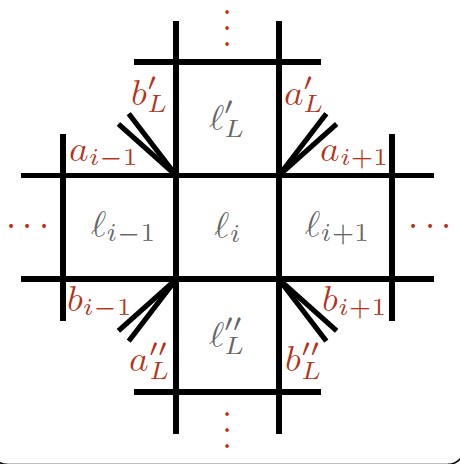
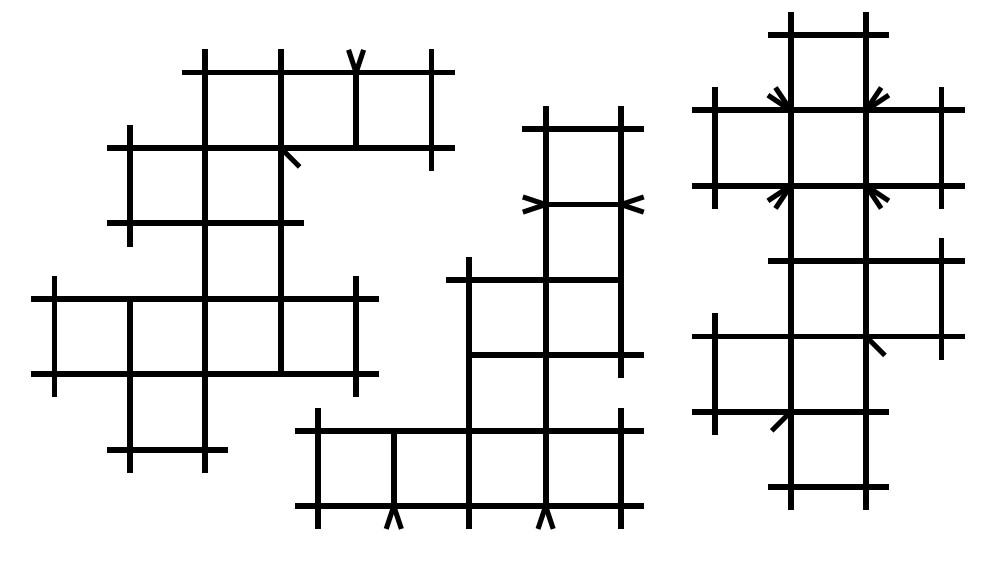
I’ve got a new paper out this week with Andrew McLeod. I’m thinking of it as another entry in this year’s “cabinet of curiosities”, interesting Feynman diagrams with unusual properties. Although this one might be hard to fit into a cabinet.

Over the past few years, I’ve been finding Feynman diagrams with interesting connections to Calabi-Yau manifolds, the spaces originally studied by string theorists to roll up their extra dimensions. With Andrew and other collaborators, I found an interesting family of these diagrams called traintracks, which involve higher-and-higher dimensional manifolds as they get longer and longer.

This time, we started hooking up our traintracks together.

We call diagrams like these traintrack network diagrams, or traintrack networks for short. The original traintracks just went “one way”: one family, going higher in Calabi-Yau dimension the longer they got. These networks branch out, one traintrack leading to another and another.

In principle, these are much more complicated diagrams. But we find we can work with them in almost the same way. We can find the same “starting point” we had for the original traintracks, the set of integrals used to find the Calabi-Yau manifold. We’ve even got more reliable tricks, a method recently honed by some friends of ours that consistently find a Calabi-Yau manifold inside the original traintracks.

Surprisingly, though, this isn’t enough.

It works for one type of traintrack network, a so-called “cross diagram” like this:

But for other diagrams, if the network branches any more, the trick stops working. We still get an answer, but that answer is some more general space, not just a Calabi-Yau manifold.

That doesn’t mean that these general traintrack networks don’t involve Calabi-Yaus at all, mind you: it just means this method doesn’t tell us one way or the other. It’s also possible that simpler versions of these diagrams, involving fewer particles, will once again involve Calabi-Yaus. This is the case for some similar diagrams in two dimensions. But it’s starting to raise a question: how special are the Calabi-Yau related diagrams? How general do we expect them to be?

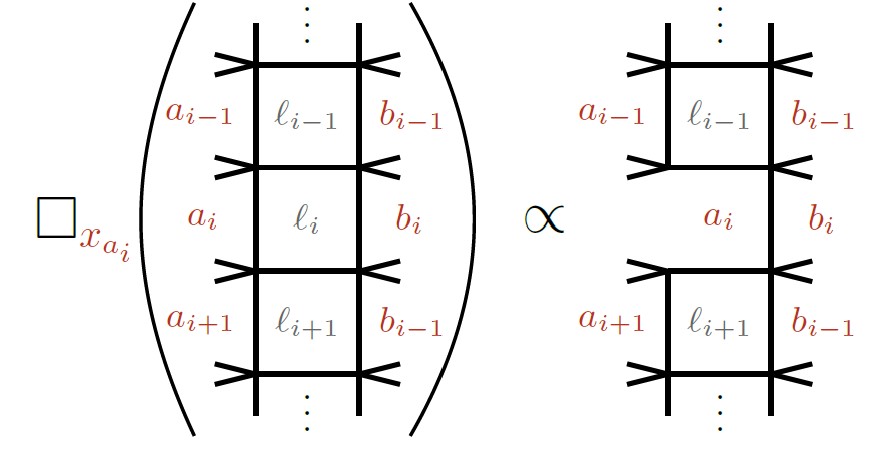
Another fun thing we noticed has to do with differential equations. There are equations that relate one diagram to another simpler one. We’ve used them in the past to build up “ladders” of diagrams, relating each picture to one with one of its boxes “deleted”. We noticed, playing with these traintrack networks, that these equations do a bit more than we thought. “Deleting” a box can make a traintrack short, but it can also chop a traintrack in half, leaving two “dangling” pieces, one on either side.

This reminded me of an important point, one we occasionally lose track of. The best-studied diagrams related to Calabi-Yaus are called “sunrise” diagrams. If you squish together a loop in one of those diagrams, the whole diagram squishes together, becoming much simpler. Because of that, we’re used to thinking of these as diagrams with a single “geometry”, one that shows up when you don’t “squish” anything.

Traintracks, and traintrack networks, are different. “Squishing” the diagram, or “deleting” a box, gives you a simpler diagram, but not much simpler. In particular, the new diagram will still contain traintracks, and traintrack networks. That means that we really should think of each traintrack network not just as one “top geometry”, but of a collection of geometries, different Calabi-Yaus that break into different combinations of Calabi-Yaus in different ways. It’s something we probably should have anticipated, but the form these networks take is a good reminder, one that points out that we still have a lot to do if we want to understand these diagrams.

Solutions and Solutions

The best misunderstandings are detective stories. You can notice when someone is confused, but digging up why can take some work. If you manage, though, you learn much more than just how to correct the misunderstanding. You learn something about the words you use, and the assumptions you make when using them.

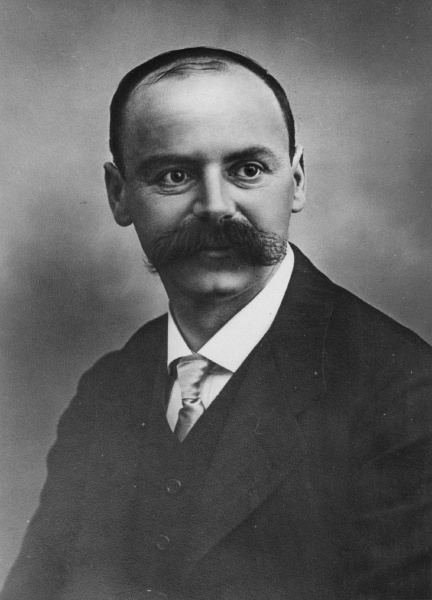
Recently, someone was telling me about a book they’d read on Karl Schwarzschild. Schwarzschild is famous for discovering the equations that describe black holes, based on Einstein’s theory of gravitation. To make the story more dramatic, he did so only shortly before dying from a disease he caught fighting in the first World War. But this person had the impression that Schwarzschild had done even more. According to this person, the book said that Schwarzschild had done something to prove Einstein’s theory, or to complete it.

Another Schwarzschild accomplishment: that mustache

At first, I thought the book this person had read was wrong. But after some investigation, I figured out what happened.

The book said that Schwarzschild had found the first exact solution to Einstein’s equations. That’s true, and as a physicist I know precisely what it means. But I now realize that the average person does not.

In school, the first equations you solve are algebraic, x+y=z. Some equations, like x^2=4, have solutions. Others, like x^2=-4, seem not to, until you learn about new types of numbers that solve them. Either way, you get used to equations being like a kind of puzzle, a question for which you need to find an answer.

If you’re thinking of equations like that, then it probably sounds like Schwarzschild “solved the puzzle”. If Schwarzschild found the first solution to Einstein’s equation, that means that Einstein did not. That makes it sound like Einstein’s work was incomplete, that he had asked the right question but didn’t yet know the right answer.

Einstein’s equations aren’t algebraic equations, though. They’re differential equations. Instead of equations for a variable, they’re equations for a mathematical function, a formula that, in this case, describes the curvature of space and time.

Scientists in many fields use differential equations, but they use them in different ways. If you’re a chemist or a biologist, it might be that you’re most used to differential equations with simple solutions, like sines, cosines, or exponentials. You learn how to solve these equations, and they feel a bit like the algebraic ones: you have a puzzle, and then you solve the puzzle.

Other fields, though, have tougher differential equations. If you’re a physicist or an engineer, you’ve likely met differential equations that you can’t treat in this way. If you’re dealing with fluid mechanics, or general relativity, or even just Newtonian gravity in an odd situation, you can’t usually solve the problem by writing down known functions like sines and cosines.

That doesn’t mean you can’t solve the problem at all, though!

Even if you can’t write down a solution to a differential equation with sines and cosines, a solution can still exist. (In some cases, we can even prove a solution exists!) It just won’t be written in terms of sines and cosines, or other functions you’ve learned in school. Instead, the solution will involve some strange functions, functions no-one has heard of before.

If you want, you can make up names for those functions. But unless you’re going to classify them in a useful way, there’s not much point. Instead, you work with these functions by approximation. You calculate them in a way that doesn’t give you the full answer, but that does let you estimate how close you are. That’s good enough to give you numbers, which in turn is good enough to compare to experiments. With just an approximate solution, like this, Einstein could check if his equations described the orbit of Mercury.

Once you know you can find these approximate solutions, you have a different perspective on equations. An equation isn’t just a mysterious puzzle. If you can approximate the solution, then you already know how to solve that puzzle. So we wouldn’t think of Einstein’s theory as incomplete because he was only able to find approximate solutions: for a theory as complicated as Einstein’s, that’s perfectly normal. Most of the time, that’s all we need.

But it’s still pretty cool when you don’t have to do this. Sometimes, we can not just approximate, but actually “write down” the solution, either using known functions or well-classified new ones. We call a solution like that an analytic solution, or an exact solution.

That’s what Schwarzschild managed. These kinds of exact solutions often only work in special situations, and Schwarzschild’s is no exception. His Schwarzschild solution works for matter in a special situation, arranged in a perfect sphere. If matter happened to be arranged in that way, then the shape of space and time would be exactly as Schwarzschild described it.

That’s actually pretty cool! Einstein’s equations are complicated enough that no-one was sure that there were any solutions like that, even in very special situations. Einstein expected it would be a long time until they could do anything except approximate solutions.

(If Schwarzschild’s solution only describes matter arranged in a perfect sphere, why do we think it describes real black holes? This took later work, by people like Roger Penrose, who figured out that matter compressed far enough will always find a solution like Schwarzschild’s.)

Schwarzschild intended to describe stars with his solution, or at least a kind of imaginary perfect star. What he found was indeed a good approximation to real stars, but also the possibility that a star shoved into a sufficiently small space would become something weird and new, something we would come to describe as a black hole. That’s a pretty impressive accomplishment, especially for someone on the front lines of World War One. And if you know the difference between an exact solution and an approximate one, you have some idea of what kind of accomplishment that is.

Reader Poll: Considering a Move to Substack

This blog is currently hosted on a site called WordPress.com. When I started the blog, I picked WordPress mostly just because it was easy and free. (Since then I started paying them money, both to remove ads and to get a custom domain, 4gravitons.com.)

Now, the blog is more popular, and you guys access it in a wide variety of ways. 333 of you are other users of WordPress.com: WordPress has a “Reader” tab that lets users follow other blogs through the site. (I use that tab to keep up with a few of the blogs in my Blogroll.) 258 of you instead get a weekly email: this is a service WordPress.com offers, letting people sign up by email to the blog. Others follow on social media: on Twitter, Facebook, and Tumblr.

(Are there other options? If someone’s figured out how to follow with an RSS feed, or wants me to change something so they can do that, let me know in the comments!)

Recently, I’ve gotten a bit annoyed with the emails WordPress sends out. The problem is that they don’t seem to handle images in a sensible way: I can scale an image to fit in a blog post, but in the email the image is always full-size, sometimes taking up the entire screen.

Last year, someone reached out to me from Substack.com, trying to recruit me to switch to their site. Substack is a (increasingly popular) blogging platform, focused on email newsletters. The whole site is built around the idea that posts are emailed to subscribers, with a simplified layout that makes that feasible and consistent. Like WordPress, they have a system where people can follow the blog through a Substack account, and the impression I get is that a lot of people use it, browsing topics they find interesting.

(Substack also has a system for paid subscribers. That isn’t mandatory, and partly due to recent events I’m not expecting to use it.)

Since Substack is built for emails, I’m guessing it would solve the issue I’ve been having with images. It would also let more people discover the blog via the Substack app. On the other hand, Substack allows a lot less customization. I wouldn’t be able to have the cute pull-down menus from the top of the blog, or the Feynman diagram background. I don’t think I could have the Tag cloud or the Categories filter.

Most importantly, though, I don’t want to lose long-term readers. I don’t know if some of you would have more trouble accessing Substack than WordPress, or if some really prefer to follow here.

One option is that I use both sites, at least for a bit. There are services built for cross-posting, that let a post on Substack automatically get posted on WordPress as well. I might do that temporarily (to make sure everyone has enough warning to transfer) or permanently (if there are people who really would never use Substack).

(I also might end up making an institutional web page with some of the useful educational guides, once I’ve got a permanent job. That could cover some features that Substack can’t.)

I wanted to do a couple polls, to get a feeling for your opinions. The first is a direct yes or no: do you prefer I stay at WordPress, prefer I switch to Substack, or don’t care either way. (For example, if you follow me via Facebook, you’ll get a link every week regardless.) The second poll asks about more detailed concerns, and you can pick as many entries as you want to give me a feeling for what matters to you. Please, if you read the blog at all regularly, fill out both polls: I want to know what you think!

Learning for a Living

It’s a question I’ve now heard several times, in different forms. People hear that I’ll be hired as a researcher at an institute of theoretical physics, and they ask, “what, exactly, are they paying you to research?”

The answer, with some caveats: “Whatever I want.”

When a company hires a researcher, they want to accomplish specific things: to improve their products, to make new ones, to cut down on fraud or out-think the competition. Some government labs are the same: if you work for NIST, for example, your work should contribute in some way to achieving more precise measurements and better standards for technology.

Other government labs, and universities, are different. They pursue basic research, research not on any specific application but on the general principles that govern the world. Researchers doing basic research are given a lot of freedom, and that freedom increases as their careers go on.

As a PhD student, a researcher is a kind of apprentice, working for their advisor. Even then, they have some independence: an advisor may suggest projects, but PhD students usually need to decide how to execute them on their own. In some fields, there can be even more freedom: in theoretical physics, it’s not unusual for the more independent students to collaborate with other people than just their advisor.

Postdocs, in turn, have even more freedom. In some fields they get hired to work on a specific project, but they tend to have more freedom as to how to execute it than a PhD student would. Other fields give them more or less free rein: in theoretical physics, a postdoc will have some guidance, but often will be free to work on whatever they find interesting.

Professors, and other long-term researchers, have the most freedom of all. Over the climb from PhD to postdoc to professor, researchers build judgement, demonstrating a track record for tackling worthwhile scientific problems. Universities, and institutes of basic research, trust that judgement. They hire for that judgement. They give their long-term researchers free reign to investigate whatever questions they think are valuable.

In practice, there are some restrictions. Usually, you’re supposed to research in a particular field: at an institute for theoretical physics, I should probably research theoretical physics. (But that can mean many things: one of my future colleagues studies the science of cities.) Further pressure comes from grant funding, money you need to hire other researchers or buy equipment that can come with restrictions attached. When you apply for a grant, you have to describe what you plan to do. (In practice, grant agencies are more flexible about this than you might expect, allowing all sorts of changes if you have a good reason…but you still can’t completely reinvent yourself.) Your colleagues themselves also have an impact: it’s much easier to work on something when you can walk down the hall and ask an expert when you get stuck. It’s why we seek out colleagues who care about the same big questions as we do.

Overall, though, research is one of the free-est professions there is. If you can get a job learning for a living, and do it well enough, then people will trust your judgement. They’ll set you free to ask your own questions, and seek your own answers.

Enfin, Permanent

My blog began, almost eleven years ago, with the title “Four Gravitons and a Grad Student”. Since then, I finished my PhD. The “Grad Student” dropped from the title, and the mysterious word “postdoc” showed up on a few pages. For three years I worked as a postdoc at the Perimeter Institute in Canada, before hopping the pond and starting another three-year postdoc job in Denmark. With a grant from the EU, three years became four. More funding got me to five (with a fancier title), and now nearing on six. Each step, my contract has been temporary: at first three years at a time, then one-year extensions. Each year I applied, all over the world, looking for a permanent job: for a chance to settle down somewhere, to build my own research group without worrying about having to move the next year.

This year, things have finally worked out. In the Fall I will be moving to France, starting a junior permanent position with L’Institut de Physique Théorique (or IPhT) at CEA Paris-Saclay.

A photo of the entryway to the Institute, taken when I interviewed

It’s been a long journey to get here, with a lot of soul-searching. This year in particular has been a year of reassessment: of digging deep and figuring out what matters to me, what I hope to accomplish and what clues I have to guide the way. Sometimes I feel like I’ve matured more as a physicist in the last year than in the last three put together.

The CEA (originally Commissariat à l’énergie atomique, now Commissariat à l’énergie atomique et aux énergies alternatives, or Alternative Energies and Atomic Energy Commission, and yes that means they’re using the “A” for two things at the same time), is roughly a parallel organization to the USA’s Department of Energy. Both organizations began as a way to manage their nation’s nuclear program, but both branched out, both into other forms of energy and into scientific research. Both run a nationwide network of laboratories, lightly linked but independent from their nations’ universities, both with notable facilities for particle physics. The CEA’s flagship site is in Saclay, on the outskirts of Paris, and it’s their Institute for Theoretical Physics where I’ll be working.

My new position is genuinely permanent: unlike a tenure-track position in the US, I don’t go up for review after a fixed span of time, with the expectation that if I don’t get promoted I lose the job altogether. It’s also not a university, which in particular means I’m not required to teach. I’ll have the option of teaching, working with nearby universities. In the long run, I think I’ll pursue that option. I’ve found teaching helpful the past couple years: it’s helped me think about physics, and think about how to communicate physics. But it’s good not to have to rush into preparing a new course when I arrive, as new professors often do.

It’s also a really great group, with a lot of people who work on things I care about. IPhT has a long track record of research in scattering amplitudes, with many leading figures. They’ve played a key role in topics that frequent readers will have seen show up on this blog: on applying techniques from particle physics to gravitational waves, to the way Calabi-Yau manifolds show up in Feynman diagrams, and even recently to the relationship of machine learning to inference in particle physics.

Working temporary positions year after year, not knowing where I’ll be the next year, has been stressful. Others have had it worse, though. Some of you might have seen a recent post by Bret Deveraux, a military historian with a much more popular blog who has been in a series of adjunct positions. Deveraux describes the job market for the humanities in the US quite well. I’m in theoretical physics in Europe, so while my situation hasn’t been easy, it has been substantially better.

First, there’s the physics component. Physics has “adjunctified” much less than other fields. I don’t think I know a single physicist who has taken an adjunct teaching position, the kind of thing where you’re paid per course and only to teach. I know many who have left physics for other kinds of work, for Wall Street or Silicon Valley or to do data science for a bank or to teach high school. On the other side, I know people in other fields who do work as adjuncts, particularly in mathematics.

Deveraux blames the culture of his field, but I think funding also must have an important role. Physicists, and scientists in many other areas, rarely get professor positions right after their PhDs, but that doesn’t mean they leave the field entirely because most can find postdoc positions. Those postdocs are focused on research, and are often paid for by government grants: in my field in the US, that usually means the Department of Energy. People can go through two or sometimes even three such positions before finding something permanent, if they don’t leave the field before that. Without something like the Department of Energy or National Institutes of Health providing funding, I don’t know if the humanities could imitate that structure even if they wanted to.

Europe, in turn, has a different situation than the US. Most European countries don’t have a tenure-track: just permanent positions and fixed-term positions. Funding also works quite differently. Department of Energy funding in the US is spread widely and lightly: grants are shared by groups of theorists at a given university, each getting funding for a few postdocs and PhDs across the group. In Europe, a lot of the funding is much more concentrated: big grants from the European Research Council going to individual professors, with various national and private grants supplementing or mirroring that structure. That kind of funding, and the rarity of tenure, in turn leads to a different kind of temporary position: one not hired to teach a course but hired for research as long as the funding lasts. The Danish word for my current title is Adjunkt, but that’s as one says in France a faux ami: the official English translation is Assistant Professor, and it’s nothing like a US adjunct. I know people in a variety of forms of that kind of position in a variety of countries, people who landed a five-year grant where they could act like a professor, hire people and so on, but who in the end were expected to move when the grant was over. It’s a stressful situation, but at least it lets us further our research and make progress, unlike a US adjunct in the humanities or math who needs to spend much of their time on teaching.

I do hope Deveraux finds a permanent position, he’s got a great blog. And to return to the theme of the post, I am extremely grateful and happy that I have managed to find a permanent position. I’m looking forward to joining the group at Saclay: to learning more about physics from them, but also, to having a place where I can start to build something, and make a lasting impact on the world around me.

Traveling This Week

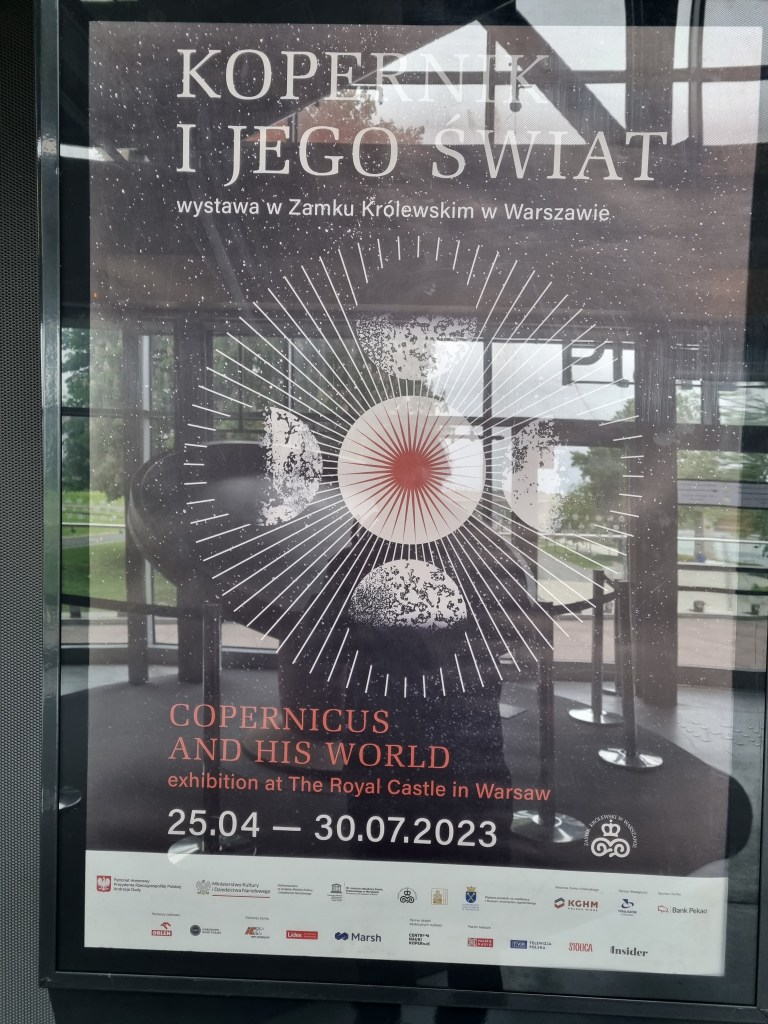
I’m traveling this week, so this will just be a short post. This isn’t a scientific trip exactly: I’m in Poland, at an event connected to the 550th anniversary of the birth of Copernicus.

Not this one, but they do have nice posters!

Part of this event involved visiting the Copernicus Science Center, the local children’s science museum. The place was sold out completely. For any tired science communicators, I recommend going to a sold-out science museum: the sheer enthusiasm you’ll find there is balm for the most jaded soul.

Extrapolated Knowledge

Scientists have famously bad work-life balance. You’ve probably heard stories of scientists working long into the night, taking work with them on weekends or vacation, or falling behind during maternity or paternity leave.

Some of this is culture. Certain fields have a very cutthroat attitude, with many groups competing to get ahead and careers on the line if they fail. Not every field is like that though: there are sub-fields that are more collaborative than competitive, that understand work-life balance and try to work together to a shared goal. I’m in a sub-field like that, so I know they exist.

Put aside the culture, and you’ve still got passion. Science is fun, it’s puzzle after puzzle, topics chosen because we find them fascinating. Even in the healthiest workplace you’d still have scientists pondering in the shower and scribbling notes on the plane, mixing business with pleasure because the work is genuinely both.

But there’s one more reason scientists are workaholics. I suspect, ultimately, it’s the most powerful reason. It’s that every scientist is, in some sense, irreplaceable.

In most jobs, if you go on vacation, someone can fill in when you’re gone. The replacement may not be perfect (think about how many times you watched movies in school with a substitute teacher), but they can cover for you, making some progress on your tasks until you get back. That works because you and they have a shared training, a common core that means they can step in and get what needs to be done done.

Scientists have shared training too, of course. Some of our tasks work the same way, the kind of thing that any appropriate expert can do, that just need someone to spend the time to do them.

But our training has a capstone, the PhD thesis. And the thing about a PhD thesis is that it is, always and without exception, original research. Each PhD thesis is an entirely new result, something no-one else had known before, discovered by the PhD candidate. Each PhD thesis is unique.

That, in turn, means that each scientist is unique. Each of us has our own knowledge, our own background, our own training, built up not just during the PhD but through our whole career. And sometimes, the work we do requires that unique background. It’s why we collaborate, why we reach out to different people around the world, looking for the unique few people who know how to do what we need.

Over time, we become a kind of embodiment of our accumulated knowledge. We build a perspective shaped by our experience, goals for the field and curiosity just a bit different from everyone else’s. We act as agents of that perspective, each the one person who can further our particular vision of where science is going. When we enter a collaboration, when we walk into the room at a conference, we are carrying with us all we picked up along the way, each a story just different enough to matter. We extrapolate from what we know, and try to do everything that knowledge can do.

So we can, and should, take vacations, yes, and we can, and should, try to maintain a work-life balance. We need to to survive, to stay sane. But we do have to accept that when we do, certain things won’t get done as fast. Our own personal vision, our extrapolated knowledge…will just have to wait.