Scientists want to know everything, and we’ve been trying to get there since the dawn of science. So why aren’t we there yet? Why are there things we still don’t know?
Sometimes, the reason is obvious: we can’t do the experiments yet. Victorian London had neither the technology nor the wealth to build a machine like Fermilab, so they couldn’t discover the top quark. Even if Newton had the idea for General Relativity, the telescopes of the era wouldn’t have let astronomers see its effect on the motion of Mercury. As we grow (in technology, in resources, in knowledge, in raw number of human beings), we can test more things and learn more about the world.
But I’m a theoretical physicist, not an experimental physicist. I still want to understand the world, but what I contribute aren’t new experiments, but new ideas and new calculations. This brings back the question in a new form: why are there calculations we haven’t done yet? Why are there ideas we haven’t had yet?
Sometimes, we can track the reason down to bottlenecks. A bottleneck is a step in a calculation that, for some reason, is harder than the rest. As you try to push a calculation to new heights, the bottleneck is the first thing that slows you down, like the way liquid bubbles through the neck of a literal bottle. If you can clear the bottleneck, you can speed up your calculation and accomplish more.
In the clearest cases, we can see how these bottlenecks could be solved with more technology. As computers get faster and more powerful, calculations become possible that weren’t possible before, in the same way new experiments become possible with new equipment. This is essentially what has happened recently with machine learning, where relatively old ideas are finally feasible to apply on a massive scale.
In physics, a subtlety is that we rarely have access to the most powerful computers available. Some types of physics are done on genuine supercomputers, but for more speculative or lower-priority research we have to use small computer clusters, or even our laptops. Something can be a bottleneck not because it can’t be done on any computer, but because it can’t be done on the computers we can afford.
Most of the time, bottlenecks aren’t quite so obvious. That’s because in theoretical physics, often, we don’t know what we want to calculate. If we want to know why something happens, and not merely that it happens, then we need a calculation that we can interpret, that “makes sense” and that thus, hopefully, we can generalize. We might have some ideas for how that calculation could work: some property a mathematical theory might have that we already know how to understand. Some of those ideas are easy to check, so we check, and make progress. Others are harder, and we have to decide: is the calculation worth it, if we don’t know if it will give us the explanation we need?
Those decisions provide new bottlenecks, often hidden ones. As we get better at calculation, the threshold for an “easy” check gets easier and easier to meet. We put aside fewer possibilities, so we notice more things, which inspire yet more ideas. We make more progress, not because the old calculations were impossible, but because they weren’t easy enough, and now they are. Progress fuels progress, a virtuous cycle that gets us closer and closer to understanding everything we want to understand (which is everything).
Nowadays, we have telescopes that detect not just light, but gravitational waves. We’ve already learned quite a bit about astrophysics from these telescopes. They observe ripples coming from colliding black holes, giving us a better idea of what kinds of black holes exist in the universe. But the coolest thing a gravitational wave telescope could discover is something that hasn’t been seen yet: a cosmic string.
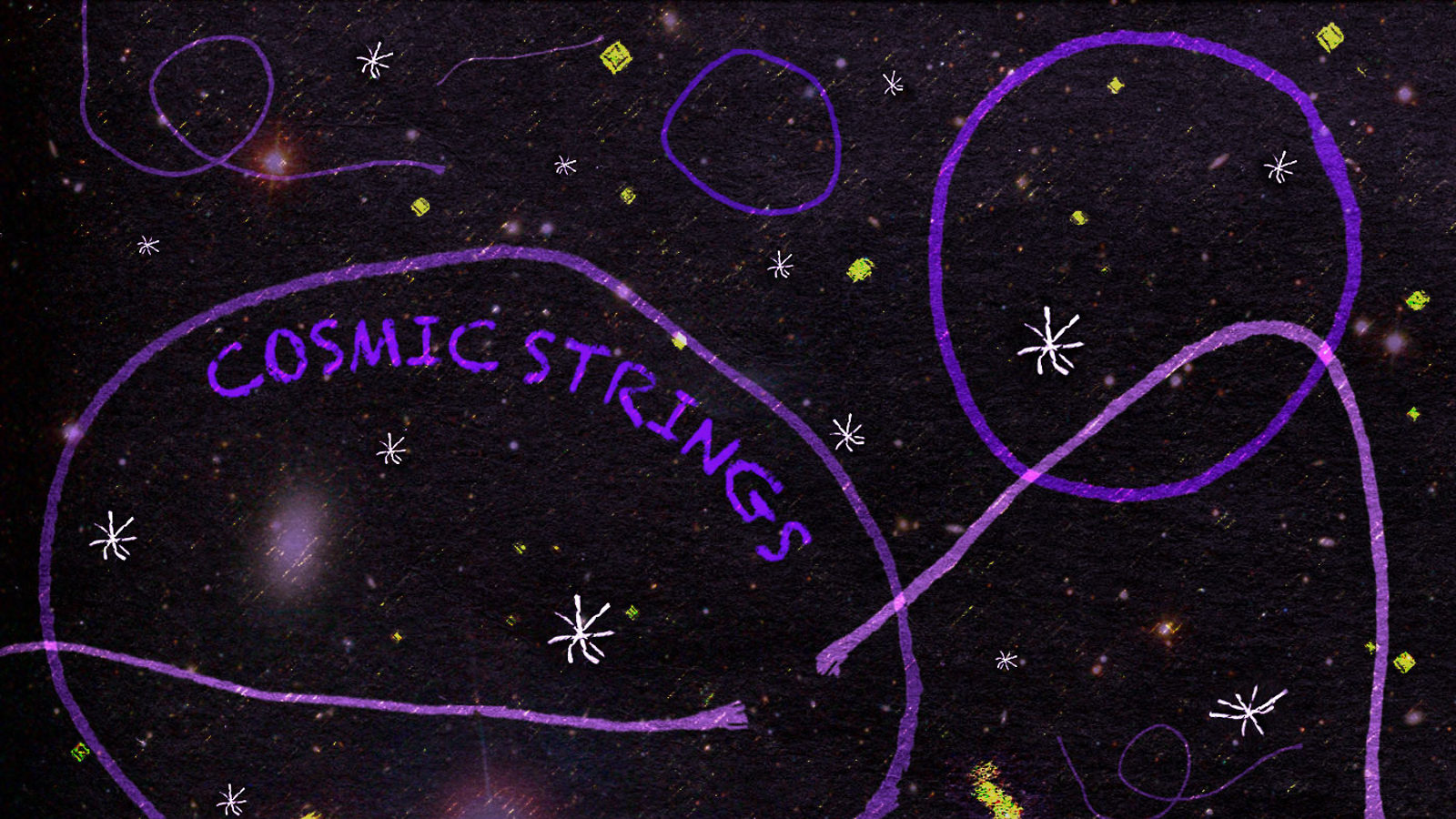
This art is from an article in Symmetry magazine which is, as far as I can tell, not actually about cosmic strings.
You might have heard of cosmic strings, but unless you’re a physicist you probably don’t know much about them. They’re a prediction, coming from cosmology, of giant string-like objects floating out in space.
That might sound like it has something to do with string theory, but it doesn’t actually have to, you can have these things without any string theory at all. Instead, you might have heard that cosmic strings are some kind of “cracks” or “wrinkles” in space-time. Some articles describe this as like what happens when ice freezes, cracks forming as water settles into a crystal.
That description, in terms of ice forming cracks between crystals, is great…if you’re a physicist who already knows how ice forms cracks between crystals. If you’re not, I’m guessing reading those kinds of explanations isn’t helpful. I’m guessing you’re still wondering why there ought to be any giant strings floating in space.
The real explanation has to do with a type of mathematical gadget physicists use, called a scalar field. You can think of a scalar field as described by a number, like a temperature, that can vary in space and time. The field carries potential energy, and that energy depends on what the scalar field’s “number” is. Left alone, the field settles into a situation with as little potential energy as it can, like a ball rolling down a hill. That situation is one of the field’s default values, something we call a “vacuum” value. Changing the field away from its vacuum value can take a lot of energy. The Higgs boson is one example of a scalar field. Its vacuum value is the value it has in day to day life. In order to make a detectable Higgs boson at the Large Hadron Collider, they needed to change the field away from its vacuum value, and that took a lot of energy.
In the very early universe, almost back at the Big Bang, the world was famously in a hot dense state. That hot dense state meant that there was a lot of energy to go around, so scalar fields could vary far from their vacuum values, pretty much randomly. As the universe expanded and cooled, there was less and less energy available for these fields, and they started to settle down.
Now, the thing about these default, “vacuum” values of a scalar field is that there doesn’t have to be just one of them. Depending on what kind of mathematical function the field’s potential energy is, there could be several different possibilities each with equal energy.
Let’s imagine a simple example, of a field with two vacuum values: +1 and -1. As the universe cooled down, some parts of the universe would end up with that scalar field number equal to +1, and some to -1. But what happens in between?
The scalar field can’t just jump from -1 to +1, that’s not allowed in physics. It has to pass through 0 in between. But, unlike -1 and +1, 0 is not a vacuum value. When the scalar field number is equal to 0, the field has more energy than it does when it’s equal to -1 or +1. Usually, a lot more energy.
That means the region of scalar field number 0 can’t spread very far: the further it spreads, the more energy it takes to keep it that way. On the other hand, the region can’t vanish altogether: something needs to happen to transition between the numbers -1 and +1.
The thing that happens is called a domain wall. A domain wall is a thin sheet, as thin as it can physically be, where the scalar field doesn’t take its vacuum value. You can roughly think of it as made up of the scalar field, a churning zone of the kind of bosons the LHC was trying to detect.
This sheet still has a lot of energy, bound up in the unusual value of the scalar field, like an LHC collision in every proton-sized chunk. As such, like any object with a lot of energy, it has a gravitational field. For a domain wall, the effect of this gravity would be very very dramatic: so dramatic, that we’re pretty sure they’re incredibly rare. If they were at all common, we would have seen evidence of them long before now!
Ok, I’ve shown you a wall, that’s weird, sure. What does that have to do with cosmic strings?
The number representing a scalar field doesn’t have to be a real number: it can be imaginary instead, or even complex. Now I’d like you to imagine a field with vacuum values on the unit circle, in the complex plane. That means that +1 and -1 are still vacuum values, but so are , and , and everything else you can write as . However, 0 is still not a vacuum value. Neither is, for example, .
With vacuum values like this, you can’t form domain walls. You can make a path between -1 and +1 that only goes through the unit circle, through for example. The field will be at its vacuum value throughout, taking no extra energy.
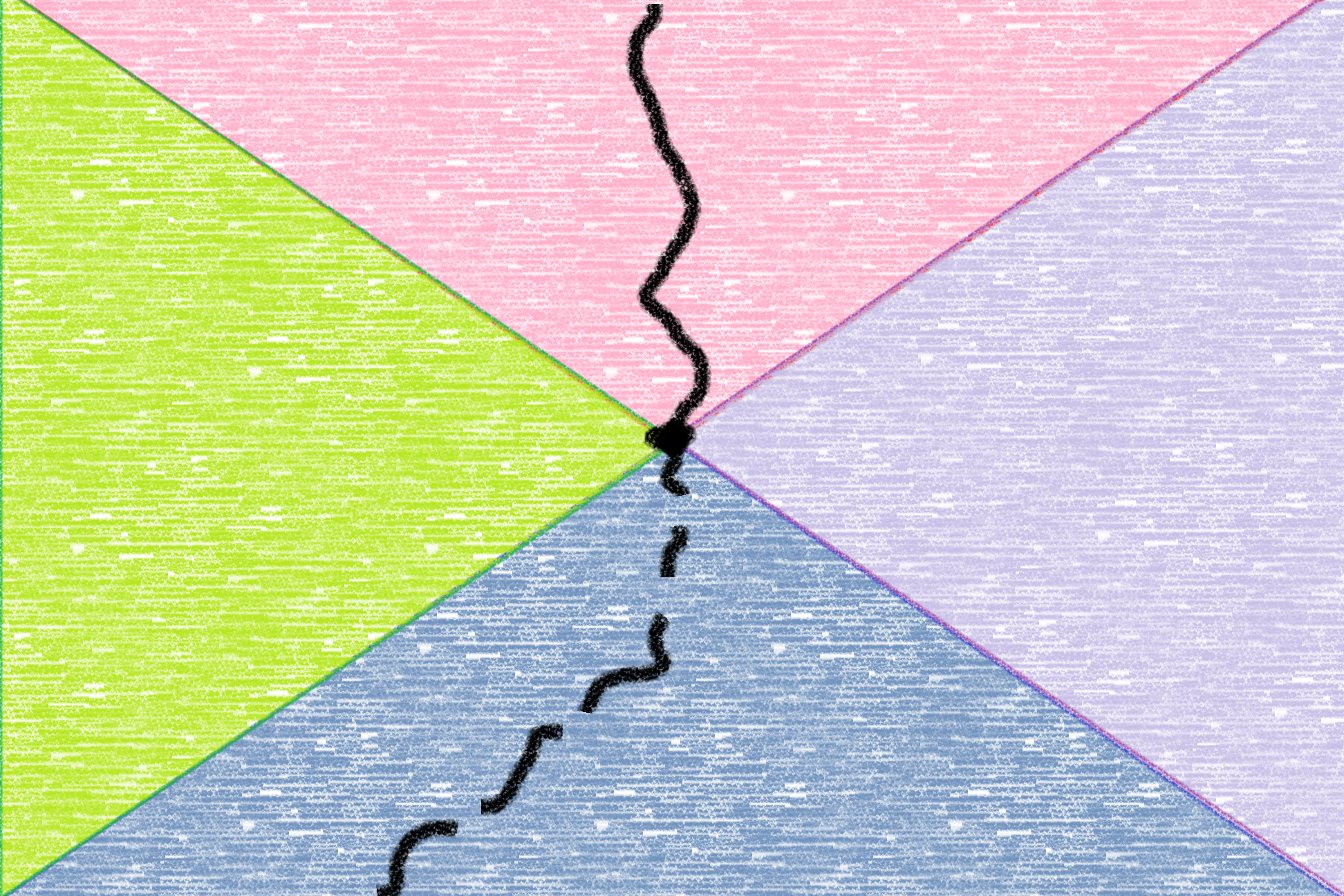
However, imagine the different regions form a circle. In the picture above, suppose that the blue area at the bottom is at vacuum value -1 and red is at +1. You might have in the green region, and in the purple region, covering the whole circle smoothly as you go around.
Now, think about what happens in the middle of the circle. On one side of the circle, you have -1. On the other, +1. (Or, on one side , on the other, ). No matter what, different sides of the circle are not allowed to be next to each other, you can’t just jump between them. So in the very middle of the circle, something else has to happen.
Once again, that something else is a field that goes away from its vacuum value, that passes through 0. Once again, that takes a lot of energy, so it occupies as little space as possible. But now, that space isn’t a giant wall. Instead, it’s a squiggly line: a cosmic string.
Cosmic strings don’t have as dramatic a gravitational effect as domain walls. That means they might not be super-rare. There might be some we haven’t seen yet. And if we do see them, it could be because they wiggle space and time, making gravitational waves.
Cosmic strings don’t require string theory, they come from a much more basic gadget, scalar fields. We know there is one quite important scalar field, the Higgs field. The Higgs vacuum values aren’t like +1 and -1, or like the unit circle, though, so the Higgs by itself won’t make domain walls or cosmic strings. But there are a lot of proposals for scalar fields, things we haven’t discovered but that physicists think might answer lingering questions in particle physics, and some of those could have the right kind of vacuum values to give us cosmic strings. Thus, if we manage to detect cosmic strings, we could learn something about one of those lingering questions.
As a kid who watched far too much educational television, I dimly remember learning about the USA’s first transcontinental railroad. Somehow, parts of the story stuck with me. Two companies built the railroad from different directions, one from California and the other from the middle of the country, aiming for a mountain in between. Despite the US Civil War happening around this time, the two companies built through, in the end racing to where the final tracks were laid with a golden spike.
I’m a theoretical physicist, so of course I don’t build railroads. Instead, I build new mathematical methods, ways to check our theories of particle physics faster and more efficiently. Still, something of that picture resonates with me.
You might think someone who develops new mathematical methods would be a mathematician, not a physicist. But while there are mathematicians who work on the problems I work on, their goals are a bit different. They care about rigor, about stating only things they can carefully prove. As such, they often need to work with simplified examples, “toy models” well-suited to the kinds of theorems they can build.
Physicists can be a bit messier. We don’t always insist on the same rigor the mathematicians do. This makes our results less reliable, but it makes our “toy models” a fair amount less “toy”. Our goal is to try to tackle questions closer to the actual real world.
What happens when physicists and mathematicians work on the same problem?
If the physicists worked alone, they might build and build, and end up with an answer that isn’t actually true. The mathematicians, keeping rigor in mind, would be safe in the truth of what they built, but might not end up anywhere near the physicists’ real-world goals.
Together, though, physicists and mathematicians can build towards each other. The physicists can keep their eyes on the mathematicians, correcting when they notice something might go wrong and building more and more rigor into their approach. The mathematicians can keep their eyes on the physicists, building more and more complex applications of their rigorous approaches to get closer and closer to the real world. Eventually, like the transcontinental railroad, the two groups meet: the mathematicians prove a rigorous version of the physicists’ approach, or the physicists adopt the mathematicians’ ideas and apply them to their own theories.
A sort of conference photo
In practice, it isn’t just two teams, physicists and mathematicians, building towards each other. Different physicists themselves work with different levels of rigor, aiming to understand different problems in different theories, and the mathematicians do the same. Each of us is building our own track, watching the other tracks build towards us on the horizon. Eventually, we’ll meet, and science will chug along over what we’ve built.
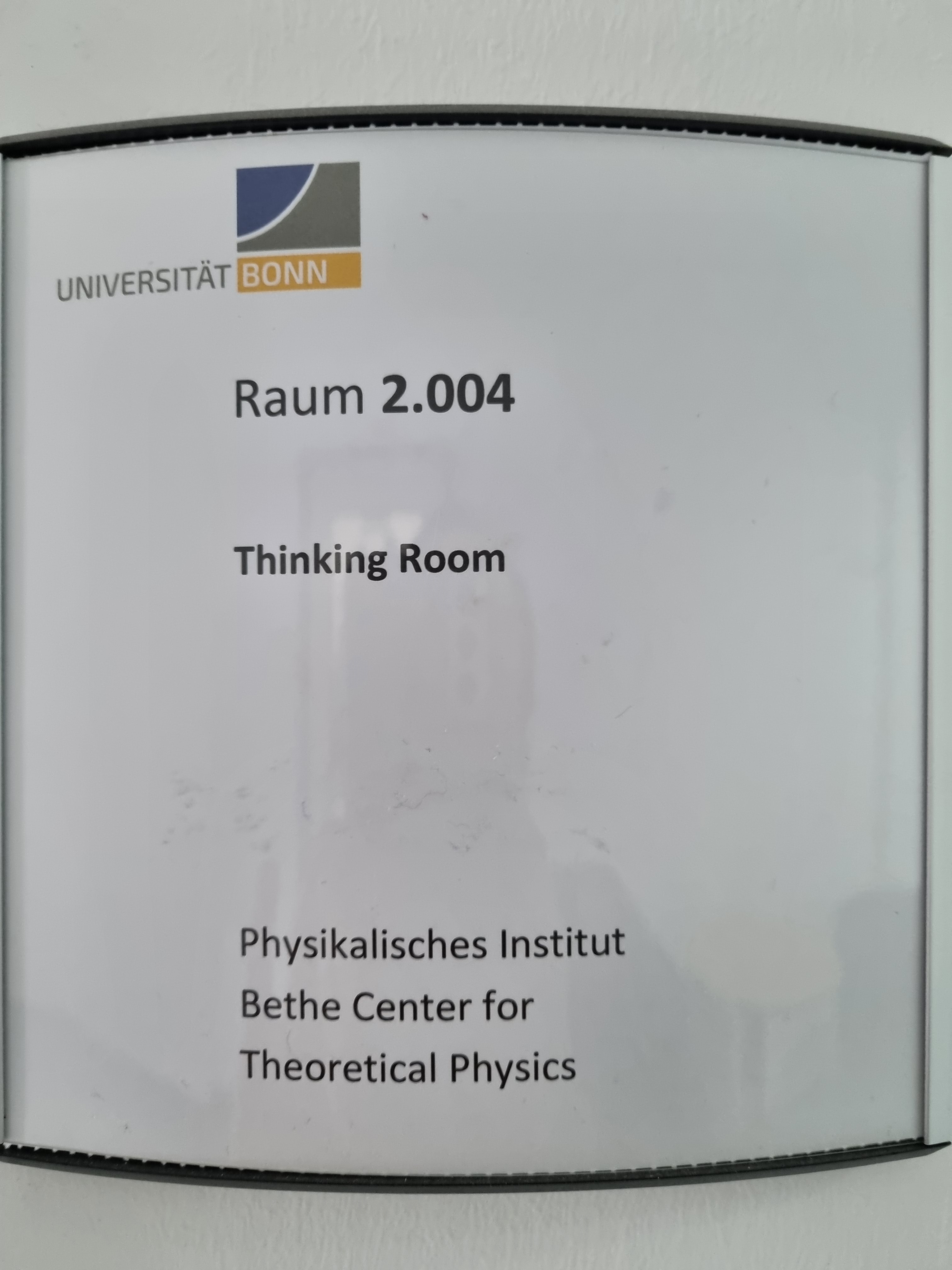
I’m at a workshop this week. It’s part of a series of “Bethe Forums”, cozy little conferences run by the Bethe Center for Theoretical Physics in Bonn.
You can tell it’s an institute for theoretical physics because they have one of these, but not a “doing room”
The workshop’s title, “Geometries and Special Functions for Physics and Mathematics”, covers a wide range of topics. There are talks on Calabi-Yau manifolds, elliptic (and hyper-elliptic) polylogarithms, and cluster algebras and cluster polylogarithms. Some of the talks are by mathematicians, others by physicists.
In addition to the talks, this conference added a fun innovative element, “my favorite problem sessions”. The idea is that a speaker spends fifteen minutes introducing their “favorite problem”, then the audience spends fifteen minutes discussing it. Some treated these sessions roughly like short talks describing their work, with the open directions at the end framed as their favorite problem. Others aimed broader, trying to describe a general problem and motivate interest in people of other sub-fields.
This was a particularly fun conference for me, because the seemingly distinct topics all connect in one way or another to my own favorite problem. In our “favorite theory” of N=4 super Yang-Mills, we can describe our calculations in terms of an “alphabet” of pieces that let us figure out predictions almost “by guesswork”. These alphabets, at least in the cases we know how to handle, turn out to correspond to mathematical structures called cluster algebras. If we look at interactions of six or seven particles, these cluster algebras are a powerful guide. For eight or nine, they still seem to matter, but are much harder to use.
We don’t know what an “alphabet” should look like for these Calabi-Yau manifolds (but I’m working on it). Because of that, we don’t know how these cluster algebras should appear.
In my view, any explanation for the role of cluster algebras in our calculations has to extend to these cases, to elliptic polylogarithms and Calabi-Yau manifolds. Without knowing how to frame an alphabet for these things, we won’t be able to solve the lingering mysteries that fill our field.
Because of that, “my favorite problem” is one of my biggest motivations, the question that drives a large chunk of what I do. It’s what’s made this conference so much fun, and so stimulating: almost every talk had something I wanted to learn.
In physics, we sometimes say that an idea “breaks down”. What do we mean by that?
When a theory “breaks down”, we mean that it stops being accurate. Newton’s theory of gravity is excellent most of the time, but for objects under strong enough gravity or high enough speed its predictions stop matching reality and a new theory (relativity) is needed. This is the sense in which we say that Newtonian gravity breaks down for the orbit of mercury, or breaks down much more severely in the area around a black hole.
When a symmetry is “broken”, we mean that it stops holding true. Most of physics looks the same when you flip it in a mirror, a property called parity symmetry. Take a pile of electric and magnetic fields, currents and wires, and you’ll find their mirror reflection is also a perfectly reasonable pile of electric and magnetic fields, currents and wires. This isn’t true for all of physics, though: the weak nuclear force isn’t the same when you flip it in a mirror. We say that the weak force breaks parity symmetry.
What about when a more general “idea” breaks down? What about space-time?
In order for space-time to break down, there needs to be a good reason to abandon the idea. And depending on how stubborn you are about it, that reason can come at different times.
You might think of space-time as just Einstein’s theory of general relativity. In that case, you could say that space-time breaks down as soon as the world deviates from that theory. In that view, any modification to general relativity, no matter how small, corresponds to space-time breaking down. You can think of this as the “least stubborn” option, the one with barely any stubbornness at all, that will let space-time break down with a tiny nudge.
But if general relativity breaks down, a slightly more stubborn person could insist that space-time is still fine. You can still describe things as located at specific places and times, moving across curved space-time. They just obey extra forces, on top of those built into the space-time.
Such a person would be happy as long as general relativity was a good approximation of what was going on, but they might admit space-time has broken down when general relativity becomes a bad approximation. If there are only small corrections on top of the usual space-time picture, then space-time would be fine, but if those corrections got so big that they overwhelmed the original predictions of general relativity then that’s quite a different situation. In that situation, space-time may have stopped being a useful description, and it may be much better to describe the world in another way.
But we could imagine an even more stubborn person who still insists that space-time is fine. Ultimately, our predictions about the world are mathematical formulas. No matter how complicated they are, we can always subtract a piece off of those formulas corresponding to the predictions of general relativity, and call the rest an extra effect. That may be a totally useless thing to do that doesn’t help you calculate anything, but someone could still do it, and thus insist that space-time still hasn’t broken down.
To convince such a person, space-time would need to break down in a way that made some important concept behind it invalid. There are various ways this could happen, corresponding to different concepts. For example, one unusual proposal is that space-time is non-commutative. If that were true then, in addition to the usual Heisenberg uncertainty principle between position and momentum, there would be an uncertainty principle between different directions in space-time. That would mean that you can’t define the position of something in all directions at once, which many people would agree is an important part of having a space-time!
Ultimately, physics is concerned with practicality. We want our concepts not just to be definable, but to do useful work in helping us understand the world. Our stubbornness should depend on whether a concept, like space-time, is still useful. If it is, we keep it. But if the situation changes, and another concept is more useful, then we can confidently say that space-time has broken down.
Sometimes, some scientists work alone. But mostly, scientists collaborate. We team up, getting more done together than we could alone.
Over the years, I’ve realized that theoretical physicists like me collaborate in a bit of a weird way, compared to other scientists. Most scientists do experiments, and those experiments require labs. Each lab typically has one principal investigator, or “PI”, who hires most of the other people in that lab. For any given project, scientists from the lab will be organized into particular roles. Some will be involved in the planning, some not. Some will do particular tests, gather data, manage lab animals, or do statistics. The whole experiment is at least roughly planned out from the beginning, and everyone has their own responsibility, to the extent that journals will sometimes ask scientists to list everyone’s roles when they publish papers. In this system, it’s rare for scientists from two different labs to collaborate. Usually it happens for a reason: a lab needs a statistician for a particularly subtle calculation, or one lab must process a sample so another lab can analyze it.
In contrast, theoretical physicists don’t have labs. Our collaborators sometimes come from the same university, but often they’re from a different one, frequently even in a different country. The way we collaborate is less like other scientists, and more like artists.
Sometimes, theoretical physicists have collaborations with dedicated roles and a detailed plan. This can happen when there is a specific calculation that needs to be done, that really needs to be done right. Some of the calculations that go into making predictions at the LHC are done in this way. I haven’t been in a collaboration like that (though in retrospect one collaborator may have had something like that in mind).
Instead, most of the collaborations I’ve been in have been more informal. They tend to start with a conversation. We chat by the coffee machine, or after a talk, anywhere there’s a blackboard nearby. It starts with “I’ve noticed something odd”, or “here’s something I don’t understand”. Then, we jam. We go back and forth, doing our thing and building on each other. Sometimes this happens in person, a barrage of questions and doubts until we hammer out something solid. Sometimes we go back to our offices, to calculate and look up references. Coming back the next day, we compare results: what did you manage to show? Did you get what I did? If not, why?
I make this sound spontaneous, but it isn’t completely. That starting conversation can be totally unplanned, but usually one of the scientists involved is trying to make it happen. There’s a different way you talk when you’re trying to start a collaboration, compared to when you just want to talk. If you’re looking for a collaboration, you go into more detail. If the other person is on the same wavelength, you start using “we” instead of “I”, or you start suggesting plans of action: “you could do X, while I do Y”. If you just want someone’s opinion, or just want to show off, then your conversation is less detailed, and less personal.
This is easiest to do with our co-workers, but we do it with people from other universities too. Sometimes this happens at conferences, more often during short visits for seminars. I’ve been on almost every end of this. As a visitor, I’ve arrived to find my hosts with a project in mind. As a host, I’ve invited a visitor with the goal of getting them involved in a collaboration, and I’ve received a visitor who came with their own collaboration idea.
After an initial flurry of work, we’ll have a rough idea of whether the project is viable. If it is, things get a bit more organized, and we sort out what needs to be done and a rough idea of who will do it. While the early stages really benefit from being done in person, this part is easier to do remotely. The calculations get longer but the concepts are clear, so each of us can work by ourselves, emailing when we make progress. If we get confused again, we can always schedule a Zoom to sort things out.
Once things are close (but often not quite done), it’s time to start writing the paper. In the past, I used Dropbox for this: my collaborators shared a folder with a draft, and we’d pass “control” back and forth as we wrote and edited. Now, I’m more likely to use something built for this purpose. Git is a tool used by programmers to collaborate on code. It lets you roll back edits you don’t like, and merge edits from two people to make sure they’re consistent. For other collaborations I use Overleaf, an online interface for the document-writing language LaTeX that lets multiple people edit in real-time. Either way, this part is also more or less organized, with a lot of “can you write this section?” that can shift around depending on how busy people end up being.
Finally, everything comes together. The edits stabilize, everyone agrees that the paper is good (or at least, that any dissatisfaction they have is too minor to be worth arguing over). We send it to a few trusted friends, then a few days later up on the arXiv it goes.
Then, the cycle begins again. If the ideas are still clear enough, the same collaboration might keep going, planning follow-up work and follow-up papers. We meet new people, or meet up with old ones, and establish new collaborations as we go. Our fortunes ebb and flow based on the conversations we have, the merits of our ideas and the strengths of our jams. Sometimes there’s more, sometimes less, but it keeps bubbling up if you let it.
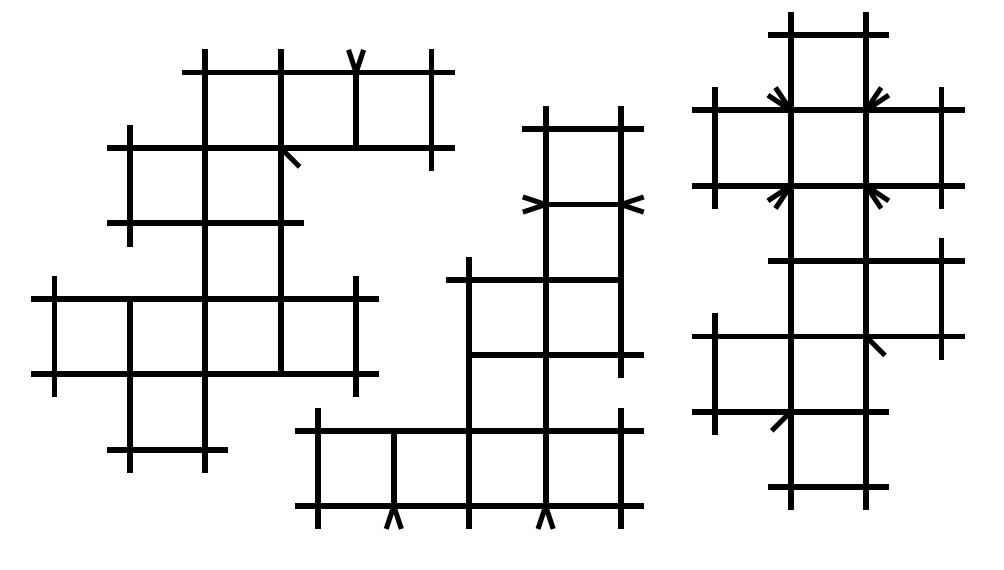
There are infinitely many of these diagrams, but they’re all beautifully simple, variations on a theme that can be written down in a precise mathematical way.
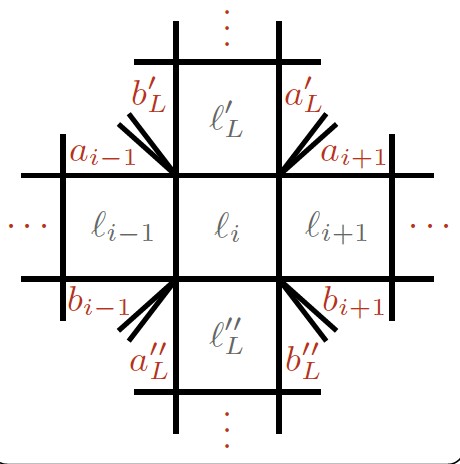
Change things a little bit, though, and the situation gets wildly more intractable. Let the rungs of the ladder peek through the sides, and you get something looking more like the tracks for a train:
These traintrack integrals are much more complicated. Describing them requires the mathematics of Calabi-Yau manifolds, involving higher and higher dimensions as the tracks get longer. I don’t think there’s any hope of understanding these things for all loops, at least not any time soon.
What if we aimed somewhere in between? A ladder that just started to turn traintrack?
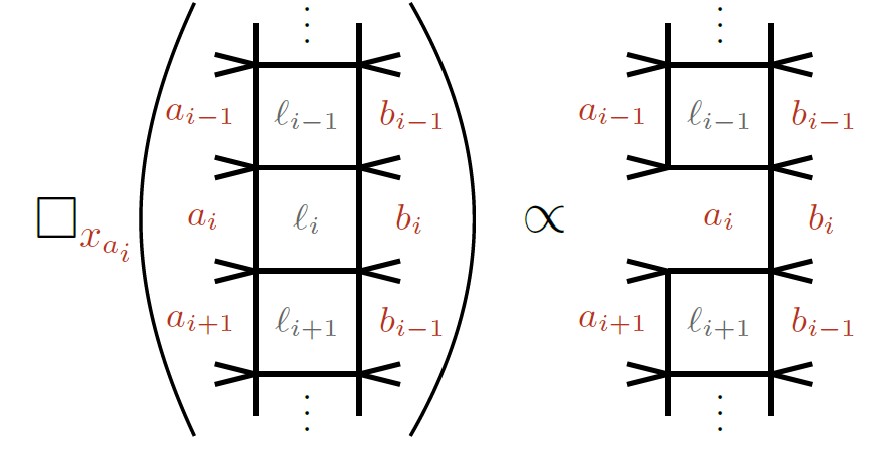
Add just a single pair of rungs, and it turns out that things remain relatively simple. If we do this, it turns out we don’t need any complicated Calabi-Yau manifolds. We just need the simplest Calabi-Yau manifold, called an elliptic curve. It’s actually the same curve for every version of the diagram. And the situation is simple enough that, with some extra cleverness, it looks like we’ve found a trick to calculate these diagrams to any number of loops we’d like.
These developments are exciting, because Feynman diagrams with elliptic curves are still tough to deal with. We still have whole conferences about them. These new elliptic diagrams can be a long list of test cases, things we can experiment with with any number of loops. With time, we might truly understand them as well as the ladder diagrams!
The problem of quantum gravity is one of the most famous problems in physics. You’ve probably heard someone say that quantum mechanics and general relativity are fundamentally incompatible. Most likely, this was narrated over pictures of a foaming, fluctuating grid of space-time. Based on that, you might think that all we have to do to solve this problem is to measure some quantum property of gravity. Maybe we could make a superposition of two different gravitational fields, see what happens, and solve the problem that way.
I mean, we could do that, some people are trying to. But it won’t solve the problem. That’s because the problem of quantum gravity isn’t just the problem of quantum gravity. It’s the problem of high-energy quantum gravity.
Merging quantum mechanics and general relativity is actually pretty easy. General relativity is a big conceptual leap, certainly, a theory in which gravity is really just the shape of space-time. At the same time, though, it’s also a field theory, the same general type of theory as electromagnetism. It’s a weirder field theory than electromagnetism, to be sure, one with deeper implications. But if we want to describe low energies, and weak gravitational fields, then we can treat it just like any other field theory. We know how to write down some pretty reasonable-looking equations, we know how to do some basic calculations with them. This part is just not that scary.
The scary part happens later. The theory we get from these reasonable-looking equations continues to look reasonable for a while. It gives formulas for the probability of things happening: things like gravitational waves bouncing off each other, as they travel through space. The problem comes when those waves have very high energy, and the nice reasonable probability formula now says that the probability is greater than one.
For those of you who haven’t taken a math class in a while, probabilities greater than one don’t make sense. A probability of one is a certainty, something guaranteed to happen. A probability greater than one isn’t more certain than certain, it’s just nonsense.
So we know something needs to change, we know we need a new theory. But we only know we need that theory when the energy is very high: when it’s the Planck energy. Before then, we might still have a different theory, but we might not: it’s not a “problem” yet.
Now, a few of you understand this part, but still have a misunderstanding. The Planck energy seems high for particle physics, but it isn’t high in an absolute sense: it’s about the energy in a tank of gasoline. Does that mean that all we have to do to measure quantum gravity is to make a quantum state out of your car?
Again, no. That’s because the problem of quantum gravity isn’t just the problem of high-energy quantum gravity either.
Energy seems objective, but it’s not. It’s subjective, or more specifically, relative. Due to special relativity, observers moving at different speeds observe different energies. Because of that, high energy alone can’t be the requirement: it isn’t something either general relativity or quantum field theory can “care about” by itself.
Instead, the real thing that matters is something that’s invariant under special relativity. This is hard to define in general terms, but it’s best to think of it as a requirement for not energy, but energy density.
(For the experts: I’m justifying this phrasing in part because of how you can interpret the quantity appearing in energy conditions as the energy density measured by an observer. This still isn’t the correct way to put it, but I can’t think of a better way that would be understandable to a non-technical reader. If you have one, let me know!)
Why do we need quantum gravity to fully understand black holes? Not just because they have a lot of mass, but because they have a lot of mass concentrated in a small area, a high energy density. Ditto for the Big Bang, when the whole universe had a very large energy density. Particle colliders are useful not just because they give particles high energy, but because they give particles high energy and put them close together, creating a situation with very high energy density.
Once you understand this, you can use it to think about whether some experiment or observation will help with the problem of quantum gravity. Does the experiment involve very high energy density, much higher than anything we can do in a particle collider right now? Is that telescope looking at something created in conditions of very high energy density, or just something nearby?
It’s not impossible for an experiment that doesn’t meet these conditions to find something. Whatever the correct quantum gravity theory is, it might be different from our current theories in a more dramatic way, one that’s easier to measure. But the only guarantee, the only situation where we know we need a new theory, is for very high energy density.
As the new year approaches, people think about the future. Me, I’m thinking about the future of fundamental physics, about what might lie beyond the Standard Model. Physicists search for many different things, with many different motivations. Some are clear missing pieces, places where the Standard Model fails and we know we’ll need to modify it. Others are based on experience, with no guarantees but an expectation that, whatever we find, it will be surprising. Finally, some are cool possibilities, ideas that would explain something or fill in a missing piece but aren’t strictly necessary.
The Almost-Sure Things
Science isn’t math, so nothing here is really a sure thing. We might yet discover a flaw in important principles like quantum mechanics and special relativity, and it might be that an experimental result we trust turns out to be flawed. But if we chose to trust those principles, and our best experiments, then these are places we know the Standard Model is incomplete:
Neutrino Masses: The original Standard Model’s neutrinos were massless. Eventually, physicists discovered this was wrong: neutrinos oscillate, switching between different types in a way they only could if they had different masses. This result is familiar enough that some think of it as already part of the Standard Model, not really beyond. But the masses of neutrinos involve unsolved mysteries: we don’t know what those masses are, but more, there are different ways neutrinos could have mass, and we don’t yet know which is present in nature. Neutrino masses also imply the existence of an undiscovered “sterile” neutrino, a particle that doesn’t interact with the strong, weak, or electromagnetic forces.
Dark Matter Phenomena (and possibly Dark Energy Phenomena): Astronomers first suggested dark matter when they observed galaxies moving at speeds inconsistent with the mass of their stars. Now, they have observed evidence for it in a wide variety of situations, evidence which seems decisively incompatible with ordinary gravity and ordinary matter. Some solve this by introducing dark matter, others by modifying gravity, but this is more of a technical difference than it sounds: in order to modify gravity, one must introduce new quantum fields, much the same way one does when introducing dark matter. The only debate is how “matter-like” those fields need to be, but either approach goes beyond the Standard Model.
Quantum Gravity:It isn’t as hard to unite quantum mechanics and gravity as you might think. Physicists have known for decades how to write down a naive theory of quantum gravity, one that follows the same steps one might use to derive the quantum theory of electricity and magnetism. The problem is, this theory is incomplete. It works at low energies, but as the energy increases it loses the ability to make predictions, eventually giving nonsensical answers like probabilities greater than one. We have candidate solutions to this problem, like string theory, but we might not know for a long time which solution is right.
Landau Poles: Here’s a more obscure one. In particle physics we can zoom in and out in our theories, using similar theories at different scales. What changes are the coupling constants, numbers that determine the strength of the different forces. You can think of this in a loosely reductionist way, with the theories at smaller scales determining the constants for theories at larger scales. This gives workable theories most of the time, but it fails for at least one part of the Standard Model. In electricity and magnetism, the coupling constant increases as you zoom in. Eventually, it becomes infinite, and what’s more, does so at a finite energy scale. It’s still not clear how we should think about this, but luckily we won’t have to very soon: this energy scale is vastly vastly higher than even the scale of quantum gravity.
Some Surprises Guarantee Others: The Standard Model is special in a way that gravity isn’t. Even if you dial up the energy, a Standard Model calculation will always “make sense”: you never get probabilities greater than one. This isn’t true for potential deviations from the Standard Model. If the Higgs boson turns out to interact differently than we expect, it wouldn’t just be a violation of the Standard Model on its own: it would guarantee mathematically that, at some higher energy, we’d have to find something new. That was precisely the kind of argument the LHC used to find the Higgs boson: without the Higgs, something new was guaranteed to happen within the energy range of the LHC to prevent impossible probability numbers.
The Argument from (Theoretical) Experience
Everything in this middle category rests on a particular sort of argument. It’s short of a guarantee, but stronger than a dream or a hunch. While the previous category was based on calculations in theories we already know how to write down, this category relies on our guesses about theories we don’t yet know how to write.
Suppose we had a deeper theory, one that could use fewer parameters to explain the many parameters of the Standard Model. For example, it might explain the Higgs mass, letting us predict it rather than just measuring it like we do now. We don’t have a theory like that yet, but what we do have are many toy model theories, theories that don’t describe the real world but do, in this case, have fewer parameters. We can observe how these theories work, and what kinds of discoveries scientists living in worlds described by them would make. By looking at this process, we can get a rough idea of what to expect, which things in our own world would be “explained” in other ways in these theories.
The Hierarchy Problem: This is also called the naturalness problem. Suppose we had a theory that explained the mass of the Higgs, one where it wasn’t just a free parameter. We don’t have such a theory for the real Higgs, but we do have many toy models with similar behavior, ones with a boson with its mass determined by something else. In these models, though, the mass of the boson is always close to the energy scale of other new particles, particles which have a role in determining its mass, or at least in postponing that determination. This was the core reason why people expected the LHC to find something besides the Higgs. Without such new particles, the large hierarchy between the mass of the Higgs and the mass of new particles becomes a mystery, one where it gets harder and harder to find a toy model with similar behavior that still predicts something like the Higgs mass.
The Strong CP Problem: The weak nuclear force does what must seem like a very weird thing, by violating parity symmetry: the laws that govern it are not the same when you flip the world in a mirror. This is also true when you flip all the charges as well, a combination called CP (charge plus parity). But while it may seem strange that the weak force violates this symmetry, physicists find it stranger that the strong force seems to obey it. Much like in the hierarchy problem, it is very hard to construct a toy model that both predicts a strong force that maintains CP (or almost maintains it) and doesn’t have new particles. The new particle in question, called the axion, is something some people also think may explain dark matter.
Matter-Antimatter Asymmetry: We don’t know the theory of quantum gravity. Even if we did, the candidate theories we have struggle to describe conditions close to the Big Bang. But while we can’t prove it, many physicists expect the quantum gravity conditions near the Big Bang to produce roughly equal amounts of matter and antimatter. Instead, matter dominates: we live in a world made almost entirely of matter, with no evidence of large antimatter areas even far out in space. This lingering mystery could be explained if some new physics was biased towards matter instead of antimatter.
Various Problems in Cosmology: Many open questions in cosmology fall in this category. The small value of the cosmological constant is mysterious for the same reasons the small value of the Higgs mass is, but at a much larger and harder to fix scale. The early universe surprises many cosmologists by its flatness and uniformity, which has led them to propose new physics. This surprise is not because such flatness and uniformity is mathematically impossible, but because it is not the behavior they would expect out of a theory of quantum gravity.
The Cool Possibilities
Some ideas for physics beyond the standard model aren’t required, either from experience or cold hard mathematics. Instead, they’re cool, and would be convenient. These ideas would explain things that look strange, or make for a simpler deeper theory, but they aren’t the only way to do so.
Grand Unified Theories: Not the same as a “theory of everything”, Grand Unified Theories unite the three “particle physics forces”: the strong nuclear force, the weak nuclear force, and electromagnetism. Under such a theory, the different parameters that determine the strengths of those forces could be predicted from one shared parameter, with the forces only seeming different at low energies. These theories often unite the different matter particles too, but they also introduce new particles and new forces. These forces would, among other things, make protons unstable, and so giant experiments have been constructed to try to detect a proton decaying into other particles. So far none has been seen.
Low-Energy Supersymmetry: String theory requires supersymmetry, a relationship where matter and force particles share many properties. That supersymmetry has to be “broken”, which means that while the matter and force particles have the same charges, they can have wildly different masses, so that the partner particles are all still undiscovered. Those masses may be extremely high, all the way up at the scale of quantum gravity, but they could also be low enough to test at the LHC. Physicists hoped to detect such particles, as they could have been a good solution to the hierarchy problem. Now that the LHC hasn’t found these supersymmetric particles, it is much harder to solve the problem this way, though some people are still working on it.
Large Extra Dimensions: String theory also involves extra dimensions, beyond our usual three space and one time. Those dimensions are by default very small, but some proposals have them substantially bigger, big enough that we could have seen evidence for them at the LHC. These proposals could explain why gravity is so much weaker than the other forces. Much like the previous members of this category though, no evidence for this has yet been found.
I think these categories are helpful, but experts may quibble about some of my choices. I also haven’t mentioned every possible thing that could be found beyond the Standard Model. If you’ve heard of something and want to know which category I’d put it in, let me know in the comments!
Here on this blog, I don’t like to get into those kinds of arguments. When I talk about public understanding of science, I share the same concerns as the journalists: we all want to prevent misunderstandings, and to spread a clearer picture. I can argue that some choices hurt the public understanding and some help it, and be reasonably confident that I’m saying something meaningful, something that would resonate with their stated values.
For the bigger questions, what goals science should have and what we should praise, I have much less of a foundation. We don’t all have a clear shared standard for which science is most important. There isn’t some premise I can posit, a fundamental principle I can use to ground a logical argument.
That doesn’t mean I don’t have an opinion, though. It doesn’t even mean I can’t persuade others of it. But it means the persuasion has to be a bit more loose. For example, I can use analogies.
So let’s say I’m looking at a result like this simulated wormhole. Researchers took advanced technology (Google’s quantum computer), and used it to model a simple system. They didn’t learn anything especially new about that system (since in this case, a normal computer can simulate it better). I get the impression they didn’t learn all that much about the advanced technology: the methods used, at this point, are pretty well-known, at least to Google. I also get the impression that it wasn’t absurdly expensive: I’ve seen other people do things of a similar scale with Google’s machine, and didn’t get the impression they had to pay through the nose for the privilege. Finally, the simple system simulated happens to be “cool”: it’s a toy model studied by quantum gravity researchers, a simple version of that sci-fi standard, the traversible wormhole.
What results are like that?
Occasionally, scientists build tiny things. If the tiny things are cute enough, or cool enough, they tend to get media attention. The most recent example I can remember was a tiny snowman, three microns tall. These tiny things tend to use very advanced technology, and it’s hard to imagine the scientists learn much from making them, but it’s also hard to imagine they cost all that much to make. They’re amusing, and they absolutely get press coverage, spreading wildly over the web. I don’t think they tend to get published in Nature unless they are a bit more advanced, but I wouldn’t be too surprised if I heard of a case that did, scientific journals can be suckers for cute stories too. They don’t tend to get discussed in glowing terms linking them to historical breakthroughs.
That seems like a pretty close analogy. Taken seriously, it would suggest the wormhole simulation was probably worth doing, probably worth a press release and some media coverage, likely not worth publication in Nature, and definitely not worth being heralded as a major breakthrough.
Ok, but proponents of the experiment might argue I’m leaving something out here. This experiment isn’t just a cute simulation. It’s supposed to be a proof of principle, an early version of an experiment that will be an actually useful simulation.
As an analogy for that…did you know LIGO started taking data in 2002?
Most people first heard of the Laser Interferometer Gravitational-Wave Observatory in 2016, when they reported their first detection of gravitational waves. But that was actually “advanced LIGO”. The original LIGO ran from 2002 to 2010, and didn’t detect anything. It just wasn’t sensitive enough. Instead, it was a prototype, an early version designed to test the basic concept.
Similarly, while this wormhole situation didn’t teach anything new, future ones might. If the quantum simulation was made larger, it might be possible to simulate more complicated toy models, ones that are too complicated to simulate on a normal computer. These aren’t feasible now, but may be feasible with somewhat bigger quantum computers: still much smaller than the computers that would be needed to break encryption, or even to do simulations that are useful for chemists and materials scientists. Proponents argue that some of these quantum toy models might teach them something interesting about the mathematics of quantum gravity.
Here, though, a number of things weaken the analogy.
LIGO’s first run taught them important things about the noise they would have to deal with, things that they used to build the advanced version. The wormhole simulation didn’t show anything novel about how to use a quantum computer: the type of thing they were doing was well-understood, even if it hadn’t been used to do that yet.
Detecting gravitational waves opened up a new type of astronomy, letting us observe things we could never have observed before. For these toy models, it isn’t obvious to me that the benefit is so unique. Future versions may be difficult to classically simulate, but it wouldn’t surprise me if theorists figured out how to understand them in other ways, or gained the same insight from other toy models and moved on to new questions. They’ll have a while to figure it out, because quantum computers aren’t getting bigger all that fast. I’m very much not an expert in this type of research, so maybe I’m wrong about this…but just comparing to similar research programs, I would be surprised if the quantum simulations end up crucial here.
Finally, even if the analogy held, I don’t think it proves very much. In particular, as far as I can tell, the original LIGO didn’t get much press. At the time, I remember meeting some members of the collaboration, and they clearly didn’t have the fame the project has now. Looking through google news and the archives of the New York times, I can’t find all that much about the experiment: a few articles discussing its progress and prospects, but no grand unveiling, no big press releases.
So ultimately, I think viewing the simulation as a proof of principle makes it, if anything, less worth the hype. A prototype like that is only really valuable when it’s testing new methods, and only in so far as the thing it’s a prototype for will be revolutionary. Recently, a prototype fusion device got a lot of press for getting more energy out of a plasma than they put into it (though still much less than it takes to run the machine). People already complained about that being overhyped, and the simulated wormhole is nowhere near that level of importance.
If anything, I think the wormhole-simulators would be on a firmer footing if they thought of their work like the tiny snowmen. It’s cute, a fun side benefit of advanced technology, and as such something worth chatting about and celebrating a bit. But it’s not the start of a new era.