Tag Archives: relativity

To Measure Something or to Test It

Black holes have been in the news a couple times recently.

On one end, there was the observation of an extremely large black hole in the early universe, when no black holes of the kind were expected to exist. My understanding is this is very much a “big if true” kind of claim, something that could have dramatic implications but may just be being misunderstood. At the moment, I’m not going to try to work out which one it is.

In between, you have a piece by me in Quanta Magazine a couple weeks ago, about tests of whether black holes deviate from general relativity. They don’t, by the way, according to the tests so far.

And on the other end, you have the coverage last week of a “confirmation” (or even “proof”) of the black hole area law.

The black hole area law states that the total area of the event horizons of all black holes will always increase. It’s also known as the second law of black hole thermodynamics, paralleling the second law of thermodynamics that entropy always increases. Hawking proved this as a theorem in 1971, assuming that general relativity holds true.

(That leaves out quantum effects, which indeed can make black holes shrink, as Hawking himself famously later argued.)

The black hole area law is supposed to hold even when two black holes collide and merge. While the combination may lose energy (leading to gravitational waves that carry energy to us), it will still have greater area, in the end, than the sum of the black holes that combined to make it.

Ok, so that’s the area law. What’s this paper that’s supposed to “finally prove” it?

The LIGO, Virgo, and KAGRA collaborations recently published a paper based on gravitational waves from one particularly clear collision of black holes, which they measured back in January. They compare their measurements to predictions from general relativity, and checked two things: whether the measurements agreed with predictions based on the Kerr metric (how space-time around a rotating black hole is supposed to behave), and whether they obeyed the area law.

The first check isn’t so different in purpose from the work I wrote about in Quanta Magazine, just using different methods. In both studies, physicists are looking for deviations from the laws of general relativity, triggered by the highly curved environments around black holes. These deviations could show up in one way or another in any black hole collision, so while you would ideally look for them by scanning over many collisions (as the paper I reported on did), you could do a meaningful test even with just one collision. That kind of a check may not be very strenuous (if general relativity is wrong, it’s likely by a very small amount), but it’s still an opportunity, diligently sought, to be proven wrong.

The second check is the one that got the headlines. It also got first billing in the paper title, and a decent amount of verbiage in the paper itself. And if you think about it for more than five minutes, it doesn’t make a ton of sense as presented.

Suppose the black hole area law is wrong, and sometimes black holes lose area when they collide. Even if this happened sometimes, you wouldn’t expect it to happen every time. It’s not like anyone is pondering a reverse black hole area law, where black holes only shrink!

Because of that, I think it’s better to say that LIGO measured the black hole area law for this collision, while they tested whether black holes obey the Kerr metric. In one case, they’re just observing what happened in this one situation. In the other, they can try to draw implications for other collisions.

That doesn’t mean their work wasn’t impressive, but it was impressive for reasons that don’t seem to be getting emphasized. It’s impressive because, prior to this paper, they had not managed to measure the areas of colliding black holes well enough to confirm that they obeyed the area law! The previous collisions looked like they obeyed the law, but when you factor in the experimental error they couldn’t say it with confidence. The current measurement is better, and can. So the new measurement is interesting not because it confirms a fundamental law of the universe or anything like that…it’s interesting because previous measurements were so bad, that they couldn’t even confirm this kind of fundamental law!

That, incidentally, feels like a “missing mood” in pop science. Some things are impressive not because of their amazing scale or awesome implications, but because they are unexpectedly, unintuitively, really really hard to do. These measurements shouldn’t be thought of, or billed, as tests of nature’s fundamental laws. Instead they’re interesting because they highlight what we’re capable of, and what we still need to accomplish.

Technology as Evidence

How much can you trust general relativity?

On the one hand, you can read through a lovely Wikipedia article full of tests, explaining just how far and how precisely scientists have pushed their knowledge of space and time. On the other hand, you can trust GPS satellites.

As many of you may know, GPS wouldn’t work if we didn’t know about general relativity. In order for the GPS in your phone to know where you are, it has to compare signals from different satellites, each giving the location and time the signal was sent. To get an accurate result, the times measured on those satellites have to be adjusted: because of the lighter gravity they experience, time moves more quickly for them than for us down on Earth.

In a sense, general relativity gets tested every minute of every day, on every phone in the world. That’s pretty trustworthy! Any time that science is used in technology, it gets tested in this way. The ideas we can use are ideas that have shown they can perform, ideas which do what we expect again and again and again.

In another sense, though, GPS is a pretty bad test of general relativity. It tests one of general relativity’s simplest consequences, based on the Schwarzchild metric for how gravity behaves near a large massive object, and not to an incredibly high degree of precision. Gravity could still violate general relativity in a huge number of other ways, and GPS would still function. That’s why the other tests are valuable: if you want to be sure general relativity doesn’t break down, you need to test it under conditions that GPS doesn’t cover, and to higher precision.

Once you know to look for it, these layers of tests come up everywhere. You might see the occasional article talking about tests of quantum gravity. The tests they describe are very specific, testing a very general and basic question: does quantum mechanics make sense at all in a gravitational world? In contrast, most scientists who research quantum gravity don’t find that question very interesting: if gravity breaks quantum mechanics in a way those experiments could test, it’s hard to imagine it not leading to a huge suite of paradoxes. Instead, quantum gravity researchers tend to be interested in deeper problems with quantum gravity, distinctions between theories that don’t dramatically break with our existing ideas, but that because of that are much harder to test.

The easiest tests are important, especially when they come from technology: they tell us, on a basic level, what we can trust. But we need the hard tests too, because those are the tests that are most likely to reveal something new, and bring us to a new level of understanding.

How Small Scales Can Matter for Large Scales

For a certain type of physicist, nothing matters more than finding the ultimate laws of nature for its tiniest building-blocks, the rules that govern quantum gravity and tell us where the other laws of physics come from. But because they know very little about those laws at this point, they can predict almost nothing about observations on the larger distance scales we can actually measure.

“Almost nothing” isn’t nothing, though. Theoretical physicists don’t know nature’s ultimate laws. But some things about them can be reasonably guessed. The ultimate laws should include a theory of quantum gravity. They should explain at least some of what we see in particle physics now, explaining why different particles have different masses in terms of a simpler theory. And they should “make sense”, respecting cause and effect, the laws of probability, and Einstein’s overall picture of space and time.

All of these are assumptions, of course. Further assumptions are needed to derive any testable consequences from them. But a few communities in theoretical physics are willing to take the plunge, and see what consequences their assumptions have.

First, there’s the Swampland. String theorists posit that the world has extra dimensions, which can be curled up in a variety of ways to hide from view, with different observable consequences depending on how the dimensions are curled up. This list of different observable consequences is referred to as the Landscape of possibilities. Based on that, some string theorists coined the term “Swampland” to represent an area outside the Landscape, containing observations that are incompatible with quantum gravity altogether, and tried to figure out what those observations would be.

In principle, the Swampland includes the work of all the other communities on this list, since a theory of quantum gravity ought to be consistent with other principles as well. In practice, people who use the term focus on consequences of gravity in particular. The earliest such ideas argued from thought experiments with black holes, finding results that seemed to demand that gravity be the weakest force for at least one type of particle. Later researchers would more frequently use string theory as an example, looking at what kinds of constructions people had been able to make in the Landscape to guess what might lie outside of it. They’ve used this to argue that dark energy might be temporary, and to try to figure out what traits new particles might have.

Second, I should mention naturalness. When talking about naturalness, people often use the analogy of a pen balanced on its tip. While possible in principle, it must have been set up almost perfectly, since any small imbalance would cause it to topple, and that perfection demands an explanation. Similarly, in particle physics, things like the mass of the Higgs boson and the strength of dark energy seem to be carefully balanced, so that a small change in how they were set up would lead to a much heavier Higgs boson or much stronger dark energy. The need for an explanation for the Higgs’ careful balance is why many physicists expected the Large Hadron Collider to discover additional new particles.

As I’ve argued before, this kind of argument rests on assumptions about the fundamental laws of physics. It assumes that the fundamental laws explain the mass of the Higgs, not merely by giving it an arbitrary number but by showing how that number comes from a non-arbitrary physical process. It also assumes that we understand well how physical processes like that work, and what kinds of numbers they can give. That’s why I think of naturalness as a type of argument, much like the Swampland, that uses the smallest scales to constrain larger ones.

Third is a host of constraints that usually go together: causality, unitarity, and positivity. Causality comes from cause and effect in a relativistic universe. Because two distant events can appear to happen in different orders depending on how fast you’re going, any way to send signals faster than light is also a way to send signals back in time, causing all of the paradoxes familiar from science fiction. Unitarity comes from quantum mechanics. If quantum calculations are supposed to give the probability of things happening, those probabilities should make sense as probabilities: for example, they should never go above one.

You might guess that almost any theory would satisfy these constraints. But if you extend a theory to the smallest scales, some theories that otherwise seem sensible end up failing this test. Actually linking things up takes other conjectures about the mathematical form theories can have, conjectures that seem more solid than the ones underlying Swampland and naturalness constraints but that still can’t be conclusively proven. If you trust the conjectures, you can derive restrictions, often called positivity constraints when they demand that some set of observations is positive. There has been a renaissance in this kind of research over the last few years, including arguments that certain speculative theories of gravity can’t actually work.

Book Review: The Case Against Reality

Nima Arkani-Hamed shows up surprisingly rarely in popular science books. A major figure in my former field, Nima is extremely quotable (frequent examples include “spacetime is doomed” and “the universe is not a crappy metal”), but those quotes don’t seem to quite have reached the popular physics mainstream. He’s been interviewed in books by physicists, and has a major role in one popular physics book that I’m aware of. From this scattering of mentions, I was quite surprised to hear of another book where he makes an appearance: not a popular physics book at all, but a popular psychology book: Donald Hoffman’s The Case Against Reality. Naturally, this meant I had to read it.

Then, I saw the first quote on the back cover…or specifically, who was quoted.

Seeing that, I settled in for a frustrating read.

A few pages later, I realized that this, despite his endorsement, is not a Deepak Chopra kind of book. Hoffman is careful in some valuable ways. Specifically, he has a philosopher’s care, bringing up objections and potential holes in his arguments. As a result, the book wasn’t frustrating in the way I expected.

It was even more frustrating, actually. But in an entirely different way.

When a science professor writes a popular book, the result is often a kind of ungainly Frankenstein. The arguments we want to make tend to be better-suited to shorter pieces, like academic papers, editorials, and blog posts. To make these into a book, we have to pad them out. We stir together all the vaguely related work we’ve done, plus all the best-known examples from other peoples’ work, trying (often not all that hard) to make the whole sound like a cohesive story. Read enough examples, and you start to see the joints between the parts.

Hoffman is ostensibly trying to tell a single story. His argument is that the reality we observe, of objects in space and time, is not the true reality. It is a convenient reality, one that has led to our survival, but evolution has not (and as he argues, cannot) let us perceive the truth. Instead, he argues that the true reality is consciousness: a world made up of conscious beings interacting with each other, with space, time, and all the rest emerging as properties of those interactions.

That certainly sounds like it could be one, cohesive argument. In practice, though, it is three, and they don’t fit together as well as he’d hope.

Hoffman is trained as a psychologist. As such, one of the arguments is psychological: that research shows that we mis-perceive the world in service of evolutionary fitness.

Hoffman is a cognitive scientist, and while many cognitive scientists are trained as psychologists, others are trained as philosophers. As such, one of his arguments is philosophical: that the contents of consciousness can never be explained by relations between material objects, and that evolution, and even science, systematically lead us astray.

Finally, Hoffman has evidently been listening to and reading the work of some physicists, like Nima and Carlo Rovelli. As such, one of his arguments is physical: that physicists believe that space and time are illusions and that consciousness may be fundamental, and that the conclusions of the book lead to his own model of the basic physical constituents of the world.

The book alternates between these three arguments, so rather than in chapter order, I thought it would be better to discuss each argument in its own section.

The Psychological Argument

Sometimes, when two academics get into a debate, they disagree about what’s true. Two scientists might argue about whether an experiment was genuine, whether the statistics back up a conclusion, or whether a speculative theory is actually consistent. These are valuable debates, and worth reading about if you want to learn something about the nature of reality.

Sometimes, though, two debating academics agree on what’s true, and just disagree on what’s important. These debates are, at best, relevant to other academics and funders. They are not generally worth reading for anybody else, and are often extremely petty and dumb.

Hoffman’s psychological argument, regrettably, is of the latter kind. He would like to claim it’s the former, and to do so he marshals a host of quotes from respected scientists that claim that human perception is veridical: that what we perceive is real, courtesy of an evolutionary process that would have killed us off if it wasn’t. From that perspective, every psychological example Hoffman gives is a piece of counter-evidence, a situation where evolution doesn’t just fail to show us the true nature of reality, but actively hides reality from us.

The problem is that, if you actually read the people Hoffman quotes, they’re clearly not making the extreme point he claims. These people are psychologists, and all they are arguing is that perception is veridical in a particular, limited way. They argue that we humans are good at estimating distances or positions of objects, or that we can see a wide range of colors. They aren’t making some sort of philosophical point about those distances or positions or colors being how the world “really is”, nor are they claiming that evolution never makes humans mis-perceive.

Instead, they, and thus Hoffman, are arguing about importance. When studying humans, is it more useful to think of us as perceiving the world as it is? Or is it more useful to think of evolution as tricking us? Which happens more often?

The answers to each of those questions have to be “it depends”. Neither answer can be right all the time. At most then, this kind of argument can convince one academic to switch from researching in one way to researching in another, by saying that right now one approach is a better strategy. It can’t tell us anything more.

If the argument Hoffman is trying to get across here doesn’t matter, are there other reasons to read this part?

Popular psychology books tend to re-use a few common examples. There are some good ones, so if you haven’t read such a book you probably should read a couple, just to hear about them. For example, Hoffman tells the story of the split-brain patients, which is definitely worth being aware of.

(Those of you who’ve heard that story may be wondering how the heck Hoffman squares it with his idea of consciousness as fundamental. He actually does have a (weird) way to handle this, so read on.)

The other examples come from Hoffman’s research, and other research in his sub-field. There are stories about what optical illusions tell us about our perception, about how evolution primes us to see different things as attractive, and about how advertisers can work with attention.

These stories would at least be a source of a few more cool facts, but I’m a bit wary. The elephant in the room here is the replication crisis. Paper after paper in psychology has turned out to be a statistical mirage, accidental successes that fail to replicate in later experiments. This can happen without any deceit on the part of the psychologist, it’s just a feature of how statistics are typically done in the field.

Some psychologists make a big deal about the replication crisis: they talk about the statistical methods they use, and what they do to make sure they’re getting a real result. Hoffman talks a bit about tricks to rule out other explanations, but mostly doesn’t focus on this kind of thing.. This doesn’t mean he’s doing anything wrong: it might just be it’s off-topic. But it makes it a bit harder to trust him, compared to other psychologists who do make a big deal about it.

The Philosophical Argument

Hoffman structures his book around two philosophical arguments, one that appears near the beginning and another that, as he presents it, is the core thesis of the book. He calls both of these arguments theorems, a naming choice sure to irritate mathematicians and philosophers alike, but the mathematical content in either is for the most part not the point: in each case, the philosophical setup is where the arguments get most of their strength.

The first of these arguments, called The Scrambling Theorem, is set up largely as background material: not his core argument, but just an entry into the overall point he’s making. I found it helpful as a way to get at his reasoning style, the sorts of things he cares about philosophically and the ones he doesn’t.

The Scrambling Theorem is meant to weigh in on the debate over a thought experiment called the Inverted Spectrum, which in turn weighs on the philosophical concept of qualia. The Inverted Spectrum asks us to imagine someone who sees the spectrum of light inverted compared to how we see it, so that green becomes red and red becomes green, without anything different about their body or brain. Such a person would learn to refer to colors the same ways that we do, still referring to red blood even though they see what we see when we see green grass. Philosophers argue that, because we can imagine this, the “qualia” we see in color, like red or green, are distinct from their practical role: they are images in the mind’s eye that can be compared across minds, but do not correspond to anything we have yet characterized scientifically in the physical world.

As a response, other philosophers argued that you can’t actually invert the spectrum. Colors aren’t really a wheel, we can distinguish, for example, more colors between red and blue than between green and yellow. Just flipping colors around would have detectable differences that would have to have physical implications, you can’t just swap qualia and nothing else.

The Scrambling Theorem is in response to this argument. Hoffman argues that, while you can’t invert the spectrum, you can scramble it. By swapping not only the colors, but the relations between them, you can arrange any arbitrary set of colors however else you’d like. You can declare that green not only corresponds to blood and not grass, but that it has more colors between it and yellow, perhaps by stealing them from the other side of the color wheel. If you’re already allowed to swap colors and their associations around, surely you can do this too, and change order and distances between them.

Believe it or not, I think Hoffman’s argument is correct, at least in its original purpose. You can’t respond to the Inverted Spectrum just by saying that colors are distributed differently on different sides of the color wheel. If you want to argue against the Inverted Spectrum, you need a better argument.

Hoffman’s work happens to suggest that better argument. Because he frames this argument in the language of mathematics, as a “theorem”, Hoffman’s argument is much more general than the summary I gave above. He is arguing that not merely can you scramble colors, but anything you like. If you want to swap electrons and photons, you can: just make your photons interact with everything the way electrons did, and vice versa. As long as you agree that the things you are swapping exist, according to Hoffman, you are free to exchange them and their properties any way you’d like.

This is because, to Hoffman, things that “actually exist” cannot be defined just in terms of their relations. An electron is not merely a thing that repels other electrons and is attracted to protons and so on, it is a thing that “actually exists” out there in the world. (Or, as he will argue, it isn’t really. But that’s because in the end he doesn’t think electrons exist.)

(I’m tempted to argue against this with a mathematical object like group elements. Surely the identity element of a group is defined by its relations? But I think he would argue identity elements of groups don’t actually exist.)

In the end, Hoffman is coming from a particular philosophical perspective, one common in modern philosophers of metaphysics, the study of the nature of reality. From this perspective, certain things exist, and are themselves by necessity. We cannot ask what if a thing were not itself. For example, in this perspective it is nonsense to ask what if Superman was not Clark Kent, because the two names refer to the same actually existing person.

(If, you know, Superman actually existed.)

Despite the name of the book, Hoffman is not actually making a case against reality in general. He very much seems to believe in this type of reality, in the idea that there are certain things out there that are real, independent of any purely mathematical definition of their properties. He thinks they are different things than you think they are, but he definitely thinks there are some such things, and that it’s important and scientifically useful to find them.

Hoffman’s second argument is, as he presents it, the core of the book. It’s the argument that’s supposed to show that the world is almost certainly not how we perceive it, even through scientific instruments and the scientific method. Once again, he calls it a theorem: the Fitness Beats Truth theorem.

The Fitness Beats Truth argument begins with a question: why should we believe what we see? Why do we expect that the things we perceive should be true?

In Hoffman’s mind, the only answer is evolution. If we perceived the world inaccurately, we would die out, replaced by creatures that perceived the world better than we did. You might think we also have evidence from biology, chemistry, and physics: we can examine our eyes, test them against cameras, see how they work and what they can and can’t do. But to Hoffman, all of this evidence may be mistaken, because to learn biology, chemistry, and physics we must first trust that we perceive the world correctly to begin with. Evolution, though, doesn’t rely on any of that. Even if we aren’t really bundles of cells replicating through DNA and RNA, we should still expect something like evolution, some process by which things differ, are selected, and reproduce their traits differently in the next generation. Such things are common enough, and general enough, that one can (handwavily) expect them through pure reason alone.

But, says Hoffman’s psychology experience, evolution tricks us! We do mis-perceive, and systematically, in ways that favor our fitness over reality. And so Hoffman asks, how often should we expect this to happen?

The Fitness Beats Truth argument thinks of fitness as randomly distributed: some parts of reality historically made us more fit, some less. This distribution could match reality exactly, so that for any two things that are actually different, they will make us fit in different ways. But it doesn’t have to. There might easily be things that are really very different from each other, but which are close enough from a fitness perspective that to us they seem exactly the same.

The “theorem” part of the argument is an attempt to quantify this. Hoffman imagines a pixelated world, and asks how likely it is that a random distribution of fitness matches a random distribution of pixels. This gets extremely unlikely for a world of any reasonable size, for pretty obvious reasons. Thus, Hoffman concludes: in a world with evolution, we should almost always expect it to hide something from us. The world, if it has any complexity at all, has an almost negligible probability of being as we perceive it.

On one level, this is all kind of obvious. Evolution does trick us sometimes, just as it tricks other animals. But Hoffman is trying to push this quite far, to say that ultimately our whole picture of reality, not just our eyes and ears and nose but everything we see with microscopes and telescopes and calorimeters and scintillators, all of that might be utterly dramatically wrong. Indeed, we should expect it to be.

In this house, we tend to dismiss the Cartesian Demon. If you have an argument that makes you doubt literally everything, then it seems very unlikely you’ll get anything useful from it. Unlike Descartes’s Demon, Hoffman thinks we won’t be tricked forever. The tricks evolution plays on us mattered in our ancestral environment, but over time we move to stranger and stranger situations. Eventually, our fitness will depend on something new, and we’ll need to learn something new about reality.

This means that ultimately, despite the skeptical cast, Hoffman’s argument fits with the way science already works. We are, very much, trying to put ourselves in new situations and test whether our evolved expectations still serve us well or whether we need to perceive things anew. That is precisely what we in science are always doing, every day. And as we’ll see in the next section, whatever new things we have to learn have no particular reason to be what Hoffman thinks they should be.

But while it doesn’t really matter, I do still want to make one counter-argument to Fitness Beats Truth. Hoffman considers a random distribution of fitness, and asks what the chance is that it matches truth. But fitness isn’t independent of truth, and we know that not just from our perception, but from deeper truths of physics and mathematics. Fitness is correlated with truth, fitness often matches truth, for one key reason: complex things are harder than simple things.

Imagine a creature evolving an eye. They have a reason, based on fitness, to need to know where their prey is moving. If evolution was a magic wand, and chemistry trivial, it would let them see their prey, and nothing else. But evolution is not magic, and chemistry is not trivial. The easiest thing for this creature to see is patches of light and darkness. There are many molecules that detect light, because light is a basic part of the physical world. To detect just prey, you need something much more complicated, molecules and cells and neurons. Fitness imposes a cost, and it means that the first eyes that evolve are spots, detecting just light and darkness.

Hoffman asks us not to assume that we know how eyes work, that we know how chemistry works, because we got that knowledge from our perceptions. But the nature of complexity and simplicity, entropy and thermodynamics and information, these are things we can approach through pure thought, as much as evolution. And those principles tell us that it will always be easier for an organism to perceive the world as it truly is than not, because the world is most likely simple and it is most likely the simplest path to perceive it directly. When benefits get high enough, when fitness gets strong enough, we can of course perceive the wrong thing. But if there is only a small fitness benefit to perceiving something incorrectly, then simplicity will win out. And by asking simpler and simpler questions, we can make real durable scientific progress towards truth.

The Physical Argument

So if I’m not impressed by the psychology or the philosophy, what about the part that motivated me to read the book in the first place, the physics?

Because this is, in a weird and perhaps crackpot way, a physics book. Hoffman has a specific idea, more specific than just that the world we perceive is an evolutionary illusion, more specific than that consciousness cannot be explained by the relations between physical particles. He has a proposal, based on these ideas, one that he thinks might lead to a revolutionary new theory of physics. And he tries to argue that physicists, in their own way, have been inching closer and closer to his proposal’s core ideas.

Hoffman’s idea is that the world is made, not of particles or fields or anything like that, but of conscious agents. You and I are, in this picture, certainly conscious agents, but so are the sources of everything we perceive. When we reach out and feel a table, when we look up and see the Sun, those are the actions of some conscious agent intruding on our perceptions. Unlike panpsychists, who believe that everything in the world is conscious, Hoffman doesn’t believe that the Sun itself is conscious, or is made of conscious things. Rather, he thinks that the Sun is an evolutionary illusion that rearranges our perceptions in a convenient way. The perceptions still come from some conscious thing or set of conscious things, but unlike in panpsychism they don’t live in the center of our solar system, or in any other place (space and time also being evolutionary illusions in this picture). Instead, they could come from something radically different that we haven’t imagined yet.

Earlier, I mentioned split brain patients. For anyone who thinks of conscious beings as fundamental, split brain patients are a challenge. These are people who, as a treatment for epilepsy, had the bridge between the two halves of their brain severed. The result is eerily as if their consciousness was split in two. While they only express one train of thought, that train of thought seems to only correspond to the thoughts of one side of their brain, controlling only half their body. The other side, controlling the other half of their body, appears to have different thoughts, different perceptions, and even different opinions, which are made manifest when instead of speaking they use that side of their body to gesture and communicate. While some argue that these cases are over-interpreted and don’t really show what they’re claimed to, Hoffman doesn’t. He accepts that these split-brain patients genuinely have their consciousness split in two.

Hoffman thinks this isn’t a problem because for him, conscious agents can be made up of other conscious agents. Each of us is conscious, but we are also supposed to be made up of simpler conscious agents. Our perceptions and decisions are not inexplicable, but can be explained in terms of the interactions of the simpler conscious entities that make us up, each one communicating with the others.

Hoffman speculates that everything is ultimately composed of the simplest possible conscious agents. For him, a conscious agent must do two things: perceive, and act. So the simplest possible agent perceives and acts in the simplest possible way. They perceive a single bit of information: 0 or 1, true or false, yes or no. And they take one action, communicating a different bit of information to another conscious agent: again, 0 or 1, true or false, yes or no.

Hoffman thinks that this could be the key to a new theory of physics. Instead of thinking about the world as composed of particles and fields, think about it as composed of these simple conscious agents, each one perceiving and communicating one bit at a time.

Hoffman thinks this, in part, because he sees physics as already going in this direction. He’s heard that “spacetime is doomed”, he’s heard that quantum mechanics is contextual and has no local realism, he’s heard that quantum gravity researchers think the world might be a hologram and space-time has a finite number of bits. This all “rhymes” enough with his proposal that he’s confident physics has his back.

Hoffman is trained in psychology. He seems to know his philosophy, at least enough to engage with the literature there. But he is absolutely not a physicist, and it shows. Time and again it seems like he relies on “pop physics” accounts that superficially match his ideas without really understanding what the physicists are actually talking about.

He keeps up best when it comes to interpretations of quantum mechanics, a field where concepts from philosophy play a meaningful role. He covers the reasons why quantum mechanics keeps philosophers up at night: Bell’s Theorem, which shows that a theory that matches the predictions of quantum mechanics cannot both be “realist”, with measurements uncovering pre-existing facts about the world, and “local”, with things only influencing each other at less than the speed of light, the broader notion of contextuality, where measured results are dependent on which other measurements are made, and the various experiments showing that both of these properties hold in the real world.

These two facts, and their implications, have spawned a whole industry of interpretations of quantum mechanics, where physicists and philosophers decide which side of various dilemmas to take and how to describe the results. Hoffman quotes a few different “non-realist” interpretations: Carlo Rovelli’s Relational Quantum Mechanics, Quantum Bayesianism/QBism, Consistent Histories, and whatever Chris Fields is into. These are all different from one another, which Hoffman is aware of. He just wants to make the case that non-realist interpretations are reasonable, that the physicists collectively are saying “maybe reality doesn’t exist” just like he is.

The problem is that Hoffman’s proposal is not, in the quantum mechanics sense, non-realist. Yes, Hoffman thinks that the things we observe are just an “interface”, that reality is really a network of conscious agents. But in order to have a non-realist interpretation, you need to also have other conscious agents not be real. That’s easily seen from the old “Wigner’s friend” thought experiment, where you put one of your friends in a Schrodinger’s cat-style box. Just as Schrodinger’s cat can be both alive and dead, your friend can both have observed something and not have observed it, or observed something and observed something else. The state of your friend’s mind, just like everything else in a non-realist interpretation, doesn’t have a definite value until you measure it.

Hoffman’s setup doesn’t, and can’t, work that way. His whole philosophical project is to declare that certain things exist and others don’t: the sun doesn’t exist, conscious agents do. In a non-realist interpretation, the sun and other conscious agents can both be useful descriptions, but ultimately nothing “really exists”. Science isn’t a catalogue of what does or doesn’t “really exist”, it’s a tool to make predictions about your observations.

Hoffman gets even more confused when he gets to quantum gravity. He starts out with a common misconception: that the Planck length represents the “pixels” of reality, sort of like the pixels of your computer screen, which he uses to support his “interface” theory of consciousness. This isn’t really the right way to think about it the Planck length, though, and certainly isn’t what the people he’s quoting have in mind. The Planck length is a minimum scale in that space and time stop making sense as one approaches it, but that’s not necessarily because space and time are made up of discrete pixels. Rather, it’s because as you get closer to the Planck length, space and time stop being the most convenient way to describe things. For a relatively simple example of how this can work, see my post here.

From there, he reflects on holography: the discovery that certain theories in physics can be described equally well by what is happening on their boundary as by their interior, the way that a 2D page can hold all the information for an apparently 3D hologram. He talks about the Bekenstein bound, the conjecture that there is a maximum amount of information needed to describe a region of space, proportional not to the volume of the region but to its area. For Hoffman, this feels suspiciously like human vision: if we see just a 2D image of the world, could that image contain all the information needed to construct that world? Could the world really be just what we see?

In a word, no.

On the physics side, the Bekenstein bound is a conjecture, and one that doesn’t always hold. A more precise version that seems to hold more broadly, called the Bousso bound, works by demanding the surface have certain very specific geometric properties in space-time, properties not generally shared by the retinas of our eyes.

But it even fails in Hoffman’s own context, once we remember that there are other types of perception than vision. When we hear, we don’t detect a 2D map, but a 1D set of frequencies, put in “stereo” by our ears. When we feel pain, we can feel it in any part of our body, essentially a 3D picture since it goes inwards as well. Nothing about human perception uniquely singles out a 2D surface.

There is actually something in physics much closer to what Hoffman is imagining, but it trades on a principle Hoffman aspires to get rid of: locality. We’ve known since Einstein that you can’t change the world around you faster than the speed of light. Quantum mechanics doesn’t change that, despite what you may have heard. More than that, simultaneity is relative: two distant events might be at the same time in your reference frame, but for someone else one of them might be first, or the other one might be, there is no one universal answer.

Because of that, if you want to think about things happening one by one, cause following effect, actions causing consequences, then you can’t think of causes or actions as spread out in space. You have to think about what happens at a single point: the location of an imagined observer.

Once you have this concept, you can ask whether describing the world in terms of this single observer works just as well as describing it in terms of a wide open space. And indeed, it actually can do well, at least under certain conditions. But one again, this really isn’t how Hoffman is doing things: he has multiple observers all real at the same time, communicating with each other in a definite order.

In general, a lot of researchers in quantum gravity think spacetime is doomed. They think things are better described in terms of objects with other properties and interactions, with space and time as just convenient approximations for a more complicated reality. They get this both from observing properties of the theories we already have, and from thought experiments showing where those theories cause problems.

Nima, the most catchy of these quotable theorists, is approaching the problem from the direction of scattering amplitudes: the calculations we do to find the probability of observations in particle physics. Each scattering amplitude describes a single observation: what someone far away from a particle collision can measure, independent of any story of what might have “actually happened” to the particles in between. Nima’s goal is to describe these amplitudes purely in terms of those observations, to get rid of the “story” that shows up in the middle as much as possible.

The other theorists have different goals, but have this in common: they treat observables as their guide. They look at the properties that a single observer’s observations can have, and try to take a fresh view, independent of any assumptions about what happens in between.

This key perspective, this key insight, is what Hoffman is missing throughout this book. He has read what many physicists have to say, but he does not understand why they are saying it. His book is titled The Case Against Reality, but he merely trades one reality for another. He stops short of the more radical, more justified case against reality: that “reality”, that thing philosophers argue about and that makes us think we can rule out theories based on pure thought, is itself the wrong approach: that instead of trying to characterize an idealized real world, we are best served by focusing on what we can do.

One thing I didn’t do here is a full critique of Hoffman’s specific proposal, treating it as a proposed theory of physics. That would involve quite a bit more work, on top of what has turned out to be a very long book review. I would need to read not just his popular description, but the actual papers where he makes his case and lays out the relevant subtleties. Since I haven’t done that, I’ll end with a few questions: things that his proposal will need to answer if it aspires to be a useful idea for physics.

  • Are the networks of conscious agents he proposes Turing-complete? In other words, can they represent any calculation a computer can do? If so, they aren’t a useful idea for physics, because you could imagine a network of conscious agents to reproduce any theory you want. The idea wouldn’t narrow things down to get us closer to a useful truth. This was also one of the things that made me uncomfortable with the Wolfram Physics Project.
  • What are the conditions that allow a network of simple conscious agents to make up a bigger conscious agent? Do those conditions depend meaningfully on the network’s agents being conscious, or do they just have to pass messages? If the latter, then Hoffman is tacitly admitting you can make a conscious agent out of non-conscious agents, even if he insists this is philosophically impossible.
  • How do you square this network with relativity and quantum mechanics? Is there a set time, an order in which all the conscious agents communicate with each other? If so, how do you square that with the relativity of simultaneity? Are the agents themselves supposed to be able to be put in quantum states, or is quantum mechanics supposed to emerge from a theory of classical agents?
  • How does evolution fit in here? A bit part of Hoffman’s argument was supported by the universality of the evolutionary algorithm. In order for evolution to matter for your simplest agents, they need to be able to be created or destroyed. But then they have more than two actions: not just 0 and 1, but 0, 1, and cease to exist. So you could have an even simpler agent that has just two bits.
Cause and Effect and Stories

You can think of cause and effect as the ultimate story. The world is filled with one damn thing happening after another, but to make sense of it we organize it into a narrative: this happened first, and it caused that, which caused that. We tie this to “what if” stories, stories about things that didn’t happen: if this hadn’t happened, then it wouldn’t have caused that, so that wouldn’t have happened.

We also tell stories about cause and effect. Physicists use cause and effect as a tool, a criterion to make sense of new theories: does this theory respect cause and effect, or not? And just like everything else in science, there is more than one story they tell about it.

As a physicist, how would you think about cause and effect?

The simplest, and most obvious requirement, is that effects should follow their causes. Cause and effect shouldn’t go backwards in time, the cause should come before the effect.

This all sounds sensible, until you remember that in physics “before” and “after” are relative. If you try to describe the order of two distant events, your description will be different than someone moving with a different velocity. You might think two things happened at the same time, while they think one happened first, and someone else thinks the other happened first.

You’d think this makes a total mess of cause and effect, but actually everything remains fine, as long nothing goes faster than the speed of light. If someone could travel between two events slower than the speed of light, then everybody will agree on their order, and so everyone can agree on which one caused the other. Cause and effect only get screwed up if they can happen faster than light.

(If the two events are two different times you observed something, then cause and effect will always be fine, since you yourself can’t go faster than the speed of light. So nobody will contradict what you observe, they just might interpret it differently.)

So if you want to make sure that your theory respects cause and effect, you’d better be sure that nothing goes faster than light. It turns out, this is not automatic! In general relativity, an effect called Shapiro time delay makes light take longer to pass a heavy object than to go through empty space. If you modify general relativity, you can accidentally get a theory with a Shapiro time advance, where light arrives sooner than it would through empty space. In such a theory, at least some observers will see effects happen before their causes!

Once you know how to check this, as a physicist, there are two kinds of stories you can tell. I’ve heard different people in the field tell both.

First, you can say that cause and effect should be a basic physical principle. Using this principle, you can derive other restrictions, demands on what properties matter and energy can have. You can carve away theories that violate these rules, making sure that we’re testing for theories that actually make sense.

On the other hand, there are a lot of stories about time travel. Time travel screws up cause and effect in a very direct way. When Harry Potter and Hermione travel back in time at the end of Harry Potter and the Prisoner of Azkaban, they cause the event that saves Harry’s life earlier in the book. Science fiction and fantasy are full of stories like this, and many of them are perfectly consistent. How can we be so sure that we don’t live in such a world?

The other type of story positions the physics of cause and effect as a search for evidence. We’re looking for physics that violates cause and effect, because if it exists, then on some small level it should be possible to travel back in time. By writing down the consequences of cause and effect, we get to describe what evidence we’d need to see it breaking down, and if we see it whole new possibilities open up.

These are both good stories! And like all other stories in science, they only capture part of what the scientists are up to. Some people stick to one or the other, some go between them, driven by the actual research, not the story itself. Like cause and effect itself, the story is just one way to describe the world around us.

Solutions and Solutions

The best misunderstandings are detective stories. You can notice when someone is confused, but digging up why can take some work. If you manage, though, you learn much more than just how to correct the misunderstanding. You learn something about the words you use, and the assumptions you make when using them.

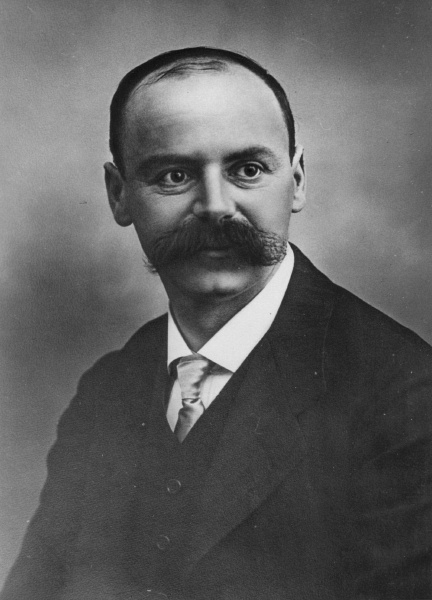
Recently, someone was telling me about a book they’d read on Karl Schwarzschild. Schwarzschild is famous for discovering the equations that describe black holes, based on Einstein’s theory of gravitation. To make the story more dramatic, he did so only shortly before dying from a disease he caught fighting in the first World War. But this person had the impression that Schwarzschild had done even more. According to this person, the book said that Schwarzschild had done something to prove Einstein’s theory, or to complete it.

Another Schwarzschild accomplishment: that mustache

At first, I thought the book this person had read was wrong. But after some investigation, I figured out what happened.

The book said that Schwarzschild had found the first exact solution to Einstein’s equations. That’s true, and as a physicist I know precisely what it means. But I now realize that the average person does not.

In school, the first equations you solve are algebraic, x+y=z. Some equations, like x^2=4, have solutions. Others, like x^2=-4, seem not to, until you learn about new types of numbers that solve them. Either way, you get used to equations being like a kind of puzzle, a question for which you need to find an answer.

If you’re thinking of equations like that, then it probably sounds like Schwarzschild “solved the puzzle”. If Schwarzschild found the first solution to Einstein’s equation, that means that Einstein did not. That makes it sound like Einstein’s work was incomplete, that he had asked the right question but didn’t yet know the right answer.

Einstein’s equations aren’t algebraic equations, though. They’re differential equations. Instead of equations for a variable, they’re equations for a mathematical function, a formula that, in this case, describes the curvature of space and time.

Scientists in many fields use differential equations, but they use them in different ways. If you’re a chemist or a biologist, it might be that you’re most used to differential equations with simple solutions, like sines, cosines, or exponentials. You learn how to solve these equations, and they feel a bit like the algebraic ones: you have a puzzle, and then you solve the puzzle.

Other fields, though, have tougher differential equations. If you’re a physicist or an engineer, you’ve likely met differential equations that you can’t treat in this way. If you’re dealing with fluid mechanics, or general relativity, or even just Newtonian gravity in an odd situation, you can’t usually solve the problem by writing down known functions like sines and cosines.

That doesn’t mean you can’t solve the problem at all, though!

Even if you can’t write down a solution to a differential equation with sines and cosines, a solution can still exist. (In some cases, we can even prove a solution exists!) It just won’t be written in terms of sines and cosines, or other functions you’ve learned in school. Instead, the solution will involve some strange functions, functions no-one has heard of before.

If you want, you can make up names for those functions. But unless you’re going to classify them in a useful way, there’s not much point. Instead, you work with these functions by approximation. You calculate them in a way that doesn’t give you the full answer, but that does let you estimate how close you are. That’s good enough to give you numbers, which in turn is good enough to compare to experiments. With just an approximate solution, like this, Einstein could check if his equations described the orbit of Mercury.

Once you know you can find these approximate solutions, you have a different perspective on equations. An equation isn’t just a mysterious puzzle. If you can approximate the solution, then you already know how to solve that puzzle. So we wouldn’t think of Einstein’s theory as incomplete because he was only able to find approximate solutions: for a theory as complicated as Einstein’s, that’s perfectly normal. Most of the time, that’s all we need.

But it’s still pretty cool when you don’t have to do this. Sometimes, we can not just approximate, but actually “write down” the solution, either using known functions or well-classified new ones. We call a solution like that an analytic solution, or an exact solution.

That’s what Schwarzschild managed. These kinds of exact solutions often only work in special situations, and Schwarzschild’s is no exception. His Schwarzschild solution works for matter in a special situation, arranged in a perfect sphere. If matter happened to be arranged in that way, then the shape of space and time would be exactly as Schwarzschild described it.

That’s actually pretty cool! Einstein’s equations are complicated enough that no-one was sure that there were any solutions like that, even in very special situations. Einstein expected it would be a long time until they could do anything except approximate solutions.

(If Schwarzschild’s solution only describes matter arranged in a perfect sphere, why do we think it describes real black holes? This took later work, by people like Roger Penrose, who figured out that matter compressed far enough will always find a solution like Schwarzschild’s.)

Schwarzschild intended to describe stars with his solution, or at least a kind of imaginary perfect star. What he found was indeed a good approximation to real stars, but also the possibility that a star shoved into a sufficiently small space would become something weird and new, something we would come to describe as a black hole. That’s a pretty impressive accomplishment, especially for someone on the front lines of World War One. And if you know the difference between an exact solution and an approximate one, you have some idea of what kind of accomplishment that is.

On Stubbornness and Breaking Down

In physics, we sometimes say that an idea “breaks down”. What do we mean by that?

When a theory “breaks down”, we mean that it stops being accurate. Newton’s theory of gravity is excellent most of the time, but for objects under strong enough gravity or high enough speed its predictions stop matching reality and a new theory (relativity) is needed. This is the sense in which we say that Newtonian gravity breaks down for the orbit of mercury, or breaks down much more severely in the area around a black hole.

When a symmetry is “broken”, we mean that it stops holding true. Most of physics looks the same when you flip it in a mirror, a property called parity symmetry. Take a pile of electric and magnetic fields, currents and wires, and you’ll find their mirror reflection is also a perfectly reasonable pile of electric and magnetic fields, currents and wires. This isn’t true for all of physics, though: the weak nuclear force isn’t the same when you flip it in a mirror. We say that the weak force breaks parity symmetry.

What about when a more general “idea” breaks down? What about space-time?

In order for space-time to break down, there needs to be a good reason to abandon the idea. And depending on how stubborn you are about it, that reason can come at different times.

You might think of space-time as just Einstein’s theory of general relativity. In that case, you could say that space-time breaks down as soon as the world deviates from that theory. In that view, any modification to general relativity, no matter how small, corresponds to space-time breaking down. You can think of this as the “least stubborn” option, the one with barely any stubbornness at all, that will let space-time break down with a tiny nudge.

But if general relativity breaks down, a slightly more stubborn person could insist that space-time is still fine. You can still describe things as located at specific places and times, moving across curved space-time. They just obey extra forces, on top of those built into the space-time.

Such a person would be happy as long as general relativity was a good approximation of what was going on, but they might admit space-time has broken down when general relativity becomes a bad approximation. If there are only small corrections on top of the usual space-time picture, then space-time would be fine, but if those corrections got so big that they overwhelmed the original predictions of general relativity then that’s quite a different situation. In that situation, space-time may have stopped being a useful description, and it may be much better to describe the world in another way.

But we could imagine an even more stubborn person who still insists that space-time is fine. Ultimately, our predictions about the world are mathematical formulas. No matter how complicated they are, we can always subtract a piece off of those formulas corresponding to the predictions of general relativity, and call the rest an extra effect. That may be a totally useless thing to do that doesn’t help you calculate anything, but someone could still do it, and thus insist that space-time still hasn’t broken down.

To convince such a person, space-time would need to break down in a way that made some important concept behind it invalid. There are various ways this could happen, corresponding to different concepts. For example, one unusual proposal is that space-time is non-commutative. If that were true then, in addition to the usual Heisenberg uncertainty principle between position and momentum, there would be an uncertainty principle between different directions in space-time. That would mean that you can’t define the position of something in all directions at once, which many people would agree is an important part of having a space-time!

Ultimately, physics is concerned with practicality. We want our concepts not just to be definable, but to do useful work in helping us understand the world. Our stubbornness should depend on whether a concept, like space-time, is still useful. If it is, we keep it. But if the situation changes, and another concept is more useful, then we can confidently say that space-time has broken down.

The Problem of Quantum Gravity Is the Problem of High-Energy (Density) Quantum Gravity

I’ve said something like this before, but here’s another way to say it.

The problem of quantum gravity is one of the most famous problems in physics. You’ve probably heard someone say that quantum mechanics and general relativity are fundamentally incompatible. Most likely, this was narrated over pictures of a foaming, fluctuating grid of space-time. Based on that, you might think that all we have to do to solve this problem is to measure some quantum property of gravity. Maybe we could make a superposition of two different gravitational fields, see what happens, and solve the problem that way.

I mean, we could do that, some people are trying to. But it won’t solve the problem. That’s because the problem of quantum gravity isn’t just the problem of quantum gravity. It’s the problem of high-energy quantum gravity.

Merging quantum mechanics and general relativity is actually pretty easy. General relativity is a big conceptual leap, certainly, a theory in which gravity is really just the shape of space-time. At the same time, though, it’s also a field theory, the same general type of theory as electromagnetism. It’s a weirder field theory than electromagnetism, to be sure, one with deeper implications. But if we want to describe low energies, and weak gravitational fields, then we can treat it just like any other field theory. We know how to write down some pretty reasonable-looking equations, we know how to do some basic calculations with them. This part is just not that scary.

The scary part happens later. The theory we get from these reasonable-looking equations continues to look reasonable for a while. It gives formulas for the probability of things happening: things like gravitational waves bouncing off each other, as they travel through space. The problem comes when those waves have very high energy, and the nice reasonable probability formula now says that the probability is greater than one.

For those of you who haven’t taken a math class in a while, probabilities greater than one don’t make sense. A probability of one is a certainty, something guaranteed to happen. A probability greater than one isn’t more certain than certain, it’s just nonsense.

So we know something needs to change, we know we need a new theory. But we only know we need that theory when the energy is very high: when it’s the Planck energy. Before then, we might still have a different theory, but we might not: it’s not a “problem” yet.

Now, a few of you understand this part, but still have a misunderstanding. The Planck energy seems high for particle physics, but it isn’t high in an absolute sense: it’s about the energy in a tank of gasoline. Does that mean that all we have to do to measure quantum gravity is to make a quantum state out of your car?

Again, no. That’s because the problem of quantum gravity isn’t just the problem of high-energy quantum gravity either.

Energy seems objective, but it’s not. It’s subjective, or more specifically, relative. Due to special relativity, observers moving at different speeds observe different energies. Because of that, high energy alone can’t be the requirement: it isn’t something either general relativity or quantum field theory can “care about” by itself.

Instead, the real thing that matters is something that’s invariant under special relativity. This is hard to define in general terms, but it’s best to think of it as a requirement for not energy, but energy density.

(For the experts: I’m justifying this phrasing in part because of how you can interpret the quantity appearing in energy conditions as the energy density measured by an observer. This still isn’t the correct way to put it, but I can’t think of a better way that would be understandable to a non-technical reader. If you have one, let me know!)

Why do we need quantum gravity to fully understand black holes? Not just because they have a lot of mass, but because they have a lot of mass concentrated in a small area, a high energy density. Ditto for the Big Bang, when the whole universe had a very large energy density. Particle colliders are useful not just because they give particles high energy, but because they give particles high energy and put them close together, creating a situation with very high energy density.

Once you understand this, you can use it to think about whether some experiment or observation will help with the problem of quantum gravity. Does the experiment involve very high energy density, much higher than anything we can do in a particle collider right now? Is that telescope looking at something created in conditions of very high energy density, or just something nearby?

It’s not impossible for an experiment that doesn’t meet these conditions to find something. Whatever the correct quantum gravity theory is, it might be different from our current theories in a more dramatic way, one that’s easier to measure. But the only guarantee, the only situation where we know we need a new theory, is for very high energy density.

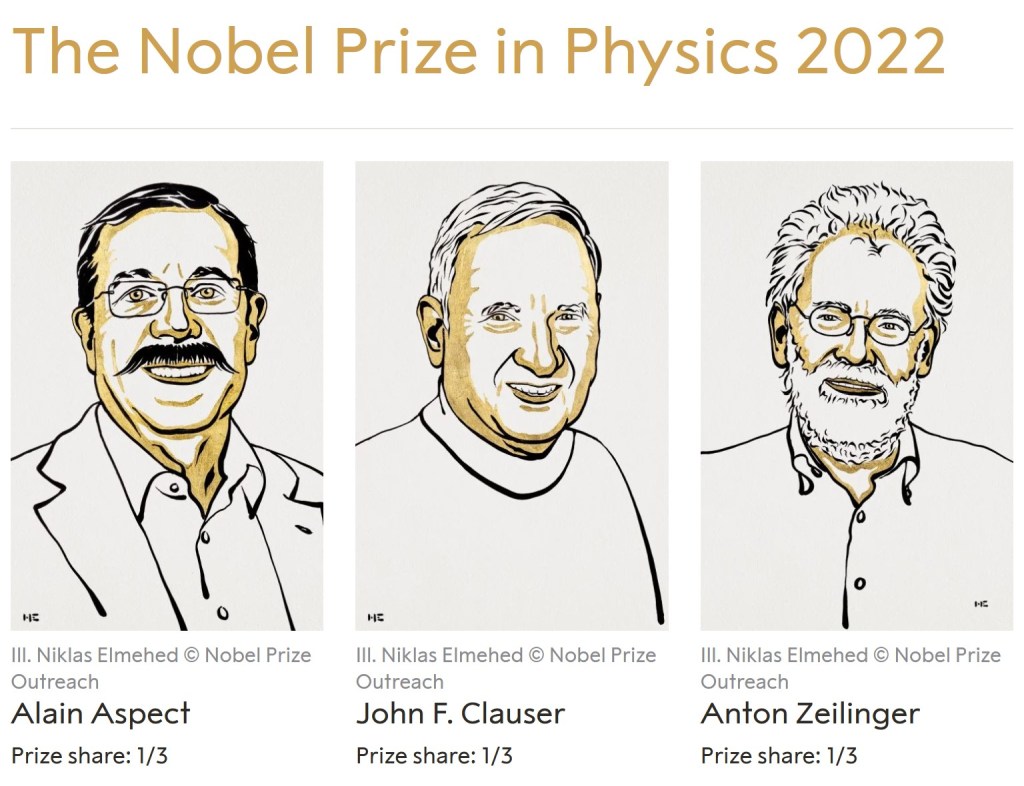
Congratulations to Alain Aspect, John F. Clauser and Anton Zeilinger!

The 2022 Nobel Prize was announced this week, awarded to Alain Aspect, John F. Clauser, and Anton Zeilinger for experiments with entangled photons, establishing the violation of Bell inequalities and pioneering quantum information science.

I’ve complained in the past about the Nobel prize awarding to “baskets” of loosely related topics. This year, though, the three Nobelists have a clear link: they were pioneers in investigating and using quantum entanglement.

You can think of a quantum particle like a coin frozen in mid-air. Once measured, the coin falls, and you read it as heads or tails, but before then the coin is neither, with equal chance to be one or the other. In this metaphor, quantum entanglement slices the coin in half. Slice a coin in half on a table, and its halves will either both show heads, or both tails. Slice our “frozen coin” in mid-air, and it keeps this property: the halves, both still “frozen”, can later be measured as both heads, or both tails. Even if you separate them, the outcomes never become independent: you will never find one half-coin to land on tails, and the other on heads.

For those who read my old posts, I think this is a much better metaphor than the different coin-cut-in-half metaphor I used five years ago.

Einstein thought that this couldn’t be the whole story. He was bothered by the way that measuring a “frozen” coin seems to change its behavior faster than light, screwing up his theory of special relativity. Entanglement, with its ability to separate halves of a coin as far as you liked, just made the problem worse. He thought that there must be a deeper theory, one with “hidden variables” that determined whether the halves would be heads or tails before they were separated.

In 1964, a theoretical physicist named J.S. Bell found that Einstein’s idea had testable consequences. He wrote down a set of statistical equations, called Bell inequalities, that have to hold if there are hidden variables of the type Einstein imagined, then showed that quantum mechanics could violate those inequalities.

Bell’s inequalities were just theory, though, until this year’s Nobelists arrived to test them. Clauser was first: in the 70’s, he proposed a variant of Bell’s inequalities, then tested them by measuring members of a pair of entangled photons in two different places. He found complete agreement with quantum mechanics.

Still, there was a loophole left for Einstein’s idea. If the settings on the two measurement devices could influence the pair of photons when they were first entangled, that would allow hidden variables to influence the outcome in a way that avoided Bell and Clauser’s calculations. It was Aspect, in the 80’s, who closed this loophole: by doing experiments fast enough to change the measurement settings after the photons were entangled, he could show that the settings could not possibly influence the forming of the entangled pair.

Aspect’s experiments, in many minds, were the end of the story. They were the ones emphasized in the textbooks when I studied quantum mechanics in school.

The remaining loopholes are trickier. Some hope for a way to correlate the behavior of particles and measurement devices that doesn’t run afoul of Aspect’s experiment. This idea, called, superdeterminism, has recently had a few passionate advocates, but speaking personally I’m still confused as to how it’s supposed to work. Others want to jettison special relativity altogether. This would not only involve measurements influencing each other faster than light, but also would break a kind of symmetry present in the experiments, because it would declare one measurement or the other to have happened “first”, something special relativity forbids. The majority, uncomfortable with either approach, thinks that quantum mechanics is complete, with no deterministic theory that can replace it. They differ only on how to describe, or interpret, the theory, a debate more the domain of careful philosophy than of physics.

After all of these philosophical debates over the nature of reality, you may ask what quantum entanglement can do for you?

Suppose you want to make a computer out of quantum particles, one that uses the power of quantum mechanics to do things no ordinary computer can. A normal computer needs to copy data from place to place, from hard disk to RAM to your processor. Quantum particles, however, can’t be copied: a theorem says that you cannot make an identical, independent copy of a quantum particle. Moving quantum data then required a new method, pioneered by Anton Zeilinger in the late 90’s using quantum entanglement. The method destroys the original particle to make a new one elsewhere, which led to it being called quantum teleportation after the Star Trek devices that do the same with human beings. Quantum teleportation can’t move information faster than light (there’s a reason the inventor of Le Guin’s ansible despairs of the materialism of “Terran physics”), but it is still a crucial technology for quantum computers, one that will be more and more relevant as time goes on.

At New Ideas in Cosmology

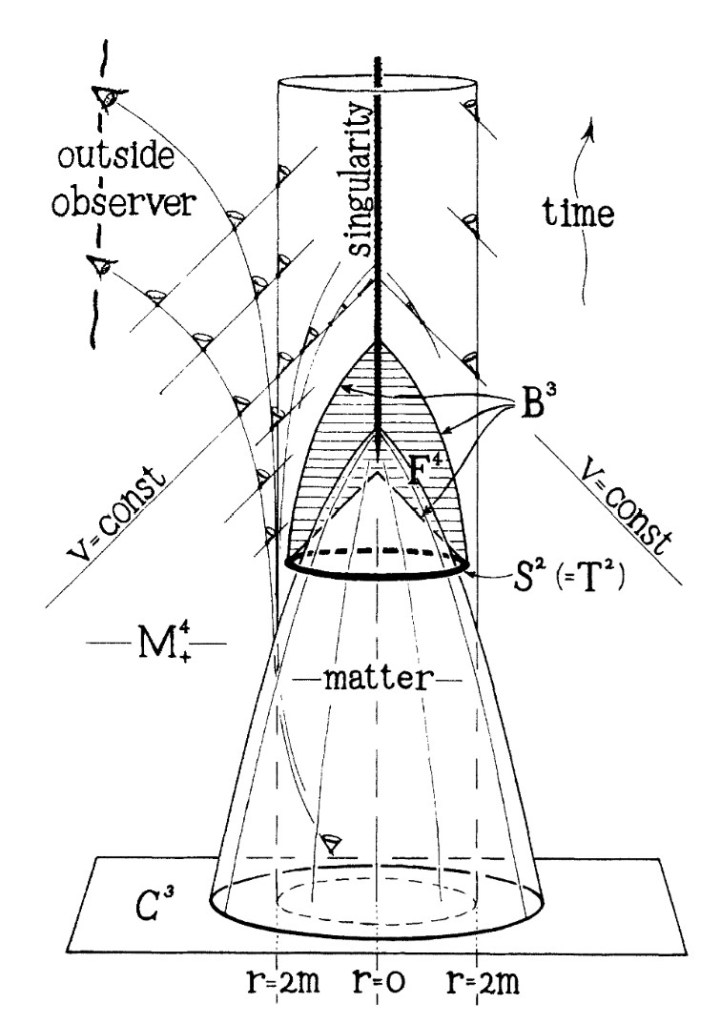
The Niels Bohr Institute is hosting a conference this week on New Ideas in Cosmology. I’m no cosmologist, but it’s a pretty cool field, so as a local I’ve been sitting in on some of the talks. So far they’ve had a selection of really interesting speakers with quite a variety of interests, including a talk by Roger Penrose with his trademark hand-stippled drawings.

Including this old classic

One thing that has impressed me has been the “interdisciplinary” feel of the conference. By all rights this should be one “discipline”, cosmology. But in practice, each speaker came at the subject from a different direction. They all had a shared core of knowledge, common models of the universe they all compare to. But the knowledge they brought to the subject varied: some had deep knowledge of the mathematics of gravity, others worked with string theory, or particle physics, or numerical simulations. Each talk, aware of the varied audience, was a bit “colloquium-style“, introducing a framework before diving in to the latest research. Each speaker knew enough to talk to the others, but not so much that they couldn’t learn from them. It’s been unexpectedly refreshing, a real interdisciplinary conference done right.