Tag Archives: PublicPerception

Why Journals Are Sticky

An older professor in my field has a quirk: every time he organizes a conference, he publishes all the talks in a conference proceeding.

In some fields, this would be quite normal. In computer science, where progress flows like a torrent, new developments are announced at conferences long before they have the time to be written up carefully as a published paper. Conference proceedings are summaries of what was presented at the conference, published so that anyone can catch up on the new developments.

In my field, this is rarer. A few results at each conference will be genuinely new, never-before-published discoveries. Most, though, are talks on older results, results already available online. Writing them up again in summarized form as a conference proceeding seems like a massive waste of time.

The cynical explanation is that this professor is doing this for the citations. Each conference proceeding one of his students publishes is another publication on their CV, another work that they can demand people cite whenever someone uses their ideas or software, something that puts them above others’ students without actually doing any extra scientific work.

I don’t think that’s how this professor thinks about it, though. He certainly cares about his students’ careers, and will fight for them to get cited as much as possible. But he asks everyone at the conference to publish a proceeding, not just his students. I think he’d argue that proceedings are helpful, that they can summarize papers in new ways and make them more accessible. And if they give everyone involved a bit more glory, if they let them add new entries to their CV and get fancy books on their shelves, so much the better for everyone.

My guess is, he really believes something like that. And I’m fairly sure he’s wrong.

The occasional conference proceeding helps, but only because it makes us more flexible. Sometimes, it’s important to let others know about a new result that hasn’t been published yet, and we let conference proceedings go into less detail than a full published paper, so this can speed things up. Sometimes, an old result can benefit from a new, clearer explanation, which normally couldn’t be published without it being a new result (or lecture notes). It’s good to have the option of a conference proceeding.

But there is absolutely no reason to have one for every single talk at a conference.

Between the cynical reason and the explicit reason, there’s the banal one. This guy insists on conference proceedings because they were more useful in the past, because they’re useful in other fields, and because he’s been doing them himself for years. He insists on them because to him, they’re a part of what it means to be a responsible scientist.

And people go along with it. Because they don’t want to get into a fight with this guy, certainly. But also because it’s a bit of extra work that could give a bit of a career boost, so what’s the harm?

I think something similar to this is why academic journals still work the way they do.

In the past, journals were the way physicists heard about new discoveries. They would get each edition in the mail, and read up on new developments. The journal needed to pay professional copyeditors and printers, so they needed money, and they got that money from investors by being part of for-profit companies that sold shares.

Now, though, physicists in my field don’t read journals. We publish our new discoveries online on a non-profit website, formatting them ourselves with software that uses the same programming skills we use in the rest of our professional lives. We then discuss the papers in email threads and journal club meetings. When a paper is wrong, or missing something important, we tell the author, and they fix it.

Oh, and then after that we submit the papers to the same for-profit journals and the same review process that we used to use before we did all this, listing the journals that finally accept the papers on our CVs.

Why do we still do that?

Again, you can be cynical. You can accuse the journals of mafia-ish behavior, you can tie things back to the desperate need to publish in high-ranked journals to get hired. But I think the real answer is a bit more innocent, and human, than that.

Imagine that you’re a senior person in the field. You may remember the time before we had all of these nice web-based publishing options, when journals were the best way to hear about new developments. More importantly than that, though, you’ve worked with these journals. You’ve certainly reviewed papers for them, everyone in the field does that, but you may have also served as an editor, tracking down reviewers and handling communication between the authors and the journal. You’ve seen plenty of cases where the journal mattered, where tracking down the right reviewers caught a mistake or shot down a crackpot’s ambitions, where the editing cleaned something up or made a work more appear more professional. You think of the journals as having high standards, standards you have helped to uphold: when choosing between candidates for a job, you notice that one has several papers in Physical Review Letters, and remember papers you’ve rejected for not meeting what you intuited were that journal’s standards. To you, journals are a key part of being a responsible scientist.

Does any of that make journals worth it, though?

Well, that depends on costs. It depends on alternatives. It depends not merely on what the journals catch, but on how often they do it, and how much would have been caught on its own. It depends on whether the high standards you want to apply to job applicants are already being applied by the people who write their recommendation letters and establish their reputations.

And you’re not in a position to evaluate any of that, of course. Few people are, who don’t spend a ton of time thinking about scientific publishing.

And thus, for the non-senior people, there’s not much reason to push back. One hears a few lofty speeches about Elsevier’s profits, and dreams about the end of the big for-profit journals. But most people aren’t cut out to be crusaders or reformers, especially when they signed up to be scientists. Most people are content not to annoy the most respected people in their field by telling them that something they’ve spent an enormous amount of time on is now pointless. Most people want to be seen as helpful by these people, to not slack off on work like reviewing that they argue needs doing.

And most of us have no reason to think we know that much better, anyway. Again, we’re scientists, not scientific publishing experts.

I don’t think it’s good practice to accuse people of cognitive biases. Everyone thinks they have good reasons to believe what they believe, and the only way to convince them is to address those reasons.

But the way we use journals in physics these days is genuinely baffling. It’s hard to explain, it’s the kind of thing people have been looking quizzically at for years. And this kind of explanation is the only one I’ve found that matches what I’ve seen. Between the cynical explanation and the literal arguments, there’s the basic human desire to do what seems like the responsible thing. That tends to explain a lot.
Why Quantum Gravity Is Controversial

Merging quantum mechanics and gravity is a famously hard physics problem. Explaining why merging quantum mechanics and gravity is hard is, in turn, a very hard science communication problem. The more popular descriptions tend to lead to misunderstandings, and I’ve posted many times over the years to chip away at those misunderstandings.

Merging quantum mechanics and gravity is hard…but despite that, there are proposed solutions. String Theory is supposed to be a theory of quantum gravity. Loop Quantum Gravity is supposed to be a theory of quantum gravity. Asymptotic Safety is supposed to be a theory of quantum gravity.

One of the great virtues of science and math is that we are, eventually, supposed to agree. Philosophers and theologians might argue to the end of time, but in math we can write down a proof, and in science we can do an experiment. If we don’t yet have the proof or the experiment, then we should reserve judgement. Either way, there’s no reason to get into an unproductive argument.

Despite that, string theorists and loop quantum gravity theorists and asymptotic safety theorists, famously, like to argue! There have been bitter, vicious, public arguments about the merits of these different theories, and decades of research doesn’t seem to have resolved them. To an outside observer, this makes quantum gravity seem much more like philosophy or theology than like science or math.

Why is there still controversy in quantum gravity? We can’t do quantum gravity experiments, sure, but if that were the problem physicists could just write down the possibilities and leave it at that. Why argue?

Some of the arguments are for silly aesthetic reasons, or motivated by academic politics. Some are arguments about which approaches are likely to succeed in future, which as always is something we can’t actually reliably judge. But the more justified arguments, the strongest and most durable ones, are about a technical challenge. They’re about something called non-perturbative physics.

Most of the time, when physicists use a theory, they’re working with an approximation. Instead of the full theory, they’re making an assumption that makes the theory easier to use. For example, if you assume that the velocity of an object is small, you can use Newtonian physics instead of special relativity. Often, physicists can systematically relax these assumptions, including more and more of the behavior of the full theory and getting a better and better approximation to the truth. This process is called perturbation theory.

Other times, this doesn’t work well. The full theory has some trait that isn’t captured by the approximations, something that hides away from these systematic tools. The theory has some important aspect that is non-perturbative.

Every proposed quantum gravity theory uses approximations like this. The theory’s proponents try to avoid these approximations when they can, but often they have to approximate and hope they don’t miss too much. The opponents, in turn, argue that the theory’s proponents are missing something important, some non-perturbative fact that would doom the theory altogether.

Asymptotic Safety is built on top of an approximation, one different from what other quantum gravity theorists typically use. To its proponents, work using their approximation suggests that gravity works without any special modifications, that the theory of quantum gravity is easier to find than it seems. Its opponents aren’t convinced, and think that the approximation is missing something important which shows that gravity needs to be modified.

In Loop Quantum Gravity, the critics think their approximation misses space-time itself. Proponents of Loop Quantum Gravity have been unable to prove that their theory, if you take all the non-perturbative corrections into account, doesn’t just roll up all of space and time into a tiny spiky ball. They expect that their theory should allow for a smooth space-time like we experience, but the critics aren’t convinced, and without being able to calculate the non-perturbative physics neither side can convince the other.

String Theory was founded and originally motivated by perturbative approximations. Later, String Theorists figured out how to calculate some things non-perturbatively, often using other simplifications like supersymmetry. But core questions, like whether or not the theory allows a positive cosmological constant, seem to depend on non-perturbative calculations that the theory gives no instructions for how to do. Some critics don’t think there is a consistent non-perturbative theory at all, that the approximations String Theorists use don’t actually approximate to anything. Even within String Theory, there are worries that the theory might try to resist approximation in odd ways, becoming more complicated whenever a parameter is small enough that you could use it to approximate something.

All of this would be less of a problem with real-world evidence. Many fields of science are happy to use approximations that aren’t completely rigorous, as long as those approximations have a good track record in the real world. In general though, we don’t expect evidence relevant to quantum gravity any time soon. Maybe we’ll get lucky, and studies of cosmology will reveal something, or an experiment on Earth will have a particularly strange result. But nature has no obligation to help us out.

Without evidence, though, we can still make mathematical progress. You could imagine someone proving that the various perturbative approaches to String Theory become inconsistent when stitched together into a full non-perturbative theory. Alternatively, you could imagine someone proving that a theory like String Theory is unique, that no other theory can do some key thing that it does. Either of these seems unlikely to come any time soon, and most researchers in these fields aren’t pursuing questions like that. But the fact the debate could be resolved means that it isn’t just about philosophy or theology. There’s a real scientific, mathematical controversy, one rooted in our inability to understand these theories beyond the perturbative methods their proponents use. And while I don’t expect it to be resolved any time soon, one can always hold out hope for a surprise.

Clickbait or Koan

Last month, I had a post about a type of theory that is, in a certain sense, “immune to gravity”. These theories don’t allow you to build antigravity machines, and they aren’t totally independent of the overall structure of space-time. But they do ignore the core thing most people think of as gravity, the curvature of space that sends planets around the Sun and apples to the ground. And while that trait isn’t something we can use for new technology, it has led to extremely productive conversations between mathematicians and physicists.

After posting, I had some interesting discussions on twitter. A few people felt that I was over-hyping things. Given all the technical caveats, does it really make sense to say that these theories defy gravity? Isn’t a title like “Gravity-Defying Theories” just clickbait?

Obviously, I don’t think so.

There’s a concept in education called inductive teaching. We remember facts better when they come in context, especially the context of us trying to solve a puzzle. If you try to figure something out, and then find an answer, you’re going to remember that answer better than if you were just told the answer from the beginning. There are some similarities here to the concept of a Zen koan: by asking questions like “what is the sound of one hand clapping?” a Zen master is supposed to get you to think about the world in a different way.

When I post with a counterintuitive title, I’m aiming for that kind of effect. I know that you’ll read the title and think “that can’t be right!” Then you’ll read the post, and hear the explanation. That explanation will stick with you better because you asked that question, because “how can that be right?” is the solution to a puzzle that, in that span of words, you cared about.

Clickbait is bad for two reasons. First, it sucks you in to reading things that aren’t actually interesting. I write my blog posts because I think they’re interesting, so I hope I avoid that. Second, it can spread misunderstandings. I try to be careful about these, and I have some tips how you can be too:

  1. Correct the misunderstanding early. If I’m worried a post might be misunderstood in a clickbaity way, I make sure that every time I post the link I include a sentence discouraging the misunderstanding. For example, for the post on Gravity-Defying Theories, before the link I wrote “No flying cars, but it is technically possible for something to be immune to gravity”. If I’m especially worried, I’ll also make sure that the first paragraph of the piece corrects the misunderstanding as well.
  2. Know your audience. This means both knowing the normal people who read your work, and how far something might go if it catches on. Your typical readers might be savvy enough to skip the misunderstanding, but if they latch on to the naive explanation immediately then the “koan” effect won’t happen. The wider your reach can be, the more careful you need to be about what you say. If you’re a well-regarded science news piece, don’t write a title saying that scientists have built a wormhole.
  3. Have enough of a conclusion to be “worth it”. This is obviously a bit subjective. If your post introduces a mystery and the answer is that you just made some poetic word choice, your audience is going to feel betrayed, like the puzzle they were considering didn’t have a puzzly answer after all. Whatever you’re teaching in your post, it needs to have enough “meat” that solving it feels like a real discovery, like the reader did some real work to solve it.

I don’t think I always live up to these, but I do try. And I think trying is better than the conservative option, of never having catchy titles that make counterintuitive claims. One of the most fun aspects of science is that sometimes a counterintuitive fact is actually true, and that’s an experience I want to share.

Does Science Require Publication?

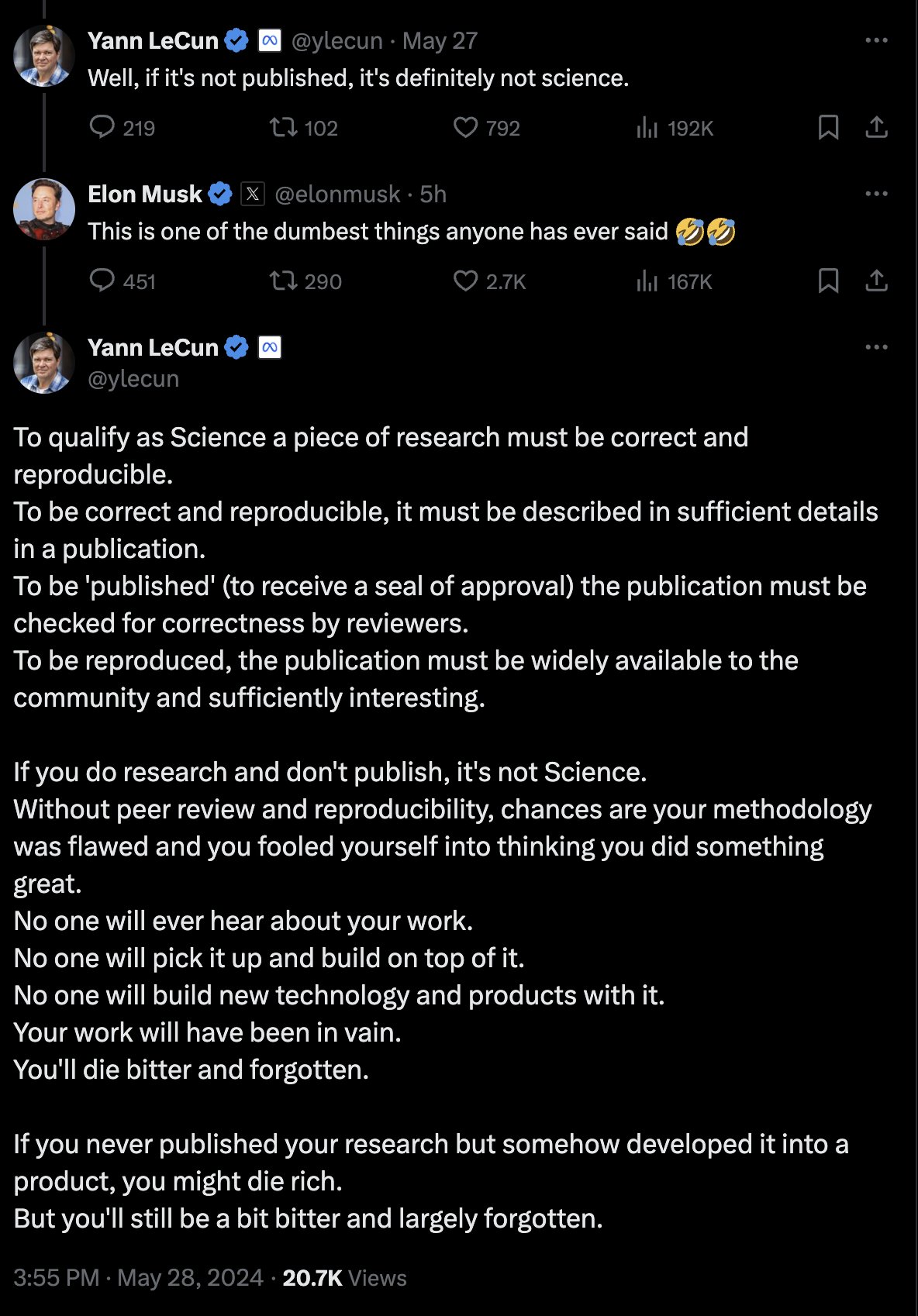
Seen on Twitter:

As is traditional, twitter erupted into dumb arguments over this. Some made fun of Yann LeCun for implying that Elon Musk will be forgotten, which despite any other faults of his seems unlikely. Science popularizer Sabine Hossenfelder pointed out that there are two senses of “publish” getting confused here: publish as in “make public” and publish as in “put in a scientific journal”. The latter tends to be necessary for scientists in practice, but is not required in principle. (The way journals work has changed a lot over just the last century!) The former, Sabine argued, is still 100% necessary.

Plenty of people on twitter still disagreed (this always happens). It got me thinking a bit about the role of publication in science.

When we talk about what science requires or doesn’t require, what are we actually talking about?

“Science” is a word, and like any word its meaning is determined by how it is used. Scientists use the word “science” of course, as do schools and governments and journalists. But if we’re getting into arguments about what does or does not count as science, then we’re asking about a philosophical problem, one in which philosophers of science try to understand what counts as science and what doesn’t.

What do philosophers of science want? Many things, but a big one is to explain why science works so well. Over a few centuries, humanity went from understanding the world in terms of familiar materials and living creatures to decomposing them in terms of molecules and atoms and cells and proteins. In doing this, we radically changed what we were capable of, computers out of the reach of blacksmiths and cures for diseases that weren’t even distinguishable. And while other human endeavors have seen some progress over this time (democracy, human rights…), science’s accomplishment demands an explanation.

Part of that explanation, I think, has to include making results public. Alchemists were interested in many of the things later chemists were, and had started to get some valuable insights. But alchemists were fearful of what their knowledge would bring (especially the ones who actually thought they could turn lead into gold). They published almost only in code. As such, the pieces of progress they made didn’t build up, didn’t aggregate, didn’t become overall progress. It was only when a new scientific culture emerged, when natural philosophers and physicists and chemists started writing to each other as clearly as they could, that knowledge began to build on itself.

Some on twitter pointed out the example of the Manhattan project during World War II. A group of scientists got together and made progress on something almost entirely in secret. Does that not count as science?

I’m willing to bite this bullet: I don’t think it does! When the Soviets tried to replicate the bomb, they mostly had to start from scratch, aside from some smuggled atomic secrets. Today, nations trying to build their own bombs know more, but they still must reinvent most of it. We may think this is a good thing, we may not want more countries to make progress in this way. But I don’t think we can deny that it genuinely does slow progress!

At the same time, to contradict myself a bit: I think you can think of science that happens within a particular community. The scientists of the Manhattan project didn’t publish in journals the Soviets could read. But they did write internal reports, they did publish to each other. I don’t think science by its nature has to include the whole of humanity (if it does, then perhaps studying the inside of black holes really is unscientific). You probably can do science sticking to just your own little world. But it will be slower. Better, for progress’s sake, if you can include people from across the world.

The Impact of Jim Simons

The obituaries have been weirdly relevant lately.

First, a couple weeks back, Daniel Dennett died. Dennett was someone who could have had a huge impact on my life. Growing up combatively atheist in the early 2000’s, Dennett seemed to be exploring every question that mattered: how the semblance of consciousness could come from non-conscious matter, how evolution gives rise to complexity, how to raise a new generation to grow beyond religion and think seriously about the world around them. I went to Tufts to get my bachelor’s degree based on a glowing description he wrote in the acknowledgements of one of his books, and after getting there, I asked him to be my advisor.

(One of three, because the US education system, like all good games, can be min-maxed.)

I then proceeded to be far too intimidated to have a conversation with him more meaningful than “can you please sign my registration form?”

I heard a few good stories about Dennett while I was there, and I saw him debate once. I went into physics for my PhD, not philosophy.

Jim Simons died on May 10. I never spoke to him at all, not even to ask him to sign something. But he had a much bigger impact on my life.

I began my PhD at SUNY Stony Brook with a small scholarship from the Simons Foundation. The university’s Simons Center for Geometry and Physics had just opened, a shining edifice of modern glass next to the concrete blocks of the physics and math departments.

For a student aspiring to theoretical physics, the Simons Center virtually shouted a message. It taught me that physics, and especially theoretical physics, was something prestigious, something special. That if I kept going down that path I could stay in that world of shiny new buildings and daily cookie breaks with the occasional fancy jar-based desserts, of talks by artists and a café with twenty-dollar lunches (half-price once a week for students, the only time we could afford it, and still about twice what we paid elsewhere on campus). There would be garden parties with sushi buffets and late conference dinners with cauliflower steaks and watermelon salads. If I was smart enough (and I longed to be smart enough), that would be my future.

Simons and his foundation clearly wanted to say something along those lines, if not quite as filtered by the stars in a student’s eyes. He thought that theoretical physics, and research more broadly, should be something prestigious. That his favored scholars deserved more, and should demand more.

This did have weird consequences sometimes. One year, the university charged us an extra “academic excellence fee”. The story we heard was that Simons had demanded Stony Brook increase its tuition in order to accept his donations, so that it would charge more similarly to more prestigious places. As a state university, Stony Brook couldn’t do that…but it could add an extra fee. And since PhD students got their tuition, but not fees, paid by the department, we were left with an extra dent in our budgets.

The Simons Foundation created Quanta Magazine. If the Simons Center used food to tell me physics mattered, Quanta delivered the same message to professors through journalism. Suddenly, someone was writing about us, not just copying press releases but with the research and care of an investigative reporter. And they wrote about everything: not just sci-fi stories and cancer cures but abstract mathematics and the space of quantum field theories. Professors who had spent their lives straining to capture the public’s interest suddenly were shown an audience that actually wanted the real story.

In practice, the Simons Foundation made its decisions through the usual experts and grant committees. But the way we thought about it, the decisions always had a Jim Simons flavor. When others in my field applied for funding from the Foundation, they debated what Simons would want: would he support research on predictions for the LHC and LIGO? Or would he favor links to pure mathematics, or hints towards quantum gravity? Simons Collaboration Grants have an enormous impact on theoretical physics, dwarfing many other sources of funding. A grant funds an army of postdocs across the US, shifting the priorities of the field for years at a time.

Denmark has big foundations that have an outsize impact on science. Carlsberg, Villum, and the bigger-than-Denmark’s GDP Novo Nordisk have foundations with a major influence on scientific priorities. But Denmark is a country of six million. It’s much harder to have that influence on a country of three hundred million. Despite that, Simons came surprisingly close.

While we did like to think of the Foundation’s priorities as Simons’, I suspect that it will continue largely on the same track without him. Quanta Magazine is editorially independent, and clearly puts its trust in the journalists that made it what it is today.

I didn’t know Simons, I don’t think I even ever smelled one of his famous cigars. Usually, that would be enough to keep me from writing a post like this. But, through the Foundation, and now through Quanta, he’s been there with me the last fourteen years. That’s worth a reflection, at the very least.

Getting It Right vs Getting It Done

With all the hype around machine learning, I occasionally get asked if it could be used to make predictions for particle colliders, like the LHC.

Physicists do use machine learning these days, to be clear. There are tricks and heuristics, ways to quickly classify different particle collisions and speed up computation. But if you’re imagining something that replaces particle physics calculations entirely, or even replace the LHC itself, then you’re misunderstanding what particle physics calculations are for.

Why do physicists try to predict the results of particle collisions? Why not just observe what happens?

Physicists make predictions not in order to know what will happen in advance, but to compare those predictions to experimental results. If the predictions match the experiments, that supports existing theories like the Standard Model. If they don’t, then a new theory might be needed.

Those predictions certainly don’t need to be made by humans: most of the calculations are done by computers anyway. And they don’t need to be perfectly accurate: in particle physics, every calculation is an approximation. But the approximations used in particle physics are controlled approximations. Physicists keep track of what assumptions they make, and how they might go wrong. That’s not something you can typically do in machine learning, where you might train a neural network with millions of parameters. The whole point is to be able to check experiments against a known theory, and we can’t do that if we don’t know whether our calculation actually respects the theory.

That difference, between caring about the result and caring about how you got there, is a useful guide. If you want to predict how a protein folds in order to understand what it does in a cell, then you will find AlphaFold useful. If you want to confirm your theory of how protein folding happens, it will be less useful.

Some industries just want the final result, and can benefit from machine learning. If you want to know what your customers will buy, or which suppliers are cheating you, or whether your warehouse is moldy, then machine learning can be really helpful.

Other industries are trying, like particle physicists, to confirm that a theory is true. If you’re running a clinical trial, you want to be crystal clear about how the trial data turn into statistics. You, and the regulators, care about how you got there, not just about what answer you got. The same can be true for banks: if laws tell you you aren’t allowed to discriminate against certain kinds of customers for loans, you need to use a method where you know what traits you’re actually discriminating against.

So will physicists use machine learning? Yes, and more of it over time. But will they use it to replace normal calculations, or replace the LHC? No, that would be missing the point.

Peer Review in Post-scarcity Academia

I posted a link last week to a dialogue written by a former colleague of mine, Sylvain Ribault. Sylvain’s dialogue is a summary of different perspectives on academic publishing. Unlike certain more famous dialogues written by physicists, Sylvain’s account doesn’t have a clear bias: he’s trying to set out the concerns different stakeholders might have and highlight the history of the subject, without endorsing one particular approach as the right one.

The purpose of such a dialogue is to provoke thought, and true to its purpose, the dialogue got me thinking.

Why do peer review? Why do we ask three or so people to read every paper, comment on it, and decide whether it should be published? While one can list many reasons, they seem to fall into two broad groups:

  1. We want to distinguish better science from worse science. We want to reward the better scientists with jobs and grants and tenure. To measure whether scientists are better, we want to see whether they publish more often in the better journals. We then apply those measures on up the chain, funding universities more when they have better scientists, and supporting grant programs that bring about better science.
  2. We want published science to be true. We want to make sure that when a paper is published that the result is actually genuine, free both from deception and from mistakes. We want journalists and the public to know which scientific results are valid, and we want scientists to know what results they can base their own research on.

The first set of goals is a product of scarcity. If we could pay every scientist and fund every scientific project with no cost, we wouldn’t need to worry so much about better and worse science. We’d fund it all and see what happens. The second set of goals is more universal: the whole point of science is to find out the truth, and we want a process that helps to achieve that.

My approach to science is to break problems down. What happens if we had only the second set of concerns, and not the first?

Well, what happens to hobbyists?

I’ve called hobby communities a kind of “post-scarcity academia”. Hobbyists aren’t trying to get jobs doing their hobby or get grants to fund it. They have their day jobs, and research their hobby as a pure passion project. There isn’t much need to rank which hobbyists are “better” than others, but they typically do care about whether what they write is true. So what happens when it’s not?

Sometimes, not much.

My main hobby community was Dungeons and Dragons. In a game with over 50 optional rulebooks covering multiple partially compatible-editions, there were frequent arguments about what the rules actually meant. Some were truly matters of opinion, but some were true misunderstandings, situations where many people thought a rule worked a certain way until they heard the right explanation.

One such rule regarded a certain type of creature called a Warbeast. Warbeasts, like Tolkien’s Oliphaunts, are “upgraded” versions of more normal wild animals, bred and trained for war. There were rules to train a Warbeast, and people interpreted these rules differently: some thought you could find an animal in the wild and train it to become a Warbeast, others thought the rules were for training a creature that was already a Warbeast to fight.

I supported the second interpretation: you can train an existing Warbeast, you can’t train a wild animal to make it into a Warbeast. As such, keep in mind, I’m biased. But every time I explained the reasoning (pointing out that the text was written in the context of an earlier version of the game, and how the numbers in it matched up with that version), people usually agreed with me. And yet, I kept seeing people use the other interpretation. New players would come in asking how to play the game, and get advised to go train wild animals to make them into Warbeasts.

Ok, so suppose the Dungeons and Dragons community had a peer review process. Would that change anything?

Not really! The wrong interpretation was popular. If whoever first proposed it got three random referees, there’s a decent chance none of them would spot the problem. In good science, sometimes the problems with an idea are quite subtle. Referees will spot obvious issues (and not even all of those!), but only the most diligent review (which sometimes happens in mathematics, and pretty much nowhere else) can spot subtle flaws in an argument. For an experiment, you sometimes need more than that: not just a review, but an actual replication.

What would have helped the Dungeons and Dragons community? Not peer review, but citations.

Suppose that, every time someone suggested you could train a wild animal to make it a Warbeast, they had to link to the first post suggesting you could do this. Then I could go to that first post, and try to convince the author that my interpretation was correct. If I succeeded, the author could correct their post, and then every time someone followed one of these citation links it would tell them the claim was wrong.

Academic citations don’t quite work like this. But the idea is out there. People have suggested letting anyone who wants to review a paper, and publishing the reviews next to the piece like comments on a blog post. Sylvain’s dialogue mentions a setup like this, and some of the risks involved.

Still, a setup like that would have gone a long way towards solving the problem for the Dungeons and Dragons community. It has me thinking that something like that is worth exploring.

No Unmoved Movers

Economists must find academics confusing.

When investors put money in a company, they have some control over what that company does. They vote to decide a board, and the board votes to hire a CEO. If the company isn’t doing what the investors want, the board can fire the CEO, or the investors can vote in a new board. Everybody is incentivized to do what the people who gave the money want to happen. And usually, those people want the company to increase its profits, since most of them people are companies with their own investors).

Academics are paid by universities and research centers, funded in the aggregate by governments and student tuition and endowments from donors. But individually, they’re also often funded by grants.

What grant-givers want is more ambiguous. The money comes in big lumps from governments and private foundations, which generally want something vague like “scientific progress”. The actual decision of who gets the money are made by committees made up of senior scientists. These people aren’t experts in every topic, so they have to extrapolate, much as investors have to guess whether a new company will be profitable based on past experience. At their best, they use their deep familiarity with scientific research to judge which projects are most likely to work, and which have the most interesting payoffs. At their weakest, though, they stick with ideas they’ve heard of, things they know work because they’ve seen them work before. That, in a nutshell, is why mainstream research prevails: not because the mainstream wants to suppress alternatives, but because sometimes the only way to guess if something will work is raw familiarity.

(What “works” means is another question. The cynical answers are “publishes papers” or “gets citations”, but that’s a bit unfair: in Europe and the US, most funders know that these numbers don’t tell the whole story. The trivial answer is “achieves what you said it would”, but that can’t be the whole story, because some goals are more pointless than others. You might want the answer to be “benefits humanity”, but that’s almost impossible to judge. So in the end the answer is “sounds like good science”, which is vulnerable to all the fads you can imagine…but is pretty much our only option, regardless.)

So are academics incentivized to do what the grant committees want? Sort of.

Science never goes according to plan. Grant committees are made up of scientists, so they know that. So while many grants have a review process afterwards to see whether you achieved what you planned, they aren’t all that picky about it. If you can tell a good story, you can explain why you moved away from your original proposal. You can say the original idea inspired a new direction, or that it became clear that a new approach was necessary. I’ve done this with an EU grant, and they were fine with it.

Looking at this, you might imagine that an academic who’s a half-capable storyteller could get away with anything they wanted. Propose a fashionable project, work on what you actually care about, and tell a good story afterwards to avoid getting in trouble. As long as you’re not literally embezzling the money (the guy who was paying himself rent out of his visitor funding, for instance), what could go wrong? You get the money without the incentives, you move the scientific world and nobody gets to move you.

It’s not quite that easy, though.

Sabine Hossenfelder told herself she could do something like this. She got grants for fashionable topics she thought were pointless, and told herself she’d spend time on the side on the things she felt were actually important. Eventually, she realized she wasn’t actually doing the important things: the faddish research ended up taking all her time. Not able to get grants doing what she actually cared about (and, in one of those weird temporary European positions that only lasts until you run out of grants), she now has to make a living from her science popularization work.

I can’t speak for Hossenfelder, but I’ve also put some thought into how to choose what to research, about whether I could actually be an unmoved mover. A few things get in the way:

First, applying for grants doesn’t just take storytelling skills, it takes scientific knowledge. Grant committees aren’t experts in everything, but they usually send grants to be reviewed by much more appropriate experts. These experts will check if your grant makes sense. In order to make the grant make sense, you have to know enough about the faddish topic to propose something reasonable. You have to keep up with the fad. You have to spend time reading papers, and talking to people in the faddish subfield. This takes work, but also changes your motivation. If you spend time around people excited by an idea, you’ll either get excited too, or be too drained by the dissonance to get any work done.

Second, you can’t change things that much. You still need a plausible story as to how you got from where you are to where you are going.

Third, you need to be a plausible person to do the work. If the committee looks at your CV and sees that you’ve never actually worked on the faddish topic, they’re more likely to give a grant to someone who’s actually worked on it.

Fourth, you have to choose what to do when you hire people. If you never hire any postdocs or students working on the faddish topic, then it will be very obvious that you aren’t trying to research it. If you do hire them, then you’ll be surrounded by people who actually care about the fad, and want your help to understand how to work with it.

Ultimately, to avoid the grant committee’s incentives, you need a golden tongue and a heart of stone, and even then you’ll need to spend some time working on something you think is pointless.

Even if you don’t apply for grants, even if you have a real permanent position or even tenure, you still feel some of these pressures. You’re still surrounded by people who care about particular things, by students and postdocs who need grants and jobs and fellow professors who are confident the mainstream is the right path forward. It takes a lot of strength, and sometimes cruelty, to avoid bowing to that.

So despite the ambiguous rules and lack of oversight, academics still respond to incentives: they can’t just do whatever they feel like. They aren’t bound by shareholders, they aren’t expected to make a profit. But ultimately, the things that do constrain them, expertise and cognitive load, social pressure and compassion for those they mentor, those can be even stronger.

I suspect that those pressures dominate the private sector as well. My guess is that for all that companies think of themselves as trying to maximize profits, the all-too-human motivations we share are more powerful than any corporate governance structure or org chart. But I don’t know yet. Likely, I’ll find out soon.

The Hidden Higgs

Peter Higgs, the theoretical physicist whose name graces the Higgs boson, died this week.

Peter Higgs, after the Higgs boson discovery was confirmed

This post isn’t an obituary: you can find plenty of those online, and I don’t have anything special to say that others haven’t. Reading the obituaries, you’ll notice they summarize Higgs’s contribution in different ways. Higgs was one of the people who proposed what today is known as the Higgs mechanism, the principle by which most (perhaps all) elementary particles gain their mass. He wasn’t the only one: Robert Brout and François Englert proposed essentially the same idea in a paper that was published two months earlier, in August 1964. Two other teams came up with the idea slightly later than that: Gerald Guralnik, Carl Richard Hagen, and Tom Kibble were published one month after Higgs, while Alexander Migdal and Alexander Polyakov found the idea independently in 1965 but couldn’t get it published till 1966.

Higgs did, however, do something that Brout and Englert didn’t. His paper doesn’t just propose a mechanism, involving a field which gives particles mass. It also proposes a particle one could discover as a result. Read the more detailed obituaries, and you’ll discover that this particle was not in the original paper: Higgs’s paper was rejected at first, and he added the discussion of the particle to make it more interesting.

At this point, I bet some of you are wondering what the big deal was. You’ve heard me say that particles are ripples in quantum fields. So shouldn’t we expect every field to have a particle?

Tell that to the other three Higgs bosons.

Electromagnetism has one type of charge, with two signs: plus, and minus. There are electrons, with negative charge, and their anti-particles, positrons, with positive charge.

Quarks have three types of charge, called colors: red, green, and blue. Each of these also has two “signs”: red and anti-red, green and anti-green, and blue and anti-blue. So for each type of quark (like an up quark), there are six different versions: red, green, and blue, and anti-quarks with anti-red, anti-green, and anti-blue.

Diagram of the colors of quarks

When we talk about quarks, we say that the force under which they are charged, the strong nuclear force, is an “SU(3)” force. The “S” and “U” there are shorthand for mathematical properties that are a bit too complicated to explain here, but the “(3)” is quite simple: it means there are three colors.

The Higgs boson’s primary role is to make the weak nuclear force weak, by making the particles that carry it from place to place massive. (That way, it takes too much energy for them to go anywhere, a feeling I think we can all relate to.) The weak nuclear force is an “SU(2)” force. So there should be two “colors” of particles that interact with the weak nuclear force…which includes Higgs bosons. For each, there should also be an anti-color, just like the quarks had anti-red, anti-green, and anti-blue. So we need two “colors” of Higgs bosons, and two “anti-colors”, for a total of four!

But the Higgs boson discovered at the LHC was a neutral particle. It didn’t have any electric charge, or any color. There was only one, not four. So what happened to the other three Higgs bosons?

The real answer is subtle, one of those physics things that’s tricky to concisely explain. But a partial answer is that they’re indistinguishable from the W and Z bosons.

Normally, the fundamental forces have transverse waves, with two polarizations. Light can wiggle along its path back and forth, or up and down, but it can’t wiggle forward and backward. A fundamental force with massive particles is different, because they can have longitudinal waves: they have an extra direction in which they can wiggle. There are two W bosons (plus and minus) and one Z boson, and they all get one more polarization when they become massive due to the Higgs.

That’s three new ways the W and Z bosons can wiggle. That’s the same number as the number of Higgs bosons that went away, and that’s no coincidence. We physicist like to say that the W and Z bosons “ate” the extra Higgs, which is evocative but may sound mysterious. Instead, you can think of it as the two wiggles being secretly the same, mixing together in a way that makes them impossible to tell apart.

The “count”, of how many wiggles exist, stays the same. You start with four Higgs wiggles, and two wiggles each for the precursors of the W+, W-, and Z bosons, giving ten. You end up with one Higgs wiggle, and three wiggles each for the W+, W-, and Z bosons, which still adds up to ten. But which fields match with which wiggles, and thus which particles we can detect, changes. It takes some thought to look at the whole system and figure out, for each field, what kind of particle you might find.

Higgs did that work. And now, we call it the Higgs boson.

Making More Nails

They say when all you have is a hammer, everything looks like a nail.

Academics are a bit smarter than that. Confidently predict a world of nails, and you fall to the first paper that shows evidence of a screw. There are limits to how long you can delude yourself when your job is supposed to be all about finding the truth.

You can make your own nails, though.

Suppose there’s something you’re really good at. Maybe, like many of my past colleagues, you can do particle physics calculations faster than anyone else, even when the particles are super-complicated hypothetical gravitons. Maybe you know more than anyone else about how to make a quantum computer, or maybe you just know how to build a “quantum computer“. Maybe you’re an expert in esoteric mathematics, who can re-phrase anything in terms of the arcane language of category theory.

That’s your hammer. Get good enough with it, and anyone with a nail-based problem will come to you to solve it. If nails are trendy, then you’ll impress grant committees and hiring committees, and your students will too.

When nails aren’t trendy, though, you need to try something else. If your job is secure, and you don’t have students with their own insecure jobs banging down your door, then you could spend a while retraining. You could form a reading group, pick up a textbook or two about screwdrivers and wrenches, and learn how to use different tools. Eventually, you might find a screwdriving task you have an advantage with, something you can once again do better than everyone else, and you’ll start getting all those rewards again.

Or, maybe you won’t. You’ll get less funding to hire people, so you’ll do less research, so your work will get less impressive and you’ll get less funding, and so on and so forth.

Instead of risking that, most academics take another path. They take what they’re good at, and invent new problems in the new trendy area to use that expertise.

If everyone is excited about gravitational waves, you turn a black hole calculation into a graviton calculation. If companies are investing in computation in the here-and-now, then you find ways those companies can use insights from your quantum research. If everyone wants to know how AI works, you build a mathematical picture that sort of looks like one part of how AI works, and do category theory to it.

At first, you won’t be competitive. Your hammer isn’t going to work nearly as well as the screwdrivers people have been using forever for these problems, and there will be all sorts of new issues you have to solve just to get your hammer in position in the first place. But that doesn’t matter so much, as long as you’re honest. Academic research is expected to take time, applications aren’t supposed to be obvious. Grant committees care about what you’re trying to do, as long as you have a reasonably plausible story about how you’ll get there.

(Investors are also not immune to a nice story. Customers are also not immune to a nice story. You can take this farther than you might think.)

So, unlike the re-trainers, you survive. And some of the time, you make it work. Your hammer-based screwdriving ends up morphing into something that, some of the time, actually does something the screwdrivers can’t. Instead of delusionally imagining nails, you’ve added a real ersatz nail to the world, where previously there was just a screw.

Making nails is a better path for you. Is it a better path for the world? I’m not sure.

If all those grants you won, all those jobs you and your students got, all that money from investors or customers drawn in by a good story, if that all went to the people who had the screwdrivers in the first place, could they have done a better job?

Sometimes, no. Sometimes you happen upon some real irreproducible magic. Your hammer is Thor’s hammer, and when hefted by the worthy it can do great things.

Sometimes, though, your hammer was just the hammer that got the funding. Now every screwdriver kit has to have a space for a little hammer, when it could have had another specialized screwdriver that fit better in the box.

In the end, the world is build out of these kinds of ill-fitting toolkits. We all try to survive, both as human beings and by our sub-culture’s concept of the good life. We each have our hammers, and regardless of whether the world is full of screws, we have to convince people they want a hammer anyway. Everything we do is built on a vast rickety pile of consequences, the end-results of billions of people desperate to be wanted. For those of us who love clean solutions and ideal paths, this is maddening and frustrating and terrifying. But it’s life, and in a world where we never know the ideal path, screw-nails and nail-screws are the best way we’ve found to get things done.