Underdetermination of Theory by Metaphor

Sometimes I explain science in unconventional ways. I’ll talk about quantum mechanics without ever using the word “measurement”, or write the action of the Standard Model in legos.

Whenever I do this, someone asks me why. Why use a weird, unfamiliar explanation? Why not just stick to the tried and true, metaphors that have been tested and honed in generations of popular science books?

It’s not that I have a problem with the popular explanations, most of the time. It’s that, even when the popular explanation does a fine job, there can be good reason to invent a new metaphor. To demonstrate my point, here’s a new metaphor to explain why:

In science, we sometimes talk about underdetermination of a theory by the data. We want to find a theory whose math matches the experimental results, but sometimes the experiments just don’t tell us enough. If multiple theories match the data, we say that the theory is underdetermined, and we go looking for more data to resolve the problem.

What if you’re not a scientist, though? Often, that means you hear about theories secondhand, from some science popularizer. You’re not hearing the full math of the theory, you’re not seeing the data. You’re hearing metaphors and putting together your own picture of the theory. Metaphors are your data, in some sense. And just as scientists can find their theories underdetermined by the experimental data, you can find them underdetermined by the metaphors.

This can happen if a metaphor is consistent with two very different interpretations. If you hear that time runs faster in lower gravity, maybe you picture space and time as curved…or maybe you think low gravity makes you skip ahead, so you end up in the “wrong timeline”. Even if the popularizer you heard it from was perfectly careful, you base your understanding of the theory on the metaphor, and you can end up with the wrong understanding.

In science, the only way out of underdetermination of a theory is new, independent data. In science popularization, it’s new, independent metaphors. New metaphors shake you out of your comfort zone. If you misunderstood the old metaphor, now you’ll try to fit that misunderstanding with the new metaphor too. Often, that won’t work: different metaphors lead to different misunderstandings. With enough different metaphors, your picture of the theory won’t be underdetermined anymore: there will be only one picture, one understanding, that’s consistent with every metaphor.

That’s why I experiment with metaphors, why I try new, weird explanations. I want to wake you up, to make sure you aren’t sticking to the wrong understanding. I want to give you more data to determine your theory.
Elliptic Integrals in Ascona

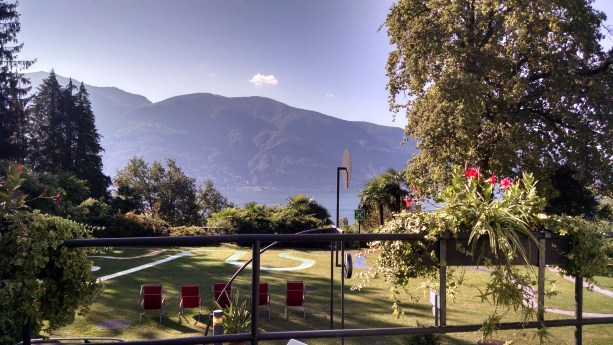
I’m at a conference this week, Elliptic Integrals in Mathematics and Physics, in Ascona, Switzerland.

IMG_20180905_094100507_HDR

Perhaps the only place where the view rivals Les Houches

Elliptic integrals are the next frontier after polylogarithms, more complicated functions that can come out of Feynman diagrams starting at two loops. The community of physicists studying them is still quite small, and a large fraction of them are here at this conference. We’re at the historic Monte Verità conference center, and we’re not even a big enough group to use their full auditorium.

There has been an impressive amount of progress in understanding these integrals, even just in the last year. Watching the talks, it’s undeniable that our current understanding is powerful, broad…and incomplete. In many ways the mysteries of the field are clearing up beautifully, with many once confusingly disparate perspectives linked together. On the other hand, it feels like we’re still working with the wrong picture, and I suspect there’s still a major paradigm shift in the future. All in all, the perfect time to be working on elliptics!

Classical Teleportation Is Easier Than Quantum Teleportation

Quantum teleportation confuses people.

Maybe you’ve heard the buzzword, and you imagine science fiction become reality: teleporting people across the galaxy, or ansibles communicating faster than light. Maybe you’ve heard a bit more, and know that quantum teleportation can’t transfer information faster than light, that it hasn’t been used on something even as complicated as a molecule…and you’re still confused, because if so, why call it teleportation in the first place?

There’s a simple way to clear up this confusion. You just have to realize that classical teleportation is easy.

What do I mean by “classical teleportation”?

Let’s start with the simplest teleporter you could imagine. It scans you on one end, then vaporizes you, and sends your information to a teleportation pad on the other end. The other end uses that information to build a copy of your body from some appropriate raw materials, and there you are!

(If the machine doesn’t vaporize you, then you end up with an army of resurrected Derek Parfits.)

Doing this with a person is, of course, absurdly difficult, and well beyond the reach of current technology.

transporter2

And no, nothing about the Star Trek version changes that

Do it with a document, though, and you’ve essentially invented the fax machine.

Yes, faxes don’t copy a piece of paper atom by atom, but they don’t need to: they just send what’s written on it. This sort of “classical teleportation” is commonplace. Trade Pokémon, and your Pikachu gets “classical teleported” from one device to another. Send an email, and your laptop teleports it to someone else. The ability to “classically teleport” is essential for computers to function, the idea that you can take the “important information” about something and copy it somewhere else.

Note that under this definition, “classical teleportation” is not faster than light. You still need to send a signal, between a “scanner” and a “printer”, and that’s only as fast as your signal normally is. Note also that the “printer” needs some “ink”, you still need the right materials to build or record whatever is being teleported over.

So suppose you’re building a quantum computer, one that uses the unique properties of quantum mechanics. Naturally, you want to be able to take a quantum state and copy it somewhere else. You need “quantum teleportation”. And the first thing you realize is that it’s harder than it looks.

The problem comes when you try to “scan” your quantum state. You might have heard quantum states described as “inherently uncertain” or “inherently indeterminate”. For this post, a better way to think about them is “inherently unknown”. For any quantum state, there is something you can’t know about its behavior. You can’t know which slit the next electron will go through, you can’t know whether Schrödinger’s cat is alive or dead. If you did, the state wouldn’t be quantum: no matter how you figure it out, there isn’t a way to discover which slit the electron will go through without getting rid of the quantum diffraction pattern.

This means that if you try to just “classically teleport” a quantum state, you lose the very properties you care about. To “scan” your state, you have to figure out everything important about it. The only way to do that, for an arbitrary state on your teleportation pad, is to observe its behavior. If you do that, though, you’ll end up knowing too much: a state whose behavior you know is not a quantum state, and it won’t do what you want it to on the other end. You’ve tried to “clone” it, and there’s a theorem proving you can’t.

(Note that this description should make sense even if you believe in a “hidden variable” interpretation of quantum mechanics. Those hidden variables have to be “non-local”, they aren’t close enough for your “scanner” to measure them.)

Since you can’t “classically teleport” your quantum state, you have to do something more subtle. That’s where “quantum teleportation” comes in. Quantum teleportation uses “entanglement”, long-distance correlations between quantum states. With a set of two entangled states, you can sneak around the “scanning” part, manipulating the states on one end to compute instructions that let someone use the other entangled particle to rebuild the “teleported” state.

Those instructions still have to be transferred normally, once again quantum teleportation isn’t faster than light. You still need the right kind of quantum state at your target, your “printer” still needs ink. What you get, though, is a way to transport the “inherently unknown” behavior of a quantum state, without scanning it and destroying the “mystery”. Quantum teleportation isn’t easier than classical teleportation, it’s harder. What’s exciting is that it’s possible at all.


On an unrelated topic, KKLT have fired back at their critics, with an impressive salvo of papers. (See also this one from the same day.) I don’t have the time or expertise to write a good post about this at the moment, currently hoping someone else does!

IGST 2018

Conference season in Copenhagen continues this week, with Integrability in Gauge and String Theory 2018. Integrability here refers to integrable theories, theories where physicists can calculate things exactly, without the perturbative approximations we typically use. Integrable theories come up in a wide variety of situations, but this conference was focused on the “high-energy” side of the field, on gauge theories (roughly, theories of fundamental forces like Yang-Mills) and string theory.

Integrability is one of the bigger sub-fields in my corner of physics, about the same size as amplitudes. It’s big enough that we can’t host the conference in the old Niels Bohr Institute auditorium.

IMG_20180820_162035401_HDR

Instead, they herded us into the old agriculture school

I don’t normally go to integrability conferences, but when the only cost is bus fare there’s not much to lose. Integrability is arguably amplitudes’s nearest neighbor. The two fields have a history of sharing ideas, and they have similar reputations in the wider community, seen as alternately deep and overly technical. Many of the talks still went over my head, but it was worth getting a chance to see how the neighbors are doing.

Current Themes 2018

I’m at Current Themes in High Energy Physics and Cosmology this week, the yearly conference of the Niels Bohr International Academy. (I talked about their trademark eclectic mix of topics last year.)

This year, the “current theme” was broadly gravitational (though with plenty of exceptions!).

IMG_20180815_180435532

For example, almost getting kicked out of the Botanical Garden

There were talks on phenomena we observe gravitationally, like dark matter. There were talks on calculating amplitudes in gravity theories, both classical and quantum. There were talks about black holes, and the overall shape of the universe. Subir Sarkar talked about his suspicion that the expansion of the universe isn’t actually accelerating, and while I still think the news coverage of it was overblown I sympathize a bit more with his point. He’s got a fairly specific worry, that we’re in a region that’s moving unusually with respect to the surrounding universe, that hasn’t really been investigated in much detail before. I don’t think he’s found anything definitive yet, but it will be interesting as more data accumulates to see what happens.

Of course, current themes can’t stick to just one theme, so there were non-gravitational talks as well. Nima Arkani-Hamed’s talk covered some results he’s talked about in the past, a geometric picture for constraining various theories, but with an interesting new development: while most of the constraints he found restrict things to be positive, one type of constraint he investigated allowed for a very small negative region, around thirty orders of magnitude smaller than the positive part. The extremely small size of the negative region was the most surprising part of the story, as it’s quite hard to get that kind of extremely small scale out of the math we typically invoke in physics (a similar sense of surprise motivates the idea of “naturalness” in particle physics).

There were other interesting talks, which I might talk about later. They should have slides up online soon in case any of you want to have a look.

Different Fields, Different Worlds

My grandfather is a molecular biologist. When we meet, we swap stories: the state of my field and his, different methods and focuses but often a surprising amount of common ground.

Recently he forwarded me an article by Raymond Goldstein, a biological physicist, arguing that biologists ought to be more comfortable with physical reasoning. The article is interesting in its own right, contrasting how physicists and biologists think about the relationship between models, predictions, and experiments. But what struck me most about the article wasn’t the content, but the context.

Goldstein’s article focuses on a question that seemed to me oddly myopic: should physical models be in the Results section, or the Discussion section?

As someone who has never written a paper with either a Results section or a Discussion section, I wondered why anyone would care. In my field, paper formats are fairly flexible. We usually have an Introduction and a Conclusion, yes, but in between we use however many sections we need to explain what we need to. In contrast, biology papers seem to have a very fixed structure: after the Introduction, there’s a Results section, a Discussion section, and a Materials and Methods section at the end.

At first blush, this seemed incredibly bizarre. Why describe your results before the methods you used to get them? How do you talk about your results without discussing them, but still take a full section to do it? And why do reviewers care how you divide things up in the first place?

It made a bit more sense once I thought about how biology differs from theoretical physics. In theoretical physics, the “methods” are most of the result: unsolved problems are usually unsolved because existing methods don’t solve them, and we need to develop new methods to make progress. Our “methods”, in turn, are often the part of the paper experts are most eager to read. In biology, in contrast, the methods are much more standardized. While papers will occasionally introduce new methods, there are so many unexplored biological phenomena that most of the time researchers don’t need to invent a new method: just asking a question no-one else has asked can be enough for a discovery. In that environment, the “results” matter a lot more: they’re the part that takes the most scrutiny, that needs to stand up on its own.

I can even understand the need for a fixed structure. Biology is a much bigger field than theoretical physics. My field is small enough that we all pretty much know each other. If a paper is hard to read, we’ll probably get a chance to ask the author what they meant. Biology, in contrast, is huge. An important result could come from anywhere, and anyone. Having a standardized format makes it a lot easier to scan through an unfamiliar paper and find what you need, especially when there might be hundreds of relevant papers.

The problem with a standardized system, as always, is the existence of exceptions. A more “physics-like” biology paper is more readable with “physics-like” conventions, even if the rest of the field needs to stay “biology-like”. Because of that, I have a lot of sympathy for Goldstein’s argument, but I can’t help but feel that he should be asking for more. If creating new mathematical models and refining them with observation is at the heart of what Goldstein is doing, then maybe he shouldn’t have to use Results/Discussion/Methods in the first place. Maybe he should be allowed to write biology papers that look more like physics papers.

Adversarial Collaborations for Physics

Sometimes physics debates get ugly. For the scientists reading this, imagine your worst opponents. Think of the people who always misinterpret your work while using shoddy arguments to prop up their own, where every question at a talk becomes a screaming match until you just stop going to the same conferences at all.

Now, imagine writing a paper with those people.

Adversarial collaborations, subject of a recent a contest on the blog Slate Star Codex, are a proposed method for resolving scientific debates. Two scientists on opposite sides of an argument commit to writing a paper together, describing the overall state of knowledge on the topic. For the paper to get published, both sides have to sign off on it: they both have to agree that everything in the paper is true. This prevents either side from cheating, or from coming back later with made-up objections: if a point in the paper is wrong, one side or the other is bound to catch it.

This won’t work for the most vicious debates, when one (or both) sides isn’t interested in common ground. But for some ongoing debates in physics, I think this approach could actually help.

One advantage of adversarial collaborations is in preventing accusations of bias. The debate between dark matter and MOND-like proposals is filled with these kinds of accusations: claims that one group or another is ignoring important data, being dishonest about the parameters they need to fit, or applying standards of proof they would never require of their own pet theory. Adversarial collaboration prevents these kinds of accusations: whatever comes out of an adversarial collaboration, both sides would make sure the other side didn’t bias it.

Another advantage of adversarial collaborations is that they make it much harder for one side to move the goalposts, or to accuse the other side of moving the goalposts. From the sidelines, one thing that frustrates me watching string theorists debate whether the theory can describe de Sitter space is that they rarely articulate what it would take to decisively show that a particular model gives rise to de Sitter. Any conclusion of an adversarial collaboration between de Sitter skeptics and optimists would at least guarantee that both parties agreed on the criteria. Similarly, I get the impression that many debates about interpretations of quantum mechanics are bogged down by one side claiming they’ve closed off a loophole with a new experiment, only for the other to claim it wasn’t the loophole they were actually using, something that could be avoided if both sides were involved in the experiment from the beginning.

It’s possible, even likely, that no-one will try adversarial collaboration for these debates. Even if they did, it’s quite possible the collaborations wouldn’t be able to agree on anything! Still, I have to hope that someone takes the plunge and tries writing a paper with their enemies. At minimum, it’ll be an interesting read!

Journalists Need to Adapt to Preprints, Not Ignore Them

Nature has an article making the rounds this week, decrying the dangers of preprints.

On the surface, this is a bit like an article by foxes decrying the dangers of henhouses. There’s a pretty big conflict of interest when a journal like Nature, that makes huge amounts of money out of research scientists would be happy to publish for free, gets snippy about scientists sharing their work elsewhere. I was expecting an article about how “important” the peer review process is, how we can’t just “let anyone” publish, and the like.

Instead, I was pleasantly surprised. The article is about a real challenge, the weakening of journalistic embargoes. While this is still a problem I think journalists can think their way around, it’s a bit subtler than the usual argument.

For the record, peer review is usually presented as much more important than it actually is. When a scientific article gets submitted to a journal, it gets sent to two or three experts in the field for comment. In the best cases, these experts read the paper carefully and send criticism back. They don’t replicate the experiments, they don’t even (except for a few heroic souls) reproduce the calculations. That kind of careful reading is important, but it’s hardly unique: it’s something scientists do on their own when they want to build off of someone else’s paper, and it’s what good journalists get when they send a paper to experts for comments before writing an article. If peer review in a journal is important, it’s to ensure that this careful reading happens at least once, a sort of minimal evidence that the paper is good enough to appear on a scientist’s CV.

The Nature article points out that peer review serves another purpose, specifically one of delay. While a journal is preparing to publish an article they can send it out to journalists, after making them sign an agreement (an embargo) that they won’t tell the public until the journal publishes. This gives the journalists a bit of lead time, so the more responsible ones can research and fact-check before publishing.

Open-access preprints cut out the lead time. If the paper just appears online with no warning and no embargoes, journalists can write about it immediately. The unethical journalists can skip fact-checking and publish first, and the ethical ones have to follow soon after, or risk publishing “old news”. Nobody gets the time to properly vet, or understand, a new paper.

There’s a simple solution I’ve seen from a few folks on Twitter: “Don’t be an unethical journalist!” That doesn’t actually solve the problem though. The question is, if you’re an ethical journalist, but other people are unethical journalists, what do you do?

Apparently, what some ethical journalists do is to carry on as if preprints didn’t exist. The Nature article describes journalists who, after a preprint has been covered extensively by others, wait until a journal publishes it and then cover it as if nothing had happened. The article frames this as virtuous, but doomed: journalists sticking to their ethics even if it means publishing “old news”.

To be 100% clear here, this is not virtuous. If you present a paper’s publication in a journal as news, when it was already released as a preprint, you are actively misleading the public. I can’t count the number of times I’ve gotten messages from readers, confused because they saw a scientific result covered again months later and thought it was new. It leads to a sort of mental “double-counting”, where the public assumes that the scientific result was found twice, and therefore that it’s more solid. Unless the publication itself is unexpected (something that wasn’t expected to pass peer review, or something controversial like Mochizuki’s proof of the ABC conjecture) mere publication in a journal of an already-public result is not news.

What science journalists need to do here is to step back, and think about how their colleagues cover stories. Current events these days don’t have embargoes, they aren’t fed through carefully managed press releases. There’s a flurry of initial coverage, and it gets things wrong and misses details and misleads people, because science isn’t the only field that’s complicated, real life is complicated. Journalists have adapted to this schedule, mostly, by specializing. Some journalists and news outlets cover breaking news as it happens, others cover it later with more in-depth analysis. Crucially, the latter journalists don’t present the topic as new. They write explicitly in the light of previous news, as a response to existing discussion. That way, the public isn’t misled, and their existing misunderstandings can be corrected.

The Nature article brings up public health, and other topics where misunderstandings can do lasting damage, as areas where embargoes are useful. While I agree, I would hope many of these areas would figure out embargoes on their own. My field certainly does: the big results of scientific collaborations aren’t just put online as preprints, they’re released only after the collaboration sets up its own journalistic embargoes, and prepares its own press releases. In a world of preprints, this sort of practice needs to happen for important controversial public health and environmental results as well. Unethical scientists might still release too fast, to keep journalists from fact-checking, but they could do that anyway, without preprints. You don’t need a preprint to call a journalist on the phone and claim you cured cancer.

As open-access preprints become the norm, journalists will have to adapt. I’m confident they will be able to, but only if they stop treating science journalism as unique, and start treating it as news. Science journalism isn’t teaching, you’re not just passing down facts someone else has vetted. You’re asking the same questions as any other journalist: who did what? And what really happened? If you can do that, preprints shouldn’t be scary.

The Physics Isn’t New, We Are

Last week, I mentioned the announcement from the IceCube, Fermi-LAT, and MAGIC collaborations of high-energy neutrinos and gamma rays detected from the same source, the blazar TXS 0506+056. Blazars are sources of gamma rays, thought to be enormous spinning black holes that act like particle colliders vastly more powerful than the LHC. This one, near Orion’s elbow, is “aimed” roughly at Earth, allowing us to detect the light and particles it emits. On September 22, a neutrino with energy around 300 TeV was detected by IceCube (a kilometer-wide block of Antarctic ice stuffed with detectors), coming from the direction of TXS 0506+056. Soon after, the satellite Fermi-LAT and ground-based telescope MAGIC were able to confirm that the blazar TXS 0506+056 was flaring at the time. The IceCube team then looked back, and found more neutrinos coming from the same source in earlier years. There are still lingering questions (Why didn’t they see this kind of behavior from other, closer blazars?) but it’s still a nice development in the emerging field of “multi-messenger” astronomy.

It also got me thinking about a conversation I had a while back, before one of Perimeter’s Public Lectures. An elderly fellow was worried about the LHC. He wondered if putting all of that energy in the same place, again and again, might do something unprecedented: weaken the fabric of space and time, perhaps, until it breaks? He acknowledged this didn’t make physical sense, but what if we’re wrong about the physics? Do we really want to take that risk?

At the time, I made the same point that gets made to counter fears of the LHC creating a black hole: that the energy of the LHC is less than the energy of cosmic rays, particles from space that collide with our atmosphere on a regular basis. If there was any danger, it would have already happened. Now, knowing about blazars, I can make a similar point: there are “galactic colliders” with energies so much higher than any machine we can build that there’s no chance we could screw things up on that kind of scale: if we could, they already would have.

This connects to a broader point, about how to frame particle physics. Each time we build an experiment, we’re replicating something that’s happened before. Our technology simply isn’t powerful enough to do something truly unprecedented in the universe: we’re not even close! Instead, the point of an experiment is to reproduce something where we can see it. It’s not the physics itself, but our involvement in it, our understanding of it, that’s genuinely new.

The IceCube experiment itself is a great example of this: throughout Antarctica, neutrinos collide with ice. The only difference is that in IceCube’s ice, we can see them do it. More broadly, I have to wonder how much this is behind the “unreasonable effectiveness of mathematics”: if mathematics is just the most precise way humans have to communicate with each other, then of course it will be effective in physics, since the goal of physics is to communicate the nature of the world to humans!

There may well come a day when we’re really able to do something truly unprecedented, that has never been done before in the history of the universe. Until then, we’re playing catch-up, taking laws the universe has tested extensively and making them legible, getting humanity that much closer to understanding physics that, somewhere out there, already exists.

Conferences Are Work! Who Knew?

I’ve been traveling for over a month now, from conference to conference, with a bit of vacation thrown in at the end.

(As such, I haven’t had time to read up on the recent announcement of the detection of neutrinos and high-energy photons from a blazar, Matt Strassler has a nice piece on it.)

One thing I didn’t expect was how exhausting going to three conferences in a row would be. I didn’t give any talks this time around, so I thought I was skipping the “work” part. But sitting in a room for talk after talk, listening and taking notes, turns out to still be work! There’s effort involved in paying attention, especially in a scientific talk where the details matter. You assess the talks in your head, turning concepts around and thinking about what you might do with them. It’s the kind of thing you don’t notice for a seminar or two, but at a conference, after a while, it really builds up. After three, let’s just say I’ve really needed this vacation. I’ll be back at work next week, and maybe I’ll have a longer blog post for you folks. Until then, I ought to get some rest!