A while back, when the MiniBoone experiment announced evidence for a sterile neutrino, I was excited. It’s still not clear whether they really found something, here’s an article laying out the current status. If they did, it would be a new particle beyond those predicted by the Standard Model, something like the neutrinos but which doesn’t interact with any of the fundamental forces except gravity.
At the time, someone asked me why this was so exciting. Does it solve the mystery of dark matter, or any other long-standing problems?
The sterile neutrino MiniBoone is suggesting isn’t, as far as I’m aware, a plausible candidate for dark matter. It doesn’t solve any long-standing problems (for example, it doesn’t explain why the other neutrinos are so much lighter than other particles). It would even introduce new problems of its own!
It still matters, though. One reason, which I’ve talked about before, is that each new type of particle implies a new law of nature, a basic truth about the universe that we didn’t know before. But there’s another reason why a new particle matters.
There’s a malaise in particle physics. For most of the twentieth century, theory and experiment were tightly linked. Unexpected experimental results would demand new theory, which would in turn suggest new experiments, driving knowledge forward. That mostly stopped with the Standard Model. There are a few lingering anomalies, like the phenomena we attribute to dark matter, that show the Standard Model can’t be the full story. But as long as every other experiment fits the Standard Model, we have no useful hints about where to go next. We’re just speculating, and too much of that warps the field.
Critics of the physics mainstream pick up on this, but I’m not optimistic about what I’ve seen of their solutions. Peter Woit has suggested that physics should emulate the culture of mathematics, caring more about rigor and being more careful to confirm things before speaking. The title of Sabine Hossenfelder’s “Lost in Math” might suggest the opposite, but I get the impression she’s arguing for something similar: that particle physicists have been using sloppy arguments and should clean up their act, taking foundational problems seriously and talking to philosophers to help clarify their ideas.
Rigor and clarity are worthwhile, but the problems they’ll solve aren’t the ones causing the malaise. If there are problems we can expect to solve just by thinking better, they’re problems that we found by thinking in the first place: quantum gravity theories that stop making sense at very high energies, paradoxical thought experiments with black holes. There, rigor and clarity can matter: to some extent they’re already there, but I can appreciate the argument that it’s not yet nearly enough.
What rigor and clarity won’t do is make physics feel (and function) like it did in the twentieth century. For that, we need new evidence: experiments that disobey the Standard Model, and do it in a clear enough way that we can’t just chalk it up to predictable errors. We need a new particle, or something like it. Without that, our theories are most likely underdetermined by the data, and anything we propose is going to be subjective. Our subjective judgements may get better, we may get rid of the worst-justified biases, but at the end of the day we still won’t have enough information to actually make durable progress.
That’s not a popular message, in part, because it’s not something we can control. There’s a degree of helplessness in realizing that if nature doesn’t throw us a bone then we’ll probably just keep going in circles forever. It’s not the kind of thing that lends itself to a pithy blog post.
If there’s something we can do, it’s to keep our eyes as open as possible, to make sure we don’t miss nature’s next hint. It’s why people are getting excited about low-energy experiments, about precision calculations, about LIGO. Even this seemingly clickbaity proposal that dark matter killed the dinosaurs is motivated by the same sort of logic: if the only evidence for dark matter we have is gravitational, what can gravitational evidence tell us about what it’s made of? In each case, we’re trying to widen our net, to see new phenomena we might have missed.
I suspect that’s why this reviewer was disappointed that Hossenfelder’s book lacked a vision for the future. It’s not that the book lacked any proposals whatsoever. But it lacked this kind of proposal, of a new place to look, where new evidence, and maybe a new particle, might be found. Without that we can still improve things, we can still make progress on deep fundamental mathematical questions, we can kill off the stupidest of the stupid arguments. But the malaise won’t lift, we won’t get back to the health of twentieth century physics. For that, we need to see something new.



 or
or 

 is greater than
  .
. 
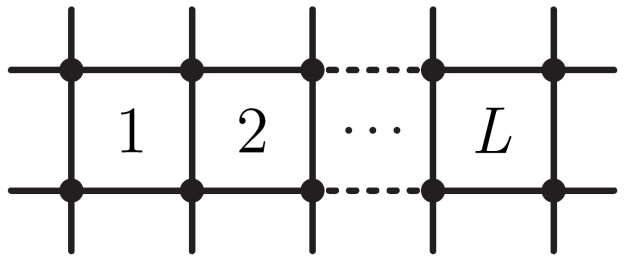
 . It’s a family of diagrams that we can write down for any number of loops: to get more loops, just extend the “…”, adding more boxes in the middle. Count the number of lines sticking out, and you get six: these are “hexagon functions”, the type of function

 loops, N=4 super Yang-Mills diverges in dimension
  . From that formula, you can see that no matter how much you increase
