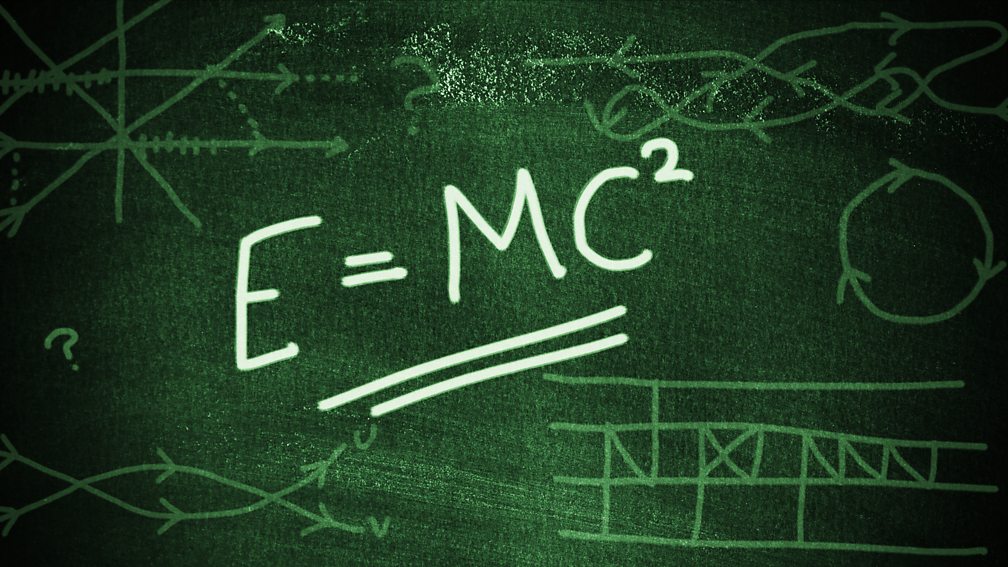
It’s the most famous equation in all of physics, written on thousands of chalkboard stock photos. Part of its charm is its simplicity: E for energy, m for mass, c for the speed of light, just a few simple symbols in a one-line equation. Despite its simplicity, is deep and important enough that there are books dedicated to explaining it.
What does mean?
Some will tell you it means mass can be converted to energy, enabling nuclear power and the atomic bomb. This is a useful picture for chemists, who like to think about balancing ingredients: this much mass on one side, this much energy on the other. It’s not the best picture for physicists, though. It makes it sound like energy is some form of “stuff” you can pour into your chemistry set flask, and energy really isn’t like that.
There’s another story you might have heard, in older books. In that story, tells you that in relativity mass, like distance and time, is relative. The more energy you have, the more mass you have. Those books will tell you that this is why you can’t go faster than light: the faster you go, the greater your mass, and the harder it is to speed up.
Modern physicists don’t talk about it that way. In fact, we don’t even write that way. We’re more likely to write:
“v” here stands for the velocity, how fast the mass is moving. The faster the mass moves, the more energy it has. Take v to zero, and you get back the familiar .
The older books weren’t lying to you, but they were thinking about a different notion of mass: “relativistic mass” instead of “rest mass” $m_0$, related like this:
which explains the difference in how we write .
Why the change? In part, it’s because of particle physics. In particle physics, we care about the rest mass of particles. Different particles have different rest mass: each electron has one rest mass, each top quark has another, regardless of how fast they’re going. They still get more energy, and harder to speed up, the faster they go, but we don’t describe it as a change in mass. Our equations match the old books, we just talk about them differently.
I titled this post “The Real E=mc^2”, but to clarify, none of these explanations are more “real” than the others. They’re words, useful in different situations and for different people. “The Real E=mc^2” isn’t the of nuclear chemists, or old books, or modern physicists. It’s the theory itself, the mathematical rules and principles that all the rest are just trying to describe.
A few weeks back I posted a poll, asking you guys what sort of physics background you have. The idea was to follow up on a poll I did back in 2015, to see how this blog’s audience has changed.
One thing that immediately leaped out of the data was how many of you are physicists. As of writing this, 66% of readers say they either have a PhD in physics or a related field, or are currently in grad school. This includes 7% specifically from my sub-field, “amplitudeology” (though this number may be higher than usual since we just had our yearly conference, and more amplitudeologists were reminded my blog exists).
I didn’t use the same categories in 2015, so the numbers can’t be easily compared. In 2015 only 2.5% of readers described themselves as amplitudeologists. Adding these up with the physics PhDs and grad students gives 59%, which goes up to 64.5% if I include the mathematicians (who this year might have put either “PhD in a related field” or “Other Academic”). So overall the percentages are pretty similar, though now it looks like more of my readers are grad students.
Despite the small difference, I am a bit worried: it looks like I’m losing non-physicist readers. I could flatter myself and think that I inspired those non-physicists to go to grad school, but more realistically I should admit that fewer of my posts have been interesting to a non-physics audience. In 2015 I worked at the Perimeter Institute, and helped out with their public lectures. Now I’m at the Niels Bohr Institute, and I get fewer opportunities to hear questions from non-physicists. I get fewer ideas for interesting questions to answer.
I want to keep this blog’s language accessible and its audience general. I appreciate that physicists like this blog and view it as a resource, but I don’t want it to turn into a blog forphysicists only. I’d like to encourage the non-physicists in the audience: ask questions! Don’t worry if it sounds naive, or if the question seems easy: if you’re confused, likely others are too.
I’m back from Amplitudes 2019, and since I have more time I figured I’d write down a few more impressions.
Amplitudes runs all the way from practical LHC calculations to almost pure mathematics, and this conference had plenty of both as well as everything in between. On the more practical side a standard “pipeline” has developed: get a large number of integrals from generalized unitarity, reduce them to a more manageable number with integration-by-parts, and then compute them with differential equations. Vladimir Smirnov and Johannes Henn presented the state of the art in this pipeline, challenging QCD calculations that required powerful methods. Others aimed to replace various parts of the pipeline. Integration-by-parts could be avoided in the numerical unitarity approach discussed by Ben Page, or alternatively with the intersection theory techniques showcased by Pierpaolo Mastrolia. More radical departures included Stefan Weinzierl’s refinement of loop-tree duality, and Jacob Bourjaily’s advocacy of prescriptive unitarity. Robert Schabinger even brought up direct integration, though I mostly viewed his talk as an independent confirmation of the usefulness of Erik Panzer’s thesis. It also showcased an interesting integral that had previously been represented by Lorenzo Tancredi and collaborators as elliptic, but turned out to be writable in terms of more familiar functions. It’s going to be interesting to see whether other such integrals arise, and whether they can be spotted in advance.
On the other end of the scale, Francis Brown was the only speaker deep enough in the culture of mathematics to insist on doing a blackboard talk. Since the conference hall didn’t actually have a blackboard, this was accomplished by projecting video of a piece of paper that he wrote on as the talk progressed. Despite the awkward setup, the talk was impressively clear, though there were enough questions that he ran out of time at the end and had to “cheat” by just projecting his notes instead. He presented a few theorems about the sort of integrals that show up in string theory. Federico Zerbini and Eduardo Casali’s talks covered similar topics, with the latter also involving intersection theory. Intersection theory also appeared in a poster from grad student Andrzej Pokraka, which overall is a pretty impressively broad showing for a part of mathematics that Sebastian Mizera first introduced to the amplitudes community less than two years ago.
Nima Arkani-Hamed’s talk on Wednesday fell somewhere in between. A series of airline mishaps brought him there only a few hours before his talk, and his own busy schedule sent him back to the airport right after the last question. The talk itself covered several topics, tied together a bit better than usual by a nice account in the beginning of what might motivate a “polytope picture” of quantum field theory. One particularly interesting aspect was a suggestion of a space, smaller than the amplituhedron, that might more accuractly the describe the “alphabet” that appears in N=4 super Yang-Mills amplitudes. If his proposal works, it may be that the infinite alphabet we were worried about for eight-particle amplitudes is actually finite. Ömer Gürdoğan’s talk mentioned this, and drew out some implications. Overall, I’m still unclear as to what this story says about whether the alphabet contains square roots, but that’s a topic for another day. My talk was right after Nima’s, and while he went over-time as always I compensated by accidentally going under-time. Overall, I think folks had fun regardless.
Though I don’t know how many people recognized this guy
It’s that time of year again, and I’m at Amplitudes, my field’s big yearly conference. This year we’re in Dublin, hosted by Trinity.
Which also hosts the Book of Kells, and the occasional conference reception just down the hall from the Book of Kells
Increasingly, the organizers of Amplitudes have been setting aside a few slots for talks from people in other fields. This year the “closest” such speaker was Kirill Melnikov, who pointed out some of the hurdles that make it difficult to have useful calculations to compare to the LHC. Many of these hurdles aren’t things that amplitudes-people have traditionally worked on, but are still things that might benefit from our particular expertise. Another such speaker, Maxwell Hansen, is from a field called Lattice QCD. While amplitudeologists typically compute with approximations, order by order in more and more complicated diagrams, Lattice QCD instead simulates particle physics on supercomputers, chopping up their calculations on a grid. This allows them to study much stronger forces, including the messy interactions of quarks inside protons, but they have a harder time with the situations we’re best at, where two particles collide from far away. Apparently, though, they are making progress on that kind of calculation, with some clever tricks to connect it to calculations they know how to do. While I was a bit worried that this would let them fire all the amplitudeologists and replace us with supercomputers, they’re not quite there yet, nonetheless they are doing better than I would have expected. Other speakers from other fields included Leron Borsten, who has been applying the amplitudes concept of the “double copy” to M theory and Andrew Tolley, who uses the kind of “positivity” properties that amplitudeologists find interesting to restrict the kinds of theories used in cosmology.
The biggest set of “non-traditional-amplitudes” talks focused on using amplitudes techniques to calculate the behavior not of particles but of black holes, to predict the gravitational wave patterns detected by LIGO. This year featured a record six talks on the topic, a sixth of the conference. Last year I commented that the research ideas from amplitudeologists on gravitational waves had gotten more robust, with clearer proposals for how to move forward. This year things have developed even further, with several initial results. Even more encouragingly, while there are several groups doing different things they appear to be genuinely listening to each other: there were plenty of references in the talks both to other amplitudes groups and to work by more traditional gravitational physicists. There’s definitely still plenty of lingering confusion that needs to be cleared up, but it looks like the community is robust enough to work through it.
I’m still busy with the conference, but I’ll say more when I’m back next week. Stay tuned for square roots, clusters, and Nima’s travel schedule. And if you’re a regular reader, please fill out last week’s poll if you haven’t already!
Back in 2015, I did a poll asking how much physics background you guys had. Now four years and many new readers later, I’d like to revisit the question. I’ll explain the categories below the poll:
Amplitudeologist: You have published a paper about scattering amplitudes in quantum field theories, or expect to publish one within the next year or so.
Physics (or related field) PhD: You have a PhD in physics, or in a field with related background such as astronomy or some parts of mathematics.
Physics (or related field) Grad Student: You are a graduate student in physics or a related field. Specifically, you are either a PhD student, or a Master’s student in a research-focused program.
Undergrad or Lower: You are currently an undergraduate student (studying for a Bachelor’s degree) or are in an earlier stage of education (for example a high school student).
Physics Autodidact: Included by popular demand from the last poll: while you don’t have a physics PhD, you have taught yourself about the subject extensively beyond your formal schooling.
Other Academic: You work in Academia, but not in physics or a closely related field.
Other Technical Profession: You work in a technical profession, such as engineering, medicine, or STEM teaching.
None of the Above: Something else.
If you fit more than one category, pick the first that matches you: for example, if you are an undergrad with a published paper in Amplitudes, list yourself as an Amplitudeologist (also, well done!)
The title is a bit of a mouthful, but I’ll walk you through it:
The Cosmic Galois Group and Extended Steinmann Relations for Planar N = 4 SYM Amplitudes
I calculate scattering amplitudes (roughly, probabilities that elementary particles bounce off each other) in a (not realistic, and not meant to be) theory called planar N=4 super-Yang-Mills (SYM for short). I can’t summarize everything we’ve been doing here, but if you read the blog posts I linked above and some of the Handy Handbooks linked at the top of the page you’ll hopefully get a clearer picture.
We started using the Steinmann Relationsa few years ago. Discovered in the 60’s, the Steinmann relations restrict the kind of equations we can use to describe particle physics. Essentially, they mean that particles can’t travel two ways at once. In this paper, we extend the Steinmann relations beyond Steinmann’s original idea. We don’t yet know if we can prove this extension works, but it seems to be true for the amplitudes we’re calculating. While we’ve presented this in talks before, this is the first time we’ve published it, and it’s one of the big results of this paper.
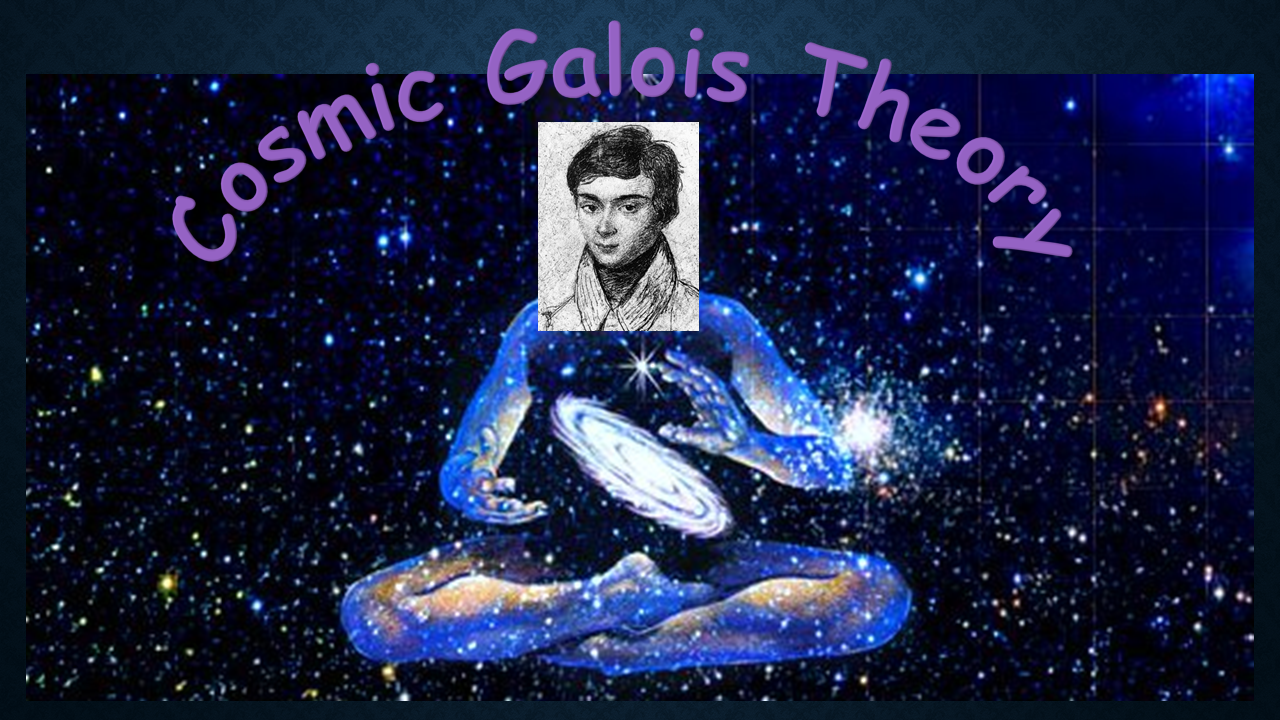
The other, more exotic-sounding result, has to do with something called the Cosmic Galois Group.
Évariste Galois, the famously duel-prone mathematician, figured out relations between algebraic numbers (that is, numbers you can get out of algebraic equations) in terms of a mathematical structure called a group. Today, mathematicians are interested not just in algebraic numbers, but in relations between transcendental numbers as well, specifically a kind of transcendental number called a period. These numbers show up a lot in physics, so mathematicians have been thinking about a Galois group for transcendental numbers that show up in physics, a so-called Cosmic Galois Group.
(Cosmic here doesn’t mean it has to do with cosmology. As far as I can tell, mathematicians just thought it sounded cool and physics-y. They also started out with rather ambitious ideas about it, if you want a laugh check out the last few paragraphs of this talk by Cartier.)
For us, Cosmic Galois Theory lets us study the unusual numbers that show up in our calculations. Doing this, we’ve noticed that certain numbers simply don’t show up. For example, the Riemann zeta function shows up often in our results, evaluated at many different numbers…but never evaluated at the number three. Nor does any number related to that one through the Cosmic Galois Group show up. It’s as if the theory only likes some numbers, and not others.
For us, this has been enormously useful. We calculate our amplitudes by guesswork, starting with the right “alphabet” and then filling in different combinations, as if we’re trying all possible answers to a word jumble. Cosmic Galois Theory and Extended Steinmann have enabled us to narrow down our guess dramatically, making it much easier and faster to get to the right answer.
More generally though, we hope to contribute to mathematicians’ investigations of Cosmic Galois Theory. Our examples are more complicated than the simple theories where they currently prove things, and contain more data than the more limited results from electrons. Hopefully together we can figure out why certain numbers show up and others don’t, and find interesting mathematical principles behind the theories that govern fundamental physics.
For now, I’ll leave you with a preview of a talk I’m giving in a couple weeks’ time:
There’s a cynical truism we use to reassure grad students. A thesis is a big, daunting project, but it shouldn’t be too stressful: in the end, nobody else is going to read it.
Like every good truism, though, there is an exception. Some rare times, you will actually want to read someone else’s thesis. This isn’t usually because the material is new: rather it’s because it’s well explained.
When we academics publish, we’re often in a hurry, and there isn’t time to write well. When we publish more slowly, often we have more collaborators, so the paper is a set of compromises written by committee. Either way, we rarely make a concept totally crystal-clear.
A thesis isn’t always crystal-clear either, but it can be. It’s written by just one person, and that person is learning. A grad student who just learned a topic can be in the best position to teach it: they know exactly what confused them when they start out. Thesis-writing is also a slower process, one that gives more time to hammer at a text until it’s right. Finally, a thesis is written for a committee, and that committee usually contains people from different fields. A thesis needs to be an accessible introduction, in a way that a published paper doesn’t.
There are topics that I never really understood until I looked up the thesis of the grad student who helped discover it. There are tricks that never made it to published papers, that I’ve learned because they were tucked in to the thesis of someone who went on to do great things.
So if you’re finding a subject confusing, if you’ve read all the papers and none of them make any sense, look for the grad students. Sometimes the best explanation of a tricky topic isn’t in the published literature, it’s hidden away in someone’s thesis.
Growing up in the US there are a lot of age-based milestones. You can drive at 16, vote at 18, and drink at 21. Once you’re in academia though, your actual age becomes much less relevant. Instead, academics are judged based on academic age, the time since you got your PhD.
More generally, when academics apply for jobs they are often weighed in terms of academic age. Compared to others, how long have you spent as a postdoc since your PhD? How many papers have you published since then, and how well cited were they? The longer you spend without finding a permanent position, the more likely employers are to wonder why, and the reasons they assume are rarely positive.
This creates some weird incentives. If you have a choice, it’s often better to graduate late than to graduate early. Employers don’t check how long you took to get your PhD, but they do pay attention to how many papers you published. If it’s an option, staying in school to finish one more project can actually be good for your career.
Biological age matters, but mostly for biological reasons: for example, if you plan to have children. Raising a family is harder if you have to move every few years, so those who find permanent positions by then have an easier time of it. That said, as academics have to take more temporary positions before settling down fewer people have this advantage.
Beyond that, biological age only matters again at the end of your career, especially if you work somewhere with a mandatory retirement age. Even then, retirement for academics doesn’t mean the same thing as for normal people: retired professors often have emeritus status, meaning that while technically retired they keep a role at the university, maintaining an office and often still doing some teaching or research.
I was talking with some other physicists about my “Black Box Theory” thought experiment, where theorists have to compete with an impenetrable block of computer code. Even if the theorists come up with a “better” theory, that theory won’t predict anything that the code couldn’t already. If “predicting something new” is an essential part of science, then the theorists can no longer do science at all.
One of my colleagues made an interesting point: in the thought experiment, the theorists can’t predict new behaviors of reality. But they can predict new behaviors of the code.
Even when we have the right theory to describe the world, we can’t always calculate its consequences. Often we’re stuck in the same position as the theorists in the thought experiment, trying to understand the output of a theory that might as well be a black box. Increasingly, we are employing a kind of “experimental theoretical physics”. We try to predict the result of new calculations, just as experimentalists try to predict the result of new experiments.
This experimental approach seems to be a genuine cultural difference between physics and mathematics. There is such a thing as experimental mathematics, to be clear. And while mathematicians prefer proof, they’re not averse to working from a good conjecture. But when mathematicians calculate and conjecture, they still try to set a firm foundation. They’re precise about what they mean, and careful about what they imply.
“Experimental theoretical physics”, on the other hand, is much more like experimental physics itself. Physicists look for plausible patterns in the “data”, seeing if they make sense in some “physical” way. The conjectures aren’t always sharply posed, and the leaps of reasoning are often more reckless than the leaps of experimental mathematicians. We try to use intuition gleaned from a history of experiments on, and calculations about, the physical world.
There’s a real danger here, because mathematical formulas don’t behave like nature does. When we look at nature, we expect it to behave statistically. If we look at a large number of examples, we get more and more confident that they represent the behavior of the whole. This is sometimes dangerous in nature, but it’s even more dangerous in mathematics, because it’s often not clear what a good “sample” even is. Proving something is true “most of the time” is vastly different from proving it is true all of the time, especially when you’re looking at an infinity of possible examples. We can’t meet our favorite “five sigma” level of statistical confidence, or even know if we’re close.
At the same time, experimental theoretical physics has real power. Experience may be a bad guide to mathematics, but it’s a better guide to the mathematics that specifically shows up in physics. And in practice, our recklessness can accomplish great things, uncovering behaviors mathematicians would never have found by themselves.
The key is to always keep in mind that the two fields are different. “Experimental theoretical physics” isn’t mathematics, and it isn’t pretending to be, any more than experimental physics is pretending to be theoretical physics. We’re gathering data and advancing tentative explanations, but we’re fully aware that they may not hold up when examined with full rigor. We want to inspire, to raise questions and get people to think about the principles that govern the messy physical theories we use to describe our world. Experimental physics, theoretical physics, and mathematics are all part of a shared ecosystem, and each has its role to play.
Avengers: Endgame has been out for a while, so I don’t have to worry about spoilers right? Right?
Right?
Anyway, time travel. The spoiler is time travel. They bring back everyone who was eliminated in the previous movie, using time travel.
They also attempt to justify the time travel, using Ant Man-flavored quantum mechanics. This works about as plausibly as you’d expect for a superhero whose shrinking powers not only let him talk to ants, but also go to a “place” called “The Quantum Realm”. Along the way, they manage to throw in splintered references to a half-dozen almost-relevant scientific concepts. It’s the kind of thing that makes some physicists squirm.
And I enjoyed it.
Movies tend to treat time travel in one of two ways. The most reckless, and most common, let their characters rewrite history as they go, like Marty McFly almost erasing himself from existence in Back to the Future. This never makes much sense, and the characters in Avengers: Endgame make fun of it, listing a series of movies that do time travel this way (inexplicably including Wrinkle In Time, which has no time travel at all).
In the other common model, time travel has to happen in self-consistent loops: you can’t change the past, but you can go back and be part of it. This is the model used, for example, in Harry Potter, where Potter is saved by a mysterious spell only to travel back in time and cast it himself. This at least makes logical sense, whether it’s possible physically is an open question.
Avengers: Endgame uses the model of self-consistent loops, but with a twist: if you don’t manage to make your loop self-consistent you instead spawn a parallel universe, doomed to suffer the consequences of your mistakes. This is a rarer setup, but not a unique one, though the only other example I can think of at the moment is Homestuck.
Is there any physics justification for the Avengers: Endgame model? Maybe not. But you can at least guess what they were thinking.
The key clue is a quote from Tony Stark, rattling off a stream of movie-grade scientific gibberish:
“ Quantum fluctuation messes with the Planck scale, which then triggers the Deutsch Proposition. Can we agree on that? ”
From this quote, one can guess not only what scientific results inspired the writers of Avengers: Endgame, but possibly also which Wikipedia entry. David Deutsch is a physicist, and an advocate for the many-worlds interpretation of quantum mechanics. In 1991 he wrote a paper discussing what happens to quantum mechanics in the environment of a wormhole. In it he pointed out that you can make a self-consistent time travel loop, not just in classical physics, but out of a quantum superposition. This offers a weird solution to the classic grandfather paradox of time travel: instead of causing a paradox, you can form a superposition. As Scott Aaronson explains here, “you’re born with probability 1/2, therefore you kill your grandfather with probability 1/2, therefore you’re born with probability 1/2, and so on—everything is consistent.” If you believe in the many-worlds interpretation of quantum mechanics, a time traveler in this picture is traveling between two different branches of the wave-function of the universe: you start out in the branch where you were born, kill your grandfather, and end up in the branch where you weren’t born. This isn’t exactly how Avengers: Endgame handles time travel, but it’s close enough that it seems like a likely explanation.
David Deutsch’s argument uses a wormhole, but how do the Avengers make a wormhole in the first place? There we have less information, just vague references to quantum fluctuations at the Planck scale, the scale at which quantum gravity becomes important. There are a few things they could have had in mind, but one of them might have been physicists Leonard Susskind and Juan Maldacena’s conjecture that quantum entanglement is related to wormholes, a conjecture known as ER=EPR.
Long-time readers of the blog might remember I got annoyed a while back, when Caltech promoted ER=EPRusing a different Disney franchise. The key difference here is that Avengers: Endgame isn’t pretending to be educational. Unlike Caltech’s ER=EPR piece, or even the movie Interstellar, Avengers: Endgame isn’t really about physics. It’s a superhero story, one that pairs the occasional scientific term with a character goofily bouncing around from childhood to old age while another character exclaims “you’re supposed to send him through time, not time through him!” The audience isn’t there to learn science, so they won’t come away with any incorrect assumptions.
The a movie like Avengers: Endgame doesn’t teach science, or even advertise it. It does celebrate it though.
That’s why, despite the silly half-correct science, I enjoyed Avengers: Endgame. It’s also why I don’t think it’s inappropriate, as some people do, to classify movies like Star Wars as science fiction. Star Wars and Avengers aren’t really about exploring the consequences of science or technology, they aren’t science fiction in that sense. But they do build off science’s role in the wider culture. They take our world and look at the advances on the horizon, robots and space travel and quantum speculations, and they let their optimism inform their storytelling. That’s not going to be scientifically accurate, and it doesn’t need to be, any more than the comic Abstruse Goose really believes Witten is from Mars. It’s about noticing we live in a scientific world, and having fun with it.





/cdn.vox-cdn.com/uploads/chorus_image/image/62644223/Screen_Shot_2018_12_07_at_9.20.22_AM.0.png)
 4 gravitons