Tag Archives: theoretical physics

The Wolfram Physics Project Makes Me Queasy

Stephen Wolfram is…Stephen Wolfram.

Once a wunderkind student of Feynman, Wolfram is now best known for his software, Mathematica, a tool used by everyone from scientists to lazy college students. Almost all of my work is coded in Mathematica, and while it has some flaws (can someone please speed up the linear solver? Maple’s is so much better!) it still tends to be the best tool for the job.

Wolfram is also known for being a very strange person. There’s his tendency to name, or rename, things after himself. (There’s a type of Mathematica file that used to be called “.m”. Now by default they’re “.wl”, “Wolfram Language” files.) There’s his live-streamed meetings. And then there’s his physics.

In 2002, Wolfram wrote a book, “A New Kind of Science”, arguing that computational systems called cellular automata were going to revolutionize science. A few days ago, he released an update: a sprawling website for “The Wolfram Physics Project”. In it, he claims to have found a potential “theory of everything”, unifying general relativity and quantum physics in a cellular automata-like form.

If that gets your crackpot klaxons blaring, yeah, me too. But Wolfram was once a very promising physicist. And he has collaborators this time, who are currently promising physicists. So I should probably give him a fair reading.

On the other hand, his introduction for a technical audience is 448 pages long. I may have more time now due to COVID-19, but I still have a job, and it isn’t reading that.

So I compromised. I didn’t read his 448-page technical introduction. I read his 90-ish page blog post. The post is written for a non-technical audience, so I know it isn’t 100% accurate. But by seeing how someone chooses to promote their work, I can at least get an idea of what they value.

I started out optimistic, or at least trying to be. Wolfram starts with simple mathematical rules, and sees what kinds of structures they create. That’s not an unheard of strategy in theoretical physics, including in my own field. And the specific structures he’s looking at look weirdly familiar, a bit like a generalization of cluster algebras.

Reading along, though, I got more and more uneasy. That unease peaked when I saw him describe how his structures give rise to mass.

Wolfram had already argued that his structures obey special relativity. (For a critique of this claim, see this twitter thread.) He found a way to define energy and momentum in his system, as “fluxes of causal edges”. He picks out a particular “flux of causal edges”, one that corresponds to “just going forward in time”, and defines it as mass. Then he “derives” E=mc^2, saying,

Sometimes in the standard formalism of physics, this relation by now seems more like a definition than something to derive. But in our model, it’s not just a definition, and in fact we can successfully derive it.

In “the standard formalism of physics”, E=mc^2 means “mass is the energy of an object at rest”. It means “mass is the energy of an object just going forward in time”. If the “standard formalism of physics” “just defines” E=mc^2, so does Wolfram.

I haven’t read his technical summary. Maybe this isn’t really how his “derivation” works, maybe it’s just how he decided to summarize it. But it’s a pretty misleading summary, one that gives the reader entirely the wrong idea about some rather basic physics. It worries me, because both as a physicist and a blogger, he really should know better. I’m left wondering whether he meant to mislead, or whether instead he’s misleading himself.

That feeling kept recurring as I kept reading. There was nothing else as extreme as that passage, but a lot of pieces that felt like they were making a big deal about the wrong things, and ignoring what a physicist would find the most important questions.

I was tempted to get snarkier in this post, to throw in a reference to Lewis’s trilemma or some variant of the old quip that “what is new is not good; and what is good is not new”. For now, I’ll just say that I probably shouldn’t have read a 90 page pop physics treatise before lunch, and end the post with that.
Thoughts on Doing Science Remotely

In these times, I’m unusually lucky.

I’m a theoretical physicist. I don’t handle goods, or see customers. Other scientists need labs, or telescopes: I just need a computer and a pad of paper. As a postdoc, I don’t even teach. In the past, commenters have asked me why I don’t just work remotely. Why go to conferences, why even go to the office?

With COVID-19, we’re finding out.

First, the good: my colleagues at the Niels Bohr Institute have been hard at work keeping everyone connected. Our seminars have moved online, where we hold weekly Zoom seminars jointly with Iceland, Uppsala and Nordita. We have a “virtual coffee room”, a Zoom room that’s continuously open with “virtual coffee breaks” at 10 and 3:30 to encourage people to show up. We’re planning virtual colloquia, and even a virtual social night with Jackbox games.

Is it working? Partially.

The seminars are the strongest part. Remote seminars let us bring in speakers from all over the world (time zones permitting). They let one seminar serve the needs of several different institutes. Most of the basic things a seminar needs (slides, blackboards, ability to ask questions, ability to clap) are present on online platforms, particularly Zoom. And our seminar organizers had the bright idea to keep the Zoom room open after the talk, which allows the traditional “after seminar conversation with the speaker” for those who want it.

Still, the setup isn’t as good as it could be. If the audience turns off their cameras and mics, the speaker can feel like they’re giving a talk to an empty room. This isn’t just awkward, it makes the talk worse: speakers improve when they can “feel the room” and see what catches their audience’s interest. If the audience keeps their cameras or mics on instead, it takes a lot of bandwidth, and the speaker still can’t really feel the room. I don’t know if there’s a good solution here, but it’s worth working on.

The “virtual coffee room” is weaker. It was quite popular at first, but as time went on fewer and fewer people (myself included) showed up. In contrast, my wife’s friends at Waterloo do a daily cryptic crossword, and that seems to do quite well. What’s the difference? They have real crosswords, we don’t have real coffee.

I kid, but only a little. Coffee rooms and tea breaks work because of a core activity, a physical requirement that brings people together. We value them for their social role, but that role on its own isn’t enough to get us in the door. We need the excuse: the coffee, the tea, the cookies, the crossword. Without that shared structure, people just don’t show up.

Getting this kind of thing right is more important than it might seem. Social activities help us feel better, they help us feel less isolated. But more than that, they help us do science better.

That’s because science works, at least in part, through serendipity.

You might think of scientific collaboration as something we plan, and it can be sometimes. Sometimes we know exactly what we’re looking for: a precise calculation someone else can do, a question someone else can answer. Sometimes, though, we’re helped by chance. We have random conversations, different people in different situations, coffee breaks and conference dinners, and eventually someone brings up an idea we wouldn’t have thought of on our own.

Other times, chance helps by providing an excuse. I have a few questions rattling around in my head that I’d like to ask some of my field’s big-shots, but that don’t feel worth an email. I’ve been waiting to meet them at a conference instead. The advantage of those casual meetings is that they give an excuse for conversation: we have to talk about something, it might as well be my dumb question. Without that kind of causal contact, it feels a lot harder to broach low-stakes topics.

None of this is impossible to do remotely. But I think we need new technology (social or digital) to make it work well. Serendipity is easy to find in person, but social networks can imitate it. Log in to facebook or tumblr looking for your favorite content, and you face a pile of ongoing conversations. Looking through them, you naturally “run into” whatever your friends are talking about. I could see something similar for academia. Take something like the list of new papers on arXiv, then run a list of ongoing conversations next to it. When we check the arXiv each morning, we could see what our colleagues were talking about, and join in if we see something interesting. It would be a way to stay connected that would keep us together more, giving more incentive and structure beyond simple loneliness, and lead to the kind of accidental meetings that science craves. You could even graft conferences on to that system, talks in the middle with conversation threads on the side.

None of us know how long the pandemic will last, or how long we’ll be asked to work from home. But even afterwards, it’s worth thinking about the kind of infrastructure science needs to work remotely. Some ideas may still be valuable after all this is over.

4gravitons Exchanges a Graviton

I had a new paper up last Friday with Michèle Levi and Andrew McLeod, on a topic I hadn’t worked on before: colliding black holes.

I am an “amplitudeologist”. I work on particle physics calculations, computing “scattering amplitudes” to find the probability that fundamental particles bounce off each other. This sounds like the farthest thing possible from black holes. Nevertheless, the two are tightly linked, through the magic of something called Effective Field Theory.

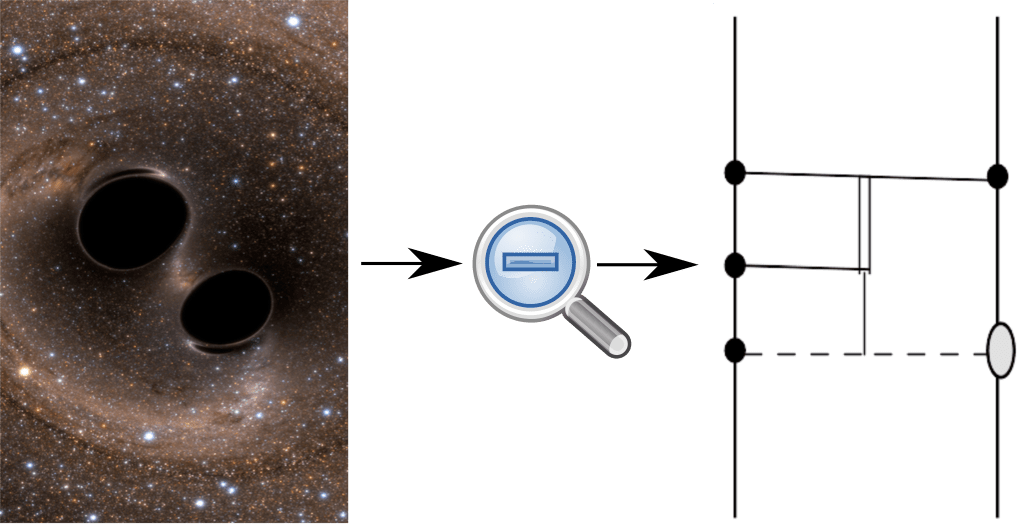
Effective Field Theory is a kind of “zoom knob” for particle physics. You “zoom out” to some chosen scale, and write down a theory that describes physics at that scale. Your theory won’t be a complete description: you’re ignoring everything that’s “too small to see”. It will, however, be an effective description: one that, at the scale you’re interested in, is effectively true.

Particle physicists usually use Effective Field Theory to go between different theories of particle physics, to zoom out from strings to quarks to protons and neutrons. But you can zoom out even further, all the way out to astronomical distances. Zoom out far enough, and even something as massive as a black hole looks like just another particle.

Just click the “zoom X10” button fifteen times, and you’re there!

In this picture, the force of gravity between black holes looks like particles (specifically, gravitons) going back and forth. With this picture, physicists can calculate what happens when two black holes collide with each other, making predictions that can be checked with new gravitational wave telescopes like LIGO.

Researchers have pushed this technique quite far. As the calculations get more and more precise (more and more “loops”), they have gotten more and more challenging. This is particularly true when the black holes are spinning, an extra wrinkle in the calculation that adds a surprising amount of complexity.

That’s where I came in. I can’t compete with the experts on black holes, but I certainly know a thing or two about complicated particle physics calculations. Amplitudeologists, like Andrew McLeod and me, have a grab-bag of tricks that make these kinds of calculations a lot easier. With Michèle Levi’s expertise working with spinning black holes in Effective Field Theory, we were able to combine our knowledge to push beyond the state of the art, to a new level of precision.

This project has been quite exciting for me, for a number of reasons. For one, it’s my first time working with gravitons: despite this blog’s name, I’d never published a paper on gravity before. For another, as my brother quipped when he heard about it, this is by far the most “applied” paper I’ve ever written. I mostly work with a theory called N=4 super Yang-Mills, a toy model we use to develop new techniques. This paper isn’t a toy model: the calculation we did should describe black holes out there in the sky, in the real world. There’s a decent chance someone will use this calculation to compare with actual data, from LIGO or a future telescope. That, in particular, is an absurdly exciting prospect.

Because this was such an applied calculation, it was an opportunity to explore the more applied part of my own field. We ended up using well-known techniques from that corner, but I look forward to doing something more inventive in future.

What I Was Not Saying in My Last Post

Science communication is a gradual process. Anything we say is incomplete, prone to cause misunderstanding. Luckily, we can keep talking, give a new explanation that corrects those misunderstandings. This of course will lead to new misunderstandings. We then explain again, and so on. It sounds fruitless, but in practice our audience nevertheless gets closer and closer to the truth.

Last week, I tried to explain physicists’ notion of a fundamental particle. In particular, I wanted to explain what these particles aren’t: tiny, indestructible spheres, like Democritus imagined. Instead, I emphasized the idea of fields, interacting and exchanging energy, with particles as just the tip of the field iceberg.

I’ve given this kind of explanation before. And when I do, there are two things people often misunderstand. These correspond to two topics which use very similar language, but talk about different things. So this week, I thought I’d get ahead of the game and correct those misunderstandings.

The first misunderstanding: None of that post was quantum.

If you’ve heard physicists explain quantum mechanics, you’ve probably heard about wave-particle duality. Things we thought were waves, like light, also behave like particles, things we thought were particles, like electrons, also behave like waves.

If that’s on your mind, and you see me say particles don’t exist, maybe you think I mean waves exist instead. Maybe when I say “fields”, you think I’m talking about waves. Maybe you think I’m choosing one side of the duality, saying that waves exist and particles don’t.

To be 100% clear: I am not saying that.

Particles and waves, in quantum physics, are both manifestations of fields. Is your field just at one specific point? Then it’s a particle. Is it spread out, with a fixed wavelength and frequency? Then it’s a wave. These are the two concepts connected by wave-particle duality, where the same object can behave differently depending on what you measure. And both of them, to be clear, come from fields. Neither is the kind of thing Democritus imagined.

The second misunderstanding: This isn’t about on-shell vs. off-shell.

Some of you have seen some more “advanced” science popularization. In particular, you might have listened to Nima Arkani-Hamed, of amplituhedron fame, talk about his perspective on particle physics. Nima thinks we need to reformulate particle physics, as much as possible, “on-shell”. “On-shell” means that particles obey their equations of motion, normally quantum calculations involve “off-shell” particles that violate those equations.

To again be clear: I’m not arguing with Nima here.

Nima (and other people in our field) will sometimes talk about on-shell vs off-shell as if it was about particles vs. fields. Normal physicists will write down a general field, and let it be off-shell, we try to do calculations with particles that are on-shell. But once again, on-shell doesn’t mean Democritus-style. We still don’t know what a fully on-shell picture of physics will look like. Chances are it won’t look like the picture of sloshing, omnipresent fields we started with, at least not exactly. But it won’t bring back indivisible, unchangeable atoms. Those are gone, and we have no reason to bring them back.

These Ain’t Democritus’s Particles

Physicists talk a lot about fundamental particles. But what do we mean by fundamental?

The Ancient Greek philosopher Democritus thought the world was composed of fundamental indivisible objects, constantly in motion. He called these objects “atoms”, and believed they could never be created or destroyed, with every other phenomenon explained by different types of interlocking atoms.

The things we call atoms today aren’t really like this, as you probably know. Atoms aren’t indivisible: their electrons can be split from their nuclei, and with more energy their nuclei can be split into protons and neutrons. More energy yet, and protons and neutrons can in turn be split into quarks. Still, at this point you might wonder: could quarks be Democritus’s atoms?

In a word, no. Nonetheless, quarks are, as far as we know, fundamental particles. As it turns out, our “fundamental” is very different from Democritus’s. Our fundamental particles can transform.

Think about beta decay. You might be used to thinking of it in terms of protons and neutrons: an unstable neutron decays, becoming a proton, an electron, and an (electron-anti-)neutrino. You might think that when the neutron decays, it literally “decays”, falling apart into smaller pieces.

But when you look at the quarks, the neutron’s smallest pieces, that isn’t the picture at all. In beta decay, a down quark in the neutron changes, turning into an up quark and an unstable W boson. The W boson then decays into an electron and a neutrino, while the up quark becomes part of the new proton. Even looking at the most fundamental particles we know, Democritus’s picture of unchanging atoms just isn’t true.

Could there be some even lower level of reality that works the way Democritus imagined? It’s not impossible. But the key insight of modern particle physics is that there doesn’t need to be.

As far as we know, up quarks and down quarks are both fundamental. Neither is “made of” the other, or “made of” anything else. But they also aren’t little round indestructible balls. They’re manifestations of quantum fields, “ripples” that slosh from one sort to another in complicated ways.

When we ask which particles are fundamental, we’re asking what quantum fields we need to describe reality. We’re asking for the simplest explanation, the simplest mathematical model, that’s consistent with everything we could observe. So “fundamental” doesn’t end up meaning indivisible, or unchanging. It’s fundamental like an axiom: used to derive the rest.

You Can’t Anticipate a Breakthrough

As a scientist, you’re surrounded by puzzles. For every test and every answer, ten new questions pop up. You can spend a lifetime on question after question, never getting bored.

But which questions matter? If you want to change the world, if you want to discover something deep, which questions should you focus on? And which should you ignore?

Last year, my collaborators and I completed a long, complicated project. We were calculating the chance fundamental particles bounce off each other in a toy model of nuclear forces, pushing to very high levels of precision. We managed to figure out a lot, but as always, there were many questions left unanswered in the end.

The deepest of these questions came from number theory. We had noticed surprising patterns in the numbers that showed up in our calculation, reminiscent of the fancifully-named Cosmic Galois Theory. Certain kinds of numbers never showed up, while others appeared again and again. In order to see these patterns, though, we needed an unusual fudge factor: an unexplained number multiplying our result. It was clear that there was some principle at work, a part of the physics intimately tied to particular types of numbers.

There were also questions that seemed less deep. In order to compute our result, we compared to predictions from other methods: specific situations where the question becomes simpler and there are other ways of calculating the answer. As we finished writing the paper, we realized we could do more with some of these predictions. There were situations we didn’t use that nonetheless simplified things, and more predictions that it looked like we could make. By the time we saw these, we were quite close to publishing, so most of us didn’t have the patience to follow these new leads. We just wanted to get the paper out.

At the time, I expected the new predictions would lead, at best, to more efficiency. Maybe we could have gotten our result faster, or cleaned it up a bit. They didn’t seem essential, and they didn’t seem deep.

Fast forward to this year, and some of my collaborators (specifically, Lance Dixon and Georgios Papathanasiou, along with Benjamin Basso) have a new paper up: “The Origin of the Six-Gluon Amplitude in Planar N=4 SYM”. The “origin” in their title refers to one of those situations: when the variables in the problem are small, and you’re close to the “origin” of a plot in those variables. But the paper also sheds light on the origin of our calculation’s mysterious “Cosmic Galois” behavior.

It turns out that the origin (of the plot) can be related to another situation, when the paths of two particles in our calculation almost line up. There, the calculation can be done with another method, called the Pentagon Operator Product Expansion, or POPE. By relating the two, Basso, Dixon, and Papathanasiou were able to predict not only how our result should have behaved near the origin, but how more complicated as-yet un-calculated results should behave.

The biggest surprise, though, lurked in the details. Building their predictions from the POPE method, they found their calculation separated into two pieces: one which described the physics of the particles involved, and a “normalization”. This normalization, predicted by the POPE method, involved some rather special numbers…the same as the “fudge factor” we had introduced earlier! Somehow, the POPE’s physics-based setup “knows” about Cosmic Galois Theory!

It seems that, by studying predictions in this specific situation, Basso, Dixon, and Papathanasiou have accomplished something much deeper: a strong hint of where our mysterious number patterns come from. It’s rather humbling to realize that, were I in their place, I never would have found this: I had assumed “the origin” was just a leftover detail, perhaps useful but not deep.

I’m still digesting their result. For now, it’s a reminder that I shouldn’t try to pre-judge questions. If you want to learn something deep, it isn’t enough to sit thinking about it, just focusing on that one problem. You have to follow every lead you have, work on every problem you can, do solid calculation after solid calculation. Sometimes, you’ll just make incremental progress, just fill in the details. But occasionally, you’ll have a breakthrough, something that justifies the whole adventure and opens your door to something strange and new. And I’m starting to think that when it comes to breakthroughs, that’s always been the only way there.

What Do Theorists Do at Work?

Picture a scientist at work. You’re probably picturing an experiment, test tubes and beakers bubbling away. But not all scientists do experiments. Theoretical physicists work on the mathematical side of the field, making predictions and trying to understand how to make them better. So what does it look like when a theoretical physicist is working?

A theoretical physicist, at work in the equation mines

The first thing you might imagine is that we just sit and think. While that happens sometimes, we don’t actually do that very often. It’s better, and easier, to think by doing something.

Sometimes, this means working with pen and paper. This should be at least a little familiar to anyone who has done math homework. We’ll do short calculations and draw quick diagrams to test ideas, and do a more detailed, organized, “show your work” calculation if we’re trying to figure out something more complicated. Sometimes very short calculations are done on a blackboard instead, it can help us visualize what we’re doing.

Sometimes, we use computers instead. There are computer algebra packages, like Mathematica, Maple, or Sage, that let us do roughly what we would do on pen and paper, but with the speed and efficiency of a computer. Others program in more normal programming languages: C++, Python, even Fortran, making programs that can calculate whatever they are interested in.

Sometimes we read. With most of our field’s papers available for free on arXiv.org, we spend time reading up on what our colleagues have done, trying to understand their work and use it to improve ours.

Sometimes we talk. A paper can only communicate so much, and sometimes it’s better to just walk down the hall and ask a question. Conversations are also a good way to quickly rule out bad ideas, and narrow down to the promising ones. Some people find it easier to think clearly about something if they talk to a colleague about it, even (sometimes especially) if the colleague isn’t understanding much.

And sometimes, of course, we do all the other stuff. We write up our papers, making the diagrams nice and the formulas clean. We teach students. We go to meetings. We write grant applications.

It’s been said that a theoretical physicist can work anywhere. That’s kind of true. Some places are more comfortable, and everyone has different preferences: a busy office, a quiet room, a cafe. But with pen and paper, a computer, and people to talk to, we can do quite a lot.

The Road to Reality

I build tools, mathematical tools to be specific, and I want those tools to be useful. I want them to be used to study the real world. But when I build those tools, most of the time, I don’t test them on the real world. I use toy models, simpler cases, theories that don’t describe reality and weren’t intended to.

I do this, in part, because it lets me stay one step ahead. I can do more with those toy models, answer more complicated questions with greater precision, than I can for the real world. I can do more ambitious calculations, and still get an answer. And by doing those calculations, I can start to anticipate problems that will crop up for the real world too. Even if we can’t do a calculation yet for the real world, if it requires too much precision or too many particles, we can still study it in a toy model. Then when we’re ready to do those calculations in the real world, we know better what to expect. The toy model will have shown us some of the key challenges, and how to tackle them.

There’s a risk, working with simpler toy models. The risk is that their simplicity misleads you. When you solve a problem in a toy model, could you solve it only because the toy model is easy? Or would a similar solution work in the real world? What features of the toy model did you need, and which are extra?

The only way around this risk is to be careful. You have to keep track of how your toy model differs from the real world. You must keep in mind difficulties that come up on the road to reality: the twists and turns and potholes that real-world theories will give you. You can’t plan around all of them, that’s why you’re working with a toy model in the first place. But for a few key, important ones, you should keep your eye on the horizon. You should keep in mind that, eventually, the simplifications of the toy model will go away. And you should have ideas, perhaps not full plans but at least ideas, for how to handle some of those difficulties. If you put the work in, you stand a good chance of building something that’s useful, not just for toy models, but for explaining the real world.

Why You Might Want to Bootstrap

A few weeks back, Quanta Magazine had an article about attempts to “bootstrap” the laws of physics, starting from simple physical principles and pulling out a full theory “by its own bootstraps”. This kind of work is a cornerstone of my field, a shared philosophy that motivates a lot of what we do. Building on deep older results, people in my field have found that just a few simple principles are enough to pick out specific physical theories.

There are limits to this. These principles pick out broad traits of theories: gravity versus the strong force versus the Higgs boson. As far as we know they don’t separate more closely related forces, like the strong nuclear force and the weak nuclear force. (Originally, the Quanta article accidentally made it sound like we know why there are four fundamental forces: we don’t, and the article’s phrasing was corrected.) More generally, a bootstrap method isn’t going to tell you which principles are the right ones. For any set of principles, you can always ask “why?”

With that in mind, why would you want to bootstrap?

First, it can make your life simpler. Those simple physical principles may be clear at the end, but they aren’t always obvious at the start of a calculation. If you don’t make good use of them, you might find you’re calculating many things that violate those principles, things that in the end all add up to zero. Bootstrapping can let you skip that part of the calculation, and sometimes go straight to the answer.

Second, it can suggest possibilities you hadn’t considered. Sometimes, your simple physical principles don’t select a unique theory. Some of the options will be theories you’ve heard of, but some might be theories that never would have come up, or even theories that are entirely new. Trying to understand the new theories, to see whether they make sense and are useful, can lead to discovering new principles as well.

Finally, even if you don’t know which principles are the right ones, some principles are better than others. If there is an ultimate theory that describes the real world, it can’t be logically inconsistent. That’s a start, but it’s quite a weak requirement. There are principles that aren’t required by logic itself, but that still seem important in making the world “make sense”. Often, we appreciate these principles only after we’ve seen them at work in the real world. The best example I can think of is relativity: while Newtonian mechanics is logically consistent, it requires a preferred reference frame, a fixed notion for which things are moving and which things are still. This seemed reasonable for a long time, but now that we understand relativity the idea of a preferred reference frame seems like it should have been obviously wrong. It introduces something arbitrary into the laws of the universe, a “why is it that way?” question that doesn’t have an answer. That doesn’t mean it’s logically inconsistent, or impossible, but it does make it suspect in a way other ideas aren’t. Part of the hope of these kinds of bootstrap methods is that they uncover principles like that, principles that aren’t mandatory but that are still in some sense “obvious”. Hopefully, enough principles like that really do specify the laws of physics. And if they don’t, we’ll at least have learned how to calculate better.

Calculating the Hard Way, for Science!

I had a new paper out last week, with Jacob Bourjaily and Matthias Volk. We’re calculating the probability that particles bounce off each other in our favorite toy model, N=4 super Yang-Mills. And this time, we’re doing it the hard way.

The “easy way” we didn’t take is one I have a lot of experience with. Almost as long as I’ve been writing this blog, I’ve been calculating these particle probabilities by “guesswork”: starting with a plausible answer, then honing it down until I can be confident it’s right. This might sound reckless, but it works remarkably well, letting us calculate things we could never have hoped for with other methods. The catch is that “guessing” is much easier when we know what we’re looking for: in particular, it works much better in toy models than in the real world.

Over the last few years, though, I’ve been using a much more “normal” method, one that so far has a better track record in the real world. This method, too, works better than you would expect, and we’ve managed some quite complicated calculations.

So we have an “easy way”, and a “hard way”. Which one is better? Is the hard way actually harder?

To test that, you need to do the same calculation both ways, and see which is easier. You want it to be a fair test: if “guessing” only works in the toy model, then you should do the “hard” version in the toy model as well. And you don’t want to give “guessing” any unfair advantages. In particular, the “guess” method works best when we know a lot about the result we’re looking for: what it’s made of, what symmetries it has. In order to do a fair test, we must use that knowledge to its fullest to improve the “hard way” as well.

We picked an example in the middle: not too easy, and not too hard, a calculation that was done a few years back “the easy way” but not yet done “the hard way”. We plugged in all the modern tricks we could, trying to use as much of what we knew as possible. We trained a grad student: Matthias Volk, who did the lion’s share of the calculation and learned a lot in the process. We worked through the calculation, and did it properly the hard way.

Which method won?

In the end, the hard way was indeed harder…but not by that much! Most of the calculation went quite smoothly, with only a few difficulties at the end. Just five years ago, when the calculation was done “the easy way”, I doubt anyone would have expected the hard way to be viable. But with modern tricks it wasn’t actually that hard.

This is encouraging. It tells us that the “hard way” has potential, that it’s almost good enough to compete at this kind of calculation. It tells us that the “easy way” is still quite powerful. And it reminds us that the more we know, and the more we apply our knowledge, the more we can do.