In the past, Michio Kaku made important contributions to string theory, but he’s best known for what could charitably be called science popularization. He’s an excited promoter of physics and technology, but that excitement often strays into inaccuracy. Pretty much every time I’ve heard him mentioned, it’s for some wildly overenthusiastic statement about physics that, rather than just being simplified for a general audience, is generally flat-out wrong, conflating a bunch of different developments in a way that makes zero actual sense.
Michio Kaku isn’t unique in this. There’s a whole industry in making nonsense statements about science, overenthusiastic books and videos hinting at science fiction or mysticism. Deepak Chopra is a famous figure from deeper on this spectrum, known for peddling loosely quantum-flavored spirituality.
There was a time I was worried about this kind of thing. Super-popular misinformation is the bogeyman of the science popularizer, the worry that for every nice, careful explanation we give, someone else will give a hundred explanations that are way more exciting and total baloney. Somehow, though, I hear less and less from these people over time, and thus worry less and less about them.
(But then in practice, I’m more likely to reflect on content with even smalleraudiences.)
If misinformation is this popular, shouldn’t I be doing more to combat it?
Popular misinformation is also going to be popular among critics. For every big-time nonsense merchant, there are dozens of people breaking down and debunking every false statement they say, every piece of hype they release. Often, these people will end up saying the same kinds of things over and over again.
If I can be useful, I don’t think it will be by saying the same thing over and over again. I come up with new metaphors, new descriptions, new explanations. I clarify things others haven’t clarified, I clear up misinformation others haven’t addressed. That feels more useful to me, especially in a world where others are already countering the big problems. I write, and writing lasts, and can be used again and again when needed. I don’t need to keep up with the Kakus and Chopras of the world to do that.
(Which doesn’t imply I’ll never address anything one of those people says…but if I do, it will be because I have something new to say back!)
For those who have been following these developments, things don’t feel quite so sudden. Already in 2019, AI Dungeon showed off how an early version of GPT could be used to mimic an old-school text-adventure game, and a tumblr blogger built a bot that imitates his posts as a fun side project. Still, the newer programs have shown some impressive capabilities.
Are we close to “real AI”, to artificial minds like the positronic brains in Isaac Asimov’s I, Robot? I can’t say, in part because I’m not sure what “real AI” really means. But if you want to understand where things like ChatGPT come from, how they work and why they can do what they do, then all the talk of AI won’t be helpful. Instead, you need to think of an entirely different set of Asimov novels: the Foundation series.
While Asimov’s more famous I, Robot focused on the science of artificial minds, the Foundation series is based on a different fictional science, the science of psychohistory. In the stories, psychohistory is a kind of futuristic social science. In the real world, historians and sociologists can find general principles of how people act, but don’t yet have the kind of predictive theories physicists or chemists do. Foundation imagines a future where powerful statistical methods have allowed psychohistorians to precisely predict human behavior: not yet that of individual people, but at least the average behavior of civilizations. They can not only guess when an empire is soon to fall, but calculate how long it will be before another empire rises, something few responsible social scientists would pretend to do today.
GPT and similar programs aren’t built to predict the course of history, but they do predict something: given part of a text, they try to predict the rest. They’re called Large Language Models, or LLMs for short. They’re “models” in the sense of mathematical models, formulas that let us use data to make predictions about the world, and the part of the world they model is our use of language.
Normally, a mathematical model is designed based on how we think the real world works. A mathematical model of a pandemic, for example, might use a list of people, each one labeled as infected or not. It could include an unknown number, called a parameter, for the chance that one person infects another. That parameter would then be filled in, or fixed, based on observations of the pandemic in the real world.
LLMs (as well as most of the rest of what people call “AI” these days) are a bit different. Their models aren’t based on what we expect about the real world. Instead, they’re in some sense “generic”, models that could in principle describe just about anything. In order to make this work, they have a lot more parameters, tons and tons of flexible numbers that can get fixed in different ways based on data.
The surprising thing is that this works, and works surprisingly well. Just as psychohistory from the Foundation novels can predict events with much more detail than today’s historians and sociologists, LLMs can predict what a text will look like much more precisely than today’s literature professors. That isn’t necessarily because LLMs are “intelligent”, or because they’re “copying” things people have written. It’s because they’re mathematical models, built by statistically analyzing a giant pile of texts.
Just as Asimov’s psychohistory can’t predict the behavior of individual people, LLMs can’t predict the behavior of individual texts. If you start writing something, you shouldn’t expect an LLM to predict exactly how you would finish. Instead, LLMs predict what, on average, the rest of the text would look like. They give a plausible answer, one of many, for what might come next.
They can’t do that perfectly, but doing it imperfectly is enough to do quite a lot. It’s why they can be used to make chatbots, by predicting how someone might plausibly respond in a conversation. It’s why they can write fiction, or ads, or college essays, by predicting a plausible response to a book jacket or ad copy or essay prompt.
LLMs like GPT were invented by computer scientists, not social scientists or literature professors. Because of that, they get described as part of progress towards artificial intelligence, not as progress in social science. But if you want to understand what ChatGPT is right now, and how it works, then that perspective won’t be helpful. You need to put down your copy of I, Robot and pick up Foundation. You’ll still be impressed, but you’ll have a clearer idea of what could come next.
I don’t want to be the kind of science blogger who constantly complains about science fiction, but sometimes I can’t help myself.
When I blogged about zero-point energy a few weeks back, there was a particular book that set me off. Ian McDonald’s River of Gods depicts the interactions of human and AI agents in a fragmented 2047 India. One subplot deals with a power company pursuing zero-point energy, using an imagined completion of M theory called M* theory. This post contains spoilers for that subplot.
What frustrated me about River of Gods is that the physics in it almost makes sense. It isn’t just an excuse for magic, or a standard set of tropes. Even the name “M* theory” is extremely plausible, the sort of term that could get used for technical reasons in a few papers and get accidentally stuck as the name of our fundamental theory of nature. But because so much of the presentation makes sense, it’s actively frustrating when it doesn’t.
The problem is the role the landscape of M* theory plays in the story. The string theory (or M theory) landscape is the space of all consistent vacua, a list of every consistent “default” state the world could have. In the story, one of the AIs is trying to make a portal to somewhere else in the landscape, a world of pure code where AIs can live in peace without competing with humans.
The problem is that the landscape is not actually a real place in string theory. It’s a metaphorical mathematical space, a list organized by some handy coordinates. The other vacua, the other “default states”, aren’t places you can travel to, there just other ways the world could have been.
Ok, but what about the multiverse?
There are physicists out there who like to talk about multiple worlds. Some think they’re hypothetical, others argue they must exist. Sometimes they’ll talk about the string theory landscape. But to get a multiverse out of the string theory landscape, you need something else as well.
Two options for that “something else” exist. One is called eternal inflation, the other is the many-worlds interpretation of quantum mechanics. And neither lets you travel around the multiverse.
In eternal inflation, the universe is expanding faster and faster. It’s expanding so fast that, in most places, there isn’t enough time for anything complicated to form. Occasionally, though, due to quantum randomness, a small part of the universe expands a bit more slowly: slow enough for stars, planets, and maybe life. Each small part like that is its own little “Big Bang”, potentially with a different “default” state, a different vacuum from the string landscape. If eternal inflation is true then you can get multiple worlds, but they’re very far apart, and getting farther every second: not easy to visit.
The many-worlds interpretation is a way to think about quantum mechanics. One way to think about quantum mechanics is to say that quantum states are undetermined until you measure them: a particle could be spinning left or right, Schrödinger’s cat could be alive or dead, and only when measured is their state certain. The many-worlds interpretation offers a different way: by doing away with measurement, it instead keeps the universe in the initial “undetermined” state. The universe only looks determined to us because of our place in it: our states become entangled with those of particles and cats, so that our experiences only correspond to one determined outcome, the “cat alive branch” or the “cat dead branch”. Combine this with the string landscape, and our universe might have split into different “branches” for each possible stable state, each possible vacuum. But you can’t travel to those places, your experiences are still “just on one branch”. If they weren’t, many-worlds wouldn’t be an interpretation, it would just be obviously wrong.
In River of Gods, the AI manipulates a power company into using a particle accelerator to make a bubble of a different vacuum in the landscape. Surprisingly, that isn’t impossible. Making a bubble like that is a bit like what the Large Hadron Collider does, but on a much larger scale. When the Large Hadron Collider detected a Higgs boson, it had created a small ripple in the Higgs field, a small deviation from its default state. One could imagine a bigger ripple doing more: with vastly more energy, maybe you could force the Higgs all the way to a different default, a new vacuum in its landscape of possibilities.
Doing that doesn’t create a portal to another world, though. It destroys our world.
That bubble of a different vacuum isn’t another branch of quantum many-worlds, and it isn’t a far-off big bang from eternal inflation. It’s a part of our own universe, one with a different “default state” where the particles we’re made of can’t exist. And typically, a bubble like that spreads at the speed of light.
In the story, they have a way to stabilize the bubble, stop it from growing or shrinking. That’s at least vaguely believable. But it means that their “portal to another world” is just a little bubble in the middle of a big expensive device. Maybe the AI can live there happily…until the humans pull the plug.
Or maybe they can’t stabilize it, and the bubble spreads and spreads at the speed of light destroying everything. That would certainly be another way for the AI to live without human interference. It’s a bit less peaceful than advertised, though.
Listen to a certain flavor of crackpot, or a certain kind of science fiction, and you’ll hear about zero-point energy. Limitless free energy drawn from quantum space-time itself, zero-point energy probably sounds like bullshit. Often it is. But lurking behind the pseudoscience and the fiction is a real physics concept, albeit one that doesn’t really work like those people imagine.
In quantum mechanics, the zero-point energy is the lowest energy a particular system can have. That number doesn’t actually have to be zero, even for empty space. People sometimes describe this in terms of so-called virtual particles, popping up from nothing in particle-antiparticle pairs only to annihilate each other again, contributing energy in the absence of any “real particles”. There’s a real force, the Casimir effect, that gets attributed to this, a force that pulls two metal plates together even with no charge or extra electromagnetic field. The same bubbling of pairs of virtual particles also gets used to explain the Hawking radiation of black holes.
I’d like to try explaining all of these things in a different way, one that might clear up some common misconceptions. To start, let’s talk about, not zero-point energy, but zero-point diagrams.
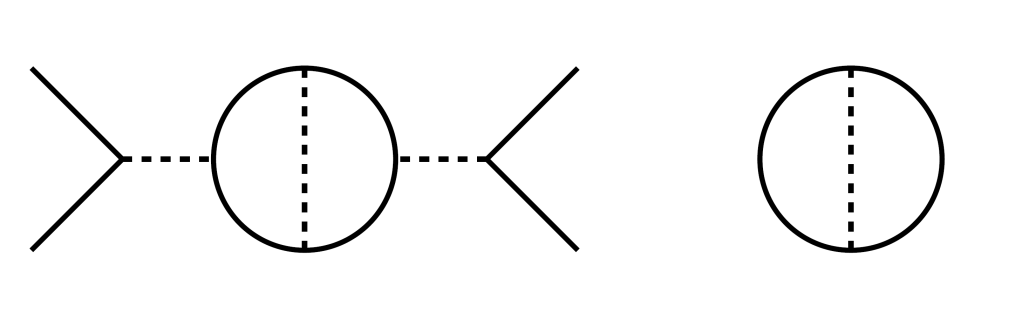
Feynman diagrams are a tool we use to study particle physics. We start with a question: if some specific particles come together and interact, what’s the chance that some (perhaps different) particles emerge? We start by drawing lines representing the particles going in and out, then connect them in every way allowed by our theory. Finally we translate the diagrams to numbers, to get an estimate for the probability. In particle physics slang, the number of “points” is the total number of particles: particles in, plus particles out. For example, let’s say we want to know the chance that two electrons go in and two electrons come out. That gives us a “four-point” diagram: two in, plus two out. A zero-point diagram, then, means zero particles in, zero particles out.
A four-point diagram and a zero-point diagram
(Note that this isn’t why zero-point energy is called zero-point energy, as far as I can tell. Zero-point energy is an older term from before Feynman diagrams.)
Remember, each Feynman diagram answers a specific question, about the chance of particles behaving in a certain way. You might wonder, what question does a zero-point diagram answer? The chance that nothing goes to nothing? Why would you want to know that?
To answer, I’d like to bring up some friends of mine, who do something that might sound equally strange: they calculate one-point diagrams, one particle goes to none. This isn’t strange for them because they study theories with defects.
For some reason, they didn’t like my suggestion to use this stamp on their papers
Normally in particle physics, we think about our particles in an empty, featureless space. We don’t have to, though. One thing we can do is introduce features in this space, like walls and mirrors, and try to see what effect they have. We call these features “defects”.
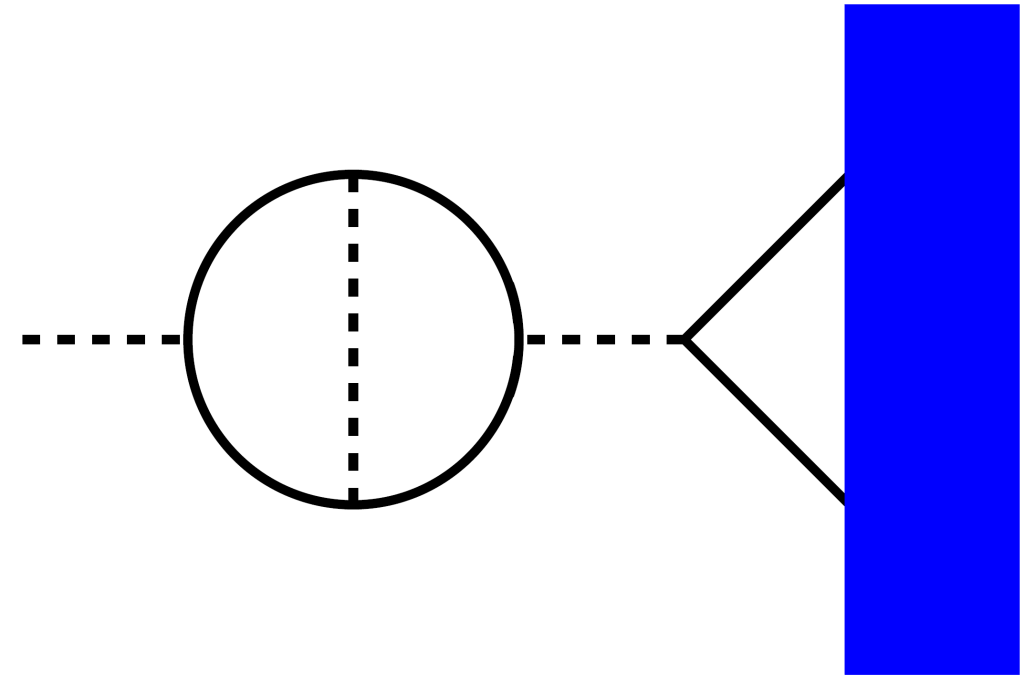
If there’s a defect like that, then it makes sense to calculate a one-point diagram, because your one particle can interact with something that’s not a particle: it can interact with the defect.
A one-point diagram with a wall, or “defect”
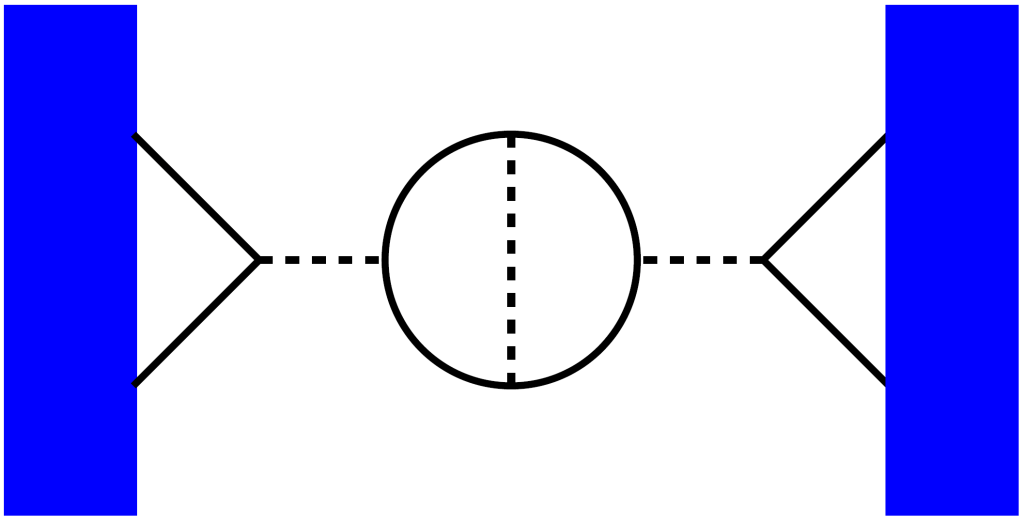
You might see where this is going: let’s say you think there’s a force between two walls, that comes from quantum mechanics, and you want to calculate it. You could imagine it involves a diagram like this:
A “zero-point diagram” between two walls
Roughly speaking, this is the kind of thing you could use to calculate the Casimir effect, that mysterious quantum force between metal plates. And indeed, it involves a zero-point diagram.
Here’s the thing, though: metal plates aren’t just “defects”. They’re real physical objects, made of real physical particles. So while you can think of the Casimir effect with a “zero-point diagram” like that, you can also think of it with a normal diagram, more like the four-point diagram I showed you earlier: one that computes, not a force between defects, but a force between the actual electrons and protons that make up the two plates.
A lot of the time when physicists talk about pairs of virtual particles popping up out of the vacuum, they have in mind a picture like this. And often, you can do the same trick, and think about it instead as interactions between physical particles. There’s a story of roughly this kind for Hawking radiation: you can think of a black hole event horizon as “cutting in half” a zero-point diagram, and see pairs of particles going out from the black hole…but you can also do a calculation that looks more like particles interacting with a gravitational field.
This also might help you understand why, contra the crackpots and science fiction writers, zero-point energy isn’t a source of unlimited free energy. Yes, a force like the Casimir effect comes “from the vacuum” in some sense. But really, it’s a force between two particles. And just like the gravitational force between two particles, this doesn’t give you unlimited free power. You have to do the work to move the particles back over and over again, using the same amount of power you gained from the force to begin with. And unlike the forces you’re used to, these are typically very small effects, as usual for something that depends on quantum mechanics. So it’s even less useful than more everyday forces for this.
Why do so many crackpots and authors expect zero-point energy to be a massive source of power? In part, this is due to mistakes physicists made early on.
Sometimes, when calculating a zero-point diagram (or any other diagram), we don’t get a sensible number. Instead, we get infinity. Physicists used to be baffled by this. Later, they understood the situation a bit better, and realized that those infinities were probably just due to our ignorance. We don’t know the ultimate high-energy theory, so it’s possible something happens at high energies to cancel those pesky infinities. Without knowing exactly what happened, physicists would estimate by using a “cutoff” energy where they expected things to change.
That kind of calculation led to an estimate you might have heard of, that the zero-point energy inside single light bulb could boil all the world’s oceans. That estimate gives a pretty impressive mental image…but it’s also wrong.
This kind of estimate led to “the worst theoretical prediction in the history of physics”, that the cosmological constant, the force that speeds up the expansion of the universe, is 120 orders of magnitude higher than its actual value (if it isn’t just zero). If there really were energy enough inside each light bulb to boil the world’s oceans, the expansion of the universe would be quite different than what we observe.
At this point, it’s pretty clear there is something wrong with these kinds of “cutoff” estimates. The only unclear part is whether that’s due to something subtle or something obvious. But either way, this particular estimate is just wrong, and you shouldn’t take it seriously. Zero-point energy exists, but it isn’t the magical untapped free energy you hear about in stories. It’s tiny quantum corrections to the forces between particles.
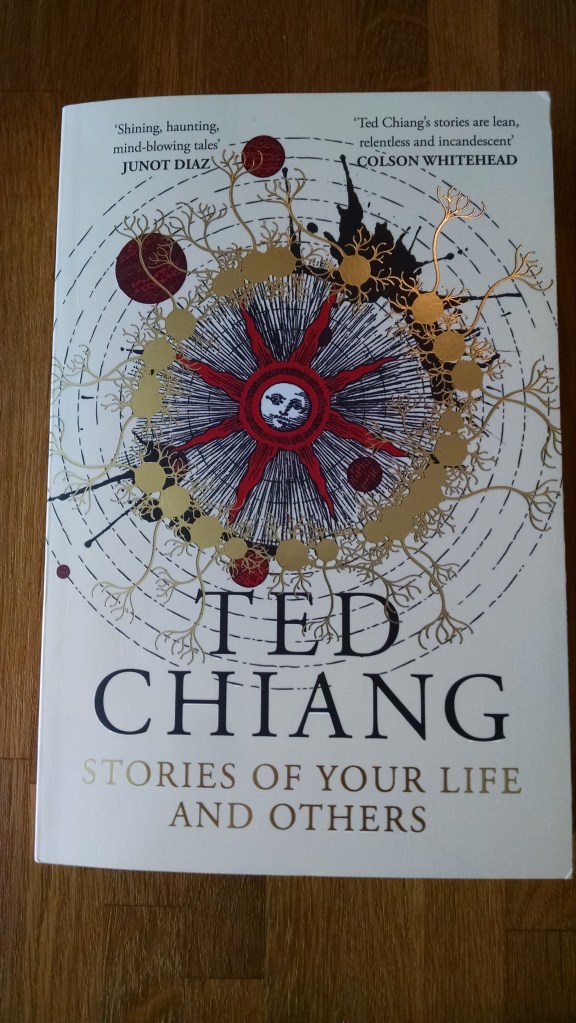
This post is once again inspired by a Ted Chiang short story. This time, it’s “The Evolution of Human Science”, which imagines a world in which super-intelligent “metahumans” have become incomprehensible to the ordinary humans they’ve left behind. Human scientists in that world practice “hermeneutics“: instead of original research, they try to interpret what the metahumans are doing, reverse-engineering their devices and observing their experiments.
Much like a blogger who, out of ideas, cribs them from books.
It’s a thought-provoking view of what science in the distant future could become. But it’s also oddly familiar.
You might think I’m talking about machine learning here. It’s true that in recent years people have started using machine learning in science, with occasionally mysterious results. There are even a few cases of physicists using machine-learning to suggest some property, say of Calabi-Yau manifolds, and then figuring out how to prove it. It’s not hard to imagine a day when scientists are reduced to just interpreting whatever the AIs throw at them…but I don’t think we’re quite there yet.
Instead, I’m thinking about my own work. I’m a particular type of theoretical physicist. I calculate scattering amplitudes, formulas that tell us the probabilities that subatomic particles collide in different ways. We have a way to calculate these, Feynman’s famous diagrams, but they’re inefficient, so researchers like me look for shortcuts.
How do we find those shortcuts? Often, it’s by doing calculations the old, inefficient way. We use older methods, look at the formulas we get, and try to find patterns. Each pattern is a hint at some new principle that can make our calculations easier. Sometimes we can understand the pattern fully, and prove it should hold. Other times, we observe it again and again and tentatively assume it will keep going, and see what happens if it does.
Either way, this isn’t so different from the hermeneutics scientists practice in the story. Feynman diagrams already “know” every pattern we find, like the metahumans in the story who already know every result the human scientists can discover. But that “knowledge” isn’t in a form we can understand or use. We have to learn to interpret it, to read between the lines and find underlying patterns, to end up with something we can hold in our own heads and put into action with our own hands. The truth may be “out there”, but scientists can’t be content with that. We need to get the truth “in here”. We need to interpret it for ourselves.
George Gamow was one of the “quantum kids” who got their start at the Niels Bohr Institute in the 30’s. He’s probably best known for the Alpher, Bethe, Gamow paper, which managed to combine one of the best sources of evidence we have for the Big Bang with a gratuitous Greek alphabet pun. He was the group jester in a lot of ways: the historians here have archives full of his cartoons and in-jokes.
Naturally, he also did science popularization.
I recently read two of Gamow’s science popularization books, “Mr Tompkins” and “Thirty Years That Shook Physics”. Reading them was a trip back in time, to when people thought about physics in surprisingly different ways.
“Mr. Tompkins” started as a series of articles in Discovery, a popular science magazine. They were published as a book in 1940, with a sequel in 1945 and an update in 1965. Apparently they were quite popular among a certain generation: the edition I’m reading has a foreword by Roger Penrose.
(As an aside: Gamow mentions that the editor of Discovery was C. P. Snow…that C. P. Snow?)
Mr Tompkins himself is a bank clerk who decides on a whim to go to a lecture on relativity. Unable to keep up, he falls asleep, and dreams of a world in which the speed of light is much slower than it is in our world. Bicyclists visibly redshift, and travelers lead much longer lives than those who stay at home. As the book goes on he meets the same professor again and again (eventually marrying his daughter) and sits through frequent lectures on physics, inevitably falling asleep and experiencing it first-hand: jungles where Planck’s constant is so large that tigers appear as probability clouds, micro-universes that expand and collapse in minutes, and electron societies kept strictly monogamous by “Father Paulini”.
The structure definitely feels dated, and not just because these days people don’t often go to physics lectures for fun. Gamow actually includes the full text of the lectures that send Mr Tompkins to sleep, and while they’re not quite boring enough to send the reader to sleep they are written on a higher level than the rest of the text, with more technical terms assumed. In the later additions to the book the “lecture” aspect grows: the last two chapters involve a dream of Dirac explaining antiparticles to a dolphin in basically the same way he would explain them to a human, and a discussion of mesons in a Japanese restaurant where the only fantastical element is a trio of geishas acting out pion exchange.
Some aspects of the physics will also feel strange to a modern audience. Gamow presents quantum mechanics in a way that I don’t think I’ve seen in a modern text: while modern treatments start with uncertainty and think of quantization as a consequence, Gamow starts with the idea that there is a minimum unit of action, and derives uncertainty from that. Some of the rest is simply limited by timing: quarks weren’t fully understood even by the 1965 printing, in 1945 they weren’t even a gleam in a theorist’s eye. Thus Tompkins’ professor says that protons and neutrons are really two states of the same particle and goes on to claim that “in my opinion, it is quite safe to bet your last dollar that the elementary particles of modern physics [electrons, protons/neutrons, and neutrinos] will live up to their name.” Neutrinos also have an amusing status: they hadn’t been detected when the earlier chapters were written, and they come across rather like some people write about dark matter today, as a silly theorist hypothesis that is all-too-conveniently impossible to observe.
“Thirty Years That Shook Physics”, published in 1966, is a more usual sort of popular science book, describing the history of the quantum revolution. While mostly focused on the scientific concepts, Gamow does spend some time on anecdotes about the people involved. If you’ve read much about the time period, you’ll probably recognize many of the anecdotes (for example, the Pauli Principle that a theorist can break experimental equipment just by walking in to the room, or Dirac’s “discovery” of purling), even the ones specific to Gamow have by now been spread far and wide.
Like Mr Tompkins, the level in this book is not particularly uniform. Gamow will spend a paragraph carefully defining an average, and then drop the word “electroscope” as if everyone should know what it is. The historical perspective taught me a few things I perhaps should have already known, but found surprising anyway. (The plum-pudding model was an actual mathematical model, and people calculated its consequences! Muons were originally thought to be mesons!)
Both books are filled with Gamow’s whimsical illustrations, something he was very much known for. Apparently he liked to imitate other art styles as well, which is visible in the portraits of physicists at the front of each chapter.
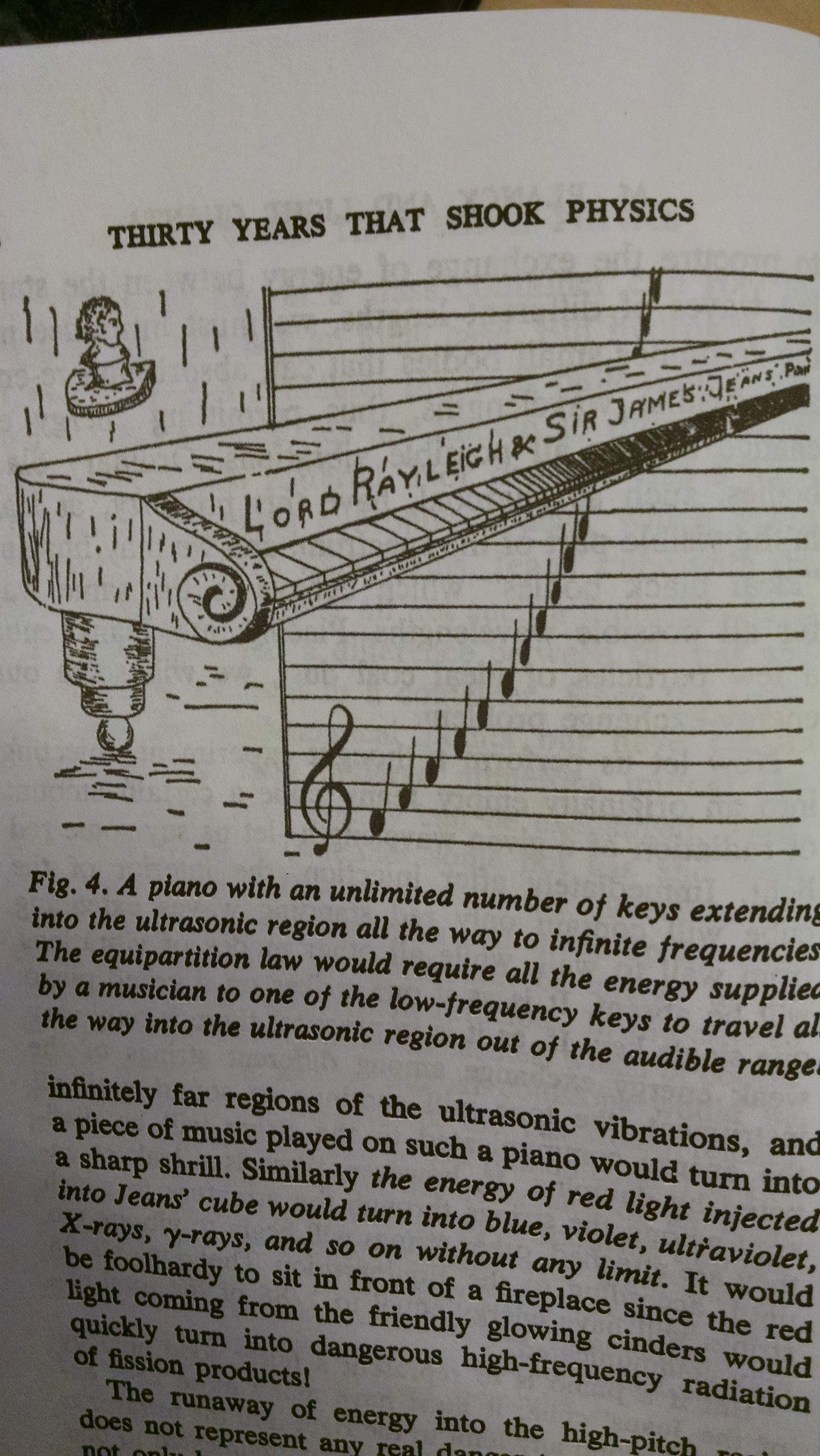
Pictured: the electromagnetic spectrum as an infinite piano
1966 was late enough that this book doesn’t have the complacency of the earlier chapters in Mr Tompkins: Gamow knew that there were more particles than just electrons, nucleons, and neutrinos. It was still early enough, though, that the new particles were not fully understood. It’s interesting seeing how Gamow reacts to this: his expectation was that physics was on the cusp of another massive change, a new theory built on new fundamental principles. He speculates that there might be a minimum length scale (although oddly enough he didn’t expect it to be related to gravity).
It’s only natural that someone who lived through the dawn of quantum mechanics should expect a similar revolution to follow. Instead, the revolution of the late 60’s and early 70’s was in our understanding: not new laws of nature so much as new comprehension of just how much quantum field theory can actually do. I wonder if the generation who lived through that later revolution left it with the reverse expectation: that the next crisis should be solved in a similar way, that the world is quantum field theory (or close cousins, like string theory) all the way down and our goal should be to understand the capabilities of these theories as well as possible.
The final section of the book is well worth waiting for. In 1932, Gamow directed Bohr’s students in staging a play, the “Blegdamsvej Faust”. A parody of Faust, it features Bohr as god, Pauli as Mephistopheles, and Ehrenfest as the “erring Faust” (Gamow’s pun, not mine) that he tempts to sin with the promise of the neutrino, Gretchen. The piece, translated to English by Gamow’s wife Barbara, is filled with in-jokes on topics as obscure as Bohr’s habitual mistakes when speaking German. It’s gloriously weird and well worth a read. If you’ve ever seen someone do a revival performance, let me know!
Around Halloween, I have a tradition of posting about the “spooky” side of physics. This year, I’ll be comparing two no doubt often confused topics, Cosmic Horror and Cosmology.
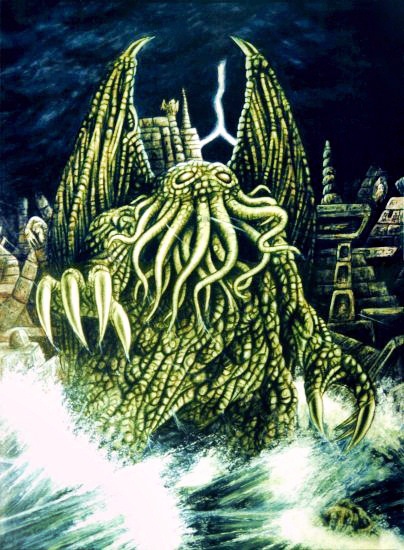
Pro tip: if this guy shows up, it’s probably Cosmic Horror
Cosmic Horror
Cosmology
Started in the 1920’s with the work of Howard Phillips Lovecraft
Started in the 1920’s with the work of Alexander Friedmann
Unimaginably ancient universe
Precisely imagined ancient universe
In strange ages even death may die
Strange ages, what redshift is that?
An expedition to Antarctica uncovers ruins of a terrifying alien civilization
An expedition to Antarctica uncovers…actually, never mind, just dust
Alien beings may propagate in hidden dimensions
Gravitons may propagate in hidden dimensions
Cultists compete to be last to be eaten by the Elder Gods
Grad students compete to be last to realize there are no jobs
Oceanic “deep ones” breed with humans
Have you seen daycare costs in a university town? No way.
Variety of inventive and bizarre creatures, inspiring libraries worth of copycat works
Fritz Zwicky
Hollywood adaptations are increasingly popular, not very faithful to source material
Actually this is exactly the same
Can waste hours on an ultimately fruitless game of Arkham Horror
Can waste hours on an ultimately fruitless argument with Paul Steinhardt
No matter what we do, eventually Azathoth will kill us all
No matter what we do, eventually vacuum decay will kill us all
Maybe you’ve heard the buzzword, and you imagine science fiction become reality: teleporting people across the galaxy, or ansibles communicating faster than light. Maybe you’ve heard a bit more, and know that quantum teleportation can’t transfer information faster than light, that it hasn’t been used on something even as complicated as a molecule…and you’re still confused, because if so, why call it teleportation in the first place?
There’s a simple way to clear up this confusion. You just have to realize that classical teleportation is easy.
What do I mean by “classical teleportation”?
Let’s start with the simplest teleporter you could imagine. It scans you on one end, then vaporizes you, and sends your information to a teleportation pad on the other end. The other end uses that information to build a copy of your body from some appropriate raw materials, and there you are!
(If the machine doesn’t vaporize you, then you end up with an army of resurrected Derek Parfits.)
Doing this with a person is, of course, absurdly difficult, and well beyond the reach of current technology.
And no, nothing about the Star Trek version changes that
Do it with a document, though, and you’ve essentially invented the fax machine.
Yes, faxes don’t copy a piece of paper atom by atom, but they don’t need to: they just send what’s written on it. This sort of “classical teleportation” is commonplace. Trade Pokémon, and your Pikachu gets “classical teleported” from one device to another. Send an email, and your laptop teleports it to someone else. The ability to “classically teleport” is essential for computers to function, the idea that you can take the “important information” about something and copy it somewhere else.
Note that under this definition, “classical teleportation” is not faster than light. You still need to send a signal, between a “scanner” and a “printer”, and that’s only as fast as your signal normally is. Note also that the “printer” needs some “ink”, you still need the right materials to build or record whatever is being teleported over.
So suppose you’re building a quantum computer, one that uses the unique properties of quantum mechanics. Naturally, you want to be able to take a quantum state and copy it somewhere else. You need “quantum teleportation”. And the first thing you realize is that it’s harder than it looks.
The problem comes when you try to “scan” your quantum state. You might have heard quantum states described as “inherently uncertain” or “inherently indeterminate”. For this post, a better way to think about them is “inherently unknown”. For any quantum state, there is something you can’t know about its behavior. You can’t know which slit the next electron will go through, you can’t know whether Schrödinger’s cat is alive or dead. If you did, the state wouldn’t be quantum: no matter how you figure it out, there isn’t a way to discover which slit the electron will go through without getting rid of the quantum diffraction pattern.
This means that if you try to just “classically teleport” a quantum state, you lose the very properties you care about. To “scan” your state, you have to figure out everything important about it. The only way to do that, for an arbitrary state on your teleportation pad, is to observe its behavior. If you do that, though, you’ll end up knowing too much: a state whose behavior you know is not a quantum state, and it won’t do what you want it to on the other end. You’ve tried to “clone” it, and there’s a theorem proving you can’t.
(Note that this description should make sense even if you believe in a “hidden variable” interpretation of quantum mechanics. Those hidden variables have to be “non-local”, they aren’t close enough for your “scanner” to measure them.)
Since you can’t “classically teleport” your quantum state, you have to do something more subtle. That’s where “quantum teleportation” comes in. Quantum teleportation uses “entanglement”, long-distance correlations between quantum states. With a set of two entangled states, you can sneak around the “scanning” part, manipulating the states on one end to compute instructions that let someone use the other entangled particle to rebuild the “teleported” state.
Those instructions still have to be transferred normally, once again quantum teleportation isn’t faster than light. You still need the right kind of quantum state at your target, your “printer” still needs ink. What you get, though, is a way to transport the “inherently unknown” behavior of a quantum state, without scanning it and destroying the “mystery”. Quantum teleportation isn’t easier than classical teleportation, it’s harder. What’s exciting is that it’s possible at all.
On an unrelated topic, KKLT have fired back at their critics, with an impressivesalvoofpapers. (See also this one from the same day.) I don’t have the time or expertise to write a good post about this at the moment, currently hoping someone else does!
I recently learned about a very cool concept, called a bubble of nothing.
Read about physics long enough, and you’ll hear all sorts of cosmic disaster scenarios. If the Higgs vacuum decays, and the Higgs field switches to a different value, then the masses of most fundamental particles would change. It would be the end of physics, and life, as we know it.
A bubble of nothing is even more extreme. In a bubble of nothing, space itself ceases to exist.
The idea was first explored by Witten in 1982. Witten started with a simple model, a world with our four familiar dimensions of space and time, plus one curled-up extra dimension. What he found was that this simple world is unstable: quantum mechanics (and, as was later found, thermodynamics) lets it “tunnel” to another world, one that contains a small “bubble”, a sphere in which nothing at all exists.
Except perhaps the Nowhere Man
A bubble of nothing might sound like a black hole, but it’s quite different. Throw a particle into a black hole and it will fall in, never to return. Throw it into a bubble of nothing, though, and something more interesting happens. As you get closer, the extra dimension of space gets smaller and smaller. Eventually, it stops, smoothly closing off. The particle you threw in will just bounce back, smoothly, off the outside of the bubble. Essentially, it reached the edge of the universe.
The bubble starts out small, comparable to the size of the curled-up dimension. But it doesn’t stay that way. In Witten’s setup, the bubble grows, faster and faster, until it’s moving at the speed of light, erasing the rest of the universe from existence.
You probably shouldn’t worry about this happening to us. As far as I’m aware, nobody has written down a realistic model that can transform into a bubble of nothing.
Still, it’s an evocative concept, and one I’m surprised isn’t used more often in science fiction. I could see writers using a bubble of nothing as a risk from an experimental FTL drive, or using a stable (or slowly growing) bubble as the relic of some catastrophic alien war. The idea of a bubble of literal nothing is haunting enough that it ought to be put to good use.





 4 gravitons