Tag Archives: quantum field theory

Why the Antipode Was Supposed to Be Useless

A few weeks back, Quanta Magazine had an article about a new discovery in my field, called antipodal duality.

Some background: I’m a theoretical physicist, and I work on finding better ways to make predictions in particle physics. Folks in my field make these predictions with formulas called “scattering amplitudes” that encode the probability that particles bounce, or scatter, in particular ways. One trick we’ve found is that these formulas can often be written as “words” in a kind of “alphabet”. If we know the alphabet, we can make our formulas much simpler, or even guess formulas we could never have calculated any other way.

Quanta’s article describes how a few friends of mine (Lance Dixon, Ömer Gürdoğan, Andrew McLeod, and Matthias Wilhelm) noticed a weird pattern in two of these formulas, from two different calculations. If you flip the “words” around, back to front (an operation called the antipode), you go from a formula describing one collision of particles to a formula for totally different particles. Somehow, the two calculations are “dual”: two different-seeming descriptions that secretly mean the same thing.

Quanta quoted me for their article, and I was (pleasantly) baffled. See, the antipode was supposed to be useless. The mathematicians told us it was something the math allows us to do, like you’re allowed to order pineapple on pizza. But just like pineapple on pizza, we couldn’t imagine a situation where we actually wanted to do it.

What Quanta didn’t say was why we thought the antipode was useless. That’s a hard story to tell, one that wouldn’t fit in a piece like that.

It fits here, though. So in the rest of this post, I’d like to explain why flipping around words is such a strange, seemingly useless thing to do. It’s strange because it swaps two things that in physics we thought should be independent: branch cuts and derivatives, or particles and symmetries.

Let’s start with the first things in each pair: branch cuts, and particles.

The first few letters of our “word” tell us something mathematical, and they tell us something physical. Mathematically, they tell us ways that our formula can change suddenly, and discontinuously.

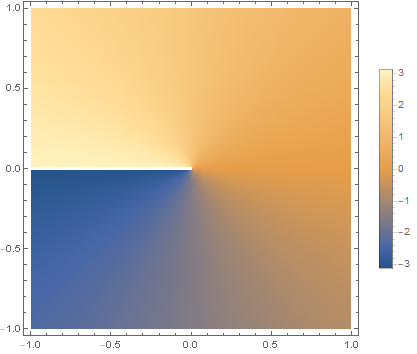
Take a logarithm, the inverse of e^x. You’re probably used to plugging in positive numbers, and getting out something reasonable, that changes in a smooth and regular way: after all, e^x is always positive, right? But in mathematics, you don’t have to just use positive numbers. You can use negative numbers. Even more interestingly, you can use complex numbers. And if you take the logarithm of a complex number, and look at the imaginary part, it looks like this:

Mostly, this complex logarithm still seems to be doing what it’s supposed to, changing in a nice slow way. But there is a weird “cut” in the graph for negative numbers: a sudden jump, from \pi to -\pi. That jump is called a “branch cut”.

As physicists, we usually don’t like our formulas to make sudden changes. A change like this is an infinitely fast jump, and we don’t like infinities much either. But we do have one good use for a formula like this, because sometimes our formulas do change suddenly: when we have enough energy to make a new particle.

Imagine colliding two protons together, like at the LHC. Colliding particles doesn’t just break the protons into pieces: due to Einstein’s famous E=mc^2, it can create new particles as well. But to create a new particle, you need enough energy: mc^2 worth of energy. So as you dial up the energy of your protons, you’ll notice a sudden change: you couldn’t create, say, a Higgs boson, and now you can. Our formulas represent some of those kinds of sudden changes with branch cuts.

So the beginning of our “words” represent branch cuts, and particles. The end represents derivatives and symmetries.

Derivatives come from the land of calculus, a place spooky to those with traumatic math class memories. Derivatives shouldn’t be so spooky though. They’re just ways we measure change. If we have a formula that is smoothly changing as we change some input, we can describe that change with a derivative.

The ending of our “words” tell us what happens when we take a derivative. They tell us which ways our formulas can smoothly change, and what happens when they do.

In doing so, they tell us about something some physicists make sound spooky, called symmetries. Symmetries are changes we can make that don’t really change what’s important. For example, you could imagine lifting up the entire Large Hadron Collider and (carefully!) carrying it across the ocean, from France to the US. We’d expect that, once all the scared scientists return and turn it back on, it would start getting exactly the same results. Physics has “translation symmetry”: you can move, or “translate” an experiment, and the important stuff stays the same.

These symmetries are closely connected to derivatives. If changing something doesn’t change anything important, that should be reflected in our formulas: they shouldn’t change either, so their derivatives should be zero. If instead the symmetry isn’t quite true, if it’s what we call “broken”, then by knowing how it was “broken” we know what the derivative should be.

So branch cuts tell us about particles, derivatives tell us about symmetries. The weird thing about the antipode, the un-physical bizarre thing, is that it swaps them. It makes the particles of one calculation determine the symmetries of another.

(And lest you’ve heard about particles with symmetries, like gluons and SU(3)…this is a different kind of thing. I don’t have enough room to explain why here, but it’s completely unrelated.)

Why the heck does this duality exist?

A commenter on the last post asked me to speculate. I said there that I have no clue, and that’s most of the answer.

If I had to speculate, though, my answer might be disappointing.

Most of the things in physics we call “dualities” have fairly deep physical meanings, linked to twisting spacetime in complicated ways. AdS/CFT isn’t fully explained, but it seems to be related to something called the holographic principle, the idea that gravity ties together the inside of space with the boundary around it. T duality, an older concept in string theory, is explained: a consequence of how strings “see” the world in terms of things to wrap around and things to spin around. In my field, one of our favorite dualities links back to this as well, amplitude-Wilson loop duality linked to fermionic T-duality.

The antipode doesn’t twist spacetime, it twists the mathematics. And it may be it matters only because the mathematics is so constrained that it’s forced to happen.

The trick that Lance Dixon and co. used to discover antipodal duality is the same trick I used with Lance to calculate complicated scattering amplitudes. It relies on taking a general guess of words in the right “alphabet”, and constraining it: using mathematical and physical principles it must obey and throwing out every illegal answer until there’s only one answer left.

Currently, there are some hints that the principles used for the different calculations linked by antipodal duality are “antipodal mirrors” of each other: that different principles have the same implication when the duality “flips” them around. If so, then it could be this duality is in some sense just a coincidence: not a coincidence limited to a few calculations, but a coincidence limited to a few principles. Thought of in this way, it might not tell us a lot about other situations, it might not really be “deep”.

Of course, I could be wrong about this. It could be much more general, could mean much more. But in that context, I really have no clue what to speculate. The antipode is weird: it links things that really should not be physically linked. We’ll have to see what that actually means.

Amplitudes 2022 Retrospective

I’m back from Amplitudes 2022 with more time to write, and (besides the several papers I’m working on) that means writing about the conference! Casual readers be warned, there’s no way around this being a technical post, I don’t have the space to explain everything!

I mostly said all I wanted about the way the conference was set up in last week’s post, but one thing I didn’t say much about was the conference dinner. Most conference dinners are the same aside from the occasional cool location or haggis speech. This one did have a cool location, and a cool performance by a blind pianist, but the thing I really wanted to comment on was the setup. Typically, the conference dinner at Amplitudes is a sit-down affair: people sit at tables in one big room, maybe getting up occasionally to pick up food, and eventually someone gives an after-dinner speech. This time the tables were standing tables, spread across several rooms. This was a bit tiring on a hot day, but it did have the advantage that it naturally mixed people around. Rather than mostly talking to “your table”, you’d wander, ending up at a new table every time you picked up new food or drinks. It was a good way to meet new people, a surprising number of which in my case apparently read this blog. It did make it harder to do an after-dinner speech, so instead Lance gave an after-conference speech, complete with the now-well-established running joke where Greta Thunberg tries to get us to fly less.

(In another semi-running joke, the organizers tried to figure out who had attended the most of the yearly Amplitudes conferences over the years. Weirdly, no-one has attended all twelve.)

In terms of the content, and things that stood out:

Nima is getting close to publishing his newest ‘hedron, the surfacehedron, and correspondingly was able to give a lot more technical detail about it. (For his first and most famous amplituhedron, see here.) He still didn’t have enough time to explain why he has to use category theory to do it, but at least he was concrete enough that it was reasonably clear where the category theory was showing up. (I wasn’t there for his eight-hour lecture at the school the week before, maybe the students who stuck around until 2am learned some category theory there.) Just from listening in on side discussions, I got the impression that some of the ideas here actually may have near-term applications to computing Feynman diagrams: this hasn’t been a feature of previous ‘hedra and it’s an encouraging development.

Alex Edison talked about progress towards this blog’s namesake problem, the question of whether N=8 supergravity diverges at seven loops. Currently they’re working at six loops on the N=4 super Yang-Mills side, not yet in a form it can be “double-copied” to supergravity. The tools they’re using are increasingly sophisticated, including various slick tricks from algebraic geometry. They are looking to the future: if they’re hoping their methods will reach seven loops, the same methods have to make six loops a breeze.

Xi Yin approached a puzzle with methods from String Field Theory, prompting the heretical-for-us title “on-shell bad, off-shell good”. A colleague reminded me of a local tradition for dealing with heretics.

While Nima was talking about a new ‘hedron, other talks focused on the original amplituhedron. Paul Heslop found that the amplituhedron is not literally a positive geometry, despite slogans to the contrary, but what it is is nonetheless an interesting generalization of the concept. Livia Ferro has made more progress on her group’s momentum amplituhedron: previously only valid at tree level, they now have a picture that can accomodate loops. I wasn’t sure this would be possible, there are a lot of things that work at tree level and not for loops, so I’m quite encouraged that this one made the leap successfully.

Sebastian Mizera, Andrew McLeod, and Hofie Hannesdottir all had talks that could be roughly summarized as “deep principles made surprisingly useful”. Each took topics that were explored in the 60’s and translated them into concrete techniques that could be applied to modern problems. There were surprisingly few talks on the completely concrete end, on direct applications to collider physics. I think Simone Zoia’s was the only one to actually feature collider data with error bars, which might explain why I singled him out to ask about those error bars later.

Likewise, Matthias Wilhelm’s talk was the only one on functions beyond polylogarithms, the elliptic functions I’ve also worked on recently. I wonder if the under-representation of some of these topics is due to the existence of independent conferences: in a year when in-person conferences are packed in after being postponed across the pandemic, when there are already dedicated conferences for elliptics and practical collider calculations, maybe people are just a bit too tired to go to Amplitudes as well.

Talks on gravitational waves seem to have stabilized at roughly a day’s worth, which seems reasonable. While the subfield’s capabilities continue to be impressive, it’s also interesting how often new conceptual challenges appear. It seems like every time a challenge to their results or methods is resolved, a new one shows up. I don’t know whether the field will ever get to a stage of “business as usual”, or whether it will be novel qualitative questions “all the way up”.

I haven’t said much about the variety of talks bounding EFTs and investigating their structure, though this continues to be an important topic. And I haven’t mentioned Lance Dixon’s talk on antipodal duality, largely because I’m planning a post on it later: Quanta Magazine had a good article on it, but there are some aspects even Quanta struggled to cover, and I think I might have a good way to do it.

At Bohr-100: Current Themes in Theoretical Physics

During the pandemic, some conferences went online. Others went dormant.

Every summer before the pandemic, the Niels Bohr International Academy hosted a conference called Current Themes in High Energy Physics and Cosmology. Current Themes is a small, cozy conference, a gathering of close friends some of whom happen to have Nobel prizes. Holding it online would be almost missing the point.

Instead, we waited. Now, at least in Denmark, the pandemic is quiet enough to hold this kind of gathering. And it’s a special year: the 100th anniversary of Niels Bohr’s Nobel, the 101st of the Niels Bohr Institute. So it seemed like the time for a particularly special Current Themes.

For one, it lets us use remarkably simple signs

A particularly special Current Themes means some unusually special guests. Our guests are usually pretty special already (Gerard t’Hooft and David Gross are regulars, to just name the Nobelists), but this year we also had Alexander Polyakov. Polyakov’s talk had a magical air to it. In a quiet voice, broken by an impish grin when he surprised us with a joke, Polyakov began to lay out five unsolved problems he considered interesting. In the end, he only had time to present one, related to turbulence: when Gross asked him to name the remaining four, the second included a term most of us didn’t recognize (striction, known in a magnetic context and which he wanted to explore gravitationally), so the discussion hung while he defined that and we never did learn what the other three problems were.

At the big 100th anniversary celebration earlier in the spring, the Institute awarded a few years worth of its Niels Bohr Institute Medal of Honor. One of the recipients, Paul Steinhardt, couldn’t make it then, so he got his medal now. After the obligatory publicity photos were taken, Steinhardt entertained us all with a colloquium about his work on quasicrystals, including the many adventures involved in finding the first example “in the wild”. I can’t do the story justice in a short blog post, but if you won’t have the opportunity to watch him speak about it then I hear his book is good.

An anniversary conference should have some historical elements as well. For this one, these were ably provided by David Broadhurst, who gave an after-dinner speech cataloguing things he liked about Bohr. Some was based on public information, but the real draw were the anecdotes: his own reminiscences, and those of people he knew who knew Bohr well.

The other talks covered interesting ground: from deep approaches to quantum field theory, to new tools to understand black holes, to the implications of causality itself. One out of the ordinary talk was by Sabrina Pasterski, who advocated a new model of physics funding. I liked some elements (endowed organizations to further a subfield) and am more skeptical of others (mostly involving NFTs). Regardless it, and the rest of the conference more broadly, spurred a lot of good debate.

Carving Out the Possible

If you imagine a particle physicist, you probably picture someone spending their whole day dreaming up new particles. They figure out how to test those particles in some big particle collider, and for a lucky few their particle gets discovered and they get a Nobel prize.

Occasionally, a wiseguy asks if we can’t just cut out the middleman. Instead of dreaming up particles to test, why don’t we just write down every possible particle and test for all of them? It would save the Nobel committee a lot of money at least!

It turns out, you can sort of do this, through something called Effective Field Theory. An Effective Field Theory is a type of particle physics theory that isn’t quite true: instead, it’s “effectively” true, meaning true as long as you don’t push it too far. If you test it at low energies and don’t “zoom in” too much then it’s fine. Crank up your collider energy high enough, though, and you expect the theory to “break down”, revealing new particles. An Effective Field Theory lets you “hide” unknown particles inside new interactions between the particles we already know.

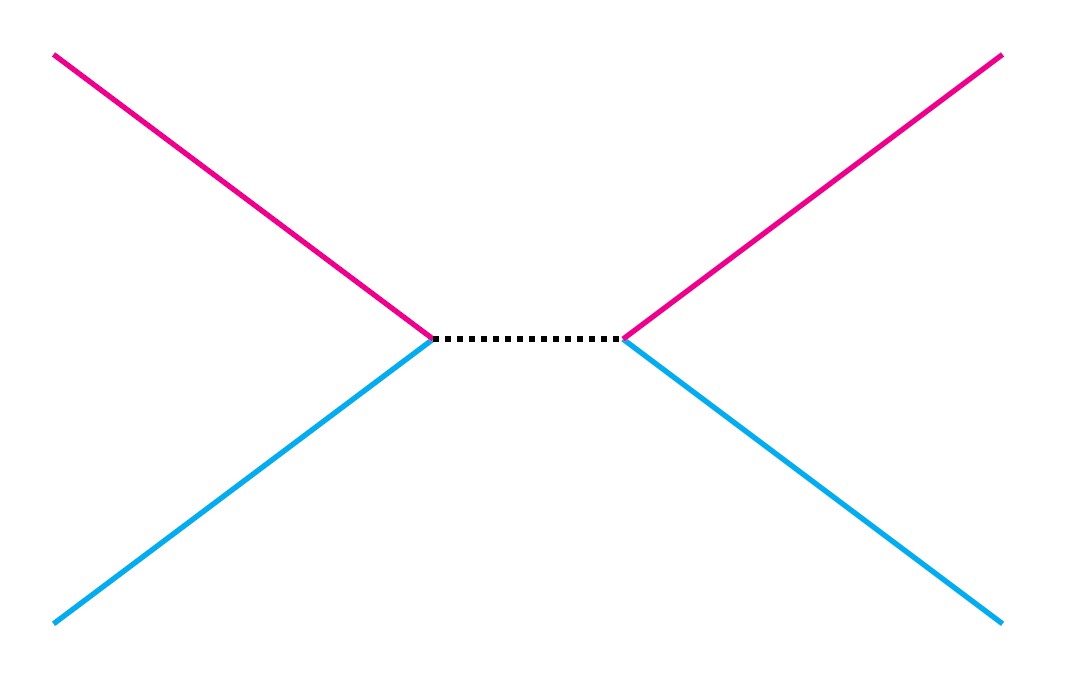
To help you picture how this works, imagine that the pink and blue lines here represent familiar particles like electrons and quarks, while the dotted line is a new particle somebody dreamed up. (The picture is called a Feynman diagram, if you don’t know what that is check out this post.)

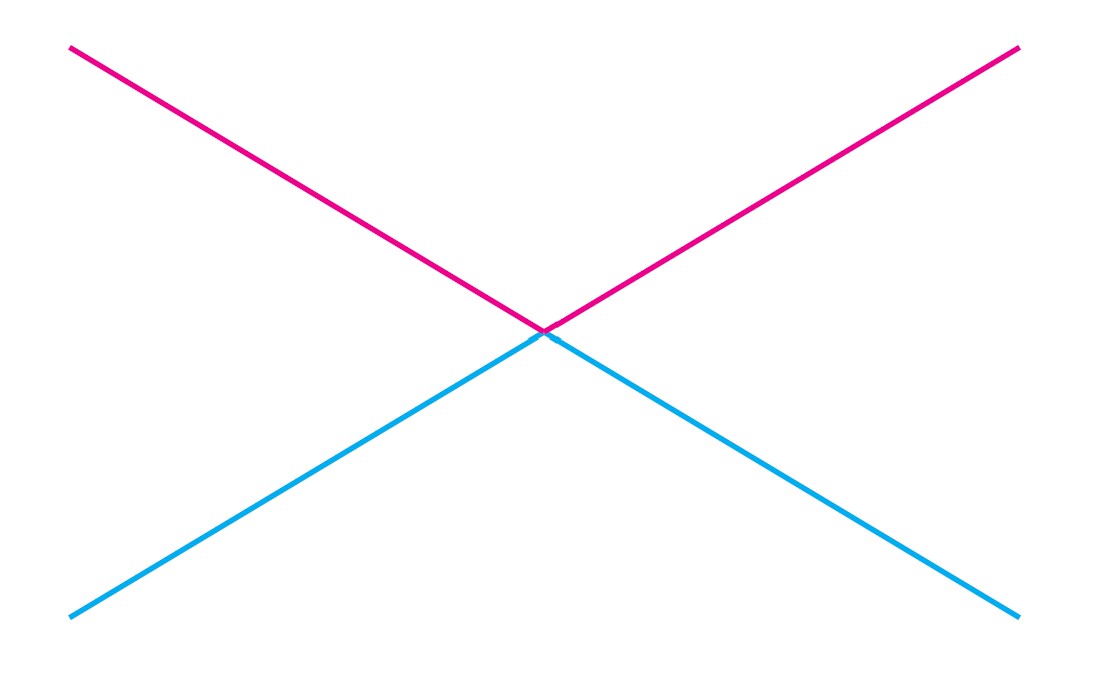
In an Effective Field Theory, we “zoom out”, until the diagram looks like this:

Now we’ve “hidden” the new particle. Instead, we have a new type of interaction between the particles we already know.

So instead of writing down every possible new particle we can imagine, we only have to write down every possible interaction between the particles we already know.

That’s not as hard as it sounds. In part, that’s because not every interaction actually makes sense. Some of the things you could write down break some important rules. They might screw up cause and effect, letting something happen before its cause instead of after. They might screw up probability, giving you a formula for the chance something happens that gives a number greater than 100%.

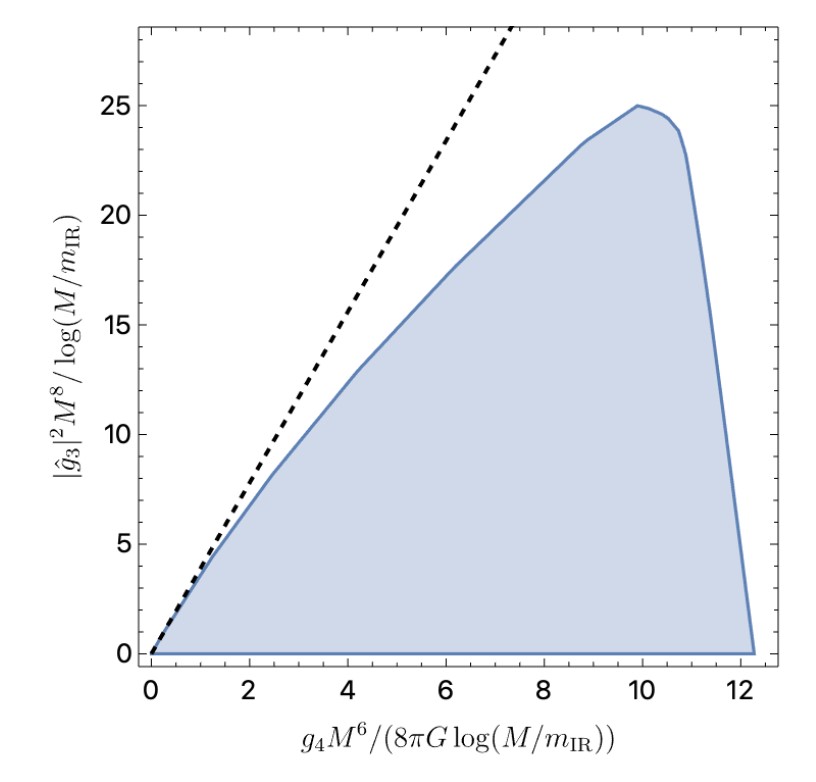
Using these rules you can play a kind of game. You start out with a space representing all of the interactions you can imagine. You begin chipping at it, carving away parts that don’t obey the rules, and you see what shape is left over. You end up with plots that look a bit like carving a ham.

People in my subfield are getting good at this kind of game. It isn’t quite our standard fare: usually, we come up with tricks to make calculations with specific theories easier. Instead, many groups are starting to look at these general, effective theories. We’ve made friends with groups in related fields, building new collaborations. There still isn’t one clear best way to do this carving, so each group manages to find a way to chip a little farther. Out of the block of every theory we could imagine, we’re carving out a space of theories that make sense, theories that could conceivably be right. Theories that are worth testing.

Trapped in the (S) Matrix

I’ve tried to convince you that you are a particle detector. You choose your experiment, what actions you take, and then observe the outcome. If you focus on that view of yourself, data out and data in, you start to wonder if the world outside really has any meaning. Maybe you’re just trapped in the Matrix.

From a physics perspective, you actually are trapped in a sort of a Matrix. We call it the S Matrix.

“S” stands for scattering. The S Matrix is a formula we use, a mathematical tool that tells us what happens when fundamental particles scatter: when they fly towards each other, colliding or bouncing off. For each action we could take, the S Matrix gives the probability of each outcome: for each pair of particles we collide, the chance we detect different particles at the end. You can imagine putting every possible action in a giant vector, and every possible observation in another giant vector. Arrange the probabilities for each action-observation pair in a big square grid, and that’s a matrix.

Actually, I lied a little bit. This is particle physics, and particle physics uses quantum mechanics. Because of that, the entries of the S Matrix aren’t probabilities: they’re complex numbers called probability amplitudes. You have to multiply them by their complex conjugate to get probability out.

Ok, that probably seemed like a lot of detail. Why am I telling you all this?

What happens when you multiply the whole S Matrix by its complex conjugate? (Using matrix multiplication, naturally.) You can still pick your action, but now you’re adding up every possible outcome. You’re asking “suppose I take an action. What’s the chance that anything happens at all?”

The answer to that question is 1. There is a 100% chance that something happens, no matter what you do. That’s just how probability works.

We call this property unitarity, the property of giving “unity”, or one. And while it may seem obvious, it isn’t always so easy. That’s because we don’t actually know the S Matrix formula most of the time. We have to approximate it, a partial formula that only works for some situations. And unitarity can tell us how much we can trust that formula.

Imagine doing an experiment trying to detect neutrinos, like the IceCube Neutrino Observatory. For you to detect the neutrinos, they must scatter off of electrons, kicking them off of their atoms or transforming them into another charged particle. You can then notice what happens as the energy of the neutrinos increases. If you do that, you’ll notice the probability also start to increase: it gets more and more likely that the neutrino can scatter an electron. You might propose a formula for this, one that grows with energy. [EDIT: Example changed after a commenter pointed out an issue with it.]

If you keep increasing the energy, though, you run into a problem. Those probabilities you predict are going to keep increasing. Eventually, you’ll predict a probability greater than one.

That tells you that your theory might have been fine before, but doesn’t work for every situation. There’s something you don’t know about, which will change your formula when the energy gets high. You’ve violated unitarity, and you need to fix your theory.

In this case, the fix is already known. Neutrinos and electrons interact due to another particle, called the W boson. If you include that particle, then you fix the problem: your probabilities stop going up and up, instead, they start slowing down, and stay below one.

For other theories, we don’t yet know the fix. Try to write down an S Matrix for colliding gravitational waves (or really, gravitons), and you meet the same kind of problem, a probability that just keeps growing. Currently, we don’t know how that problem should be solved: string theory is one answer, but may not be the only one.

So even if you’re trapped in an S Matrix, sending data out and data in, you can still use logic. You can still demand that probability makes sense, that your matrix never gives a chance greater than 100%. And you can learn something about physics when you do!

At Mikefest

I’m at a conference this week of a very particular type: a birthday conference. When folks in my field turn 60, their students and friends organize a special conference for them, celebrating their research legacy. With COVID restrictions just loosening, my advisor Michael Douglas is getting a last-minute conference. And as one of the last couple students he graduated at Stony Brook, I naturally showed up.

The conference, Mikefest, is at the Institut des Hautes Études Scientifiques, just outside of Paris. Mike was a big supporter of the IHES, putting in a lot of fundraising work for them. Another big supporter, James Simons, was Mike’s employer for a little while after his time at Stony Brook. The conference center we’re meeting in is named for him.

You might have to zoom in to see that, though.

I wasn’t involved in organizing the conference, so it was interesting seeing differences between this and other birthday conferences. Other conferences focus on the birthday prof’s “family tree”: their advisor, their students, and some of their postdocs. We’ve had several talks from Mike’s postdocs, and one from his advisor, but only one from a student. Including him and me, three of Mike’s students are here: another two have had their work mentioned but aren’t speaking or attending.

Most of the speakers have collaborated with Mike, but only for a few papers each. All of them emphasized a broader debt though, for discussions and inspiration outside of direct collaboration. The message, again and again, is that Mike’s work has been broad enough to touch a wide range of people. He’s worked on branes and the landscape of different string theory universes, pure mathematics and computation, neuroscience and recently even machine learning. The talks generally begin with a few anecdotes about Mike, before pivoting into research talks on the speakers’ recent work. The recent-ness of the work is perhaps another difference from some birthday conferences: as one speaker said, this wasn’t just a celebration of Mike’s past, but a “welcome back” after his return from the finance world.

One thing I don’t know is how much this conference might have been limited by coming together on short notice. For other birthday conferences impacted by COVID (and I’m thinking of one in particular), it might be nice to have enough time to have most of the birthday prof’s friends and “academic family” there in person. As-is, though, Mike seems to be having fun regardless.

Happy Birthday Mike!

Geometry and Geometry

Last week, I gave the opening lectures for a course on scattering amplitudes, the things we compute to find probabilities in particle physics. After the first class, one of the students asked me if two different descriptions of these amplitudes, one called CHY and the other called the amplituhedron, were related. There does happen to be a connection, but it’s a bit subtle and indirect, not the sort of thing the student would have been thinking of. Why then, did he think they might be related? Well, he explained, both descriptions are geometric.

If you’ve been following this blog for a while, you’ve seen me talk about misunderstandings. There are a lot of subtle ways a smart student can misunderstand something, ways that can be hard for a teacher to recognize. The right question, or the right explanation, can reveal what’s going on. Here, I think the problem was that there are multiple meanings of geometry.

One of the descriptions the student asked about, CHY, is related to string theory. It describes scattering particles in terms of the path of a length of string through space and time. That path draws out a surface called a world-sheet, showing all the places the string touches on its journey. And that picture, of a wiggly surface drawn in space and time, looks like what most people think of as geometry: a “shape” in a pretty normal sense, which here describes the physics of scattering particles.

The other description, the amplituhedron, also uses geometric objects to describe scattering particles. But the “geometric objects” here are much more abstract. A few of them are familiar: straight lines, the area between them forming shapes on a plane. Most of them, though are generalizations of this: instead of lines on a plane, they have higher dimensional planes in higher dimensional spaces. These too get described as geometry, even though they aren’t the “everyday” geometry you might be familiar with. Instead, they’re a “natural generalization”, something that, once you know the math, is close enough to that “everyday” geometry that it deserves the same name.

This week, two papers presented a totally different kind of geometric description of particle physics. In those papers, “geometric” has to do with differential geometry, the mathematics behind Einstein’s theory of general relativity. The descriptions are geometric because they use the same kinds of building-blocks of that theory, a metric that bends space and time. Once again, this kind of geometry is a natural generalization of the everyday notion, but now in once again a different way.

All of these notions of geometry do have some things in common, of course. Maybe you could even write down a definition of “geometry” that includes all of them. But they’re different enough that if I tell you that two descriptions are “geometric”, it doesn’t tell you all that much. It definitely doesn’t tell you the two descriptions are related.

It’s a reasonable misunderstanding, though. It comes from a place where, used to “everyday” geometry, you expect two “geometric descriptions” of something to be similar: shapes moving in everyday space, things you can directly compare. Instead, a geometric description can be many sorts of shape, in many sorts of spaces, emphasizing many sorts of properties. “Geometry” is just a really broad term.

Book Review: The Joy of Insight

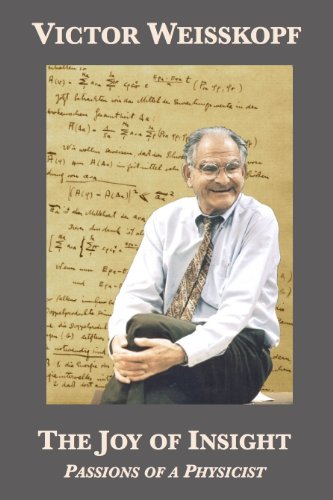
There’s something endlessly fascinating about the early days of quantum physics. In a century, we went from a few odd, inexplicable experiments to a practically complete understanding of the fundamental constituents of matter. Along the way the new ideas ended a world war, almost fueled another, and touched almost every field of inquiry. The people lucky enough to be part of this went from familiarly dorky grad students to architects of a new reality. Victor Weisskopf was one of those people, and The Joy of Insight: Passions of a Physicist is his autobiography.

Less well-known today than his contemporaries, Weisskopf made up for it with a front-row seat to basically everything that happened in particle physics. In the late 20’s and early 30’s he went from studying in Göttingen (including a crush on Maria Göppert before a car-owning Joe Mayer snatched her up) to a series of postdoctoral positions that would exhaust even a modern-day physicist, working in Leipzig, Berlin, Copenhagen, Cambridge, Zurich, and Copenhagen again, before fleeing Europe for a faculty position in Rochester, New York. During that time he worked for, studied under, collaborated or partied with basically everyone you might have heard of from that period. As a result, this section of the autobiography was my favorite, chock-full of stories, from the well-known (Pauli’s rudeness and mythical tendency to break experimental equipment) to the less-well known (a lab in Milan planned to prank Pauli with a door that would trigger a fake explosion when opened, which worked every time they tested it…and failed when Pauli showed up), to the more personal (including an in retrospect terrifying visit to the Soviet Union, where they asked him to critique a farming collective!) That era also saw his “almost Nobel”, in his case almost discovering the Lamb Shift.

Despite an “almost Nobel”, Weisskopf was paid pretty poorly when he arrived in Rochester. His story there puts something I’d learned before about another refugee physicist, Hertha Sponer, in a new light. Sponer’s university also didn’t treat her well, and it seemed reminiscent of modern academia. Weisskopf, though, thinks his treatment was tied to his refugee status: that, aware that they had nowhere else to go, universities gave the scientists who fled Europe worse deals than they would have in a Nazi-less world, snapping up talent for cheap. I could imagine this was true for Sponer as well.

Like almost everyone with the relevant expertise, Weisskopf was swept up in the Manhattan project at Los Alamos. There he rose in importance, both in the scientific effort (becoming deputy leader of the theoretical division) and the local community (spending some time on and chairing the project’s “town council”). Like the first sections, this surreal time leads to a wealth of anecdotes, all fascinating. In his descriptions of the life there I can see the beginnings of the kinds of “hiking retreats” physicists would build in later years, like the one at Aspen, that almost seem like attempts to recreate that kind of intense collaboration in an isolated natural place.

After the war, Weisskopf worked at MIT before a stint as director of CERN. He shepherded the facility’s early days, when they were building their first accelerators and deciding what kinds of experiments to pursue. I’d always thought that the “nuclear” in CERN’s name was an artifact of the times, when “nuclear” and “particle” physics were thought of as the same field, but according to Weisskopf the fields were separate and it was already a misnomer when the place was founded. Here the book’s supply of anecdotes becomes a bit more thin, and instead he spends pages on glowing descriptions of people he befriended. The pattern continues after the directorship as his duties get more administrative, spending time as head of the physics department at MIT and working on arms control, some of the latter while a member of the Pontifical Academy of Sciences (which apparently even a Jewish atheist can join). He does work on some science, though, collaborating on the “bag of quarks” model of protons and neutrons. He lives to see the fall of the Berlin wall, and the end of the book has a bit of 90’s optimism to it, the feeling that finally the conflicts of his life would be resolved. Finally, the last chapter abandons chronology altogether, and is mostly a list of his opinions of famous composers, capped off with a Bohr-inspired musing on the complementary nature of science and the arts, humanities, and religion.

One of the things I found most interesting in this book was actually something that went unsaid. Weisskopf’s most famous student was Murray Gell-Mann, a key player in the development of the theory of quarks (including coining the name). Gell-Mann was famously cultured (in contrast to the boorish-almost-as-affectation Feynman) with wide interests in the humanities, and he seems like exactly the sort of person Weisskopf would have gotten along with. Surprisingly though, he gets no anecdotes in this book, and no glowing descriptions: just a few paragraphs, mostly emphasizing how smart he was. I have to wonder if there was some coldness between them. Maybe Weisskopf had difficulty with a student who became so famous in his own right, or maybe they just never connected. Maybe Weisskopf was just trying to be generous: the other anecdotes in that part of the book are of much less famous people, and maybe Weisskopf wanted to prioritize promoting them, feeling that they were underappreciated.

Weisskopf keeps the physics light to try to reach a broad audience. This means he opts for short explanations, and often these are whatever is easiest to reach for. It creates some interesting contradictions: the way he describes his “almost Nobel” work in quantum electrodynamics is very much the way someone would have described it at the time, but very much not how it would be understood later, and by the time he talks about the bag of quarks model his more modern descriptions don’t cleanly link with what he said earlier. Overall, his goal isn’t really to explain the physics, but to explain the physicists. I enjoyed the book for that: people do it far too rarely, and the result was a really fun read.

Duality and Emergence: When Is Spacetime Not Spacetime?

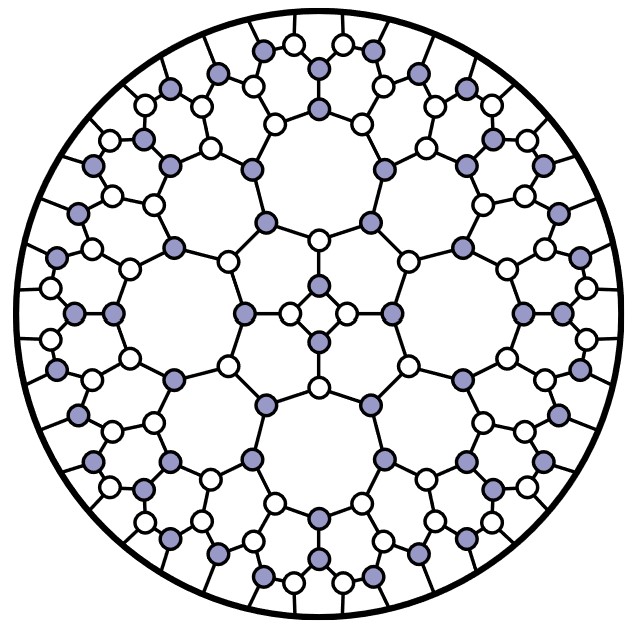
Spacetime is doomed! At least, so say some physicists. They don’t mean this as a warning, like some comic-book universe-destroying disaster, but rather as a research plan. These physicists believe that what we think of as space and time aren’t the full story, but that they emerge from something more fundamental, so that an ultimate theory of nature might not use space or time at all. Other, grumpier physicists are skeptical. Joined by a few philosophers, they think the “spacetime is doomed” crowd are over-excited and exaggerating the implications of their discoveries. At the heart of the argument is the distinction between two related concepts: duality and emergence.

In physics, sometimes we find that two theories are actually dual: despite seeming different, the patterns of observations they predict are the same. Some of the more popular examples are what we call holographic theories. In these situations, a theory of quantum gravity in some space-time is dual to a theory without gravity describing the edges of that space-time, sort of like how a hologram is a 2D image that looks 3D when you move it. For any question you can ask about the gravitational “bulk” space, there is a matching question on the “boundary”. No matter what you observe, neither description will fail.

If theories with gravity can be described by theories without gravity, does that mean gravity doesn’t really exist? If you’re asking that question, you’re asking whether gravity is emergent. An emergent theory is one that isn’t really fundamental, but instead a result of the interaction of more fundamental parts. For example, hydrodynamics, the theory of fluids like water, emerges from more fundamental theories that describe the motion of atoms and molecules.

(For the experts: I, like most physicists, am talking about “weak emergence” here, not “strong emergence”.)

The “spacetime is doomed” crowd think that not just gravity, but space-time itself is emergent. They expect that distances and times aren’t really fundamental, but a result of relationships that will turn out to be more fundamental, like entanglement between different parts of quantum fields. As evidence, they like to bring up dualities where the dual theories have different concepts of gravity, number of dimensions, or space-time. Using those theories, they argue that space and time might “break down”, and not be really fundamental.

(I’ve made arguments like that in the past too.)

The skeptics, though, bring up an important point. If two theories are really dual, then no observation can distinguish them: they make exactly the same predictions. In that case, say the skeptics, what right do you have to call one theory more fundamental than the other? You can say that gravity emerges from a boundary theory without gravity, but you could just as easily say that the boundary theory emerges from the gravity theory. The whole point of duality is that no theory is “more true” than the other: one might be more or less convenient, but both describe the same world. If you want to really argue for emergence, then your “more fundamental” theory needs to do something extra: to predict something that your emergent theory doesn’t predict.

Sometimes this is a fair objection. There are members of the “spacetime is doomed” crowd who are genuinely reckless about this, who’ll tell a journalist about emergence when they really mean duality. But many of these people are more careful, and have thought more deeply about the question. They tend to have some mix of these two perspectives:

First, if two descriptions give the same results, then do the descriptions matter? As physicists, we have a history of treating theories as the same if they make the same predictions. Space-time itself is a result of this policy: in the theory of relativity, two people might disagree on which one of two events happened first or second, but they will agree on the overall distance in space-time between the two. From this perspective, a duality between a bulk theory and a boundary theory isn’t evidence that the bulk theory emerges from the boundary, but it is evidence that both the bulk and boundary theories should be replaced by an “overall theory”, one that treats bulk and boundary as irrelevant descriptions of the same physical reality. This perspective is similar to an old philosophical theory called positivism: that statements are meaningless if they cannot be derived from something measurable. That theory wasn’t very useful for philosophers, which is probably part of why some philosophers are skeptics of “space-time is doomed”. The perspective has been quite useful to physicists, though, so we’re likely to stick with it.

Second, some will say that it’s true that a dual theory is not an emergent theory…but it can be the first step to discover one. In this perspective, dualities are suggestive evidence that a deeper theory is waiting in the wings. The idea would be that one would first discover a duality, then discover situations that break that duality: examples on one side that don’t correspond to anything sensible on the other. Maybe some patterns of quantum entanglement are dual to a picture of space-time, but some are not. (Closer to my sub-field, maybe there’s an object like the amplituhedron that doesn’t respect locality or unitarity.) If you’re lucky, maybe there are situations, or even experiments, that go from one to the other: where the space-time description works until a certain point, then stops working, and only the dual description survives. Some of the models of emergent space-time people study are genuinely of this type, where a dimension emerges in a theory that previously didn’t have one. (For those of you having a hard time imagining this, read my old post about “bubbles of nothing”, then think of one happening in reverse.)

It’s premature to say space-time is doomed, at least as a definite statement. But it is looking like, one way or another, space-time won’t be the right picture for fundamental physics. Maybe that’s because it’s equivalent to another description, redundant embellishment on an essential theoretical core. Maybe instead it breaks down, and a more fundamental theory could describe more situations. We don’t know yet. But physicists are trying to figure it out.

The arXiv SciComm Challenge

Fellow science communicators, think you can explain everything that goes on in your field? If so, I have a challenge for you. Pick a day, and go through all the new papers on arXiv.org in a single area. For each one, try to give a general-audience explanation of what the paper is about. To make it easier, you can ignore cross-listed papers. If your field doesn’t use arXiv, consider if you can do the challenge with another appropriate site.

I’ll start. I’m looking at papers in the “High Energy Physics – Theory” area, announced 6 Jan, 2022. I’ll warn you in advance that I haven’t read these papers, just their abstracts, so apologies if I get your paper wrong!

arXiv:2201.01303 : Holographic State Complexity from Group Cohomology

This paper says it is a contribution to a Proceedings. That means it is based on a talk given at a conference. In my field, a talk like this usually won’t be presenting new results, but instead summarizes results in a previous paper. So keep that in mind.

There is an idea in physics called holography, where two theories are secretly the same even though they describe the world with different numbers of dimensions. Usually this involves a gravitational theory in a “box”, and a theory without gravity that describes the sides of the box. The sides turn out to fully describe the inside of the box, much like a hologram looks 3D but can be printed on a flat sheet of paper. Using this idea, physicists have connected some properties of gravity to properties of the theory on the sides of the box. One of those properties is complexity: the complexity of the theory on the sides of the box says something about gravity inside the box, in particular about the size of wormholes. The trouble is, “complexity” is a bit subjective: it’s not clear how to give a good definition for it for this type of theory. In this paper, the author studies a theory with a precise mathematical definition, called a topological theory. This theory turns out to have mathematical properties that suggest a well-defined notion of complexity for it.

arXiv:2201.01393 : Nonrelativistic effective field theories with enhanced symmetries and soft behavior

We sometimes describe quantum field theory as quantum mechanics plus relativity. That’s not quite true though, because it is possible to define a quantum field theory that doesn’t obey special relativity, a non-relativistic theory. Physicists do this if they want to describe a system moving much slower than the speed of light: it gets used sometimes for nuclear physics, and sometimes for modeling colliding black holes.

In particle physics, a “soft” particle is one with almost no momentum. We can classify theories based on how they behave when a particle becomes more and more soft. In normal quantum field theories, if they have special behavior when a particle becomes soft it’s often due to a symmetry of the theory, where the theory looks the same even if something changes. This paper shows that this is not true for non-relativistic theories: they have more requirements to have special soft behavior, not just symmetry. They “bootstrap” a few theories, using some general restrictions to find them without first knowing how they work (“pulling them up by their own bootstraps”), and show that the theories they find are in a certain sense unique, the only theories of that kind.

arXiv:2201.01552 : Transmutation operators and expansions for 1-loop Feynman integrands

In recent years, physicists in my sub-field have found new ways to calculate the probability that particles collide. One of these methods describes ordinary particles in a way resembling string theory, and from this discovered a whole “web” of theories that were linked together by small modifications of the method. This method originally worked only for the simplest Feynman diagrams, the “tree” diagrams that correspond to classical physics, but was extended to the next-simplest diagrams, diagrams with one “loop” that start incorporating quantum effects.

This paper concerns a particular spinoff of this method, that can find relationships between certain one-loop calculations in a particularly efficient way. It lets you express calculations of particle collisions in a variety of theories in terms of collisions in a very simple theory. Unlike the original method, it doesn’t rely on any particular picture of how these collisions work, either Feynman diagrams or strings.

arXiv:2201.01624 : Moduli and Hidden Matter in Heterotic M-Theory with an Anomalous U(1) Hidden Sector

In string theory (and its more sophisticated cousin M theory), our four-dimensional world is described as a world with more dimensions, where the extra dimensions are twisted up so that they cannot be detected. The shape of the extra dimensions influences the kinds of particles we can observe in our world. That shape is described by variables called “moduli”. If those moduli are stable, then the properties of particles we observe would be fixed, otherwise they would not be. In general it is a challenge in string theory to stabilize these moduli and get a world like what we observe.

This paper discusses shapes that give rise to a “hidden sector”, a set of particles that are disconnected from the particles we know so that they are hard to observe. Such particles are often proposed as a possible explanation for dark matter. This paper calculates, for a particular kind of shape, what the masses of different particles are, as well as how different kinds of particles can decay into each other. For example, a particle that causes inflation (the accelerating expansion of the universe) can decay into effects on the moduli and dark matter. The paper also shows how some of the moduli are made stable in this picture.

arXiv:2201.01630 : Chaos in Celestial CFT

One variant of the holography idea I mentioned earlier is called “celestial” holography. In this picture, the sides of the box are an infinite distance away: a “celestial sphere” depicting the angles particles go after they collide, in the same way a star chart depicts the angles between stars. Recent work has shown that there is something like a sensible theory that describes physics on this celestial sphere, that contains all the information about what happens inside.

This paper shows that the celestial theory has a property called quantum chaos. In physics, a theory is said to be chaotic if it depends very precisely on its initial conditions, so that even a small change will result in a large change later (the usual metaphor is a butterfly flapping its wings and causing a hurricane). This kind of behavior appears to be present in this theory.

arXiv:2201.01657 : Calculations of Delbrück scattering to all orders in αZ

Delbrück scattering is an effect where the nuclei of heavy elements like lead can deflect high-energy photons, as a consequence of quantum field theory. This effect is apparently tricky to calculate, and previous calculations have involved approximations. This paper finds a way to calculate the effect without those approximations, which should let it match better with experiments.

(As an aside, I’m a little confused by the claim that they’re going to all orders in αZ when it looks like they just consider one-loop diagrams…but this is probably just my ignorance, this is a corner of the field quite distant from my own.)

arXiv:2201.01674 : On Unfolded Approach To Off-Shell Supersymmetric Models

Supersymmetry is a relationship between two types of particles: fermions, which typically make up matter, and bosons, which are usually associated with forces. In realistic theories this relationship is “broken” and the two types of particles have different properties, but theoretical physicists often study models where supersymmetry is “unbroken” and the two types of particles have the same mass and charge. This paper finds a new way of describing some theories of this kind that reorganizes them in an interesting way, using an “unfolded” approach in which aspects of the particles that would normally be combined are given their own separate variables.

(This is another one I don’t know much about, this is the first time I’d heard of the unfolded approach.)

arXiv:2201.01679 : Geometric Flow of Bubbles

String theorists have conjectured that only some types of theories can be consistently combined with a full theory of quantum gravity, others live in a “swampland” of non-viable theories. One set of conjectures characterizes this swampland in terms of “flows” in which theories with different geometry can flow in to each other. The properties of these flows are supposed to be related to which theories are or are not in the swampland.

This paper writes down equations describing these flows, and applies them to some toy model “bubble” universes.

arXiv:2201.01697 : Graviton scattering amplitudes in first quantisation

This paper is a pedagogical one, introducing graduate students to a topic rather than presenting new research.

Usually in quantum field theory we do something called “second quantization”, thinking about the world not in terms of particles but in terms of fields that fill all of space and time. However, sometimes one can instead use “first quantization”, which is much more similar to ordinary quantum mechanics. There you think of a single particle traveling along a “world-line”, and calculate the probability it interacts with other particles in particular ways. This approach has recently been used to calculate interactions of gravitons, particles related to the gravitational field in the same way photons are related to the electromagnetic field. The approach has some advantages in terms of simplifying the results, which are described in this paper.