Tag Archives: quantum field theory

The Amplituhedron and Other Excellently Silly Words

Nima Arkani-Hamed recently gave a talk at the Simons Center on the topic of what he and Jaroslav Trnka are calling the Amplituhedron.

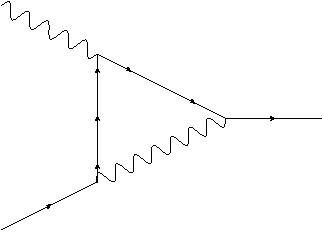
There’s an article on it in Quanta Magazine. The article starts out a bit hype-y for my taste (too much language of importance, essentially), but it has several very solid descriptions of the history of the situation. I particularly like how the author concisely describes the Feynman diagram picture in the space of a single paragraph, and I would recommend reading that part even if you don’t have time to read the whole article. In general it’s worth it to get a picture of what’s going on.

That said, I obviously think I can clear a few things up, otherwise I wouldn’t be writing about it, so here I go!

“The” Amplituhedron

Nima’s new construction, the Amplituhedron, encodes amplitudes (building blocks of probabilities in particle physics) in N=4 super Yang-Mills as the “area” of a multi-dimensional analog of a polyhedron (hence, Amplitu-hedron).

Now, I’m a big supporter of silly-sounding words with amplitu- at the beginning (amplitudeologist, anyone?), and this is no exception. Anyway, the word Amplitu-hedron isn’t what’s confusing people. What’s confusing people is the word the.

When the Quanta article says that Nima has found “the” Amplituhedron, it makes it sound like he has discovered one central formula that somehow contains the whole universe. If you read the comments, many readers went away with that impression.

In case you needed me to say it, that’s not what is going on. The problem is in the use of the word “the”.

Suppose it was 1886, and I told you that a fellow named Carl Benz had invented “the Automobile”, a marvelous machine that can get everyone to work on time (as well as become the dominant form of life on Long Island).

My use of “the” might make you imagine that Benz invented some single, giant machine that would roam across the country, picking people up and somehow transporting everyone to work. You’d be skeptical of this, of course, expecting that long queues to use this gigantic, wondrous machine would swiftly ruin any speed advantage it might possess…

The Automobile, here to take you to work.

Or, you could view “the” in another light, as indicating a type of thing.

Much like “the Automobile” is a concept, manifested in many different cars and trucks across the country, “the Amplituhedron” is a concept, manifested in many different amplituhedra, each corresponding to a particular calculation that we might attempt.

Advantages…

Each amplituhedron has to do with an amplitude involving a specific number of particles, with a particular number of internal loops. (The Quanta article has a pretty good explanation of loops, here’s mine if you’d rather read that). Based on the problem you’re trying to solve, there are a set of rules that you use to construct the particular amplituhedron you need. The “area” of this amplituhedron (in quotation marks because I mean the area in an abstract, mathematical sense) is the amplitude for the process, which lets you calculate the probability that whatever particle physics situation you’re describing will happen.

Now, we already have many methods to calculate these probabilities. The amplituhedron’s advantage is that it makes these calculations much simpler. What was once quite a laborious and complicated four-loop calculation, Nima claims can be done by hand using amplituhedra. I didn’t get a chance to ask whether the same efficiency improvement holds true at six loops, but Nima’s description made it sound like it would at least speed things up.

[Edit: Some of my fellow amplitudeologists have reminded me of two things. First, that paper I linked above paved the way to more modern methods for calculating these things, which also let you do the four-loop calculation by hand. (You need only six or so diagrams). Second, even back then the calculation wasn’t exactly “laborious”, there were some pretty slick tricks that sped things up. With that in mind, I’m not sure Nima’s method is faster per se. But it is a fast method that has the other advantages described below.]

The amplituhedron has another, more sociological advantage. By describing the amplitude in terms of a geometrical object rather than in terms of our usual terminology, we phrase things in a way that mathematicians are more likely to understand. By making things more accessible to mathematicians (and the more math-headed physicists), we invite them to help us solve our problems, so that together we can come up with more powerful methods of calculation.

Nima and the Quanta article both make a big deal about how the amplituhedron gets rid of the principles of locality and unitarity, two foundational principles of quantum field theory. I’m a bit more impressed by this than Woit is. The fine distinction that needs to be made here is that the amplituhedron isn’t simply “throwing out” locality and unitarity. Rather, it’s written in such a way that it doesn’t need locality and unitarity to function. In the end, the formulas it computes still obey both principles. Nima’s hope is that, now that we are able to write amplitudes without needing locality and unitarity, if we end up having to throw out either of those principles to make a new theory we will be able to do so. That’s legitimately quite a handy advantage to have, it just doesn’t mean that locality and unitarity must be thrown out right now.

…and Disadvantages

It’s important to remember that this whole story is limited to N=4 super Yang-Mills. Nima doesn’t know how to apply it to other theories, and nobody else seems to have any good ideas either. In addition, this only applies to the planar part of the theory. I’m not going to explain what that term means here; for now just be aware that while there are tricks that let you “square” a calculation in super Yang-Mills to get a similar calculation in quantum gravity, those tricks rely on having non-planar data, or information beyond the planar part of the theory. So at this point, this doesn’t give us any new hints about quantum gravity. It’s conceivable that physicists will find ways around both of these limits, but for now this result, though impressive, is quite limited.

Nima hasn’t found some sort of singular “jewel at the heart of physics”. Rather, he’s found a very slick, very elegant, quite efficient way to make calculations within one particular theory. This is profound, because it expresses things in terms that mathematicians can address, and because it shows that we can write down formulas without relying on what are traditionally some of the most fundamental principles of quantum field theory. Only time will tell whether Nima or others can generalize this picture, taking it beyond planar N=4 super Yang-Mills and into the tougher theories that still await this sort of understanding.

Duality: Find out what it means to me

There’s a cute site out there called Why String Theory. Started by Oxford and the Royal Society, Why String Theory contains lots of concise and well-illustrated explanations of string theory, and it even wades into some of the more complex topics like AdS/CFT and string dualities in general. Their explanation of dualities is a nice introduction to why dualities matter in string theory, but I don’t think it does a very good job of explaining what a duality actually is or how one works. As your fearless host, I’m confident that I can do better.

Why String Theory defines dualities as when “different mathematical theories describe the same physics.” How does that work, though? In what sense are the theories different, if they describe the same thing? And if they describe the same thing, why do we need both of them?

1563px-face_or_vase_ata_01.svg_

You’ve probably seen the above image before, or one much like it. Look at it one way, and you see a goblet. Another, and you see two faces.

Now imagine that instead of a flat image, these are 3D objects, models you have in your house. You’ve got a goblet, and a pair of clay faces. You’re still pretty sure they fit together like they do in the image, though. Maybe they said they fit together on the packaging, maybe you stuck them together and it didn’t look like there were any gaps. Whatever the reason, you’re confident enough about this that you’re willing to assume it’s true.

Now suppose you want to figure out how long the noses on the faces are. In case you’ve never measured a human nose, I can let you know that it’s tricky. You could put a ruler along the nose, but it would be diagonal rather than straight, so you wouldn’t get an accurate measurement. Even putting the ruler beneath the nose doesn’t work for rounded noses like these.

That said, measuring the goblet is easy. You can run measuring tape around the neck of the goblet to find the circumference, and then calculate the diameter. And if you measure the goblet in this way, you also know how long the faces’ noses are.

You could go further, and build up a list of things you can measure on one object that tell you about the other one. The necks match up to the base of the goblet, the foreheads to the mouth, etc. It would be like a dictionary, translating between two languages: the language of measurements of the faces, and the language of measurements of the goblet.

That sort of “dictionary” is the essence of duality. When two theories have a duality (are dual to each other), you can make a “dictionary” to translate measurements in one theory to measurements in the other. That doesn’t mean, however, that the theories are clearly connected: like 3D models of the faces and the goblet, it may be that without looking at the particular “silhouette” defined by duality the two views are radically different. Rather than physical objects, the theories compare mathematical “objects”, so rather than physical obstructions like the solidity of noses we have to deal with mathematical ones, situations where one quantity or another is easier or harder to calculate depending on how the math is set up. For example, many dualities relate things that require calculations at very high loops to things that can be calculated with fewer loops (for an explanation of loops, check out this post).

As Why String Theory points out, one of the most prominent dualities is called AdS/CFT, and it relates N=4 super Yang-Mills (a Conformal Field Theory, or CFT) to string theory in something called Anti-de Sitter (AdS) space (tricky to describe, but essentially a world in which space is warped like a hyperbola). Another duality relates N=4 super Yang-Mills Feynman diagrams with n particles coming in from outside to diagrams with an n-sided shape and particles randomly coming in from the edges of the shape (these latter diagrams are called Wilson loops). In general N=4 super Yang-Mills is involved in many, many dualities, which is a big part of why it’s so dang cool.

What’s A Graviton? Or: How I Learned to Stop Worrying and Love Quantum Gravity

I’m four gravitons and a grad student. And despite this, I haven’t bothered to explain what a graviton is. It’s time to change that.

Let’s start like we often do, with a quick answer that will take some unpacking:

Gravitons are the force-carrying bosons of gravity.

I mentioned force-carrying bosons briefly here. Basically, a force can either be thought of as a field, or as particles called bosons that carry the effect of that field. Thinking about the force in terms of particles helps, because it allows you to visualize Feynman diagrams. While most forces come from Yang-Mills fields with spin 1, gravity has spin 2.

Now you may well ask, how exactly does this relate to the idea that gravity, unlike other forces, is a result of bending space and time?

First, let’s talk about what it means for space itself to be bent. If space is bent, distances are different than they otherwise would be.

Suppose we’ve got some coordinates: x and y. How do we find a distance? We use the Pythagorean Theorem:

d^2=x^2+y^2

Where d is the full distance. If space is bent, the formula changes:

d^2=g_{x}x^2+g_{y}y^2

Here g_{x} and g_{y} come from gravity. Normally, they would depend on x and y, modifying the formula and thus “bending” space.

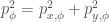
Let’s suppose instead of measuring a distance, we want to measure the momentum of some other particle, which we call \phi because physicists are overly enamored of Greek letters. If p_{x,\phi} is its momentum (physicists also really love subscripts), then its total momentum can be calculated using the Pythagorean Theorem as well:
p_\phi^2= p_{x,\phi}^2+ p_{y,\phi}^2

Or with gravity:

p_\phi^2= g_{x}p_{x,\phi}^2+ g_{y} p_{y,\phi}^2

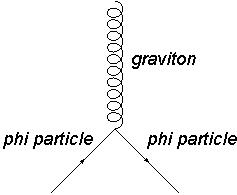
At the moment, this looks just like the distance formula with a bunch of extra stuff in it. Interpreted another way, though, it becomes instructions for the interactions of the graviton. If g_{x} and g_{y} represent the graviton, then this formula says that one graviton can interact with two \phi particles, like so:

graviton

Saying that gravitons can interact with \phi particles ends up meaning the same thing as saying that gravity changes the way we measure the \phi particle’s total momentum. This is one of the more important things to understand about quantum gravity: the idea that when people talk about exotic things like “gravitons”, they’re really talking about the same theory that Einstein proposed in 1916. There’s nothing scary about describing gravity in terms of particles just like the other forces. The scary bit comes later, as a result of the particular way that quantum calculations with gravity end up. But that’s a tale for another day.

Nature Abhors a Constant

Why is a neutrino lighter than an electron? Why is the strong nuclear force so much stronger than the weak nuclear force, and why are both so much stronger than gravity? For that matter, why do any particles have the masses they do, or forces have the strengths they do?

To some people, these sorts of questions are meaningless. A scientist’s job is to find out the facts, to measure what the constants are. To ask why, though…why would you want to do that?

Maybe a sense of history?

See, physics has a history of taking what look like arbitrary facts (the orbits of the planets, the rate objects fall, the pattern of chemical elements) and finding out why they are that way. And there’s no reason not to expect this trend to continue.

The point can be made even more strongly: increasingly, it is becoming clear that nature abhors a constant.

To explain this, I first have to clarify what I mean by a constant. If you were asked to think of a constant, you’d probably think of the speed of light. The thing is, the speed of light is actually not the sort of constant I have in mind. The speed of light is three hundred million meters per second…but it’s also 671 million miles per hour, or one light year per year. Choose the right units, and the speed of light is just one. To go a bit further: the speed of light is merely an artifact of how we choose our units of distance and time, so it’s not a “real” constant at all!

So what would a “real” constant look like? Well, imagine if there were two fundamental speeds: a maximum, like the speed of light and a minimum, which nothing could go slower than. You could pick units so that one of the speeds was one, or so that the other was…but they couldn’t both be one at the same time. Their ratio stays the same, no matter what units you’re using. That’s the sign of a true constant. To say it another way: a “real” constant is dimensionless.

It is these “real” constants that nature so abhors, because whenever such a “real” constant appears to exist, it is likely to be due to a scalar field.

To remind readers, a scalar field is a type of quantum field consisting of a number that can vary through space. Temperature is an iconic illustration of a scalar field: at any given point you can define temperature by a number, and that number changes as you move from place to place.

Now constants, being constant, are not known for changing from place to place. Just because we don’t see mass or charge being different in different places, though, doesn’t mean they aren’t scalar fields.

To illustrate, imagine that you live far in the past, far enough that no-one knows that air has weight. Through careful experimentation, though, you can observe air pressure: everything is pressed upon in all directions by some mysterious force. Even if you don’t have access to mountains and therefore can’t see that air pressure varies by height, maybe you have begun to guess that air pressure is related to the weight of the air. You have a possible explanation for your constant pressure, in terms of a scalar pressure field. But how do you test your idea? Well, the big difference between a scalar and a constant is that a scalar can vary. Since there’s so much air above you, it’s hard to get air pressure to vary: you have to put enough energy in to the air to make it happen. More specifically, you vibrate the air: you create sound waves! By measuring how fast the sound waves go, you can test out your proposed number for the mass of the air, and if everything lines up right, you have successfully replaced a mysterious constant with a logical explanation.

This is almost exactly what happened with the Higgs. Scientists observed that particle masses seemed to be arbitrary numbers, and proposed a scalar field to explain them. (As a matter of fact, the masses involved actually cannot just be constants; the mathematics involved doesn’t allow it. They must be scalar fields). In order to test out the theory, we built the Large Hadron Collider, and used it to cause ripples in the seemingly constant masses, just like sound waves in air. In this case, those ripples were the Higgs particle, which served as evidence for the Higgs field just as sound waves serve as evidence for the mass of air.

And this sort of method keeps going. The Higgs explains mass in many cases, but it doesn’t explain the differences between particle masses, and it may be that new fields are needed to explain those. The same thing goes for the strengths of forces. Scalar fields are the most likely explanations for inflation, and in string theory scalars control the size and shape of the extra dimensions. So if you’ve got a mysterious constant, nature likely has a scalar field waiting in the wings to explain it.

Why a Quantum Field Theorist is the wrong person to ask about Quantum Mechanics

Quantum Mechanics is quite possibly the sexiest, most mysterious thing to come out of 20th century physics. Almost a century of evidence has confirmed that the world is fundamentally ambiguous and yet deeply predictable, that physics is best described probabilistically, and that however alien this seems the world wouldn’t work without it. Quantum Mechanics raises deep philosophical questions about the nature of reality, some of the most interesting of which are still unanswered to this day.

And I am (for the moment, at least) not the best person to ask about these questions. Because while I specialize in Quantum Field Theory, that actually means I pay very little attention to the paradoxes of Quantum Mechanics.

It all boils down to the way calculations in quantum field theory work. As I described in a previous post, quantum field theory involves adding up progressively more complicated Feynman Diagrams. There are methods that don’t involve Feynman Diagrams, but in one way or another they work on the same basic principle: to take quantum mechanics into account, add up all possible outcomes, either literally or through shortcuts.

That may sound profound, but in many ways it’s quite mundane. Yes, you’re adding up all possibilities, but each possibility is essentially a mundane possibility. There are a few caveats, but essentially each element you add in, each Feynman Diagram for example, looks roughly like the sort of thing you could get without quantum mechanics.

In a typical quantum field theory calculation, you don’t see the mysterious parts of quantum mechanics: you don’t see entanglement, or measurements collapsing the wavefunction, and you don’t have to think about whether reality is really real. Because of that, I’m not the best person to ask about quantum paradoxes, as I’ve got little more than an undergraduate’s knowledge of these things.

There are people whose work focuses much more on quantum paradoxes. Generally these people focus on systems closer to everyday experiments, atoms rather than more fundamental particles. Because the experimentalists they cooperate with have much more ability to manipulate the systems they study, they are able to probe much more intricate quantum properties. People interested in the possibility of a quantum computer are often at the forefront of this, so if you’ve got a question about a quantum paradox, don’t ask me, ask people like WLOG blog.

A final note: there are many people (often very experienced and elite researchers) who, though they might primarily be described as quantum field theorists, have weighed in on the subject of quantum paradoxes. If you’ve heard of the black hole firewall debate, that is a recent high-profile example of this. The important thing to remember is that these people are masters of many areas of physics. They have taken the time to study the foundations of quantum mechanics, and have broadened their horizons to the tools more commonly used in other subfields. So while your average grad student quantum field theorist won’t know an awful lot about quantum paradoxes, these guys do.

What’s so hard about Quantum Field Theory anyway?

As I have mentioned before a theory in theoretical physics can be described as a list of quantum fields and the ways in which they interact. It turns out this is all you need to start drawing Feynman Diagrams.

Feynman Diagrams are tools physicists use to calculate the probability of things happening: radioactive particles decaying, protons colliding, electrons changing course in a magnetic field…basically anything small enough that quantum mechanics is important. Each Feynman Diagram depicts the paths that a group of particles take over time, interacting as they go. It’s important to remember, however, that Feynman Diagrams are not literally what’s going on: rather, they are tools for calculation.

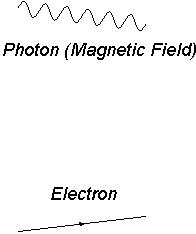
To start making a Feynman Diagram, think about what you need present in order to start whatever process you’re investigating. For the examples given above, this means a radioactive particle, two protons, and an electron and a magnetic field, respectively. For each particle or field that you start out with, draw a line on the left of the diagram.

4gravincoming

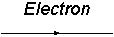
If you’re making a Feynman Diagram you’re looking for a probability of some particular outcome. Draw lines corresponding to the particles and fields in that outcome on the left of the diagram. For example, if you were looking at a radioactive decay, you’d want the new particles the original particle decayed into. For an electron moving in a magnetic field, you want the electron’s new path.

4gravoutgoing

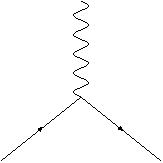
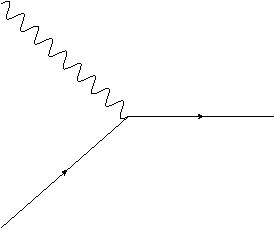
Now come the interactions. Each way that the particles and fields can interact is a potential way that lines can come together. For example, electrons are affected by the photons that make up electric and magnetic fields. Specifically, an electron can absorb a photon, changing its path. This gives us an interaction: an electron and a photon go in, and an electron comes out.

4gravinteraction

You’ve got the basic building blocks: particles as lines, and interactions where the lines come together. Now, just link them all up! Something like this:

4gravclassical

Then again, you could also do it like this:

4gravanom

Or this:

4grav2loop

Or this:

4gravcomplicated

You get the idea. To use these diagrams, a physicist assigns a number to each line and each interaction, depending on various traits of the particles involved including their energy and angles of travel. For each diagram, all these numbers are multiplied together. Then, because in quantum mechanics every possible event has to be included, you add up all the numbers from all of the diagrams. Every single one.

Not just the simple diagram on the top, but also the more complicated one below it, and the one below that, and every way you could possibly link up all of the particles going in and coming out, each more and more complicated. An infinite list of diagrams. Only by adding all of those diagrams together can a physicist find the true, complete probability of a quantum event.

Adding an infinite set of increasingly complicated diagrams is tricky. By tricky, I mean nearly absolutely impossible and so insane in principle that mathematicians aren’t even sure that it has any real meaning.

Because of this, everything that physicists calculate is an approximation. This approximation is possible because each interaction multiplies the total for a diagram by a “small” number, which gets smaller the weaker the force involved, from around 1/2 for the strong nuclear force to about 1/12 for electricity and magnetism. If you limit the number of points of interaction, you limit the number of possible diagrams. For our example, limiting things to one point of interaction gives only the first diagram. If you allow up to three points, you get the second diagram, and so on. Each time you add two more interactions, your diagram gets another loop, and the contribution to the total is smaller, so that even just four loops with a force as weak as electricity and magnetism gets you all but a billionth of the total, which is about as accurate as the experiments are anyway.

What this means, though, is that we’re only at the very edge of a vast ocean of knowledge. We know the rules, the laws of physics if you will, but we can only tiptoe loop by loop towards the full formulas, sitting infinitely far away.

That, in essence, is what I work on. I look for patterns in the numbers, tricks in the calculation, ways to yank ourselves up by our bootstraps to higher and higher loops, and maybe, just maybe, for a shortcut up to infinity.

Because just because we know the rules, doesn’t mean we know how the game is played.

That’s Quantum Field Theory.

Why I Am Not A Mathematician

(No relation to Russel’s Why I Am Not A Christian. Well, not much.)

I am a theorist. I study theories. Not the well-supported theories of the AAAS definition, but simply potential lists of particles, and lists that, further, are almost certainly not “true”.

Most people find that disconcerting. Used to thinking of scientists as people who investigate the real world, people whose ideas are always tested in the fire of experiment, the idea of a scientist whose work has no direct connection to the real world is a major source of cognitive dissonance…for at least a few minutes. After that, a light dawns in most people’s heads, as they turn to me with a sigh of relief and say,

“Oh. So you’re a Mathematician.”

No.

No, I am not a Mathematician. There is a difference, subtle but vast, between what I do and a mathematician does.

An illustrative example: Quantum Electro-Dynamics, or QED, is the most successful theory in the entirety of science. Yes, I do mean the entirety of science. Quantum Electro-Dynamics, the theory of how electrons and light behave, agrees with experiments to ten decimal places. Ten digits of detail, predicted then observed. That’s more confirmed accuracy than anything else in physics, in science at all, has ever achieved.

And if you ask a mathematician who specializes in this sort of thing, they’ll tell you that QED probably doesn’t exist.

Now, by this they don’t mean that electrons don’t exist, or that light doesn’t exist. What they mean is that, if you follow the theory’s implications all the way, you get a contradiction. You can calculate each step of the way, getting reasonable results each time, results that keep agreeing perfectly with experiments…but if you were to go all the way, off to infinity, you get results that make your whole theory stop making any sort of reasonable sense.

But as physicists, we keep using it. Because before reaching infinity, for any real calculation, it works. Perfectly.

That’s the difference between a theoretical physicist and a mathematician: for a mathematician, everything must be completely rigorous, and every implication, out to infinity, has to be vetted. For a physicist, if a theory gives reasonable results, we don’t really care whether it is completely clear how it works mathematically. We use physical reasoning, using concepts that work in the physical world, even if we’re studying a theory that doesn’t actually exist in the physical world. And while that sounds like a poor way to study abstract ideas, it allows us to take risks mathematicians can’t, which sometimes means we can make discoveries that even the mathematicians find interesting.

N=4: Maximal Particles for Maximal Fun

Part Four of a Series on N=4 Super Yang-Mills Theory

This is the fourth in a series of articles that will explain N=4 super Yang-Mills theory. In this series I take that phrase apart bit by bit, explaining as I go. Because I’m perverse and out to confuse you, I started with the last bit here, and now I’ve reached the final part.

N=4 Super Yang-Mills Theory

Last time I explained supersymmetry as a relationship between two particles, one with spin X and the other with spin X-½. It’s actually a leeetle bit more complicated than that.

When a shape is symmetric, you can turn it around and it will look the same. When a theory is supersymmetric, you can “turn” it, moving from particles with spin X to particles of spin X-½, and the theory will look the same.

With a 2D shape, that’s the whole story. But if you have a symmetric 3D shape, you can turn it in two different directions, moving to different positions, and the shape will look the same either way. In supersymmetry, the number of different ways you can “turn” the theory and still have it look the same is called N.

N=1 symmetric shape

N=2 symmetric shape

Consider the example of super Yang-Mills. If we start out with a particle of spin 1 (a Yang-Mills field), N=1 supersymmetry says that there will also be a particle of spin ½, similar to the particles of everyday matter. But suppose that instead we had N=2 supersymmetry. You can move from the spin 1 particle to spin ½ in one direction, or in the other one, and just like regular symmetry moving in two different directions will get you to two different positions. That means you need two different spin ½ particles! Furthermore, you can also move in one direction, then in the other one: you go from spin 1 to spin ½, then down from spin ½ to spin 0. So our theory can’t just have spin 1 and spin ½, it has to have spin 0 particles as well!

You can keep increasing N, as long as you keep increasing the number and types of particles. Finally, at N=4, you’ve got the maximal set: one Yang-Mills field with spin 1, four different spin ½ particles, and six different spin 0 scalars. The diagram below shows how the particles are related: you start in the center with a Yang-Mills field, and then travel in one of four directions to the spin ½ particles. Picking two of those directions, you travel further, to a scalar in between two spin ½ particles. Applying more supersymmetry just takes you back down: first to spin ½, then all the way back to spin 1.

N=4 super Yang-Mills is where the magic happens. Its high degree of symmetry gives it conformal invariance and dual conformal invariance, it has been observed to have maximal transcendentality and it may even be integrable. Any one of those statements could easily take a full blog post to explain. For now, trust me when I tell you that while N=4 super Yang-Mills may seem complicated, its symmetry means that deep down it is one of the easiest theories to work with, and in fact it might be the simplest non-gravity quantum field theory possible. That makes it an immensely important stepping stone, the first link to take us to a full understanding of particle physics.

One final note: you’re probably wondering why we stopped at N=4. At N=4 we have enough symmetry to go out from spin 1 to spin 0, and then back in to spin 1 again. Any more symmetry, and we need more space, which in this case means higher spin, which means we need to start talking about gravity. Supergravity takes us all the way up to N=8, and has its own delightful properties…but that’s a topic for another day.

Supersymmetry, to the Rescue!

Part Three of a Series on N=4 Super Yang-Mills Theory

This is the third in a series of articles that will explain N=4 super Yang-Mills theory. In this series I take that phrase apart bit by bit, explaining as I go. Because I’m perverse and out to confuse you, I started with the last bit here, and now I’m working my way up.

N=4 Super Yang-Mills Theory

Ah, supersymmetry…trendy, sexy, mysterious…an excuse to put “super” in front of words…it’s a grand subject.

If I’m going to manage to explain supersymmetry at all, then I need to explain spin. Luckily, you don’t need to know much about spin for this to work. While I could start telling you about how particles literally spin around like tops despite having a radius of zero, and how quantum mechanics restricts how fast they spin to a few particular values measured by Planck’s constant…all you really need to know is the following:

Spin is a way to categorize particles.

In particular, there are:
Spin 1: Yang-Mills fields are spin 1, carrying forces with a direction and strength.
Spin ½: This spin covers pretty much all of the particles you encounter in everyday matter: electrons, neutrons, and protons, as well as more exotic stuff like neutrinos. If you want to make large-scale, interesting structures like rocks or lifeforms you pretty much need spin ½ particles.
Spin 0: A spin zero field (also called a scalar) is a number, like a temperature, that can vary from place to place. The Higgs field is an example of a spin zero field, where the number is part of the mass of other particles, and the Higgs boson is a ripple in that field, like a cold snap would be for temperature.

While they aren’t important for this post, you can also have higher numbers for spin: gravity has spin 2, for example.

With this definition in hand, we can start talking about supersymmetry, which is also pretty straightforward if you ignore all of the actual details.

Supersymmetry is a relationship (or symmetry) between particles with spin X, and particles with spin X-½

For example, you could have a relationship between a spin 1 Yang-Mills field and a spin ½ matter particle, or between a spin ½ matter particle and a spin 0 scalar.

“Relationship” is a vague term here, much like it is in romance, and just like in romance you’d do well to clarify precisely what you mean by it. Here, it means something like the following: if you switch a particle for its “superpartner” (the other particle in the relationship) then the physics should remain the same. This has two important consequences: superpartners have the same mass as each-other and superpartners have the same interactions as each-other.

The second consequence means that if a particle has electric charge -1, its superpartner also has electric charge -1. If you’ve got gluons, each with a color and an anti-color, then their superpartners will also have both a color and an anti-color. Astute readers will have remembered that quarks just have a color or an anti-color, and realized the implication: quarks cannot be the superpartners of gluons.

Other, even more well-informed readers will be wondering about the first consequence. Such readers might have heard that the LHC is looking for superpartners, or that superpartners could explain dark matter, and that in either case superpartners have very high mass. How can this be if superpartners have to have the same mass as their partners among the regular particles?

The important point to make here is that our real world is not supersymmetric, even if superpartners are discovered at the LHC, because supersymmetry is broken. In physics, when a symmetry of any sort is broken it’s like a broken mirror: it no longer is the same on each side, but the two sides are still related in a systematic way. Broken supersymmetry means that particles that would be superpartners can have different masses, but they will still have the same interactions.

When people look for supersymmetry at the LHC, they’re looking for new particles with the same interactions as the old particles, but generally much higher mass. When I talk about supersymmetry, though, I’m talking about unbroken supersymmetry: pairs of particles with the same interactions and the same mass. And N=4 super Yang-Mills is full of them.

How full? N=4 full. And that’s next week’s topic.

Yang-Mills: Plays Well With Itself

Part Two of a Series on N=4 Super Yang-Mills Theory

This is the second in a series of articles that will explain N=4 super Yang-Mills theory. In this series I take that phrase apart bit by bit, explaining as I go. Because I’m perverse and out to confuse you, I started with the last bit here, and now I’m working my way up.

N=4 Super Yang-Mills Theory

So first these physicists expect us to accept a nonsense word like quark, and now they’re calling their theory Yang-Mills? What silly word are they going to foist on us next?

Umm…Yang and Mills are people.

Chen Ning Yang and Robert Mills were two physicists, famous for being very well treated by the Chinese government and for not being the father of nineteenth century Utilitarianism, respectively.

Has a wife 56 years younger than him

Did not design the Panopticon

In the 1950’s, Yang and Mills were faced with a problem: how to describe the strong nuclear force, the force that holds protons and neutrons in the nuclei of atoms together. At the time, the nature of this force was very mysterious. Nuclear experiments were uncovering new insight about the behavior of the strong force, but those experiments showed that the strong force didn’t behave like the well-understood force of electricity and magnetism. In particular, the strong force seemed to treat neutrons and protons in a related way, almost as if they were two sides of the same particle.

In 1954, Yang and Mills proposed a solution to this problem. In order to do so, they had to suggest something novel: a force that interacts with itself. To understand what that means and why that’s special, let’s discuss a bit about forces.

Each fundamental force can be thought of in terms of a field extending across space and time. The direction and strength of this field in each place determines which way the force pushes. When this field ripples, things that we observe as particles are created, the result of waves in the field. Particles of light, or photons, are waves in the field of the fundamental force of electricity and magnetism.

The electric force attracts charges with opposite sign, and repels charges when they have the same sign. Photons, however, have no charge, so they pass right through electric and magnetic fields. This is what I mean when I say that electricity and magnetism is a force that doesn’t interact with itself.

The strong force is different. Yang and Mills didn’t know this at the time, but we know now that the strong force acts on fundamental particles inside protons and neutrons called quarks, and that quarks come in three colors, unimaginatively named red, blue, and green, while their antiparticles are classified as antired, antiblue, or antigreen. Like all other forces, the strong force gives rise to a particle, in this case called a gluon. Unlike photons, gluons are not neutral! While they have no electric charge, they are affected by the strong force. Each gluon has a color and an anti-color: red/anti-green, blue/anti-red, etc. This means that while the strong force binds quarks together, it also binds itself together as well, keeping it from reaching outside of atoms and affecting the everyday world like electricity does.

Quarks and Gluons in a Proton

Yang and Mills’ description wasn’t perfect for the strong force (they had two types of charge rather than three) but it was fairly close to how the weak force worked, as other physicists realized in 1956. It was realized much later (in the 70’s) that a modification of Yang and Mills’ proposal worked for the strong force as well. In recognition of their insight, today the names Yang and Mills are attached to any force that interacts with itself.

A Yang-Mills theory, then, is a theory that contains a fundamental force that can interact with itself. This force generates particles (often called force-carrying bosons) which have something like charge or color with respect to the Yang-Mills force. If you remember the definition of a theory, you’ll see that we have everything we need: we have specified a particle (the force-carrying boson) and the ways in which it can interact (specifically, with itself).

Tune in next week when I explain the rest of the phrase, in a brief primer on the superheroic land of supersymmetry.