Tag Archives: quantum field theory

Hexagon Functions II: Lost in (super)Space

My new paper went up last night.

It’s on a very similar topic to my last paper, actually. That paper dealt with a specific process involving six particles in my favorite theory, N=4 super Yang-Mills. Two particles collide, and after the metaphorical dust settles four particles emerge. That means six “total” particles, if you add the two in with the four out, for a “hexagon” of variables. To understand situations like that, my collaborators and I created “hexagon functions”, formulas that depended on the states of the six particles.

One thing I didn’t emphasize then was that that calculation only applied to one specific choice of particles, one in which all of the particles are Yang-Mills bosons, particles (like photons) created by the fundamental forces. There are lots of other particles in N=4 super Yang-Mills, though. What happens when they collide?

That question is answered by my new paper. Though it may sound surprising, all of the other particles can be taken into account with a single formula. In order to explain why, I have to tell you about something called superspace.

A while back I complained about a blog post by George Musser about the (2,0) theory. One of the things that irked me about that post was his attempt to explain superspace:

Supersymmetry is the idea that spacetime, in addition to its usual dimensions of space and time, has an entirely different type of dimension—a quantum dimension, whose coordinates are not ordinary real numbers but a whole new class of number that can be thought of as the square roots of zero.

This is actually a great way to think about superspace…if you’re already a physicist. If you’re not, it’s not very informative. Here’s a better way to think about it:

As I’ve talked about before, supersymmetry is a relationship between different types of particles. Two particles related by supersymmetry have the same mass, and the same charge. While they can be very different in other ways (specifically, having different spin), supersymmetric particles are described by many of the same equations as each-other. Rather than writing out those equations multiple times, it’s often nicer to write them all in a unified way, and that’s where superspace comes in.

At its simplest, superspace is just a trick used to write equations in a simpler way. Instead of writing down a different equation for each particle we write one equation with an extra variable, representing a “dimension” of supersymmetry. Traveling in that dimension takes you from particle to particle, in the same way that “turning” the theory (as I phrase it here) does, but it does it within the space of a single equation.

That, essentially, is the trick that we use. With four “superspace dimensions”, we can include the four supersymmetries of N=4 super Yang-Mills, showing how the formulas vary when you go beyond the equation from our first paper.

So far, you may be wondering why I’m calling superspace a “dimension”, when it probably sounds like more of a label. I’ve mentioned before that, just because something is a variable, doesn’t mean it counts as a real dimension.

The key difference is that superspace dimensions are related to regular dimensions in a precise way. In a sense, they’re the square roots of regular dimensions. (Though independently, as George Musser described, they’re the square roots of zero: go in the same direction twice in supersymmetry, and you get back where you’re started, going zero distance.) The coexistence of these two seemingly contradictory statements isn’t some sort of quantum mystery, it’s just a consequence of the fact that, mathematically, I’m saying two very different things. I just can’t think of a way to explain them differently without math.

Superspace isn’t a real place…but it can often be useful to think of it that way. In theories with supersymmetry, it can unify the world, putting disparate particles together into a single equation.
Feeling Perturbed?

You might think of physics as the science of certainties and exact statements: action and reaction, F=ma, and all that. However, most calculations in physics aren’t exact, they’re approximations. This is especially true today, but it’s been true almost since the dawn of physics. In particular, approximations are performed via a method known as perturbation theory.

Perturbation theory is a trick used to solve problems that, for one reason or another, are too difficult to solve all in one go. It works by solving a simpler problem, then perturbing that solution, adjusting it closer to the target.

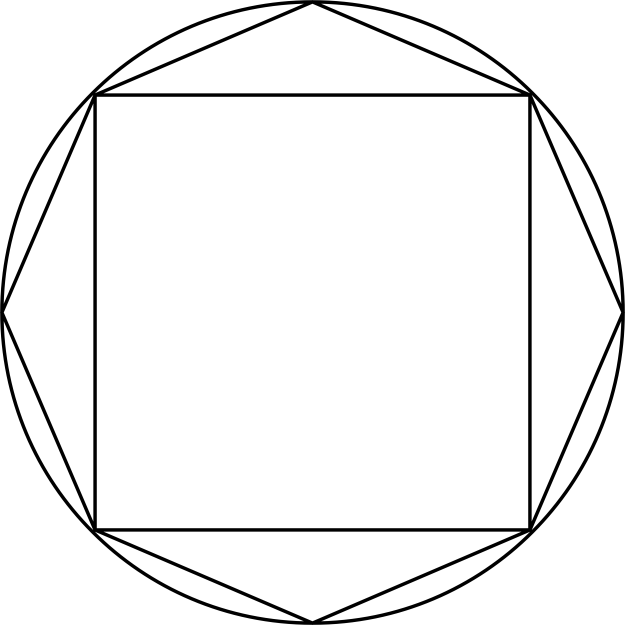
To give an analogy: let’s say you want to find the area of a circle, but you only know how to draw straight lines. You could start by drawing a square: it’s easy to find the area, and you get close to the area of the circle. But you’re still a long ways away from the total you’re aiming for. So you add more straight lines, getting an octagon. Now it’s harder to find the area, but you’re closer to the full circle. You can keep adding lines, each step getting closer and closer.

And so on.

And so on.

This, broadly speaking, is what’s going on when particle physicists talk about loops. The calculation with no loops (or “tree-level” result) is the easier problem to solve, omitting quantum effects. Each loop then is the next stage, more complicated but closer to the real total.

There are, as usual, holes in this analogy. One is that it leaves out an important aspect of perturbation theory, namely that it involves perturbing with a parameter. When that parameter is small, perturbation theory works, but as it gets larger the approximation gets worse and worse. In the case of particle physics, the parameter is the strength of the forces involves, with weaker forces (like the weak nuclear force, or electromagnetism) having better approximations than stronger forces (like the strong nuclear force). If you squint, this can still fit the analogy: different shapes might be harder to approximate than the circle, taking more sets of lines to get acceptably close.

Where the analogy fails completely, though, is when you start approaching infinity. Keep adding more lines, and you should be getting closer and closer to the circle each time. In quantum field theory, though, this frequently is not the case. As I’ve mentioned before, while lower loops keep getting closer to the true (and experimentally verified) results, going all the way out to infinite loops results not in the full circle, but in an infinite result instead. There’s an understanding of why this happens, but it does mean that perturbation theory can’t be thought of in the most intuitive way.

Almost every calculation in particle physics uses perturbation theory, which means almost always we are just approximating the real result, trying to draw a circle using straight lines. There are only a few theories where we can bypass this process and look at the full circle. These are known as integrable theories. N=4 super Yang-Mills may be among them, one of many reasons why studying it offers hope for a deeper understanding of particle physics.

Look what I made!

In a few weeks, I’ll be giving a talk for Stony Brook’s Graduate Awards Colloquium, to an audience of social science grad students and their parents.

One of the most useful tools when talking to people in other fields is a shared image. You want something from your field that they’ve seen, that they’re used to, that they’ll recognize. Building off of that kind of thing can be a great way to communicate.

If there’s one particle physics image that lots and lots of people have seen, it’s the Standard Model. Generally, it’s organized into charts like this:

Standard_Model_of_Elementary_Particles

I thought that if people saw a chart like that, but for N=4 super Yang-Mills, it might make the theory seem a bit more familiar. N=4 super Yang-Mills has a particle much like the Standard Model’s gluon with spin 1, paired with four gluinos, particles that are sort of but not really like quarks with spin 1/2, and six scalars, particles whose closest analogue in the Standard Model is the Higgs with spin 0.

In N=4 super Yang-Mills, none of these particles have any mass, since if supersymmetry isn’t “broken” all particles have the same mass. So where mass is written in the Standard Model table, I can just put zero. The table I linked also gives the electric charge of each particle. That doesn’t really mean anything for N=4 super Yang-Mills. It isn’t a theory that tries to describe the real world, so there’s no direct equivalent to a real-world force like electromagnetism. Since everything in the theory has to have the same charge, again due to supersymmetry, I can just list all of their “electric charges” as zero.

Putting it all together, I get the diagram below. The theory has eleven particles in total, so it won’t fit into a nice neat square. Still, this should be more familiar than most of the ways I could present things.

N4SYMParticleContent

Gravity is Yang-Mills Squared

There’s a concept that I’ve wanted to present for quite some time. It’s one of the coolest accomplishments in my subfield, but I thought that explaining it would involve too much technical detail. However, the recent BICEP2 results have brought one aspect of it to the public eye, so I’ve decided that people are ready.

If you’ve been following the recent announcements by the BICEP2 telescope of their indirect observation of primordial gravitational waves, you’ve probably seen the phrases “E-mode polarization” and “B-mode polarization” thrown around. You may even have seen pictures, showing that light in the cosmic microwave background is polarized differently by quantum fluctuations in the inflaton field and by quantum fluctuations in gravity.

But why is there a difference? What’s unique about gravitational waves that makes them different from the other waves in nature?

As it turns out, the difference all boils down to one statement:

Gravity is Yang-Mills squared.

This is both a very simple claim and a very subtle one, and it comes up in many many places in physics.

Yang-Mills, for those who haven’t read my older posts, is a general category that contains most of the fundamental forces. Electromagnetism, the strong nuclear force, and the weak nuclear force are all variants of Yang-Mills forces.

Yang-Mills forces have “spin 1”. Another way to say this is that Yang-Mills forces are vector forces. If you remember vectors from math class, you might remember that a vector has a direction and a strength. This hopefully makes sense: forces point in a direction, and have a strength. You may also remember that vectors can also be described in terms of components. A vector in four space-time dimensions has four components: x, y, z, and time, like so:

\left( \begin{array}{c} x \\ y \\ z \\ t \end{array} \right)

Gravity has “spin 2”.

As I’ve talked about before, gravity bends space and time, which means that it modifies the way you calculate distances. In practice, that means it needs to be something that can couple two vectors together: a matrix, or more precisely, a tensor, like so:

\left( \begin{array}{cccc} xx & xy & xz & xt\\ yx & yy & yz & yt\\ zx & zy & zz & zt\\ tx & ty & tz & tt\end{array} \right)

So while a Yang-Mills force has four components, gravity has sixteen. Gravity is Yang-Mills squared.

(Technical note: gravity actually doesn’t use all sixteen components, because it’s traceless and symmetric. However, often when studying gravity’s quantum properties theorists often add on extra fields to “complete the square” and fill in the remaining components.)

There’s much more to the connection than that, though. For one, it appears in the kinds of waves the two types of forces can create.

In order to create an electromagnetic wave you need a dipole, a negative charge and a positive charge at opposite ends of a line, and you need that dipole to change over time.

Change over time, of course, is a property of Gifs.

Gravity doesn’t have negative and positive charges, it just has one type of charge. Thus, to create gravitational waves you need not a dipole, but a quadrupole: instead of a line between two opposite charges, you have four gravitational charges (masses) arranged in a square. This creates a “breathing” sort of motion, instead of the back-and-forth motion of electromagnetic waves.

This is your brain on gravitational waves.

This is why gravitational waves have a different shape than electromagnetic waves, and why they have a unique effect on the cosmic microwave background, allowing them to be spotted by BICEP2. Gravity, once again, is Yang-Mills squared.

But wait there’s more!

So far, I’ve shown you that gravity is the square of Yang-Mills, but not in a very literal way. Yes, there are lots of similarities, but it’s not like you can just square a calculation in Yang-Mills and get a calculation in gravity, right?

Well actually…

In quantum field theory, calculations are traditionally done using tools called Feynman diagrams, organized by how many loops the diagram contains. The simplest diagrams have no loops, and are called tree diagrams.

Fascinatingly, for tree diagrams the message of this post is as literal as it can be. Using something called the Kawai-Lewellen-Tye relations, the result of a tree diagram calculation in gravity can be found just by taking a similar calculation in Yang-Mills and squaring it.

(Interestingly enough, these relations were originally discovered using string theory, but they don’t require string theory to work. It’s yet another example of how string theory functions as a laboratory to make discoveries about quantum field theory.)

Does this hold beyond tree diagrams? As it turns out, the answer is again yes!
The calculation involved is a little more complicated, but as discovered by Zvi Bern, John Joseph Carrasco, and Henrik Johansson, if you can get your calculation in Yang-Mills into the right format then all you need to do is square the right thing at the right step to get gravity, even for diagrams with loops!

zvi-bern-350

carrasco

This trick, called BCJ duality after its discoverers, has allowed calculations in quantum gravity that far outpace what would be possible without it. In N=8 supergravity, the gravity analogue of N=4 super Yang-Mills, calculations have progressed up to four loops, and have revealed tantalizing hints that the uncontrolled infinities that usually plague gravity theories are absent in N=8 supergravity, even without adding in string theory. Results like these are why BCJ duality is viewed as one of the “foundational miracles” of the field for those of us who study scattering amplitudes.

Gravity is Yang-Mills squared, in more ways than one. And because gravity is Yang-Mills squared, gravity may just be tame-able after all.

A Wild Infinity Appears! Or, Renormalization

Back when Numberphile’s silly video about the zeta function came up, I wrote a post explaining the process of regularization, where physicists take an incorrect infinite result and patch it over to get something finite. At the end of that post I mentioned a particular variant of regularization, called renormalization, which was especially important in quantum field theory.

Renormalization has to do with how we do calculations and make predictions in particle physics. If you haven’t read my post “What’s so hard about Quantum Field Theory anyway?” you should read it before trying to tackle this one. The important concepts there are that probabilities in particle physics are calculated using Feynman Diagrams, that those diagrams consist of lines representing particles and points representing the ways they interact, that each line and point in the diagram gives a number that must be plugged in to the calculation, and that to do the full calculation you have to add up all the possible diagrams you can draw.

Let’s say you’re interested in finding out the mass of a particle. How about the Higgs?

You can’t weigh it, or otherwise see how gravity affects it: it’s much too light, and decays into other particles much too fast. Luckily, there is another way. As I mentioned in this post, a particle’s mass and its kinetic energy (energy of motion) both contribute to its total energy, which in turn affects what particles it can turn into if it decays. So if you want to find a particle’s mass, you need the relationship between its motion and its energy.

Suppose we’ve got a Higgs particle moving along. We know it was created out of some collision, and we know what it decays into at the end. With that, we can figure out its mass.

higgstree

There’s a problem here, though: we only know what happens at the beginning and the end of this diagram. We can’t be certain what happens in the middle. That means we need to add in all of the other diagrams, every possible diagram with that beginning and that end.

Just to look at one example, suppose the Higgs particle splits into a quark and an anti-quark (the antimatter version of the quark). If they come back together later into a Higgs, the process would look the same from the outside. Here’s the diagram for it:

higgsloop

When we’re “measuring the Higgs mass”, what we’re actually measuring is the sum of every single diagram that begins with the creation of a Higgs and ends with it decaying.

Surprisingly, that’s not the problem!

The problem comes when you try to calculate the number that comes out of that diagram, when the Higgs splits into a quark-antiquark pair. According to the rules of quantum field theory, those quarks don’t have to obey the normal relationship between total energy, kinetic energy, and mass. They can have any kinetic energy at all, from zero all the way up to infinity. And because it’s quantum field theory, you have to add up all of those possible kinetic energies, all the way up. In this case, the diagram actually gives you infinity.

(Note that not every diagram with unlimited kinetic energy is going to be infinite. The first time theorists calculated infinite diagrams, they were surprised.

For those of you who know calculus, the problem here comes after you integrate over momentum. The two quarks each give a factor of one over the momentum, and then you integrate the result four times (for three dimensions of space plus time), which gives an infinite result. If you had different particles arranged in a different way you might divide by more factors of momentum and get a finite value.)

The modern understanding of infinite results like this is that they arise from our ignorance. The mass of the Higgs isn’t actually infinity, because we can’t just add up every kinetic energy up to infinity. Instead, at some point before we get to infinity “something else” happens.

We don’t know what that “something else” is. It might be supersymmetry, it might be something else altogether. Whatever it is, we don’t know enough about it now to include it in the calculations as anything more than a cutoff, a point beyond which “something” happens. A theory with a cutoff like this, one that is only “effective” below a certain energy, is called an Effective Field Theory.

While we don’t know what happens at higher energies, we still need a way to complete our calculations if we want to use them in the real world. That’s where renormalization comes in.

When we use renormalization, we bring in experimental observations. We know that, no matter what is contributing to the Higgs particle’s mass, what we observe in the real world is finite. “Something” must be canceling the divergence, so we simply assume that “something” does, and that the final result agrees with the experiment!

"Something"

“Something”

In order to do this, we accepted the experimental result for the mass of the Higgs. That means that we’ve lost any ability to predict the mass from our theory. This is a general rule for renormalization: we trade ignorance (of the “something” that happens at high energy) for a loss of predictability.

If we had to do this for every calculation, we couldn’t predict anything at all. Luckily, for many theories (called renormalizable theories) there are theorems proving that you only need to do this a few times to fix the entire theory. You give up the ability to predict the results of a few experiments, but you gain the ability to predict the rest.

Luckily for us, the Standard Model is a renormalizable theory. Unfortunately, some important theories are not. In particular, quantum gravity is non-renormalizable. In order to fix the infinities in quantum gravity, you need to do the renormalization trick an infinite number of times, losing an infinite amount of predictability. Thus, while making a theory of quantum gravity is not difficult in principle, in practice the most obvious way to create the theory results in a “theory” that can never make any predictions.

One of the biggest virtues of string theory (some would say its greatest virtue) is that these infinities never appear. You never need to renormalize string theory in this way, which is what lets it work as a theory of quantum gravity. N=8 supergravity, the gravity cousin of N=4 super Yang-Mills, might also have this handy property, which is why many people are so eager to study it.

How (Not) to Sum the Natural Numbers: Zeta Function Regularization

1+2+3+4+5+6+\ldots=-\frac{1}{12}

If you follow Numberphile on YouTube or Bad Astronomy on Slate you’ve already seen this counter-intuitive sum written out. Similarly, if you follow those people or Sciencetopia’s Good Math, Bad Math, you’re aware that the way that sum was presented by Numberphile in that video was seriously flawed.

There is a real sense in which adding up all of the natural numbers (numbers 1, 2, 3…) really does give you minus twelve, despite all the reasons this should be impossible. However, there is also a real sense in which it does not, and cannot, do any such thing. To explain this, I’m going to introduce two concepts: complex analysis and regularization.

This discussion is not going to be mathematically rigorous, but it should give an authentic and accurate view of where these results come from. If you’re interested in the full mathematical details, a later discussion by Numberphile should help, and the mathematically confident should read Terence Tao’s treatment from back in 2010.

With that said, let’s talk about sums! Well, one sum in particular:

\frac{1}{1^s}+\frac{1}{2^s}+\frac{1}{3^s}+\frac{1}{4^s}+\frac{1}{5^s}+\frac{1}{6^s}+\ldots = \zeta(s)

If s is greater than one, then each term in this infinite sum gets smaller and smaller fast enough that you can add them all up and get a number. That number is referred to as \zeta(s), the Riemann Zeta Function.

So what if s is smaller than one?

The infinite sum that I described doesn’t converge for s less than one. Add it up in any reasonable way, and it just approaches infinity. Put another way, the sum is not properly defined. But despite this, \zeta(s) is not infinite for s less than one!

Now as you might object, we only defined the Riemann Zeta Function for s greater than one. How do we know anything at all about it for s less than one?

That is where complex analysis comes in. Complex analysis sounds like a made-up term for something unreasonably complicated, but it’s quite a bit more approachable when you know what it means. Analysis is the type of mathematics that deals with functions, infinite series, and the basis of calculus. It’s often contrasted with Algebra, which usually considers mathematical concepts that are discrete rather than smooth (this definition is a huge simplification, but it’s not very relevant to this post). Complex means that complex analysis deals with functions, not of everyday real numbers, but of complex numbers, or numbers with an imaginary part.

So what does complex analysis say about the Riemann Zeta Function?

One of the most impressive results of complex analysis is the discovery that if a function of a complex number is sufficiently smooth (the technical term is analytic) then it is very highly constrained. In particular, if you know how the function behaves over an area (technical term: open set), then you know how it behaves everywhere else!

If you’re expecting me to explain why this is true, you’ll be disappointed. This is serious mathematics, and serious mathematics isn’t the sort of thing you can give the derivation for in a few lines. It takes as much effort and knowledge to replicate a mathematical result as it does to replicate many lab results in science.

What I can tell you is that this sort of approach crops up in many places, and is part of a general theme. There is a lot you can tell about a mathematical function just by looking at its behavior in some limited area, because mathematics is often much more constrained than it appears. It’s the same sort of principle behind the work I’ve been doing recently.

In the case of the Riemann Zeta Function, we have a definition for s greater than one. As it turns out, this definition still works if s is a complex number, as long as the real part of s is greater than one. Using this information, the value of the Riemann Zeta Function for a large area (half of the complex numbers), complex analysis tells us its value for every other number. In particular, it tells us this:

\zeta(-1)= -\frac{1}{12}

If the Riemann Zeta Function is consistently defined for every complex number, then it must have this value when s is minus one.

If we still trusted the sum definition for this value of s, we could plug in -1 and get

 1+2+3+4+5+6+\ldots=-\frac{1}{12}

Does that make this statement true? Sort of. It all boils down to a concept from physics called regularization.

In physics, we know that in general there is no such thing as infinity. With a few exceptions, nothing in nature should be infinite, and finite evidence (without mathematical trickery) should never lead us to an infinite conclusion.

Despite this, occasionally calculations in physics will give infinite results. Almost always, this is evidence that we are doing something wrong: we are not thinking hard enough about what’s really going on, or there is something we don’t know or aren’t taking into account.

Doing physics research isn’t like taking a physics class: sometimes, nobody knows how to do the problem correctly! In many cases where we find infinities, we don’t know enough about “what’s really going on” to correct them. That’s where regularization comes in handy.

Regularization is the process by which an infinite result is replaced with a finite result (made “regular”), in a way so that it keeps the same properties. These finite results can then be used to do calculations and make predictions, and so long as the final predictions are regularization independent (that is, the same if you had done a different regularization trick instead) then they are legitimate.

In string theory, one way to compute the required dimensions of space and time ends up giving you an infinite sum, a sum that goes 1+2+3+4+5+…. In context, this result is obviously wrong, so we regularize it. In particular, we say that what we’re really calculating is the Riemann Zeta Function, which we happen to be evaluating at -1. Then we replace 1+2+3+4+5+… with -1/12.

Now remember when I said that getting infinities is a sign that you’re doing something wrong? These days, we have a more rigorous way to do this same calculation in string theory, one that never forces us to take an infinite sum. As expected, it gives the same result as the old method, showing that the old calculation was indeed regularization independent.

Sometimes we don’t have a better way of doing the calculation, and that’s when regularization techniques come in most handy. A particular family of tricks called renormalization is quite important, and I’ll almost certainly discuss it in a future post.

So can you really add up all the natural numbers and get -1/12? No. But if a calculation tells you to add up all the natural numbers, and it’s obvious that the result can’t be infinite, then it may secretly be asking you to calculate the Riemann Zeta Function at -1. And that, as we know from complex analysis, is indeed -1/12.

Update on the Amplituhedron

Awhile back I wrote a post on the Amplituhedron, a type of mathematical object  found by Nima Arkani-Hamed and Jaroslav Trnka that can be used to do calculations of scattering amplitudes in planar N=4 super Yang-Mills theory. (Scattering amplitudes are formulas used to calculate probabilities in particle physics, from the probability that an unstable particle will decay to the probability that a new particle could be produced by a collider.) Since then, they published two papers on the topic, the most recent of which came out the day before New Year’s Eve. These papers laid out the amplituhedron concept in some detail, and answered a few lingering questions. The latest paper focused on one particular formula, the probability that two particles bounce off each other. In discussing this case, the paper serves two purposes:

1. Demonstrating that Arkani-Hamed and Trnka did their homework.

2. Showing some advantages of the amplituhedron setup.

Let’s talk about them one at a time.

Doing their homework

There’s already a lot known about N=4 super Yang-Mills theory. In order to propose a new framework like the amplituhedron, Arkani-Hamed and Trnka need to show that the new framework can reproduce the old knowledge. Most of the paper is dedicated to doing just that. In several sections Arkani-Hamed and Trnka show that the amplituhedron reproduces known properties of the amplitude, like the behavior of its logarithm, its collinear limit (the situation when two momenta in the calculation become parallel), and, of course, unitarity.

What, you heard the amplituhedron “removes” unitarity? How did unitarity get back in here?

This is something that has confused several commenters, both here and on Ars Technica, so it bears some explanation.

Unitarity is the principle that enforces the laws of probability. In its simplest form, unitarity requires that all probabilities for all possible events add up to one. If this seems like a pretty basic and essential principle, it is! However, it and locality (the idea that there is no true “action at a distance”, that particles must meet to interact) can be problematic, causing paradoxes for some approaches to quantum gravity. Paradoxes like these inspired Arkani-Hamed to look for ways to calculate scattering amplitudes that don’t rely on locality and unitarity, and with the amplituhedron he succeeded.

However, just because the amplituhedron doesn’t rely on unitarity and locality, doesn’t mean it violates them. The amplituhedron, for all its novelty, still calculates quantities in N=4 super Yang-Mills. N=4 super Yang-Mills is well understood, it’s well-behaved and cuddly, and it obeys locality and unitarity.

This is why the amplituhedron is not nearly as exciting as a non-physicist might think. The amplituhedron, unlike most older methods, isn’t based on unitarity and locality. However, the final product still has to obey unitarity and locality, because it’s the same final product that others calculate through other means. So it’s not as if we’ve completely given up on basic principles of physics.

Not relying on unitarity and locality is valuable. For those who research scattering amplitudes, it has often been useful to try to “eliminate” one principle or another from our calculations. 20 years ago, avoiding Feynman diagrams was the key to finding dramatic simplifications. Now, many different approaches try to sidestep different principles. (For example, while the amplituhedron calculates an integrand and leaves a final integral to be done, I’m working on approaches that never employ an integrand.)

If we can avoid relying on some “basic” principle, that’s usually good evidence that the principle might be a consequence of something even more basic. By showing how unitarity can arise from the amplituhedron, Arkani-Hamed and Trnka have shown that a seemingly basic principle can come out of a theory that doesn’t impose it.

Advantages of the Amplituhedron

Not all of the paper compares to old results and principles, though. A few sections instead investigate novel territory, and in doing so show some of the advantages and disadvantages of the amplituhedron.

Last time I wrote on this topic, I was unclear on whether the amplituhedron was more efficient than existing methods. At this point, it appears that it is not. While the formula that the amplituhedron computes has been found by other methods up to seven loops, the amplituhedron itself can only get up to three loops or so in practical cases. (Loops are a way that calculations are classified in particle physics. More loops means a more complex calculation, and a more precise final result.)

The amplituhedron’s primary advantage is not in efficiency, but rather in the fact that its mathematical setup makes it straightforward to derive interesting properties for any number of loops desired. As Trnka occasionally puts it, the central accomplishment of the amplituhedron is to find “the question to which the amplitude is the answer”. By being able to phrase this “question” mathematically, one can be very general, which allows them to discover several properties that should hold no matter how complex the rest of the calculation becomes. It also has another implication: if this mathematical question has a complete mathematical answer, that answer could calculate the amplitude for any number of loops. So while the amplituhedron is not more efficient than other methods now, it has the potential to be dramatically more efficient if it can be fully understood.

All that said, it’s important to remember that the amplituhedron is still limited in scope. Currently, it applies to a particular theory, one that doesn’t (and isn’t meant to) describe the real world. It’s still too early to tell whether similar concepts can be defined for more realistic theories. If they can, though, it won’t depend on supersymmetry or string theory. One of the most powerful techniques for making predictions for the Large Hadron Collider, the technique of generalized unitarity, was first applied to N=4 super Yang-Mills. While the amplituhedron is limited now, I would not be surprised if it (and its competitors) give rise to practical techniques ten or twenty years down the line. It’s happened before, after all.

The Parke-Taylor Amplitudes: Why Quantum Field Theory Might Not Be So Hard, After All

If you’ve been following my blog for a while, you know that Quantum Field Theory is hard work. To calculate anything, you have to draw an ever-increasing number of diagrams, translate them into formulas involving the momentum and energy of your particles, and add all those formulas up to get your final result, the amplitude of the process you’re interested in.

As I said in that post, my area of research involves trying to find patterns in the results of these calculations, patterns that make doing the calculation simpler. With that in mind, you might wonder why we expect to find any patterns in the first place. If Quantum Field Theory is so complicated, what insurance do we have that it can be made simpler? Where does the motivation come from?

Our motivation comes from a series of discoveries that show that things really do simplify, often in unexpected ways. I won’t go through all of these discoveries here, but I want to tell you about one of the first discoveries that showed amplitudes researchers that they were on the right track.

Let’s try to calculate a comparatively simple process. Say that we’ve got two gluons (force carrying bosons for the strong force, an example of a Yang-Mills field). Suppose the two gluons collide, and some number of gluons emerge. It could be two again, or it could be three, or more.

For now, let’s just think about diagrams at tree level, that is, diagrams with no loops. The particles can travel from place to place in the diagram, but they can’t form closed loops on the inside.

Gluons have two types of interactions, places where particle lines can come together. You can either have three lines meeting at one point, or four.

If two gluons come in and two come out, we have four possible diagrams:

4ptMHV

Note that while the last diagram looks like it has a loop in it (in the form of the triangle in the middle), actually that triangle just represents that two particles are passing each other without colliding, so that their lines cross.

The number of diagrams increases substantially as you increase the number of outgoing particles. With two particles going to three particles, you get fifteen diagrams. Here are three examples:

5ptMHV

Since the number of diagrams just keeps increasing, you’d expect the final amplitude to become more and more complicated as well. However, Steven Parke and Tomasz Taylor found in 1986 that for a particular arrangement of the spins of the particles (for technical people: this is the Maximally Helicity Violating configuration, or two particles with negative helicity and all the rest with positive helicity) the answer simplifies dramatically. In the sort of variables we use these days, the result can be expressed in an incredibly simple form:

\frac{\langle 1 | 2 \rangle^4}{ \langle 1 | 2 \rangle\langle 2 | 3 \rangle\langle 3 | 4 \rangle \ldots \langle n-1 | n \rangle\langle n | 1 \rangle}

Here the angle brackets represent momenta of the incoming (for 1 and 2) and outgoing (all the other numbers) particles, with n being the total number of particles (two going in, and however many going out). (Technically, these are spinor-helicity variables, and those interested in the technical details should check out chapter 3 of this or chapter 2 of this.)

Nowadays, we know why this amplitude looks so simple, in terms of something called BCFW recursion. At the time though, it was quite extraordinary.

This is the sort of simplification we keep running into when studying amplitudes. Almost always, it means that there is some deeper principle that we don’t yet understand, something that would let us do our calculations much faster and more efficiently. It indicates that Quantum Field Theory might not be so hard after all.

What are Vacua? (A Point about the String Landscape)

A couple weeks back, there was a bit of a scuffle between Matt Strassler and Peter Woit on the subject of predictions in string theory (or more properly, the question of whether any predictions can be made at all). As a result, Strassler has begun a series on the subject of quantum field theory, string theory, and predictions.

Strassler hasn’t gotten to the topic of string vacua yet, but he’s probably going to cover the subject in a future post. While his take on the subject is likely to be more expansive and precise than mine, I think my perspective on the problem might still be of interest.

Let’s start with the basics: one of the problems often cited with string theory is the landscape problem, the idea that string theory has a metaphorical landscape of around 10^500 vacua.

What are vacua?

Vacua is the plural of vacuum.

Ok, and?

A vacuum is empty space.

That’s what you thought, right? That’s the normal meaning of vacuum. But if a vacuum is empty, how can there be more than one of them, let alone 10^500?

“Empty” is subjective.

Now we’re getting somewhere. The problem with defining a concept like “empty space” in string theory or field theory is that it’s unclear what precisely it should be empty of. Naively, such a space should be empty of “stuff”, or “matter”, but our naive notions of “matter” don’t apply to field theory or string theory. In fact, there is plenty of “stuff” that can be present in “empty” space.

Think about two pieces of construction paper. One is white, the other is yellow. Which is empty? Neither has anything drawn on it, so while one has a color and the other does not, both are empty.

“Empty space” doesn’t come in multiple colors like construction paper, but there are equivalent parameters that can vary. In quantum field theory, one option is for scalar fields to take different values. In string theory, different dimensions can be curled up in different ways (as an aside, when string theory leads to a quantum field theory often these different curling-up shapes correspond to different values for scalar fields, so the two ideas are related).

So if space can have “stuff” in it and still count as empty, are there any limits on what can be in it?

As it turns out, there is a quite straightforward limit. But to explain it, I need to talk a bit about why physicists care about vacua in the first place.

Why do physicists care about vacua?

In physics, there is a standard modus operandi for solving problems. If you’ve taken even a high school physics course, you’ve probably encountered it in some form. It’s not the only way to solve problems, but it’s one of the easiest. The idea, broadly, is the following:

First get the initial conditions, and then use the laws of physics to see what happens next.

In high school physics, this is how almost every problem works: your teacher tells you what the situation is, and you use what you know to figure out what happens next.

In quantum field theory, things are a bit more subtle, but there is a strong resemblance. You start with a default state, and then find the perturbations, or small changes, around that state.

In high school, your teacher told you what the initial conditions were. In quantum field theory, you need another source for the “default state”. Sometimes, you get that from observations of the real world. Sometimes, though, you want to make a prediction that goes beyond what your observations tell you. In that case, one trick often proves useful:

To find the default state, find which state is stable.

If your system starts out in a state that is unstable, it will change. It will keep changing until eventually it changes into a stable state, where it will stop changing. So if you’re looking for a default state, that state should be one in which the system is stable, where it won’t change.

(I’m oversimplifying things a bit here to make them easier to understand. In particular, I’m making it sound like these things change over time, which is a bit of a tricky subject when talking about different “default” states for the whole of space and time. There’s also a cool story connected to this about why tachyons don’t exist, which I’d love to go into for another post.)

Since we know that the “default” state has to be stable, if there is only one stable state, we’ve found the default!

Because of this, we can lay down a somewhat better definition:

A vacuum is a stable state.

There’s more to the definition than this, but this should be enough to give you the feel for what’s going on. If we want to know the “default” state of the world, the state which everything else is just a small perturbation on top of, we need to find a vacuum. If there is only one plausible vacuum, then our work is done.

When there are many plausible vacua, though, we have a problem. When there are 10^500 vacua, we have a huge problem.

That, in essence, is why many people despair of string theory ever making any testable predictions. String theory has around 10^500 plausible vacua (for a given, technical, meaning of plausible).

It’s important to remember a few things here.

First, the reason we care about vacuum states is because we want a “default” to make predictions around. That is, in a sense, a technical problem, in that it is an artifact of our method. It’s a result of the fact that we are choosing a default state and perturbing around it, rather than proving things that don’t depend on our choice of default state. That said, this isn’t as useful an insight as it might appear, and as it turns out there is generally very little that can be predicted without choosing a vacuum.

Second, the reason that the large number of vacua is a problem is that if there was only one vacuum, we would know which state was the default state for our world. Instead, we need some other method to pick, out of the many possible vacua, which one to use to make predictions. That is, in a sense, a philosophical problem, in that it asks what seems ostensibly to be a philosophical question: what is the basic, default state of the universe?

This happens to be a slightly more useful insight than the first one, and it leads to a number of different approaches. The most intuitive solution is to just shrug and say that we will see which vacuum we’re in by observing the world around us. That’s a little glib, since many different vacua could lead to very similar observations. A better tactic might be to try to make predictions on general grounds by trying to see what the world we can already observe implies about which vacua are possible, but this is also quite controversial. And there are some people who try another approach, attempting to pick a vacuum not based on observations, but rather on statistics, choosing a vacuum that appears to be “typical” in some sense, or that satisfies anthropic constraints. All of these, again, are controversial, and I make no commentary here about which approaches are viable and which aren’t. It’s a complicated situation and there are a fair number of people working on it. Perhaps, in the end, string theory will be ruled un-testable. Perhaps the relevant solution is right under peoples’ noses. We just don’t know.

Planar vs. Non-Planar: A Colorful Story

Last week, I used two terms, planar theory and non-planar theory, without defining them. This week, I’m going to explain what they mean, and why they’re important.

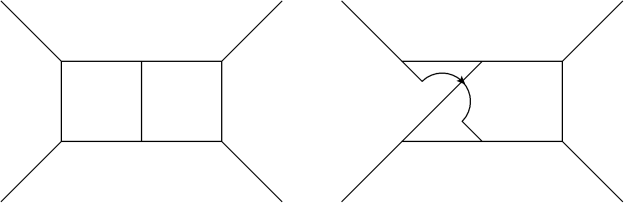
Suppose you’re working with a Yang-Mills theory (not necessarily N=4 super Yang-Mills. To show you the difference between planar and non-planar, I’ll draw some two-loop Feynman diagrams for a process where two particles go in and two particles come out:

planarity1

The diagram on your left is planar, while the diagram on your right is non-planar. The diagram on the left can be written entirely on a flat page (or screen), with no tricks. By contrast, with the diagram on the right I have to cheat and make one of the particle lines jump over another one (that’s what the arrow is meant to show). Try as you might, you can’t twist that diagram so that it lies flat on a plane (at least not while keeping the same particles going in and out). That’s the difference between planar and non-planar.

Now, what does it mean for a theory to be planar or non-planar?

Let’s review some facts about Yang-Mills theories. (For a more detailed explanation, see here). In Yang-Mills there are a certain number of colors, where each one works a bit like a different kind of electric charge. The strong force, the force that holds protons and neutrons together, has three colors, usually referred to as red, blue, and green (this is of course just jargon, not the literal color of the particles).

Forces give rise to particles. In the case of the strong force, those particles are called gluons. Each gluon has a color and an anti-color, where you can think of the color like a positive charge and the anti-color like a negative charge. A given gluon might be red-antiblue, or green-antired, or even red-antired.

While the strong force has three colors, for this article it will be convenient to pretend that there are four: red, green, blue, and yellow.

An important principle of Yang-Mills theories is that color must be conserved. Since anti-colors are like negative colors, they can cancel normal colors out. So if you’ve got a red-antiblue gluon that collides with a blue-antigreen gluon, the blue and antiblue can cancel each other out, and you can end up with, for example, red-antiyellow and yellow-antigreen instead.

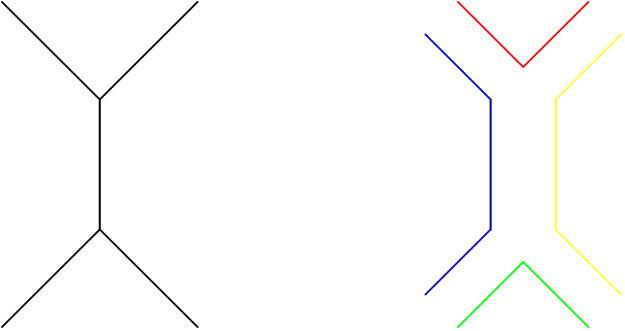
Let’s consider that process in particular. There are lots of Feynman diagrams you can draw for it, let’s draw one of the simplest ones first:

planarity2

The diagram on the left just shows the process in terms of the particles involved: two gluons go in, two come out.

The other diagram takes into account conservation of colors. The red from the red-antiblue gluon becomes the red in the red-antiyellow gluon on the other side. The antiblue instead goes down and meets the blue from the blue-antigreen gluon, and both vanish in the middle, cancelling each other out. It’s as if the blue color entered the diagram, then turned around backwards and left it again. (If you’ve ever heard someone make the crazy-sounding claim that antimatter is normal matter going backwards in time, this is roughly what they mean.)

From this diagram, we can start observing a general principle: to make sure that color is conserved, each line must have only one color.

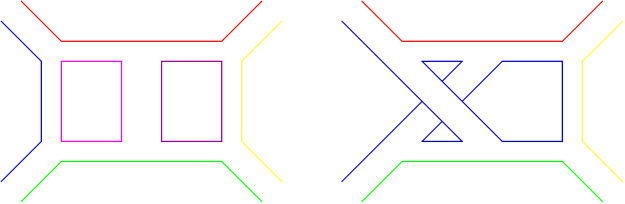
Now let’s try to apply this principle to the two-loop diagrams from the beginning of the article. If you draw double lines like we did in the last example, fill in the colors, and work things out, this is what you get:

planarity3

What’s going on here?

In the diagram on the left, you see the same lines as the earlier diagram on the outside. On the inside, though, I’ve drawn two loops of color, purple and pink.

I drew the lines that way because, just based on the external lines, you don’t know what color they should be. They could be red, or yellow, or green, or blue. Nothing tells you which one is right, so all of them are possible.

Remember that for Feynman diagrams, we need to add up every diagram we can draw to get the final result. That means that there are actually four times four or sixteen copies of this diagram, each one with different colors in the loops.

Now let’s look at the other diagram. Like the first one, it’s a diagram with two loops. However, in this case, the inside of both loops is blue. If you like, you can try to trace out the lines in the loops. You’ll find that they’re all connected together. Because this diagram is non-planar, color conservation fixes the color in the loops.

So while there are sixteen copies of the first diagram, there is only one possible version of the second one. Since you add all the diagrams together, that means that the first diagram is sixteen times more important than the second diagram.

Now suppose we had more than four colors. Lots more.

More than that…

With ten colors, the planar diagrams are a hundred times more important. With a hundred colors, they are ten thousand times more important. Keep increasing the number of colors, and it gets to the point where you can honestly say that the non-planar diagrams don’t matter at all.

What, then, is a “planar theory”?

A planar theory is a theory with a very large (infinite) number of colors.

In a planar theory, you can ignore the non-planar diagrams and focus only on the planar ones.

Nima Arkani-Hamed’s Amplituhedron method applies to the planar version of N=4 super Yang-Mills. There is a lot of progress on the planar version of the theory, and it is because the restriction to planar diagrams makes things simpler.

However, sometimes you need to go beyond planar diagrams. There are relationships between planar and non-planar diagrams, based on the ways that you can pair different colors together in the theory. Fully understanding this relationship is powerful for understanding Yang-Mills theory, but, as it turns out, it’s also the key to relating Yang-Mills theory to gravity! But that’s a story for another post.