Tag Archives: PublicPerception

Insert Muscle Joke Here

I’m graduating this week, so I probably shouldn’t spend too much time writing this post. I ought to mention, though, that there has been some doubt about the recent discovery by the BICEP2 telescope of evidence for gravitational waves in the cosmic microwave background caused by the early inflation of the universe. Résonaances got to the story first and Of Particular Significance has some good coverage that should be understandable to a wide audience.

In brief, the worry is that the signal detected by BICEP2 might not be caused by inflation, but instead by interstellar dust. While the BICEP2 team used several models of dust to show that it should be negligible, the controversy centers around one of these models in particular, one taken from another, similar experiment called PLANCK.

The problem is, BICEP2 didn’t get PLANCK’s information on dust directly. Instead, it appears they took the data from a slide in a talk by the PLANCK team. This process, known as “data scraping”, involves taking published copies of the slides and reading information off of the charts presented. If BICEP2 misinterpreted the slide, they might have miscalculated the contribution by interstellar dust.

If you’re like me, the whole idea of data scraping seems completely ludicrous. The idea of professional scientists sneaking information off of a presentation, rather than simply asking the other team for data like reasonable human beings, feels almost cartoonishly wrong-headed.

It’s a bit more understandable, though, when you think about the culture behind these big experiments. The PLANCK and BICEP2 teams are colleagues, but they are also competitors. There is an enormous amount of glory in finding evidence for something like cosmic inflation first, and an equally enormous amount of shame in screwing up and announcing something that turns out to be wrong. As such, these experiments are quite protective of their data. Not only might someone with early access to the data preempt them on an important discovery, they might rush to publish a conclusion that is wrong. That’s why most of these big experiments spend a large amount of time checking and re-checking the data, communicating amongst themselves and settling on an interpretation before they feel comfortable releasing it to the wider community. It’s why BICEP2 couldn’t just ask PLANCK for their data.

From BICEP2’s perspective, they can expect that plots presented at a talk by PLANCK should be accurate, digital plots. Unlike Fox News, scientists have an obligation to present their data in a way that isn’t misleading. And while relying on such a dubious source seems like a bad idea, by all accounts that’s not what the BICEP2 team did. PLANCK’s data was just one dust model used by the team, kept in part because it agreed well with other, non-“data-scraped” models.

It’s a shame that these experiments are so large and prestigious that they need to guard their data in such a potentially destructive way. My sub-field is generally much nicer about this sort of thing: the stakes are lower, and the groups are smaller and have less media attention, so we’re able to share data when we need to. In fact, my most recent paper got a significant boost from some data shared by folks at the Perimeter Institute.

Only time will tell whether the BICEP2 result wins out, or whether it was a fluke caused by caustic data-sharing practices. A number of other experiments are coming online within the next year, and one of them may confirm or deny what BICEP2 has showed.

Look what I made!

In a few weeks, I’ll be giving a talk for Stony Brook’s Graduate Awards Colloquium, to an audience of social science grad students and their parents.

One of the most useful tools when talking to people in other fields is a shared image. You want something from your field that they’ve seen, that they’re used to, that they’ll recognize. Building off of that kind of thing can be a great way to communicate.

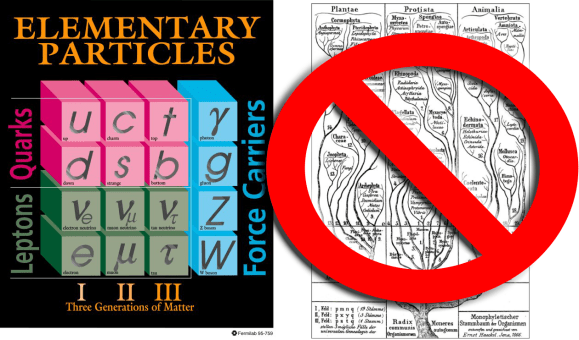
If there’s one particle physics image that lots and lots of people have seen, it’s the Standard Model. Generally, it’s organized into charts like this:

Standard_Model_of_Elementary_Particles

I thought that if people saw a chart like that, but for N=4 super Yang-Mills, it might make the theory seem a bit more familiar. N=4 super Yang-Mills has a particle much like the Standard Model’s gluon with spin 1, paired with four gluinos, particles that are sort of but not really like quarks with spin 1/2, and six scalars, particles whose closest analogue in the Standard Model is the Higgs with spin 0.

In N=4 super Yang-Mills, none of these particles have any mass, since if supersymmetry isn’t “broken” all particles have the same mass. So where mass is written in the Standard Model table, I can just put zero. The table I linked also gives the electric charge of each particle. That doesn’t really mean anything for N=4 super Yang-Mills. It isn’t a theory that tries to describe the real world, so there’s no direct equivalent to a real-world force like electromagnetism. Since everything in the theory has to have the same charge, again due to supersymmetry, I can just list all of their “electric charges” as zero.

Putting it all together, I get the diagram below. The theory has eleven particles in total, so it won’t fit into a nice neat square. Still, this should be more familiar than most of the ways I could present things.

N4SYMParticleContent

Particles are not Species

It has been estimated that there are 7.5 million undiscovered species of animals, plants and fungi. Most of these species are insects. If someone wanted billions of dollars to search the Amazon rainforest with the goal of cataloging every species of insect, you’d want them to have a pretty good reason. Maybe they are searching for genes that could cure diseases, or trying to understand why an ecosystem is dying.

The primary goal of the Large Hadron Collider is to search for new subatomic particles. If we’re spending billions searching for these things, they must have some use, right? After all, it’s all well and good knowing about a bunch of different particles, but there must be a whole lot of sorts of particles out there, at least if you judge by science fiction (these two are also relevant). Surely we could just focus on finding the useful ones, and ignore the rest?

The thing is, particle physics isn’t like that. Particles aren’t like insects, you don’t find rare new types scattered in out-of-the-way locations. That’s because each type of particle isn’t like a species of animal. Instead, each particle is a fundamental law of nature.

Move over Linnaeus.

Move over Linnaeus.

It wasn’t always like this. In the late 50’s and early 60’s, particle accelerators were producing a zoo of new particles with no clear rhyme or reason, and it looked like they would just keep producing more. That impression changed when Murray Gell-Mann proposed his Eightfold Way, which led to the development of the quark model. He explained the mess of new particles in terms of a few fundamental particles, the quarks, which made up the more complicated particles that were being discovered.

Nowadays, the particles that we’re trying to discover aren’t, for the most part, the zoo of particles of yesteryear. Instead, we’re looking for new fundamental particles.

What makes a particle fundamental?

The new particles of the early 60’s were a direct consequence of the existence of quarks. Once you understood how quarks worked, you could calculate the properties of all of the new particles, and even predict ones that hadn’t been found yet.

By contrast, fundamental particles aren’t based on any other particles, and you can’t predict everything about them. When we discover a new fundamental particle like the Higgs boson, we’re discovering a new, independent law of nature. Each fundamental particle is a law that states, across all of space and time, “if this happens, make this particle”. It’s a law that holds true always and everywhere, regardless of how often the particle is actually produced.

Think about the laws of physics like the cockpit of a plane. In front of the pilot is a whole mess of controls, dials and switches and buttons. Some of those controls are used every flight, some much more rarely. There are probably buttons on that plane that have never been used. But if a single button is out of order, the plane can’t take off.

Each fundamental particle is like a button on that plane. Some turn “on” all the time, while some only turn “on” in special circumstances. But each button is there all the same, and if you’re missing one, your theory is incomplete. It may agree with experiments now, but eventually you’re going to run into problems of one sort or another that make your theory inconsistent.

The point of discovering new particles isn’t just to find the one that will give us time travel or let us blow up Vulcan. Technological applications would be nice, but the real point is deeper: we want to know how reality works, and for every new fundamental particle we discover, we’ve found out a fact that’s true about the whole universe.

The Four Ways Physicists Name Things

If you’re a biologist and you discover a new animal, you’ve always got Latin to fall back on. If you’re an astronomer, you can describe what you see. But if you’re a physicist, your only option appears to involve falling back on one of a few terrible habits.

The most reasonable option is just to name it after a person. Yang-Mills and the Higgs Boson may sound silly at first, but once you know the stories of C. N. Yang, Robert Mills, Peter Higgs and Satyendra Nath Bose you start appreciating what the names mean. While this is usually the most elegant option, the increasingly collaborative nature of physics means that many things have to be named with a series of initials, like ABJM, BCJ and KKLT.

A bit worse is the tendency to just give it the laziest name possible. What do you call the particles that “glue” protons and neutrons together? Why gluons, of course, yuk yuk yuk!

This is particularly common when it comes to supersymmetry, where putting the word “super” in front of something almost always works. If that fails, it’s time to go for more specific conventions: to find the partner of an existing particle, if the new particle is a boson, just add “s-” for “super”“scalar” apparently to the name. This creates perfectly respectable names like stau, sneutrino, and selectron. If the new particle is a fermion, instead you add “-ino” to the end, getting something like a gluino if you start with a gluon. If you’ve heard of neutrinos, you may know that neutrino means “little neutral one”. You might perfectly rationally expect that gluino means “little gluon”, if you had any belief that physicists name things logically. We don’t. A gluino is called a gluino because it’s a fermion, and neutrinos are fermions, and the physicists who named it were too lazy to check what “neutrino” actually means.

Pictured: the superpartner of Nidoran?

Worse still are names that are obscure references and bad jokes. These are mercifully rare, and at least memorable when they occur. In quantum mechanics, you write down probabilities using brackets of two quantum states, \langle a | b\rangle. What if you need to separate the two states, \langle a| and |b\rangle? Then you’ve got a “bra” and a “ket”!

Or have you heard the story of how quarks were named? Quarks, for those of you unfamiliar with them, are found in protons and neutrons in groups of three. Murray Gell-Mann, one of the two people who first proposed the existence of quarks, got their name from Finnegan’s Wake, a novel by James Joyce, which at one point calls for “Three quarks for Muster Mark!” While this may at first sound like a heartwarming tale of respect for the literary classics, it should be kept in mind that a) Finnegan’s Wake is a novel composed almost entirely of gibberish, read almost exclusively by people who pretend to understand it to seem intelligent and b) this isn’t exactly the most important or memorable line in the book. So Gell-Mann wasn’t so much paying homage to a timeless work of literature as he was referencing the most mind-numbingly obscure piece of nerd trivia before the invention of Mara Jade. Luckily these days we have better ways to remember the name.

Albeit wrinklier ways.

The final, worst category, though, don’t even have good stories going for them. They are the names that tell you absolutely nothing about the thing they are naming.

Probably the worst examples of this from my experience are the a-theorem and the c-theorem. In both cases, a theory happened to have a parameter in it labeled by a letter. When a theorem was proven about that parameter, rather than giving it a name that told you anything at all about what it was, people just called it by the name of the parameter. Mathematics is full of names like this too. Without checking Wikipedia, what’s the difference between a set, a group, and a category? What the heck is a scheme?

If you ever have to name something, be safe and name it after a person. If you don’t, just try to avoid falling into these bad habits of physics naming.

Flexing the BICEP2 Results

The physicsverse has been abuzz this week with news of the BICEP2 experiment’s observations of B-mode polarization in the Cosmic Microwave Background.

There are lots of good sources on this, and it’s not really my field, so I’m just going to give a quick summary before talking about a few aspects I find interesting.

BICEP2 is a telescope in Antarctica that observes the Cosmic Microwave Background, light left over from the first time that the universe was clear enough for light to travel. (If you’re interested in a background on what we know about how the universe began, Of Particular Significance has an article here that should be fairly detailed, and I have a take on some more speculative aspects here.) Earlier experiments that observed the Cosmic Microwave Background discovered a surprising amount of uniformity. This led to the proposal of a concept called inflation: the idea that at some point the early universe expanded exponentially, smearing any non-uniformities across the sky and smoothing everything out. Since the rate the universe expands is a number, if that number is to vary it naturally should be a scalar field, which in this case is called the inflaton.

During inflation, distances themselves get stretched out. Think about inflation like enlarging an image. As you’ve probably noticed (maybe even in early posts on this blog), enlarging an image doesn’t always work out well. The resulting image is often pixelated or distorted. Some of the distortion comes from glitches in the program that enlarges the image, while some of it is just what happens when the pixels of the original image get enlarged to the point that you can see them.

Enlarging the Cosmic Microwave Background

Quantum fluctuations in the inflaton field itself are the glitches in the program, enlarging some areas more than others. The pattern they create in the Cosmic Microwave Background is called E-mode polarization, and several other experiments have been able to detect it.

Much weaker are the effect of the “pixels” of the original image. Since the original image is spacetime itself, the pixels are the quantum fluctuations of spacetime: quantum gravity waves. Inflation enlarged them to the point that they were visible on a large-distance scale, fundamental non-uniformity in the world blown up big enough to affect the distribution of light. The effect this had on light is detectably different: it’s called B-mode polarization, and this is the first experiment to detect it on the right scale for it to be caused by gravity waves.

Measuring this polarization, in particular how strong it is, tells us a lot about how inflation occurred. It’s enough to rule out several models, and lend support to several others. If the results are corroborated this will be real, useful evidence, the sort physicists love to get, and folks are happily crunching numbers on it all over the world.

All that said, this site is called four gravitons and a grad student, and I’m betting that some of you want to ask this grad student: is this evidence for gravitons, or for gravity waves?

Sort of.

We already had good indirect evidence for gravity waves: pairs of neutron stars release gravity waves as they orbit each other, which causes them to slow down. Since we’ve observed them slowing down at the right rates, we were already confident gravity waves exist. And if you’ve got gravity waves, gravitons follow as a natural consequence of quantum mechanics.

The data from BICEP2 is also indirect. The gravity waves “observed” by BICEP2 were present in the early universe. It is their effect on the light that would become the Cosmic Microwave Background that is being observed, not the gravity waves directly. We still have yet to directly detect gravity waves, with a gravity telescope like LIGO.

On the other hand, a “gravity telescope” isn’t exactly direct either. In order to detect gravity waves, LIGO and other gravity telescopes attempt to measure their effect on the distances between objects. How do they do that? By looking at interference patterns of light.

In both cases, we’re looking at light, present in the environment of a gravity wave, and examining its properties. Of course, in a gravity telescope the light is from a nearby environment under tight control, while the Cosmic Microwave Background is light from as far away and long ago as anything within the reach of science today. In both cases, though, it’s not nearly as simple as “observing” an effect. “Seeing” anything in high energy physics or astrophysics is always a matter of interpreting data based on science we already know.

Alright, that’s evidence for gravity waves. Does that mean evidence for gravitons?

I’ve seen a few people describe BICEP2’s results as evidence for quantum gravity/quantum gravity effects. I felt a little uncomfortable with that claim, so I asked Matt Strassler what he thought. I think his perspective on this is the right one. Quantum gravity is just what happens when gravity exists in a quantum world. As I’ve said on this site before, quantum gravity is easy. The hard part is making a theory of quantum gravity that has real predictive power, and that’s something these results don’t shed any light on at all.

That said, I’m a bit conflicted. They really are seeing a quantum effect in gravity, and as far as I’m aware this really is the first time such an effect has been observed. Gravity is so weak, and quantum gravity effects so small, that it takes inflation blowing them up across the sky for them to be visible. Now, I don’t think there was anyone out there who thought gravity didn’t have quantum fluctuations (or at least, anyone with a serious scientific case). But seeing into a new regime, even if it doesn’t tell us much…that’s important, isn’t it? (After writing this, I read Matt Strassler’s more recent post, where he has a paragraph professing similar sentiments).

On yet another hand, I’ve heard it asserted in another context that loop quantum gravity researchers don’t know how to get gravitons. I know nothing about the technical details of loop quantum gravity, so I don’t know if that actually has any relevance here…but it does amuse me.

Why we Physics

There are a lot of good reasons to study theories in theoretical physics, even the ones that aren’t true. They teach us how to do calculations in other theories, including those that do describe reality, which lets us find out fundamental facts about nature. They let us hone our techniques, developing novel methods that often find use later, in some cases even spinoff technology. (Mathematica came out of the theoretical physics community, while experimental high energy physics led to the birth of the modern internet.)

Of course, none of this is why physicists actually do physics. Sure, Nima Arkani-Hamed might need to tell himself that space-time is doomed to get up in the morning, but for a lot of us, it isn’t about proving any wide-ranging point about the universe. It’s not even all about the awesome, as some would have it: most of what we do on a day-to-day basis isn’t especially awesome. It goes a bit deeper than that.

Science, in the end, is about solving puzzles. And solving puzzles is immensely satisfying, on a deep, fundamental level.

There’s a unique feeling that you get when all the pieces come together, when you’re calculating something and everything cancels and you’re left with a simple answer, and for some people that’s the best thing in existence.

It’s especially true when you’re working with an ansatz or using some other method where you fix parameters and fill in uncertainties, one by one. You can see how close you are to the answer, which means each step gives you that little thrill of getting just that much closer. One of my colleagues describes the calculations he does in supergravity as not tedious but “delightful” for precisely this reason: a calculation where every step puts another piece in the right place just feels good.

Theoretical physicists are the kind of people who would get a Lego set for their birthday, build it up to completion, and then never play with it again (unless it was to take it apart and make something else). We do it for the pure joy of seeing something come together and become complete. Save what it’s “for” for the grant committees, we’ve got a different rush in mind.

Editors, Please Stop Misquoting Hawking

If you’ve been following science news recently, you’ve probably heard the apparently alarming news that Steven Hawking has turned his back on black holes, or that black holes can actually be escaped, or…how about I just show you some headlines:

FoxHawking

NatureHawking

YahooHawking

Now, Hawking didn’t actually say that black holes don’t exist, but while there are a few good pieces on the topic, in many cases the real message has gotten lost in the noise.

From Hawking’s paper:

ActualPaperHawking

What Hawking is proposing is that the “event horizon” around a black hole, rather than being an absolute permanent boundary from which nothing can escape, is a more temporary “apparent” horizon, the properties of which he goes on to describe in detail.

Why is he proposing this? It all has to do with the debate over black hole firewalls.

Starting with a paper by Polchinski and colleagues a year and a half ago, the black hole firewall paradox centers on contradictory predictions from general relativity and quantum mechanics. General relativity predicts that an astronaut falling past a black hole’s event horizon will notice nothing particularly odd about the surrounding space, but that once past the event horizon none of the “information” that specifies the astronaut’s properties can escape to the outside world. Quantum mechanics on the other hand predicts that information cannot be truly lost. The combination appears to suggest something radical, a “firewall” of high energy radiation around the event horizon carrying information from everything that fell into the black hole in the past, so powerful that it would burn our hypothetical astronaut to a crisp.

Since then, a wide variety of people have made one proposal or another, either attempting to avoid the seemingly preposterous firewall or to justify and further explain it. The reason the debate is so popular is because it touches on some of the fundamental principles of quantum mechanics.

Now, as I have pointed out before, I’m not a good person to ask about the fundamental principles of quantum mechanics. (Incidentally, I’d love it if some of the more quantum information or general relativity-focused bloggers would take a more substantial crack at this! Carroll, Preskill, anyone?) What I can talk about, though, is hype.

All of the headlines I listed take Hawking’s quote out of context, but not all of the articles do. The problem isn’t so much the journalists, as the editors.

One of an editor’s responsibilities is to take articles and give them titles that draw in readers. The editor wants a title that will get people excited, make them curious, and most importantly, get them to click. While a journalist won’t have any particular incentive to improve ad revenue, the same cannot be said for an editor. Thus, editors will often rephrase the title of an article in a way that makes the whole story seem more shocking.

Now that, in itself, isn’t a problem. I’ve used titles like that myself. The problem comes when the title isn’t just shocking, but misleading.

When I call astrophysics “impossible”, nobody is going to think I mean it literally. The title is petulant and ridiculous enough that no-one would take it at face value, but still odd enough to make people curious. By contrast, when you say that Hawking has “changed his mind” about black holes or said that “black holes do not exist”, there are people who will take that at face value as supporting their existing beliefs, as the Borowitz Report humorously points out. These people will go off thinking that Hawking really has given up on black holes. If the title confirms their beliefs enough, people might not even bother to read the article. Thus, by using an actively misleading title, you may actually be decreasing clicks!

It’s not that hard to write a title that’s both enough of a hook to draw people in and won’t mislead. Editors of the world, you’re well-trained writers, certainly much better than me. I’m sure you can manage it.

There really is some interesting news here, if people had bothered to look into it. The firewall debate has been going on for a year and a half, and while Hawking isn’t the universal genius the media occasionally depicts he’s still the world’s foremost expert on the quantum properties of black holes. Why did he take so long to weigh in? Is what he’s proposing even particularly new? I seem to remember people discussing eliminating the horizon in one way or another (even “naked” singularities) much earlier in the firewall debate…what makes Hawking’s proposal novel and different?

This is the sort of thing you can use to draw in interest, editors of the world. Don’t just write titles that cause ignorant people to roll their eyes and move on, instead, get people curious about what’s really going on in science! More ad revenue for you, more science awareness for us, sounds like a win-win!

How (Not) to Sum the Natural Numbers: Zeta Function Regularization

1+2+3+4+5+6+\ldots=-\frac{1}{12}

If you follow Numberphile on YouTube or Bad Astronomy on Slate you’ve already seen this counter-intuitive sum written out. Similarly, if you follow those people or Sciencetopia’s Good Math, Bad Math, you’re aware that the way that sum was presented by Numberphile in that video was seriously flawed.

There is a real sense in which adding up all of the natural numbers (numbers 1, 2, 3…) really does give you minus twelve, despite all the reasons this should be impossible. However, there is also a real sense in which it does not, and cannot, do any such thing. To explain this, I’m going to introduce two concepts: complex analysis and regularization.

This discussion is not going to be mathematically rigorous, but it should give an authentic and accurate view of where these results come from. If you’re interested in the full mathematical details, a later discussion by Numberphile should help, and the mathematically confident should read Terence Tao’s treatment from back in 2010.

With that said, let’s talk about sums! Well, one sum in particular:

\frac{1}{1^s}+\frac{1}{2^s}+\frac{1}{3^s}+\frac{1}{4^s}+\frac{1}{5^s}+\frac{1}{6^s}+\ldots = \zeta(s)

If s is greater than one, then each term in this infinite sum gets smaller and smaller fast enough that you can add them all up and get a number. That number is referred to as \zeta(s), the Riemann Zeta Function.

So what if s is smaller than one?

The infinite sum that I described doesn’t converge for s less than one. Add it up in any reasonable way, and it just approaches infinity. Put another way, the sum is not properly defined. But despite this, \zeta(s) is not infinite for s less than one!

Now as you might object, we only defined the Riemann Zeta Function for s greater than one. How do we know anything at all about it for s less than one?

That is where complex analysis comes in. Complex analysis sounds like a made-up term for something unreasonably complicated, but it’s quite a bit more approachable when you know what it means. Analysis is the type of mathematics that deals with functions, infinite series, and the basis of calculus. It’s often contrasted with Algebra, which usually considers mathematical concepts that are discrete rather than smooth (this definition is a huge simplification, but it’s not very relevant to this post). Complex means that complex analysis deals with functions, not of everyday real numbers, but of complex numbers, or numbers with an imaginary part.

So what does complex analysis say about the Riemann Zeta Function?

One of the most impressive results of complex analysis is the discovery that if a function of a complex number is sufficiently smooth (the technical term is analytic) then it is very highly constrained. In particular, if you know how the function behaves over an area (technical term: open set), then you know how it behaves everywhere else!

If you’re expecting me to explain why this is true, you’ll be disappointed. This is serious mathematics, and serious mathematics isn’t the sort of thing you can give the derivation for in a few lines. It takes as much effort and knowledge to replicate a mathematical result as it does to replicate many lab results in science.

What I can tell you is that this sort of approach crops up in many places, and is part of a general theme. There is a lot you can tell about a mathematical function just by looking at its behavior in some limited area, because mathematics is often much more constrained than it appears. It’s the same sort of principle behind the work I’ve been doing recently.

In the case of the Riemann Zeta Function, we have a definition for s greater than one. As it turns out, this definition still works if s is a complex number, as long as the real part of s is greater than one. Using this information, the value of the Riemann Zeta Function for a large area (half of the complex numbers), complex analysis tells us its value for every other number. In particular, it tells us this:

\zeta(-1)= -\frac{1}{12}

If the Riemann Zeta Function is consistently defined for every complex number, then it must have this value when s is minus one.

If we still trusted the sum definition for this value of s, we could plug in -1 and get

 1+2+3+4+5+6+\ldots=-\frac{1}{12}

Does that make this statement true? Sort of. It all boils down to a concept from physics called regularization.

In physics, we know that in general there is no such thing as infinity. With a few exceptions, nothing in nature should be infinite, and finite evidence (without mathematical trickery) should never lead us to an infinite conclusion.

Despite this, occasionally calculations in physics will give infinite results. Almost always, this is evidence that we are doing something wrong: we are not thinking hard enough about what’s really going on, or there is something we don’t know or aren’t taking into account.

Doing physics research isn’t like taking a physics class: sometimes, nobody knows how to do the problem correctly! In many cases where we find infinities, we don’t know enough about “what’s really going on” to correct them. That’s where regularization comes in handy.

Regularization is the process by which an infinite result is replaced with a finite result (made “regular”), in a way so that it keeps the same properties. These finite results can then be used to do calculations and make predictions, and so long as the final predictions are regularization independent (that is, the same if you had done a different regularization trick instead) then they are legitimate.

In string theory, one way to compute the required dimensions of space and time ends up giving you an infinite sum, a sum that goes 1+2+3+4+5+…. In context, this result is obviously wrong, so we regularize it. In particular, we say that what we’re really calculating is the Riemann Zeta Function, which we happen to be evaluating at -1. Then we replace 1+2+3+4+5+… with -1/12.

Now remember when I said that getting infinities is a sign that you’re doing something wrong? These days, we have a more rigorous way to do this same calculation in string theory, one that never forces us to take an infinite sum. As expected, it gives the same result as the old method, showing that the old calculation was indeed regularization independent.

Sometimes we don’t have a better way of doing the calculation, and that’s when regularization techniques come in most handy. A particular family of tricks called renormalization is quite important, and I’ll almost certainly discuss it in a future post.

So can you really add up all the natural numbers and get -1/12? No. But if a calculation tells you to add up all the natural numbers, and it’s obvious that the result can’t be infinite, then it may secretly be asking you to calculate the Riemann Zeta Function at -1. And that, as we know from complex analysis, is indeed -1/12.

Astrophysics, the Impossible Science

Last week, Nobel Laureate Martinus Veltman gave a talk at the Simons Center. After the talk, a number of people asked him questions about several things he didn’t know much about, including supersymmetry and dark matter. After deflecting a few such questions, he proceeded to go on a brief rant against astrophysics, professing suspicion of the field’s inability to do experiments and making fun of an astrophysicist colleague’s imprecise data. The rant was a rather memorable feat of curmudgeonliness, and apparently typical Veltman behavior. It left several of my astrophysicist friends fuming. For my part, it inspired me to write a positive piece on astrophysics, highlighting something I don’t think is brought up enough.

The thing about astrophysics, see, is that astrophysics is impossible.

Imagine, if you will, an astrophysical object. As an example, picture a black hole swallowing a star.

Are you picturing it?

Now think about where you’re looking from. Chances are, you’re at some point up above the black hole, watching the star swirl around, seeing something like this:

Where are you in this situation? On a spaceship? Looking through a camera on some probe?

Astrophysicists don’t have spaceships that can go visit black holes. Even the longest-ranging probes have barely left the solar system. If an astrophysicist wants to study a black hole swallowing a star, they can’t just look at a view like that. Instead, they look at something like this:

The image on the right is an artist’s idea of what a black hole looks like. The three on the left? They’re what the astrophysicist actually sees. And even that is cleaned up a bit, the raw output can be even more opaque.

A black hole swallowing a star? Just a few blobs of light, pixels on screen. You can measure brightness and dimness, filter by color from gamma rays to radio waves, and watch how things change with time. You don’t even get a whole lot of pixels for distant objects. You can’t do experiments, either, you just have to wait for something interesting to happen and try to learn from the results.

It’s like staring at the static on a TV screen, day after day, looking for patterns, until you map out worlds and chart out new laws of physics and infer a space orders of magnitude larger than anything anyone’s ever experienced.

And naively, that’s just completely and utterly impossible.

And yet…and yet…and yet…it works!

Crazy people staring at a screen can’t successfully make predictions about what another part of the screen will look like. They can’t compare results and hone their findings. They can’t demonstrate principles (like General Relativity) that change technology here on Earth. Astrophysics builds on itself, discovery by discovery, in a way that can only be explained by accepting that it really does work (a theme that I’ve had occasion to harp on before).

Physics began with astrophysics. Trying to explain the motion of dots in a telescope and objects on the ground with the same rules led to everything we now know about the world. Astrophysics is hard, arguably impossible…but impossible or not, there are people who spend their lives successfully making it work.

The Amplituhedron and Other Excellently Silly Words

Nima Arkani-Hamed recently gave a talk at the Simons Center on the topic of what he and Jaroslav Trnka are calling the Amplituhedron.

There’s an article on it in Quanta Magazine. The article starts out a bit hype-y for my taste (too much language of importance, essentially), but it has several very solid descriptions of the history of the situation. I particularly like how the author concisely describes the Feynman diagram picture in the space of a single paragraph, and I would recommend reading that part even if you don’t have time to read the whole article. In general it’s worth it to get a picture of what’s going on.

That said, I obviously think I can clear a few things up, otherwise I wouldn’t be writing about it, so here I go!

“The” Amplituhedron

Nima’s new construction, the Amplituhedron, encodes amplitudes (building blocks of probabilities in particle physics) in N=4 super Yang-Mills as the “area” of a multi-dimensional analog of a polyhedron (hence, Amplitu-hedron).

Now, I’m a big supporter of silly-sounding words with amplitu- at the beginning (amplitudeologist, anyone?), and this is no exception. Anyway, the word Amplitu-hedron isn’t what’s confusing people. What’s confusing people is the word the.

When the Quanta article says that Nima has found “the” Amplituhedron, it makes it sound like he has discovered one central formula that somehow contains the whole universe. If you read the comments, many readers went away with that impression.

In case you needed me to say it, that’s not what is going on. The problem is in the use of the word “the”.

Suppose it was 1886, and I told you that a fellow named Carl Benz had invented “the Automobile”, a marvelous machine that can get everyone to work on time (as well as become the dominant form of life on Long Island).

My use of “the” might make you imagine that Benz invented some single, giant machine that would roam across the country, picking people up and somehow transporting everyone to work. You’d be skeptical of this, of course, expecting that long queues to use this gigantic, wondrous machine would swiftly ruin any speed advantage it might possess…

The Automobile, here to take you to work.

Or, you could view “the” in another light, as indicating a type of thing.

Much like “the Automobile” is a concept, manifested in many different cars and trucks across the country, “the Amplituhedron” is a concept, manifested in many different amplituhedra, each corresponding to a particular calculation that we might attempt.

Advantages…

Each amplituhedron has to do with an amplitude involving a specific number of particles, with a particular number of internal loops. (The Quanta article has a pretty good explanation of loops, here’s mine if you’d rather read that). Based on the problem you’re trying to solve, there are a set of rules that you use to construct the particular amplituhedron you need. The “area” of this amplituhedron (in quotation marks because I mean the area in an abstract, mathematical sense) is the amplitude for the process, which lets you calculate the probability that whatever particle physics situation you’re describing will happen.

Now, we already have many methods to calculate these probabilities. The amplituhedron’s advantage is that it makes these calculations much simpler. What was once quite a laborious and complicated four-loop calculation, Nima claims can be done by hand using amplituhedra. I didn’t get a chance to ask whether the same efficiency improvement holds true at six loops, but Nima’s description made it sound like it would at least speed things up.

[Edit: Some of my fellow amplitudeologists have reminded me of two things. First, that paper I linked above paved the way to more modern methods for calculating these things, which also let you do the four-loop calculation by hand. (You need only six or so diagrams). Second, even back then the calculation wasn’t exactly “laborious”, there were some pretty slick tricks that sped things up. With that in mind, I’m not sure Nima’s method is faster per se. But it is a fast method that has the other advantages described below.]

The amplituhedron has another, more sociological advantage. By describing the amplitude in terms of a geometrical object rather than in terms of our usual terminology, we phrase things in a way that mathematicians are more likely to understand. By making things more accessible to mathematicians (and the more math-headed physicists), we invite them to help us solve our problems, so that together we can come up with more powerful methods of calculation.

Nima and the Quanta article both make a big deal about how the amplituhedron gets rid of the principles of locality and unitarity, two foundational principles of quantum field theory. I’m a bit more impressed by this than Woit is. The fine distinction that needs to be made here is that the amplituhedron isn’t simply “throwing out” locality and unitarity. Rather, it’s written in such a way that it doesn’t need locality and unitarity to function. In the end, the formulas it computes still obey both principles. Nima’s hope is that, now that we are able to write amplitudes without needing locality and unitarity, if we end up having to throw out either of those principles to make a new theory we will be able to do so. That’s legitimately quite a handy advantage to have, it just doesn’t mean that locality and unitarity must be thrown out right now.

…and Disadvantages

It’s important to remember that this whole story is limited to N=4 super Yang-Mills. Nima doesn’t know how to apply it to other theories, and nobody else seems to have any good ideas either. In addition, this only applies to the planar part of the theory. I’m not going to explain what that term means here; for now just be aware that while there are tricks that let you “square” a calculation in super Yang-Mills to get a similar calculation in quantum gravity, those tricks rely on having non-planar data, or information beyond the planar part of the theory. So at this point, this doesn’t give us any new hints about quantum gravity. It’s conceivable that physicists will find ways around both of these limits, but for now this result, though impressive, is quite limited.

Nima hasn’t found some sort of singular “jewel at the heart of physics”. Rather, he’s found a very slick, very elegant, quite efficient way to make calculations within one particular theory. This is profound, because it expresses things in terms that mathematicians can address, and because it shows that we can write down formulas without relying on what are traditionally some of the most fundamental principles of quantum field theory. Only time will tell whether Nima or others can generalize this picture, taking it beyond planar N=4 super Yang-Mills and into the tougher theories that still await this sort of understanding.