Tag Archives: mathematics

Pi in the Sky Science Journalism

You’ve probably seen it somewhere on your facebook feed, likely shared by a particularly wide-eyed friend: pi found hidden in the hydrogen atom!


FionaPi

ChoPi

OuellettePi

From the headlines, this sounds like some sort of kabbalistic nonsense, like finding the golden ratio in random pictures.

Read the actual articles, and the story is a bit more reasonable. The last two I linked above seem to be decent takes on it, they’re just saddled with ridiculous headlines. As usual, I blame the editors. This time, they’ve obscured an interesting point about the link between physics and mathematics.

So what does “pi found hidden in the hydrogen atom” actually mean?

It doesn’t mean that there’s some deep importance to the number pi in nature, beyond its relevance in mathematics in general. The reason that pi is showing up here isn’t especially deep.

It isn’t trivial either, though. I’ve seen a few people whose first response to this article was “of course they found pi in the hydrogen atom, hydrogen atoms are spherical!” That’s not what’s going on here. The connection isn’t about the shape of the hydrogen atom, it’s about one particular technique for estimating its energy.

Carl Hagen is a physicist at the University of Rochester who was teaching a quantum mechanics class in which he taught a well-known approximation technique called the variational principle. Specifically, he had his students apply this technique to the hydrogen atom. The nice thing about the hydrogen atom is that it’s one of the few atoms simple enough that it’s possible to find its energy levels exactly. The exact calculation can then be compared to the approximation.

What Hagen noticed was that this approximation was surprisingly good, especially for high energy states for which it wasn’t expected to be. In the end, working with Rochester math professor Tamar Friedmann, he figured out that the variational principle was making use of a particular identity between a type of mathematical functions, called Gamma functions, that are quite common in physics. Using those Gamma functions, the two researchers were able to re-derive what turned out to be a 17th century formula for pi, giving rise to a much cleaner proof for that formula than had been known previously.

So pi isn’t appearing here because “the hydrogen atom is a sphere”. It’s appearing because pi appears all over the place in physics, and because in general, the same sorts of structures appear again and again in mathematics.

Pi’s appearance in the hydrogen atom is thus not very special, regardless. What is a little bit special is the fact that, using the hydrogen atom, these folks were able to find a cleaner proof of an old approximation for pi, one that mathematicians hadn’t found before.

That, if anything, is the interesting part of this news story, but it’s also part of a broader trend, one in which physicists provide “physics proofs” for mathematical results. One of the more famous accomplishments of string theory is a class of “physics proofs” of this sort, using a principle called mirror symmetry.

The existence of  “physics proofs” doesn’t mean that mathematics is secretly constrained by the physical world. Rather, they’re a result of the fact that physicists are interested in different aspects of mathematics, and in general are a bit more reckless in using approximations that haven’t been mathematically vetted. A physicist can sometimes prove something in just a few lines that mathematicians would take many pages to prove, but usually they do this by invoking a structure that would take much longer for a mathematician to define. As physicists, we’re building on the shoulders of other physicists, using concepts that mathematicians usually don’t have much reason to bother with. That’s why it’s always interesting when we find something like the Amplituhedron, a clean mathematical concept hidden inside what would naively seem like a very messy construction. It’s also why “physics proofs” like this can happen: we’re dealing with things that mathematicians don’t naturally consider.

So please, ignore the pi-in-the-sky headlines. Some physicists found a trick, some mathematicians found it interesting, the hydrogen atom was (quite tangentially) involved…and no nonsense needs to be present.

Using Effective Language

Physicists like to use silly names for things, but sometimes it’s best to just use an everyday word. It can trigger useful intuitions, and it makes remembering concepts easier. What gets confusing, though, is when the everyday word you use has a meaning that’s not quite the same as the colloquial one.

“Realism” is a pretty classic example, where Bell’s elegant use of the term in quantum mechanics doesn’t quite match its common usage, leading to inevitable confusion whenever it’s brought up. “Theory” is such a useful word that multiple branches of science use it…with different meanings! In both cases, the naive meaning of the word is the basis of how it gets used scientifically…just not the full story.

There are two things to be wary of here. First, those of us who communicate science must be sure to point out when a word we use doesn’t match its everyday meaning, to guide readers’ intuitions away from first impressions to understand how the term is used in our field. Second, as a reader, you need to be on the look-out for hidden technical terms, especially when you’re reading technical work.

I remember making a particularly silly mistake along these lines. It was early on in grad school, back when I knew almost nothing about quantum field theory. One of our classes was a seminar, structured so that each student would give a talk on some topic that could be understood by the whole group. Unfortunately, some grad students with deeper backgrounds in theoretical physics hadn’t quite gotten the memo.

It was a particular phrase that set me off: “This theory isn’t an effective theory”.

My immediate response was to raise my hand. “What’s wrong with it? What about this theory makes it ineffective?”

The presenter boggled for a moment before responding. “Well, it’s complete up to high energies…it has no ultraviolet divergences…”

“Then shouldn’t that make it even more effective?”

After a bit more of this back-and-forth, we finally cleared things up. As it turns out, “effective field theory” is a technical term! An “effective field theory” is only “effectively” true, describing physics at low energies but not at high energies. As you can see, the word “effective” here is definitely pulling its weight, helping to make the concept understandable…but if you don’t recognize it as a technical term and interpret it literally, you’re going to leave everyone confused!

Over time, I’ve gotten better at identifying when something is a technical term. It really is a skill you can learn: there are different tones people use when speaking, different cadences when writing, a sense of uneasiness that can clue you in to a word being used in something other than its literal sense. Without that skill, you end up worried about mathematicians’ motives for their evil schemes. With it, you’re one step closer to what may be the most important skill in science: the ability to recognize something you don’t know yet.

Bras and Kets, Trading off Instincts

Some physics notation is a joke, but that doesn’t mean it shouldn’t be taken seriously.

Take bras and kets. On the surface, as silly a physics name as any. If you want to find the probability that a state in quantum mechanics turns into another state, you write down a “bracket” between the two states:

\langle a | b\rangle

This leads, with typical physics logic, to the notation for the individual states: separate out the two parts, into a “bra” and a “ket”:

\langle a||b\rangle

It’s kind of a dumb joke, and it annoys the heck out of mathematicians. Not for the joke, of course, mathematicians probably have worse.

Mathematicians are annoyed when we use complicated, weird notation for something that looks like a simple, universal concept. Here, we’re essentially just taking inner products of vectors, something mathematicians have been doing in one form or another for centuries. Yet rather than use their time-tested notation we use our own silly setup.

There’s a method to the madness, though. Bras and kets are handy for our purposes because they allow us to leverage one of the most powerful instincts of programmers: the need to close parentheses.

In programming, various forms of parentheses and brackets allow you to isolate parts of code for different purposes. One set of lines might only activate under certain circumstances, another set of brackets might make text bold. But in essentially every language, you never want to leave an open parenthesis. Doing so is almost always a mistake, one that leaves the rest of your code open to whatever isolated region you were trying to create.

Open parentheses make programmers nervous, and that’s exactly what “bras” and “kets” are for. As it turns out, the states represented by “bras” and “kets” are in a certain sense un-measurable: the only things we can measure are the brackets between them. When people say that in quantum mechanics we can only predict probabilities, that’s a big part of what they mean: the states themselves mean nothing without being assembled into probability-calculating brackets.

This ends up making “bras” and “kets” very useful. If you’re calculating something in the real world and your formula ends up with a free “bra” or a “ket”, you know you’ve done something wrong. Only when all of your bras and kets are assembled into brackets will you have something physically meaningful. Since most physicists have done some programming, the programmer’s instinct to always close parentheses comes to the rescue, nagging until you turn your formula into something that can be measured.

So while our notation may be weird, it does serve a purpose: it makes our instincts fit the counter-intuitive world of quantum mechanics.

Lewis Carroll, Anti-String Theorist?

You all know the real meaning of Alice in Wonderland, right?

No, I’m not talking about drugs, or darker things. I’m talking about math!

The 19th century was a time of great changes in mathematics, and Charles Dodgson, pen name Lewis Carroll, was opposed to almost all of it. A very traditional mathematician, Dodgson thought of Euclid’s Elements as the pinnacle of mathematical reasoning. Non-Euclidean geometry, symbolic algebra, complex numbers, all of these were viewed by Dodgson as nonsense, perverting students away from the study of Euclidean geometry and arithmetic, subjects that actually described the real world.

Scholars of Dodgson/Carroll’s writing have posited that the craziness of Wonderland was intended to parody the craziness Dodgson saw in mathematics. When Alice encounters the Caterpillar, she grows and shrinks non-uniformly as the Caterpillar advises her to “keep her temper”. “Temper” here refers not to anger, but to ratios between different parts: something preserved in Euclidean geometry but potentially violated by symbolic algebra. Similarly, the frantic rotations around the table by the Mad Hatter and his tea party are thought to represent imaginary numbers and quaternions, concepts used to understand rotation which had to postulate extra dimensions to do so.

Dodgson was on the wrong side of history, and today mathematics deals with even more abstract concepts. What amuses me, though, is how well Dodgson’s parodies match certain criticisms of string theory.

String theorists often study theories with two properties not found in the real world: conformal symmetry and supersymmetry.

In a theory with conformal symmetry, distances aren’t fixed. Different parts of objects can grow and shrink different amounts, and the theory will still predict the same physical behavior. The only restriction is that angles need to be preserved: two lines that meet at a given angle must meet at the same angle after transformation. In other words, keep your temper.

Alice, undergoing a conformal transformation.

I’ve talked about supersymmetry before. A supersymmetric theory can be “turned” in certain ways, related to exchanging different types of particles. If you “turn” the theory twice in the same “direction”, you get back to where you started, sort of like how if you square the imaginary number i you get back to the real number -1. Supersymmetry sees a group of particles and declares that “it’s time to change places!”

I thought the string theory skeptics among my readers might find the parallels here amusing. With parody, if not always with science, the best work was often done long, long ago.

Calculus Is About Pokemon

Occasionally, people tell me that calculus was when they really gave up on math. It’s a pity, because for me calculus was the first time math really started to become fun. After all, it’s when math introduces the Pokemon.

What Pokemon? Why, the special functions of course.

By special functions I mean things like \sin x, \cos x, e^x, and \ln x. Like Pokemon, these guys come in a bewildering variety. And in calculus, you learn that they, like Pokemon, can evolve.

x integrates into \frac{1}{2}x^2!

\frac{1}{x} integrates into \ln x!

\sin x integrates into -\cos x, and \cos x integrates into…\sin x.

Ok, the analogy isn’t perfect. Pokemon don’t evolve back into themselves. But the same things that make Pokemon so appealing are precisely why calculus was such a breath of fresh air. Suddenly, there was a grand diversity of new things, and those new things were related.

College gave me new Pokemon, in the form of the Bessel functions. Nowadays, I work with a group of functions called Polylogarithms, and they’re even more like Pokemon. Logarithms are like the baby Pokemon of the Polylogarithms, integrating into Dilogarithms. Dilogarithms integrate into Trilogarithms, and so on.

062poliwrath

Polylogarithms, in turn, evolve into Poliwrath

To this day, the talks I enjoy the most are those that show me new special functions, or new relations between old ones. If a talk shows me a new use of multiple zeta values, or new types of Polylogarithm, it’s not just teaching me new physics or mathematics: it’s expanding my Pokemon collection.

What Can Pi Do for You?

Tomorrow is Pi Day!

And what a Pi Day! 3/14/15 (if you’re in the US, Belize, Micronesia, some parts of Canada, the Philippines, or Swahili-speaking Kenya), best celebrated at 9:26:53, if you’re up by then. Grab a slice of pie, or cake if you really must, and enjoy!

If you don’t have some of your own, download this one!

Pi is great not just because it’s fun to recite digits and eat pastries, but because it serves a very important role in physics. That’s because, often, pi is one of the most “natural” ways to get larger numbers.

Suppose you’re starting with some sort of “natural” theory. Here I don’t mean natural in the technical sense. Instead, I want you to imagine a theory that has very few free parameters, a theory that is almost entirely fixed by mathematics.

Many physicists hope that the world is ultimately described by this sort of theory, but it’s hard to see in the world we live in. There are so many different numbers, from the tiny mass of the electron to the much larger mass of the top quark, that would all have to come from a simple, overarching theory. Often, it’s easier to get these numbers when they’re made out of factors of pi.

Why is pi easy to get?

In general, pi shows up a lot in physics and mathematics, and its appearance can be mysterious the uninitiated, as this joke related by Eugene Wigner in an essay I mentioned a few weeks ago demonstrates:

THERE IS A story about two friends, who were classmates in high school, talking about their jobs. One of them became a statistician and was working on population trends. He showed a reprint to his former classmate. The reprint started, as usual, with the Gaussian distribution and the statistician explained to his former classmate the meaning of the symbols for the actual population, for the average population, and so on. His classmate was a bit incredulous and was not quite sure whether the statistician was pulling his leg. “How can you know that?” was his query. “And what is this symbol here?” “Oh,” said the statistician, “this is pi.” “What is that?” “The ratio of the circumference of the circle to its diameter.” “Well, now you are pushing your joke too far,” said the classmate, “surely the population has nothing to do with the circumference of the circle.”

While it may sound silly, in a sense the population really is connected to the circumference of the circle. That’s because pi isn’t just about circles, pi is about volumes.

Take a bit to check out that link. Not just the area of a circle, but the volume of a sphere, and that of all sorts of higher-dimensional ball-shaped things, is calculated with the value of pi. It’s not just spheres, either: pi appears in the volume of many higher-dimensional shapes.

Why does this matter for physics? Because you don’t need a literal shape to get a volume. Most of the time, there aren’t literal circles and spheres giving you factors of pi…but there are abstract spaces, and they contain circles and spheres. A electric and magnetic fields might not be shaped like circles, but the mathematics that describes them can still make good use of a circular space.

That’s why, when I describe the mathematical formulas I work with, formulas that often produce factors of pi, mathematicians will often ask if they’re the volume of some particular mathematical space. It’s why Nima Arkani-Hamed is trying to understand related formulas by thinking of them as the volume of some new sort of geometrical object.

All this is not to say you should go and plug factors of pi together until you get the physical constants you want. Throw in enough factors of pi and enough other numbers and you can match current observations, sure…but you could also match anything else in the same way. Instead, it’s better to think of pi as an assistant: waiting in the wings, ready to translate a pure mathematical theory into the complicated mess of the real world.

So have a Happy Pi Day, everyone, and be grateful to our favorite transcendental number. The universe would be a much more boring place without it.

Explanations of Phenomena Are All Alike; Every Unexplained Phenomenon Is Unexplained in Its Own Way

Vladimir Kazakov began his talk at ICTP-SAIFR this week with a variant of Tolstoy’s famous opening to the novel Anna Karenina: “Happy families are all alike; every unhappy family is unhappy in its own way.” Kazakov flipped the order of the quote, stating that while “Un-solvable models are each un-solvable in their own way, solvable models are all alike.”

In talking about solvable and un-solvable models, Kazakov was referring to a concept called integrability, the idea that in certain quantum field theories it’s possible to avoid the messy approximations of perturbation theory and instead jump straight to the answer. Kazakov was observing that these integrable systems seem to have a deep kinship: the same basic methods appear to work to understand all of them.

I’d like to generalize Kazakov’s point, and talk about a broader trend in physics.

Much has been made over the years of the “unreasonable effectiveness of mathematics in the natural sciences”, most notably in physicist Eugene Wigner’s famous essay, The Unreasonable Effectiveness of Mathematics in the Natural Sciences. There’s a feeling among some people that mathematics is much better at explaining physical phenomena than one would expect, that the world appears to be “made of math” and that it didn’t have to be.

On the surface, this is a reasonable claim. Certain mathematical ideas, group theory for example, seem to pop up again and again in physics, sometimes in wildly different contexts. The history of fundamental physics has tended to see steady progress over the years, from clunkier mathematical concepts to more and more elegant ones.

Some physicists tend to be dismissive of this. Lee Smolin in particular seems to be under the impression that mathematics is just particularly good at providing useful approximations. This perspective links to his definition of mathematics as “the study of systems of evoked relationships inspired by observations of nature,” a definition to which Peter Woit vehemently objects. Woit argues what I think any mathematician would when presented by a statement like Smolin’s: that mathematics is much more than just a useful tool for approximating observations, and that contrary to physicists’ vanity most of mathematics goes on without any explicit interest in observing the natural world.

While it’s generally rude for physicists to propose definitions for mathematics, I’m going to do so anyway. I think the following definition is one mathematicians would be more comfortable with, though it may be overly broad: Mathematics is the study of simple rules with complex consequences.

We live in a complex world. The breadth of the periodic table, the vast diversity of life, the tangled webs of galaxies across the sky, these are things that display both vast variety and a sense of order. They are, in a rather direct way, the complex consequences of rules that are at heart very very simple.

Part of the wonder of modern mathematics is how interconnected it has become. Many sub-fields, once distinct, have discovered over the years that they are really studying different aspects of the same phenomena. That’s why when you see a proof of a three-hundred-year-old mathematical conjecture, it uses terms that seem to have nothing to do with the original problem. It’s why Woit, in an essay on this topic, quotes Edward Frenkel’s description of a particular recent program as a blueprint for a “Grand Unified Theory of Mathematics”. Increasingly, complex patterns are being shown to be not only consequences of simple rules, but consequences of the same simple rules.

Mathematics itself is “unreasonably effective”. That’s why, when faced with a complex world, we shouldn’t be surprised when the same simple rules pop up again and again to explain it. That’s what explaining something is: breaking down something complex into the simple rules that give rise to it. And as mathematics progresses, it becomes more and more clear that a few closely related types of simple rules lie behind any complex phenomena. While each unexplained fact about the universe may seem unexplained in its own way, as things are explained bit by bit they show just how alike they really are.

Where do you get all those mathematical toys?

I’m at a conference at Caltech this week, so it’s going to be a shorter post than usual.

The conference is on something call the Positive Grassmannian, a precursor to Nima Arkani-Hamed’s much-hyped Amplituhedron. Both are variants of a central idea: take complicated calculations in physics and express them in terms of clean, well-defined mathematical objects.

Because of this, this conference is attended not just by physicists, but by mathematicians as well, and it’s been interesting watching how the two groups interact.

From a physics perspective, mathematicians are great because they give us so many useful tools! Many significant advances in my field happened because a physicist talked to a mathematician and learned that a problem that had stymied the physics world had already been solved in the math community.

This tends to lead to certain expectations among physicists. If a mathematician gives a talk at a physics conference, we expect them to present something we can use. Our ideal math talk is like when Q presents the gadgets at the beginning of a Bond movie: a ton of new toys with just enough explanation for us to use them to save the day in the second act.

Pictured: Mathematicians, through Physicist eyes

You may see the beginning of a problem here, once you realize that physicists are the James Bond in this analogy.

Physicists like to see themselves as the protagonists of their own stories. That’s true of every field, though, to some degree or another. And it’s certainly true of mathematicians.

Mathematicians don’t go to physics conferences just to be someone’s supporting cast. They do it because physics problems are interesting to them: by hearing what physicists are working on they hope to get inspiration for new mathematical structures, concepts jury-rigged together by physicists that represent corners that mathematics hasn’t yet explored. Their goal is to take home an idea that they can turn into something productive, gaining glory among their fellow mathematicians. And if that sounds familiar…

Pictured: Physicists, through Mathematician eyes

While it’s amusing to watch the different expectations go head-to-head, the best collaborations between physicists and mathematicians are those where both sides respect that the other is the protagonist of their own story. Allow for give-and-take, paying attention not just to what you find interesting but to what the other person does, without assuming a tired old movie script, and it’s possible to make great progress.

Of course, that’s true of life in general as well.

Feeling Perturbed?

You might think of physics as the science of certainties and exact statements: action and reaction, F=ma, and all that. However, most calculations in physics aren’t exact, they’re approximations. This is especially true today, but it’s been true almost since the dawn of physics. In particular, approximations are performed via a method known as perturbation theory.

Perturbation theory is a trick used to solve problems that, for one reason or another, are too difficult to solve all in one go. It works by solving a simpler problem, then perturbing that solution, adjusting it closer to the target.

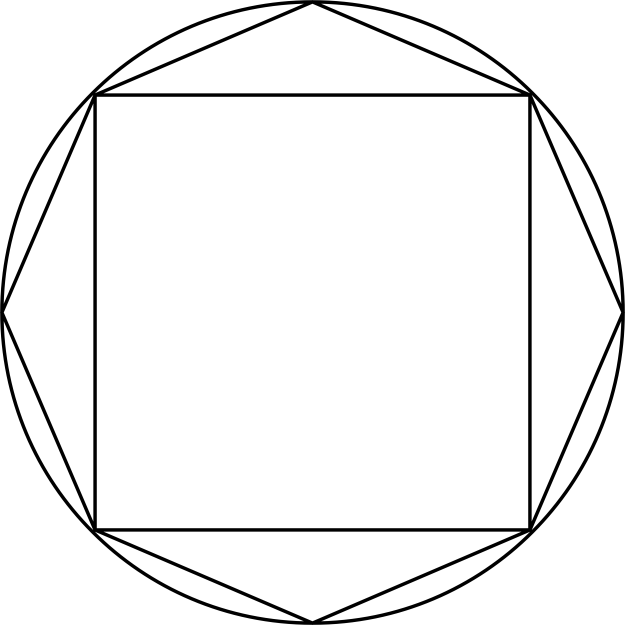
To give an analogy: let’s say you want to find the area of a circle, but you only know how to draw straight lines. You could start by drawing a square: it’s easy to find the area, and you get close to the area of the circle. But you’re still a long ways away from the total you’re aiming for. So you add more straight lines, getting an octagon. Now it’s harder to find the area, but you’re closer to the full circle. You can keep adding lines, each step getting closer and closer.

And so on.

And so on.

This, broadly speaking, is what’s going on when particle physicists talk about loops. The calculation with no loops (or “tree-level” result) is the easier problem to solve, omitting quantum effects. Each loop then is the next stage, more complicated but closer to the real total.

There are, as usual, holes in this analogy. One is that it leaves out an important aspect of perturbation theory, namely that it involves perturbing with a parameter. When that parameter is small, perturbation theory works, but as it gets larger the approximation gets worse and worse. In the case of particle physics, the parameter is the strength of the forces involves, with weaker forces (like the weak nuclear force, or electromagnetism) having better approximations than stronger forces (like the strong nuclear force). If you squint, this can still fit the analogy: different shapes might be harder to approximate than the circle, taking more sets of lines to get acceptably close.

Where the analogy fails completely, though, is when you start approaching infinity. Keep adding more lines, and you should be getting closer and closer to the circle each time. In quantum field theory, though, this frequently is not the case. As I’ve mentioned before, while lower loops keep getting closer to the true (and experimentally verified) results, going all the way out to infinite loops results not in the full circle, but in an infinite result instead. There’s an understanding of why this happens, but it does mean that perturbation theory can’t be thought of in the most intuitive way.

Almost every calculation in particle physics uses perturbation theory, which means almost always we are just approximating the real result, trying to draw a circle using straight lines. There are only a few theories where we can bypass this process and look at the full circle. These are known as integrable theories. N=4 super Yang-Mills may be among them, one of many reasons why studying it offers hope for a deeper understanding of particle physics.

Numerics, or, Why can’t you just tell the computer to do it?

When most people think of math, they think of the math they did in school: repeated arithmetic until your brain goes numb, followed by basic algebra and trig. You weren’t allowed to use calculators on most tests for the simple reason that almost everything you did could be done by a calculator in a fraction of the time.

Real math isn’t like that. Mathematicians handle proofs and abstract concepts, definitions and constructions and functions and generally not a single actual number in sight. That much, at least, shouldn’t be surprising.

What might be surprising is that even tasks which seem very much like things computers could do easily take a fair bit of human ingenuity.

In physics, I do a lot of integrals. For those of you unfamiliar with calculus, integrals can be thought of as the area between a curve and the x-axis.

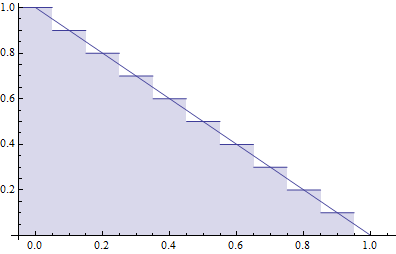
Areas seem like the sort of thing it would be easy for a computer to find. Chop the space into little rectangles, add up all the rectangles under the curve, and if your rectangles are small enough you should get the right answer. Broadly, this is the method of numerical integration. Since computers can do billions of calculations per second, you can chop things up into billions of rectangles and get as close as you’d like, right?

Heck, ten is a lot. Can we just do ten?

Heck, ten is a lot. Can we just do ten?

For some curves, this works fine. For others, though…

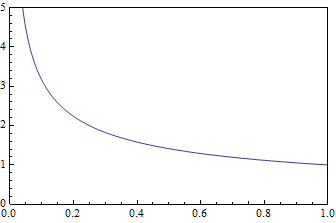
Ten might not be enough for this one.

Ten might not be enough for this one.

See how the left side of that plot goes off the chart? That curve goes to infinity. No matter how many rectangles you put on that side, you still won’t have any that are infinitely tall, so you’ll still miss that part of the curve.

Surprisingly enough, the area under this curve isn’t infinite. Do the integral correctly, and you get a result of 2. Set a computer to calculate this integral via the sort of naïve numerical integration discussed above though, and you’ll never find that answer. You need smarter methods: smart humans doing the math, or smart humans programming the computer.

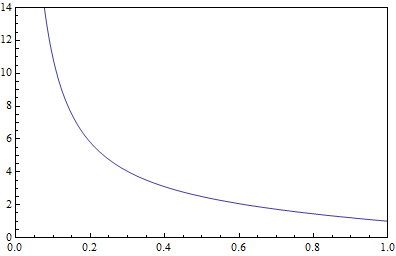
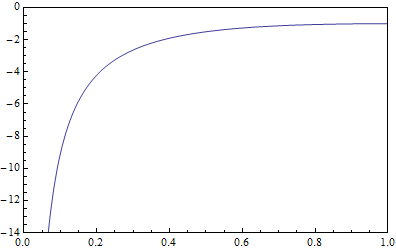
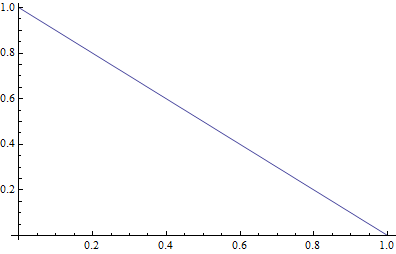
Another way this can come up is if you’re adding up two parts of something that go to infinity in opposite directions. Try to integrate each part by itself and you’ll be stuck.

firstplot

secondplot

But add them together, and you get something quite a bit more tractable.

Yeah, definitely a ten-rectangle job.

Yeah, definitely a ten-rectangle job.

Numerical integration, and computers in general, are a very important tool in a scientist’s arsenal. But in order to use them, we have to be smart, and know what we’re doing. Knowing how to use our tools right can take almost as much expertise and care as working without tools.

So no, I can’t just tell the computer to do it.