Two big physics experiments consistently make the news. The Large Hadron Collider, or LHC, and the Laser Interferometer Gravitational-Wave Observatory, or LIGO. One collides protons, the other watches colliding black holes and neutron stars. But while this may make the experiments sound quite similar, their goals couldn’t be more different.
The goal of the LHC, put simply, is to discover the rules that govern reality. Should the LHC find a new fundamental particle, it will tell us something we didn’t know about the laws of physics, a newly discovered fact that holds true everywhere in the universe. So far, it has discovered the Higgs boson, and while that particular rule was expected we didn’t know the details until they were tested. Now physicists hope to find something more, a deviation from the Standard Model that hints at a new law of nature altogether.
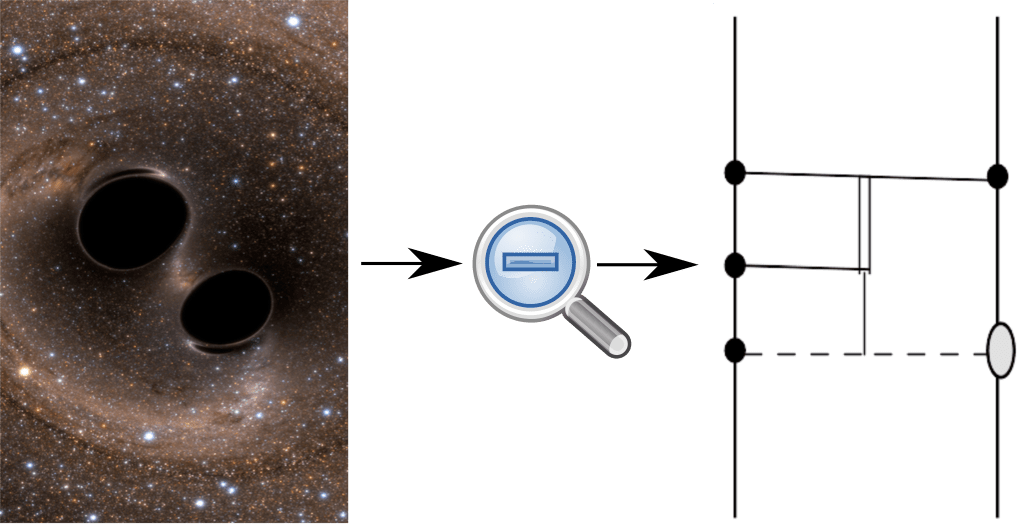
LIGO, in contrast, isn’t really for discovering the rules of the universe. Instead, it discovers the consequences of those rules, on a grand scale. Even if we knew the laws of physics completely, we can’t calculate everything from those first principles. We can simulate some things, and approximate others, but we need experiments to tweak those simulations and test those approximations. LIGO fills that role. We can try to estimate how common black holes are, and how large, but LIGO’s results were still a surprise, suggesting medium-sized black holes are more common than researchers expected. In the future, gravitational wave telescopes might discover more of these kinds of consequences, from the shape of neutron stars to the aftermath of cosmic inflation.
There are a few exceptions for both experiments. The LHC can also discover the consequences of the laws of physics, especially when those consequences are very difficult to calculate, finding complicated arrangements of known particles, like pentaquarks and glueballs. And it’s possible, though perhaps not likely, that LIGO could discover something about quantum gravity. Quantum gravity’s effects are expected to be so small that these experiments won’t see them, but some have speculated that an unusually large effect could be detected by a gravitational wave telescope.
As scientists, we want to know everything we can about everything we find. We want to know the basic laws that govern the universe, but we also want to know the consequences of those laws, the story of how our particular universe came to be the way it is today. And luckily, we have experiments for both.


 over
over  . You can write:

 , what do you know about this sum?
 and
and  and
and  , or
, or  and
and  . You could even use different letters in each term, if you wanted to. You could even just pick one term, and swap
 is zero.
 4 gravitons