Grant Roulette

Sometimes, it feels like applying for funding in science is a form of high-stakes gambling. You put in weeks of work assembling a grant application, making sure that it’s exciting and relevant and contains all the obnoxious buzzwords you’re supposed to use…and in the end, it gets approved or rejected for reasons that seem entirely out of your control.

What if, instead, you were actually gambling?

Put all my money on post-Newtonian corrections…

That’s the philosophy behind a 2016 proposal by Ferric Fang and Arturo Casadevall, recently summarized in an article on Vox by Kelsey Piper. The goal is to cut down on the time scientists waste applying for money from various government organizations (for them, the US’s National Institute of Health) by making part of the process random. Applications would be reviewed to make sure they met a minimum standard, but past that point every grant would have an equal chance of getting funded. That way scientists wouldn’t spend so much time perfecting grant applications, and could focus on the actual science.

It’s an idea that seems, on its face, a bit too cute. Yes, grant applications are exhausting, but surely you still want some way to prioritize better ideas over worse ones? For all its flaws, one would hope the grant review process at least does that.

Well, maybe not. The Vox piece argues that, at least in medicine, grants are almost random already. Each grant is usually reviewed by multiple experts. Several studies cited in the piece looked at the variability between these experts: do they usually agree, or disagree? Measuring this in a variety of ways, they came to the same conclusion: there is almost no consistency among ratings by different experts. In effect, the NIH appears to already be using a lottery, one in which grants are randomly accepted or rejected depending on who reviews them.

What encourages me about these studies is that there really is a concrete question to ask. You could argue that physics shouldn’t suffer from the same problems as medicine, that grant review is really doing good work in our field. If you want to argue that, you can test it! Look at old reviews by different people, or get researchers to do “mock reviews”, and test statistical measures like inter-rater reliability. If there really is no consistency between reviews then we have a real problem in need of fixing.

I genuinely don’t know what to expect from that kind of study in my field. But the way people talk about grants makes me suspicious. Everyone seems to feel like grant agencies are biased against their sub-field. Grant-writing advice is full of weird circumstantial tips. (“I heard so-and-so is reviewing this year, so don’t mention QCD!”) It could all be true…but it’s also the kind of superstition people come up with when they look for patterns in a random process. If all the grant-writing advice in the world boils down to “bet on red”, we might as well admit which game we’re playing.

Book Review: Thirty Years That Shook Physics and Mr Tompkins in Paperback

George Gamow was one of the “quantum kids” who got their start at the Niels Bohr Institute in the 30’s. He’s probably best known for the Alpher, Bethe, Gamow paper, which managed to combine one of the best sources of evidence we have for the Big Bang with a gratuitous Greek alphabet pun. He was the group jester in a lot of ways: the historians here have archives full of his cartoons and in-jokes.

Naturally, he also did science popularization.

I recently read two of Gamow’s science popularization books, “Mr Tompkins” and “Thirty Years That Shook Physics”. Reading them was a trip back in time, to when people thought about physics in surprisingly different ways.

“Mr. Tompkins” started as a series of articles in Discovery, a popular science magazine. They were published as a book in 1940, with a sequel in 1945 and an update in 1965. Apparently they were quite popular among a certain generation: the edition I’m reading has a foreword by Roger Penrose.

(As an aside: Gamow mentions that the editor of Discovery was C. P. Snow…that C. P. Snow?)

Mr Tompkins himself is a bank clerk who decides on a whim to go to a lecture on relativity. Unable to keep up, he falls asleep, and dreams of a world in which the speed of light is much slower than it is in our world. Bicyclists visibly redshift, and travelers lead much longer lives than those who stay at home. As the book goes on he meets the same professor again and again (eventually marrying his daughter) and sits through frequent lectures on physics, inevitably falling asleep and experiencing it first-hand: jungles where Planck’s constant is so large that tigers appear as probability clouds, micro-universes that expand and collapse in minutes, and electron societies kept strictly monogamous by “Father Paulini”.

The structure definitely feels dated, and not just because these days people don’t often go to physics lectures for fun. Gamow actually includes the full text of the lectures that send Mr Tompkins to sleep, and while they’re not quite boring enough to send the reader to sleep they are written on a higher level than the rest of the text, with more technical terms assumed. In the later additions to the book the “lecture” aspect grows: the last two chapters involve a dream of Dirac explaining antiparticles to a dolphin in basically the same way he would explain them to a human, and a discussion of mesons in a Japanese restaurant where the only fantastical element is a trio of geishas acting out pion exchange.

Some aspects of the physics will also feel strange to a modern audience. Gamow presents quantum mechanics in a way that I don’t think I’ve seen in a modern text: while modern treatments start with uncertainty and think of quantization as a consequence, Gamow starts with the idea that there is a minimum unit of action, and derives uncertainty from that. Some of the rest is simply limited by timing: quarks weren’t fully understood even by the 1965 printing, in 1945 they weren’t even a gleam in a theorist’s eye. Thus Tompkins’ professor says that protons and neutrons are really two states of the same particle and goes on to claim that “in my opinion, it is quite safe to bet your last dollar that the elementary particles of modern physics [electrons, protons/neutrons, and neutrinos] will live up to their name.” Neutrinos also have an amusing status: they hadn’t been detected when the earlier chapters were written, and they come across rather like some people write about dark matter today, as a silly theorist hypothesis that is all-too-conveniently impossible to observe.

“Thirty Years That Shook Physics”, published in 1966, is a more usual sort of popular science book, describing the history of the quantum revolution. While mostly focused on the scientific concepts, Gamow does spend some time on anecdotes about the people involved. If you’ve read much about the time period, you’ll probably recognize many of the anecdotes (for example, the Pauli Principle that a theorist can break experimental equipment just by walking in to the room, or Dirac’s “discovery” of purling), even the ones specific to Gamow have by now been spread far and wide.

Like Mr Tompkins, the level in this book is not particularly uniform. Gamow will spend a paragraph carefully defining an average, and then drop the word “electroscope” as if everyone should know what it is. The historical perspective taught me a few things I perhaps should have already known, but found surprising anyway. (The plum-pudding model was an actual mathematical model, and people calculated its consequences! Muons were originally thought to be mesons!)

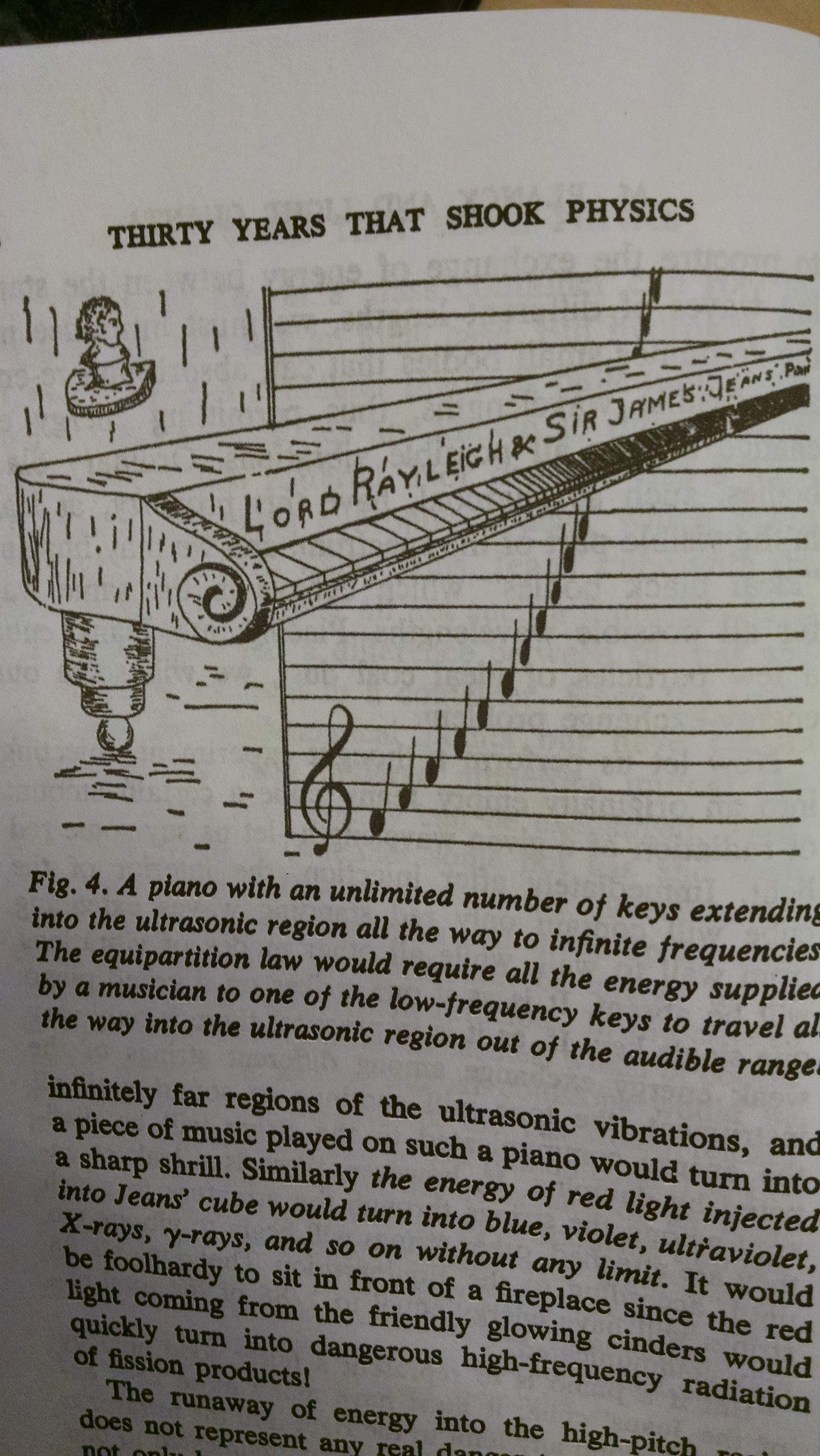
Both books are filled with Gamow’s whimsical illustrations, something he was very much known for. Apparently he liked to imitate other art styles as well, which is visible in the portraits of physicists at the front of each chapter.

Pictured: the electromagnetic spectrum as an infinite piano

1966 was late enough that this book doesn’t have the complacency of the earlier chapters in Mr Tompkins: Gamow knew that there were more particles than just electrons, nucleons, and neutrinos. It was still early enough, though, that the new particles were not fully understood. It’s interesting seeing how Gamow reacts to this: his expectation was that physics was on the cusp of another massive change, a new theory built on new fundamental principles. He speculates that there might be a minimum length scale (although oddly enough he didn’t expect it to be related to gravity).

It’s only natural that someone who lived through the dawn of quantum mechanics should expect a similar revolution to follow. Instead, the revolution of the late 60’s and early 70’s was in our understanding: not new laws of nature so much as new comprehension of just how much quantum field theory can actually do. I wonder if the generation who lived through that later revolution left it with the reverse expectation: that the next crisis should be solved in a similar way, that the world is quantum field theory (or close cousins, like string theory) all the way down and our goal should be to understand the capabilities of these theories as well as possible.

The final section of the book is well worth waiting for. In 1932, Gamow directed Bohr’s students in staging a play, the “Blegdamsvej Faust”. A parody of Faust, it features Bohr as god, Pauli as Mephistopheles, and Ehrenfest as the “erring Faust” (Gamow’s pun, not mine) that he tempts to sin with the promise of the neutrino, Gretchen. The piece, translated to English by Gamow’s wife Barbara, is filled with in-jokes on topics as obscure as Bohr’s habitual mistakes when speaking German. It’s gloriously weird and well worth a read. If you’ve ever seen someone do a revival performance, let me know!

Made of Quarks Versus Made of Strings

When you learn physics in school, you learn it in terms of building blocks.

First, you learn about atoms. Indivisible elements, as the Greeks foretold…until you learn that they aren’t indivisible. You learn that atoms are made of electrons, protons, and neutrons. Then you learn that protons and neutrons aren’t indivisible either, they’re made of quarks. They’re what physicists call composite particles, particles made of other particles stuck together.

Hearing this story, you notice a pattern. Each time physicists find a more fundamental theory, they find that what they thought were indivisible particles are actually composite. So when you hear physicists talking about the next, more fundamental theory, you might guess it has to work the same way. If quarks are made of, for example, strings, then each quark is made of many strings, right?

Nope! As it turns out, there are two different things physicists can mean when they say a particle is “made of” a more fundamental particle. Sometimes they mean the particle is composite, like the proton is made of quarks. But sometimes, like when they say particles are “made of strings”, they mean something different.

To understand what this “something different” is, let’s go back to quarks for a moment. You might have heard there are six types, or flavors, of quarks: up and down, strange and charm, top and bottom. The different types have different mass and electric charge. You might have also heard that quarks come in different colors, red green and blue. You might wonder then, aren’t there really eighteen types of quark? Red up quarks, green top quarks, and so forth?

Physicists don’t think about it that way. Unlike the different flavors, the different colors of quark have a more unified mathematical description. Changing the color of a quark doesn’t change its mass or electric charge. All it changes is how the quark interacts with other particles via the strong nuclear force. Know how one color works, and you know how the other colors work. Different colors can also “mix” together, similarly to how different situations can mix together in quantum mechanics: just as Schrodinger’s cat can be both alive and dead, a quark can be both red and green.

This same kind of thing is involved in another example, electroweak unification. You might have heard that electromagnetism and the weak nuclear force are secretly the same thing. Each force has corresponding particles: the familiar photon for electromagnetism, and W and Z bosons for the weak nuclear force. Unlike the different colors of quarks, photons and W and Z bosons have different masses from each other. It turns out, though, that they still come from a unified mathematical description: they’re “mixtures” (in the same Schrodinger’s cat-esque sense) of the particles from two more fundamental forces (sometimes called “weak isospin” and “weak hypercharge”). The reason they have different masses isn’t their own fault, but the fault of the Higgs: the Higgs field we have in our universe interacts with different parts of this unified force differently, so the corresponding particles end up with different masses.

A physicist might say that electromagnetism and the weak force are “made of” weak isospin and weak hypercharge. And it’s that kind of thing that physicists mean when they say that quarks might be made of strings, or the like: not that quarks are composite, but that quarks and other particles might have a unified mathematical description, and look different only because they’re interacting differently with something else.

This isn’t to say that quarks and electrons can’t be composite as well. They might be, we don’t know for sure. If they are, the forces binding them together must be very strong, strong enough that our most powerful colliders can’t make them wiggle even a little out of shape. The tricky part is that composite particles get mass from the energy holding them together. A particle held together by very powerful forces would normally be very massive, if you want it to end up lighter you have to construct your theory carefully to do that. So while occasionally people will suggest theories where quarks or electrons are composite, these theories aren’t common. Most of the time, if a physicist says that quarks or electrons are “made of ” something else, they mean something more like “particles are made of strings” than like “protons are made of quarks”.

What Science Would You Do If You Had the Time?

I know a lot of people who worry about the state of academia. They worry that the competition for grants and jobs has twisted scientists’ priorities, that the sort of dedicated research of the past, sitting down and thinking about a topic until you really understand it, just isn’t possible anymore. The timeline varies: there are people who think the last really important development was the Standard Model, or the top quark, or AdS/CFT. Even more optimistic people, who think physics is still just as great as it ever was, often complain that they don’t have enough time.

Sometimes I wonder what physics would be like if we did have the time. If we didn’t have to worry about careers and funding, what would we do? I can speculate, comparing to different communities, but here I’m interested in something more concrete: what, specifically, could we accomplish? I often hear people complain that the incentives of academia discourage deep work, but I don’t often hear examples of the kind of deep work that’s being discouraged.

So I’m going to try an experiment here. I know I have a decent number of readers who are scientists of one field or another. Imagine you didn’t have to worry about funding any more. You’ve got a permanent position, and what’s more, your favorite collaborators do too. You don’t have to care about whether your work is popular, whether it appeals to the university or the funding agencies or any of that. What would you work on? What projects would you personally do, that you don’t have the time for in the current system? What worthwhile ideas has modern academia left out?

Assumptions for Naturalness

Why did physicists expect to see something new at the LHC, more than just the Higgs boson? Mostly, because of something called naturalness.

Naturalness, broadly speaking, is the idea that there shouldn’t be coincidences in physics. If two numbers that appear in your theory cancel out almost perfectly, there should be a reason that they cancel. Put another way, if your theory has a dimensionless constant in it, that constant should be close to one.

(To see why these two concepts are the same, think about a theory where two large numbers miraculously almost cancel, leaving just a small difference. Take the ratio of one of those large numbers to the difference, and you get a very large dimensionless number.)

You might have heard it said that the mass of the Higgs boson is “unnatural”. There are many different physical processes that affect what we measure as the mass of the Higgs. We don’t know exactly how big these effects are, but we do know that they grow with the scale of “new physics” (aka the mass of any new particles we might have discovered), and that they have to cancel to give the Higgs mass we observe. If we don’t see any new particles, the Higgs mass starts looking more and more unnatural, driving some physicists to the idea of a “multiverse”.

If you find parts of this argument hokey, you’re not alone. Critics of naturalness point out that we don’t really have a good reason to favor “numbers close to one”, nor do we have any way to quantify how “bad” a number far from one is (we don’t know the probability distribution, in other words). They critique theories that do preserve naturalness, like supersymmetry, for being increasingly complicated and unwieldy, violating Occam’s razor. And in some cases they act baffled by the assumption that there should be any “new physics” at all.

Some of these criticisms are reasonable, but some are distracting and off the mark. The problem is that the popular argument for naturalness leaves out some important assumptions. These assumptions are usually kept in mind by the people arguing for naturalness (at least the more careful people), but aren’t often made explicit. I’d like to state some of these assumptions. I’ll be framing the naturalness argument in a bit of an unusual (if not unprecedented) way. My goal is to show that some criticisms of naturalness don’t really work, while others still make sense.

I’d like to state the naturalness argument as follows:

  1. The universe should be ultimately described by a theory with no free dimensionless parameters at all. (For the experts: the theory should also be UV-finite.)
  2. We are reasonably familiar with theories of the sort described in 1., we know roughly what they can look like.
  3. If we look at such a theory at low energies, it will appear to have dimensionless parameters again, based on the energy where we “cut off” our description. We understand this process well enough to know what kinds of values these parameters can take, starting from 2.
  4. Point 3. can only be consistent with the observed mass of the Higgs if there is some “new physics” at around the scales the LHC can measure. That is, there is no known way to start with a theory like those of 2. and get the observed Higgs mass without new particles.

Point 1. is often not explicitly stated. It’s an assumption, one that sits in the back of a lot of physicists’ minds and guides their reasoning. I’m really not sure if I can fully justify it, it seems like it should be a consequence of what a final theory is.

(For the experts: you’re probably wondering why I’m insisting on a theory with no free parameters, when usually this argument just demands UV-finiteness. I demand this here because I think this is the core reason why we worry about coincidences: free parameters of any intermediate theory must eventually be explained in a theory where those parameters are fixed, and “unnatural” coincidences are those we don’t expect to be able to fix in this way.)

Point 2. may sound like a stretch, but it’s less of one than you might think. We do know of a number of theories that have few or no dimensionless parameters (and that are UV-finite), they just don’t describe the real world. Treating these theories as toy models, we can hopefully get some idea of how theories like this should look. We also have a candidate theory of this kind that could potentially describe the real world, M theory, but it’s not fleshed out enough to answer these kinds of questions definitively at this point. At best it’s another source of toy models.

Point 3. is where most of the technical arguments show up. If someone talking about naturalness starts talking about effective field theory and the renormalization group, they’re probably hashing out the details of point 3. Parts of this point are quite solid, but once again there are some assumptions that go into it, and I don’t think we can say that this point is entirely certain.

Once you’ve accepted the arguments behind points 1.-3., point 4. follows. The Higgs is unnatural, and you end up expecting new physics.

Framed in this way, arguments about the probability distribution of parameters are missing the point, as are arguments from Occam’s razor.

The point is not that the Standard Model has unlikely parameters, or that some in-between theory has unlikely parameters. The point is that there is no known way to start with the kind of theory that could be an ultimate description of the universe and end up with something like the observed Higgs and no detectable new physics. Such a theory isn’t merely unlikely, if you take this argument seriously it’s impossible. If your theory gets around this argument, it can be as cumbersome and Occam’s razor-violating as it wants, it’s still a better shot than no possible theory at all.

In general, the smarter critics of naturalness are aware of this kind of argument, and don’t just talk probabilities. Instead, they reject some combination of point 2. and point 3.

This is more reasonable, because point 2. and point 3. are, on some level, arguments from ignorance. We don’t know of a theory with no dimensionless parameters that can give something like the Higgs with no detectable new physics, but maybe we’re just not trying hard enough. Given how murky our understanding of M theory is, maybe we just don’t know enough to make this kind of argument yet, and the whole thing is premature. This is where probability can sneak back in, not as some sort of probability distribution on the parameters of physics but just as an estimate of our own ability to come up with new theories. We have to guess what kinds of theories can make sense, and we may well just not know enough to make that guess.

One thing I’d like to know is how many critics of naturalness reject point 1. Because point 1. isn’t usually stated explicitly, it isn’t often responded to explicitly either. The way some critics of naturalness talk makes me suspect that they reject point 1., that they honestly believe that the final theory might simply have some unexplained dimensionless numbers in it that we can only fix through measurement. I’m curious whether they actually think this, or whether I’m misreading them.

There’s a general point to be made here about framing. Suppose that tomorrow someone figures out a way to start with a theory with no dimensionless parameters and plausibly end up with a theory that describes our world, matching all existing experiments. (People have certainly been trying.) Does this mean naturalness was never a problem after all? Or does that mean that this person solved the naturalness problem?

Those sound like very different statements, but it should be clear at this point that they’re not. In principle, nothing distinguishes them. In practice, people will probably frame the result one way or another based on how interesting the solution is.

If it turns out we were missing something obvious, or if we were extremely premature in our argument, then in some sense naturalness was never a real problem. But if we were missing something subtle, something deep that teaches us something important about the world, then it should be fair to describe it as a real solution to a real problem, to cite “solving naturalness” as one of the advantages of the new theory.

If you ask for my opinion? You probably shouldn’t, I’m quite far from an expert in this corner of physics, not being a phenomenologist. But if you insist on asking anyway, I suspect there probably is something wrong with the naturalness argument. That said, I expect that whatever we’re missing, it will be something subtle and interesting, that naturalness is a real problem that needs to really be solved.

A Newtonmas Present of Internet Content

I’m lazy this Newtonmas, so instead of writing a post of my own I’m going to recommend a few other people who do excellent work.

Quantum Frontiers is a shared blog updated by researchers connected to Caltech’s Institute for Quantum Information and Matter. While the whole blog is good, I’m going to be more specific and recommend the posts by Nicole Yunger Halpern. Nicole is really a great writer, and her posts are full of vivid imagery and fun analogies. If she’s not as well-known, it’s only because she lacks the attention-grabbing habit of getting into stupid arguments with other bloggers. Definitely worth a follow.

Recommending Slate Star Codex feels a bit strange, because it seems like everyone I’ve met who would enjoy the blog already reads it. It’s not a physics blog by any stretch, so it’s also an unusual recommendation to give here. Slate Star Codex writes about a wide variety of topics, and while the author isn’t an expert in most of them he does a lot more research than you or I would. If you’re interested in up-to-date meta-analyses on psychology, social science, and policy, pored over by someone with scrupulous intellectual honesty and an inexplicably large amount of time to indulge it, then Slate Star Codex is the blog for you.

I mentioned Piled Higher and Deeper a few weeks back, when I reviewed the author’s popular science book We Have No Idea. Piled Higher and Deeper is a webcomic about life in grad school. Humor is all about exaggeration, and it’s true that Piled Higher and Deeper exaggerates just how miserable and dysfunctional grad school can be…but not by as much as you’d think. I recommend that anyone considering grad school read Piled Higher and Deeper, and take it seriously. Grad school can really be like that, and if you don’t think you can deal with spending five or six years in the world of that comic you should take that into account.

This Week, at Scientific American

I’ve written an article for Scientific American! It went up online this week, the print versions go out on the 25th. The online version is titled “Loopy Particle Math”, the print one is “The Particle Code”, but they’re the same article.

For those who don’t subscribe to Scientific American, sorry about the paywall!

“The Particle Code” covers what will be familiar material to regulars on this blog. I introduce Feynman diagrams, and talk about the “amplitudeologists” who try to find ways around them. I focus on my corner of the amplitudes field, how the work of Goncharov, Spradlin, Vergu, and Volovich introduced us to “symbology”, a set of tricks for taking apart more complicated integrals (or “periods”) into simple logarithmic building blocks. I talk about how my collaborators and I use symbology, using these building blocks to compute amplitudes that would have been impossible with other techniques. Finally, I talk about the frontier of the field, the still-mysterious “elliptic polylogarithms” that are becoming increasingly well-understood.

(I don’t talk about the even more mysterious “Calabi-Yau polylogarithms“…another time for those!)

Working with Scientific American was a fun experience. I got to see how the professionals do things. They got me to clarify and explain, pointing out terms I needed to define and places I should pause to summarize. They took my rough gel-pen drawings and turned them into polished graphics. While I’m still a little miffed about them removing all the contractions, overall I learned a lot, and I think they did a great job of bringing the article to the printed page.

Interdisciplinarity Is Good for the Soul

Interdisciplinary research is trendy these days. Grant agencies love it, for one. But talking to people in other fields isn’t just promoted by the authorities: like eating your vegetables, it’s good for you too.

If you talk only to people from your own field, you can lose track of what matters in the wider world. There’s a feedback effect where everyone in a field works on what everyone else in the field finds interesting, and the field spirals inward. “Interesting” starts meaning what everyone else is working on, without fulfilling any other criteria. Interdisciplinary contacts hold that back: not only can they call bullshit when you’re deep in your field’s arcane weirdness, they can also point out things that are more interesting than you expected, ideas that your field has seen so often they look boring but that are actually more surprising or useful than you realize.

Interdisciplinary research is good for self-esteem, too. As a young researcher, you can easily spend all your time talking to people who know more about your field than you do. Branching out reminds you of how much you’ve learned: all that specialized knowledge may be entry-level in your field, but it still puts you ahead of the rest of the world. Even as a grad student, you can be someone else’s guest expert if the right topic comes up.

Book Review: We Have No Idea

I have no idea how I’m going to review this book.

Ok fine, I have some idea.

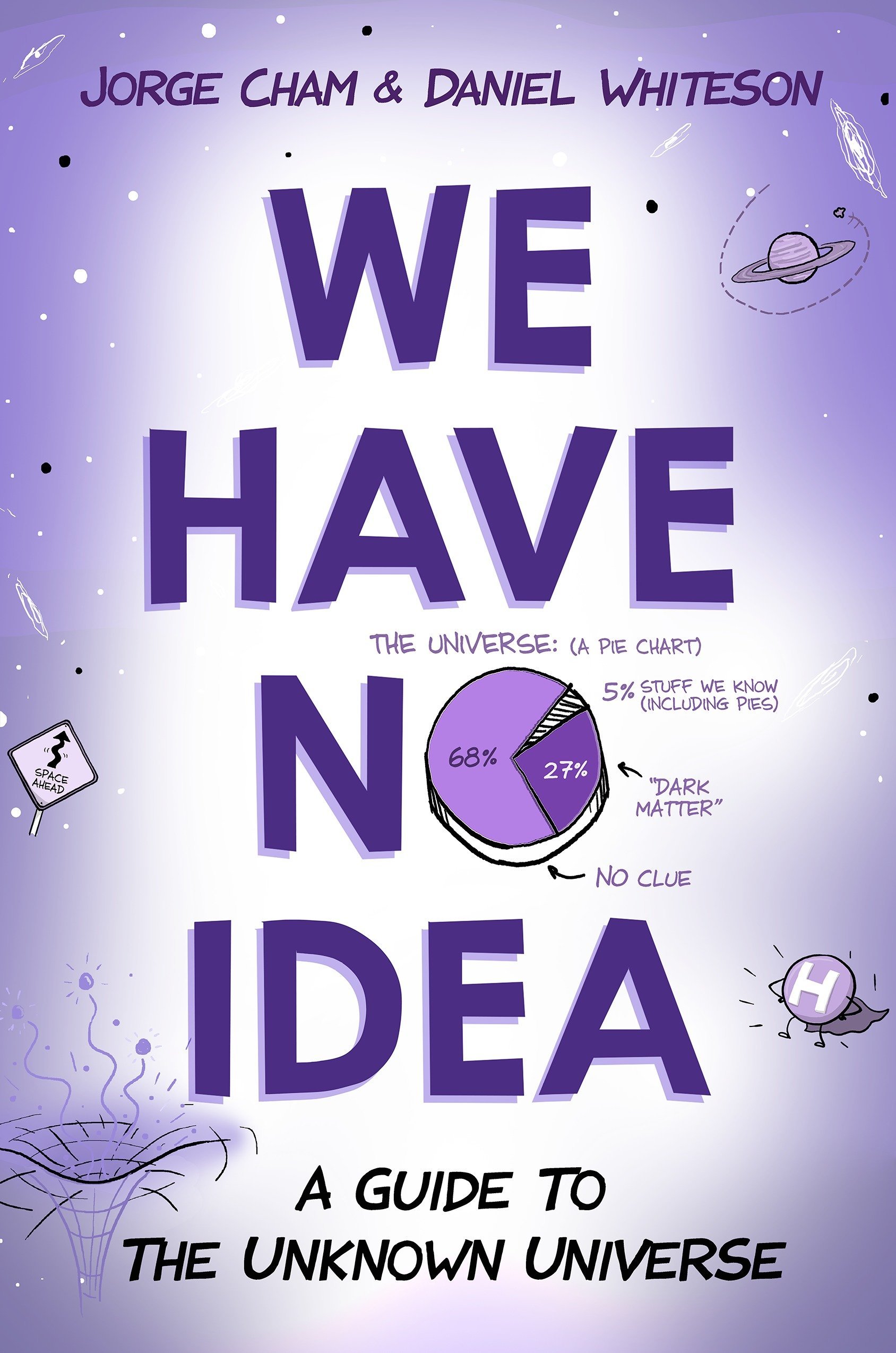
Jorge Cham writes Piled Higher and Deeper, a webcomic with possibly the most accurate depiction of grad school available. Daniel Whiteson is a professor at the University of California, Irvine, and a member of the ATLAS collaboration (one of the two big groups that make measurements at the Large Hadron Collider). Together, they’ve written a popular science book covering everything we don’t know about fundamental physics.

Writing a book about what we don’t know is an unusual choice, and there was a real risk it would end up as just a superficial gimmick. The pie chart on the cover presents the most famous “things physicists don’t know”, dark matter and dark energy. If they had just stuck to those this would have been a pretty ordinary popular physics book.

Refreshingly, they don’t do that. After blazing through dark matter and dark energy in the first three chapters, the rest of the book focuses on a variety of other scientific mysteries.

The book contains a mix of problems that get serious research attention (matter-antimatter asymmetry, high-energy cosmic rays) and more blue-sky “what if” questions (does matter have to be made out of particles?). As a theorist, I’m not sure that all of these questions are actually mysterious (we do have some explanation of the weird “1/3” charges of quarks, and I’d like to think we understand why mass includes binding energy), but even in these cases what we really know is that they follow from “sensible assumptions”, and one could just as easily ask “what if” about those assumptions instead. Overall, these “what if” questions make the book unique, and it would be a much weaker book without them.

“We Have No Idea” is strongest when the authors actually have some idea, i.e. when Whiteson is discussing experimental particle physics. It gets weaker on other topics, where the authors seem to rely more on others’ popular treatments (their discussion of “pixels of space-time” motivated me to write this post). Still, they at least seem to have asked the right people, and their accounts are on the more accurate end of typical pop science. (Closer to Quanta than IFLScience.)

The book’s humor really ties it together, often in surprisingly subtle ways. Each chapter has its own running joke, initially a throwaway line that grows into metaphors for everything the chapter discusses. It’s a great way to help the audience visualize without introducing too many new concepts at once. If there’s one thing cartoonists can teach science communicators, it’s the value of repetition.

I liked “We Have No Idea”. It could have been more daring, or more thorough, but it was still charming and honest and fun. If you’re looking for a Christmas present to explain physics to your relatives, you won’t go wrong with this book.

Pan Narrans Scientificus

As scientists, we want to describe the world as objectively as possible. We try to focus on what we can establish conclusively, to leave out excessive speculation and stick to cold, hard facts.

Then we have to write application letters.

Stick to the raw, un-embellished facts, and an application letter would just be a list: these papers in these journals, these talks and awards. Though we may sometimes wish applications worked that way, we don’t live in that kind of world. To apply for a job or a grant, we can’t just stick to the most easily measured facts. We have to tell a story.

The author Terry Pratchett called humans Pan Narrans, the Storytelling Ape. Stories aren’t just for fun, they’re how we see the world, how we organize our perceptions and actions. Without a story, the world doesn’t make sense. And that applies even to scientists.

Applications work best when they tell a story: how did you get here, and where are you going? Scientific papers, similarly, require some sort of narrative: what did you do, and why did you do it? When teaching or writing about science, we almost never just present the facts. We try to fit it into a story, one that presents the facts but also makes sense, in that deliciously human way. A story, more than mere facts, lets us project to the future, anticipating what you’ll do with that grant money or how others will take your research in new directions.

It’s important to remember, though, that stories aren’t actually facts. You can’t get too attached to one story, you have to be willing to shift as new facts come in. Those facts can be scientific measurements, but they can also be steps in your career. You aren’t going to tell the same story when applying to grad school as when you’re trying for tenure, and that’s not just because you’ll have more to tell. The facts of your life will be organized in new ways, rearranging in importance as the story shifts.

Keep your stories in mind as you write or do science. Think about your narrative, the story you’re using to understand the world. Think about what it predicts, how the next step in the story should go. And be ready to start a new story when you need to.