QCD and Reductionism: Stranger Than You’d Think

Earlier this year, I made a list of topics I wanted to understand. The most abstract and technical of them was something called “Wilsonian effective field theory”. I still don’t understand Wilsonian effective field theory. But while thinking about it, I noticed something that seemed weird. It’s something I think many physicists already understand, but that hasn’t really sunk in with the public yet.

There’s an old problem in particle physics, described in many different ways over the years. Take our theories and try to calculate some reasonable number (say, the angle an electron turns in a magnetic field), and instead of that reasonable number we get infinity. We fix this problem with a process called renormalization that hides that infinity away, changing the “normalization” of some constant like a mass or a charge. While renormalization first seemed like a shady trick, physicists eventually understood it better. First, we thought of it as a way to work around our ignorance, that the true final theory would have no infinities at all. Later, physicists instead thought about renormalization in terms of scaling.

Imagine looking at the world on a camera screen. You can zoom in, or zoom out. The further you zoom out, the more details you’ll miss: they’re just too small to be visible on your screen. You can guess what they might be, but your picture will be different depending on how you zoom.

In particle physics, many of our theories are like that camera. They come with a choice of “zoom setting”, a minimum scale where they still effectively tell the whole story. We call theories like these effective field theories. Some physicists argue that these are all we can ever have: since our experiments are never perfect, there will always be a scale so small we have no evidence about it.

In general, theories can be quite different at different scales. Some theories, though, are especially nice: they look almost the same as we zoom in to smaller scales. The only things that change are the mass of different particles, and their charges.

Trippy

One theory like this is Quantum Chromodynamics (or QCD), the theory of quarks and gluons. Zoom in, and the theory looks pretty much the same, with one crucial change: the force between particles get weaker. There’s a number, called the “coupling constant“, that describes how strong a force is, think of it as sort of like an electric charge. As you zoom in to quarks and gluons, you find you can still describe them with QCD, just with a smaller coupling constant. If you could zoom “all the way in”, the constant (and thus the force between particles) would be zero.

This makes QCD a rare kind of theory: one that could be complete to any scale. No matter how far you zoom in, QCD still “makes sense”. It never gives contradictions or nonsense results. That doesn’t mean it’s actually true: it interacts with other forces, like gravity, that don’t have complete theories, so it probably isn’t complete either. But if we didn’t have gravity or electricity or magnetism, if all we had were quarks and gluons, then QCD could have been the final theory that described them.

And this starts feeling a little weird, when you think about reductionism.

Philosophers define reductionism in many different ways. I won’t be that sophisticated. Instead, I’ll suggest the following naive definition: Reductionism is the claim that theories on larger scales reduce to theories on smaller scales.

Here “reduce to” is intentionally a bit vague. It might mean “are caused by” or “can be derived from” or “are explained by”. I’m gesturing at the sort of thing people mean when they say that biology reduces to chemistry, or chemistry to physics.

What happens when we think about QCD, with this intuition?

QCD on larger scales does indeed reduce to QCD on smaller scales. If you want to ask why QCD on some scale has some coupling constant, you can explain it by looking at the (smaller) QCD coupling constant on a smaller scale. If you have equations for QCD on a smaller scale, you can derive the right equations for a larger scale. In some sense, everything you observe in your larger-scale theory of QCD is caused by what happens in your smaller-scale theory of QCD.

But this isn’t quite the reductionism you’re used to. When we say biology reduces to chemistry, or chemistry reduces to physics, we’re thinking of just a few layers: one specific theory reduces to another specific theory. Here, we have an infinite number of layers, every point on the scale from large to small, each one explained by the next.

Maybe you think you can get out of this, by saying that everything should reduce to the smallest scale. But remember, the smaller the scale the smaller our “coupling constant”, and the weaker the forces between particles. At “the smallest scale”, the coupling constant is zero, and there is no force. It’s only when you put your hand on the zoom nob and start turning that the force starts to exist.

It’s reductionism, perhaps, but not as we know it.

Now that I understand this a bit better, I get some of the objections to my post about naturalness a while back. I was being too naive about this kind of thing, as some of the commenters (particularly Jacques Distler) noted. I believe there’s a way to rephrase the argument so that it still works, but I’d have to think harder about how.

I also get why I was uneasy about Sabine Hossenfelder’s FQXi essay on reductionism. She considered a more complicated case, where the chain from large to small scale could be broken, a more elaborate variant of a problem in Quantum Electrodynamics. But if I’m right here, then it’s not clear that scaling in effective field theories is even the right way to think about this. When you have an infinite series of theories that reduce to other theories, you’re pretty far removed from what most people mean by reductionism.

Finally, this is the clearest reason I can find why you can’t do science without an observer. The “zoom” is just a choice we scientists make, an arbitrary scale describing our ignorance. But without it, there’s no way to describe QCD. The notion of scale is an inherent and inextricable part of the theory, and it doesn’t have to mean our theory is incomplete.

Experts, please chime in here if I’m wrong on the physics here. As I mentioned at the beginning, I still don’t think I understand Wilsonian effective field theory. If I’m right though, this seems genuinely weird, and something more of the public should appreciate.

Guest Post: On the Real Inhomogeneous Universe and the Weirdness of ‘Dark Energy’

A few weeks ago, I mentioned a paper by a colleague of mine, Mohamed Rameez, that generated some discussion. Since I wasn’t up for commenting on the paper’s scientific content, I thought it would be good to give Rameez a chance to explain it in his own words, in a guest post. Here’s what he has to say:


In an earlier post, 4gravitons had contemplated the question of ‘when to trust the contrarians’, in the context of our about-to-be-published paper in which we argue that accounting for the effects of the bulk flow in the local Universe, there is no evidence for any isotropic cosmic acceleration, which would be required to claim some sort of ‘dark energy’.

In the following I would like to emphasize that this is a reasonable view, and not a contrarian one. To do so I will examine the bulk flow of the local Universe and the historical evolution of what appears to be somewhat dodgy supernova data. I will present a trivial solution (from data) to the claimed ‘Hubble tension’.  I will then discuss inhomogeneous cosmology, and the 2011 Nobel prize in Physics. I will proceed to make predictions that can be falsified with future data. I will conclude with some questions that should be frequently asked.

Disclaimer: The views expressed here are not necessarily shared by my collaborators. 

The bulk flow of the local Universe:

The largest anisotropy in the Cosmic Microwave Background is the dipole, believed to be caused by our motion with respect to the ‘rest frame’ of the CMB with a velocity of ~369 km s^-1. Under this view, all matter in the local Universe appear to be flowing. At least out to ~300 Mpc, this flow continues to be directionally coherent, to within ~40 degrees of the CMB dipole, and the scale at which the average relative motion between matter and radiation converges to zero has so far not been found.

This is one of the most widely accepted results in modern cosmology, to the extent that SN1a data come pre ‘corrected’ for it.

Such a flow has covariant consequences under general relativity and this is what we set out to test.

Supernova data, directions in the sky and dodgyness:

Both Riess et al 1998 and Perlmutter et al 1999 used samples of supernovae down to redshifts of 0.01, in which almost all SNe at redshifts below 0.1 were in the direction of the flow.

Subsequently in Astier et al 2006, Kowalsky et al 2008, Amanullah et al 2010 and Suzuki et al 2011, it is reported that a process of outlier rejection was adopted in which data points >3\sigma from the Hubble diagram were discarded. This was done using a highly questionable statistical method that involves adjusting an intrinsic dispersion term \sigma_{\textrm{int}} by hand until a \chi^2/\textrm{ndof} of 1 is obtained to the assumed \LambdaCDM model. The number of outliers rejected is however far in excess of 0.3% – which is the 3\sigma expectation. As the sky coverage became less skewed, supernovae with redshift less than ~0.023 were excluded for being outside the Hubble flow. While the Hubble diagram so far had been inferred from heliocentric redshifts and magnitudes, with the introduction of SDSS supernovae that happened to be in the direction opposite to the flow, peculiar velocity ‘corrections’ were adopted in the JLA catalogue and supernovae down to extremely low redshifts were reintroduced. While the early claims of a cosmological constant were stated as ‘high redshift supernovae were found to be dimmer (15% in flux) than the low redshift supernovae (compared to what would be expected in a \Lambda=0 universe)’, it is worth noting that the peculiar velocity corrections change the redshifts and fluxes of low redshift supernovae by up to ~20 %.

When it was observed that even with this ‘corrected’ sample of 740 SNe, any evidence for isotropic acceleration using a principled Maximum Likelihood Estimator is less than 3\sigma , it was claimed that by adding 12 additional parameters (to the 10 parameter model) to allow for redshift and sample dependence of the light curve fitting parameters, the evidence was greater than 4\sigma .

As we discuss in Colin et al. 2019, these corrections also appear to be arbitrary, and betray an ignorance of the fundamentals of both basic statistical analysis and relativity. With the Pantheon compilation, heliocentric observables were no longer public and these peculiar velocity corrections initially extended far beyond the range of any known flow model of the Local Universe. When this bug was eventually fixed, both the heliocentric redshifts and magnitudes of the SDSS SNe that filled in the ‘redshift desert’ between low and high redshift SNe were found to be alarmingly discrepant. The authors have so far not offered any clarification of these discrepancies.

Thus it seems to me that the latest generation of ‘publicly available’ supernova data are not aiding either open science or progress in cosmology.

A trivial solution to the ‘Hubble tension’?

The apparent tension between the Hubble parameter as inferred from the Cosmic Microwave Background and low redshift tracers has been widely discussed, and recent studies suggest that redshift errors as low as 0.0001 can have a significant impact. Redshift discrepancies as big as 0.1 have been reported. The shifts reported between JLA and Pantheon appear to be sufficient to lower the Hubble parameter from ~73 km s^-1 Mpc^-1 to ~68 km s^-1 Mpc^-1.

On General Relativity, cosmology, metric expansion and inhomogeneities:

In the maximally symmetric Friedmann-Lemaitre-Robertson-Walker solution to general relativity, there is only one meaningful global notion of distance and it expands at the same rate everywhere. However, the late time Universe has structure on all scales, and one may only hope for statistical (not exact) homogeneity. The Universe is expected to be lumpy. A background FLRW metric is not expected to exist and quantities analogous to the Hubble and deceleration parameters will vary across the sky.  Peculiar velocities may be more precisely thought of as variations in the expansion rate of the Universe. At what rate does a real Universe with structure expand? The problems of defining a meaningful average notion of volume, its dynamical evolution, and connecting it to observations are all conceptually open.

On the 2011 Nobel Prize in Physics:

The Fitting Problem in cosmology was written in 1987. In the context of this work and the significant theoretical difficulties involved in inferring fundamental physics from the real Universe, any claims of having measured a cosmological constant from directionally skewed, sparse samples of intrinsically scattered observations should have been taken with a grain of salt.  By honouring this claim with a Nobel Prize, the Swedish Academy may have induced runaway prestige bias in favour of some of the least principled analyses in science, strengthening the confirmation bias that seems prevalent in cosmology.

This has resulted in the generation of a large body of misleading literature, while normalizing the practice of ‘massaging’ scientific data. In her recent video about gravitational waves, Sabine Hossenfelder says “We should not hand out Nobel Prizes if we don’t know how the predictions were fitted to the data”. What about when the data was fitted (in 1998-1999) using a method that has been discredited in 1989 to a toy model that has been cautioned against in 1987, leading to a ‘discovery’ of profound significance to fundamental physics?

A prediction with future cosmological data:

With the advent of high statistics cosmological data in the future, such as from the Large Synoptic Survey Telescope, I predict that the Hubble and deceleration parameters inferred from supernovae in hemispheres towards and away from the CMB dipole will be found to be different in a statistically significant (>5\sigma ) way. Depending upon the criterion for selection and blind analyses of data that can be agreed upon, I would be willing to bet a substantial amount of money on this prediction.

Concluding : on the amusing sociology of ‘Dark Energy’ and manufactured concordance:

Of the two authors of the well-known cosmology textbook ‘The Early Universe’, Edward Kolb writes these interesting papers questioning dark energy while Michael Turner is credited with coining the term ‘Dark Energy’.  Reasonable scientific perspectives have to be presented as ‘Dark Energy without dark energy’. Papers questioning the need to invoke such a mysterious content that makes up ‘68% of the Universe’ are quickly targeted by inane articles by non-experts or perhaps well-meant but still misleading YouTube videos. Much of this is nothing more than a spectacle.

In summary, while the theoretical debate about whether what has been observed as Dark Energy is the effect of inhomogeneities is ongoing, observers appear to have been actively using the most inhomogeneous feature of the local Universe through opaque corrections to data, to continue claiming that this ‘dark energy’ exists.

It is heartening to see that recent works lean toward a breaking of this manufactured concordance and speak of a crisis for cosmology.

Questions that should be frequently asked:

Q. Is there a Hubble frame in the late time Universe?

A. The Hubble frame is a property of the FLRW exact solution, and in the late time Universe in which galaxies and clusters have peculiar motions with respect to each other, an equivalent notion does not exist. While popular inference treats the frame in which the CMB dipole vanishes as the Hubble frame, the scale at which the bulk flow of the local Universe converges to that frame has never been found. We are tilted observers.

Q. I am about to perform blinded analyses on new cosmological data. Should I correct all my redshifts towards the CMB rest frame?

A. No. Correcting all your redshifts towards a frame that has never been found is a good way to end up with ‘dark energy’. It is worth noting that while the CMB dipole has been known since 1994, supernova data have been corrected towards the CMB rest frame only after 2010, for what appear to be independent reasons.

Q. Can I combine new data with existing Supernova data?

A. No. The current generation of publicly available supernova data suffer from the natural biases that are to be expected when data are compiled incrementally through a human mediated process. It would be better to start fresh with a new sample.

Q. Is ‘dark energy’ fundamental or new physics?

A. Given that general relativity is a 100+ year old theory and significant difficulties exist in describing the late time Universe with it, it is unnecessary to invoke new fundamental physics when confronting any apparent acceleration of the real Universe. All signs suggest that what has been ascribed to dark energy are the result of a community that is hell bent on repeating what Einstein supposedly called his greatest mistake.

Digging deeper:

The inquisitive reader may explore the resources on inhomogeneous cosmology, as well as the works of George Ellis, Thomas Buchert and David Wiltshire.

Academia Has Changed Less Than You’d Think

I recently read a biography of James Franck. Many of you won’t recognize the name, but physicists might remember the Franck-Hertz experiment from a lab class. Franck and Hertz performed a decisive test of Bohr’s model of the atom, ushering in the quantum age and receiving the 1925 Nobel Prize. After fleeing Germany when Hitler took power, Franck worked on the Manhattan project and co-authored the Franck Report urging the US not to use nuclear bombs on Japan. He settled at the University of Chicago, which named an institute after him.*

You can find all that on his Wikipedia page. The page also mentions his marriage later in life to Hertha Sponer. Her Wikipedia page talks about her work in spectroscopy, about how she was among the first women to receive a PhD in Germany and the first on the physics faculty at Duke University, and that she remained a professor there until 1966, when she was 70.

Neither Wikipedia page talks about two-body problems, or teaching loads, or pensions.

That’s why I was surprised when the biography covered Franck’s later life. Until Franck died, he and Sponer would travel back and forth, he visiting her at Duke and she visiting him in Chicago. According to the biography, this wasn’t exactly by choice: they both would have preferred to live together in the same city. Somehow though, despite his Nobel Prize and her scientific accomplishments, they never could. The biography talks about how the university kept her teaching class after class, so she struggled to find time for research. It talks about what happened as the couple got older, as their health made it harder and harder to travel back and forth, and they realized that without access to their German pensions they would not be able to support themselves in retirement. The biography gives the impression that Sponer taught till 70 not out of dedication but because she had no alternative.

When we think about the heroes of the past, we imagine them battling foes with historic weight: sexism, antisemitism, Nazi-ism. We don’t hear about their more everyday battles, with academic two-body problems and stingy universities. From this, we can get the impression that the dysfunctions of modern academia are new. But while the problems have grown, we aren’t the first academics with underpaid, overworked teaching faculty, nor the first to struggle to live where we want and love who we want. These are struggles academics have faced for a long, long time.

*Full disclosure: Franck was also my great-great-grandfather, hence I may find his story more interesting than most.

Rooting out the Answer

I have a new paper out today, with Jacob Bourjaily, Andrew McLeod, Matthias Wilhelm, Cristian Vergu and Matthias Volk.

There’s a story I’ve told before on this blog, about a kind of “alphabet” for particle physics predictions. When we try to make a prediction in particle physics, we need to do complicated integrals. Sometimes, these integrals simplify dramatically, in unexpected ways. It turns out we can understand these simplifications by writing the integrals in a sort of “alphabet”, breaking complicated mathematical “periods” into familiar logarithms. If we want to simplify an integral, we can use relations between logarithms like these:

\log(a b)=\log(a)+\log(b),\quad \log(a^n)=n\log(a)

to factor our “alphabet” into pieces as simple as possible.

The simpler the alphabet, the more progress you can make. And in the nice toy model theory we’re working with, the alphabets so far have been simple in one key way. Expressed in the right variables, they’re rational. For example, they contain no square roots.

Would that keep going? Would we keep finding rational alphabets? Or might the alphabets, instead, have square roots?

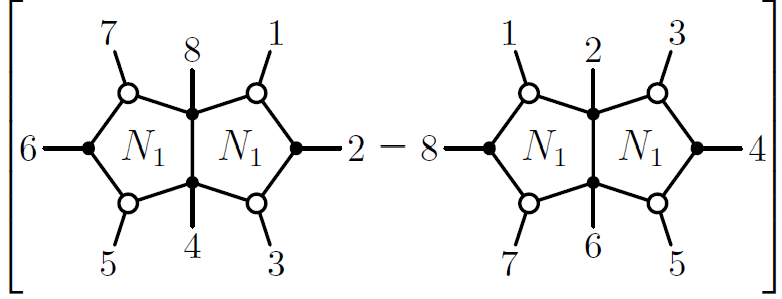
After some searching, we found a clean test case. There was a calculation we could do with just two Feynman diagrams. All we had to do was subtract one from the other. If they still had square roots in their alphabet, we’d have proven that the nice, rational alphabets eventually had to stop.

Easy-peasy

So we calculated these diagrams, doing the complicated integrals. And we found they did indeed have square roots in their alphabet, in fact many more than expected. They even had square roots of square roots!

You’d think that would be the end of the story. But square roots are trickier than you’d expect.

Remember that to simplify these integrals, we break them up into an alphabet, and factor the alphabet. What happens when we try to do that with an alphabet that has square roots?

Suppose we have letters in our alphabet with \sqrt{-5}. Suppose another letter is the number 9. You might want to factor it like this:

9=3\times 3

Simple, right? But what if instead you did this:

9=(2+ \sqrt{-5} )\times(2- \sqrt{-5} )

Once you allow \sqrt{-5} in the game, you can factor 9 in two different ways. The central assumption, that you can always just factor your alphabet, breaks down. In mathematical terms, you no longer have a unique factorization domain.

Instead, we had to get a lot more mathematically sophisticated, factoring into something called prime ideals. We got that working and started crunching through the square roots in our alphabet. Things simplified beautifully: we started with a result that was ten million terms long, and reduced it to just five thousand. And at the end of the day, after subtracting one integral from the other…

We found no square roots!

After all of our simplifications, all the letters we found were rational. Our nice test case turned out much, much simpler than we expected.

It’s been a long road on this calculation, with a lot of false starts. We were kind of hoping to be the first to find square root letters in these alphabets; instead it looks like another group will beat us to the punch. But we developed a lot of interesting tricks along the way, and we thought it would be good to publish our “null result”. As always in our field, sometimes surprising simplifications are just around the corner.

When to Trust the Contrarians

One of my colleagues at the NBI had an unusual experience: one of his papers took a full year to get through peer review. This happens often in math, where reviewers will diligently check proofs for errors, but it’s quite rare in physics: usually the path from writing to publication is much shorter. Then again, the delays shouldn’t have been too surprising for him, given what he was arguing.

My colleague Mohamed Rameez, along with Jacques Colin, Roya Mohayaee, and Subir Sarkar, wants to argue against one of the most famous astronomical discoveries of the last few decades: that the expansion of our universe is accelerating, and thus that an unknown “dark energy” fills the universe. They argue that one of the key pieces of evidence used to prove acceleration is mistaken: that a large region of the universe around us is in fact “flowing” in one direction, and that tricked astronomers into thinking its expansion was accelerating. You might remember a paper making a related argument back in 2016. I didn’t like the media reaction to that paper, and my post triggered a response by the authors, one of whom (Sarkar) is on this paper as well.

I’m not an astronomer or an astrophysicist. I’m not qualified to comment on their argument, and I won’t. I’d still like to know whether they’re right, though. And that means figuring out which experts to trust.

Pick anything we know in physics, and you’ll find at least one person who disagrees. I don’t mean a crackpot, though they exist too. I mean an actual expert who is convinced the rest of the field is wrong. A contrarian, if you will.

I used to be very unsympathetic to these people. I was convinced that the big results of a field are rarely wrong, because of how much is built off of them. I thought that even if a field was using dodgy methods or sloppy reasoning, the big results are used in so many different situations that if they were wrong they would have to be noticed. I’d argue that if you want to overturn one of these big claims you have to disprove not just the result itself, but every other success the field has ever made.

I still believe that, somewhat. But there are a lot of contrarians here at the Niels Bohr Institute. And I’ve started to appreciate what drives them.

The thing is, no scientific result is ever as clean as it ought to be. Everything we do is jury-rigged. We’re almost never experts in everything we’re trying to do, so we often don’t know the best method. Instead, we approximate and guess, we find rough shortcuts and don’t check if they make sense. This can take us far sometimes, sure…but it can also backfire spectacularly.

The contrarians I’ve known got their inspiration from one of those backfires. They saw a result, a respected mainstream result, and they found a glaring screw-up. Maybe it was an approximation that didn’t make any sense, or a statistical measure that was totally inappropriate. Whatever it was, it got them to dig deeper, and suddenly they saw screw-ups all over the place. When they pointed out these problems, at best the people they accused didn’t understand. At worst they got offended. Instead of cooperation, the contrarians are told they can’t possibly know what they’re talking about, and ignored. Eventually, they conclude the entire sub-field is broken.

Are they right?

Not always. They can’t be, for every claim you can find a contrarian, believing them all would be a contradiction.

But sometimes?

Often, they’re right about the screw-ups. They’re right that there’s a cleaner, more proper way to do that calculation, a statistical measure more suited to the problem. And often, doing things right raises subtleties, means that the big important result everyone believed looks a bit less impressive.

Still, that’s not the same as ruling out the result entirely. And despite all the screw-ups, the main result is still often correct. Often, it’s justified not by the original, screwed-up argument, but by newer evidence from a different direction. Often, the sub-field has grown to a point that the original screwed-up argument doesn’t really matter anymore.

Often, but again, not always.

I still don’t know whether to trust the contrarians. I still lean towards expecting fields to sort themselves out, to thinking that error alone can’t sustain long-term research. But I’m keeping a more open mind now. I’m waiting to see how far the contrarians go.

Knowing When to Hold/Fold ‘Em in Science

The things one learns from Wikipedia. For example, today I learned that the country song “The Gambler” was selected for preservation by the US Library of Congress as being “culturally, historically, or artistically significant.”

You’ve got to know when to hold ’em, know when to fold ’em,

Know when to walk away, know when to run.

Knowing when to “hold ’em” or “fold ’em” is important in life in general, but it’s particularly important in science.

And not just on poker night

As scientists, we’re often trying to do something no-one else has done before. That’s exciting, but it’s risky too: sometimes whatever we’re trying simply doesn’t work. In those situations, it’s important to recognize when we aren’t making progress, and change tactics. The trick is, we can’t give up too early either: science is genuinely hard, and sometimes when we feel stuck we’re actually close to the finish line. Knowing which is which, when to “hold” and when to “fold”, is an essential skill, and a hard one to learn.

Sometimes, we can figure this out mathematically. Computational complexity theory classifies calculations by how difficult they are, including how long they take. If you can estimate how much time you should take to do a calculation, you can decide whether you’ll finish it in a reasonable amount of time. If you just want a rough guess, you can do a simpler version of the calculation, and see how long that takes, then estimate how much longer the full one will. If you figure out you’re doomed, then it’s time to switch to a more efficient algorithm, or a different question entirely.

Sometimes, we don’t just have to consider time, but money as well. If you’re doing an experiment, you have to estimate how much the equipment will cost, and how much it will cost to run it. Experimenters get pretty good at estimating these things, but they still screw up sometimes and run over budget. Occasionally this is fine: LIGO didn’t detect anything in its first eight-year run, but they upgraded the machines and tried again, and won a Nobel prize. Other times it’s a disaster, and money keeps being funneled into a project that never works. Telling the difference is crucial, and it’s something we as a community are still not so good at.

Sometimes we just have to follow our instincts. This is dangerous, because we have a bias (the “sunk cost fallacy”) to stick with something if we’ve already spent a lot of time or money on it. To counteract that, it’s good to cultivate a bias in the opposite direction, which you might call “scientific impatience”. Getting frustrated with slow progress may not seem productive, but it keeps you motivated to search for a better way. Experienced scientists get used to how long certain types of project take. Too little progress, and they look for another option. This can fail, killing a project that was going to succeed, but it can also prevent over-investment in a failing idea. Only a mix of instincts keeps the field moving.

In the end, science is a gamble. Like the song, we have to know when to hold ’em and fold ’em, when to walk away, and when to run an idea as far as it will go. Sometimes it works, and sometimes it doesn’t. That’s science.

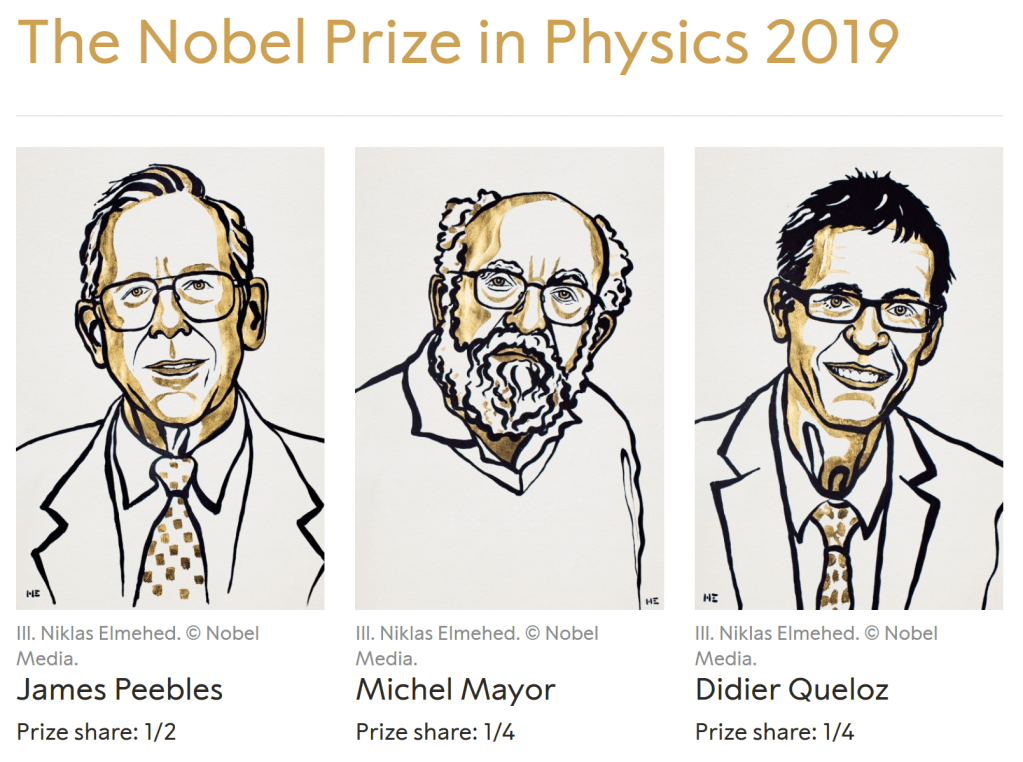
Congratulations to James Peebles, Michel Mayor, and Didier Queloz!

The 2019 Physics Nobel Prize was announced this week, awarded to James Peebles for work in cosmology and to Michel Mayor and Didier Queloz for the first observation of an exoplanet.

Peebles introduced quantitative methods to cosmology. He figured out how to use the Cosmic Microwave Background (light left over from the Big Bang) to understand how matter is distributed in our universe, including the presence of still-mysterious dark matter and dark energy. Mayor and Queloz were the first team to observe a planet outside of our solar system (an “exoplanet”), in 1995. By careful measurement of the spectrum of light coming from a star they were able to find a slight wobble, caused by a Jupiter-esque planet in orbit around it. Their discovery opened the floodgates of observation. Astronomers found many more planets than expected, showing that, far from a rare occurrence, exoplanets are quite common.

It’s a bit strange that this Nobel was awarded to two very different types of research. This isn’t the first time the prize was divided between two different discoveries, but all of the cases I can remember involve discoveries in closely related topics. This one didn’t, and I’m curious about the Nobel committee’s logic. It might have been that neither discovery “merited a Nobel” on its own, but I don’t think we’re supposed to think of shared Nobels as “lesser” than non-shared ones. It would make sense if the Nobel committee thought they had a lot of important results to “get through” and grouped them together to get through them faster, but if anything I have the impression it’s the opposite: that at least in physics, it’s getting harder and harder to find genuinely important discoveries that haven’t been acknowledged. Overall, this seems like a very weird pairing, and the Nobel committee’s citation “for contributions to our understanding of the evolution of the universe and Earth’s place in the cosmos” is a pretty loose justification.

Calabi-Yaus in Feynman Diagrams: Harder and Easier Than Expected

I’ve got a new paper up, about the weird geometrical spaces we keep finding in Feynman diagrams.

With Jacob Bourjaily, Andrew McLeod, and Matthias Wilhelm, and most recently Cristian Vergu and Matthias Volk, I’ve been digging up odd mathematics in particle physics calculations. In several calculations, we’ve found that we need a type of space called a Calabi-Yau manifold. These spaces are often studied by string theorists, who hope they represent how “extra” dimensions of space are curled up. String theorists have found an absurdly large number of Calabi-Yau manifolds, so many that some are trying to sift through them with machine learning. We wanted to know if our situation was quite that ridiculous: how many Calabi-Yaus do we really need?

So we started asking around, trying to figure out how to classify our catch of Calabi-Yaus. And mostly, we just got confused.

It turns out there are a lot of different tools out there for understanding Calabi-Yaus, and most of them aren’t all that useful for what we’re doing. We went in circles for a while trying to understand how to desingularize toric varieties, and other things that will sound like gibberish to most of you. In the end, though, we noticed one small thing that made our lives a whole lot simpler.

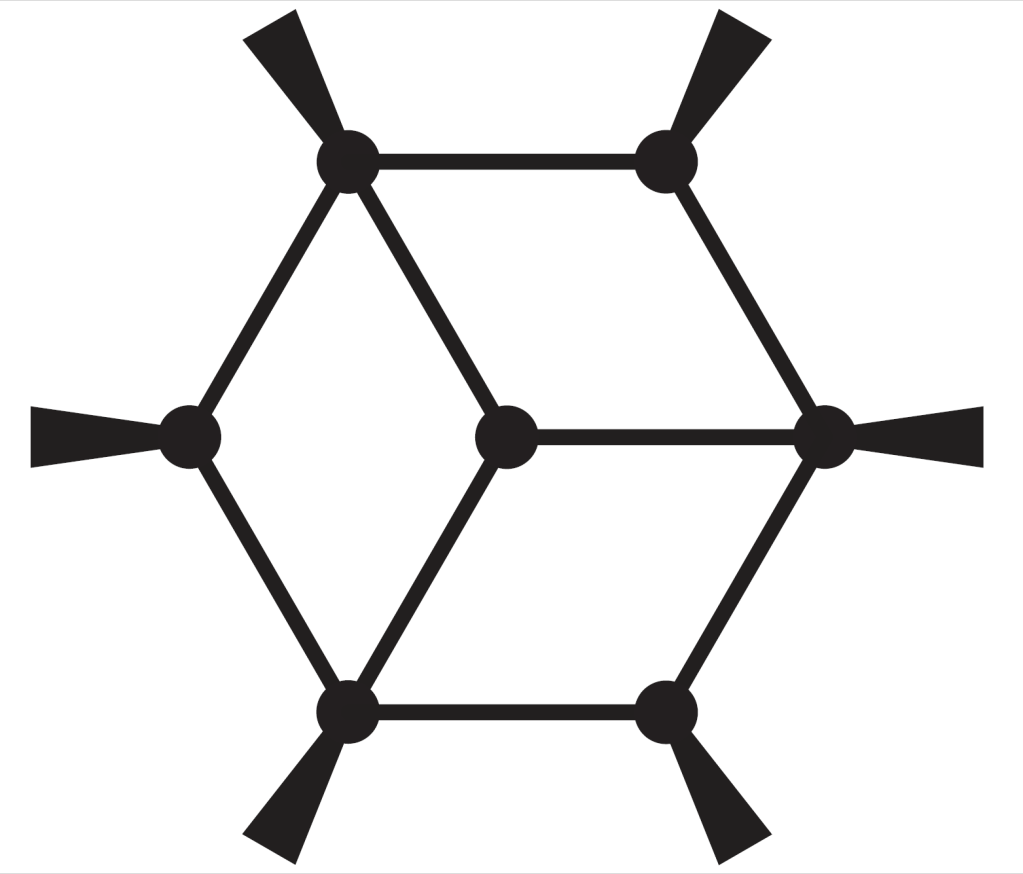
It turns out that all of the Calabi-Yaus we’ve found are, in some sense, the same. While the details of the physics varies, the overall “space” is the same in each case. It’s a space we kept finding for our “Calabi-Yau bestiary”, but it turns out one of the “traintrack” diagrams we found earlier can be written in the same way. We found another example too, a “wheel” that seems to be the same type of Calabi-Yau.

And that actually has a sensible name

We also found many examples that we don’t understand. Add another rung to our “traintrack” and we suddenly can’t write it in the same space. (Personally, I’m quite confused about this one.) Add another spoke to our wheel and we confuse ourselves in a different way.

So while our calculation turned out simpler than expected, we don’t think this is the full story. Our Calabi-Yaus might live in “the same space”, but there are also physics-related differences between them, and these we still don’t understand.

At some point, our abstract included the phrase “this paper raises more questions than it answers”. It doesn’t say that now, but it’s still true. We wrote this paper because, after getting very confused, we ended up able to say a few new things that hadn’t been said before. But the questions we raise are if anything more important. We want to inspire new interest in this field, toss out new examples, and get people thinking harder about the geometry of Feynman integrals.

Facts About Our Capabilities Are Facts About the World

A paper leaked from Google last week claimed that their researchers had achieved “quantum supremacy”, the milestone at which a quantum computer performs a calculation faster than any existing classical computer. Scott Aaronson has a great explainer about this. The upshot is that Google’s computer is much too small to crack all our encryptions (only 53 qubits, the equivalent of bits for quantum computers), but it still appears to be a genuine quantum computer doing a genuine quantum computation that is genuinely not feasible otherwise.

How impressed should we be about this?

On one hand, the practical benefits of a 53-qubit computer are pretty minimal. Scott discusses some applications: you can generate random numbers, distributed in a way that will let others verify that they are truly random, the kind of thing it’s occasionally handy to do in cryptography. Still, by itself this won’t change the world, and compared to the quantum computing hype I can understand if people find this underwhelming.

On the other hand, as Scott says, this falsifies the Extended Church-Turing Thesis! And that sounds pretty impressive, right?

Ok, I’m actually just re-phrasing what I said before. The Extended Church-Turing Thesis proposes that a classical computer (more specifically, a probabilistic Turing machine) can efficiently simulate any reasonable computation. Falsifying it means finding something that a classical computer cannot compute efficiently but another sort of computer (say, a quantum computer) can. If the calculation Google did truly can’t be done efficiently on a classical computer (this is not proven, though experts seem to expect it to be true) then yes, that’s what Google claims to have done.

So we get back to the real question: should we be impressed by quantum supremacy?

Well, should we have been impressed by the Higgs?

The detection of the Higgs boson in 2012 hasn’t led to any new Higgs-based technology. No-one expected it to. It did teach us something about the world: that the Higgs boson exists, and that it has a particular mass. I think most people accept that that’s important: that it’s worth knowing how the world works on a fundamental level.

Google may have detected the first-known violation of the Extended Church-Turing Thesis. This could eventually lead to some revolutionary technology. For now, though, it hasn’t. Instead, it teaches us something about the world.

It may not seem like it, at first. Unlike the Higgs boson, “Extended Church-Turing is false” isn’t a law of physics. Instead, it’s a fact about our capabilities. It’s a statement about the kinds of computers we can and cannot build, about the kinds of algorithms we can and cannot implement, the calculations we can and cannot do.

Facts about our capabilities are still facts about the world. They’re still worth knowing, for the same reasons that facts about the world are still worth knowing. They still give us a clearer picture of how the world works, which tells us in turn what we can and cannot do. According to the leaked paper, Google has taught us a new fact about the world, a deep fact about our capabilities. If that’s true we should be impressed, even without new technology.

The Changing Meaning of “Explain”

This is another “explanations are weird” post.

I’ve been reading a biography of James Clerk Maxwell, who formulated the theory of electromagnetism. Nowadays, we think about the theory in terms of fields: we think there is an “electromagnetic field”, filling space and time. At the time, though, this was a very unusual way to think, and not even Maxwell was comfortable with it. He felt that he had to present a “physical model” to justify the theory: a picture of tiny gears and ball bearings, somehow occupying the same space as ordinary matter.

Bang! Bang! Maxwell’s silver bearings…

Maxwell didn’t think space was literally filled with ball bearings. He did, however, believe he needed a picture that was sufficiently “physical”, that wasn’t just “mathematics”. Later, when he wrote down a theory that looked more like modern field theory, he still thought of it as provisional: a way to use Lagrange’s mathematics to ignore the unknown “real physical mechanism” and just describe what was observed. To Maxwell, field theory was a description, but not an explanation.

This attitude surprised me. I would have thought physicists in Maxwell’s day could have accepted fields. After all, they had accepted Newton.

In his time, there was quite a bit of controversy about whether Newton’s theory of gravity was “physical”. When rival models described planets driven around by whirlpools, Newton simply described the mathematics of the force, an “action at a distance”. Newton famously insisted hypotheses non fingo, “I feign no hypotheses”, and insisted that he wasn’t saying anything about why gravity worked, merely how it worked. Over time, as the whirlpool models continued to fail, people gradually accepted that gravity could be explained as action at a distance.

You’d think that this would make them able to accept fields as well. Instead, by Maxwell’s day the options for a “physical explanation” had simply been enlarged by one. Now instead of just explaining something with mechanical parts, you could explain it with action at a distance as well. Indeed, many physicists tried to explain electricity and magnetism with some sort of gravity-like action at a distance. They failed, though. You really do need fields.

The author of the biography is an engineer, not a physicist, so I find his perspective unusual at times. After discussing Maxwell’s discomfort with fields, the author says that today physicists are different: instead of insisting on a physical explanation, they accept that there are some things they just cannot know.

At first, I wanted to object: we do have physical explanations, we explain things with fields! We have electromagnetic fields and electron fields, gluon fields and Higgs fields, even a gravitational field for the shape of space-time. These fields aren’t papering over some hidden mechanism, they are the mechanism!

Are they, though?

Fields aren’t quite like the whirlpools and ball bearings of historical physicists. Sometimes fields that look different are secretly the same: the two “different explanations” will give the same result for any measurement you could ever perform. In my area of physics, we try to avoid this by focusing on the measurements instead, building as much as we can out of observable quantities instead of fields. In effect we’re going back yet another layer, another dose of hypotheses non fingo.

Physicists still ask for “physical explanations”, and still worry that some picture might be “just mathematics”. But what that means has changed, and continues to change. I don’t think we have a common standard right now, at least nothing as specific as “mechanical parts or action at a distance, and nothing else”. Somehow, we still care about whether we’ve given an explanation, or just a description, even though we can’t define what an explanation is.