A Scale of “Sure-Thing-Ness” for Experiments

No experiment is a sure thing. No matter what you do, what you test, what you observe, there’s no guarantee that you find something new. Even if you do your experiment correctly and measure what you planned to measure, nature might not tell you anything interesting.

Still, some experiments are more sure than others. Sometimes you’re almost guaranteed to learn something, even if it wasn’t what you hoped, while other times you just end up back where you started.

The first, and surest, type of experiment, is a voyage into the unknown. When nothing is known about your target, no expectations, and no predictions, then as long as you successfully measure anything you’ll have discovered something new. This can happen if the thing you’re measuring was only recently discovered. If you’re the first person who manages to measure the reaction rates of an element, or the habits of an insect, or the atmosphere of a planet, then you’re guaranteed to find out something you didn’t know before.

If you don’t have a total unknown to measure, then you want to test a clear hypothesis. The best of these are the theory killers, experiments which can decisively falsify an idea. History’s most famous experiments take this form, like the measurement of the perihelion of Mercury to test General Relativity or Pasteur’s tests of spontaneous generation. When you have a specific prediction and not much wiggle room, an experiment can teach you quite a lot.

“Not much wiggle room” is key, because these tests can all to easily become theory modifiers instead. If you can tweak your theory enough, then your experiment might not be able to falsify it. Something similar applies when you have a number of closely related theories. Even if you falsify one, you can just switch to another similar idea. In those cases, testing your theory won’t always teach you as much: you have to get lucky and see something that pins your theory down more precisely.

Finally, you can of course be just looking. Some experiments are just keeping an eye out, in the depths of space or the precision of quantum labs, watching for something unexpected. That kind of experiment might never see anything, and never rule anything out, but they can still sometimes be worthwhile.

There’s some fuzziness to these categories, of course. Often when scientists argue about whether an experiment is worth doing they’re arguing about which category to place it in. Would a new collider be a “voyage into the unknown” (new energy scales we’ve never measured before), a theory killer/modifier (supersymmetry! but which one…) or just “just looking”? Is your theory of cosmology specific enough to be “killed”, or merely “modified”? Is your wacky modification of quantum mechanics something that can be tested, or merely “just looked” for?

For any given experiment, it’s worth keeping in mind what you expect, and what would happen if you’re wrong. In science, we can’t do every experiment we want. We have to focus our resources and try to get results. Even if it’s never a sure thing.

Math Is the Art of Stating Things Clearly

Why do we use math?

In physics we describe everything, from the smallest of particles to the largest of galaxies, with the language of mathematics. Why should that one field be able to describe so much? And why don’t we use something else?

The truth is, this is a trick question. Mathematics isn’t a language like English or French, where we can choose whichever translation we want. We use mathematics because it is, almost by definition, the best choice. That is because mathematics is the art of stating things clearly.

An infinite number of mathematicians walk into a bar. The first orders a beer. The second orders half a beer. The third orders a quarter. The bartender stops them, pours two beers, and says “You guys should know your limits.”

That was an (old) joke about infinite series of numbers. You probably learned in high school that if you add up one plus a half plus a quarter…you eventually get two. To be a bit more precise:

\sum_{i=0}^\infty \frac{1}{2^i} = 1+\frac{1}{2}+\frac{1}{4}+\ldots=2

We say that this infinite sum limits to two.

But what does it actually mean for an infinite sum to limit to a number? What does it mean to sum infinitely many numbers, let alone infinitely many beers ordered by infinitely many mathematicians?

You’re asking these questions because I haven’t yet stated the problem clearly. Those of you who’ve learned a bit more mathematics (maybe in high school, maybe in college) will know another way of stating it.

You know how to sum a finite set of beers. You start with one beer, then one and a half, then one and three-quarters. Sum N beers, and you get

\sum_{i=0}^N \frac{1}{2^i}

What does it mean for the sum to limit to two?

Let’s say you just wanted to get close to two. You want to get \epsilon close, where epsilon is the Greek letter we use for really small numbers.

For every \epsilon>0 you choose, no matter how small, I can pick a (finite!) N and get at least that close. That means that, with higher and higher N, I can get as close to two as a I want.

As it turns out, that’s what it means for a sum to limit to two. It’s saying the same thing, but more clearly, without sneaking in confusing claims about infinity.

These sort of proofs, with \epsilon (and usually another variable, \delta) form what mathematicians view as the foundations of calculus. They’re immortalized in story and song.

And they’re not even the clearest way of stating things! Go down that road, and you find more mathematics: definitions of numbers, foundations of logic, rabbit holes upon rabbit holes, all from the effort to state things clearly.

That’s why I’m not surprised that physicists use mathematics. We have to. We need clarity, if we want to understand the world. And mathematicians, they’re the people who spend their lives trying to state things clearly.

What Do Theorists Do at Work?

Picture a scientist at work. You’re probably picturing an experiment, test tubes and beakers bubbling away. But not all scientists do experiments. Theoretical physicists work on the mathematical side of the field, making predictions and trying to understand how to make them better. So what does it look like when a theoretical physicist is working?

A theoretical physicist, at work in the equation mines

The first thing you might imagine is that we just sit and think. While that happens sometimes, we don’t actually do that very often. It’s better, and easier, to think by doing something.

Sometimes, this means working with pen and paper. This should be at least a little familiar to anyone who has done math homework. We’ll do short calculations and draw quick diagrams to test ideas, and do a more detailed, organized, “show your work” calculation if we’re trying to figure out something more complicated. Sometimes very short calculations are done on a blackboard instead, it can help us visualize what we’re doing.

Sometimes, we use computers instead. There are computer algebra packages, like Mathematica, Maple, or Sage, that let us do roughly what we would do on pen and paper, but with the speed and efficiency of a computer. Others program in more normal programming languages: C++, Python, even Fortran, making programs that can calculate whatever they are interested in.

Sometimes we read. With most of our field’s papers available for free on arXiv.org, we spend time reading up on what our colleagues have done, trying to understand their work and use it to improve ours.

Sometimes we talk. A paper can only communicate so much, and sometimes it’s better to just walk down the hall and ask a question. Conversations are also a good way to quickly rule out bad ideas, and narrow down to the promising ones. Some people find it easier to think clearly about something if they talk to a colleague about it, even (sometimes especially) if the colleague isn’t understanding much.

And sometimes, of course, we do all the other stuff. We write up our papers, making the diagrams nice and the formulas clean. We teach students. We go to meetings. We write grant applications.

It’s been said that a theoretical physicist can work anywhere. That’s kind of true. Some places are more comfortable, and everyone has different preferences: a busy office, a quiet room, a cafe. But with pen and paper, a computer, and people to talk to, we can do quite a lot.

The Road to Reality

I build tools, mathematical tools to be specific, and I want those tools to be useful. I want them to be used to study the real world. But when I build those tools, most of the time, I don’t test them on the real world. I use toy models, simpler cases, theories that don’t describe reality and weren’t intended to.

I do this, in part, because it lets me stay one step ahead. I can do more with those toy models, answer more complicated questions with greater precision, than I can for the real world. I can do more ambitious calculations, and still get an answer. And by doing those calculations, I can start to anticipate problems that will crop up for the real world too. Even if we can’t do a calculation yet for the real world, if it requires too much precision or too many particles, we can still study it in a toy model. Then when we’re ready to do those calculations in the real world, we know better what to expect. The toy model will have shown us some of the key challenges, and how to tackle them.

There’s a risk, working with simpler toy models. The risk is that their simplicity misleads you. When you solve a problem in a toy model, could you solve it only because the toy model is easy? Or would a similar solution work in the real world? What features of the toy model did you need, and which are extra?

The only way around this risk is to be careful. You have to keep track of how your toy model differs from the real world. You must keep in mind difficulties that come up on the road to reality: the twists and turns and potholes that real-world theories will give you. You can’t plan around all of them, that’s why you’re working with a toy model in the first place. But for a few key, important ones, you should keep your eye on the horizon. You should keep in mind that, eventually, the simplifications of the toy model will go away. And you should have ideas, perhaps not full plans but at least ideas, for how to handle some of those difficulties. If you put the work in, you stand a good chance of building something that’s useful, not just for toy models, but for explaining the real world.

Why You Might Want to Bootstrap

A few weeks back, Quanta Magazine had an article about attempts to “bootstrap” the laws of physics, starting from simple physical principles and pulling out a full theory “by its own bootstraps”. This kind of work is a cornerstone of my field, a shared philosophy that motivates a lot of what we do. Building on deep older results, people in my field have found that just a few simple principles are enough to pick out specific physical theories.

There are limits to this. These principles pick out broad traits of theories: gravity versus the strong force versus the Higgs boson. As far as we know they don’t separate more closely related forces, like the strong nuclear force and the weak nuclear force. (Originally, the Quanta article accidentally made it sound like we know why there are four fundamental forces: we don’t, and the article’s phrasing was corrected.) More generally, a bootstrap method isn’t going to tell you which principles are the right ones. For any set of principles, you can always ask “why?”

With that in mind, why would you want to bootstrap?

First, it can make your life simpler. Those simple physical principles may be clear at the end, but they aren’t always obvious at the start of a calculation. If you don’t make good use of them, you might find you’re calculating many things that violate those principles, things that in the end all add up to zero. Bootstrapping can let you skip that part of the calculation, and sometimes go straight to the answer.

Second, it can suggest possibilities you hadn’t considered. Sometimes, your simple physical principles don’t select a unique theory. Some of the options will be theories you’ve heard of, but some might be theories that never would have come up, or even theories that are entirely new. Trying to understand the new theories, to see whether they make sense and are useful, can lead to discovering new principles as well.

Finally, even if you don’t know which principles are the right ones, some principles are better than others. If there is an ultimate theory that describes the real world, it can’t be logically inconsistent. That’s a start, but it’s quite a weak requirement. There are principles that aren’t required by logic itself, but that still seem important in making the world “make sense”. Often, we appreciate these principles only after we’ve seen them at work in the real world. The best example I can think of is relativity: while Newtonian mechanics is logically consistent, it requires a preferred reference frame, a fixed notion for which things are moving and which things are still. This seemed reasonable for a long time, but now that we understand relativity the idea of a preferred reference frame seems like it should have been obviously wrong. It introduces something arbitrary into the laws of the universe, a “why is it that way?” question that doesn’t have an answer. That doesn’t mean it’s logically inconsistent, or impossible, but it does make it suspect in a way other ideas aren’t. Part of the hope of these kinds of bootstrap methods is that they uncover principles like that, principles that aren’t mandatory but that are still in some sense “obvious”. Hopefully, enough principles like that really do specify the laws of physics. And if they don’t, we’ll at least have learned how to calculate better.

Science, the Gift That Keeps on Giving

Merry Newtonmas, everyone!

You’ll find many scientists working over the holidays this year. Partly that’s because of the competitiveness of academia, with many scientists competing for a few positions, where even those who are “safe” have students who aren’t. But to put a more positive spin on it, it’s also because science is a gift that keeps on giving.

Scientists are driven by curiosity. We want to know more about the world, to find out everything we can. And the great thing about science is that, every time we answer a question, we have another one to ask.

Discover a new particle? You need to measure its properties, understand how it fits into your models and look for alternative explanations. Do a calculation, and in addition to checking it, you can see if the same method works on other cases, or if you can use the result to derive something else.

Down the line, the science that survives leads to further gifts. Good science spreads, with new fields emerging to investigate new phenomena. Eventually, science leads to technology, and our lives are enriched by the gifts of new knowledge.

Science is the gift that keeps on giving. It takes new forms, builds new ideas, it fills our lives and nourishes our minds. It’s a neverending puzzle.

So this Newtonmas, I hope you receive the greatest gift of all: the gift of science.

Calculating the Hard Way, for Science!

I had a new paper out last week, with Jacob Bourjaily and Matthias Volk. We’re calculating the probability that particles bounce off each other in our favorite toy model, N=4 super Yang-Mills. And this time, we’re doing it the hard way.

The “easy way” we didn’t take is one I have a lot of experience with. Almost as long as I’ve been writing this blog, I’ve been calculating these particle probabilities by “guesswork”: starting with a plausible answer, then honing it down until I can be confident it’s right. This might sound reckless, but it works remarkably well, letting us calculate things we could never have hoped for with other methods. The catch is that “guessing” is much easier when we know what we’re looking for: in particular, it works much better in toy models than in the real world.

Over the last few years, though, I’ve been using a much more “normal” method, one that so far has a better track record in the real world. This method, too, works better than you would expect, and we’ve managed some quite complicated calculations.

So we have an “easy way”, and a “hard way”. Which one is better? Is the hard way actually harder?

To test that, you need to do the same calculation both ways, and see which is easier. You want it to be a fair test: if “guessing” only works in the toy model, then you should do the “hard” version in the toy model as well. And you don’t want to give “guessing” any unfair advantages. In particular, the “guess” method works best when we know a lot about the result we’re looking for: what it’s made of, what symmetries it has. In order to do a fair test, we must use that knowledge to its fullest to improve the “hard way” as well.

We picked an example in the middle: not too easy, and not too hard, a calculation that was done a few years back “the easy way” but not yet done “the hard way”. We plugged in all the modern tricks we could, trying to use as much of what we knew as possible. We trained a grad student: Matthias Volk, who did the lion’s share of the calculation and learned a lot in the process. We worked through the calculation, and did it properly the hard way.

Which method won?

In the end, the hard way was indeed harder…but not by that much! Most of the calculation went quite smoothly, with only a few difficulties at the end. Just five years ago, when the calculation was done “the easy way”, I doubt anyone would have expected the hard way to be viable. But with modern tricks it wasn’t actually that hard.

This is encouraging. It tells us that the “hard way” has potential, that it’s almost good enough to compete at this kind of calculation. It tells us that the “easy way” is still quite powerful. And it reminds us that the more we know, and the more we apply our knowledge, the more we can do.

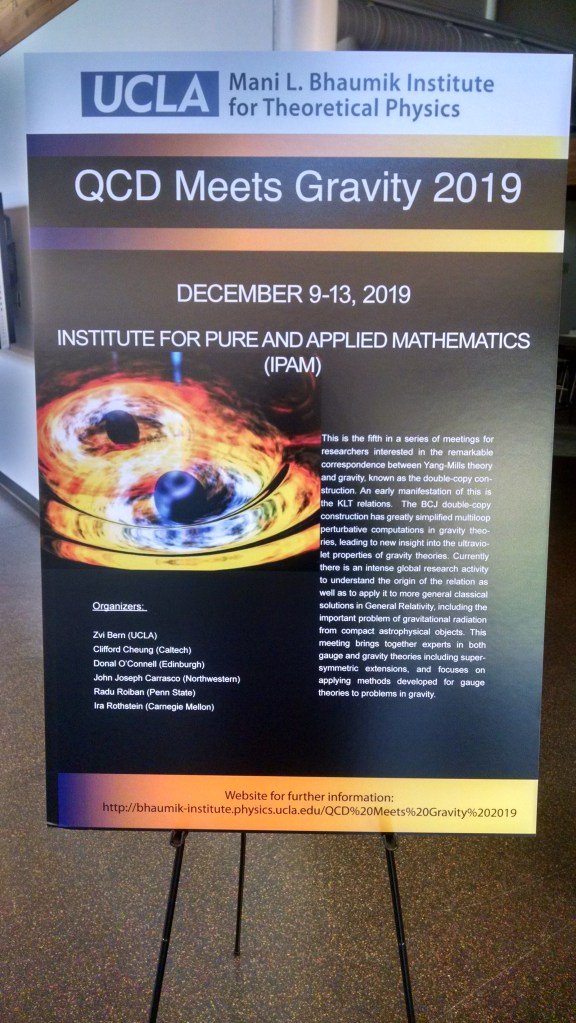
QCD Meets Gravity 2019

I’m at UCLA this week for QCD Meets Gravity, a conference about the surprising ways that gravity is “QCD squared”.

When I attended this conference two years ago, the community was branching out into a new direction: using tools from particle physics to understand the gravitational waves observed at LIGO.

At this year’s conference, gravitational waves have grown from a promising new direction to a large fraction of the talks. While there were still the usual talks about quantum field theory and string theory (everything from bootstrap methods to a surprising application of double field theory), gravitational waves have clearly become a major focus of this community.

This was highlighted before the first talk, when Zvi Bern brought up a recent paper by Thibault Damour. Bern and collaborators had recently used particle physics methods to push beyond the state of the art in gravitational wave calculations. Damour, an expert in the older methods, claims that Bern et al’s result is wrong, and in doing so also questions an earlier result by Amati, Ciafaloni, and Veneziano. More than that, Damour argued that the whole approach of using these kinds of particle physics tools for gravitational waves is misguided.

There was a lot of good-natured ribbing of Damour in the rest of the conference, as well as some serious attempts to confront his points. Damour’s argument so far is somewhat indirect, so there is hope that a more direct calculation (which Damour is currently pursuing) will resolve the matter. In the meantime, Julio Parra-Martinez described a reproduction of the older Amati/Ciafaloni/Veneziano result with more Damour-approved techniques, as well as additional indirect arguments that Bern et al got things right.

Before the QCD Meets Gravity community worked on gravitational waves, other groups had already built a strong track record in the area. One encouraging thing about this conference was how much the two communities are talking to each other. Several speakers came from the older community, and there were a lot of references in both groups’ talks to the other group’s work. This, more than even the content of the talks, felt like the strongest sign that something productive is happening here.

Many talks began by trying to motivate these gravitational calculations, usually to address the mysteries of astrophysics. Two talks were more direct, with Ramy Brustein and Pierre Vanhove speculating about new fundamental physics that could be uncovered by these calculations. I’m not the kind of physicist who does this kind of speculation, and I confess both talks struck me as rather strange. Vanhove in particular explicitly rejects the popular criterion of “naturalness”, making me wonder if his work is the kind of thing critics of naturalness have in mind.

Life Cycle of an Academic Scientist

So you want to do science for a living. Some scientists work for companies, developing new products. Some work for governments. But if you want to do “pure science”, science just to learn about the world, then you’ll likely work at a university, as part of what we call academia.

The first step towards academia is graduate school. In the US, this means getting a PhD.

(Master’s degrees, at least in the US, have a different purpose. Most are “terminal Master’s”, designed to be your last degree. With a terminal Master’s, you can be a technician in a lab, but you won’t get farther down this path. In the US you don’t need a Master’s before you apply for a PhD program, and having one is usually a waste of time: PhD programs will make you re-take most of the same classes.)

Once you have a PhD, it’s time to get a job! Often, your first job after graduate school is a postdoc. Postdocs are short-term jobs, usually one to three years long. Some people are lucky enough to go to the next stage quickly, others have more postdoc jobs first. These jobs will take you all over the world, everywhere people with your specialty work. Sometimes these jobs involve teaching, but more often you just do scientific research.

In the US system, If everything goes well, eventually you get a tenure-track job. These jobs involve both teaching and research. You get to train PhD students, hire postdocs, and in general start acting like a proper professor. This stage lasts around seven years, while the university evaluates you. If they decide you’re not worth it then typically you’ll have to leave to apply for another job in another university. If they like you though, you get tenure.

Tenure is the first time as an academic scientist that you aren’t on a short-term contract. Your job is more permanent than most, you have extra protection from being fired that most people don’t. While you can’t just let everything slide, you have freedom to make more of your own decisions.

A tenured job can last until retirement, when you become an emeritus professor. Emeritus professors are retired but still do some of the work they did as professors. They’re paid out of their pension instead of a university salary, but they still sometimes teach or do research, and they usually still have an office. The university can hire someone new, and the cycle continues.

This isn’t the only path scientists take. Some work in a national lab instead. These don’t usually involve teaching duties, and the path to a permanent job is a bit different. Some get teaching jobs instead of research professorships. These teaching jobs are usually not permanent, instead universities are hiring more and more adjunct faculty who have to string together temporary contracts to make a precarious living.

I’ve mostly focused on the US system here. Europe is a bit different: Master’s degrees are a real part of the system, tenure-track doesn’t really exist, and adjunct faculty don’t always either. Some particular countries, like Germany, have their own quite complicated systems, other countries fall in between.

The Teaching Heuristic for Non-Empirical Science

Science is by definition empirical. We discover how the world works not by sitting and thinking, but by going out and observing the world. But sometimes, all the observing we can do can’t possibly answer a question. In those situations, we might need “non-empirical science”.

The blog Slate Star Codex had a series of posts on this topic recently. He hangs out with a crowd that supports the many-worlds interpretation of quantum mechanics: the idea that quantum events are not truly random, but instead that all outcomes happen, the universe metaphorically splitting into different possible worlds. These metaphorical universes can’t be observed, so no empirical test can tell the difference between this and other interpretations of quantum mechanics: if we could ever know the difference, it would have to be for “non-empirical” reasons.

What reasons are those? Slate Star Codex teases out a few possible intuitions. He points out that we reject theories that have “unnecessary” ideas. He imagines a world where chemists believe that mixing an acid and a base also causes a distant star to go supernova, and a creationist world where paleontologists believe fossils are placed by the devil. In both cases, there might be no observable difference between their theories and ours, but because their theories have “extra pieces” (the distant star, the devil), we reject them for non-empirical reasons. Slate Star Codex asks if this supports many-worlds: without the extra assumption that quantum events randomly choose one outcome, isn’t quantum mechanics simpler?

I agree with some of this. Science really does use non-empirical reasoning. Without it, there’s no reason not to treat the world as a black box, a series of experiments with no mechanism behind it. But while we do reject theories with unnecessary ideas, that isn’t our only standard. We also need our theories to teach us about the world.

Ultimately, we trust science because it allows us to do things. If we understand the world, we can interact with it: we can build technology, design new experiments, and propose new theories. With this in mind, we can judge scientific theories by how well they help us do these things. A good scientific theory is one that gives us more power to interact with the world. It can do this by making correct predictions, but it can also do this by explaining things, making it easier for us to reason about them. Beyond empiricism, we can judge science by how well it teaches us.

This gives us an objection to the “supernova theory” of Slate Star Codex’s imagined chemists: it’s much more confusing to teach. To teach chemistry in that world you also have to teach the entire life cycle of stars, a subject that students won’t use in any other part of the course. The creationists’ “devil theory” of paleontology has the same problem: if their theory really makes the right predictions they’d have to teach students everything our paleontologists do: every era of geologic history, every theory of dinosaur evolution, plus an extra course in devil psychology. They end up with a mix that only makes it harder to understand the subject.

Many-worlds may seem simpler than other interpretations of quantum mechanics, but that doesn’t make it more useful, or easier to teach. You still need to teach students how to predict the results of experiments, and those results will still be random. If you teach them many-worlds, you need to add more discussion much earlier on, advanced topics like self-localizing uncertainty and decoherence. You need a quite extensive set of ideas, many of which won’t be used again, to justify rules another interpretation could have introduced much more simply. This would be fine if those ideas made additional predictions, but they don’t: like every interpretation of quantum mechanics, you end up doing the same experiments and building the same technology in the end.

I’m not saying I know many-worlds is false, or that I know another interpretation is true. All I’m saying is that, when physicists criticize many-worlds, they’re not just blindly insisting on empiricism. They’re rejecting many-worlds, in part, because all it does is make their work harder. And that, more than elegance or simplicity, is how we judge theories.