What’s a Cosmic String?

Nowadays, we have telescopes that detect not just light, but gravitational waves. We’ve already learned quite a bit about astrophysics from these telescopes. They observe ripples coming from colliding black holes, giving us a better idea of what kinds of black holes exist in the universe. But the coolest thing a gravitational wave telescope could discover is something that hasn’t been seen yet: a cosmic string.
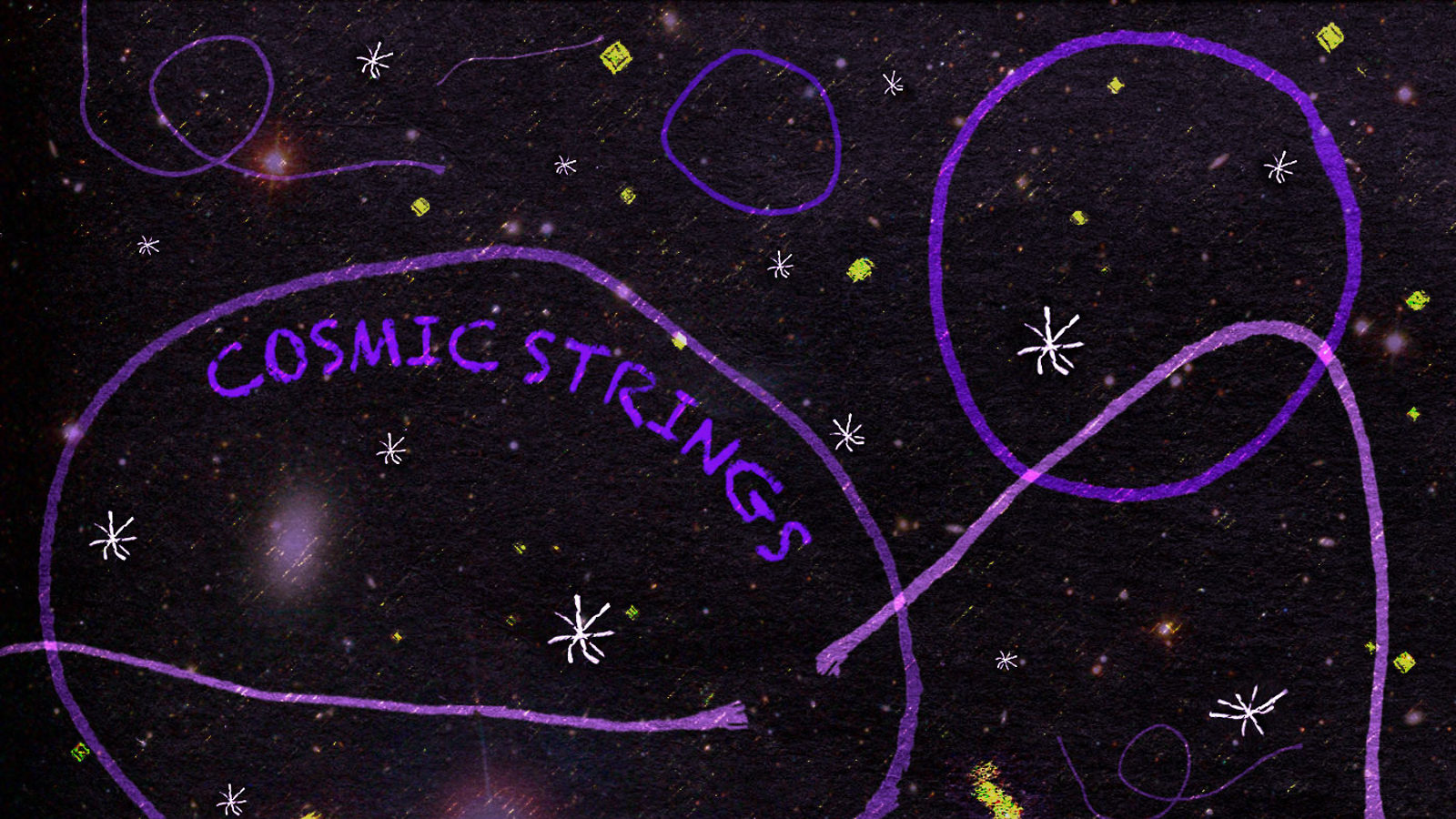
This art is from an article in Symmetry magazine which is, as far as I can tell, not actually about cosmic strings.

You might have heard of cosmic strings, but unless you’re a physicist you probably don’t know much about them. They’re a prediction, coming from cosmology, of giant string-like objects floating out in space.

That might sound like it has something to do with string theory, but it doesn’t actually have to, you can have these things without any string theory at all. Instead, you might have heard that cosmic strings are some kind of “cracks” or “wrinkles” in space-time. Some articles describe this as like what happens when ice freezes, cracks forming as water settles into a crystal.

That description, in terms of ice forming cracks between crystals, is great…if you’re a physicist who already knows how ice forms cracks between crystals. If you’re not, I’m guessing reading those kinds of explanations isn’t helpful. I’m guessing you’re still wondering why there ought to be any giant strings floating in space.

The real explanation has to do with a type of mathematical gadget physicists use, called a scalar field. You can think of a scalar field as described by a number, like a temperature, that can vary in space and time. The field carries potential energy, and that energy depends on what the scalar field’s “number” is. Left alone, the field settles into a situation with as little potential energy as it can, like a ball rolling down a hill. That situation is one of the field’s default values, something we call a “vacuum” value. Changing the field away from its vacuum value can take a lot of energy. The Higgs boson is one example of a scalar field. Its vacuum value is the value it has in day to day life. In order to make a detectable Higgs boson at the Large Hadron Collider, they needed to change the field away from its vacuum value, and that took a lot of energy.

In the very early universe, almost back at the Big Bang, the world was famously in a hot dense state. That hot dense state meant that there was a lot of energy to go around, so scalar fields could vary far from their vacuum values, pretty much randomly. As the universe expanded and cooled, there was less and less energy available for these fields, and they started to settle down.

Now, the thing about these default, “vacuum” values of a scalar field is that there doesn’t have to be just one of them. Depending on what kind of mathematical function the field’s potential energy is, there could be several different possibilities each with equal energy.

Let’s imagine a simple example, of a field with two vacuum values: +1 and -1. As the universe cooled down, some parts of the universe would end up with that scalar field number equal to +1, and some to -1. But what happens in between?

The scalar field can’t just jump from -1 to +1, that’s not allowed in physics. It has to pass through 0 in between. But, unlike -1 and +1, 0 is not a vacuum value. When the scalar field number is equal to 0, the field has more energy than it does when it’s equal to -1 or +1. Usually, a lot more energy.

That means the region of scalar field number 0 can’t spread very far: the further it spreads, the more energy it takes to keep it that way. On the other hand, the region can’t vanish altogether: something needs to happen to transition between the numbers -1 and +1.

The thing that happens is called a domain wall. A domain wall is a thin sheet, as thin as it can physically be, where the scalar field doesn’t take its vacuum value. You can roughly think of it as made up of the scalar field, a churning zone of the kind of bosons the LHC was trying to detect.

This sheet still has a lot of energy, bound up in the unusual value of the scalar field, like an LHC collision in every proton-sized chunk. As such, like any object with a lot of energy, it has a gravitational field. For a domain wall, the effect of this gravity would be very very dramatic: so dramatic, that we’re pretty sure they’re incredibly rare. If they were at all common, we would have seen evidence of them long before now!

Ok, I’ve shown you a wall, that’s weird, sure. What does that have to do with cosmic strings?
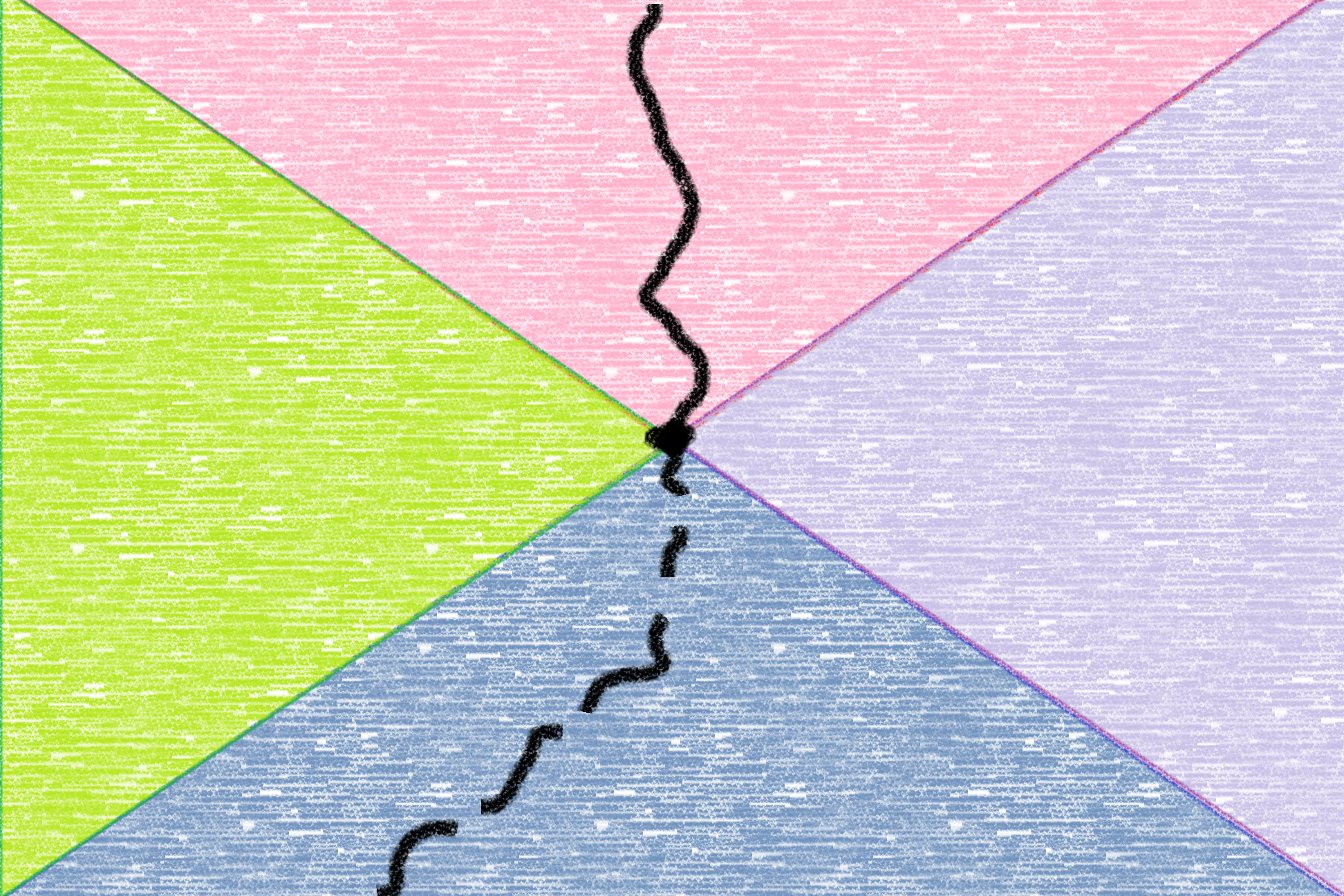
The number representing a scalar field doesn’t have to be a real number: it can be imaginary instead, or even complex. Now I’d like you to imagine a field with vacuum values on the unit circle, in the complex plane. That means that +1 and -1 are still vacuum values, but so are e^{i \pi/2}, and e^{3 i \pi/2}, and everything else you can write as e^{i\theta}. However, 0 is still not a vacuum value. Neither is, for example, 2 e^{i\pi/3}.

With vacuum values like this, you can’t form domain walls. You can make a path between -1 and +1 that only goes through the unit circle, through e^{i \pi/2} for example. The field will be at its vacuum value throughout, taking no extra energy.

However, imagine the different regions form a circle. In the picture above, suppose that the blue area at the bottom is at vacuum value -1 and red is at +1. You might have e^{i \pi/2} in the green region, and e^{3 i \pi/2} in the purple region, covering the whole circle smoothly as you go around.

Now, think about what happens in the middle of the circle. On one side of the circle, you have -1. On the other, +1. (Or, on one side e^{i \pi/2}, on the other, e^{3 i \pi/2}). No matter what, different sides of the circle are not allowed to be next to each other, you can’t just jump between them. So in the very middle of the circle, something else has to happen.

Once again, that something else is a field that goes away from its vacuum value, that passes through 0. Once again, that takes a lot of energy, so it occupies as little space as possible. But now, that space isn’t a giant wall. Instead, it’s a squiggly line: a cosmic string.

Cosmic strings don’t have as dramatic a gravitational effect as domain walls. That means they might not be super-rare. There might be some we haven’t seen yet. And if we do see them, it could be because they wiggle space and time, making gravitational waves.

Cosmic strings don’t require string theory, they come from a much more basic gadget, scalar fields. We know there is one quite important scalar field, the Higgs field. The Higgs vacuum values aren’t like +1 and -1, or like the unit circle, though, so the Higgs by itself won’t make domain walls or cosmic strings. But there are a lot of proposals for scalar fields, things we haven’t discovered but that physicists think might answer lingering questions in particle physics, and some of those could have the right kind of vacuum values to give us cosmic strings. Thus, if we manage to detect cosmic strings, we could learn something about one of those lingering questions.

Why Are Universities So International?

Worldwide, only about one in thirty people live in a different country from where they were born. Wander onto a university campus, though, and you may get a different impression. The bigger the university and the stronger its research, the more international its employees become. You’ll see international PhD students, international professors, and especially international temporary researchers like postdocs.

I’ve met quite a few people who are surprised by this. I hear the same question again and again, from curious Danes at outreach events to a tired border guard in the pre-clearance area of the Toronto airport: why are you, an American, working here?

It’s not, on the face of it, an unreasonable question. Moving internationally is hard and expensive. You may have to take your possessions across the ocean, learn new languages and customs, and navigate an unfamiliar bureaucracy. You begin as a temporary resident, not a citizen, with all the risks and uncertainty that involves. Given a choice, most people choose to stay close to home. Countries sometimes back up this choice with additional incentives. There are laws in many places that demand that, given a choice, companies hire a local instead of a foreigner. In some places these laws apply to universities as well. With all that weight, why do so many researchers move abroad?

Two different forces stir the pot, making universities international: specialization, and diversification.

Researchers may find it easier to live close to people who grew up with us, but we work better near people who share our research interests. Science, and scholarship more generally, are often collaborative: we need to discuss with and learn from others to make progress. That’s still very hard to do remotely: it requires serendipity, chance encounters in the corridor and chats at the lunch table. As researchers in general have become more specialized, we’ve gotten to the point where not just any university will do: the people who do our kind of work are few enough that we often have to go to other countries to find them.

Specialization alone would tend to lead to extreme clustering, with researchers in each area gathering in only a few places. Universities push back against this, though. A university wants to maximize the chance that one of their researchers makes a major breakthrough, so they don’t want to hire someone whose work will just be a copy of someone they already have. They want to encourage interdisciplinary collaboration, to try to get people in different areas to talk to each other. Finally, they want to offer a wide range of possible courses, to give the students (many of whom are still local), a chance to succeed at many different things. As a result, universities try to diversify their faculty, to hire people from areas that, while not too far for meaningful collaboration, are distinct from what their current employees are doing.

The result is a constant international churn. We search for jobs in a particular sweet spot: with people close enough to spur good discussion, but far enough to not overspecialize. That search takes us all over the world, and all but guarantees we won’t find a job where we were trained, let alone where we were born. It makes universities quite international places, with a core of local people augmented by opportune choices from around the world. It makes us, and the way we lead our lives, quite unusual on a global scale. But it keeps the science fresh, and the ideas moving.

AI Is the Wrong Sci-Fi Metaphor

Over the last year, some people felt like they were living in a science fiction novel. Last November, the research laboratory OpenAI released ChatGPT, a program that can answer questions on a wide variety of topics. Last month, they announced GPT-4, a more powerful version of ChatGPT’s underlying program. Already in February, Microsoft used GPT-4 to add a chatbot feature to its search engine Bing, which journalists quickly managed to use to spin tales of murder and mayhem.

For those who have been following these developments, things don’t feel quite so sudden. Already in 2019, AI Dungeon showed off how an early version of GPT could be used to mimic an old-school text-adventure game, and a tumblr blogger built a bot that imitates his posts as a fun side project. Still, the newer programs have shown some impressive capabilities.

Are we close to “real AI”, to artificial minds like the positronic brains in Isaac Asimov’s I, Robot? I can’t say, in part because I’m not sure what “real AI” really means. But if you want to understand where things like ChatGPT come from, how they work and why they can do what they do, then all the talk of AI won’t be helpful. Instead, you need to think of an entirely different set of Asimov novels: the Foundation series.

While Asimov’s more famous I, Robot focused on the science of artificial minds, the Foundation series is based on a different fictional science, the science of psychohistory. In the stories, psychohistory is a kind of futuristic social science. In the real world, historians and sociologists can find general principles of how people act, but don’t yet have the kind of predictive theories physicists or chemists do. Foundation imagines a future where powerful statistical methods have allowed psychohistorians to precisely predict human behavior: not yet that of individual people, but at least the average behavior of civilizations. They can not only guess when an empire is soon to fall, but calculate how long it will be before another empire rises, something few responsible social scientists would pretend to do today.

GPT and similar programs aren’t built to predict the course of history, but they do predict something: given part of a text, they try to predict the rest. They’re called Large Language Models, or LLMs for short. They’re “models” in the sense of mathematical models, formulas that let us use data to make predictions about the world, and the part of the world they model is our use of language.

Normally, a mathematical model is designed based on how we think the real world works. A mathematical model of a pandemic, for example, might use a list of people, each one labeled as infected or not. It could include an unknown number, called a parameter, for the chance that one person infects another. That parameter would then be filled in, or fixed, based on observations of the pandemic in the real world.

LLMs (as well as most of the rest of what people call “AI” these days) are a bit different. Their models aren’t based on what we expect about the real world. Instead, they’re in some sense “generic”, models that could in principle describe just about anything. In order to make this work, they have a lot more parameters, tons and tons of flexible numbers that can get fixed in different ways based on data.

(If that part makes you a bit uncomfortable, it bothers me too, though I’ve mostly made my peace with it.)

The surprising thing is that this works, and works surprisingly well. Just as psychohistory from the Foundation novels can predict events with much more detail than today’s historians and sociologists, LLMs can predict what a text will look like much more precisely than today’s literature professors. That isn’t necessarily because LLMs are “intelligent”, or because they’re “copying” things people have written. It’s because they’re mathematical models, built by statistically analyzing a giant pile of texts.

Just as Asimov’s psychohistory can’t predict the behavior of individual people, LLMs can’t predict the behavior of individual texts. If you start writing something, you shouldn’t expect an LLM to predict exactly how you would finish. Instead, LLMs predict what, on average, the rest of the text would look like. They give a plausible answer, one of many, for what might come next.

They can’t do that perfectly, but doing it imperfectly is enough to do quite a lot. It’s why they can be used to make chatbots, by predicting how someone might plausibly respond in a conversation. It’s why they can write fiction, or ads, or college essays, by predicting a plausible response to a book jacket or ad copy or essay prompt.

LLMs like GPT were invented by computer scientists, not social scientists or literature professors. Because of that, they get described as part of progress towards artificial intelligence, not as progress in social science. But if you want to understand what ChatGPT is right now, and how it works, then that perspective won’t be helpful. You need to put down your copy of I, Robot and pick up Foundation. You’ll still be impressed, but you’ll have a clearer idea of what could come next.

Building the Railroad to Rigor

As a kid who watched far too much educational television, I dimly remember learning about the USA’s first transcontinental railroad. Somehow, parts of the story stuck with me. Two companies built the railroad from different directions, one from California and the other from the middle of the country, aiming for a mountain in between. Despite the US Civil War happening around this time, the two companies built through, in the end racing to where the final tracks were laid with a golden spike.

I’m a theoretical physicist, so of course I don’t build railroads. Instead, I build new mathematical methods, ways to check our theories of particle physics faster and more efficiently. Still, something of that picture resonates with me.

You might think someone who develops new mathematical methods would be a mathematician, not a physicist. But while there are mathematicians who work on the problems I work on, their goals are a bit different. They care about rigor, about stating only things they can carefully prove. As such, they often need to work with simplified examples, “toy models” well-suited to the kinds of theorems they can build.

Physicists can be a bit messier. We don’t always insist on the same rigor the mathematicians do. This makes our results less reliable, but it makes our “toy models” a fair amount less “toy”. Our goal is to try to tackle questions closer to the actual real world.

What happens when physicists and mathematicians work on the same problem?

If the physicists worked alone, they might build and build, and end up with an answer that isn’t actually true. The mathematicians, keeping rigor in mind, would be safe in the truth of what they built, but might not end up anywhere near the physicists’ real-world goals.

Together, though, physicists and mathematicians can build towards each other. The physicists can keep their eyes on the mathematicians, correcting when they notice something might go wrong and building more and more rigor into their approach. The mathematicians can keep their eyes on the physicists, building more and more complex applications of their rigorous approaches to get closer and closer to the real world. Eventually, like the transcontinental railroad, the two groups meet: the mathematicians prove a rigorous version of the physicists’ approach, or the physicists adopt the mathematicians’ ideas and apply them to their own theories.

A sort of conference photo

In practice, it isn’t just two teams, physicists and mathematicians, building towards each other. Different physicists themselves work with different levels of rigor, aiming to understand different problems in different theories, and the mathematicians do the same. Each of us is building our own track, watching the other tracks build towards us on the horizon. Eventually, we’ll meet, and science will chug along over what we’ve built.

At Geometries and Special Functions for Physics and Mathematics in Bonn

I’m at a workshop this week. It’s part of a series of “Bethe Forums”, cozy little conferences run by the Bethe Center for Theoretical Physics in Bonn.

You can tell it’s an institute for theoretical physics because they have one of these, but not a “doing room”

The workshop’s title, “Geometries and Special Functions for Physics and Mathematics”, covers a wide range of topics. There are talks on Calabi-Yau manifolds, elliptic (and hyper-elliptic) polylogarithms, and cluster algebras and cluster polylogarithms. Some of the talks are by mathematicians, others by physicists.

In addition to the talks, this conference added a fun innovative element, “my favorite problem sessions”. The idea is that a speaker spends fifteen minutes introducing their “favorite problem”, then the audience spends fifteen minutes discussing it. Some treated these sessions roughly like short talks describing their work, with the open directions at the end framed as their favorite problem. Others aimed broader, trying to describe a general problem and motivate interest in people of other sub-fields.

This was a particularly fun conference for me, because the seemingly distinct topics all connect in one way or another to my own favorite problem. In our “favorite theory” of N=4 super Yang-Mills, we can describe our calculations in terms of an “alphabet” of pieces that let us figure out predictions almost “by guesswork”. These alphabets, at least in the cases we know how to handle, turn out to correspond to mathematical structures called cluster algebras. If we look at interactions of six or seven particles, these cluster algebras are a powerful guide. For eight or nine, they still seem to matter, but are much harder to use.

For ten particles, though, things get stranger. That’s because ten particles is precisely where elliptic curves, and their related elliptic polylogarithms, show up. Things then get yet more strange, and with twelve particles or more we start seeing Calabi-Yau manifolds magically show up in our calculations.

We don’t know what an “alphabet” should look like for these Calabi-Yau manifolds (but I’m working on it). Because of that, we don’t know how these cluster algebras should appear.

In my view, any explanation for the role of cluster algebras in our calculations has to extend to these cases, to elliptic polylogarithms and Calabi-Yau manifolds. Without knowing how to frame an alphabet for these things, we won’t be able to solve the lingering mysteries that fill our field.

Because of that, “my favorite problem” is one of my biggest motivations, the question that drives a large chunk of what I do. It’s what’s made this conference so much fun, and so stimulating: almost every talk had something I wanted to learn.

Talking and Teaching

Someone recently shared with me an article written by David Mermin in 1992 about physics talks. Some aspects are dated (our slides are no longer sheets of plastic, and I don’t think anyone writing an article like that today would feel the need to put it in the mouth of a fictional professor (which is a shame honestly)), but most of it still holds true. I particularly recognized the self-doubt of being a young physicist sitting in a talk and thinking “I’m supposed to enjoy this?”

Mermin’s basic point is to keep things as light as possible. You want to convey motivation more than content, and background more than your own contributions. Slides should be sparse, both because people won’t be able to see everything but also because people can get frustrated “reading ahead” of what you say.

Mermin’s suggestion that people read from a prepared text was probably good advice for him, but maybe not for others. It can be good if you can write like he does, but I don’t think most people’s writing is that much better than what they say in talks (you can judge this by reading peoples’ papers!) Some are much clearer speaking impromptu. I agree with him that in practice people end up just reading from their slides, which indeed is bad, but reading from a normal physics paper isn’t any better.

I also don’t completely agree with him about the value of speech over text. Yes, putting text on your slides means people can read ahead (unless you hide some of the text, which is easier to do these days than in the days of overhead transparencies). But just saying things means that if someone’s attention lapses for just a moment, they’ll be lost. Unless you repeat yourself a lot (good practice in any case), you should avoid just saying anything you need your audience to remember, and make sure they can read it somewhere if they need it as well.

That said, “if they need it” is doing a lot of work here, and this is where I agree again with Mermin. Fundamentally, you don’t need to convey everything you think you do. (I don’t usually need to convey everything I think I do!) It’s a lesson I’ve been learning this year from pedagogy courses, a message they try to instill in everyone who teaches at the university. If you want to really convey something well, then you just can’t convey that much. You need to focus, pick a few things and try to get them across, and structure the rest of what you say to reinforce those things. When teaching, or when speaking, less is more.

On Stubbornness and Breaking Down

In physics, we sometimes say that an idea “breaks down”. What do we mean by that?

When a theory “breaks down”, we mean that it stops being accurate. Newton’s theory of gravity is excellent most of the time, but for objects under strong enough gravity or high enough speed its predictions stop matching reality and a new theory (relativity) is needed. This is the sense in which we say that Newtonian gravity breaks down for the orbit of mercury, or breaks down much more severely in the area around a black hole.

When a symmetry is “broken”, we mean that it stops holding true. Most of physics looks the same when you flip it in a mirror, a property called parity symmetry. Take a pile of electric and magnetic fields, currents and wires, and you’ll find their mirror reflection is also a perfectly reasonable pile of electric and magnetic fields, currents and wires. This isn’t true for all of physics, though: the weak nuclear force isn’t the same when you flip it in a mirror. We say that the weak force breaks parity symmetry.

What about when a more general “idea” breaks down? What about space-time?

In order for space-time to break down, there needs to be a good reason to abandon the idea. And depending on how stubborn you are about it, that reason can come at different times.

You might think of space-time as just Einstein’s theory of general relativity. In that case, you could say that space-time breaks down as soon as the world deviates from that theory. In that view, any modification to general relativity, no matter how small, corresponds to space-time breaking down. You can think of this as the “least stubborn” option, the one with barely any stubbornness at all, that will let space-time break down with a tiny nudge.

But if general relativity breaks down, a slightly more stubborn person could insist that space-time is still fine. You can still describe things as located at specific places and times, moving across curved space-time. They just obey extra forces, on top of those built into the space-time.

Such a person would be happy as long as general relativity was a good approximation of what was going on, but they might admit space-time has broken down when general relativity becomes a bad approximation. If there are only small corrections on top of the usual space-time picture, then space-time would be fine, but if those corrections got so big that they overwhelmed the original predictions of general relativity then that’s quite a different situation. In that situation, space-time may have stopped being a useful description, and it may be much better to describe the world in another way.

But we could imagine an even more stubborn person who still insists that space-time is fine. Ultimately, our predictions about the world are mathematical formulas. No matter how complicated they are, we can always subtract a piece off of those formulas corresponding to the predictions of general relativity, and call the rest an extra effect. That may be a totally useless thing to do that doesn’t help you calculate anything, but someone could still do it, and thus insist that space-time still hasn’t broken down.

To convince such a person, space-time would need to break down in a way that made some important concept behind it invalid. There are various ways this could happen, corresponding to different concepts. For example, one unusual proposal is that space-time is non-commutative. If that were true then, in addition to the usual Heisenberg uncertainty principle between position and momentum, there would be an uncertainty principle between different directions in space-time. That would mean that you can’t define the position of something in all directions at once, which many people would agree is an important part of having a space-time!

Ultimately, physics is concerned with practicality. We want our concepts not just to be definable, but to do useful work in helping us understand the world. Our stubbornness should depend on whether a concept, like space-time, is still useful. If it is, we keep it. But if the situation changes, and another concept is more useful, then we can confidently say that space-time has broken down.

Visiting CERN

So, would you believe I’ve never visited CERN before?

I was at CERN for a few days this week, visiting friends and collaborators and giving an impromptu talk. Surprisingly, this is the first time I’ve been, a bit of an embarrassing admission for someone who’s ostensibly a particle physicist.

Despite that, CERN felt oddly familiar. The maze of industrial buildings and winding roads, the security gates and cards (and work-arounds for when you arrive outside of card-issuing hours, assisted by friendly security guards), the constant construction and remodeling, all of it reminded me of the times I visited SLAC during my PhD. This makes a lot of sense, of course: one accelerator is at least somewhat like another. But besides a visit to Fermilab for a conference several years ago, I haven’t been in many other places like that since then.

(One thing that might have also been true of SLAC and Fermilab but I never noticed: CERN buildings not only have evacuation instructions for the building in case of a fire, but also evacuation instructions for the whole site.)

CERN is a bit less “pretty” than SLAC on average, without the nice grassy area in the middle or the California sun that goes with it. It makes up for it with what seems like more in terms of outreach resources, including a big wooden dome of a mini-museum sponsored by Rolex, and a larger visitor center still under construction.

The outside, including a sculpture depicting the history of science with the Higgs boson discovery on the “cutting edge”
The inside. Bubbles on the ground contain either touchscreens or small objects (detectors, papers, a blackboard with the string theory genus expansion for some reason). Bubbles in the air were too high for me to check.

CERN hosts a variety of theoretical physicists doing various different types of work. I was hosted by the “QCD group”, but the string theorists just down the hall include a few people I know as well. The lounge had a few cardboard signs hidden under the table, leftovers of CERN’s famous yearly Christmas play directed by John Ellis.

It’s been a fun, if brief, visit. I’ll likely get to see a bit more this summer, when they host Amplitudes 2023. Until then, it was fun reconnecting with that “accelerator feel”.

The Temptation of Spinoffs

Read an argument for a big scientific project, and you’ll inevitably hear mention of spinoffs. Whether it’s NASA bringing up velcro or CERN and the World-Wide Web, scientists love to bring up times when a project led to some unrelated technology that improved peoples’ lives.

Just as inevitably as they show up, though, these arguments face criticism. Advocates of the projects argue that promoting spinoffs misses the point, training the public to think about science in terms of unrelated near-term gadgets rather than the actual point of the experiments. They think promoters should focus on the scientific end-goals, justifying them either in terms of benefit to humanity or as a broader, “it makes the country worth defending” human goal. It’s a perspective that shows up in education too, where even when students ask “when will I ever use this in real life?” it’s not clear that’s really what they mean.

On the other side, opponents of the projects will point out that the spinoffs aren’t good enough to justify the science. Some, like velcro, weren’t actually spinoffs to begin with. Others seem like tiny benefits compared to the vast cost of the scientific projects, or like things that would have been much easier to get with funding that was actually dedicated to achieving the spinoff.

With all these downsides, why do people keep bringing spinoffs up? Are they just a cynical attempt to confuse people?

I think there’s something less cynical going on here. Things make a bit more sense when you listen to what the scientists say, not to the public, but when talking to scientists in other disciplines.

Scientists speaking to fellow scientists still mention spinoffs, but they mention scientific spinoffs. The speaker in a talk I saw recently pointed out that the LHC doesn’t just help with particle physics: by exploring the behavior of collisions of high-energy atomic nuclei it provides essential information for astrophysicists understanding neutron stars and cosmologists studying the early universe. When these experiments study situations we can’t model well, they improve the approximations we use to describe those situations in other contexts. By knowing more, we know more. Knowledge builds on knowledge, and the more we know about the world the more we can do, often in surprising and un-planned ways.

I think that when scientists promote spinoffs to the public, they’re trying to convey this same logic. Like promoting an improved understanding of stars to astrophysicists, they’re modeling the public as “consumer goods scientists” and trying to pick out applications they’d find interesting.

Knowing more does help us know more, that much is true. And eventually that knowledge can translate to improving people’s lives. But in a public debate, people aren’t looking for these kinds of principles, let alone a scientific “I’ll scratch your back if you’ll scratch mine”. They’re looking for something like a cost-benefit analysis, “why are we doing this when we could do that?”

(This is not to say that most public debates involve especially good cost-benefit analysis. Just that it is, in the end, what people are trying to do.)

Simply listing spinoffs doesn’t really get at this. The spinoffs tend to be either small enough that they don’t really argue the point (velcro, even if NASA had invented it, could probably have been more cheaply found without a space program), or big but extremely unpredictable (it’s not like we’re going to invent another world-wide web).

Focusing on the actual end-products of the science should do a bit better. That can include “scientific spinoffs”, if not the “consumer goods spinoffs”. Those collisions of heavy nuclei change our understanding of how we model complex systems. That has applications in many areas of science, from how we model stars to materials to populations, and those applications in turn could radically improve people’s lives.

Or, well, they could not. Basic science is very hard to do cost-benefit analyses with. It’s the fabled explore/exploit dilemma, whether to keep trying to learn more or focus on building on what you have. If you don’t know what’s out there, if you don’t know what you don’t know, then you can’t really solve that dilemma.

So I get the temptation of reaching to spinoffs, of pointing to something concrete in everyday life and saying “science did that!” Science does radically improve people’s lives, but it doesn’t always do it especially quickly. You want to teach people that knowledge leads to knowledge, and you try to communicate it the way you would to other scientists, by saying how your knowledge and theirs intersect. But if you want to justify science to the public, you want something with at least the flavor of cost-benefit analysis. And you’ll get more mileage out of that if you think about where the science itself can go, than if you focus on the consumer goods it accidentally spins off along the way.

Valentine’s Day Physics Poem 2023

Since Valentine’s Day was this week, it’s time for the next installment of my traditional Valentine’s Day Physics Poems. New readers, don’t let this drive you off, I only do it once a year! And if you actually like it, you can take a look at poems from previous years here.

Married to a Model

If you ever face a physics class distracted,
Rappers and footballers twinkling on their phones,
Then like an awkward youth pastor, interject,
“You know who else is married to a Model?”

Her name is Standard, you see,
Wife of fifty years to Old Man Physics,
Known for her beauty, charm, and strangeness too.
But Old Man Physics has a wandering eye,
and dreams of Models Beyond.

Let the old man bend your ear,
you’ll hear
a litany of Problems.

He’ll never understand her, so he starts.
Some matters she holds weighty, some feather-light
with nary rhyme or reason
(which he is owed, he’s sure).

She’s unnatural, he says,
(echoing Higgins et al.),
a set of rules he can’t predict.
(But with those rules, all else is possible.)

Some regularities she holds to fast, despite room for exception,
others breaks, like an ill-lucked bathroom mirror.

And then, he says, she’ll just blow up
(when taken to extremes),
while singing nonsense in the face of Gravity.

He’s been keeping a careful eye
and noticing anomalies
(and each time, confronting them,
finds an innocent explanation,
but no matter).

And he imagines others
with yet wilder curves
and more sensitive reactions
(and nonsense, of course,
that he’s lived fifty years without).

Old man physics talks,
that’s certain.
But beyond the talk,
beyond the phases and phrases,
(conscious uncoupling, non-empirical science),
he stays by her side.

He knows Truth, 
in this world,
is worth fighting for.