
Monthly Archives: December 2021

Classicality Has Consequences

Last week, I mentioned some interesting new results in my corner of physics. I’ve now finally read the two papers and watched the recorded talk, so I can satisfy my frustrated commenters.

Quantum mechanics is a very cool topic and I am much less qualified than you would expect to talk about it. I use quantum field theory, which is based on quantum mechanics, so in some sense I use quantum mechanics every day. However, most of the “cool” implications of quantum mechanics don’t come up in my work. All the debates about whether measurement “collapses the wavefunction” are irrelevant when the particles you measure get absorbed in a particle detector, never to be seen again. And while there are deep questions about how a classical world emerges from quantum probabilities, they don’t matter so much when all you do is calculate those probabilities.

They’ve started to matter, though. That’s because quantum field theorists like me have recently started working on a very different kind of problem: trying to predict the output of gravitational wave telescopes like LIGO. It turns out you can do almost the same kind of calculation we’re used to: pretend two black holes or neutron stars are sub-atomic particles, and see what happens when they collide. This trick has grown into a sub-field in its own right, one I’ve dabbled in a bit myself. And it’s gotten my kind of physicists to pay more attention to the boundary between classical and quantum physics.

The thing is, the waves that LIGO sees really are classical. Any quantum gravity effects there are tiny, undetectably tiny. And while this doesn’t have the implications an expert might expect (we still need loop diagrams), it does mean that we need to take our calculations to a classical limit.

Figuring out how to do this has been surprisingly delicate, and full of unexpected insight. A recent example involves two papers, one by Andrea Cristofoli, Riccardo Gonzo, Nathan Moynihan, Donal O’Connell, Alasdair Ross, Matteo Sergola, and Chris White, and one by Ruth Britto, Riccardo Gonzo, and Guy Jehu. At first I thought these were two groups happening on the same idea, but then I noticed Riccardo Gonzo on both lists, and realized the papers were covering different aspects of a shared story. There is another group who happened upon the same story: Paolo Di Vecchia, Carlo Heissenberg, Rodolfo Russo and Gabriele Veneziano. They haven’t published yet, so I’m basing this on the Gonzo et al papers.

The key question each group asked was, what does it take for gravitational waves to be classical? One way to ask the question is to pick something you can observe, like the strength of the field, and calculate its uncertainty. Classical physics is deterministic: if you know the initial conditions exactly, you know the final conditions exactly. Quantum physics is not. What should happen is that if you calculate a quantum uncertainty and then take the classical limit, that uncertainty should vanish: the observation should become certain.

Another way to ask is to think about the wave as made up of gravitons, particles of gravity. Then you can ask how many gravitons are in the wave, and how they are distributed. It turns out that you expect them to be in a coherent state, like a laser, one with a very specific distribution called a Poisson distribution: a distribution in some sense right at the border between classical and quantum physics.

The results of both types of questions were as expected: the gravitational waves are indeed classical. To make this work, though, the quantum field theory calculation needs to have some surprising properties.

If two black holes collide and emit a gravitational wave, you could depict it like this:
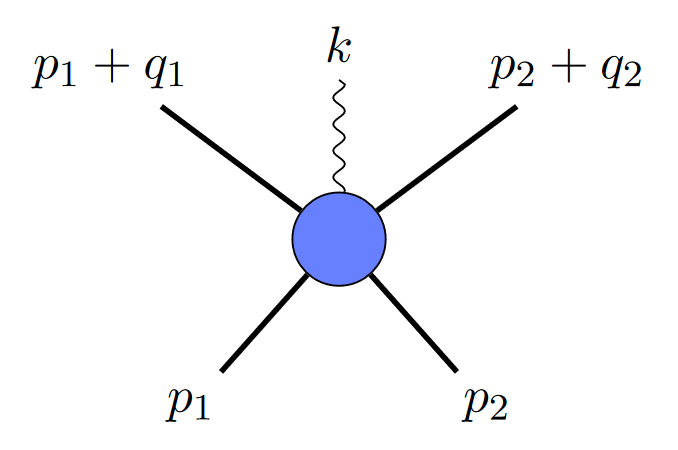
All pictures from arXiv:2112.07556

where the straight lines are black holes, and the squiggly line is a graviton. But since gravitational waves are made up of multiple gravitons, you might ask, why not depict it with two gravitons, like this?
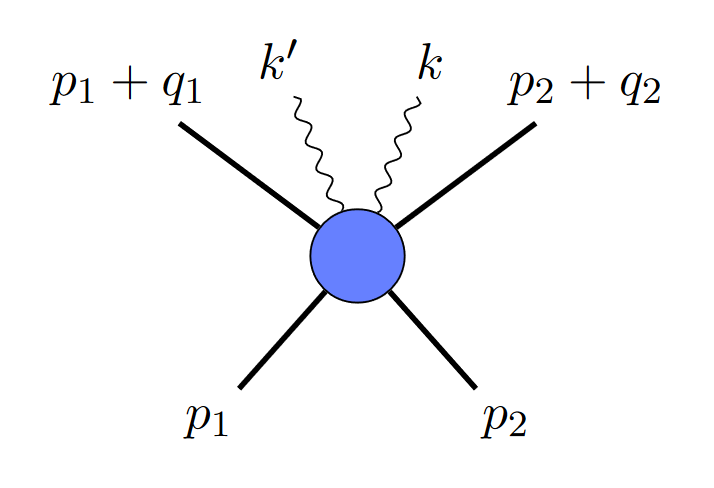
It turns out that diagrams like that are a problem: they mean your two gravitons are correlated, which is not allowed in a Poisson distribution. In the uncertainty picture, they also would give you non-zero uncertainty. Somehow, in the classical limit, diagrams like that need to go away.

And at first, it didn’t look like they do. You can try to count how many powers of Planck’s constant show up in each diagram. The authors do that, and it certainly doesn’t look like it goes away:
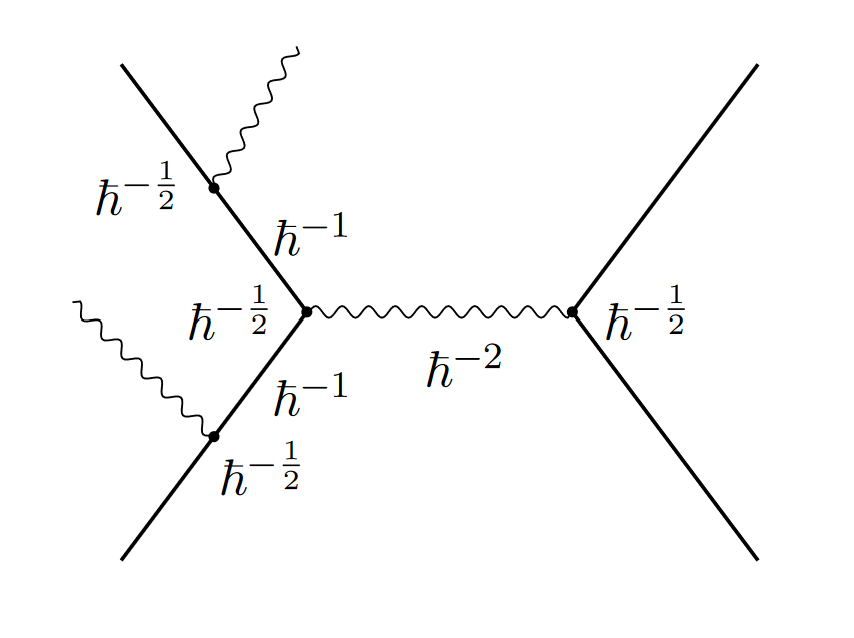
An example from the paper with Planck’s constants sprinkled around

Luckily, these quantum field theory calculations have a knack for surprising us. Calculate each individual diagram, and things look hopeless. But add them all together, and they miraculously cancel. In the classical limit, everything combines to give a classical result.

You can do this same trick for diagrams with more graviton particles, as many as you like, and each time it ought to keep working. You get an infinite set of relationships between different diagrams, relationships that have to hold to get sensible classical physics. From thinking about how the quantum and classical are related, you’ve learned something about calculations in quantum field theory.

That’s why these papers caught my eye. A chunk of my sub-field is needing to learn more and more about the relationship between quantum and classical physics, and it may have implications for the rest of us too. In the future, I might get a bit more qualified to talk about some of the very cool implications of quantum mechanics.

Science, Gifts Enough for Lifetimes

Merry Newtonmas, Everyone!

In past years, I’ve compared science to a gift: the ideal gift for the puzzle-fan, one that keeps giving new puzzles. I think people might not appreciate the scale of that gift, though.

Bigger than all the creative commons Wikipedia images

Maybe you’ve heard the old joke that studying for a PhD means learning more and more about less and less until you know absolutely everything about nothing at all. This joke is overstating things: even when you’ve specialized down to nothing at all, you still won’t know everything.

If you read the history of science, it might feel like there are only a few important things going on at a time. You notice the simultaneous discoveries, like calculus from Newton and Liebniz and natural selection from Darwin and Wallace. You can get the impression that everyone was working on a few things, the things that would make it into the textbooks. In fact, though, there was always a lot to research, always many interesting things going on at once. As a scientist, you can’t escape this. Even if you focus on your own little area, on a few topics you care about, even in a small field, there will always be more going on than you can keep up with.

This is especially clear around the holiday season. As everyone tries to get results out before leaving on vacation, there is a tidal wave of new content. I have five papers open on my laptop right now (after closing four or so), and some recorded talks I keep meaning to watch. Two of the papers are the kind of simultaneous discovery I mentioned: two different groups noticing that what might seem like an obvious fact – that in classical physics, unlike in quantum, one can have zero uncertainty – has unexpected implications for our kind of calculations. (A third group got there too, but hasn’t published yet.) It’s a link I would never have expected, and with three groups coming at it independently you’d think it would be the only thing to pay attention to: but even in the same sub-sub-sub-field, there are other things going on that are just as cool! It’s wild, and it’s not some special quirk of my area: that’s science, for all us scientists. No matter how much you expect it to give you, you’ll get more, lifetimes and lifetimes worth. That’s a Newtonmas gift to satisfy anyone.

Calculations of the Past

Last week was a birthday conference for one of the pioneers of my sub-field, Ettore Remiddi. I wasn’t there, but someone who was pointed me to some of the slides, including a talk by Stefano Laporta. For those of you who didn’t see my post a few weeks back, Laporta was one of Remiddi’s students, who developed one of the most important methods in our field and then vanished, spending ten years on an amazingly detailed calculation. Laporta’s talk covers more of the story, about what it was like to do precision calculations in that era.

“That era”, the 90’s through 2000’s, witnessed an enormous speedup in computers, and a corresponding speedup in what was possible. Laporta worked with Remiddi on the three-loop electron anomalous magnetic moment, something Remiddi had been working on since 1969. When Laporta joined in 1989, twenty-one of the seventy-two diagrams needed had still not been computed. They would polish them off over the next seven years, before Laporta dove in to four loops. Twenty years later, he had that four-loop result to over a thousand digits.

One fascinating part of the talk is seeing how the computational techniques change over time, as language replaces language and computer clusters get involved. As a student, Laporta learns a lesson we all often need: that to avoid mistakes, we need to do as little by hand as possible, even for something as simple as copying a one-line formula. Looking at his review of others’ calculations, it’s remarkable how many theoretical results had to be dramatically corrected a few years down the line, and how much still might depend on theoretical precision.

Another theme was one of Remiddi suggesting something and Laporta doing something entirely different, and often much more productive. Whether it was using the arithmetic-geometric mean for an elliptic integral instead of Gaussian quadrature, or coming up with his namesake method, Laporta spent a lot of time going his own way, and Remiddi quickly learned to trust him.

There’s a lot more in the slides that’s worth reading, including a mention of one of this year’s Physics Nobelists. The whole thing is an interesting look at what it takes to press precision to the utmost, and dedicate years to getting something right.

Of p and sigma

Ask a doctor or a psychologist if they’re sure about something, and they might say “it has p<0.05”. Ask a physicist, and they’ll say it’s a “5 sigma result”. On the surface, they sound like they’re talking about completely different things. As it turns out, they’re not quite that different.

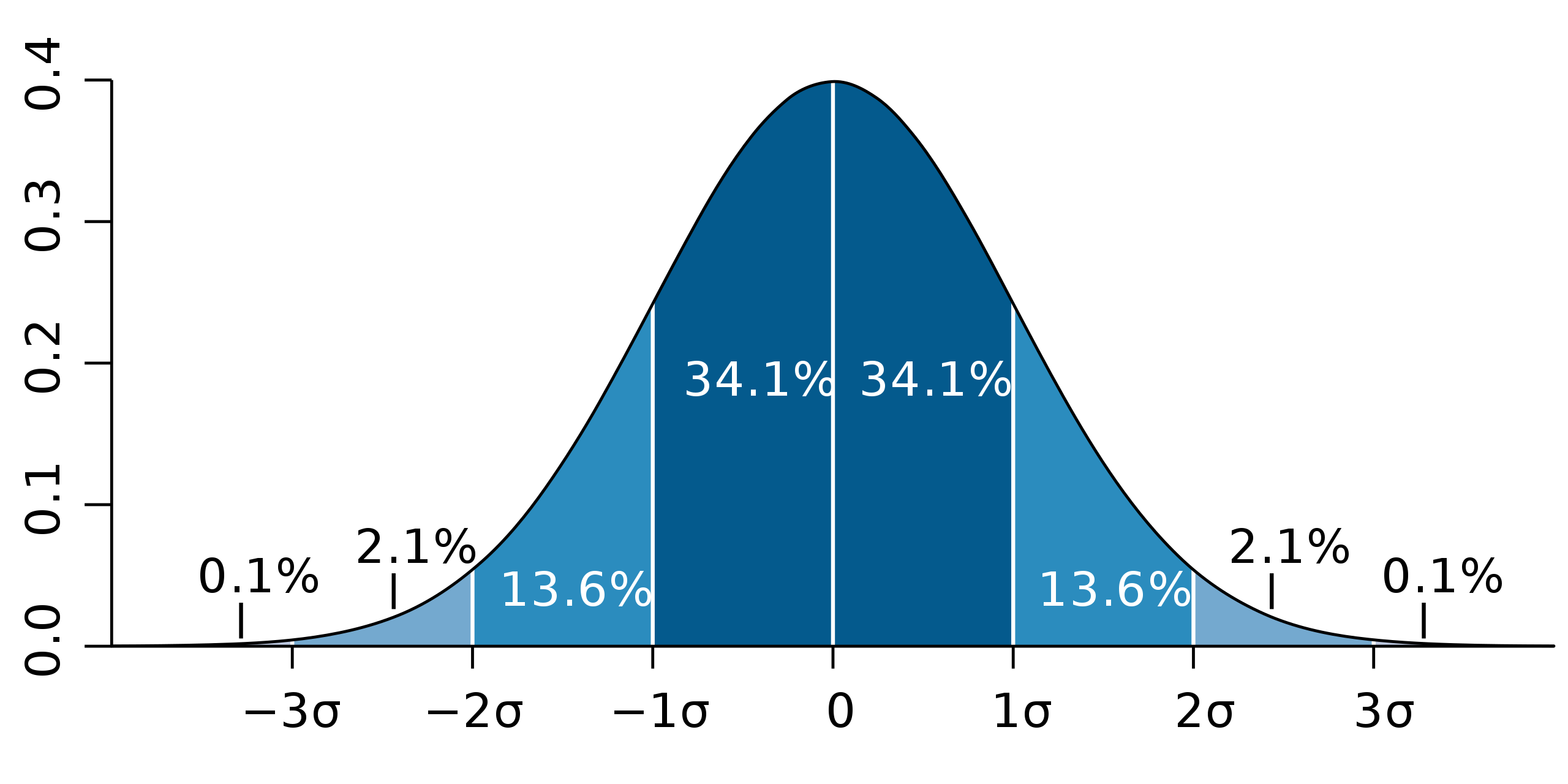
Whether it’s a p-value or a sigma, what scientists are giving you is shorthand for a probability. The p-value is the probability itself, while sigma tells you how many standard deviations something is away from the mean on a normal distribution. For people not used to statistics this might sound very complicated, but it’s not so tricky in the end. There’s a graph, called a normal distribution, and you can look at how much of it is above a certain point, measured in units called standard deviations, or “sigmas”. That gives you your probability.

Give it a try: how much of this graph is past the 1\sigma line? How about 2\sigma?

What are these numbers a probability of? At first, you might think they’re a probability of the scientist being right: of the medicine working, or the Higgs boson being there.

That would be reasonable, but it’s not how it works. Scientists can’t measure the chance they’re right. All they can do is compare models. When a scientist reports a p-value, what they’re doing is comparing to a kind of default model, called a “null hypothesis”. There are different null hypotheses for different experiments, depending on what the scientists want to test. For the Higgs, scientists looked at pairs of photons detected by the LHC. The null hypothesis was that these photons were created by other parts of the Standard Model, like the strong force, and not by a Higgs boson. For medicine, the null hypothesis might be that people get better on their own after a certain amount of time. That’s hard to estimate, which is why medical experiments use a control group: a similar group without the medicine, to see how much they get better on their own.

Once we have a null hypothesis, we can use it to estimate how likely it is that it produced the result of the experiment. If there was no Higgs, and all those photons just came from other particles, what’s the chance there would still be a giant pile of them at one specific energy? If the medicine didn’t do anything, what’s the chance the control group did that much worse than the treatment group?

Ideally, you want a small probability here. In medicine and psychology, you’re looking for a 5% probability, for p<0.05. In physics, you need 5 sigma to make a discovery, which corresponds to a one in 3.5 million probability. If the probability is low, then you can say that it would be quite unlikely for your result to happen if the null hypothesis was true. If you’ve got a better hypothesis (the Higgs exists, the medicine works), then you should pick that instead.

Note that this probability still uses a model: it’s the probability of the result given that the model is true. It isn’t the probability that the model is true, given the result. That probability is more important to know, but trickier to calculate. To get from one to the other, you need to include more assumptions: about how likely your model was to begin with, given everything else you know about the world. Depending on those assumptions, even the tiniest p-value might not show that your null hypothesis is wrong.

In practice, unfortunately, we usually can’t estimate all of those assumptions in detail. The best we can do is guess their effect, in a very broad way. That usually just means accepting a threshold for p-values, declaring some a discovery and others not. That limitation is part of why medicine and psychology demand p-values of 0.05, while physicists demand 5 sigma results. Medicine and psychology have some assumptions they can rely on: that people function like people, that biology and physics keep working. Physicists don’t have those assumptions, so we have to be extra-strict.

Ultimately, though, we’re all asking the same kind of question. And now you know how to understand it when we do.

Discovering New Elements, Discovering New Particles

In school, you learn that the world around you is made up of chemical elements. There’s oxygen and nitrogen in the air, hydrogen and oxygen in water, sodium and chlorine in salt, and carbon in all living things. Other elements are more rare. Often, that’s because they’re unstable, due to radioactivity, like the plutonium in a bomb or americium in a smoke detector. The heaviest elements are artificial, produced in tiny amounts by massive experiments. In 2002, the heaviest element yet was found at the Joint Institute for Nuclear Research near Moscow. It was later named Oganesson, after the scientist who figured out how to make these heavy elements, Yuri Oganessian. To keep track of the different elements, we organize them in the periodic table like this:

In that same school, you probably also learn that the elements aren’t quite so elementary. Unlike the atoms imagined by the ancient Greeks, our atoms are made of smaller parts: protons and neutrons, surrounded by a cloud of electrons. They’re what give the periodic table its periodic structure, the way it repeats from row to row, with each different element having a different number of protons.

If your school is a bit more daring, you also learn that protons and neutrons themselves aren’t elementary. Each one is made of smaller particles called quarks: a proton of two “up quarks” and one “down quark”, and a neutron of two “down” and one “up”. Up quarks, down quarks, and electrons are all what physicists call fundamental particles, and they make up everything you see around you. Just like the chemical elements, some fundamental particles are more obscure than others, and the heaviest ones are all very unstable, produced temporarily by particle collider experiments. The most recent particle to be discovered was in 2012, when the Large Hadron Collider near Geneva found the Higgs boson. The Higgs boson is named after Peter Higgs, one of those who predicted it back in the 60’s. All the fundamental particles we know are part of something called the Standard Model, which we sometimes organize in a table like this:

So far, these stories probably sound similar. The experiments might not even sound that different: the Moscow experiment shoots a beam of high-energy calcium atoms at a target of heavy radioactive elements, while the Geneva one shoots a beam of high-energy protons at another beam of high-energy protons. With all those high-energy beams, what’s the difference really?

In fact there is a big different between chemical elements and fundamental particles, and between the periodic table and the Standard Model. The latter are fundamental, the former are not.

When they made new chemical elements, scientists needed to start with a lot of protons and neutrons. That’s why they used calcium atoms in their beam, and even heavier elements as their target. We know that heavy elements are heavy because they contain more protons and neutrons, and we can use the arrangement of those protons and neutrons to try to predict their properties. That’s why, even though only five or six oganesson atoms have been detected, scientists have some idea what kind of material it would make. Oganesson is a noble gas, like helium, neon, and radon. But calculations predict it is actually a solid at room temperature. What’s more, it’s expected to be able to react with other elements, something the other noble gases are very reluctant to do.

The Standard Model has patterns, just like the chemical elements. Each matter particle is one of three “generations”, each heavier and more unstable: for example, electrons have heavier relatives called muons, and still heavier ones called tauons. But unlike with the elements, we don’t know where these patterns come from. We can’t explain them with smaller particles, like we could explain the elements with protons and neutrons. We think the Standard Model particles might actually be fundamental, not made of anything smaller.

That’s why when we make them, we don’t need a lot of other particles: just two protons, each made of three quarks, is enough. With that, we can make not just new arrangements of quarks, but new particles altogether. Some are even heavier than the protons we started with: the Higgs boson is more than a hundred times as heavy as a proton! We can do this because, in particle physics, mass isn’t conserved: mass is just another type of energy, and you can turn one type of energy into another.

Discovering new elements is hard work, but discovering new particles is on another level. It’s hard to calculate which elements are stable or unstable, and what their properties might be. But we know the rules, and with enough skill and time we could figure it out. In particle physics, we don’t know the rules. We have some good guesses, simple models to solve specific problems, and sometimes, like with the Higgs, we’re right. But despite making many more than five or six Higgs bosons, we still aren’t sure it has the properties we expect. We don’t know the rules. Even with skill and time, we can’t just calculate what to expect. We have to discover it.