Tag Archives: theoretical physics

The Near and the Far: Motivations for Physics

When I introduce myself, I often describe my job like this:

“I develop mathematical tools to make calculations in particle physics easier and more efficient.”

However, I could equally well describe my job like this:

“I’m looking for a radical new way to reformulate particle physics in order to solve fundamental problems in space and time.”

These may sound very different, but they’re both correct. That’s because in theoretical physics, like in many branches of science, we have two types of goals: near-term and far-term.

In the near-term, I develop mathematical tools and tricks, which let me calculate things I (and others) couldn’t calculate before. Pushing the tricks to their limits gives me more proficiency, making the tools I develop more robust. In the future, I can imagine applying the tools to more types of calculations, and specifically to more “important” calculations.

All of that still involves relatively near-term goals, though. Develop a new trick, and you can already envision what it might be used for. The far-term goals are generally deeper.

End of the road, not just the next tree.

In the far term, the new techniques that I and others develop might lead to fundamentally new ways to understand particle physics. That’s because a central feature of most of the tricks we develop is that they rephrase the calculation in a way that leaves out something that used to be thought of as fundamental. They’re “revolutions”, overthrowing some basic principle of how we do things. The hope is that the right “revolution” will help us solve problems that our current understanding of physics seems incapable of solving.

Most scientists have both sorts of goals. Someone who studies quantum mechanics might talk about developing a quantum computer, but in the near-term be interested in perfecting some algorithm. A biologist might study how information is stored in a cell, but introduce themself as someone trying to cure cancer.

For some people, the far-term goals are a big component of how they view themselves. Nima Arkani-Hamed, for example, has joked that believing that “spacetime is doomed” is what allows him to get out of bed in the morning. (For a transcript of the relevant parts, see here.) There are plenty of others with similar perspectives, people who need a “big” goal to feel motivated.

Myself, I find it harder to identify with these kinds of goals, because the payoff is so uncertain. Rephrasing particle physics in a new way might be the solution to a fundamental problem…but it could also just be another way to say the same thing. There’s no guarantee that any one project will be that one magical solution. In contrast, for me, near term goals are something I can feel confident I’m making real progress on. I can envision each step along the way, and see the part my work plays in a larger picture, led along by the satisfaction of solving each puzzle as it comes.

Neither way is better than the other, and both are important parts of science. Some people do better with one, some do better with the other, and in the end, everyone can view themselves as accomplishing something they care about.

What’s an Amplitude? Just about everything.

I am an Amplitudeologist. In other words, I study scattering amplitudes. I’ve explained bits and pieces of what scattering amplitudes are in other posts, but I ought to give a short definition here so everyone’s on the same page:

A scattering amplitude is the formula used to calculate the probability that some collection of particles will “scatter”, emerging as some (possibly different) collection of particles.

Note that I’m using some weasel words here. The scattering amplitude is not a probability itself, but “the formula used to calculate the probability”. For those familiar with the mathematics of waves, the scattering amplitude gives the amplitude of a “probability wave” that must be squared to get the probability. (Those familiar with waves might also ask: “If this is the amplitude, what about the period?” The truth is that because scattering amplitudes are calculated using complex numbers, what we call the “amplitude” also contains information about the wave’s “period”. It may seem like an inconsistent way to name things from the perspective of a beginning student, but it is actually consistent with the terminology in a large chunk of physics.)

In some of the simplest scattering amplitudes particles literally “scatter”, with two particles “colliding” and emerging traveling in different directions.

A scattering amplitude can also describe a more complicated situation, though. At particle colliders like the Large Hadron Collider, two particles (a pair of protons for the LHC) are accelerated fast enough that when they collide they release a whole slew of new particles. Since it still fits the “some particles go in, some particles go out” template, this is still described by a scattering amplitude.

It goes even further than that, though, because “some particles” could also just be “one particle”. If you’re dealing with something unstable (the particle equivalent of radioactive, essentially) then one particle can decay into two or more particles. There’s a whole slew of questions that require that sort of calculation. For example, if unstable particles were produced in the early universe, how many of them would be left around today? If dark matter is unstable (and some possible candidates are), when it decays it might release particles we could detect. In general, this sort of scattering amplitude is often of interest to astrophysicists when they happen to get involved in particle physics.

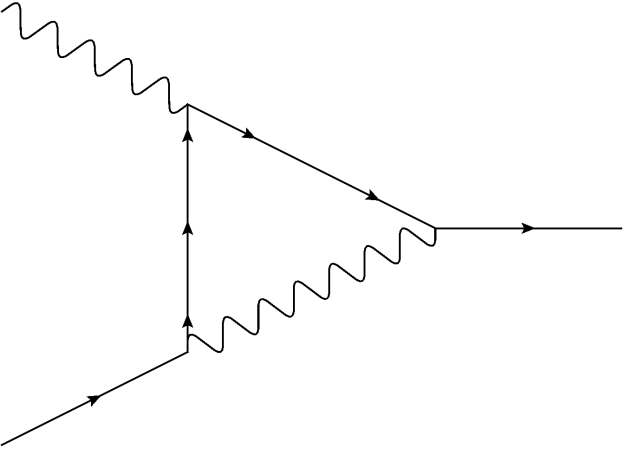
You can even use scattering amplitudes to describe situations that, at first glance, don’t sound like collisions of particles at all. If you want to find the effect of a magnetic field on an electron to high accuracy, the calculation also involves a scattering amplitude. A magnetic field can be thought of in terms of photons, particles of light, because light is a vibration in the electro-magnetic field. This means that the effect of a magnetic field on an electron can be calculated by “scattering” an electron and a photon.

4gravanom

If this looks familiar, check the handbook section.

In fact, doing the calculation in this way leads to what is possibly the most accurately predicted number in all of science.

Scattering amplitudes show up all over the place, from particle physics at the Large Hadron Collider to astrophysics to delicate experiments on electrons in magnetic fields. That said, there are plenty of things people calculate in theoretical physics that don’t use scattering amplitudes, either because they involve questions that are difficult to answer from the scattering amplitude point of view, or because they invoke different formulas altogether. Still, scattering amplitudes are central to the work of a large number of physicists. They really do cover just about everything.

Am I a String Theorist?

Perimeter, like most institutes of theoretical physics, divides their researchers into semi-informal groups. At Perimeter, these are:

  • Condensed Matter
  • Cosmology
  • Mathematical Physics
  • Particle Physics
  • Quantum Fields and Strings
  • Quantum Foundations
  • Quantum Gravity
  • Quantum Information
  • Strong Gravity

I’m in the Quantum Fields and Strings group, which many people seem to refer to simply as the String Theory group. So for the past week or so, I’ve been introducing myself as a String Theorist. As I briefly mention in my Who Am I? post, this isn’t completely accurate.

Am I a String Theorist?

The theories that I study do derive from string theory. They were first framed by string theorists, and research into them is still deeply intertwined with string theory research. I’ve definitely had occasion to compare my results to those of string theorists, or to bring in calculations by string theorists to advance my work.

And if you’re the kind of person who views the world as a competition between string theory and its rivals (like Loop Quantum Gravity) then I suppose I’m on the string theory “side”. I’m optimistic, at least, that the reason why string theory research is so much more common than any other approach to quantum gravity is simply because string theory provides many more interesting and viable projects for researchers.

On the other hand, though, there’s the basic fact that the theories I work with are not, themselves, string theories. They’re quantum field theories, the broader class that encompasses the modern synthesis of quantum mechanics and special relativity. The theories I work with are often reasonably close to the well-tested theories of the real world, close enough that the calculations are more “particle physics” than the they are “string theory”.

Of course, all of that could change. One of the great things about string theory is the way it connects lots of different interesting quantum field theories together. There’s a “string”, the “GKP string”, involved in the work of Basso, Sever, and Vieira, work that I will probably get involved with here at Perimeter. The (2,0) theory is a quantum field theory, but it’s much closer to string theory than to particle physics, so if I get more involved with the (2,0) theory would that make me a string theorist?

The fact is, these days string theory is so ubiquitous that the question “Am I a String Theorist?” doesn’t actually mean anything. String theory is there, lurking in the background, able to get involved at any time even if it’s not directly involved at present. Theoretical physicists don’t fall into neat categories.

I am a String Theorist. Also, I am not.

Perimeter!

I’m moving in at Perimeter this week, so I don’t have time to write a long post. For those who aren’t familiar with it, the Perimeter Institute for Theoretical Physics is an independent research institute, not affiliated with any university. Instead, it’s funded by a combination of government and private sources (for why private sources might fund theoretical physics, read my discussion here). Because it’s not a university they have budgets to do things like hire people to make the transition process easier, so everything has been really nice and well-organized.

The postdoc offices are really nice, with a view of the nearby park, shown below.

On the Perimeter...of Waterloo Park

On the Perimeter…of Waterloo Park

Hexagon Functions II: Lost in (super)Space

My new paper went up last night.

It’s on a very similar topic to my last paper, actually. That paper dealt with a specific process involving six particles in my favorite theory, N=4 super Yang-Mills. Two particles collide, and after the metaphorical dust settles four particles emerge. That means six “total” particles, if you add the two in with the four out, for a “hexagon” of variables. To understand situations like that, my collaborators and I created “hexagon functions”, formulas that depended on the states of the six particles.

One thing I didn’t emphasize then was that that calculation only applied to one specific choice of particles, one in which all of the particles are Yang-Mills bosons, particles (like photons) created by the fundamental forces. There are lots of other particles in N=4 super Yang-Mills, though. What happens when they collide?

That question is answered by my new paper. Though it may sound surprising, all of the other particles can be taken into account with a single formula. In order to explain why, I have to tell you about something called superspace.

A while back I complained about a blog post by George Musser about the (2,0) theory. One of the things that irked me about that post was his attempt to explain superspace:

Supersymmetry is the idea that spacetime, in addition to its usual dimensions of space and time, has an entirely different type of dimension—a quantum dimension, whose coordinates are not ordinary real numbers but a whole new class of number that can be thought of as the square roots of zero.

This is actually a great way to think about superspace…if you’re already a physicist. If you’re not, it’s not very informative. Here’s a better way to think about it:

As I’ve talked about before, supersymmetry is a relationship between different types of particles. Two particles related by supersymmetry have the same mass, and the same charge. While they can be very different in other ways (specifically, having different spin), supersymmetric particles are described by many of the same equations as each-other. Rather than writing out those equations multiple times, it’s often nicer to write them all in a unified way, and that’s where superspace comes in.

At its simplest, superspace is just a trick used to write equations in a simpler way. Instead of writing down a different equation for each particle we write one equation with an extra variable, representing a “dimension” of supersymmetry. Traveling in that dimension takes you from particle to particle, in the same way that “turning” the theory (as I phrase it here) does, but it does it within the space of a single equation.

That, essentially, is the trick that we use. With four “superspace dimensions”, we can include the four supersymmetries of N=4 super Yang-Mills, showing how the formulas vary when you go beyond the equation from our first paper.

So far, you may be wondering why I’m calling superspace a “dimension”, when it probably sounds like more of a label. I’ve mentioned before that, just because something is a variable, doesn’t mean it counts as a real dimension.

The key difference is that superspace dimensions are related to regular dimensions in a precise way. In a sense, they’re the square roots of regular dimensions. (Though independently, as George Musser described, they’re the square roots of zero: go in the same direction twice in supersymmetry, and you get back where you’re started, going zero distance.) The coexistence of these two seemingly contradictory statements isn’t some sort of quantum mystery, it’s just a consequence of the fact that, mathematically, I’m saying two very different things. I just can’t think of a way to explain them differently without math.

Superspace isn’t a real place…but it can often be useful to think of it that way. In theories with supersymmetry, it can unify the world, putting disparate particles together into a single equation.

Stop! Impostor!

Ever felt like you don’t belong? Like you don’t deserve to be where you are, that you’re just faking competence you don’t really have?

If not, it may surprise you to learn that this is a very common feeling among successful young academics. It’s called impostor syndrome, and it happens to some very talented people.

It’s surprisingly easy to rationalize success as luck, to assume praise comes from people who don’t know the full story. In science, we’re surrounded by people who seem to come up with brilliant insights on a regular basis. We see others’ successes far more often than we see their failures, and often we forget that science is at its heart a process of throwing ideas against a wall until something sticks. Hyper-aware of our own failures, when we present ourselves as successful we can feel like we’re putting on a paper-thin disguise, constantly at risk that someone will see through it.

As paper-thin disguises go, I prefer the classics.

In my experience, theoretical physics is especially heavy on impostor syndrome, for a number of reasons.

First, there’s the fact that beginning grad students really don’t know all they need to. Theoretical physics requires a lot of specialized knowledge, and most grad students just have the bare bones basics of a physics undergrad degree. On the strength of those basics, you’re somehow supposed to convince a potential advisor, an established, successful scientist, that you’re worth paying attention to.

Throw in the fact that many people have a little more than the basics, whether from undergrad research projects or grad-level courses taken early, and you have a group where everyone is trying to seem more advanced than they are. There’s a very real element of fake it till you make it, of going to talks and picking up just enough of the lingo to bluff your way through a conversation.

And the thing is, even after you make it, you’ll probably still feel like you’re faking it.

As I’ve mentioned before, there’s an enormous amount of jury-rigging that goes into physics research. There are a huge number of side-disciplines that show up at one point or another, from numerical methods to programming to graphic design. We can’t hire a professional to handle these things, we have to learn them ourselves. As such, we become minor dabblers in a whole mess of different fields. Work on something enough and others will start looking to you for help. It won’t feel like you’re an expert, though, because you know in the back of your mind that the real experts know so much more.

In the end, the best approach I’ve found is simply to keep saying yes. Keep using what you know, going to talks and trying new things. The more you “pretend” to know what you’re doing, the more experience you’ll get, until you really do know what you’re doing. There’s always going to be more to learn, but chances are if you’re feeling impostor syndrome you’ve already learned a lot. Take others’ opinions of you at face value, and see just how far you can go.

Feeling Perturbed?

You might think of physics as the science of certainties and exact statements: action and reaction, F=ma, and all that. However, most calculations in physics aren’t exact, they’re approximations. This is especially true today, but it’s been true almost since the dawn of physics. In particular, approximations are performed via a method known as perturbation theory.

Perturbation theory is a trick used to solve problems that, for one reason or another, are too difficult to solve all in one go. It works by solving a simpler problem, then perturbing that solution, adjusting it closer to the target.

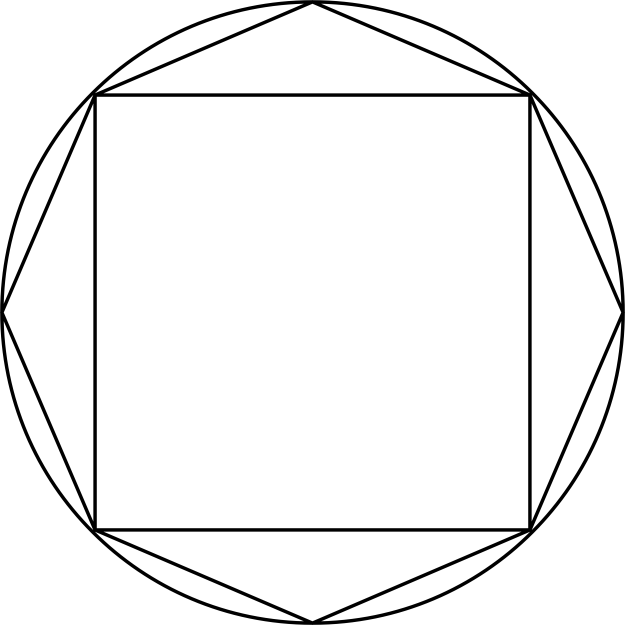
To give an analogy: let’s say you want to find the area of a circle, but you only know how to draw straight lines. You could start by drawing a square: it’s easy to find the area, and you get close to the area of the circle. But you’re still a long ways away from the total you’re aiming for. So you add more straight lines, getting an octagon. Now it’s harder to find the area, but you’re closer to the full circle. You can keep adding lines, each step getting closer and closer.

And so on.

And so on.

This, broadly speaking, is what’s going on when particle physicists talk about loops. The calculation with no loops (or “tree-level” result) is the easier problem to solve, omitting quantum effects. Each loop then is the next stage, more complicated but closer to the real total.

There are, as usual, holes in this analogy. One is that it leaves out an important aspect of perturbation theory, namely that it involves perturbing with a parameter. When that parameter is small, perturbation theory works, but as it gets larger the approximation gets worse and worse. In the case of particle physics, the parameter is the strength of the forces involves, with weaker forces (like the weak nuclear force, or electromagnetism) having better approximations than stronger forces (like the strong nuclear force). If you squint, this can still fit the analogy: different shapes might be harder to approximate than the circle, taking more sets of lines to get acceptably close.

Where the analogy fails completely, though, is when you start approaching infinity. Keep adding more lines, and you should be getting closer and closer to the circle each time. In quantum field theory, though, this frequently is not the case. As I’ve mentioned before, while lower loops keep getting closer to the true (and experimentally verified) results, going all the way out to infinite loops results not in the full circle, but in an infinite result instead. There’s an understanding of why this happens, but it does mean that perturbation theory can’t be thought of in the most intuitive way.

Almost every calculation in particle physics uses perturbation theory, which means almost always we are just approximating the real result, trying to draw a circle using straight lines. There are only a few theories where we can bypass this process and look at the full circle. These are known as integrable theories. N=4 super Yang-Mills may be among them, one of many reasons why studying it offers hope for a deeper understanding of particle physics.

N=8: That’s a Whole Lot of Symmetry

In two weeks, I’m planning an extensive overhaul of the blog. I’ll be switching from 4gravitons.wordpress.com to just 4gravitons.wordpress.com, since I’m no longer a grad student. Don’t worry, I’ll be forwarding traffic from the old address, so if you miss the changeover you’ll have plenty of time to readjust. I’ll also be changing the blog’s look a bit, and adding some new tools and sections, including my current project, a series on the theory N=8 supergravity. This is post will be the last in the N=8 supergravity series.

I’ve told you about how gravity can be thought of as interactions with spin 2 particles, called gravitons. I’ve talked about how adding supersymmetry gives you a whole new type of particle, a gravitino, one different from all of the other particles we’ve seen in nature. Add supersymmetry to gravity, and you get a type of theory called supergravity.

In this post I want to discuss a particularly interesting form of supergravity. It’s called N=8 supergravity, and it’s closely related to N=4 super Yang-Mills.

In my articles about N=4 super Yang-Mills, I talked about supersymmetry. Supersymmetry is a relationship between particles of spin X and particles of spin X-½, but it gets more complicated when N (the number of “directions” of supersymmetry) is greater than one.

I’d encourage you to read at least the two links in the above paragraph. The gist is that just like a symmetrical object can be turned in different directions and still remain the same, a supersymmetrical theory can be “turned” so that a particle with spin X becomes a particle of spin X-½ (a different type of particle), and the theory will remain the same. The higher the number N, the more different directions the theory can be “turned”.

N=4 was something I could depict in a picture. We started with a particle of spin 1, then could “turn” it in four different directions, each resulting in a different particle of spin ½. By combining two different “turns” we ended up with six distinct particles of spin 0. Miraculously, I could fit this all into one image.

N=8 is tougher. This time, we start with 1 particle of spin 2: the graviton, the particle that corresponds to the force of gravity. From there we can “turn” the theory in eight different directions, leading to 8 different gravitino particles with spin 3/2.

After that, things get more complicated. You can “turn” the theory twice to reach spin 1. Spin 1 particles correspond to Yang-Mills forces, the fundamental forces of nature (besides gravity). Photons are the spin 1 particles that correspond to Electromagnetism. The spin 1 particles here, connected as they are to gravity by supersymmetry, are typically called graviphotons. There are 28 distinct graviphotons in N=8 supergravity.

From the graviphotons, we can keep turning, getting to spin ½, where we find 56 new particles of the same “type” as electrons and quarks. On our fourth turn, we get to spin 0, the scalars, with 70 new particles. Turning further takes us back: from spin 0 to spin ½, spin ½ to spin 1, spin 1 to spin 3/2, and spin 3/2 to spin 2, back where we started after eight “turns”.

I’ve tried to depict this in the same way as N=4 super Yang-Mills, but there’s just no way to fit everything in. The best I can do is to take a slice through the space, letting certain particles overlap to give at best a general impression of what’s going on.
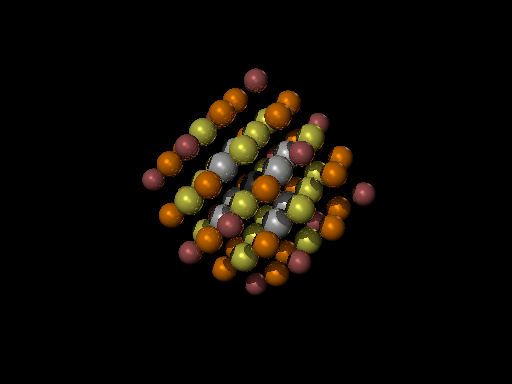
Graviton in black, gravitinos in grey, graviphotons in yellow, fermions in orange, scalars in red, and comprehensibility omitted entirely.

Graviton in black, gravitinos in grey, graviphotons in yellow, fermions in orange, scalars in red, making a firework of incomprehensible graphics. Incidentally, happy 4th of July to my American readers.

That picture doesn’t give you any intuition about the numbers. It doesn’t show you why there are 28 graviphotons, or 70 scalars. To explain that, it’s best to turn to another, hopefully more familiar picture, Pascal’s triangle.

Getting math class flashbacks yet?

Pascal’s triangle is a way of writing down how many distinct combinations you can make out of a list, and that’s really all that’s going on here. If you have four directions to “turn” and you pick one, you have four options, while picking two gives you six distinct choices. That’s just the 1-4-6-4-1 line on the triangle. If you go down to the eighth, you’ll spot the numbers from N=8 supergravity: 1 graviton, 8 gravitinos, 28 graviphotons, 56 fermions, and 70 scalars.

That’s a lot of particles. With that many particles, you might wonder if you could somehow fit the real world in there.

Actually, that isn’t such a naive thought. When N=8 supergravity was first discovered, people tried to fit the existing particles of nature inside it, hoping that it could explain them. Over the years though, it was realized that N=8 supergravity simply doesn’t provide enough tools to fully capture the particles of the standard model. Something more diverse, like string theory, would be needed.

That means that N=8 supergravity, like many of the things theorists call theories, does not describe the real world. Instead, it’s interesting for a different reason.

You’ve probably heard that gravity and quantum mechanics are incompatible. That’s not exactly true: you can write down a quantum theory of gravity about as easily as you can write down a quantum theory of anything else. The problem is that most such theories have divergences, infinite results that shouldn’t be infinite. Dealing with those results involves a process called renormalization, which papers over the infinities but reduces our ability to make predictions. For gravity theories, this process has to be performed an infinite number of times, resulting in an infinite loss of predictability. So while you can certainly write down a theory of quantum gravity, you can’t predict anything with it.

String theory is different. It doesn’t have the same sorts of infinite results, doesn’t require renormalization. That, really, is it’s purpose, it’s biggest virtue: everything else is a side benefit.

N=4 super Yang-Mills isn’t a theory of gravity at all, but it does have that same neat trait: you never get this sort of infinite results, so you never need to give up predictive power.

What’s so cool about N=8 supergravity is that it just might be in the same category. By all rights, it shouldn’t be…but loop after loop its divergences seem to be behaving much like N=4 super Yang-Mills. (For those new to this blog, loops are a measure of how complex a calculation is in particle physics. Most practical calculations only involve one or two loops, while four loops represents possibly the most precise test ever performed by science.)

Now, two predictions are at the fore. One suggests that this magic behavior will be broken at the terrifyingly complex level of seven loops. The other proposes that the magic will continue, and N=8 supergravity will never see a divergence. The only way for certain is to do the calculation, look at four gravitons at seven loops and see what happens.

If N=8 supergravity really doesn’t diverge, then the biggest “point” of string theory isn’t unique anymore. If you don’t need all the bells and whistles of string theory to get an acceptable quantum theory of gravity, then maybe there’s a better way to think about the problem of quantum gravity in general. Even if N=8 supergravity doesn’t describe the real world, there may be other ways forward, other ways to handle the problem of divergences. If someone can manage that calculation (not as impossible as it sounds nowadays, but still very very hard) then we might see something really truly new.

(Super)gravity: Meet the Gravitino

I’m putting together a series of posts about N=8 supergravity, with the goal of creating a guide much like I have for N=4 super Yang-Mills and the (2,0) theory.

N=8 supergravity is what happens when you add the maximum amount of supersymmetry to a theory of gravity. I’m going to strongly recommend that you read both of those posts before reading this one, as there are a number of important concepts there: the idea that different types of particles are categorized by a number called spin, the idea that supersymmetry is a relationship between particles with spin X and particles with spin X-½, and the idea that gravity can be thought of equally as a bending of space and time or as a particle with spin 2, called a graviton.

Knowing all that, if you add supersymmetry to gravity, you’d relate a spin 2 particle (the graviton) to a spin 3/2 particle (for 2-½).

What is a spin 3/2 particle?

Spin 0 particles correspond to a single number, like a temperature, that can vary over space. The Higgs boson is the one example of a spin 0 particle that we know of in the real world. Spin ½ covers electrons, protons, and almost all of the particles that make up ordinary matter, while spin 1 covers Yang-Mills forces. That covers the entire Standard Model, all of the particles scientists have seen in the real world. So what could a spin 3/2 particle possibly be?

We can at least guess at what it would be called. Whatever this spin 3/2 particle is, it’s the supersymmetric partner of the graviton. For somewhat stupid reasons, that means its name is determined by taking “graviton” and adding “-ino” to the end, to get gravitino.

But that still doesn’t answer the question: What is a gravitino?

Here’s the quick answer: A gravitino is a spin 1 particle combined with a spin ½ particle.

What sort of combination am I talking about? Not the one you might think. A gravitino is a fundamental particle, it is not made up of other particles.


NOT like this.

So in what sense is it a combination?

A handy way for physicists to think about particles is as manifestations of an underlying field. The field is stronger or weaker in different places, and when the field is “on”, a particle is present. For example, the electron field covers all of space, but only where that electron field is greater than zero do actual electrons show up.

I’ve said that a scalar field is simple to understand because it’s just a number, like a temperature, that takes different values in different places. The other types of fields are like this too, but instead of one number there’s generally a more complicated set of numbers needed to define them. Yang-Mills fields, with spin 1, are forces, with a direction and a strength. This is why they’re often called vector fields. Spin ½ particles have a set of numbers that characterizes them as well. It’s called a spinor, and unfortunately it’s not something I can give you an intuitive definition for. Just be aware that, like vectors, it involves a series of numbers that specify how the field behaves at each point.

It’s a bit like a computer game. The world is full of objects, and different objects have different stats. A weapon might have damage and speed, while a quest-giver would have information about what quests they give. Since everything is just code, though, you can combine the two, and all you have to do is put both types of stats on the same object.

Like this.

For quantum fields, the “stats” are the numbers I mentioned earlier: a single number for scalars, direction and strength for vectors, and the spinor information for spinors. So if you want to combine two of them, say spin 1 and spin ½, you just need a field that has both sets of “stats”.

That’s the gravitino. The gravitino has vector “stats” from the spin 1 part, and spinor “stats” from the spin ½ part. It’s a combination of two types of fundamental particles, to create one that nobody has seen before.

That doesn’t mean nobody will ever see one, though. Gravitinos could well exist in our world, they’re actually a potential (if problematic) candidate for dark matter.

But much like supersymmetry in general, while gravitinos may exist, N=8 of them certainly don’t. N=8 is a whole lot of supersymmetry…but that’s a topic for another post. Stay tuned for the next post in the series!

Does Science have Fads?

97% of climate scientists agree that global warming exists, and is most probably human-caused. On a more controversial note, string theorists vastly outnumber adherents of other approaches to quantum gravity, such as Loop Quantum Gravity.

As many who disagree with climate change or string theory would argue, the majority is not always right. Science should be concerned with truth, not merely with popularity. After all, what if scientists are merely taking part in a fad? What makes climate change any more objectively true than pet rocks?

Apparently this wikipedia’s best example of a fad.

People are susceptible to fads, after all. A style of music becomes popular, and everyone’s listening to the same sounds. A style of clothing, and everything’s wearing the same thing. So if an idea in science became popular, everyone might…write the same papers?

That right there is the problem. Scientists only succeed by creating meaningfully original work. If we don’t discover something new, we can’t publish, and as the old saying goes it’s publish or perish out there. Even if social pressure gets us working on something, if we’re going to get any actual work done there has to be enough there, at least, for us to do something different, something no-one has done before.

This doesn’t mean scientists can’t be influenced by popularity, but it means that that influence is limited by the requirements of doing meaningful, original work. In the case of climate change, climate scientists investigate the topic with so many different approaches and look at so many different areas of impact (for example, did you know rising CO2 levels make the ocean acidic?) that the whole field simply wouldn’t function if climate change wasn’t real: there’d be a contradiction, and most of the myriad projects involving it simply wouldn’t work. As I’ve talked about before, science is an interlocking system, and it’s hard to doubt one part without being forced to doubt everything else.

What about string theory? Here, the situation is a little different. There aren’t experiments testing string theory, so whether or not string theory describes the real world won’t have much effect on whether people can write string theory papers.

The existence of so many string theory papers does say something, though. The up-side of not involving experiments is that you can’t go and test something slightly different and write a paper about it. In order to be original, you really need to calculate something that nobody expected you to calculate, or notice a trend nobody expected to exist. The fact that there are so many more string theorists than loop quantum gravity theorists is in part because there are so many more interesting string theory projects than interesting loop quantum gravity projects.

In string theory, projects tend to be interesting because they unveil some new aspect of quantum field theory, the class of theories that explain the behavior of subatomic particles. Given how hard quantum field theory is, any insight is valuable, and in my experience these sorts of insights are what most string theorists are after. So while string theory’s popularity says little about whether it describes the real world, it says a lot about its ability to say interesting things about quantum field theory. And since quantum field theories do describe the real world, string theory’s continued popularity is also evidence that it continues to be useful.

Climate change and string theory aren’t fads, not exactly. They’re popular, not simply because they’re popular, but because they make important contributions and valuable to science. And as long as science continues to reward original work, that’s not about to change.