Tag Archives: theoretical physics

N=8: That’s a Whole Lot of Symmetry

In two weeks, I’m planning an extensive overhaul of the blog. I’ll be switching from 4gravitons.wordpress.com to just 4gravitons.wordpress.com, since I’m no longer a grad student. Don’t worry, I’ll be forwarding traffic from the old address, so if you miss the changeover you’ll have plenty of time to readjust. I’ll also be changing the blog’s look a bit, and adding some new tools and sections, including my current project, a series on the theory N=8 supergravity. This is post will be the last in the N=8 supergravity series.

I’ve told you about how gravity can be thought of as interactions with spin 2 particles, called gravitons. I’ve talked about how adding supersymmetry gives you a whole new type of particle, a gravitino, one different from all of the other particles we’ve seen in nature. Add supersymmetry to gravity, and you get a type of theory called supergravity.

In this post I want to discuss a particularly interesting form of supergravity. It’s called N=8 supergravity, and it’s closely related to N=4 super Yang-Mills.

In my articles about N=4 super Yang-Mills, I talked about supersymmetry. Supersymmetry is a relationship between particles of spin X and particles of spin X-½, but it gets more complicated when N (the number of “directions” of supersymmetry) is greater than one.

I’d encourage you to read at least the two links in the above paragraph. The gist is that just like a symmetrical object can be turned in different directions and still remain the same, a supersymmetrical theory can be “turned” so that a particle with spin X becomes a particle of spin X-½ (a different type of particle), and the theory will remain the same. The higher the number N, the more different directions the theory can be “turned”.

N=4 was something I could depict in a picture. We started with a particle of spin 1, then could “turn” it in four different directions, each resulting in a different particle of spin ½. By combining two different “turns” we ended up with six distinct particles of spin 0. Miraculously, I could fit this all into one image.

N=8 is tougher. This time, we start with 1 particle of spin 2: the graviton, the particle that corresponds to the force of gravity. From there we can “turn” the theory in eight different directions, leading to 8 different gravitino particles with spin 3/2.

After that, things get more complicated. You can “turn” the theory twice to reach spin 1. Spin 1 particles correspond to Yang-Mills forces, the fundamental forces of nature (besides gravity). Photons are the spin 1 particles that correspond to Electromagnetism. The spin 1 particles here, connected as they are to gravity by supersymmetry, are typically called graviphotons. There are 28 distinct graviphotons in N=8 supergravity.

From the graviphotons, we can keep turning, getting to spin ½, where we find 56 new particles of the same “type” as electrons and quarks. On our fourth turn, we get to spin 0, the scalars, with 70 new particles. Turning further takes us back: from spin 0 to spin ½, spin ½ to spin 1, spin 1 to spin 3/2, and spin 3/2 to spin 2, back where we started after eight “turns”.

I’ve tried to depict this in the same way as N=4 super Yang-Mills, but there’s just no way to fit everything in. The best I can do is to take a slice through the space, letting certain particles overlap to give at best a general impression of what’s going on.
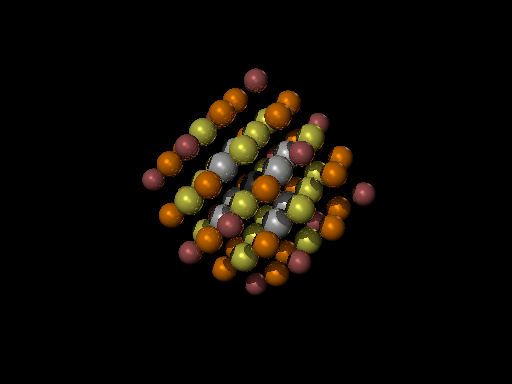
Graviton in black, gravitinos in grey, graviphotons in yellow, fermions in orange, scalars in red, and comprehensibility omitted entirely.

Graviton in black, gravitinos in grey, graviphotons in yellow, fermions in orange, scalars in red, making a firework of incomprehensible graphics. Incidentally, happy 4th of July to my American readers.

That picture doesn’t give you any intuition about the numbers. It doesn’t show you why there are 28 graviphotons, or 70 scalars. To explain that, it’s best to turn to another, hopefully more familiar picture, Pascal’s triangle.

Getting math class flashbacks yet?

Pascal’s triangle is a way of writing down how many distinct combinations you can make out of a list, and that’s really all that’s going on here. If you have four directions to “turn” and you pick one, you have four options, while picking two gives you six distinct choices. That’s just the 1-4-6-4-1 line on the triangle. If you go down to the eighth, you’ll spot the numbers from N=8 supergravity: 1 graviton, 8 gravitinos, 28 graviphotons, 56 fermions, and 70 scalars.

That’s a lot of particles. With that many particles, you might wonder if you could somehow fit the real world in there.

Actually, that isn’t such a naive thought. When N=8 supergravity was first discovered, people tried to fit the existing particles of nature inside it, hoping that it could explain them. Over the years though, it was realized that N=8 supergravity simply doesn’t provide enough tools to fully capture the particles of the standard model. Something more diverse, like string theory, would be needed.

That means that N=8 supergravity, like many of the things theorists call theories, does not describe the real world. Instead, it’s interesting for a different reason.

You’ve probably heard that gravity and quantum mechanics are incompatible. That’s not exactly true: you can write down a quantum theory of gravity about as easily as you can write down a quantum theory of anything else. The problem is that most such theories have divergences, infinite results that shouldn’t be infinite. Dealing with those results involves a process called renormalization, which papers over the infinities but reduces our ability to make predictions. For gravity theories, this process has to be performed an infinite number of times, resulting in an infinite loss of predictability. So while you can certainly write down a theory of quantum gravity, you can’t predict anything with it.

String theory is different. It doesn’t have the same sorts of infinite results, doesn’t require renormalization. That, really, is it’s purpose, it’s biggest virtue: everything else is a side benefit.

N=4 super Yang-Mills isn’t a theory of gravity at all, but it does have that same neat trait: you never get this sort of infinite results, so you never need to give up predictive power.

What’s so cool about N=8 supergravity is that it just might be in the same category. By all rights, it shouldn’t be…but loop after loop its divergences seem to be behaving much like N=4 super Yang-Mills. (For those new to this blog, loops are a measure of how complex a calculation is in particle physics. Most practical calculations only involve one or two loops, while four loops represents possibly the most precise test ever performed by science.)

Now, two predictions are at the fore. One suggests that this magic behavior will be broken at the terrifyingly complex level of seven loops. The other proposes that the magic will continue, and N=8 supergravity will never see a divergence. The only way for certain is to do the calculation, look at four gravitons at seven loops and see what happens.

If N=8 supergravity really doesn’t diverge, then the biggest “point” of string theory isn’t unique anymore. If you don’t need all the bells and whistles of string theory to get an acceptable quantum theory of gravity, then maybe there’s a better way to think about the problem of quantum gravity in general. Even if N=8 supergravity doesn’t describe the real world, there may be other ways forward, other ways to handle the problem of divergences. If someone can manage that calculation (not as impossible as it sounds nowadays, but still very very hard) then we might see something really truly new.

(Super)gravity: Meet the Gravitino

I’m putting together a series of posts about N=8 supergravity, with the goal of creating a guide much like I have for N=4 super Yang-Mills and the (2,0) theory.

N=8 supergravity is what happens when you add the maximum amount of supersymmetry to a theory of gravity. I’m going to strongly recommend that you read both of those posts before reading this one, as there are a number of important concepts there: the idea that different types of particles are categorized by a number called spin, the idea that supersymmetry is a relationship between particles with spin X and particles with spin X-½, and the idea that gravity can be thought of equally as a bending of space and time or as a particle with spin 2, called a graviton.

Knowing all that, if you add supersymmetry to gravity, you’d relate a spin 2 particle (the graviton) to a spin 3/2 particle (for 2-½).

What is a spin 3/2 particle?

Spin 0 particles correspond to a single number, like a temperature, that can vary over space. The Higgs boson is the one example of a spin 0 particle that we know of in the real world. Spin ½ covers electrons, protons, and almost all of the particles that make up ordinary matter, while spin 1 covers Yang-Mills forces. That covers the entire Standard Model, all of the particles scientists have seen in the real world. So what could a spin 3/2 particle possibly be?

We can at least guess at what it would be called. Whatever this spin 3/2 particle is, it’s the supersymmetric partner of the graviton. For somewhat stupid reasons, that means its name is determined by taking “graviton” and adding “-ino” to the end, to get gravitino.

But that still doesn’t answer the question: What is a gravitino?

Here’s the quick answer: A gravitino is a spin 1 particle combined with a spin ½ particle.

What sort of combination am I talking about? Not the one you might think. A gravitino is a fundamental particle, it is not made up of other particles.


NOT like this.

So in what sense is it a combination?

A handy way for physicists to think about particles is as manifestations of an underlying field. The field is stronger or weaker in different places, and when the field is “on”, a particle is present. For example, the electron field covers all of space, but only where that electron field is greater than zero do actual electrons show up.

I’ve said that a scalar field is simple to understand because it’s just a number, like a temperature, that takes different values in different places. The other types of fields are like this too, but instead of one number there’s generally a more complicated set of numbers needed to define them. Yang-Mills fields, with spin 1, are forces, with a direction and a strength. This is why they’re often called vector fields. Spin ½ particles have a set of numbers that characterizes them as well. It’s called a spinor, and unfortunately it’s not something I can give you an intuitive definition for. Just be aware that, like vectors, it involves a series of numbers that specify how the field behaves at each point.

It’s a bit like a computer game. The world is full of objects, and different objects have different stats. A weapon might have damage and speed, while a quest-giver would have information about what quests they give. Since everything is just code, though, you can combine the two, and all you have to do is put both types of stats on the same object.

Like this.

For quantum fields, the “stats” are the numbers I mentioned earlier: a single number for scalars, direction and strength for vectors, and the spinor information for spinors. So if you want to combine two of them, say spin 1 and spin ½, you just need a field that has both sets of “stats”.

That’s the gravitino. The gravitino has vector “stats” from the spin 1 part, and spinor “stats” from the spin ½ part. It’s a combination of two types of fundamental particles, to create one that nobody has seen before.

That doesn’t mean nobody will ever see one, though. Gravitinos could well exist in our world, they’re actually a potential (if problematic) candidate for dark matter.

But much like supersymmetry in general, while gravitinos may exist, N=8 of them certainly don’t. N=8 is a whole lot of supersymmetry…but that’s a topic for another post. Stay tuned for the next post in the series!

Does Science have Fads?

97% of climate scientists agree that global warming exists, and is most probably human-caused. On a more controversial note, string theorists vastly outnumber adherents of other approaches to quantum gravity, such as Loop Quantum Gravity.

As many who disagree with climate change or string theory would argue, the majority is not always right. Science should be concerned with truth, not merely with popularity. After all, what if scientists are merely taking part in a fad? What makes climate change any more objectively true than pet rocks?

Apparently this wikipedia’s best example of a fad.

People are susceptible to fads, after all. A style of music becomes popular, and everyone’s listening to the same sounds. A style of clothing, and everything’s wearing the same thing. So if an idea in science became popular, everyone might…write the same papers?

That right there is the problem. Scientists only succeed by creating meaningfully original work. If we don’t discover something new, we can’t publish, and as the old saying goes it’s publish or perish out there. Even if social pressure gets us working on something, if we’re going to get any actual work done there has to be enough there, at least, for us to do something different, something no-one has done before.

This doesn’t mean scientists can’t be influenced by popularity, but it means that that influence is limited by the requirements of doing meaningful, original work. In the case of climate change, climate scientists investigate the topic with so many different approaches and look at so many different areas of impact (for example, did you know rising CO2 levels make the ocean acidic?) that the whole field simply wouldn’t function if climate change wasn’t real: there’d be a contradiction, and most of the myriad projects involving it simply wouldn’t work. As I’ve talked about before, science is an interlocking system, and it’s hard to doubt one part without being forced to doubt everything else.

What about string theory? Here, the situation is a little different. There aren’t experiments testing string theory, so whether or not string theory describes the real world won’t have much effect on whether people can write string theory papers.

The existence of so many string theory papers does say something, though. The up-side of not involving experiments is that you can’t go and test something slightly different and write a paper about it. In order to be original, you really need to calculate something that nobody expected you to calculate, or notice a trend nobody expected to exist. The fact that there are so many more string theorists than loop quantum gravity theorists is in part because there are so many more interesting string theory projects than interesting loop quantum gravity projects.

In string theory, projects tend to be interesting because they unveil some new aspect of quantum field theory, the class of theories that explain the behavior of subatomic particles. Given how hard quantum field theory is, any insight is valuable, and in my experience these sorts of insights are what most string theorists are after. So while string theory’s popularity says little about whether it describes the real world, it says a lot about its ability to say interesting things about quantum field theory. And since quantum field theories do describe the real world, string theory’s continued popularity is also evidence that it continues to be useful.

Climate change and string theory aren’t fads, not exactly. They’re popular, not simply because they’re popular, but because they make important contributions and valuable to science. And as long as science continues to reward original work, that’s not about to change.

Experimentalist Says What?

I’m a theoretical physicist. That means I work with pencil and paper, or with my laptop, or at most with a computer cluster. I don’t have a lab, and even if I did I wouldn’t have any equipment to store there.

By contrast, most physicists (and most scientists in general) are experimentalists, the people who actually do experiments, actually work in labs, and actually use piles and piles of expensive equipment. Naturally, these two groups have very different ways of doing things, spawned by different requirements for their jobs. This leads to very different ways of talking. We theorists sometimes get confused by the quaint turns of phrase used by experimentalists, so I’ve put together this handy translation guide:


Lab: Kind of like an office, but has a bunch of big machines in it for some reason. Also, in some of them they don’t even drink coffee, some nonsense about toxic contaminants. I don’t know how they get any work done with all those test tubes all over the place.

PI: Not Private Investigator, but close! The Primary Investigator is the big cheese among the experimentalists, the one who owns all the big machines. All of the others must bow before him or her, even fellow professors must grovel if they want to use the PI’s expensive equipment. Naturally, this makes experimentalists very hierarchical, a sharp contrast to theorists who are obviously totally egalitarian.

Poster: Let me tell you a secret about experimentalists: there are a lot of them. Way more than there are theorists. So many, that if they all go to a conference it’s impossible for them all to give talks! That’s where posters come in: some of the experimentalists all stand in a room in front of rectangles of cardboard covered in charts, while the others walk around and ask questions. Traditionally, these posters are printed an hour before the conference, obviously for maximum freshness and not at all because of procrastination.

Group: Like our Institutes, but (because there are a lot of experimentalists) there isn’t just one per university and (because of the shared lab) they actually have something to talk about. This leads to regular group meetings, because when you’re using expensive equipment you actually need to show you’re doing something worthwhile with it.

IRB: For the medical and psychological folks, the Internal Review Board is there to tell you that, no, you can’t infect monkeys with flesh-eating bacteria just to see what happens. They’re also the people who ask you whether a grammatical change in your online survey will pose risks to pregnant women, which is clearly exactly as important. Theorists don’t have these, because numbers are an oppressed underclass with no rights to speak of. EHS (Environmental Health and Safety) fills a similar role for those who only oppress yeast and their own grad students.

Annual Meeting: Experimentalists tend to be part of big organizations like the American Physical Society. And that’s all well and good, occupies a space on the CV and so forth. What’s somewhat more baffling is their tendency to trust those organizations to run conferences. Generally these are massive affairs, with people from all sorts of sub-fields participating. This only works because experimentalists have the mysterious ability to walk into each other’s talks and actually understand what’s going on, even if the subject matter is very different from what they’re used to. Experts suggest this has something to do with actually studying real things in the real world, but this is a hypothesis at best.

How do I get where you are?

I’ve mentioned before that this blog will be undergoing a redesign this summer, transitioning from 4gravitons.wordpress.com to just 4gravitons.wordpress.com. One part of that redesign will be the introduction of new categories to help people search for content, as well as new guides like the ones for N=4 super Yang-Mills and the (2,0) theory for some of those categories. Of those, one planned category/guide will discuss careers in physics, with an eye towards explaining some of the often-unstated assumptions behind the process.

I’ve already posted on being a graduate research assistant and on what a postdoc is. I haven’t said much yet about the process leading up to becoming a graduate student. In this post, I’m going to give an overview of a career in theoretical physics, with a focus on what happens before you find an advisor. This is going to be inherently biased, based as it will be on my experiences. In particular, each country’s education system is different, so much of this will only be relevant for students in the US.

Let’s start at the beginning.

A very good place to start.

If you want to become a theoretical physicist, you’d better start by taking physics and math courses in high school. Unfortunately, this is where socioeconomic status has a big effect. Some schools have Advanced Placement or International Baccalaureate courses that let you get a head-start on college, many don’t. Some schools don’t even have physics courses at all anymore. My only advice here is to get what you can, when you can. If you can take a physics course, do it. If you can take calculus, do it. If you can take classes that will give you university credit, take them.

After high school, you go to college for a Bachelor’s degree in physics. Getting into college these days is some sort of ridiculous popularity contest, and I don’t pretend to be able to give advice on that. What I can say is that once you’re in college, coursework is important, but research is more important. Graduate schools will look at how well you did in your courses and how advanced those courses were, but they will pay special attention to who you get recommendations from, and whether you did research with them. Whether or not your college has anyone who you can research with, you should consider doing summer research somewhere interesting. With programs like the NSF’s Research Experience for Undergraduates (or REU) you can apply to get hooked up with interesting projects and mentors. In addition to looking good on an application to grad school, doing research helps boost your self-confidence: knowing that you can do something real really helps you start feeling like a scientist. Research also teaches you specialized skills much faster than coursework can: I’ve learned much more about programming from having to use it on projects than from any actual programming course.

That said, coursework is also useful. You want courses that will familiarize you with basic tools of your field, physics courses on classical mechanics and quantum mechanics and electromagnetism and math courses on linear algebra and differential equations. You want to take a math course on group theory, but only if it’s taught by a physicist, as mathematicians focus on different aspects. More than any of that, though, you want to try to take at least a few graduate-level courses in while you’re still in college.

That’s important, because grad school in theoretical physics is kind of a mess. You’ll be there for around five years in total (I was in at the low end with four, some people take six or seven). However, you take most if not all of your courses in the first two years. In general, during that time you are paid as a Teaching Assistant. The school pays your tuition and a livable (if barely) wage, and in return you lead lab sections or grade papers. Teaching experience can be a positive thing, but you don’t want to keep doing it for too long, because the point of grad school isn’t teaching or courses, it’s research. Your goal is to find an advisor who is willing to pay you out of one of their (usually government) grants, so that you can transition from Teaching Assistant to Research Assistant. This is hard to do while you’re still taking courses: you won’t have time, and worse, you won’t know everything you need. Theoretical physics requires a lot of background, and much of it gets taught in grad school. Here at Stony Brook, you’d be taking graduate-level quantum mechanics, quantum field theory, and string theory. Until recently, each one of those was a one-year course, and the most logical way to take them was one after the other. Add that up, and that’s three years…kind of a problem when you want to start research after two. That’s why getting ahead in courses, however and whenever you can, is so important: not so much for the courses themselves, but so you can get past them and do research.

Research is what you do for the rest of your time in grad school. It’s what you do after you graduate, when you become a postdoc. It (and teaching) are what you do as a professor, what you are judged on when they decide whether or not you get tenure. Working through research is going to teach you more than any other experience you will have, so get as much of it as you can. And good luck!

The Four Ways Physicists Name Things

If you’re a biologist and you discover a new animal, you’ve always got Latin to fall back on. If you’re an astronomer, you can describe what you see. But if you’re a physicist, your only option appears to involve falling back on one of a few terrible habits.

The most reasonable option is just to name it after a person. Yang-Mills and the Higgs Boson may sound silly at first, but once you know the stories of C. N. Yang, Robert Mills, Peter Higgs and Satyendra Nath Bose you start appreciating what the names mean. While this is usually the most elegant option, the increasingly collaborative nature of physics means that many things have to be named with a series of initials, like ABJM, BCJ and KKLT.

A bit worse is the tendency to just give it the laziest name possible. What do you call the particles that “glue” protons and neutrons together? Why gluons, of course, yuk yuk yuk!

This is particularly common when it comes to supersymmetry, where putting the word “super” in front of something almost always works. If that fails, it’s time to go for more specific conventions: to find the partner of an existing particle, if the new particle is a boson, just add “s-” for “super”“scalar” apparently to the name. This creates perfectly respectable names like stau, sneutrino, and selectron. If the new particle is a fermion, instead you add “-ino” to the end, getting something like a gluino if you start with a gluon. If you’ve heard of neutrinos, you may know that neutrino means “little neutral one”. You might perfectly rationally expect that gluino means “little gluon”, if you had any belief that physicists name things logically. We don’t. A gluino is called a gluino because it’s a fermion, and neutrinos are fermions, and the physicists who named it were too lazy to check what “neutrino” actually means.

Pictured: the superpartner of Nidoran?

Worse still are names that are obscure references and bad jokes. These are mercifully rare, and at least memorable when they occur. In quantum mechanics, you write down probabilities using brackets of two quantum states, \langle a | b\rangle. What if you need to separate the two states, \langle a| and |b\rangle? Then you’ve got a “bra” and a “ket”!

Or have you heard the story of how quarks were named? Quarks, for those of you unfamiliar with them, are found in protons and neutrons in groups of three. Murray Gell-Mann, one of the two people who first proposed the existence of quarks, got their name from Finnegan’s Wake, a novel by James Joyce, which at one point calls for “Three quarks for Muster Mark!” While this may at first sound like a heartwarming tale of respect for the literary classics, it should be kept in mind that a) Finnegan’s Wake is a novel composed almost entirely of gibberish, read almost exclusively by people who pretend to understand it to seem intelligent and b) this isn’t exactly the most important or memorable line in the book. So Gell-Mann wasn’t so much paying homage to a timeless work of literature as he was referencing the most mind-numbingly obscure piece of nerd trivia before the invention of Mara Jade. Luckily these days we have better ways to remember the name.

Albeit wrinklier ways.

The final, worst category, though, don’t even have good stories going for them. They are the names that tell you absolutely nothing about the thing they are naming.

Probably the worst examples of this from my experience are the a-theorem and the c-theorem. In both cases, a theory happened to have a parameter in it labeled by a letter. When a theorem was proven about that parameter, rather than giving it a name that told you anything at all about what it was, people just called it by the name of the parameter. Mathematics is full of names like this too. Without checking Wikipedia, what’s the difference between a set, a group, and a category? What the heck is a scheme?

If you ever have to name something, be safe and name it after a person. If you don’t, just try to avoid falling into these bad habits of physics naming.

A Wild Infinity Appears! Or, Renormalization

Back when Numberphile’s silly video about the zeta function came up, I wrote a post explaining the process of regularization, where physicists take an incorrect infinite result and patch it over to get something finite. At the end of that post I mentioned a particular variant of regularization, called renormalization, which was especially important in quantum field theory.

Renormalization has to do with how we do calculations and make predictions in particle physics. If you haven’t read my post “What’s so hard about Quantum Field Theory anyway?” you should read it before trying to tackle this one. The important concepts there are that probabilities in particle physics are calculated using Feynman Diagrams, that those diagrams consist of lines representing particles and points representing the ways they interact, that each line and point in the diagram gives a number that must be plugged in to the calculation, and that to do the full calculation you have to add up all the possible diagrams you can draw.

Let’s say you’re interested in finding out the mass of a particle. How about the Higgs?

You can’t weigh it, or otherwise see how gravity affects it: it’s much too light, and decays into other particles much too fast. Luckily, there is another way. As I mentioned in this post, a particle’s mass and its kinetic energy (energy of motion) both contribute to its total energy, which in turn affects what particles it can turn into if it decays. So if you want to find a particle’s mass, you need the relationship between its motion and its energy.

Suppose we’ve got a Higgs particle moving along. We know it was created out of some collision, and we know what it decays into at the end. With that, we can figure out its mass.

higgstree

There’s a problem here, though: we only know what happens at the beginning and the end of this diagram. We can’t be certain what happens in the middle. That means we need to add in all of the other diagrams, every possible diagram with that beginning and that end.

Just to look at one example, suppose the Higgs particle splits into a quark and an anti-quark (the antimatter version of the quark). If they come back together later into a Higgs, the process would look the same from the outside. Here’s the diagram for it:

higgsloop

When we’re “measuring the Higgs mass”, what we’re actually measuring is the sum of every single diagram that begins with the creation of a Higgs and ends with it decaying.

Surprisingly, that’s not the problem!

The problem comes when you try to calculate the number that comes out of that diagram, when the Higgs splits into a quark-antiquark pair. According to the rules of quantum field theory, those quarks don’t have to obey the normal relationship between total energy, kinetic energy, and mass. They can have any kinetic energy at all, from zero all the way up to infinity. And because it’s quantum field theory, you have to add up all of those possible kinetic energies, all the way up. In this case, the diagram actually gives you infinity.

(Note that not every diagram with unlimited kinetic energy is going to be infinite. The first time theorists calculated infinite diagrams, they were surprised.

For those of you who know calculus, the problem here comes after you integrate over momentum. The two quarks each give a factor of one over the momentum, and then you integrate the result four times (for three dimensions of space plus time), which gives an infinite result. If you had different particles arranged in a different way you might divide by more factors of momentum and get a finite value.)

The modern understanding of infinite results like this is that they arise from our ignorance. The mass of the Higgs isn’t actually infinity, because we can’t just add up every kinetic energy up to infinity. Instead, at some point before we get to infinity “something else” happens.

We don’t know what that “something else” is. It might be supersymmetry, it might be something else altogether. Whatever it is, we don’t know enough about it now to include it in the calculations as anything more than a cutoff, a point beyond which “something” happens. A theory with a cutoff like this, one that is only “effective” below a certain energy, is called an Effective Field Theory.

While we don’t know what happens at higher energies, we still need a way to complete our calculations if we want to use them in the real world. That’s where renormalization comes in.

When we use renormalization, we bring in experimental observations. We know that, no matter what is contributing to the Higgs particle’s mass, what we observe in the real world is finite. “Something” must be canceling the divergence, so we simply assume that “something” does, and that the final result agrees with the experiment!

"Something"

“Something”

In order to do this, we accepted the experimental result for the mass of the Higgs. That means that we’ve lost any ability to predict the mass from our theory. This is a general rule for renormalization: we trade ignorance (of the “something” that happens at high energy) for a loss of predictability.

If we had to do this for every calculation, we couldn’t predict anything at all. Luckily, for many theories (called renormalizable theories) there are theorems proving that you only need to do this a few times to fix the entire theory. You give up the ability to predict the results of a few experiments, but you gain the ability to predict the rest.

Luckily for us, the Standard Model is a renormalizable theory. Unfortunately, some important theories are not. In particular, quantum gravity is non-renormalizable. In order to fix the infinities in quantum gravity, you need to do the renormalization trick an infinite number of times, losing an infinite amount of predictability. Thus, while making a theory of quantum gravity is not difficult in principle, in practice the most obvious way to create the theory results in a “theory” that can never make any predictions.

One of the biggest virtues of string theory (some would say its greatest virtue) is that these infinities never appear. You never need to renormalize string theory in this way, which is what lets it work as a theory of quantum gravity. N=8 supergravity, the gravity cousin of N=4 super Yang-Mills, might also have this handy property, which is why many people are so eager to study it.

Why we Physics

There are a lot of good reasons to study theories in theoretical physics, even the ones that aren’t true. They teach us how to do calculations in other theories, including those that do describe reality, which lets us find out fundamental facts about nature. They let us hone our techniques, developing novel methods that often find use later, in some cases even spinoff technology. (Mathematica came out of the theoretical physics community, while experimental high energy physics led to the birth of the modern internet.)

Of course, none of this is why physicists actually do physics. Sure, Nima Arkani-Hamed might need to tell himself that space-time is doomed to get up in the morning, but for a lot of us, it isn’t about proving any wide-ranging point about the universe. It’s not even all about the awesome, as some would have it: most of what we do on a day-to-day basis isn’t especially awesome. It goes a bit deeper than that.

Science, in the end, is about solving puzzles. And solving puzzles is immensely satisfying, on a deep, fundamental level.

There’s a unique feeling that you get when all the pieces come together, when you’re calculating something and everything cancels and you’re left with a simple answer, and for some people that’s the best thing in existence.

It’s especially true when you’re working with an ansatz or using some other method where you fix parameters and fill in uncertainties, one by one. You can see how close you are to the answer, which means each step gives you that little thrill of getting just that much closer. One of my colleagues describes the calculations he does in supergravity as not tedious but “delightful” for precisely this reason: a calculation where every step puts another piece in the right place just feels good.

Theoretical physicists are the kind of people who would get a Lego set for their birthday, build it up to completion, and then never play with it again (unless it was to take it apart and make something else). We do it for the pure joy of seeing something come together and become complete. Save what it’s “for” for the grant committees, we’ve got a different rush in mind.

The Royal We of Theoretical Physics

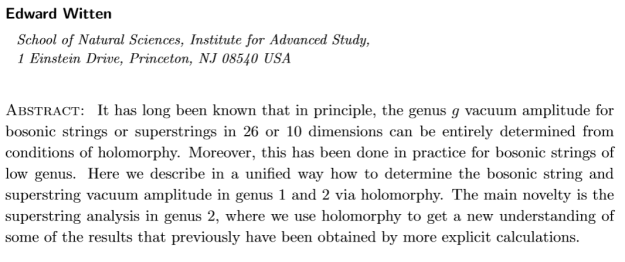
I’m about to show you an abstract from a theoretical physics paper. Don’t worry about what it says, just observe the grammar.

wittenabstract

Notice anything? Here, I’ll zoom in:

wittenwe

This paper has one author, Edward Witten. So who’s “we”?

As it turns out, it is actually quite common in theoretical physics for a paper to use the word “we”, even when it is written by a single author. While this tradition has been called stilted, pompous, and just plain bad writing, there is a legitimate reason behind it. “We” is convenient, because it represents several different important things.

While the paper I quoted was written by only one author, many papers are collaborative efforts. For a collaboration, depending on collaboration style, it is often hard to distinguish who did what in a consistent way. As such, “we” helps smooth over different collaboration styles in a consistent way.

What about single-authored papers, though? For a single author, and often even for multiple authors, “we” means the author plus the reader.

In principle, anyone reading a paper in theoretical physics should be able to follow along, doing the calculations on their own, and replicate the paper’s results. In practice this can often be difficult to impossible, but it’s still true that if you want to really retain what you read in theoretical physics, you need to follow along and do some of the calculation yourself. As a nod to this, it is conventional to write theoretical physics papers as if the reader was directly participating, leading them through the results point by point like exercises in a textbook. “We” do one calculation, then “we” use the result to derive the next point, and so on.

There are other meanings that “we” can occasionally serve, such as referring to everyone in a particular field, or a group in a hypothetical example.

While each of these meanings of “we” could potentially use a different word, that tends to make a paper feel cluttered, with jarring transitions between different subjects. Using “we” for everything gives the paper a consistent voice and feel, though it does come at the cost of obscuring some of the specific details of who did what. Especially for collaborations, the “we the collaborators” and “we the author plus reader” meanings can overlap and blur together. This usually isn’t a problem, but as I’ve been finding out recently it does make things tricky when writing for people who aren’t theoretical physicists, such as universities with guidelines that require a thesis to clearly specify who in a collaboration did what.

On an unrelated note, two papers went up this week pushing the hexagon function story to new and impressive heights. I wasn’t directly involved in either, I’ve been attacking a somewhat different part of the problem, and you can look forward to something on that in a few months.

What’s in a Thesis?

As I’ve mentioned before, I’m graduating this spring, which means I need to write that most foreboding of documents, the thesis. As I work on it, I’ve been thinking about how the nature of the thesis varies from field to field.

If you don’t have much experience with academics, you probably think of a thesis as a single, overarching achievement that structures a grad student’s career. A student enters grad school, designs an experiment, performs it, collects data, analyzes the data, draws some conclusion, then writes a thesis about it and graduates.

In some fields, the thesis really does work that way. In biology for example, the process of planning an experiment, setting it up, and analyzing and writing up the data can be just the right size so that, a reasonable percentage of the time, it really can all be done over the course of a PhD.

Other fields tend more towards smaller, faster-paced projects. In theoretical physics, mathematics, and computer science, most projects don’t have the same sort of large experimental overhead that psychologists or biologists have to deal with. The projects I’ve worked on are large-scale for theoretical physics, and I’ll still likely have worked on three distinct things before I graduate. Others, with smaller projects, will often have covered more.

In this situation, a thesis isn’t one overarching idea. Rather, it’s a compilation of work from past projects, sewed together with a pretense of an overall theme. It’s a bit messy, but because it’s the way things are expected to be done in these fields, no-one minds particularly much.

The other end of the spectrum is potentially much harder to deal with. For those who work on especially big experiments, the payoff might take longer to arrive than any reasonable degree. Big machines like colliders and particle detectors can take well over a decade before they start producing data, while longitudinal studies that follow a population as they grow and age take a long time no matter how fast you work.

In cases like this, the challenge is to chop off a small enough part of the project to make it feel like a thesis. A thesis could be written about designing one component for the eventual machine, or analyzing one part of the vast sea of data it produces. Preliminary data from a longitudinal study could be analyzed, even when the final results are many years down the line.

People in these fields have to be flexible and creative when it comes to creating a thesis, but usually the thesis committee is reasonable. In the end, a thesis is what you need to graduate, whatever that actually is for you.