Tag Archives: theoretical physics

Outreach Talk on Math’s Role in Physics

Tonight is “Culture Night” in Copenhagen, the night when the city throws open its doors and lets the public in. Museums and hospitals, government buildings and even the Freemasons, all have public events. The Niels Bohr Institute does too, of course: an evening of physics exhibits and demos, capped off with a public lecture by Denmark’s favorite bow-tie wearing weirder-than-usual string theorist, Holger Bech Nielsen. In between, there are a number of short talks by various folks at the institute, including yours truly.

In my talk, I’m going to try and motivate the audience to care about math. Math is dry of course, and difficult for some, but we physicists need it to do our jobs. If you want to be precise about a claim in physics, you need math simply to say what you want clearly enough.

Since you guys likely don’t overlap with my audience tonight, it should be safe to give a little preview. I’ll be using a few examples, but this one is the most complicated:

I’ll be telling a story I stole from chapter seven of the web serial Almost Nowhere. (That link is to the first chapter, by the way, in case you want to read the series without spoilers. It’s very strange, very unique, and at least in my view quite worth reading.) You follow a warrior carrying a spear around a globe in two different paths. The warrior tries to always point in the same direction, but finds that the two different paths result in different spears when they meet. The story illustrates that such a simple concept as “what direction you are pointing” isn’t actually so simple: if you want to think about directions in curved space (like the surface of the Earth, but also, like curved space-time in general relativity) then you need more sophisticated mathematics (a notion called parallel transport) to make sense of it.

It’s kind of an advanced concept for a public talk. But seeing it show up in Almost Nowhere inspired me to try to get it across. I’ll let you know how it goes!

By the way, if you are interested in learning the kinds of mathematics you need for theoretical physics, and you happen to be a Bachelor’s student planning to pursue a PhD, then consider the Perimeter Scholars International Master’s Program! It’s a one-year intensive at the Perimeter Institute in Waterloo, Ontario, in Canada. In a year it gives you a crash course in theoretical physics, giving you tools that will set you ahead of other beginning PhD students. I’ve witnessed it in action, and it’s really remarkable how much the students learn in a year, and what they go on to do with it. Their early registration deadline is on November 15, just a month away, so if you’re interested you may want to start thinking about it.

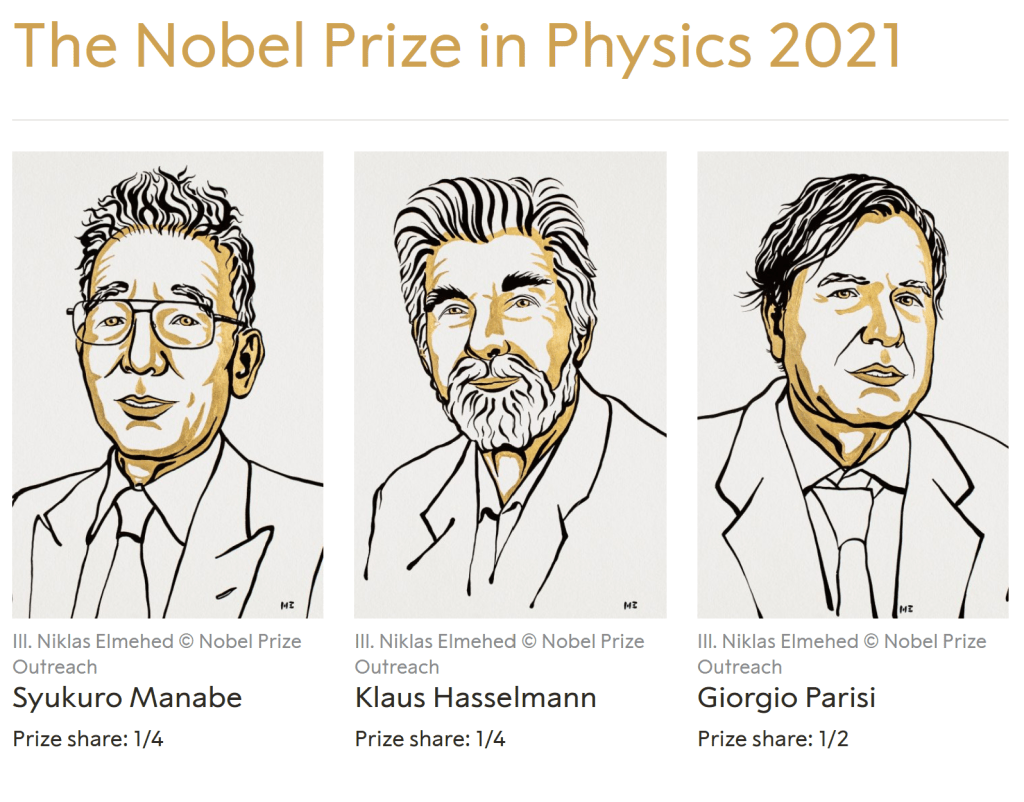
Congratulations to Syukuro Manabe, Klaus Hasselmann, and Giorgio Parisi!

The 2021 Nobel Prize in Physics was announced this week, awarded to Syukuro Manabe and Klaus Hasselmann for climate modeling and Giorgio Parisi for understanding a variety of complex physical systems.

Before this year’s prize was announced, I remember a few “water cooler chats” about who might win. No guess came close, though. The Nobel committee seems to have settled in to a strategy of prizes on a loosely linked “basket” of topics, with half the prize going to a prominent theorist and the other half going to two experimental, observational, or (in this case) computational physicists. It’s still unclear why they’re doing this, but regardless it makes it hard to predict what they’ll do next!

When I read the announcement, my first reaction was, “surely it’s not that Parisi?” Giorgio Parisi is known in my field for the Altarelli-Parisi equations (more properly known as the DGLAP equations, the longer acronym because, as is often the case in physics, the Soviets got there first). These equations are in some sense why the scattering amplitudes I study are ever useful at all. I calculate collisions of individual fundamental particles, like quarks and gluons, but a real particle collider like the LHC collides protons. Protons are messy, interacting combinations of quarks and gluons. When they collide you need not merely the equations describing colliding quarks and gluons, but those that describe their messy dynamics inside the proton, and in particular how those dynamics look different for experiments with different energies. The equation that describes that is the DGLAP equation.

As it turns out, Parisi is known for a lot more than the DGLAP equation. He is best known for his work on “spin glasses”, models of materials where quantum spins try to line up with each other, never quite settling down. He also worked on a variety of other complex systems, including flocks of birds!

I don’t know as much about Manabe and Hasselmann’s work. I’ve only seen a few talks on the details of climate modeling. I’ve seen plenty of talks on other types of computer modeling, though, from people who model stars, galaxies, or black holes. And from those, I can appreciate what Manabe and Hasselmann did. Based on those talks, I recognize the importance of those first one-dimensional models, a single column of air, especially back in the 60’s when computer power was limited. Even more, I recognize how impressive it is for someone to stay on the forefront of that kind of field, upgrading models for forty years to stay relevant into the 2000’s, as Manabe did. Those talks also taught me about the challenge of coupling different scales: how small effects in churning fluids can add up and affect the simulation, and how hard it is to model different scales at once. To use these effects to discover which models are reliable, as Hasselmann did, is a major accomplishment.

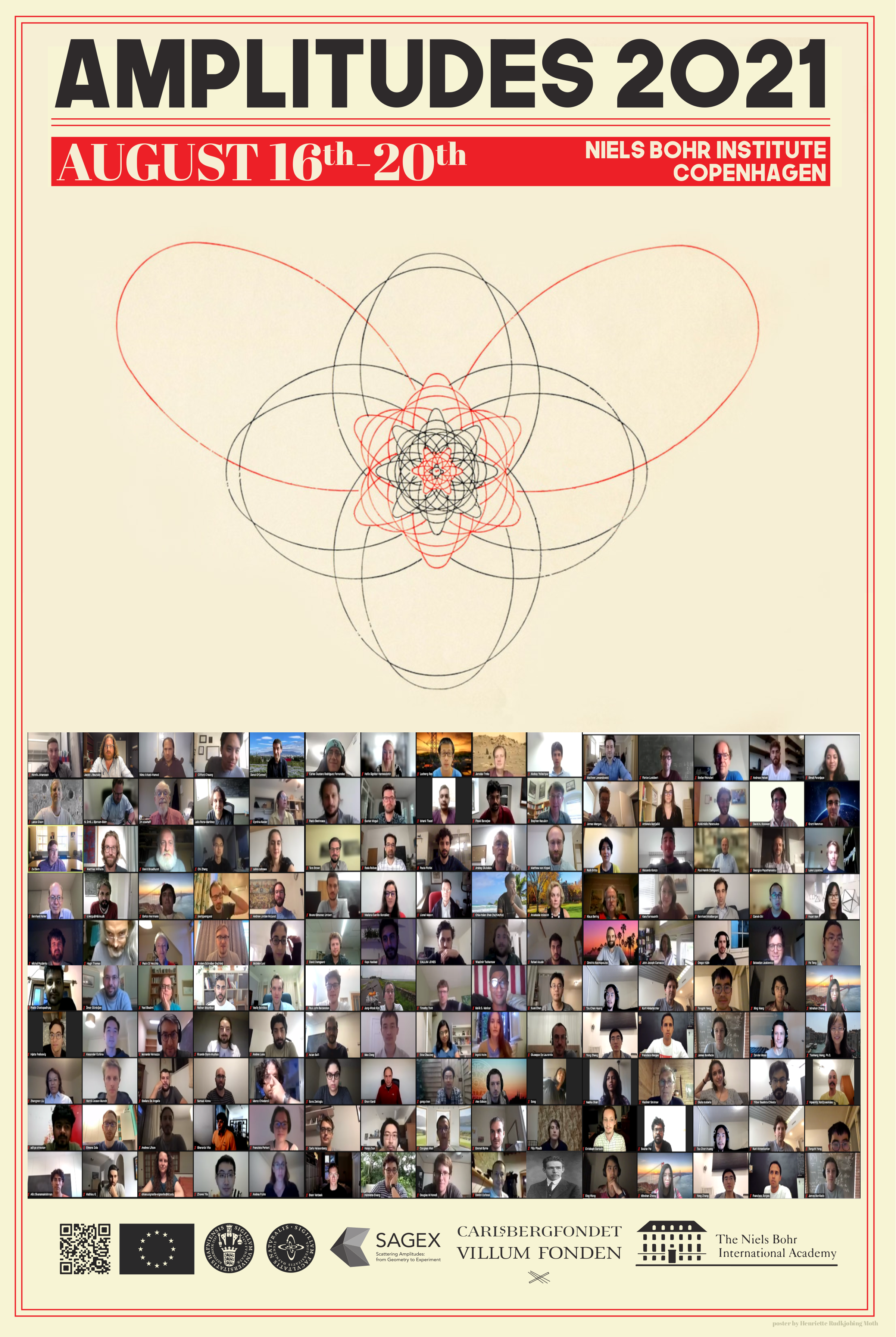
Amplitudes 2021 Retrospective

Phew!

The conference photo

Now that I’ve rested up after this year’s Amplitudes, I’ll give a few of my impressions.

Overall, I think the conference went pretty well. People seemed amused by the digital Niels Bohr, even if he looked a bit like a puppet (Lance compared him to Yoda in his final speech, which was…apt). We used Gather.town, originally just for the poster session and a “virtual reception”, but later we also encouraged people to meet up in it during breaks. That in particular was a big hit: I think people really liked the ability to just move around and chat in impromptu groups, and while nobody seemed to use the “virtual bar”, the “virtual beach” had a lively crowd. Time zones were inevitably rough, but I think we ended up with a good compromise where everyone could still see a meaningful chunk of the conference.

A few things didn’t work as well. For those planning conferences, I would strongly suggest not making a brand new gmail account to send out conference announcements: for a lot of people the emails went straight to spam. Zulip was a bust: I’m not sure if people found it more confusing than last year’s Slack or didn’t notice it due to the spam issue, but almost no-one posted in it. YouTube was complicated: the stream went down a few times and I could never figure out exactly why, it may have just been internet issues here at the Niels Bohr Institute (we did have a power outage one night and had to scramble to get internet access back the next morning). As far as I could tell YouTube wouldn’t let me re-open the previous stream so each time I had to post a new link, which probably was frustrating for those following along there.

That said, this was less of a problem than it might have been, because attendance/”viewership” as a whole was lower than expected. Zoomplitudes last year had massive numbers of people join in both on Zoom and via YouTube. We had a lot fewer: out of over 500 registered participants, we had fewer than 200 on Zoom at any one time, and at most 30 or so on YouTube. Confusion around the conference email might have played a role here, but I suspect part of the difference is simple fatigue: after over a year of this pandemic, online conferences no longer feel like an exciting new experience.

The actual content of the conference ranged pretty widely. Some people reviewed earlier work, others presented recent papers or even work-in-progress. As in recent years, a meaningful chunk of the conference focused on applications of amplitudes techniques to gravitational wave physics. This included a talk by Thibault Damour, who has by now mostly made his peace with the field after his early doubts were sorted out. He still suspected that the mismatch of scales (weak coupling on the one hand, classical scattering on the other) would cause problems in future, but after his work with Laporta and Mastrolia even he had to acknowledge that amplitudes techniques were useful.

In the past I would have put the double-copy and gravitational wave researchers under the same heading, but this year they were quite distinct. While a few of the gravitational wave talks mentioned the double-copy, most of those who brought it up were doing something quite a bit more abstract than gravitational wave physics. Indeed, several people were pushing the boundaries of what it means to double-copy. There were modified KLT kernels, different versions of color-kinematics duality, and explorations of what kinds of massive particles can and (arguably more interestingly) cannot be compatible with a double-copy framework. The sheer range of different generalizations had me briefly wondering whether the double-copy could be “too flexible to be meaningful”, whether the right definitions would let you double-copy anything out of anything. I was reassured by the points where each talk argued that certain things didn’t work: it suggests that wherever this mysterious structure comes from, its powers are limited enough to make it meaningful.

A fair number of talks dealt with what has always been our main application, collider physics. There the context shifted, but the message stayed consistent: for a “clean” enough process two or three-loop calculations can make a big difference, taking a prediction that would be completely off from experiment and bringing it into line. These are more useful the more that can be varied about the calculation: functions are more useful than numbers, for example. I was gratified to hear confirmation that a particular kind of process, where two massless particles like quarks become three massive particles like W or Z bosons, is one of these “clean enough” examples: it means someone will need to compute my “tardigrade” diagram eventually.

If collider physics is our main application, N=4 super Yang-Mills has always been our main toy model. Jaroslav Trnka gave us the details behind Nima’s exciting talk from last year, and Nima had a whole new exciting talk this year with promised connections to category theory (connections he didn’t quite reach after speaking for two and a half hours). Anastasia Volovich presented two distinct methods for predicting square-root symbol letters, while my colleague Chi Zhang showed some exciting progress with the elliptic double-box, realizing the several-year dream of representing it in a useful basis of integrals and showcasing several interesting properties. Anne Spiering came over from the integrability side to show us just how special the “planar” version of the theory really is: by increasing the number of colors of gluons, she showed that one could smoothly go between an “integrability-esque” spectrum and a “chaotic” spectrum. Finally, Lance Dixon mentioned his progress with form-factors in his talk at the end of the conference, showing off some statistics of coefficients of different functions and speculating that machine learning might be able to predict them.

On the more mathematical side, Francis Brown showed us a new way to get numbers out of graphs, one distinct but related to our usual interpretation in terms of Feynman diagrams. I’m still unsure what it will be used for, but the fact that it maps every graph to something finite probably has some interesting implications. Albrecht Klemm and Claude Duhr talked about two sides of the same story, their recent work on integrals involving Calabi-Yau manifolds. They focused on a particular nice set of integrals, and time will tell whether the methods work more broadly, but there are some exciting suggestions that at least parts will.

There’s been a resurgence of the old dream of the S-matrix community, constraining amplitudes via “general constraints” alone, and several talks dealt with those ideas. Sebastian Mizera went the other direction, and tried to test one of those “general constraints”, seeing under which circumstances he could prove that you can swap a particle going in with an antiparticle going out. Others went out to infinity, trying to understand amplitudes from the perspective of the so-called “celestial sphere” where they appear to be governed by conformal field theories of some sort. A few talks dealt with amplitudes in string theory itself: Yvonne Geyer built them out of field-theory amplitudes, while Ashoke Sen explained how to include D-instantons in them.

We also had three “special talks” in the evenings. I’ve mentioned Nima’s already. Zvi Bern gave a retrospective talk that I somewhat cheesily describe as “good for the soul”: a look to the early days of the field that reminded us of why we are who we are. Lance Dixon closed the conference with a light-hearted summary and a look to the future. That future includes next year’s Amplitudes, which after a hasty discussion during this year’s conference has now localized to Prague. Let’s hope it’s in person!

Lessons From Neutrinos, Part II

Last week I talked about the history of neutrinos. Neutrinos come in three types, or “flavors”. Electron neutrinos are the easiest: they’re produced alongside electrons and positrons in the different types of beta decay. Electrons have more massive cousins, called muon and tau particles. As it turns out, each of these cousins has a corresponding flavor of neutrino: muon neutrinos, and tau neutrinos.

For quite some time, physicists thought that all of these neutrinos had zero mass.

(If the idea of a particle with zero mass confuses you, think about photons. A particle with zero mass travels, like a photon, at the speed of light. This doesn’t make them immune to gravity: just as no light can escape a black hole, neither can any other massless particle. It turns out that once you take into account Einstein’s general theory of relativity, gravity cares about energy, not just mass.)

Eventually, physicists started to realize they were wrong, and neutrinos had a small non-zero mass after all. Their reason why might seem a bit strange, though. Physicists didn’t weigh the neutrinos, or measure their speed. Instead, they observed that different flavors of neutrinos transform into each other. We say that they oscillate: electron neutrinos oscillate into muon or tau neutrinos, which oscillate into the other flavors, and so on. Over time, a beam of electron neutrinos will become a beam of mostly tau and muon neutrinos, before becoming a beam of electron neutrinos again.

That might not sound like it has much to do with mass. To understand why it does, you’ll need to learn this post’s lesson:

Lesson 2: Mass is just How Particles Move

Oscillating particles seem like a weird sort of evidence for mass. What would be a more normal kind of evidence?

Those of you who’ve taken physics classes might remember the equation F=ma. Apply a known force to something, see how much it accelerates, and you can calculate its mass. If you’ve had a bit more physics, you’ll know that this isn’t quite the right equation to use for particles close to the speed of light, but that there are other equations we can use in a similar way. In particular, using relativity, we have E^2=p^2 c^2 + m^2 c^4. (At rest, p=0, and we have the famous E=mc^2). This lets us do the same kind of thing: give something a kick and see how it moves.

So let’s say we do that: we give a particle a kick, and measure it later. I’ll visualize this with a tool physicists use called a Feynman diagram. The line represents a particle traveling from one side to the other, from “kick” to “measurement”:

Because we only measure the particle at the end, we might miss if something happens in between. For example, it might interact with another particle or field, like this:

If we don’t know about this other field, then when we try to measure the particle’s mass we will include interactions like this. As it turns out, this is how the Higgs boson works: the Higgs field interacts with particles like electrons and quarks, changing how they move, so that they appear to have mass.

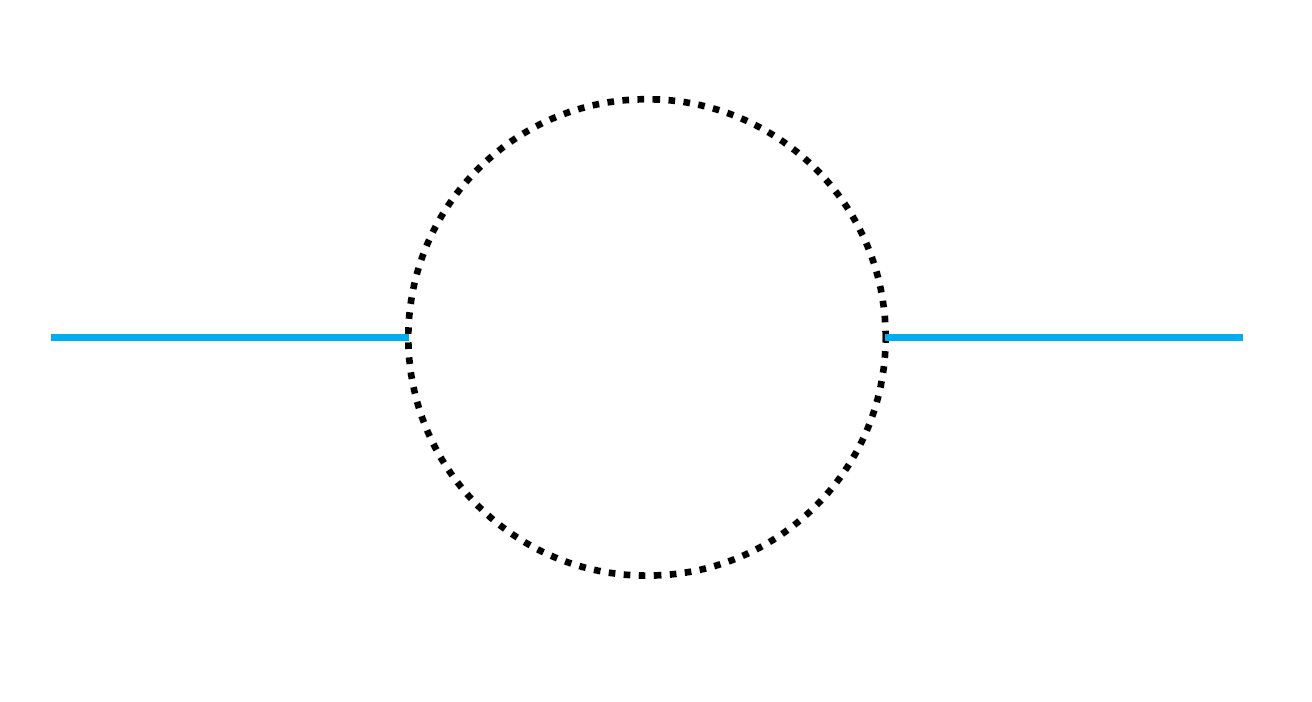
Quantum particles can do other things too. You might have heard people talk about one particle turning into a pair of temporary “virtual particles”. When people say that, they usually have a diagram in mind like this:

In particle physics, we need to take into account every diagram of this kind, every possible thing that could happen in between “kick” and measurement. The final result isn’t one path or another, but a sum of all the different things that could have happened in between. So when we measure the mass of a particle, we’re including every diagram that’s allowed: everything that starts with our “kick” and ends with our measurement.

Now what if our particle can transform, from one flavor to another?

Now we have a new type of thing that can happen in between “kick” and measurement. And if it can happen once, it can happen more than once:

Remember that, when we measure mass, we’re measuring a sum of all the things that can happen in between. That means our particle could oscillate back and forth between different flavors many many times, and we need to take every possibility into account. Because of that, it doesn’t actually make sense to ask what the mass is for one flavor, for just electron neutrinos or just muon neutrinos. Instead, mass is for the thing that actually moves: an average (actually, a quantum superposition) over all the different flavors, oscillating back and forth any number of times.

When a process like beta decay produces an electron neutrino, the thing that actually moves is a mix (again, a superposition) of particles with these different masses. Because each of these masses respond to their initial “kick” in different ways, you see different proportions of them over time. Try to measure different flavors at the end, and you’ll find different ones depending on when and where you measure. That’s the oscillation effect, and that’s why it means that neutrinos have mass.

It’s a bit more complicated to work out the math behind this, but not unreasonably so: it’s simpler than a lot of other physics calculations. Working through the math, we find that by measuring how long it takes neutrinos to oscillate we can calculate the differences between (squares of) neutrino masses. What we can’t calculate are the masses themselves. We know they’re small: neutrinos travel at almost the speed of light, and our cosmological models of the universe have surprisingly little room for massive neutrinos: too much mass, and our universe would look very different than it does today. But we don’t know much more than that. We don’t even know the order of the masses: you might assume electron neutrinos are on average lighter than muon neutrinos, which are lighter than tau neutrinos…but it could easily be the other way around! We also don’t know whether neutrinos get their mass from the Higgs like other particles do, or if they work in a completely different way.

Unlike other mysteries of physics, we’ll likely have the answer to some of these questions soon. People are already picking through the data from current experiments, seeing if they hint towards one order of masses or the other, or to one or the other way for neutrinos to get their mass. More experiments will start taking data this year, and others are expected to start later this decade. At some point, the textbooks may well have more “normal” mass numbers for each of the neutrinos. But until then, they serve as a nice illustration of what mass actually means in particle physics.


Digging for Buried Insight

The scientific method, as we usually learn it, starts with a hypothesis. The scientist begins with a guess, and asks a question with a clear answer: true, or false? That guess lets them design an experiment, observe the consequences, and improve our knowledge of the world.

But where did the scientist get the hypothesis in the first place? Often, through some form of exploratory research.

Exploratory research is research done, not to answer a precise question, but to find interesting questions to ask. Each field has their own approach to exploration. A psychologist might start with interviews, asking broad questions to find narrower questions for a future survey. An ecologist might film an animal, looking for changes in its behavior. A chemist might measure many properties of a new material, seeing if any stand out. Each approach is like digging for treasure, not sure of exactly what you will find.

Mathematicians and theoretical physicists don’t do experiments, but we still need hypotheses. We need an idea of what we plan to prove, or what kind of theory we want to build: like other scientists, we want to ask a question with a clear, true/false answer. And to find those questions, we still do exploratory research.

What does exploratory research look like, in the theoretical world? Often, it begins with examples and calculations. We can start with a known method, or a guess at a new one, a recipe for doing some specific kind of calculation. Recipe in hand, we proceed to do the same kind of calculation for a few different examples, covering different sorts of situation. Along the way, we notice patterns: maybe the same steps happen over and over, or the result always has some feature.

We can then ask, do those same steps always happen? Does the result really always have that feature? We have our guess, our hypothesis, and our attempt to prove it is much like an experiment. If we find a proof, our hypothesis was true. On the other hand, we might not be able to find a proof. Instead, exploring, we might find a counterexample – one where the steps don’t occur, the feature doesn’t show up. That’s one way to learn that our hypothesis was false.

This kind of exploration is essential to discovery. As scientists, we all have to eventually ask clear yes/no questions, to submit our beliefs to clear tests. But we can’t start with those questions. We have to dig around first, to observe the world without a clear plan, to get to a point where we have a good question to ask.

A Few Advertisements

A couple different things that some of you might like to know about:

Are you an amateur with an idea you think might revolutionize all of physics? If so, absolutely do not contact me about it. Instead, you can talk to these people. Sabine Hossenfelder runs a service that will hook you up with a scientist who will patiently listen to your idea and help you learn what you need to develop it further. They do charge for that service, and they aren’t cheap, so only do this if you can comfortably afford it. If you can’t, then I have some advice in a post here. Try to contact people who are experts in the specific topic you’re working on, ask concrete questions that you expect to give useful answers, and be prepared to do some background reading.

Are you an undergraduate student planning for a career in theoretical physics? If so, consider the Perimeter Scholars International (PSI) master’s program. Located at the Perimeter Institute in Waterloo, Canada, PSI is an intense one-year boot-camp in theoretical physics, teaching the foundational ideas you’ll need for the rest of your career. It’s something I wish I was aware of when I was applying for schools at that age. Theoretical physics is a hard field, and a big part of what makes it hard is all the background knowledge one needs to take part in it. Starting work on a PhD with that background knowledge already in place can be a tremendous advantage. There are other programs with similar concepts, but I’ve gotten a really good impression of PSI specifically so it’s them I would recommend. Note that applications for the new year aren’t open yet: I always plan to advertise them when they open, and I always forget. So consider this an extremely-early warning.

Are you an amplitudeologist? Registration for Amplitudes 2021 is now live! We’re doing an online conference this year, co-hosted by the Niels Bohr Institute and Penn State. We’ll be doing a virtual poster session, so if you want to contribute to that please include a title and abstract when you register. We also plan to stream on YouTube, and will have a fun online surprise closer to the conference date.

Who Is, and Isn’t, Counting Angels on a Pinhead

How many angels can dance on the head of a pin?

It’s a question famous for its sheer pointlessness. While probably no-one ever had that exact debate, “how many angels fit on a pin” has become a metaphor, first for a host of old theology debates that went nowhere, and later for any academic study that seems like a waste of time. Occasionally, physicists get accused of doing this: typically string theorists, but also people who debate interpretations of quantum mechanics.

Are those accusations fair? Sometimes yes, sometimes no. In order to tell the difference, we should think about what’s wrong, exactly, with counting angels on the head of a pin.

One obvious answer is that knowing the number of angels that fit on a needle’s point is useless. Wikipedia suggests that was the origin of the metaphor in the first place, a pun on “needle’s point” and “needless point”. But this answer is a little too simple, because this would still be a useful debate if angels were real and we could interact with them. “How many angels fit on the head of a pin” is really a question about whether angels take up space, whether two angels can be at the same place at the same time. Asking that question about particles led physicists to bosons and fermions, which among other things led us to invent the laser. If angelology worked, perhaps we would have angel lasers as well.

Be not afraid of my angel laser

“If angelology worked” is key here, though. Angelology didn’t work, it didn’t lead to angel-based technology. And while Medieval people couldn’t have known that for certain, maybe they could have guessed. When people accuse academics of “counting angels on the head of a pin”, they’re saying they should be able to guess that their work is destined for uselessness.

How do you guess something like that?

Well, one problem with counting angels is that nobody doing the counting had ever seen an angel. Counting angels on the head of a pin implies debating something you can’t test or observe. That can steer you off-course pretty easily, into conclusions that are either useless or just plain wrong.

This can’t be the whole of the problem though, because of mathematics. We rarely accuse mathematicians of counting angels on the head of a pin, but the whole point of math is to proceed by pure logic, without an experiment in sight. Mathematical conclusions can sometimes be useless (though we can never be sure, some ideas are just ahead of their time), but we don’t expect them to be wrong.

The key difference is that mathematics has clear rules. When two mathematicians disagree, they can look at the details of their arguments, make sure every definition is as clear as possible, and discover which one made a mistake. Working this way, what they build is reliable. Even if it isn’t useful yet, the result is still true, and so may well be useful later.

In contrast, when you imagine Medieval monks debating angels, you probably don’t imagine them with clear rules. They might quote contradictory bible passages, argue everyday meanings of words, and win based more on who was poetic and authoritative than who really won the argument. Picturing a debate over how many angels can fit on the head of a pin, it seems more like Calvinball than like mathematics.

This then, is the heart of the accusation. Saying someone is just debating how many angels can dance on a pin isn’t merely saying they’re debating the invisible. It’s saying they’re debating in a way that won’t go anywhere, a debate without solid basis or reliable conclusions. It’s saying, not just that the debate is useless now, but that it will likely always be useless.

As an outsider, you can’t just dismiss a field because it can’t do experiments. What you can and should do, is dismiss a field that can’t produce reliable knowledge. This can be hard to judge, but a key sign is to look for these kinds of Calvinball-style debates. Do people in the field seem to argue the same things with each other, over and over? Or do they make progress and open up new questions? Do the people talking seem to be just the famous ones? Or are there cases of young and unknown researchers who happen upon something important enough to make an impact? Do people just list prior work in order to state their counter-arguments? Or do they build on it, finding consequences of others’ trusted conclusions?

A few corners of string theory do have this Calvinball feel, as do a few of the debates about the fundamentals of quantum mechanics. But if you look past the headlines and blogs, most of each of these fields seems more reliable. Rather than interminable back-and-forth about angels and pinheads, these fields are quietly accumulating results that, one way or another, will give people something to build on.

Being Precise About Surprise

A reader pointed me to Stephen Wolfram’s one-year update of his proposal for a unified theory of physics. I was pretty squeamish about it one year ago, and now I’m even less interested in wading in to the topic. But I thought it would be worth saying something, and rather than say something specific, I realized I could say something general. I thought I’d talk a bit about how we judge good and bad research in theoretical physics.

In science, there are two things we want out of a new result: we want it to be true, and we want it to be surprising. The first condition should be obvious, but the second is also important. There’s no reason to do an experiment or calculation if it will just tell us something we already know. We do science in the hope of learning something new, and that means that the best results are the ones we didn’t expect.

(What about replications? We’ll get there.)

If you’re judging an experiment, you can measure both of these things with statistics. Statistics lets you estimate how likely an experiment’s conclusion is to be true: was there a large enough sample? Strong enough evidence? It also lets you judge how surprising the experiment is, by estimating how likely it would be to happen given what was known beforehand. Did existing theories and earlier experiments make the result seem likely, or unlikely? While you might not have considered replications surprising, from this perspective they can be: if a prior experiment seems unreliable, successfully replicating it can itself be a surprising result.

If instead you’re judging a theoretical result, these measures get more subtle. There aren’t always good statistical tools to test them. Nonetheless, you don’t have to rely on vague intuitions either. You can be fairly precise, both about how true a result is and how surprising it is.

We get our results in theoretical physics through mathematical methods. Sometimes, this is an actual mathematical proof: guaranteed to be true, no statistics needed. Sometimes, it resembles a proof, but falls short: vague definitions and unstated assumptions mar the argument, making it less likely to be true. Sometimes, the result uses an approximation. In those cases we do get to use some statistics, estimating how good the approximation may be. Finally, a result can’t be true if it contradicts something we already know. This could be a logical contradiction in the result itself, but if the result is meant to describe reality (note: not always the case), it might contradict the results of a prior experiment.

What makes a theoretical result surprising? And how precise can we be about that surprise?

Theoretical results can be surprising in the light of earlier theory. Sometimes, this gets made precise by a no-go theorem, a proof that some kind of theoretical result is impossible to obtain. If a result finds a loophole in a no-go theorem, that can be quite surprising. Other times, a result is surprising because it’s something no-one else was able to do. To be precise about that kind of surprise, you need to show that the result is something others wanted to do, but couldn’t. Maybe someone else made a conjecture, and only you were able to prove it. Maybe others did approximate calculations, and now you can do them more precisely. Maybe a question was controversial, with different people arguing for different sides, and you have a more conclusive argument. This is one of the better reasons to include a long list of references in a paper: not to pad your friends’ citation counts, but to show that your accomplishment is surprising: that others might have wanted to achieve it, but had to settle for something lesser.

In general, this means that showing whether a theoretical result is good: not merely true, but surprising and new, links you up to the rest of the theoretical community. You can put in all the work you like on a theory of everything, and make it as rigorous as possible, but if all you did was reproduce a sub-case of someone else’s theory then you haven’t accomplished all that much. If you put your work in context, compare and contrast to what others have done before, then we can start getting precise about how much we should be surprised, and get an idea of what your result is really worth.

Building One’s Technology

There are theoretical physicists who can do everything they do with a pencil and a piece of paper. I’m not one of them. The calculations I do are long, complicated, or tedious enough that they’re often best done with a computer. For a calculation like that, I can’t just use existing software “out of the box”: I need to program special-purpose tools to do the kind of calculation I need. This means each project has its own kind of learning curve. If I already have the right code, or almost the right code, things go very smoothly: with a few tweaks I can do a lot of interesting calculations. If I don’t have the right code yet, things go much more slowly: I have to build up my technology, figuring out what I need piece by piece until I’m back up to my usual speed.

I don’t always need to use computers to do my calculations. Sometimes my work hinges on something more conceptual: understanding a mathematical proof, or the arguments from another physicist’s paper. While this seems different on the surface, I’ve found that it has the same kinds of learning curves. If I know the right papers and mathematical methods, I can go pretty quickly. If I don’t, I have to “build up my technology”, reading and practicing, a slow build-up to my goal.

The times when I have to “build my technology” are always a bit frustrating. I don’t work as fast as I’d like, and I get tripped up by dumb mistakes. I keep having to go back, almost to the beginning, realizing that some aspect of how I set things up needs to be changed to make the rest work. As I go, though, the work gets more and more satisfying. I find pieces (of the code, of my understanding) that become solid, that I can rely on. I build my technology, and I can do more and more, and feel better about myself in the bargain. Eventually, I get back up to my full abilities, my technology set up, and a wide variety of calculations become possible.

Doing Difficult Things Is Its Own Reward

Does antimatter fall up, or down?

Technically, we don’t know yet. The ALPHA-g experiment would have been the first to check this, making anti-hydrogen by trapping anti-protons and positrons in a long tube and seeing which way it falls. While they got most of their setup working, the LHC complex shut down before they could finish. It starts up again next month, so we should have our answer soon.

That said, for most theorists’ purposes, we absolutely do know: antimatter falls down. Antimatter is one of the cleanest examples of a prediction from pure theory that was confirmed by experiment. When Paul Dirac first tried to write down an equation that described electrons, he found the math forced him to add another particle with the opposite charge. With no such particle in sight, he speculated it could be the proton (this doesn’t work, they need the same mass), before Carl D. Anderson discovered the positron in 1932.

The same math that forced Dirac to add antimatter also tells us which way it falls. There’s a bit more involved, in the form of general relativity, but the recipe is pretty simple: we know how to take an equation like Dirac’s and add gravity to it, and we have enough practice doing it in different situations that we’re pretty sure it’s the right way to go. Pretty sure doesn’t mean 100% sure: talk to the right theorists, and you’ll probably find a proposal or two in which antimatter falls up instead of down. But they tend to be pretty weird proposals, from pretty weird theorists.

Ok, but if those theorists are that “weird”, that outside the mainstream, why does an experiment like ALPHA-g exist? Why does it happen at CERN, one of the flagship facilities for all of mainstream particle physics?

This gets at a misconception I occasionally hear from critics of the physics mainstream. They worry about groupthink among mainstream theorists, the physics community dismissing good ideas just because they’re not trendy (you may think I did that just now, for antigravity antimatter!) They expect this to result in a self-fulfilling prophecy where nobody tests ideas outside the mainstream, so they find no evidence for them, so they keep dismissing them.

The mistake of these critics is in assuming that what gets tested has anything to do with what theorists think is reasonable.

Theorists talk to experimentalists, sure. We motivate them, give them ideas and justification. But ultimately, people do experiments because they can do experiments. I watched a talk about the ALPHA experiment recently, and one thing that struck me was how so many different techniques play into it. They make antiprotons using a proton beam from the accelerator, slow them down with magnetic fields, and cool them with lasers. They trap their antihydrogen in an extremely precise vacuum, and confirm it’s there with particle detectors. The whole setup is a blend of cutting-edge accelerator physics and cutting-edge tricks for manipulating atoms. At its heart, ALPHA-g feels like its primary goal is to stress-test all of those tricks: to push the state of the art in a dozen experimental techniques in order to accomplish something remarkable.

And so even if the mainstream theorists don’t care, ALPHA will keep going. It will keep getting funding, it will keep getting visited by celebrities and inspiring pop fiction. Because enough people recognize that doing something difficult can be its own reward.

In my experience, this motivation applies to theorists too. Plenty of us will dismiss this or that proposal as unlikely or impossible. But give us a concrete calculation, something that lets us use one of our flashy theoretical techniques, and the tune changes. If we’re getting the chance to develop our tools, and get a paper out of it in the process, then sure, we’ll check your wacky claim. Why not?

I suspect critics of the mainstream would have a lot more success with this kind of pitch-based approach. If you can find a theorist who already has the right method, who’s developing and extending it and looking for interesting applications, then make your pitch: tell them how they can answer your question just by doing what they do best. They’ll think of it as a chance to disprove you, and you should let them, that’s the right attitude to take as a scientist anyway. It’ll work a lot better than accusing them of hogging the grant money.