Tag Archives: supersymmetry

(Super)gravity: Meet the Gravitino

I’m putting together a series of posts about N=8 supergravity, with the goal of creating a guide much like I have for N=4 super Yang-Mills and the (2,0) theory.

N=8 supergravity is what happens when you add the maximum amount of supersymmetry to a theory of gravity. I’m going to strongly recommend that you read both of those posts before reading this one, as there are a number of important concepts there: the idea that different types of particles are categorized by a number called spin, the idea that supersymmetry is a relationship between particles with spin X and particles with spin X-½, and the idea that gravity can be thought of equally as a bending of space and time or as a particle with spin 2, called a graviton.

Knowing all that, if you add supersymmetry to gravity, you’d relate a spin 2 particle (the graviton) to a spin 3/2 particle (for 2-½).

What is a spin 3/2 particle?

Spin 0 particles correspond to a single number, like a temperature, that can vary over space. The Higgs boson is the one example of a spin 0 particle that we know of in the real world. Spin ½ covers electrons, protons, and almost all of the particles that make up ordinary matter, while spin 1 covers Yang-Mills forces. That covers the entire Standard Model, all of the particles scientists have seen in the real world. So what could a spin 3/2 particle possibly be?

We can at least guess at what it would be called. Whatever this spin 3/2 particle is, it’s the supersymmetric partner of the graviton. For somewhat stupid reasons, that means its name is determined by taking “graviton” and adding “-ino” to the end, to get gravitino.

But that still doesn’t answer the question: What is a gravitino?

Here’s the quick answer: A gravitino is a spin 1 particle combined with a spin ½ particle.

What sort of combination am I talking about? Not the one you might think. A gravitino is a fundamental particle, it is not made up of other particles.


NOT like this.

So in what sense is it a combination?

A handy way for physicists to think about particles is as manifestations of an underlying field. The field is stronger or weaker in different places, and when the field is “on”, a particle is present. For example, the electron field covers all of space, but only where that electron field is greater than zero do actual electrons show up.

I’ve said that a scalar field is simple to understand because it’s just a number, like a temperature, that takes different values in different places. The other types of fields are like this too, but instead of one number there’s generally a more complicated set of numbers needed to define them. Yang-Mills fields, with spin 1, are forces, with a direction and a strength. This is why they’re often called vector fields. Spin ½ particles have a set of numbers that characterizes them as well. It’s called a spinor, and unfortunately it’s not something I can give you an intuitive definition for. Just be aware that, like vectors, it involves a series of numbers that specify how the field behaves at each point.

It’s a bit like a computer game. The world is full of objects, and different objects have different stats. A weapon might have damage and speed, while a quest-giver would have information about what quests they give. Since everything is just code, though, you can combine the two, and all you have to do is put both types of stats on the same object.

Like this.

For quantum fields, the “stats” are the numbers I mentioned earlier: a single number for scalars, direction and strength for vectors, and the spinor information for spinors. So if you want to combine two of them, say spin 1 and spin ½, you just need a field that has both sets of “stats”.

That’s the gravitino. The gravitino has vector “stats” from the spin 1 part, and spinor “stats” from the spin ½ part. It’s a combination of two types of fundamental particles, to create one that nobody has seen before.

That doesn’t mean nobody will ever see one, though. Gravitinos could well exist in our world, they’re actually a potential (if problematic) candidate for dark matter.

But much like supersymmetry in general, while gravitinos may exist, N=8 of them certainly don’t. N=8 is a whole lot of supersymmetry…but that’s a topic for another post. Stay tuned for the next post in the series!

The (2, 0) Theory: What does it mean?

Part Two of a Series on the (2, 0) Theory

Apologies in advance. This is going to be a long one.

So now that you know that the (2, 0) theory is the world-volume theory of an M5-brane, you might be asking what the hell (2, 0) means. Why is this theory labeled with an arcane bunch of numbers rather than words like any sensible theory?

To explain that, we have to talk a bit about how we count supersymmetries. As I talked about with N=4 super Yang-Mills, supersymmetry is a relationship between particles of different spins, and since one particle can be related in this way to more than one other particle, we indicated the number of different related particles by the number N. (I’d recommend reading those posts to understand this one. If you need a quick summary, spin is a way of categorizing particles, with spin 1 corresponding to forces of nature like electromagnetism and the Yang-Mills forces in general, while spin ½ corresponds to the types of particles that make up much of everyday matter, like electrons and quarks.)

As it turns out, we count the number of supersymmetries N differently in different dimensions. The reasons are fairly technical, and are related to the fact that spin ½ particles are more complicated in higher dimensions. The end result is that while super Yang-Mills has N=4 in four dimensions (three space one time), in six dimensions it only has N=2 (in case you’re curious, it goes all the way down to N=1 in ten dimensions).

The “2” in the (2, 0) theory means the same thing as that N=2. However, the (2, 0) theory is very different from super Yang-Mills, and that’s where the other number in the pair comes in. To explain this, I have to talk a bit about something called chirality.

Chirality is a word for handedness. If you’re given a right-handed glove, no matter what you do you can’t rotate it to turn it into a left-handed glove. The only way you could change a right-handed glove into a left-handed glove would be to flip it through a mirror, like Alice through the looking glass.

Particles often behave similarly. While they don’t have fingers to flip, they do have spin.

I told you earlier to think of spin as just a way to classify particles. That’s still the best way for you to think about it, but in order to explain chirality I have to mention that spin isn’t just an arbitrary classification scheme, it’s a number that corresponds to how fast a particle is “spinning”.

Here I have to caution that the particle isn’t necessarily literally spinning. Rather, it acts as if it were spinning, interacting with other objects as if it were spinning with a particular speed. If you’ve ever played with a gyroscope, you know that a spinning object behaves differently from a non-spinning one: the faster it spins, the harder it is to change the direction in which it is spinning.

Suppose that a particle is flying at you head-on. If you measured the particle’s spin, it would appear to be spinning either clockwise or counterclockwise, to the left or to the right. This choice, left or right, is the particle’s chirality.

L for left, R for right, V and p show which way the particle is going.

The weird thing is that there are some particles that only spin one way. For example, every neutrino that has been discovered has left-handed chirality. In general when a fermion only spins one way we call it a chiral fermion.

What does this have to do with the (2, 0) theory?

Supersymmetry relates particles of spin X to particles of spin X-½.  As such, you can look at supersymmetry as taking the original particle, and “subtracting” a particle of spin ½. These aren’t really particles, but they share some properties, and those properties can include chirality. You can have left-supersymmetry, and right-supersymmetry.

So what does (2, 0) mean? It means that not only is the (2, 0) theory an N=2 theory in six dimensions, but those two supersymmetries are chiral. They are only left-handed (or, if you prefer, only right-handed). By contrast, super Yang-Mills in six dimensions is a (1, 1) theory. It has one left-handed supersymmetry, and one right-handed supersymmetry.

We can now learn a bit more about the sorts of particles in the (2, 0) theory.

As I said when discussing N=4 super Yang-Mills, N=4 is the most supersymmetry you can have in Yang-Mills in four dimensions. Any more, and you need to include gravity.  Recall that the (2, 0) theory comes from the behavior of M5-branes in M theory. M theory includes gravity, which means that it can go higher than N=4.

How high? As it turns out, the maximum including gravity (which I will explain a bit more when I do a series on supergravity) is N=8. That’s in four dimensions, however. In M theory’s native eleven dimensions, this is just N=1. In six dimensions, where the (2, 0) theory lives, this becomes N=4. More specifically, including information about chirality, its supersymmetry is (2, 2).

So if M theory in six dimensions has (2, 2) symmetry, how to we get to (2, 0)? What happens to the other ( ,2)?

As I talked about in the last post, the varying position of the M5-brane in the other five dimensions gives rise to five scalar fields. In a way, we have broken the symmetry between the eleven dimensions of M theory, treating five of them differently from the other six.

It turns out that supersymmetry is closely connected to the symmetry of space and time. What this means in practice is that when you break the symmetry of space-time, you can also break supersymmetry, reducing the number N of symmetries. Here, the M5-brane breaks supersymmetry from (2, 2) to (2, 0), so two of the supersymmetries are broken.

Just like the position of the M5-brane can vary, so too can the specific supersymmetries broken. What this means is that just like the numbers for the positions become scalar fields, the choices of supersymmetry to be broken become new fermion fields. Because supersymmetry is broken in a chiral way, these new fermion fields are chiral, which for technical reasons ends up meanings that because of the two broken supersymmetries, there are four new chiral fermions.

So far, we know that the (2, 0) theory has five scalar fields, and four chiral fermions. But scalar fields and chiral fermions are pretty ordinary, surely not as mysterious as the Emperor, or even Mara Jade. What makes the (2, 0) theory so mysterious, so difficult to deal with? What makes it, in a word, sexy? Tune in next week to find out!

What if there’s nothing new?

In the weeks after the folks at the Large Hadron Collider announced that they had found the Higgs, people I met would ask if I was excited. After all, the Higgs was what particle physicists were searching for, right?

 As usual in this blog, the answer is “Not really.”

We were all pretty sure the Higgs had to exist; we just didn’t know what its mass would be. And while many people had predictions for what properties the Higgs might have (including some string theorists), fundamentally they were interested for other reasons.

Those reasons, for the most part, are supersymmetry. If the Higgs had different properties than we expected, it could be evidence for one or another proposed form of supersymmetry. Supersymmetry is still probably the best explanation for dark matter, and it’s necessary in some form or another for string theory. It also helps with other goals of particle physics, like unifying the fundamental forces and getting rid of fine-tuned parameters.

Fundamentally, though, the Higgs isn’t likely to answer these questions. To get enough useful information we’ll need to discover an actual superpartner particle. And so far…we haven’t.

That’s why we’re not all that excited about the Higgs anymore. And that’s why, increasingly, particle physics is falling into doom and gloom.

Sure, when physicists talk about the situation, they’re quick to claim that they’re just as hopeful as ever. We still may well see supersymmetry in later runs of the LHC, as it still has yet to reach its highest energies. But people are starting, quietly and behind closed doors, to ask: what if we don’t?

What happens if we don’t see any new particles in the LHC?

There are good mathematical reasons to think that some form of supersymmetry holds. Even if we don’t see supersymmetric particles in the LHC, they may still exist. We just won’t know anything new about them.

That’s a problem.

We’ve been spinning our wheels for too long, and it’s becoming more and more obvious. With no new information from experiments, it’s not clear what we can do anymore.

And while, yes, many theorists are studying theories that aren’t true, sometimes without even an inkling of a connection to the real world, we’re all part of the same zeitgeist. We may not be studying reality itself, but at least we’re studying parts of reality, rearranged in novel ways. Without the support of experiment the rest of the field starts to decay. And one by one, those who can are starting to leave.

Despite how it may seem, most of physics doesn’t depend on supersymmetry. If you’re investigating novel materials, or the coolest temperatures ever achieved, or doing other awesome things with lasers, then the LHC’s failure to find supersymmetry will mean absolutely nothing to you. It’s only a rather small area of physics that will progressively fall into self-doubt until the only people left are the insane or the desperate.

But those of us in that area? If there really is nothing new? Yeah, we’re screwed.

N=4: Maximal Particles for Maximal Fun

Part Four of a Series on N=4 Super Yang-Mills Theory

This is the fourth in a series of articles that will explain N=4 super Yang-Mills theory. In this series I take that phrase apart bit by bit, explaining as I go. Because I’m perverse and out to confuse you, I started with the last bit here, and now I’ve reached the final part.

N=4 Super Yang-Mills Theory

Last time I explained supersymmetry as a relationship between two particles, one with spin X and the other with spin X-½. It’s actually a leeetle bit more complicated than that.

When a shape is symmetric, you can turn it around and it will look the same. When a theory is supersymmetric, you can “turn” it, moving from particles with spin X to particles of spin X-½, and the theory will look the same.

With a 2D shape, that’s the whole story. But if you have a symmetric 3D shape, you can turn it in two different directions, moving to different positions, and the shape will look the same either way. In supersymmetry, the number of different ways you can “turn” the theory and still have it look the same is called N.

N=1 symmetric shape

N=2 symmetric shape

Consider the example of super Yang-Mills. If we start out with a particle of spin 1 (a Yang-Mills field), N=1 supersymmetry says that there will also be a particle of spin ½, similar to the particles of everyday matter. But suppose that instead we had N=2 supersymmetry. You can move from the spin 1 particle to spin ½ in one direction, or in the other one, and just like regular symmetry moving in two different directions will get you to two different positions. That means you need two different spin ½ particles! Furthermore, you can also move in one direction, then in the other one: you go from spin 1 to spin ½, then down from spin ½ to spin 0. So our theory can’t just have spin 1 and spin ½, it has to have spin 0 particles as well!

You can keep increasing N, as long as you keep increasing the number and types of particles. Finally, at N=4, you’ve got the maximal set: one Yang-Mills field with spin 1, four different spin ½ particles, and six different spin 0 scalars. The diagram below shows how the particles are related: you start in the center with a Yang-Mills field, and then travel in one of four directions to the spin ½ particles. Picking two of those directions, you travel further, to a scalar in between two spin ½ particles. Applying more supersymmetry just takes you back down: first to spin ½, then all the way back to spin 1.

N=4 super Yang-Mills is where the magic happens. Its high degree of symmetry gives it conformal invariance and dual conformal invariance, it has been observed to have maximal transcendentality and it may even be integrable. Any one of those statements could easily take a full blog post to explain. For now, trust me when I tell you that while N=4 super Yang-Mills may seem complicated, its symmetry means that deep down it is one of the easiest theories to work with, and in fact it might be the simplest non-gravity quantum field theory possible. That makes it an immensely important stepping stone, the first link to take us to a full understanding of particle physics.

One final note: you’re probably wondering why we stopped at N=4. At N=4 we have enough symmetry to go out from spin 1 to spin 0, and then back in to spin 1 again. Any more symmetry, and we need more space, which in this case means higher spin, which means we need to start talking about gravity. Supergravity takes us all the way up to N=8, and has its own delightful properties…but that’s a topic for another day.

Supersymmetry, to the Rescue!

Part Three of a Series on N=4 Super Yang-Mills Theory

This is the third in a series of articles that will explain N=4 super Yang-Mills theory. In this series I take that phrase apart bit by bit, explaining as I go. Because I’m perverse and out to confuse you, I started with the last bit here, and now I’m working my way up.

N=4 Super Yang-Mills Theory

Ah, supersymmetry…trendy, sexy, mysterious…an excuse to put “super” in front of words…it’s a grand subject.

If I’m going to manage to explain supersymmetry at all, then I need to explain spin. Luckily, you don’t need to know much about spin for this to work. While I could start telling you about how particles literally spin around like tops despite having a radius of zero, and how quantum mechanics restricts how fast they spin to a few particular values measured by Planck’s constant…all you really need to know is the following:

Spin is a way to categorize particles.

In particular, there are:
Spin 1: Yang-Mills fields are spin 1, carrying forces with a direction and strength.
Spin ½: This spin covers pretty much all of the particles you encounter in everyday matter: electrons, neutrons, and protons, as well as more exotic stuff like neutrinos. If you want to make large-scale, interesting structures like rocks or lifeforms you pretty much need spin ½ particles.
Spin 0: A spin zero field (also called a scalar) is a number, like a temperature, that can vary from place to place. The Higgs field is an example of a spin zero field, where the number is part of the mass of other particles, and the Higgs boson is a ripple in that field, like a cold snap would be for temperature.

While they aren’t important for this post, you can also have higher numbers for spin: gravity has spin 2, for example.

With this definition in hand, we can start talking about supersymmetry, which is also pretty straightforward if you ignore all of the actual details.

Supersymmetry is a relationship (or symmetry) between particles with spin X, and particles with spin X-½

For example, you could have a relationship between a spin 1 Yang-Mills field and a spin ½ matter particle, or between a spin ½ matter particle and a spin 0 scalar.

“Relationship” is a vague term here, much like it is in romance, and just like in romance you’d do well to clarify precisely what you mean by it. Here, it means something like the following: if you switch a particle for its “superpartner” (the other particle in the relationship) then the physics should remain the same. This has two important consequences: superpartners have the same mass as each-other and superpartners have the same interactions as each-other.

The second consequence means that if a particle has electric charge -1, its superpartner also has electric charge -1. If you’ve got gluons, each with a color and an anti-color, then their superpartners will also have both a color and an anti-color. Astute readers will have remembered that quarks just have a color or an anti-color, and realized the implication: quarks cannot be the superpartners of gluons.

Other, even more well-informed readers will be wondering about the first consequence. Such readers might have heard that the LHC is looking for superpartners, or that superpartners could explain dark matter, and that in either case superpartners have very high mass. How can this be if superpartners have to have the same mass as their partners among the regular particles?

The important point to make here is that our real world is not supersymmetric, even if superpartners are discovered at the LHC, because supersymmetry is broken. In physics, when a symmetry of any sort is broken it’s like a broken mirror: it no longer is the same on each side, but the two sides are still related in a systematic way. Broken supersymmetry means that particles that would be superpartners can have different masses, but they will still have the same interactions.

When people look for supersymmetry at the LHC, they’re looking for new particles with the same interactions as the old particles, but generally much higher mass. When I talk about supersymmetry, though, I’m talking about unbroken supersymmetry: pairs of particles with the same interactions and the same mass. And N=4 super Yang-Mills is full of them.

How full? N=4 full. And that’s next week’s topic.

Why I Study a Theory That Isn’t “True”

I study a theory called N=4 super Yang-Mills. (There’s a half-decent explanation of the theory here. For now, just know that it involves a concept called supersymmetry, where forces and matter are very closely related.) When I mention this to people, sometimes they ask me if I’m expecting to see evidence for N=4 super Yang-Mills at the Large Hadron Collider. And if not there, when can we expect a test of the theory?

Never.

Never? Yep. N=4 super Yang-Mills will never be tested, because N=4 super Yang-Mills (sYM for short) is not “true”.

We know it’s not “true”, because it contains particles that don’t exist. Not just particles we might not have found yet, but particles that would make the universe a completely different and possibly unknowable place.

So if it isn’t true, why do I study it?

Let me give you an analogy. Remember back in 2008 when Sarah Palin made fun of funding “fruit fly research in France”?

Most people I talked to found that pretty ridiculous. After all, fruit flies are one of the most stereotypical research animals, second only to mice. And besides, hadn’t we all grown up knowing about how they were used to research HOX genes?

Wait, you didn’t know about that? Evidently, you weren’t raised by a biologist.

HOX genes are how your body knows what limbs go where. When HOX genes activate in an embryo, they send signals, telling cells where to grow arms and legs.

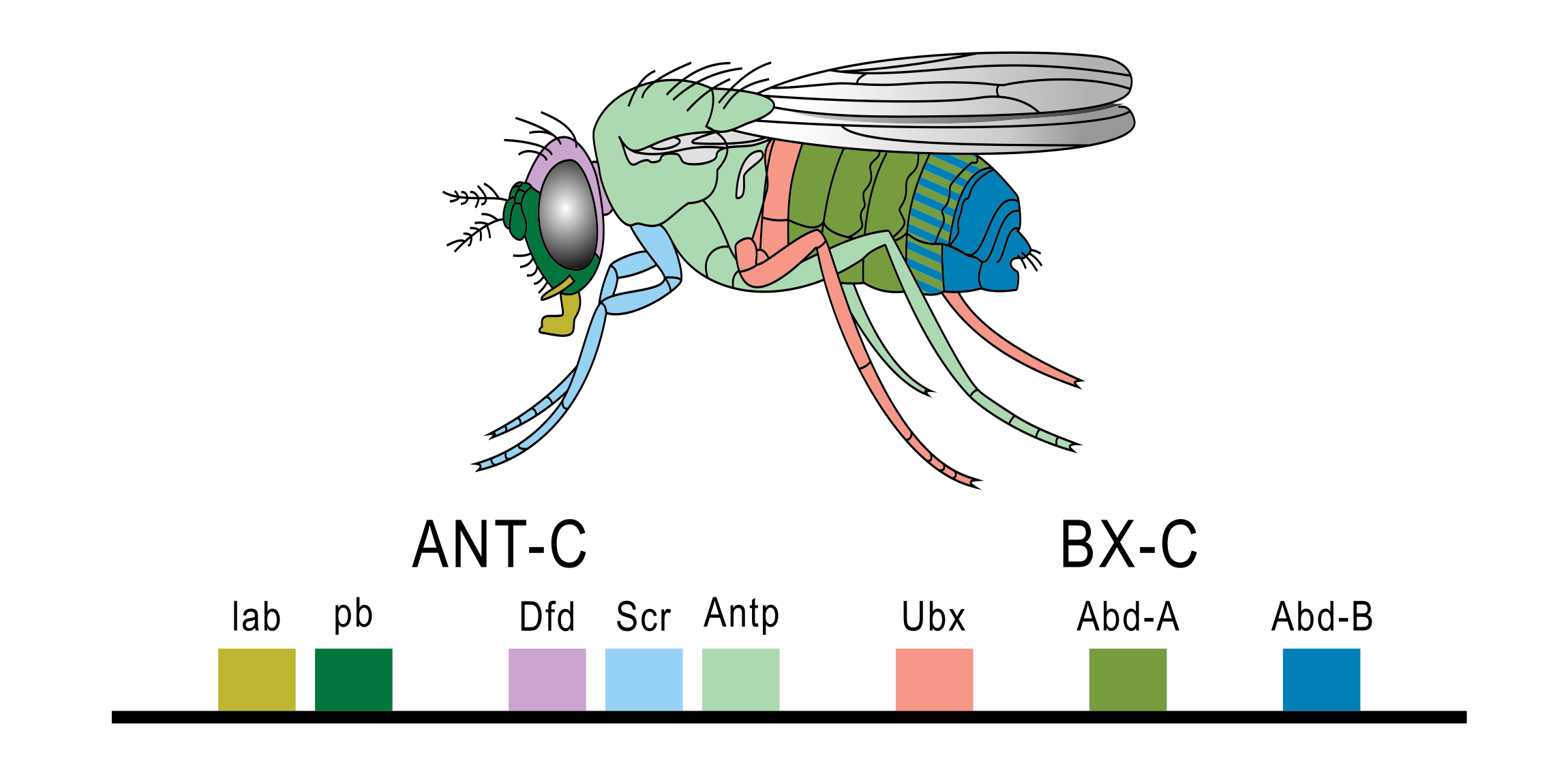
Much of HOX genes’ power was first discovered in fruit flies. With their relatively simple genetics, scientists were able to manipulate the HOX genes, creating crazy frankenflies like Antennapedia (literally: antenna-feet) here.

A fruity fly’s HOX genes, and the body parts they correspond to.

Old antenna-feet. Ain’t he a beauty?

It was only later, as the science got more sophisticated, that biologists began to track what HOX genes do in humans, making substantial progress in understanding debilitating mutations.

How is this related to N=4 super Yang-Mills? Well, just as fruit flies are simpler to study than humans, sYM is simpler to study than the whole mess of unconnected particles that exist in the real world. We can do calculations with sYM that would be out of reach in normal particle physics. As we do these calculations, we discover new patterns and new techniques. The hope is that, just like HOX genes, we will discover traits that still hold in the more complicated situation of the real world. We’re not quite there yet, but it’s getting close.


By the way, make sure to watch Big Bang Theory on Thursday (11/29, 8/7c on CBS). Turns out, Sheldon is working on this stuff too, and for those who have read arXiv:1210.7709, his diagrams should look quite familiar…