Tag Archives: string theory

Machine Learning, Occam’s Razor, and Fundamental Physics

There’s a saying in physics, attributed to the famous genius John von Neumann: “With four parameters I can fit an elephant, and with five I can make him wiggle his trunk.”

Say you want to model something, like some surprising data from a particle collider. You start with some free parameters: numbers in your model that aren’t decided yet. You then decide those numbers, “fixing” them based on the data you want to model. Your goal is for your model not only to match the data, but to predict something you haven’t yet measured. Then you can go out and check, and see if your model works.

The more free parameters you have in your model, the easier this can go wrong. More free parameters make it easier to fit your data, but that’s because they make it easier to fit any data. Your model ends up not just matching the physics, but matching the mistakes as well: the small errors that crop up in any experiment. A model like that may look like it’s a great fit to the data, but its predictions will almost all be wrong. It wasn’t just fit, it was overfit.

We have statistical tools that tell us when to worry about overfitting, when we should be impressed by a model and when it has too many parameters. We don’t actually use these tools correctly, but they still give us a hint of what we actually want to know, namely, whether our model will make the right predictions. In a sense, these tools form the mathematical basis for Occam’s Razor, the idea that the best explanation is often the simplest one, and Occam’s Razor is a critical part of how we do science.
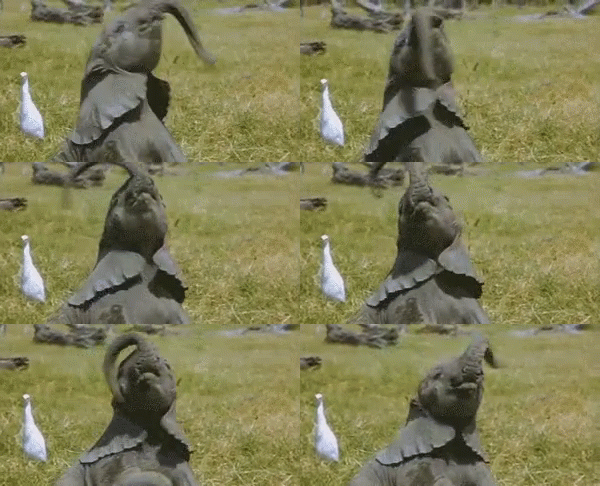
So, did you know machine learning was just modeling data?

All of the much-hyped recent advances in artificial intelligence, GPT and Stable Diffusion and all those folks, at heart they’re all doing this kind of thing. They start out with a model (with a lot more than five parameters, arranged in complicated layers…), then use data to fix the free parameters. Unlike most of the models physicists use, they can’t perfectly fix these numbers: there are too many of them, so they have to approximate. They then test their model on new data, and hope it still works.

Increasingly, it does, and impressively well, so well that the average person probably doesn’t realize this is what it’s doing. When you ask one of these AIs to make an image for you, what you’re doing is asking what image the model predicts would show up captioned with your text. It’s the same sort of thing as asking an economist what their model predicts the unemployment rate will be when inflation goes up. The machine learning model is just way, way more complicated.

As a physicist, the first time I heard about this, I had von Neumann’s quote in the back of my head. Yes, these machines are dealing with a lot more data, from a much more complicated reality. They literally are trying to fit elephants, even elephants wiggling their trunks. Still, the sheer number of parameters seemed fishy here. And for a little bit things seemed even more fishy, when I learned about double descent.

Suppose you start increasing the number of parameters in your model. Initially, your model gets better and better. Your predictions have less and less error, your error descends. Eventually, though, the error increases again: you have too many parameters so you’re over-fitting, and your model is capturing accidents in your data, not reality.

In machine learning, weirdly, this is often not the end of the story. Sometimes, your prediction error rises, only to fall once more, in a double descent.

For a while, I found this deeply disturbing. The idea that you can fit your data, start overfitting, and then keep overfitting, and somehow end up safe in the end, was terrifying. The way some of the popular accounts described it, like you were just overfitting more and more and that was fine, was baffling, especially when they seemed to predict that you could keep adding parameters, keep fitting tinier and tinier fleas on the elephant’s trunk, and your predictions would never start going wrong. It would be the death of Occam’s Razor as we know it, more complicated explanations beating simpler ones off to infinity.

Luckily, that’s not what happens. And after talking to a bunch of people, I think I finally understand this enough to say something about it here.

The right way to think about double descent is as overfitting prematurely. You do still expect your error to eventually go up: your model won’t be perfect forever, at some point you will really overfit. It might take a long time, though: machine learning people are trying to model very complicated things, like human behavior, with giant piles of data, so very complicated models may often be entirely appropriate. In the meantime, due to a bad choice of model, you can accidentally overfit early. You will eventually overcome this, pushing past with more parameters into a model that works again, but for a little while you might convince yourself, wrongly, that you have nothing more to learn.

(You can even mitigate this by tweaking your setup, potentially avoiding the problem altogether.)

So Occam’s Razor still holds, but with a twist. The best model is simple enough, but no simpler. And if you’re not careful enough, you can convince yourself that a too-simple model is as complicated as you can get.

Image from Astral Codex Ten

I was reminded of all this recently by some articles by Sabine Hossenfelder.

Hossenfelder is a critic of mainstream fundamental physics. The articles were her restating a point she’s made many times before, including in (at least) one of her books. She thinks the people who propose new particles and try to search for them are wasting time, and the experiments motivated by those particles are wasting money. She’s motivated by something like Occam’s Razor, the need to stick to the simplest possible model that fits the evidence. In her view, the simplest models are those in which we don’t detect any more new particles any time soon, so those are the models she thinks we should stick with.

I tend to disagree with Hossenfelder. Here, I was oddly conflicted. In some of her examples, it seemed like she had a legitimate point. Others seemed like she missed the mark entirely.

Talk to most astrophysicists, and they’ll tell you dark matter is settled science. Indeed, there is a huge amount of evidence that something exists out there in the universe that we can’t see. It distorts the way galaxies rotate, lenses light with its gravity, and wiggled the early universe in pretty much the way you’d expect matter to.

What isn’t settled is whether that “something” interacts with anything else. It has to interact with gravity, of course, but everything else is in some sense “optional”. Astroparticle physicists use satellites to search for clues that dark matter has some other interactions: perhaps it is unstable, sometimes releasing tiny signals of light. If it did, it might solve other problems as well.

Hossenfelder thinks this is bunk (in part because she thinks those other problems are bunk). I kind of do too, though perhaps for a more general reason: I don’t think nature owes us an easy explanation. Dark matter isn’t obligated to solve any of our other problems, it just has to be dark matter. That seems in some sense like the simplest explanation, the one demanded by Occam’s Razor.

At the same time, I disagree with her substantially more on collider physics. At the Large Hadron Collider so far, all of the data is reasonably compatible with the Standard Model, our roughly half-century old theory of particle physics. Collider physicists search that data for subtle deviations, one of which might point to a general discrepancy, a hint of something beyond the Standard Model.

While my intuitions say that the simplest dark matter is completely dark, they don’t say that the simplest particle physics is the Standard Model. Back when the Standard Model was proposed, people might have said it was exceptionally simple because it had a property called “renormalizability”, but these days we view that as less important. Physicists like Ken Wilson and Steven Weinberg taught us to view theories as a kind of series of corrections, like a Taylor series in calculus. Each correction encodes new, rarer ways that particles can interact. A renormalizable theory is just the first term in this series. The higher terms might be zero, but they might not. We even know that some terms cannot be zero, because gravity is not renormalizable.

The two cases on the surface don’t seem that different. Dark matter might have zero interactions besides gravity, but it might have other interactions. The Standard Model might have zero corrections, but it might have nonzero corrections. But for some reason, my intuition treats the two differently: I would find it completely reasonable for dark matter to have no extra interactions, but very strange for the Standard Model to have no corrections.

I think part of where my intuition comes from here is my experience with other theories.

One example is a toy model called sine-Gordon theory. In sine-Gordon theory, this Taylor series of corrections is a very familiar Taylor series: the sine function! If you go correction by correction, you’ll see new interactions and more new interactions. But if you actually add them all up, something surprising happens. Sine-Gordon turns out to be a special theory, one with “no particle production”: unlike in normal particle physics, in sine-Gordon particles can neither be created nor destroyed. You would never know this if you did not add up all of the corrections.

String theory itself is another example. In string theory, elementary particles are replaced by strings, but you can think of that stringy behavior as a series of corrections on top of ordinary particles. Once again, you can try adding these things up correction by correction, but once again the “magic” doesn’t happen until the end. Only in the full series does string theory “do its thing”, and fix some of the big problems of quantum gravity.

If the real world really is a theory like this, then I think we have to worry about something like double descent.

Remember, double descent happens when our models can prematurely get worse before getting better. This can happen if the real thing we’re trying to model is very different from the model we’re using, like the example in this explainer that tries to use straight lines to match a curve. If we think a model is simpler because it puts fewer corrections on top of the Standard Model, then we may end up rejecting a reality with infinite corrections, a Taylor series that happens to add up to something quite nice. Occam’s Razor stops helping us if we can’t tell which models are really the simple ones.

The problem here is that every notion of “simple” we can appeal to here is aesthetic, a choice based on what makes the math look nicer. Other sciences don’t have this problem. When a biologist or a chemist wants to look for the simplest model, they look for a model with fewer organisms, fewer reactions…in the end, fewer atoms and molecules, fewer of the building-blocks given to those fields by physics. Fundamental physics can’t do this: we build our theories up from mathematics, and mathematics only demands that we be consistent. We can call theories simpler because we can write them in a simple way (but we could write them in a different way too). Or we can call them simpler because they look more like toy models we’ve worked with before (but those toy models are just a tiny sample of all the theories that are possible). We don’t have a standard of simplicity that is actually reliable.

From the Wikipedia page for dark matter halos

There is one other way out of this pickle. A theory that is easier to write down is under no obligation to be true. But it is more likely to be useful. Even if the real world is ultimately described by some giant pile of mathematical parameters, if a simple theory is good enough for the engineers then it’s a better theory to aim for: a useful theory that makes peoples’ lives better.

I kind of get the feeling Hossenfelder would make this objection. I’ve seen her argue on twitter that scientists should always be able to say what their research is good for, and her Guardian article has this suggestive sentence: “However, we do not know that dark matter is indeed made of particles; and even if it is, to explain astrophysical observations one does not need to know details of the particles’ behaviour.”

Ok yes, to explain astrophysical observations one doesn’t need to know the details of dark matter particles’ behavior. But taking a step back, one doesn’t actually need to explain astrophysical observations at all.

Astrophysics and particle physics are not engineering problems. Nobody out there is trying to steer a spacecraft all the way across a galaxy, navigating the distribution of dark matter, or creating new universes and trying to make sure they go just right. Even if we might do these things some day, it will be so far in the future that our attempts to understand them won’t just be quaint: they will likely be actively damaging, confusing old research in dead languages that the field will be better off ignoring to start from scratch.

Because of that, usefulness is also not a meaningful guide. It cannot tell you which theories are more simple, which to favor with Occam’s Razor.

Hossenfelder’s highest-profile recent work falls afoul of one or the other of her principles. Her work on the foundations of quantum mechanics could genuinely be useful, but there’s no reason aside from claims of philosophical beauty to expect it to be true. Her work on modeling dark matter is at least directly motivated by data, but is guaranteed to not be useful.

I’m not pointing this out to call Hossenfelder a hypocrite, as some sort of ad hominem or tu quoque. I’m pointing this out because I don’t think it’s possible to do fundamental physics today without falling afoul of these principles. If you want to hold out hope that your work is useful, you don’t have a great reason besides a love of pretty math: otherwise, anything useful would have been discovered long ago. If you just try to model existing data as best you can, then you’re making a model for events far away or locked in high-energy particle colliders, a model no-one else besides other physicists will ever use.

I don’t know the way through this. I think if you need to take Occam’s Razor seriously, to build on the same foundations that work in every other scientific field…then you should stop doing fundamental physics. You won’t be able to make it work. If you still need to do it, if you can’t give up the sub-field, then you should justify it on building capabilities, on the kind of “practice” Hossenfelder also dismisses in her Guardian piece.

We don’t have a solid foundation, a reliable notion of what is simple and what isn’t. We have guesses and personal opinions. And until some experiment uncovers some blinding flash of new useful meaningful magic…I don’t think we can do any better than that.


Jumpstarting Elliptic Bootstrapping

I was at a mini-conference this week, called Jumpstarting Elliptic Bootstrap Methods for Scattering Amplitudes.

I’ve done a lot of work with what we like to call “bootstrap” methods. Instead of doing a particle physics calculation in all its gory detail, we start with a plausible guess and impose requirements based on what we know. Eventually, we have the right answer pulled up “by its own bootstraps”: the only answer the calculation could have, without actually doing the calculation.

This method works very well, but so far it’s only been applied to certain kinds of calculations, involving mathematical functions called polylogarithms. More complicated calculations involve a mathematical object called an elliptic curve, and until very recently it wasn’t clear how to bootstrap them. To get people thinking about it, my colleagues Hjalte Frellesvig and Andrew McLeod asked the Carlsberg Foundation (yes, that Carlsberg) to fund a mini-conference. The idea was to get elliptic people and bootstrap people together (along with Hjalte’s tribe, intersection theory people) to hash things out. “Jumpstart people” are not a thing in physics, so despite the title they were not invited.

Anyone remember these games? Did you know that they still exist, have an educational MMO, and bought neopets?

Having the conference so soon after the yearly Elliptics meeting had some strange consequences. There was only one actual duplicate talk, but the first day of talks all felt like they would have been welcome additions to the earlier conference. Some might be functioning as “overflow”: Elliptics this year focused on discussion and so didn’t have many slots for talks, while this conference despite its discussion-focused goal had a more packed schedule. In other cases, people might have been persuaded by the more relaxed atmosphere and lack of recording or posted slides to give more speculative talks. Oliver Schlotterer’s talk was likely in this category, a discussion of the genus-two functions one step beyond elliptics that I think people at the previous conference would have found very exciting, but which involved work in progress that I could understand him being cautious about presenting.

The other days focused more on the bootstrap side, with progress on some surprising but not-quite-yet elliptic avenues. It was great to hear that Mark Spradlin is making new progress on his Ziggurat story, to hear James Drummond suggest a picture for cluster algebras that could generalize to other theories, and to get some idea of the mysterious ongoing story that animates my colleague Cristian Vergu.

There was one thing the organizers couldn’t have anticipated that ended up throwing the conference into a new light. The goal of the conference was to get people started bootstrapping elliptic functions, but in the meantime people have gotten started on their own. Roger Morales Espasa presented his work on this with several of my other colleagues. They can already reproduce a known result, the ten-particle elliptic double-box, and are well on-track to deriving something genuinely new, the twelve-particle version. It’s exciting, but it definitely makes the rest of us look around and take stock. Hopefully for the better!

At Elliptic Integrals in Fundamental Physics in Mainz

I’m at a conference this week. It’s named Elliptic Integrals in Fundamental Physics, but I think of it as “Elliptics 2022”, the latest in a series of conferences on elliptic integrals in particle physics.

It’s in Mainz, which you can tell from the Gutenberg street art

Elliptics has been growing in recent years, hurtling into prominence as a subfield of amplitudes (which is already a subfield of theoretical physics). This has led to growing lists of participants and a more and more packed schedule.

This year walked all of that back a bit. There were three talks a day: two one-hour talks by senior researchers and one half-hour talk by a junior researcher. The rest, as well as the whole last day, are geared to discussion. It’s an attempt to go back to the subfield’s roots. In the beginning, the Elliptics conferences drew together a small group to sort out a plan for the future, digging through the often-confusing mathematics to try to find a baseline for future progress. The field has advanced since then, but some of our questions are still almost as basic. What relations exist between different calculations? How much do we value fast numerics, versus analytical understanding? What methods do we want to preserve, and which aren’t serving us well? To answer these questions, it helps to get a few people together in one place, not to silently listen to lectures, but to question and discuss and hash things out. I may have heard a smaller range of topics at this year’s Elliptics, but due to the sheer depth we managed to probe on those fewer topics I feel like I’ve learned much more.

Since someone always asks, I should say that the talks were not recorded, but they are posting slides online, so if you’re interested in the topic you can watch there. A few people discussed new developments, some just published and some yet to be published. I discussed the work I talked about last week, and got a lot of good feedback and ideas about how to move forward.

Amplitudes 2022 Retrospective

I’m back from Amplitudes 2022 with more time to write, and (besides the several papers I’m working on) that means writing about the conference! Casual readers be warned, there’s no way around this being a technical post, I don’t have the space to explain everything!

I mostly said all I wanted about the way the conference was set up in last week’s post, but one thing I didn’t say much about was the conference dinner. Most conference dinners are the same aside from the occasional cool location or haggis speech. This one did have a cool location, and a cool performance by a blind pianist, but the thing I really wanted to comment on was the setup. Typically, the conference dinner at Amplitudes is a sit-down affair: people sit at tables in one big room, maybe getting up occasionally to pick up food, and eventually someone gives an after-dinner speech. This time the tables were standing tables, spread across several rooms. This was a bit tiring on a hot day, but it did have the advantage that it naturally mixed people around. Rather than mostly talking to “your table”, you’d wander, ending up at a new table every time you picked up new food or drinks. It was a good way to meet new people, a surprising number of which in my case apparently read this blog. It did make it harder to do an after-dinner speech, so instead Lance gave an after-conference speech, complete with the now-well-established running joke where Greta Thunberg tries to get us to fly less.

(In another semi-running joke, the organizers tried to figure out who had attended the most of the yearly Amplitudes conferences over the years. Weirdly, no-one has attended all twelve.)

In terms of the content, and things that stood out:

Nima is getting close to publishing his newest ‘hedron, the surfacehedron, and correspondingly was able to give a lot more technical detail about it. (For his first and most famous amplituhedron, see here.) He still didn’t have enough time to explain why he has to use category theory to do it, but at least he was concrete enough that it was reasonably clear where the category theory was showing up. (I wasn’t there for his eight-hour lecture at the school the week before, maybe the students who stuck around until 2am learned some category theory there.) Just from listening in on side discussions, I got the impression that some of the ideas here actually may have near-term applications to computing Feynman diagrams: this hasn’t been a feature of previous ‘hedra and it’s an encouraging development.

Alex Edison talked about progress towards this blog’s namesake problem, the question of whether N=8 supergravity diverges at seven loops. Currently they’re working at six loops on the N=4 super Yang-Mills side, not yet in a form it can be “double-copied” to supergravity. The tools they’re using are increasingly sophisticated, including various slick tricks from algebraic geometry. They are looking to the future: if they’re hoping their methods will reach seven loops, the same methods have to make six loops a breeze.

Xi Yin approached a puzzle with methods from String Field Theory, prompting the heretical-for-us title “on-shell bad, off-shell good”. A colleague reminded me of a local tradition for dealing with heretics.

While Nima was talking about a new ‘hedron, other talks focused on the original amplituhedron. Paul Heslop found that the amplituhedron is not literally a positive geometry, despite slogans to the contrary, but what it is is nonetheless an interesting generalization of the concept. Livia Ferro has made more progress on her group’s momentum amplituhedron: previously only valid at tree level, they now have a picture that can accomodate loops. I wasn’t sure this would be possible, there are a lot of things that work at tree level and not for loops, so I’m quite encouraged that this one made the leap successfully.

Sebastian Mizera, Andrew McLeod, and Hofie Hannesdottir all had talks that could be roughly summarized as “deep principles made surprisingly useful”. Each took topics that were explored in the 60’s and translated them into concrete techniques that could be applied to modern problems. There were surprisingly few talks on the completely concrete end, on direct applications to collider physics. I think Simone Zoia’s was the only one to actually feature collider data with error bars, which might explain why I singled him out to ask about those error bars later.

Likewise, Matthias Wilhelm’s talk was the only one on functions beyond polylogarithms, the elliptic functions I’ve also worked on recently. I wonder if the under-representation of some of these topics is due to the existence of independent conferences: in a year when in-person conferences are packed in after being postponed across the pandemic, when there are already dedicated conferences for elliptics and practical collider calculations, maybe people are just a bit too tired to go to Amplitudes as well.

Talks on gravitational waves seem to have stabilized at roughly a day’s worth, which seems reasonable. While the subfield’s capabilities continue to be impressive, it’s also interesting how often new conceptual challenges appear. It seems like every time a challenge to their results or methods is resolved, a new one shows up. I don’t know whether the field will ever get to a stage of “business as usual”, or whether it will be novel qualitative questions “all the way up”.

I haven’t said much about the variety of talks bounding EFTs and investigating their structure, though this continues to be an important topic. And I haven’t mentioned Lance Dixon’s talk on antipodal duality, largely because I’m planning a post on it later: Quanta Magazine had a good article on it, but there are some aspects even Quanta struggled to cover, and I think I might have a good way to do it.

At Bohr-100: Current Themes in Theoretical Physics

During the pandemic, some conferences went online. Others went dormant.

Every summer before the pandemic, the Niels Bohr International Academy hosted a conference called Current Themes in High Energy Physics and Cosmology. Current Themes is a small, cozy conference, a gathering of close friends some of whom happen to have Nobel prizes. Holding it online would be almost missing the point.

Instead, we waited. Now, at least in Denmark, the pandemic is quiet enough to hold this kind of gathering. And it’s a special year: the 100th anniversary of Niels Bohr’s Nobel, the 101st of the Niels Bohr Institute. So it seemed like the time for a particularly special Current Themes.

For one, it lets us use remarkably simple signs

A particularly special Current Themes means some unusually special guests. Our guests are usually pretty special already (Gerard t’Hooft and David Gross are regulars, to just name the Nobelists), but this year we also had Alexander Polyakov. Polyakov’s talk had a magical air to it. In a quiet voice, broken by an impish grin when he surprised us with a joke, Polyakov began to lay out five unsolved problems he considered interesting. In the end, he only had time to present one, related to turbulence: when Gross asked him to name the remaining four, the second included a term most of us didn’t recognize (striction, known in a magnetic context and which he wanted to explore gravitationally), so the discussion hung while he defined that and we never did learn what the other three problems were.

At the big 100th anniversary celebration earlier in the spring, the Institute awarded a few years worth of its Niels Bohr Institute Medal of Honor. One of the recipients, Paul Steinhardt, couldn’t make it then, so he got his medal now. After the obligatory publicity photos were taken, Steinhardt entertained us all with a colloquium about his work on quasicrystals, including the many adventures involved in finding the first example “in the wild”. I can’t do the story justice in a short blog post, but if you won’t have the opportunity to watch him speak about it then I hear his book is good.

An anniversary conference should have some historical elements as well. For this one, these were ably provided by David Broadhurst, who gave an after-dinner speech cataloguing things he liked about Bohr. Some was based on public information, but the real draw were the anecdotes: his own reminiscences, and those of people he knew who knew Bohr well.

The other talks covered interesting ground: from deep approaches to quantum field theory, to new tools to understand black holes, to the implications of causality itself. One out of the ordinary talk was by Sabrina Pasterski, who advocated a new model of physics funding. I liked some elements (endowed organizations to further a subfield) and am more skeptical of others (mostly involving NFTs). Regardless it, and the rest of the conference more broadly, spurred a lot of good debate.

The Most Anthropic of All Possible Worlds

Today, we’d call Leibniz a mathematician, a physicist, and a philosopher. As a mathematician, Leibniz turned calculus into something his contemporaries could actually use. As a physicist, he championed a doomed theory of gravity. In philosophy, he seems to be most remembered for extremely cheaty arguments.

Free will and determinism? Can’t it just be a coincidence?

I don’t blame him for this. Faced with a tricky philosophical problem, it’s enormously tempting to just blaze through with an answer that makes every subtlety irrelevant. It’s a temptation I’ve succumbed to time and time again. Faced with a genie, I would always wish for more wishes. On my high school debate team, I once forced everyone at a tournament to switch sides with some sneaky definitions. It’s all good fun, but people usually end up pretty annoyed with you afterwards.

People were annoyed with Leibniz too, especially with his solution to the problem of evil. If you believe in a benevolent, all-powerful god, as Leibniz did, why is the world full of suffering and misery? Leibniz’s answer was that even an all-powerful god is constrained by logic, so if the world contains evil, it must be logically impossible to make the world any better: indeed, we live in the best of all possible worlds. Voltaire famously made fun of this argument in Candide, dragging a Leibniz-esque Professor Pangloss through some of the most creative miseries the eighteenth century had to offer. It’s possibly the most famous satire of a philosopher, easily beating out Aristophanes’ The Clouds (which is also great).

Physicists can also get accused of cheaty arguments, and probably the most mocked is the idea of a multiverse. While it hasn’t had its own Candide, the multiverse has been criticized by everyone from bloggers to Nobel prizewinners. Leibniz wanted to explain the existence of evil, physicists want to explain “unnaturalness”: the fact that the kinds of theories we use to explain the world can’t seem to explain the mass of the Higgs boson. To explain it, these physicists suggest that there are really many different universes, separated widely in space or built in to the interpretation of quantum mechanics. Each universe has a different Higgs mass, and ours just happens to be the one we can live in. This kind of argument is called “anthropic” reasoning. Rather than the best of all possible worlds, it says we live in the world best-suited to life like ours.

I called Leibniz’s argument “cheaty”, and you might presume I think the same of the multiverse. But “cheaty” doesn’t mean “wrong”. It all depends what you’re trying to do.

Leibniz’s argument and the multiverse both work by dodging a problem. For Leibniz, the problem of evil becomes pointless: any evil might be necessary to secure a greater good. With a multiverse, naturalness becomes pointless: with many different laws of physics in different places, the existence of one like ours needs no explanation.

In both cases, though, the dodge isn’t perfect. To really explain any given evil, Leibniz would have to show why it is secretly necessary in the face of a greater good (and Pangloss spends Candide trying to do exactly that). To explain any given law of physics, the multiverse needs to use anthropic reasoning: it needs to show that that law needs to be the way it is to support human-like life.

This sounds like a strict requirement, but in both cases it’s not actually so useful. Leibniz could (and Pangloss does) come up with an explanation for pretty much anything. The problem is that no-one actually knows which aspects of the universe are essential and which aren’t. Without a reliable way to describe the best of all possible worlds, we can’t actually test whether our world is one.

The same problem holds for anthropic reasoning. We don’t actually know what conditions are required to give rise to people like us. “People like us” is very vague, and dramatically different universes might still contain something that can perceive and observe. While it might seem that there are clear requirements, so far there hasn’t been enough for people to do very much with this type of reasoning.

However, for both Leibniz and most of the physicists who believe anthropic arguments, none of this really matters. That’s because the “best of all possible worlds” and “most anthropic of all possible worlds” aren’t really meant to be predictive theories. They’re meant to say that, once you are convinced of certain things, certain problems don’t matter anymore.

Leibniz, in particular, wasn’t trying to argue for the existence of his god. He began the argument convinced that a particular sort of god existed: one that was all-powerful and benevolent, and set in motion a deterministic universe bound by logic. His argument is meant to show that, if you believe in such a god, then the problem of evil can be ignored: no matter how bad the universe seems, it may still be the best possible world.

Similarly, the physicists convinced of the multiverse aren’t really getting there through naturalness. Rather, they’ve become convinced of a few key claims: that the universe is rapidly expanding, leading to a proliferating multiverse, and that the laws of physics in such a multiverse can vary from place to place, due to the huge landscape of possible laws of physics in string theory. If you already believe those things, then the naturalness problem can be ignored: we live in some randomly chosen part of the landscape hospitable to life, which can be anywhere it needs to be.

So despite their cheaty feel, both arguments are fine…provided you agree with their assumptions. Personally, I don’t agree with Leibniz. For the multiverse, I’m less sure. I’m not confident the universe expands fast enough to create a multiverse, I’m not even confident it’s speeding up its expansion now. I know there’s a lot of controversy about the math behind the string theory landscape, about whether the vast set of possible laws of physics are as consistent as they’re supposed to be…and of course, as anyone must admit, we don’t know whether string theory itself is true! I don’t think it’s impossible that the right argument comes around and convinces me of one or both claims, though. These kinds of arguments, “if assumptions, then conclusion” are the kind of thing that seems useless for a while…until someone convinces you of the conclusion, and they matter once again.

So in the end, despite the similarity, I’m not sure the multiverse deserves its own Candide. I’m not even sure Leibniz deserved Candide. But hopefully by understanding one, you can understand the other just a bit better.

Trapped in the (S) Matrix

I’ve tried to convince you that you are a particle detector. You choose your experiment, what actions you take, and then observe the outcome. If you focus on that view of yourself, data out and data in, you start to wonder if the world outside really has any meaning. Maybe you’re just trapped in the Matrix.

From a physics perspective, you actually are trapped in a sort of a Matrix. We call it the S Matrix.

“S” stands for scattering. The S Matrix is a formula we use, a mathematical tool that tells us what happens when fundamental particles scatter: when they fly towards each other, colliding or bouncing off. For each action we could take, the S Matrix gives the probability of each outcome: for each pair of particles we collide, the chance we detect different particles at the end. You can imagine putting every possible action in a giant vector, and every possible observation in another giant vector. Arrange the probabilities for each action-observation pair in a big square grid, and that’s a matrix.

Actually, I lied a little bit. This is particle physics, and particle physics uses quantum mechanics. Because of that, the entries of the S Matrix aren’t probabilities: they’re complex numbers called probability amplitudes. You have to multiply them by their complex conjugate to get probability out.

Ok, that probably seemed like a lot of detail. Why am I telling you all this?

What happens when you multiply the whole S Matrix by its complex conjugate? (Using matrix multiplication, naturally.) You can still pick your action, but now you’re adding up every possible outcome. You’re asking “suppose I take an action. What’s the chance that anything happens at all?”

The answer to that question is 1. There is a 100% chance that something happens, no matter what you do. That’s just how probability works.

We call this property unitarity, the property of giving “unity”, or one. And while it may seem obvious, it isn’t always so easy. That’s because we don’t actually know the S Matrix formula most of the time. We have to approximate it, a partial formula that only works for some situations. And unitarity can tell us how much we can trust that formula.

Imagine doing an experiment trying to detect neutrinos, like the IceCube Neutrino Observatory. For you to detect the neutrinos, they must scatter off of electrons, kicking them off of their atoms or transforming them into another charged particle. You can then notice what happens as the energy of the neutrinos increases. If you do that, you’ll notice the probability also start to increase: it gets more and more likely that the neutrino can scatter an electron. You might propose a formula for this, one that grows with energy. [EDIT: Example changed after a commenter pointed out an issue with it.]

If you keep increasing the energy, though, you run into a problem. Those probabilities you predict are going to keep increasing. Eventually, you’ll predict a probability greater than one.

That tells you that your theory might have been fine before, but doesn’t work for every situation. There’s something you don’t know about, which will change your formula when the energy gets high. You’ve violated unitarity, and you need to fix your theory.

In this case, the fix is already known. Neutrinos and electrons interact due to another particle, called the W boson. If you include that particle, then you fix the problem: your probabilities stop going up and up, instead, they start slowing down, and stay below one.

For other theories, we don’t yet know the fix. Try to write down an S Matrix for colliding gravitational waves (or really, gravitons), and you meet the same kind of problem, a probability that just keeps growing. Currently, we don’t know how that problem should be solved: string theory is one answer, but may not be the only one.

So even if you’re trapped in an S Matrix, sending data out and data in, you can still use logic. You can still demand that probability makes sense, that your matrix never gives a chance greater than 100%. And you can learn something about physics when you do!

At New Ideas in Cosmology

The Niels Bohr Institute is hosting a conference this week on New Ideas in Cosmology. I’m no cosmologist, but it’s a pretty cool field, so as a local I’ve been sitting in on some of the talks. So far they’ve had a selection of really interesting speakers with quite a variety of interests, including a talk by Roger Penrose with his trademark hand-stippled drawings.

Including this old classic

One thing that has impressed me has been the “interdisciplinary” feel of the conference. By all rights this should be one “discipline”, cosmology. But in practice, each speaker came at the subject from a different direction. They all had a shared core of knowledge, common models of the universe they all compare to. But the knowledge they brought to the subject varied: some had deep knowledge of the mathematics of gravity, others worked with string theory, or particle physics, or numerical simulations. Each talk, aware of the varied audience, was a bit “colloquium-style“, introducing a framework before diving in to the latest research. Each speaker knew enough to talk to the others, but not so much that they couldn’t learn from them. It’s been unexpectedly refreshing, a real interdisciplinary conference done right.

At Mikefest

I’m at a conference this week of a very particular type: a birthday conference. When folks in my field turn 60, their students and friends organize a special conference for them, celebrating their research legacy. With COVID restrictions just loosening, my advisor Michael Douglas is getting a last-minute conference. And as one of the last couple students he graduated at Stony Brook, I naturally showed up.

The conference, Mikefest, is at the Institut des Hautes Études Scientifiques, just outside of Paris. Mike was a big supporter of the IHES, putting in a lot of fundraising work for them. Another big supporter, James Simons, was Mike’s employer for a little while after his time at Stony Brook. The conference center we’re meeting in is named for him.

You might have to zoom in to see that, though.

I wasn’t involved in organizing the conference, so it was interesting seeing differences between this and other birthday conferences. Other conferences focus on the birthday prof’s “family tree”: their advisor, their students, and some of their postdocs. We’ve had several talks from Mike’s postdocs, and one from his advisor, but only one from a student. Including him and me, three of Mike’s students are here: another two have had their work mentioned but aren’t speaking or attending.

Most of the speakers have collaborated with Mike, but only for a few papers each. All of them emphasized a broader debt though, for discussions and inspiration outside of direct collaboration. The message, again and again, is that Mike’s work has been broad enough to touch a wide range of people. He’s worked on branes and the landscape of different string theory universes, pure mathematics and computation, neuroscience and recently even machine learning. The talks generally begin with a few anecdotes about Mike, before pivoting into research talks on the speakers’ recent work. The recent-ness of the work is perhaps another difference from some birthday conferences: as one speaker said, this wasn’t just a celebration of Mike’s past, but a “welcome back” after his return from the finance world.

One thing I don’t know is how much this conference might have been limited by coming together on short notice. For other birthday conferences impacted by COVID (and I’m thinking of one in particular), it might be nice to have enough time to have most of the birthday prof’s friends and “academic family” there in person. As-is, though, Mike seems to be having fun regardless.

Happy Birthday Mike!

Geometry and Geometry

Last week, I gave the opening lectures for a course on scattering amplitudes, the things we compute to find probabilities in particle physics. After the first class, one of the students asked me if two different descriptions of these amplitudes, one called CHY and the other called the amplituhedron, were related. There does happen to be a connection, but it’s a bit subtle and indirect, not the sort of thing the student would have been thinking of. Why then, did he think they might be related? Well, he explained, both descriptions are geometric.

If you’ve been following this blog for a while, you’ve seen me talk about misunderstandings. There are a lot of subtle ways a smart student can misunderstand something, ways that can be hard for a teacher to recognize. The right question, or the right explanation, can reveal what’s going on. Here, I think the problem was that there are multiple meanings of geometry.

One of the descriptions the student asked about, CHY, is related to string theory. It describes scattering particles in terms of the path of a length of string through space and time. That path draws out a surface called a world-sheet, showing all the places the string touches on its journey. And that picture, of a wiggly surface drawn in space and time, looks like what most people think of as geometry: a “shape” in a pretty normal sense, which here describes the physics of scattering particles.

The other description, the amplituhedron, also uses geometric objects to describe scattering particles. But the “geometric objects” here are much more abstract. A few of them are familiar: straight lines, the area between them forming shapes on a plane. Most of them, though are generalizations of this: instead of lines on a plane, they have higher dimensional planes in higher dimensional spaces. These too get described as geometry, even though they aren’t the “everyday” geometry you might be familiar with. Instead, they’re a “natural generalization”, something that, once you know the math, is close enough to that “everyday” geometry that it deserves the same name.

This week, two papers presented a totally different kind of geometric description of particle physics. In those papers, “geometric” has to do with differential geometry, the mathematics behind Einstein’s theory of general relativity. The descriptions are geometric because they use the same kinds of building-blocks of that theory, a metric that bends space and time. Once again, this kind of geometry is a natural generalization of the everyday notion, but now in once again a different way.

All of these notions of geometry do have some things in common, of course. Maybe you could even write down a definition of “geometry” that includes all of them. But they’re different enough that if I tell you that two descriptions are “geometric”, it doesn’t tell you all that much. It definitely doesn’t tell you the two descriptions are related.

It’s a reasonable misunderstanding, though. It comes from a place where, used to “everyday” geometry, you expect two “geometric descriptions” of something to be similar: shapes moving in everyday space, things you can directly compare. Instead, a geometric description can be many sorts of shape, in many sorts of spaces, emphasizing many sorts of properties. “Geometry” is just a really broad term.