Tag Archives: science communication

Starshot: The Right Kind of Longshot

On Tuesday, Yuri Milner and Stephen Hawking announced Starshot, a $100 million dollar research initiative. The goal is to lay the groundwork for a very ambitious, but surprisingly plausible project: sending probes to the nearest star, Alpha Centauri. Their idea is to have hundreds of ultra-light probes, each with a reflective sail a few meters in diameter. By aiming an extremely powerful laser at these sails, it should be possible to accelerate the probes up to around a fifth of the speed of light, enough to make the trip in twenty years. Here’s the most complete article I’ve found on the topic.

I can’t comment on the engineering side of the project. The impression I get is that nothing they’re proposing is known to be impossible, but there are a lot of “ifs” along the way that might scupper things. What I can comment on is the story.

Milner and Hawking have both put quite a bit of effort recently into what essentially amounts to telling stories. Milner’s Breakthrough Prizes involve giving awards of $3 million to prominent theoretical physicists (and, more recently, mathematicians). Quite a few of my fellow theorists have criticized these prizes, arguing that the money would be better spent in a grant program like that of the Simons Foundation. While that would likely be better for science, the Breakthrough Prize isn’t really about that. Instead, it’s about telling a story: a story in which progress in theoretical physics is exalted in a public, Nobel-sized way.

Similarly, Hawking’s occasional pronouncements about aliens or AI aren’t science per se, and the media has a tendency to talk about his contributions to ongoing scientific debates out of proportion to their importance. Both of these things, though, contribute to the story of Hawking: a mascot for physics, someone to carry Einstein’s role of the most recognizable genius in the world. Hawking Inc. is about a role as much as it is about a man.

In calling Hawking and Milner’s activity “stories”, I’m not dismissing them. Stories can be important. And the story told by Starshot is a particularly important one.

Cosmology isn’t just a scientific subject, it contributes to how people see themselves. Here I don’t just mean cosmology the field, but cosmology in the broader sense of our understanding of the universe and our place in it.

A while back, I read a book called The View from the Center of the Universe. The book starts by describing the worldviews of the ancients, cosmologies in which they really did think of themselves as the center of the universe. It then suggests that this played an important role: that this kind of view of the world, in which humans have a place in the cosmos, is important to how we view ourselves. The rest of the book then attempts to construct this sort of mythological understanding out of the modern cosmological picture, with some success.

One thing the book doesn’t discuss very much, though, is the future. We care about our place in the universe not just because we want to know where we came from, but because we want to have some idea of where we’re going. We want to contribute to a greater goal, to see ourselves making progress towards something important and vast and different. That’s why so many religions have not just cosmologies, but eschatologies, why people envision armageddons and raptures.

Starshot places the future in our sight in a way that few other things do. Humanity’s spread among the stars seems like something so far distant that nothing we do now could matter to it. What Starshot does is give us something concrete, a conceptual stepping-stone that can link people in to the broader narrative. Right now, people can work on advanced laser technology and optics, work on making smaller chips and lighter materials, work that would be useful and worth funding regardless of whether it was going to lead to Alpha Centauri. But because of Starshot, we can view that work as the near-term embodiment of humanity’s interstellar destiny.

That combination, bridging the gap between the distant future and our concrete present, is the kind of story people need right now. And so for once, I think Milner’s storytelling is doing exactly what it should.

I Don’t Get Crackpots

[Note: not an April fool’s post. Now I’m wishing I wrote one though.]

After the MHV@30 conference, I spent a few days visiting my sister. I hadn’t seen her in a while, and she noticed something new about me.

“You’re not sure about anything. It’s always ‘I get the impression’ or ‘I believe so’ or ‘that seems good’.”

On reflection, she’s right.

It’s a habit I’ve picked up from spending time around scientists. When you’re surrounded by people who are likely to know more than you do about something, it’s usually good to qualify your statements. A little intellectual humility keeps simple corrections from growing into pointless arguments, and makes it easier to learn from your mistakes.

With that kind of mindset, though, I really really don’t get crackpots.

open-uri20150422-20810-4a7nvg_87d49366

For example, why do they always wear funnels on their heads?

The thing about genuine crackpots (as opposed to just scientists with weird ideas) is that they tend to have almost none of the relevant background for a given field, but nevertheless have extremely strong opinions about it. That basic first step, of assuming that there are people who probably know a lot more about whatever you’re talking about? Typically, they don’t bother with that. The qualifiers, the “typically” and “as far as I know” just don’t show up. And I have a lot of trouble understanding how a person can work that way.

Is some of it the Dunning-Kruger effect? Sure. If you don’t know much about something, you don’t know the limits of your own knowledge, so you think you know more than you really do. But I don’t think it’s just that…there’s a baseline level of doubt, of humility in general, that just isn’t there for most crackpots.

I wonder if some fraction of crackpots are genuinely mentally ill, but if so I’m not sure what the illness would be. Mania is an ok fit some of the time, and the word salad and “everyone but me is crazy” attitude almost seem schizophrenic, but I doubt either is really what’s going on in most cases.

All of this adds up to me just being completely unable to relate to people who display a sufficient level of crackpottery.

The thing is, there are crackpots out there who I kind of wish I could talk to, because if I could maybe I could help them. There are crackpots who seem genuinely willing to be corrected, to be told what they’re doing wrong. But that core of implicit arrogance, the central assumption that it’s possible to make breakthroughs in a field while knowing almost nothing about it, that’s still there, and it makes it impossible for me to deal with them.

I kind of wish there was a website I could link, dedicated to walking crackpots through their mistakes. There used to be something like that for supernatural crackpots, in the form of the James Randi Educational Foundation‘s Million Dollar Prize, complete with forums where (basically) helpful people would patiently walk applicants through how to set up a test of their claims. There’s never been anything like that for science, as far as I’m aware, and it seems like it would take a lot more work. Still, it would be nice if there were people out there patient enough to do it.

You Go, LIGO!

Well folks, they did it. LIGO has detected gravitational waves!

FAQ:

What’s a gravitational wave?

Gravitational waves are ripples in space and time. As Einstein figured out a century ago, masses bend space and time, which causes gravity. Wiggle masses in the right way and you get a gravity wave, like a ripple on a pond.

Ok, but what is actually rippling? It’s some stuff, right? Dust or something?

In a word, no. Not everything has to be “stuff”. Energy isn’t “stuff”, and space-time isn’t either, but space-time is really what vibrates when a gravitational wave passes by. Distances themselves are changing, in a way that is described by the same math and physics as a ripple in a pond.

What’s LIGO?

LIGO is the Laser Interferometer Gravitational-Wave Observatory. In simple terms, it’s an observatory (or rather, a pair of observatories in Washington and Louisiana) that can detect gravitational waves. It does this using beams of laser light four kilometers long. Gravitational waves change the length of these beams when they pass through, causing small but measurable changes in the laser light observed.

Are there other gravitational wave observatories?

Not currently in operation. LIGO originally ran from 2002 to 2010, and during that time there were other gravitational wave observatories also in operation (VIRGO in Italy and GEO600 in Germany). All of them (including LIGO) failed to detect anything, and so LIGO and VIRGO were shut down in order for them to be upgraded to more sensitive, advanced versions. Advanced LIGO went into operation first, and made the detection. VIRGO is still under construction, as is KAGRA, a detector in Japan. There are also plans for a detector in India.

Other sorts of experiments can detect gravitational waves on different scales. eLISA is a planned space-based gravitational wave observatory, while Pulsar Timing Arrays could use distant neutron stars as an impromptu detector.

What did they detect? What could they detect?

The gravitational waves that LIGO detected came from a pair of black holes merging. In general, gravitational waves come from a pair of masses, or one mass with an uneven and rapidly changing shape. As such, LIGO and future detectors might be able to observe binary stars, supernovas, weird-shaped neutron stars, colliding galaxies…pretty much any astrophysical event involving large things moving comparatively fast.

What does this say about string theory?

Basically nothing. There are gravity waves in string theory, sure (and they play a fairly important role), but there were gravity waves in Einstein’s general relativity. As far as I’m aware, no-one at this point seriously thought that gravitational waves didn’t exist. Nothing that LIGO observed has any bearing on the quantum properties of gravity.

But what about cosmic strings? They mentioned those in the announcement!

Cosmic strings, despite the name, aren’t a unique prediction of string theory. They’re big, string-shaped wrinkles in space and time, possible results of the rapid expansion of space during cosmic inflation. You can think of them a bit like the cracks that form in an over-inflated balloon right before it bursts.

Cosmic strings, if they exist, should produce gravitational waves. This means that in the future we may have concrete evidence of whether or not they exist. This wouldn’t say all that much about string theory: while string theory does have its own explanations for cosmic strings, it’s unclear whether it actually has unique predictions about them. It would say a lot about cosmic inflation, though, and would presumably help distinguish it from proposed alternatives. So keep your eyes open: in the next few years, gravitational wave observatories may well have something important to say about the overall history of the universe.

Why is this discovery important, though? If we already knew that gravitational waves existed, why does discovering them matter?

LIGO didn’t discover that gravitational waves exist. LIGO discovered that we can detect them.

The existence of gravitational waves is no discovery. But the fact that we now have observatories sensitive enough to detect them is huge. It opens up a whole new type of astronomy: we can now observe the universe not just by the light it sheds (and neutrinos), but through a whole new lens. And every time we get another observational tool like this, we notice new things, things we couldn’t have seen without it. It’s the dawn of a new era in astronomy, and LIGO was right to announce it with all the pomp and circumstance they could muster.


My impressions from the announcement:

Speaking of pomp and circumstance, I was impressed by just how well put-together LIGO’s announcement was.

As the US presidential election heats up, I’ve seen a few articles about the various candidates’ (well, usually Trump’s) use of the language of political propaganda. The idea is that there are certain visual symbols at political events for which people have strong associations, whether with historical events or specific ideas or the like, and that using these symbols makes propaganda more powerful.

What I haven’t seen is much discussion of a language of scientific propaganda. Still, the overwhelming impression I got from LIGO’s announcement is that it was shaped by a master in the use of such a language. They tapped in to a wide variety of powerful images: from the documentary-style interviews at the beginning, to Weiss’s tweed jacket and handmade demos, to the American flag in the background, that tied LIGO’s result to the history of scientific accomplishment.

Perimeter’s presentations tend to have a slicker look, my friends at Stony Brook are probably better at avoiding jargon. But neither is quite as good at propaganda, at saying “we are part of history” and doing so without a hitch, as the folks at LIGO have shown themselves to be with this announcement.

I was also fairly impressed that they kept this under wraps for so long. While there were leaks, I don’t think many people had a complete grasp of what was going to be announced until the week before. Somehow, LIGO made sure a collaboration of thousands was able to (mostly) keep their mouths shut!

Beyond the organizational and stylistic notes, my main thought was “What’s next?” They’ve announced the detection of one event. I’ve heard others rattle off estimates, that they should be detecting anywhere from one black hole merger per year to a few hundred. Are we going to see more events soon, or should we settle into a long wait? Could they already have detected more, with the evidence buried in their data, to be revealed by careful analysis? (The waves from this black hole merger were clear enough for them to detect them in real-time, but more subtle events might not make things so easy!) Should we be seeing more events already, and does not seeing them tell us something important about the universe?

Most of the reason I delayed my post till this week was to see if anyone had an answer to these questions. So far, I haven’t seen one, besides the “one to a few hundred” estimate mentioned. As more people weigh in and more of LIGO’s run is analyzed, it will be interesting to see where that side of the story goes.

The Higgs Solution

My grandfather is a molecular biologist. Over the holidays I had many opportunities to chat with him, and our conversations often revolved around explaining some aspect of our respective fields. While talking to him, I came up with a chemistry-themed description of the Higgs field, and how it leads to electro-weak symmetry breaking. Very few of you are likely to be chemists, but I think you still might find the metaphor worthwhile.

Picture the Higgs as a mixture of ions, dissolved in water.

In this metaphor, the Higgs field is a sort of “Higgs solution”. Overall, this solution should be uniform: if you have more ions of a certain type in one place than another, over time they will dissolve until they reach a uniform mixture again. In this metaphor, the Higgs particle detected by the LHC is like a brief disturbance in the fluid: by stirring the solution at high energy, we’ve managed to briefly get more of one type of ion in one place than the average concentration.

What determines the average concentration, though?

Essentially, it’s arbitrary. If this were really a chemistry experiment, it would depend on the initial conditions: which ions we put in to the mixture in the first place. In physics, quantum mechanics plays a role, randomly selecting one option out of the many possibilities.


nile_red_01

Choose wisely

(Note that this metaphor doesn’t explain why there has to be a solution, why the water can’t just be “pure”. A setup that required this would probably be chemically complicated enough to confuse nearly everybody, so I’m leaving that feature out. Just trust that “no ions” isn’t one of our options.)

Up till now, the choice of mixture didn’t matter very much. But different ions interact with other chemicals in different ways, and this has some interesting implications.

Suppose we have a tube filled with our Higgs solution. We want to shoot some substance through the tube, and collect it on the other side. This other substance is going to represent a force.

If our force substance doesn’t react with the ions in our Higgs solution, it will just go through to the other side. If it does react, though, then it will be slowed down, and only some of it will get to the other side, possibly none at all.

You can think of the electro-weak force as a mixture of these sorts of substances. Normally, there is no way to tell the different substances apart. Just like the different Higgs solutions, different parts of the electro-weak force are arbitrary.

However, once we’ve chosen a Higgs solution, things change. Now, different parts of our electro-weak substance will behave differently. The parts that react with the ions in our Higgs solution will slow down, and won’t make it through the tube, while the parts that don’t interact will just flow on through.

We call the part that gets through the tube electromagnetism, and the part that doesn’t the weak nuclear force. Electromagnetism is long-range, its waves (light) can travel great distances. The weak nuclear force is short-range, and doesn’t have an effect outside of the scale of atoms.

The important thing to take away from this is that the division between electromagnetism and the weak nuclear force is totally arbitrary. Taken by themselves, they’re equivalent parts of the same, electro-weak force. It’s only because some of them interact with the Higgs, while others don’t, that we distinguish those parts from each other. If the Higgs solution were a different mixture (if the Higgs field had different charges) then a different part of the electroweak force would be long-range, and a different part would be short-range.

We wouldn’t be able to tell the difference, though. We’d see a long-range force, and a short-range force, and a Higgs field. In the end, our world would be completely the same, just based on a different, arbitrary choice.

Newtonmas 2015

Merry Newtonmas!

I’ll leave up my poll a bit longer, but the results are already looking pretty consistent.

A strong plurality of my readers have PhDs in high energy or theoretical physics, a little more than a quarter. Another big chunk (a bit over a fifth) are physics grad students. All together, that means almost half of my readers have some technical background in what I do.

In the comments, Cliff suggests this is a good reason to start writing more technical posts. Looking at the results, I agree, it looks like there would definitely be an audience for that sort of thing. Technical posts take a lot more effort than general audience posts, so don’t expect a lot of them…but you can definitely look forward to a few technical posts next year.

On the other hand, between people with some college physics and people who only saw physics in high school, about a third of my audience wouldn’t get much out of technical posts. Most of my posts will still be geared to this audience, since it’s kind of my brand at this point, but I do want to start experimenting with aiming a few posts to more specific segments.

Beyond that, I’ve got a smattering of readers in other parts of physics, and a few mathematicians. Aside from the occasional post defending physics notation, there probably won’t be much aimed at either group, but do let me know what I can do to make things more accessible!


Visiting the Blog? Here’s a Poll!

A few of my recent posts talked about how important it is to know your audience when communicating science. As it turns out, I don’t actually know much about who reads this blog. WordPress tells me which countries you come from (mostly from the US, but large contingents from several other countries, with views from 122 countries last year), and in some cases what links you clicked on to get here (lots of search engines, facebook, reddit, twitter, various other peoples’ blogs). What it doesn’t tell me, though, is what your background is.

That’s what this poll is for. Readers, I’d like you to tell me how much physics background you have. Did you only run into it in high school (if at all), or did you see some college physics too? How many of you are actually physicists? How many of you are mathematicians? (From my observations, even mathematicians with no physics experience favor very different explanations from other people with no physics experience.)

I try to make this blog accessible to as many people as I can, but I do wonder how much of my audience needs that accessibility. So whether you’re just stopping by to read a post linked on reddit, or you’re a long-time reader, vote in the poll and let me know where you stand. And if you’ve got more to say or the poll doesn’t capture some subtlety, feel free to respond in the comments!

The “Lies to Children” Model of Science Communication, and The “Amplitudes Are Weird” Model of Amplitudes

Let me tell you a secret.

Scattering amplitudes in N=4 super Yang-Mills don’t actually make sense.

Scattering amplitudes calculate the probability that particles “scatter”: coming in from far away, interacting in some fashion, and producing new particles that travel far away in turn. N=4 super Yang-Mills is my favorite theory to work with: a highly symmetric version of the theory that describes the strong nuclear force. In particular, N=4 super Yang-Mills has conformal symmetry: if you re-scale everything larger or smaller, you should end up with the same predictions.

You might already see the contradiction here: scattering amplitudes talk about particles coming in from very far away…but due to conformal symmetry, “far away” doesn’t mean anything, since we can always re-scale it until it’s not far away anymore!

So when I say that I study scattering amplitudes in N=4 super Yang-Mills, am I lying?

Well…yes. But it’s a useful type of lie.

There’s a concept in science writing called “lies to children”, first popularized in a fantasy novel.
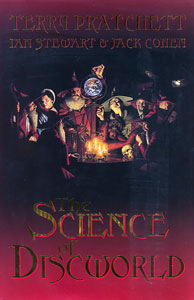
the-science-of-discworld-1

This one.

When you explain science to the public, it’s almost always impossible to explain everything accurately. So much background is needed to really understand most of modern science that conveying even a fraction of it would bore the average audience to tears. Instead, you need to simplify, to skip steps, and even (to be honest) to lie.

The important thing to realize here is that “lies to children” aren’t meant to mislead. Rather, they’re chosen in such a way that they give roughly the right impression, even as they leave important details out. When they told you in school that energy is always conserved, that was a lie: energy is a consequence of symmetry in time, and when that symmetry is broken energy doesn’t have to be conserved. But “energy is conserved” is a useful enough rule that lets you understand most of everyday life.

In this case, the “lie” that we’re calculating scattering amplitudes is fairly close to the truth. We’re using the same methods that people use to calculate scattering amplitudes in theories where they do make sense, like QCD. For a while, people thought these scattering amplitudes would have to be zero, since anything else “wouldn’t make sense”…but in practice, we found they were remarkably similar to scattering amplitudes in other theories. Now, we have more rigorous definitions for what we’re calculating that avoid this problem, involving objects called polygonal Wilson loops.

This illustrates another principle, one that hasn’t (yet) been popularized by a fantasy novel. I’d like to call it the “amplitudes are weird” principle. Time and again we amplitudes-folks will do a calculation that doesn’t really make sense, find unexpected structure, and go back to figure out what that structure actually means. It’s been one of the defining traits of the field, and we’ve got a pretty good track record with it.

A couple of weeks back, Lance Dixon gave an interview for the SLAC website, talking about his work on quantum gravity. This was immediately jumped on by Peter Woit and Lubos Motl as ammo for the long-simmering string wars. To one extent or another, both tried to read scientific arguments into the piece. This is in general a mistake: it is in the nature of a popularization piece to contain some volume of lies-to-children, and reading a piece aimed at a lower audience can be just as confusing as reading one aimed at a higher audience.

In the remainder of this post, I’ll try to explain what Lance was talking about in a slightly higher-level way. There will still be lies-to-children involved, this is a popularization blog after all. But I should be able to clear up a few misunderstandings. Lubos probably still won’t agree with the resulting argument, but it isn’t the self-evidently wrong one he seems to think it is.

Lance Dixon has done a lot of work on quantum gravity. Those of you who’ve read my old posts might remember that quantum gravity is not so difficult in principle: general relativity naturally leads you to particles called gravitons, which can be treated just like other particles. The catch is that the theory that you get by doing this fails to be predictive: one reason why is that you get an infinite number of erroneous infinite results, which have to be papered over with an infinite number of arbitrary constants.

Working with these non-predictive theories, however, can still yield interesting results. In the article, Lance mentions the work of Bern, Carrasco, and Johansson. BCJ (as they are abbreviated) have found that calculating a gravity amplitude often just amounts to calculating a (much easier to find) Yang-Mills amplitude, and then squaring the right parts. This was originally found in the context of string theory by another three-letter group, Kawai, Lewellen, and Tye (or KLT). In string theory, it’s particularly easy to see how this works, as it’s a basic feature of how string theory represents gravity. However, the string theory relations don’t tell the whole story: in particular, they only show that this squaring procedure makes sense on a classical level. Once quantum corrections come in, there’s no known reason why this squaring trick should continue to work in non-string theories, and yet so far it has. It would be great if we had a good argument why this trick should continue to work, a proof based on string theory or otherwise: for one, it would allow us to be much more confident that our hard work trying to apply this trick will pay off! But at the moment, this falls solidly under the “amplitudes are weird” principle.

Using this trick, BCJ and collaborators (frequently including Lance Dixon) have been calculating amplitudes in N=8 supergravity, a highly symmetric version of those naive, non-predictive gravity theories. For this particular, theory, the theory you “square” for the above trick is N=4 super Yang-Mills. N=4 super Yang-Mills is special for a number of reasons, but one is that the sorts of infinite results that lose you predictive power in most other quantum field theories never come up. Remarkably, the same appears to be true of N=8 supergravity. We’re still not sure, the relevant calculation is still a bit beyond what we’re capable of. But in example after example, N=8 supergravity seems to be behaving similarly to N=4 super Yang-Mills, and not like people would have predicted from its gravitational nature. Once again, amplitudes are weird, in a way that string theory helped us discover but by no means conclusively predicted.

If N=8 supergravity doesn’t lose predictive power in this way, does that mean it could describe our world?

In a word, no. I’m not claiming that, and Lance isn’t claiming that. N=8 supergravity simply doesn’t have the right sorts of freedom to give you something like the real world, no matter how you twist it. You need a broader toolset (string theory generally) to get something realistic. The reason why we’re interested in N=8 supergravity is not because it’s a candidate for a real-world theory of quantum gravity. Rather, it’s because it tells us something about where the sorts of dangerous infinities that appear in quantum gravity theories really come from.

That’s what’s going on in the more recent paper that Lance mentioned. There, they’re not working with a supersymmetric theory, but with the naive theory you’d get from just trying to do quantum gravity based on Einstein’s equations. What they found was that the infinity you get is in a certain sense arbitrary. You can’t get rid of it, but you can shift it around (infinity times some adjustable constant 😉 ) by changing the theory in ways that aren’t physically meaningful. What this suggests is that, in a sense that hadn’t been previously appreciated, the infinite results naive gravity theories give you are arbitrary.

The inevitable question, though, is why would anyone muck around with this sort of thing when they could just use string theory? String theory never has any of these extra infinities, that’s one of its most important selling points. If we already have a perfectly good theory of quantum gravity, why mess with wrong ones?

Here, Lance’s answer dips into lies-to-children territory. In particular, Lance brings up the landscape problem: the fact that there are 10^500 configurations of string theory that might loosely resemble our world, and no clear way to sift through them to make predictions about the one we actually live in.

This is a real problem, but I wouldn’t think of it as the primary motivation here. Rather, it gets at a story people have heard before while giving the feeling of a broader issue: that string theory feels excessive.

princess_diana_wedding_dress

Why does this have a Wikipedia article?

Think of string theory like an enormous piece of fabric, and quantum gravity like a dress. You can definitely wrap that fabric around, pin it in the right places, and get a dress. You can in fact get any number of dresses, elaborate trains and frilly togas and all sorts of things. You have to do something with the extra material, though, find some tricky but not impossible stitching that keeps it out of the way, and you have a fair number of choices of how to do this.

From this perspective, naive quantum gravity theories are things that don’t qualify as dresses at all, scarves and socks and so forth. You can try stretching them, but it’s going to be pretty obvious you’re not really wearing a dress.

What we amplitudes-folks are looking for is more like a pencil skirt. We’re trying to figure out the minimal theory that covers the divergences, the minimal dress that preserves modesty. It would be a dress that fits the form underneath it, so we need to understand that form: the infinities that quantum gravity “wants” to give rise to, and what it takes to cancel them out. A pencil skirt is still inconvenient, it’s hard to sit down for example, something that can be solved by adding extra material that allows it to bend more. Similarly, fixing these infinities is unlikely to be the full story, there are things called non-perturbative effects that probably won’t be cured. But finding the minimal pencil skirt is still going to tell us something that just pinning a vast stretch of fabric wouldn’t.

This is where “amplitudes are weird” comes in in full force. We’ve observed, repeatedly, that amplitudes in gravity theories have unexpected properties, traits that still aren’t straightforwardly explicable from the perspective of string theory. In our line of work, that’s usually a sign that we’re on the right track. If you’re a fan of the amplituhedron, the project here is along very similar lines: both are taking the results of plodding, not especially deep loop-by-loop calculations, observing novel simplifications, and asking the inevitable question: what does this mean?

That far-term perspective, looking off into the distance at possible insights about space and time, isn’t my style. (It isn’t usually Lance’s either.) But for the times that you want to tell that kind of story…well, this isn’t that outlandish of a story to tell. And unless your primary concern is whether a piece gives succor to the Woits of the world, it shouldn’t be an objectionable one.


Knowing Too Little, Knowing Too Much

(Commenter nueww has asked me to comment on the flurry of blog posts around an interview with Lance Dixon that recently went up on the SLAC website. I’m not going to comment on it until I have a chance to talk with Lance, beyond saying that this is a remarkable amount of attention paid to a fairly workaday organizational puff piece.)

I’ve been in Oregon this week, giving talks at Oregon State and at the University of Oregon. After my talk at Brown in front of some of the world’s top experts in my subfield, I’ve had to adapt quite a bit for these talks. Oregon State doesn’t have any particle theorists at all, while at the University of Oregon I gave a seminar for their Institute of Theoretical Science, which contains a mix of researchers ranging from particle theorists to theoretical chemists.

Guess which talk was harder to give?

If you guessed the UofO talk, you’re right. At Oregon State, I had a pretty good idea of everyone’s background. I knew these were people who would be pretty familiar with quantum mechanics, but probably wouldn’t have heard of Feynman diagrams. From that, I could build a strategy, and end up giving a pretty good talk.

At the University of Oregon, if I aimed for the particle physicists in the audience, I’d lose the chemists. So I should aim for the chemists, right?

That has its problems too. I’ve talked about some of them: the risk that the experts in your audience feel talked-down to, that you don’t cover the more important parts of your work. But there’s another problem, one that I noticed when I tried to prepare this talk: knowing too little can lead to misunderstandings, but so can knowing too much.

What would happen if I geared the talk completely to the chemists? Well, I’d end up being very vague about key details of what I did. And for the chemists, that would be fine: they’d get a flavor of what I do, and they’d understand not to read any more into it. People are pretty good at putting something in the “I don’t understand this completely” box, as long as it’s reasonably clearly labeled.

That vagueness, though, would be a disaster for the physicists in the audience. It’s not just that they wouldn’t get the full story: unless I was very careful, they’d end up actively misled. The same vague descriptions that the chemists would accept as “flavor”, the physicists would actively try to read for meaning. And with the relevant technical terms replaced with terms the chemists would recognize, they would end up with an understanding that would be actively wrong.

In the end, I ended up giving a talk mostly geared to the physicists, but with some background and vagueness to give the chemists some value. I don’t feel like I did as good of a job as I would like, and neither group really got as much out of the talk as I wanted them to. It’s tricky talking for a mixed audience, and it’s something I’m still learning how to do.

Pi in the Sky Science Journalism

You’ve probably seen it somewhere on your facebook feed, likely shared by a particularly wide-eyed friend: pi found hidden in the hydrogen atom!

FionaPi

ChoPi

OuellettePi

From the headlines, this sounds like some sort of kabbalistic nonsense, like finding the golden ratio in random pictures.

Read the actual articles, and the story is a bit more reasonable. The last two I linked above seem to be decent takes on it, they’re just saddled with ridiculous headlines. As usual, I blame the editors. This time, they’ve obscured an interesting point about the link between physics and mathematics.

So what does “pi found hidden in the hydrogen atom” actually mean?

It doesn’t mean that there’s some deep importance to the number pi in nature, beyond its relevance in mathematics in general. The reason that pi is showing up here isn’t especially deep.

It isn’t trivial either, though. I’ve seen a few people whose first response to this article was “of course they found pi in the hydrogen atom, hydrogen atoms are spherical!” That’s not what’s going on here. The connection isn’t about the shape of the hydrogen atom, it’s about one particular technique for estimating its energy.

Carl Hagen is a physicist at the University of Rochester who was teaching a quantum mechanics class in which he taught a well-known approximation technique called the variational principle. Specifically, he had his students apply this technique to the hydrogen atom. The nice thing about the hydrogen atom is that it’s one of the few atoms simple enough that it’s possible to find its energy levels exactly. The exact calculation can then be compared to the approximation.

What Hagen noticed was that this approximation was surprisingly good, especially for high energy states for which it wasn’t expected to be. In the end, working with Rochester math professor Tamar Friedmann, he figured out that the variational principle was making use of a particular identity between a type of mathematical functions, called Gamma functions, that are quite common in physics. Using those Gamma functions, the two researchers were able to re-derive what turned out to be a 17th century formula for pi, giving rise to a much cleaner proof for that formula than had been known previously.

So pi isn’t appearing here because “the hydrogen atom is a sphere”. It’s appearing because pi appears all over the place in physics, and because in general, the same sorts of structures appear again and again in mathematics.

Pi’s appearance in the hydrogen atom is thus not very special, regardless. What is a little bit special is the fact that, using the hydrogen atom, these folks were able to find a cleaner proof of an old approximation for pi, one that mathematicians hadn’t found before.

That, if anything, is the interesting part of this news story, but it’s also part of a broader trend, one in which physicists provide “physics proofs” for mathematical results. One of the more famous accomplishments of string theory is a class of “physics proofs” of this sort, using a principle called mirror symmetry.

The existence of  “physics proofs” doesn’t mean that mathematics is secretly constrained by the physical world. Rather, they’re a result of the fact that physicists are interested in different aspects of mathematics, and in general are a bit more reckless in using approximations that haven’t been mathematically vetted. A physicist can sometimes prove something in just a few lines that mathematicians would take many pages to prove, but usually they do this by invoking a structure that would take much longer for a mathematician to define. As physicists, we’re building on the shoulders of other physicists, using concepts that mathematicians usually don’t have much reason to bother with. That’s why it’s always interesting when we find something like the Amplituhedron, a clean mathematical concept hidden inside what would naively seem like a very messy construction. It’s also why “physics proofs” like this can happen: we’re dealing with things that mathematicians don’t naturally consider.

So please, ignore the pi-in-the-sky headlines. Some physicists found a trick, some mathematicians found it interesting, the hydrogen atom was (quite tangentially) involved…and no nonsense needs to be present.

Using Effective Language

Physicists like to use silly names for things, but sometimes it’s best to just use an everyday word. It can trigger useful intuitions, and it makes remembering concepts easier. What gets confusing, though, is when the everyday word you use has a meaning that’s not quite the same as the colloquial one.

“Realism” is a pretty classic example, where Bell’s elegant use of the term in quantum mechanics doesn’t quite match its common usage, leading to inevitable confusion whenever it’s brought up. “Theory” is such a useful word that multiple branches of science use it…with different meanings! In both cases, the naive meaning of the word is the basis of how it gets used scientifically…just not the full story.

There are two things to be wary of here. First, those of us who communicate science must be sure to point out when a word we use doesn’t match its everyday meaning, to guide readers’ intuitions away from first impressions to understand how the term is used in our field. Second, as a reader, you need to be on the look-out for hidden technical terms, especially when you’re reading technical work.

I remember making a particularly silly mistake along these lines. It was early on in grad school, back when I knew almost nothing about quantum field theory. One of our classes was a seminar, structured so that each student would give a talk on some topic that could be understood by the whole group. Unfortunately, some grad students with deeper backgrounds in theoretical physics hadn’t quite gotten the memo.

It was a particular phrase that set me off: “This theory isn’t an effective theory”.

My immediate response was to raise my hand. “What’s wrong with it? What about this theory makes it ineffective?”

The presenter boggled for a moment before responding. “Well, it’s complete up to high energies…it has no ultraviolet divergences…”

“Then shouldn’t that make it even more effective?”

After a bit more of this back-and-forth, we finally cleared things up. As it turns out, “effective field theory” is a technical term! An “effective field theory” is only “effectively” true, describing physics at low energies but not at high energies. As you can see, the word “effective” here is definitely pulling its weight, helping to make the concept understandable…but if you don’t recognize it as a technical term and interpret it literally, you’re going to leave everyone confused!

Over time, I’ve gotten better at identifying when something is a technical term. It really is a skill you can learn: there are different tones people use when speaking, different cadences when writing, a sense of uneasiness that can clue you in to a word being used in something other than its literal sense. Without that skill, you end up worried about mathematicians’ motives for their evil schemes. With it, you’re one step closer to what may be the most important skill in science: the ability to recognize something you don’t know yet.