Tag Archives: PublicPerception

Research or Conference? Can’t it be both?

“If you’re there for two months, for sure you’ll be doing research.”

I wanted to be snarky. I wanted to point out that, as a theoretical physicist, I do research wherever I go. I wanted to say that I even did research on the drive over. (This may not have been true, I think I mostly thought about Magic the Gathering cards.)

More than any of those, though, I wanted to get my travel visa. So instead I said,

“That’s fair.”

“Mmhmm, that’s fair.” Looking down at the invitation letter, she triumphantly pointed to the name of the inviting institution: “South American Institute for Fundamental Research.”

A bit of background: I’m going to Brazil this winter. Partly, this is because winter in Canada is not especially desirable, but it’s also because Sao Paulo’s International Center for Theoretical Physics is running a Program on Integrability, the arcane set of techniques that seeks to bypass the approximate perturbations we often use in particle physics and find full, exact results.

What do I mean by a Program? It’s not the sort of scientific program I’ve talked about before, though the ideas are related. When an institute holds a Program, they’re declaring a theme. For a certain length of time (generally from a few months to a whole semester), there will be a large number of talks at the institute focused on some particular scientific theme. The institute invites people from all over the world who work on that theme. Those people are there to give and attend talks, but they’re also there to share ideas with each other, to network and collaborate and do research.

This is where things get tricky. See, Brazil has multiple types of visas. A Tourist Visa can be used, among other things, for attending a scientific conference. On the other hand, someone coming to Brazil to do research uses Visa 1.

A Program is essentially a long conference…but it’s also an opportunity to do research. So are most short conferences, though! In theoretical physics we have workshops, short conferences explicitly focused on collaboration and research, but even if a conference isn’t a workshop you can bet that we’ll be doing some research there, for sure. We don’t need labs, and some of us don’t even need computers, research can happen whenever the inspiration strikes. The distinction between conferences and research, from our perspective, is an arbitrary one.

In physics, we like to cut through this sort of ambiguity by looking at what’s really important. I wanted to figure out what about research makes the Brazilian government use a different visa for it, whether it was about motivating people to enter the country for specific reasons or tracking certain sorts of activities. I wanted to understand that, because it would let me figure out whether my own research fell under those reasons, and thus figure out objectively which type of visa I ought to have.

I wanted to ask about all of this…but more than any of that, I wanted to get my travel visa. So I applied for the visa they told me to, and left.

Love It or Hate It, Don’t Fear the Multiverse

“In an infinite universe, anything is possible.”

A nice maxim for science fiction, perhaps. But it probably doesn’t sound like productive science.

A growing number of high profile scientists and science popularizers have come out in favor of the idea that there may exist a “multiverse” of multiple universes, and that this might explain some of the unusual properties of our universe. If there are multiple universes, each with different physical laws, then we must exist in one of the universes with laws capable of supporting us, no matter how rare or unlikely such a universe is. This sort of argument is called anthropic reasoning.

(If you’re picky about definitions and don’t like the idea of more than one universe, think instead of a large universe with many different regions, each one separated from the others. There are some decent physics-based reasons to suppose we live in such a universe.)

Not to mention continuity reasons.

Why is anyone in favor of this idea? It all goes back to the Higgs.

The Higgs field interacts with other particles, giving them mass. What most people don’t mention is that the effect, in some sense, goes both ways. Because the Higgs interacts with other particles, the mass of the Higgs is also altered. This alteration is large, much larger than the observed mass of the Higgs. (In fact, in a sense it’s infinite!)

In order for the Higgs to have the mass we observe, then, something has to cancel out these large corrections. That cancellation can either be a coincidence, or there can be a reason for it.

The trouble is, we’re running out of good reasons. One of the best was supersymmetry, the idea that each particle has a partner with tightly related properties. But if supersymmetry was going to save the day, we probably would have detected some of those partners at the Large Hadron Collider by now. More generally, it can be argued that almost all possible “good reasons” require some new particle to be found at the LHC.

If there are no good reasons, then we’re stuck with a coincidence. (This is often referred to as the Naturalness Problem in particle physics.) And it’s this uncomfortable coincidence that has driven prominent physicists to the arms of the multiverse.

There’s a substantial backlash, though. Many people view the multiverse as a cop-out. Some believe it to be even more toxic than that: if there’s a near-infinite number of possible universes then in principle any unusual feature of our universe could be explained by anthropic reasoning, which sounds like it could lead to the end of physics as we know it.

You can disdain the multiverse as a cop-out, but, as I’ll argue here, you shouldn’t fear it. Those who think the multiverse will destroy physics are fundamentally misunderstanding the way physics research works.

The key thing to keep in mind is that almost nobody out there prefers the multiverse. When a prominent physicist supports the multiverse, that doesn’t mean they’re putting aside productive work on other solutions to the problem. In general, it means they don’t have other solutions to the problem. Supporting the multiverse isn’t going to stop them from having ideas they wouldn’t have had to begin with.

And indeed, many of these people are quite supportive of alternatives to the multiverse. I’ve seen Nima Arkani-Hamed talk about the multiverse, and he generally lists a number of other approaches (some quite esoteric!) that he has worked (and failed to make progress) on, and encourages the audience to look into them.

Physics isn’t a zero-sum game, nor is it ruled by a few prominent people. If a young person has a good idea about how to explain something without the multiverse, they’re going to have all the support and recognition that such an idea deserves.

What the multiverse adds is another track, another potentially worthwhile line of research. Surprising as it may seem, the multiverse doesn’t automatically answer every question. It might not even answer the question of the mass of the Higgs! All that the existence of a multiverse tells us is that we should exist somewhere where intelligent life could exist…but if intelligent life is more likely to exist in a universe very different from ours, then we’re back to square one. There’s a lot of research involved in figuring out just what the multiverse implies, research by people who wouldn’t have been working on this sort of problem if the idea of the multiverse hadn’t been proposed.

That’s the key take-away message here. The multiverse may be wrong, but just considering it isn’t going to destroy physics. Rather, it’s opened up new avenues of research, widening the community of those trying to solve the Naturalness Problem. It may well be a cop-out for individuals, but science as a whole doesn’t have cop-outs: there’s always room for someone with a good idea to sweep away the cobwebs and move things forward.

(Interstellar) Dust In The Wind…

The news has hit the blogosphere: the team behind the Planck satellite has released new dust measurements, and they seem to be a nail in the coffin of BICEP2’s observation of primordial gravitational waves.

Some background for those who haven’t been following the story:

BICEP2, a telescope in Antarctica, is set up to observe the Cosmic Microwave Background, light left over from the very early universe. Back in March, they announced that they had seen characteristic ripples in that light, ripples that they believed were caused by gravitational waves in the early universe. By comparing the size of these gravitational waves to their (quantum-small) size when they were created, they could make statements about the exponential expansion of the early universe (called inflation). This amounted to better (and more specific) evidence about inflation than anyone else had ever found, so naturally people were very excited about it.

However, doubt was rather quickly cast on these exciting results. Like all experimental science, BICEP2 needed to estimate the chance that their observations could be caused by something more mundane. In particular, interstellar dust can cause similar “ripples” to those they observed. They argued that dust would have contributed a much smaller effect, so their “ripples” must be the real deal…but to make this argument, they needed an estimate of how much dust they should have seen. They had several estimates, but one in particular was based on data “scraped” off of a slide from a talk by the Planck collaboration.

Unfortunately, it seems that the BICEP2 team misinterpreted this “scraped” data. Now, Planck have released the actual data, and it seems like dust could account for BICEP2’s entire signal.

I say “could” because more information is needed before we know for sure. The BICEP2 and Planck teams are working together now, trying to tease out whether BICEP2’s observations are entirely dust, or whether there might still be something left.

I know I’m not the only person who wishes that this sort of collaboration could have happened before BICEP2 announced their discovery to the world. If Planck had freely shared their early data with BICEP2, they would have had accurate dust estimates to begin with, and they wouldn’t have announced all of this prematurely.

Of course, expecting groups to freely share data when Nobel prizes and billion-dollar experiments are on the line is pretty absurdly naive. I just wish we lived in a world where none of this was at issue, where careers didn’t ride on “who got there first”.

I’ve got no idea how to bring about such a world, of course. Any suggestions?

“China” plans super collider

When I saw the headline, I was excited.

“China plans super collider” says Nature News.

There’s been a lot of worry about what may happen if the Large Hadron Collider finishes its run without discovering anything truly new. If that happens, finding new particles might require a much bigger machine…and since even that machine has no guarantee of finding anything at all, world governments may be understandably reluctant to fund it.

As such, several prominent people in the physics community have put their hopes on China. The country’s somewhat autocratic nature means that getting funding for a collider is a matter of convincing a few powerful people, not a whole fractious gaggle of legislators. It’s a cynical choice, but if it keeps the field alive so be it.

If China was planning a super collider, then, that would be great news!

Too bad it’s not.

Buried eight paragraphs in to Nature’s article we find the following:

The Chinese government is yet to agree on any funding, but growing economic confidence in the country has led its scientists to believe that the political climate is ripe, says Nick Walker, an accelerator physicist at DESY, Germany’s high-energy physics laboratory in Hamburg. Although some technical issues remain, such as keeping down the power demands of an energy-hungry ring, none are major, he adds.

The Chinese government is yet to agree on any funding. China, if by China you mean the Chinese government, is not planning a super collider.

So who is?

Someone must have drawn these diagrams, after all.

Reading the article, the most obvious answer is Beijing’s Institute of High Energy Physics (IHEP). While this is true, the article leaves out any mention of a more recently founded site, the Center for Future High Energy Physics (CFHEP).

This is a bit odd, given that CFHEP’s whole purpose is to compose a plan for the next generation of colliders, and persuade China’s government to implement it. They were founded, with heavy involvement from non-Chinese physicists including their director Nima Arkani-Hamed, with that express purpose in mind. And since several of the quotes in the article come from Yifang Wang, director of IHEP and member of the advisory board of CFHEP, it’s highly unlikely that this isn’t CFHEP’s plan.

So what’s going on here? On one level, it could be a problem on the journalists’ side. News editors love to rewrite headlines to be more misleading and click-bait-y, and claiming that China is definitely going to build a collider draws much more attention than pointing out the plans of a specialized think tank. I hope that it’s just something like that, and not the sort of casual racism that likes to think of China as a single united will. Similarly, I hope that the journalists involved just didn’t dig deep enough to hear about CFHEP, or left it out to simplify things, because there is a somewhat darker alternative.

CFHEP’s goal is to convince the Chinese government to build a collider, and what better way to do that than to present them with a fait accompli? If the public thinks that this is “China’s” plan, that wheels are already in motion, wouldn’t it benefit the Chinese government to play along? Throw in a few sweet words about the merits of international collaboration (a big part of the strategy of CFHEP is to bring international scientists to China to show the sort of community a collider could attract) and you’ve got a winning argument, or at least enough plausibility to get US and European funding agencies in a competitive mood.

This…is probably more cynical than what’s actually going on. For one, I don’t even know whether this sort of tactic would work.

Do these guys look like devious manipulators?

Indeed, it might just be a journalistic omission, part of a wider tendency of science journalists to focus on big projects and ignore the interesting part, the nitty-gritty things that people do to push them forward. It’s a shame, because people are what drive the news forward, and as long as science is viewed as something apart from real human beings people are going to continue to mistrust and misunderstand it.

Either way, one thing is clear. The public deserves to hear a lot more about CFHEP.

Made of Energy, or Made of Nonsense?

I did a few small modifications to the blog settings this week. Comments now support Markdown, reply-chains in the comments can go longer, and there are a few more sharing buttons on the posts. I’m gearing up to do a more major revamp of the blog in July for when the name changes over from 4 gravitons and a grad student to just 4 gravitons.

io9 did an article recently on scientific ideas that scientists wish the public would stop misusing. They’ve got a lot of good ones (Proof, Quantum, Organic), but they somehow managed to miss one of the big ones: Energy. Matt Strassler has a nice, precise article on this particular misconception, but nonetheless I think it’s high time I wrote my own.

There’s a whole host of misconceptions regarding energy. Some of them are simple misuses of language, like zero-calorie energy drinks:

Zero Purpose

Energy can be measured in several different units. You can use Joules, or electron-Volts, or dynes…or calories. Calories are a measure of energy, so zero calories quite literally means zero energy.

Now, that’s not to say the makers of zero calorie energy drinks are lying. They’re just using a different meaning of energy from the scientific one. Their drinks give you vim and vigor, the get-up-and-go required to make money playing computer games. For most of the public, that “get-up-and-go” is called energy, even if scientifically it’s not.

That’s not really a misconception, more of an amusing use of language. This next one though really makes my blood boil.

Raise your hand if you’ve seen a Sci-Fi movie or TV show where some creature is described as being made of “pure energy”. Whether they’re peaceful, ultra-advanced ascended beings, or genocidal maniacs from another dimension, the concept of creatures made of “pure energy” shows up again and again and again.

You can’t fight the Drej, they’re pure bullshit!

Even if you aren’t the type to take Sci-Fi technobabble seriously, you’ve probably heard that matter and antimatter annihilate to form energy, or that photons are made out of energy. These sound more reasonable, but they rest on the same fundamental misconception:

Nothing is “made out of energy”.

Rather,

Energy is a property that things have.

Energy isn’t a substance, it isn’t a fluid, it isn’t some kind of nebulous stuff you can make into an indestructible alien body. Things have energy, but nothing is energy.

What about light, then? And what happens when antimatter collides with matter?

Light, just like anything else, has energy. The difference between light and most other things is that light also does not have mass.

In everyday life, we like to think of mass as some sort of basic “stuff”. If things are “made out of mass” or “made out of matter”, and something like light doesn’t have mass, then it must be made out of some other “stuff”, right?

The thing is, mass isn’t really “stuff” any more than energy is. Just like energy, mass is a property that things have. In fact, as I’ve talked about some before, mass is really just a type of energy. Specifically, mass is the energy something has when left alone and at rest. That’s the meaning of Einstein’s famous equation, E equals m c squared: it tells you how to take a known mass and calculate the rest energy that it implies.

Lots of hype for a unit conversion formula, huh?

In the case of light, all of its energy can be thought of in terms of its (light-speed) motion, so it has no mass. That might tempt you to think of it as being “made of energy”, but really, you and light are not so different.

You are made of atoms, and atoms are made of protons, neutrons, and electrons. Let’s consider a proton. A proton’s mass, expressed in the esoteric units physicists favor, is 938 Mega-electron-Volts. That’s how much energy a proton has alone and and rest. A proton is made of three quarks, so you’d think that they would contribute most of its mass. In reality, though, the quarks in protons have masses of only a few Mega-electron-Volts. Most of a proton’s mass doesn’t come from the mass of the quarks.

Quarks interact with each other via the strong nuclear force, the strongest fundamental force in existence. That interaction has a lot of energy, and when viewed from a distance that energy contributes almost all of the proton’s mass. So if light is “made of energy”, so are you.

So why do people say that matter and anti-matter annihilate to make energy?

A matter particle and its anti-matter partner are opposite in a lot of ways. In particular, they have opposite charges: not just electric charge, but other types of charge too.

Charge must be conserved, so if a particle collides with its anti-particle the result has a total charge of zero, as the opposite charges of the two cancel each other out. Light has zero charge, so it’s one of the most common results of a matter-antimatter collision. When people say that matter and antimatter produce “pure energy”, they really just mean that they produce light.

So next time someone says something is “made of energy”, be wary. Chances are, they aren’t talking about something fully scientific.

Insert Muscle Joke Here

I’m graduating this week, so I probably shouldn’t spend too much time writing this post. I ought to mention, though, that there has been some doubt about the recent discovery by the BICEP2 telescope of evidence for gravitational waves in the cosmic microwave background caused by the early inflation of the universe. Résonaances got to the story first and Of Particular Significance has some good coverage that should be understandable to a wide audience.

In brief, the worry is that the signal detected by BICEP2 might not be caused by inflation, but instead by interstellar dust. While the BICEP2 team used several models of dust to show that it should be negligible, the controversy centers around one of these models in particular, one taken from another, similar experiment called PLANCK.

The problem is, BICEP2 didn’t get PLANCK’s information on dust directly. Instead, it appears they took the data from a slide in a talk by the PLANCK team. This process, known as “data scraping”, involves taking published copies of the slides and reading information off of the charts presented. If BICEP2 misinterpreted the slide, they might have miscalculated the contribution by interstellar dust.

If you’re like me, the whole idea of data scraping seems completely ludicrous. The idea of professional scientists sneaking information off of a presentation, rather than simply asking the other team for data like reasonable human beings, feels almost cartoonishly wrong-headed.

It’s a bit more understandable, though, when you think about the culture behind these big experiments. The PLANCK and BICEP2 teams are colleagues, but they are also competitors. There is an enormous amount of glory in finding evidence for something like cosmic inflation first, and an equally enormous amount of shame in screwing up and announcing something that turns out to be wrong. As such, these experiments are quite protective of their data. Not only might someone with early access to the data preempt them on an important discovery, they might rush to publish a conclusion that is wrong. That’s why most of these big experiments spend a large amount of time checking and re-checking the data, communicating amongst themselves and settling on an interpretation before they feel comfortable releasing it to the wider community. It’s why BICEP2 couldn’t just ask PLANCK for their data.

From BICEP2’s perspective, they can expect that plots presented at a talk by PLANCK should be accurate, digital plots. Unlike Fox News, scientists have an obligation to present their data in a way that isn’t misleading. And while relying on such a dubious source seems like a bad idea, by all accounts that’s not what the BICEP2 team did. PLANCK’s data was just one dust model used by the team, kept in part because it agreed well with other, non-“data-scraped” models.

It’s a shame that these experiments are so large and prestigious that they need to guard their data in such a potentially destructive way. My sub-field is generally much nicer about this sort of thing: the stakes are lower, and the groups are smaller and have less media attention, so we’re able to share data when we need to. In fact, my most recent paper got a significant boost from some data shared by folks at the Perimeter Institute.

Only time will tell whether the BICEP2 result wins out, or whether it was a fluke caused by caustic data-sharing practices. A number of other experiments are coming online within the next year, and one of them may confirm or deny what BICEP2 has showed.

Look what I made!

In a few weeks, I’ll be giving a talk for Stony Brook’s Graduate Awards Colloquium, to an audience of social science grad students and their parents.

One of the most useful tools when talking to people in other fields is a shared image. You want something from your field that they’ve seen, that they’re used to, that they’ll recognize. Building off of that kind of thing can be a great way to communicate.

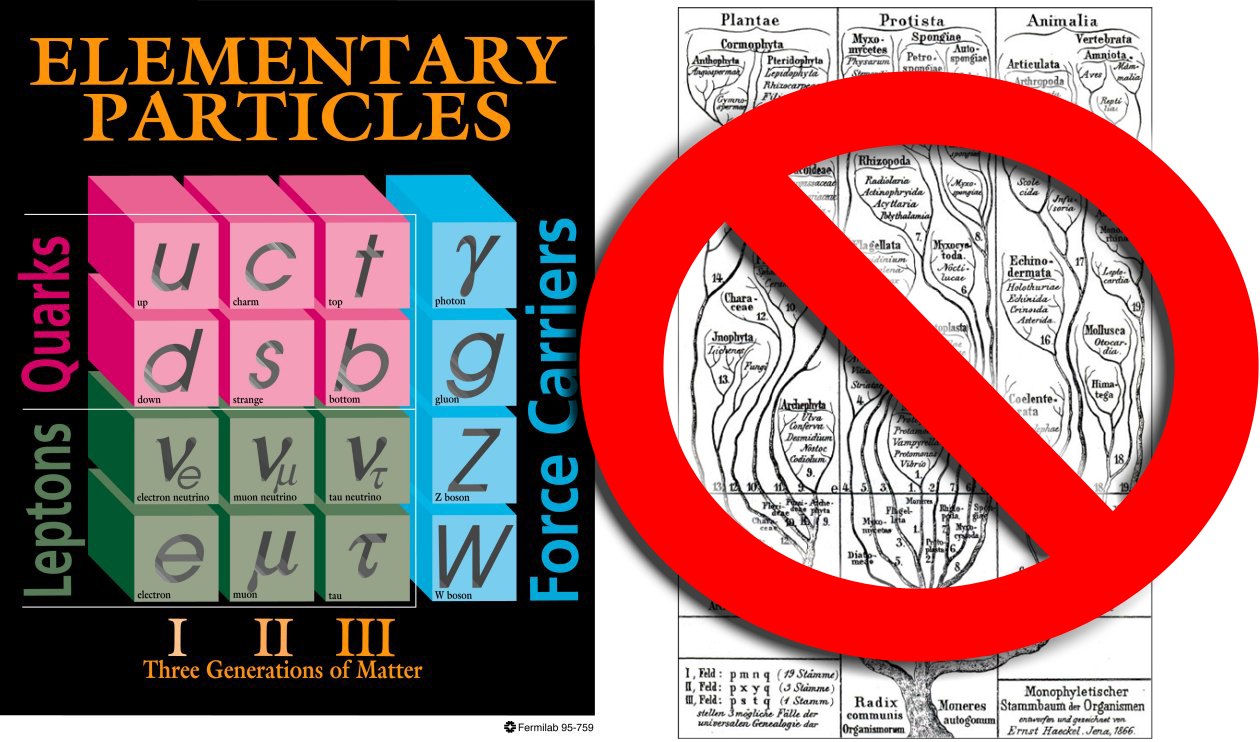
If there’s one particle physics image that lots and lots of people have seen, it’s the Standard Model. Generally, it’s organized into charts like this:

Standard_Model_of_Elementary_Particles

I thought that if people saw a chart like that, but for N=4 super Yang-Mills, it might make the theory seem a bit more familiar. N=4 super Yang-Mills has a particle much like the Standard Model’s gluon with spin 1, paired with four gluinos, particles that are sort of but not really like quarks with spin 1/2, and six scalars, particles whose closest analogue in the Standard Model is the Higgs with spin 0.

In N=4 super Yang-Mills, none of these particles have any mass, since if supersymmetry isn’t “broken” all particles have the same mass. So where mass is written in the Standard Model table, I can just put zero. The table I linked also gives the electric charge of each particle. That doesn’t really mean anything for N=4 super Yang-Mills. It isn’t a theory that tries to describe the real world, so there’s no direct equivalent to a real-world force like electromagnetism. Since everything in the theory has to have the same charge, again due to supersymmetry, I can just list all of their “electric charges” as zero.

Putting it all together, I get the diagram below. The theory has eleven particles in total, so it won’t fit into a nice neat square. Still, this should be more familiar than most of the ways I could present things.

N4SYMParticleContent

Particles are not Species

It has been estimated that there are 7.5 million undiscovered species of animals, plants and fungi. Most of these species are insects. If someone wanted billions of dollars to search the Amazon rainforest with the goal of cataloging every species of insect, you’d want them to have a pretty good reason. Maybe they are searching for genes that could cure diseases, or trying to understand why an ecosystem is dying.

The primary goal of the Large Hadron Collider is to search for new subatomic particles. If we’re spending billions searching for these things, they must have some use, right? After all, it’s all well and good knowing about a bunch of different particles, but there must be a whole lot of sorts of particles out there, at least if you judge by science fiction (these two are also relevant). Surely we could just focus on finding the useful ones, and ignore the rest?

The thing is, particle physics isn’t like that. Particles aren’t like insects, you don’t find rare new types scattered in out-of-the-way locations. That’s because each type of particle isn’t like a species of animal. Instead, each particle is a fundamental law of nature.

Move over Linnaeus.

Move over Linnaeus.

It wasn’t always like this. In the late 50’s and early 60’s, particle accelerators were producing a zoo of new particles with no clear rhyme or reason, and it looked like they would just keep producing more. That impression changed when Murray Gell-Mann proposed his Eightfold Way, which led to the development of the quark model. He explained the mess of new particles in terms of a few fundamental particles, the quarks, which made up the more complicated particles that were being discovered.

Nowadays, the particles that we’re trying to discover aren’t, for the most part, the zoo of particles of yesteryear. Instead, we’re looking for new fundamental particles.

What makes a particle fundamental?

The new particles of the early 60’s were a direct consequence of the existence of quarks. Once you understood how quarks worked, you could calculate the properties of all of the new particles, and even predict ones that hadn’t been found yet.

By contrast, fundamental particles aren’t based on any other particles, and you can’t predict everything about them. When we discover a new fundamental particle like the Higgs boson, we’re discovering a new, independent law of nature. Each fundamental particle is a law that states, across all of space and time, “if this happens, make this particle”. It’s a law that holds true always and everywhere, regardless of how often the particle is actually produced.

Think about the laws of physics like the cockpit of a plane. In front of the pilot is a whole mess of controls, dials and switches and buttons. Some of those controls are used every flight, some much more rarely. There are probably buttons on that plane that have never been used. But if a single button is out of order, the plane can’t take off.

Each fundamental particle is like a button on that plane. Some turn “on” all the time, while some only turn “on” in special circumstances. But each button is there all the same, and if you’re missing one, your theory is incomplete. It may agree with experiments now, but eventually you’re going to run into problems of one sort or another that make your theory inconsistent.

The point of discovering new particles isn’t just to find the one that will give us time travel or let us blow up Vulcan. Technological applications would be nice, but the real point is deeper: we want to know how reality works, and for every new fundamental particle we discover, we’ve found out a fact that’s true about the whole universe.

The Four Ways Physicists Name Things

If you’re a biologist and you discover a new animal, you’ve always got Latin to fall back on. If you’re an astronomer, you can describe what you see. But if you’re a physicist, your only option appears to involve falling back on one of a few terrible habits.

The most reasonable option is just to name it after a person. Yang-Mills and the Higgs Boson may sound silly at first, but once you know the stories of C. N. Yang, Robert Mills, Peter Higgs and Satyendra Nath Bose you start appreciating what the names mean. While this is usually the most elegant option, the increasingly collaborative nature of physics means that many things have to be named with a series of initials, like ABJM, BCJ and KKLT.

A bit worse is the tendency to just give it the laziest name possible. What do you call the particles that “glue” protons and neutrons together? Why gluons, of course, yuk yuk yuk!

This is particularly common when it comes to supersymmetry, where putting the word “super” in front of something almost always works. If that fails, it’s time to go for more specific conventions: to find the partner of an existing particle, if the new particle is a boson, just add “s-” for “super”“scalar” apparently to the name. This creates perfectly respectable names like stau, sneutrino, and selectron. If the new particle is a fermion, instead you add “-ino” to the end, getting something like a gluino if you start with a gluon. If you’ve heard of neutrinos, you may know that neutrino means “little neutral one”. You might perfectly rationally expect that gluino means “little gluon”, if you had any belief that physicists name things logically. We don’t. A gluino is called a gluino because it’s a fermion, and neutrinos are fermions, and the physicists who named it were too lazy to check what “neutrino” actually means.

Pictured: the superpartner of Nidoran?

Worse still are names that are obscure references and bad jokes. These are mercifully rare, and at least memorable when they occur. In quantum mechanics, you write down probabilities using brackets of two quantum states, \langle a | b\rangle. What if you need to separate the two states, \langle a| and |b\rangle? Then you’ve got a “bra” and a “ket”!

Or have you heard the story of how quarks were named? Quarks, for those of you unfamiliar with them, are found in protons and neutrons in groups of three. Murray Gell-Mann, one of the two people who first proposed the existence of quarks, got their name from Finnegan’s Wake, a novel by James Joyce, which at one point calls for “Three quarks for Muster Mark!” While this may at first sound like a heartwarming tale of respect for the literary classics, it should be kept in mind that a) Finnegan’s Wake is a novel composed almost entirely of gibberish, read almost exclusively by people who pretend to understand it to seem intelligent and b) this isn’t exactly the most important or memorable line in the book. So Gell-Mann wasn’t so much paying homage to a timeless work of literature as he was referencing the most mind-numbingly obscure piece of nerd trivia before the invention of Mara Jade. Luckily these days we have better ways to remember the name.

Albeit wrinklier ways.

The final, worst category, though, don’t even have good stories going for them. They are the names that tell you absolutely nothing about the thing they are naming.

Probably the worst examples of this from my experience are the a-theorem and the c-theorem. In both cases, a theory happened to have a parameter in it labeled by a letter. When a theorem was proven about that parameter, rather than giving it a name that told you anything at all about what it was, people just called it by the name of the parameter. Mathematics is full of names like this too. Without checking Wikipedia, what’s the difference between a set, a group, and a category? What the heck is a scheme?

If you ever have to name something, be safe and name it after a person. If you don’t, just try to avoid falling into these bad habits of physics naming.

Flexing the BICEP2 Results

The physicsverse has been abuzz this week with news of the BICEP2 experiment’s observations of B-mode polarization in the Cosmic Microwave Background.

There are lots of good sources on this, and it’s not really my field, so I’m just going to give a quick summary before talking about a few aspects I find interesting.

BICEP2 is a telescope in Antarctica that observes the Cosmic Microwave Background, light left over from the first time that the universe was clear enough for light to travel. (If you’re interested in a background on what we know about how the universe began, Of Particular Significance has an article here that should be fairly detailed, and I have a take on some more speculative aspects here.) Earlier experiments that observed the Cosmic Microwave Background discovered a surprising amount of uniformity. This led to the proposal of a concept called inflation: the idea that at some point the early universe expanded exponentially, smearing any non-uniformities across the sky and smoothing everything out. Since the rate the universe expands is a number, if that number is to vary it naturally should be a scalar field, which in this case is called the inflaton.

During inflation, distances themselves get stretched out. Think about inflation like enlarging an image. As you’ve probably noticed (maybe even in early posts on this blog), enlarging an image doesn’t always work out well. The resulting image is often pixelated or distorted. Some of the distortion comes from glitches in the program that enlarges the image, while some of it is just what happens when the pixels of the original image get enlarged to the point that you can see them.

Enlarging the Cosmic Microwave Background

Quantum fluctuations in the inflaton field itself are the glitches in the program, enlarging some areas more than others. The pattern they create in the Cosmic Microwave Background is called E-mode polarization, and several other experiments have been able to detect it.

Much weaker are the effect of the “pixels” of the original image. Since the original image is spacetime itself, the pixels are the quantum fluctuations of spacetime: quantum gravity waves. Inflation enlarged them to the point that they were visible on a large-distance scale, fundamental non-uniformity in the world blown up big enough to affect the distribution of light. The effect this had on light is detectably different: it’s called B-mode polarization, and this is the first experiment to detect it on the right scale for it to be caused by gravity waves.

Measuring this polarization, in particular how strong it is, tells us a lot about how inflation occurred. It’s enough to rule out several models, and lend support to several others. If the results are corroborated this will be real, useful evidence, the sort physicists love to get, and folks are happily crunching numbers on it all over the world.

All that said, this site is called four gravitons and a grad student, and I’m betting that some of you want to ask this grad student: is this evidence for gravitons, or for gravity waves?

Sort of.

We already had good indirect evidence for gravity waves: pairs of neutron stars release gravity waves as they orbit each other, which causes them to slow down. Since we’ve observed them slowing down at the right rates, we were already confident gravity waves exist. And if you’ve got gravity waves, gravitons follow as a natural consequence of quantum mechanics.

The data from BICEP2 is also indirect. The gravity waves “observed” by BICEP2 were present in the early universe. It is their effect on the light that would become the Cosmic Microwave Background that is being observed, not the gravity waves directly. We still have yet to directly detect gravity waves, with a gravity telescope like LIGO.

On the other hand, a “gravity telescope” isn’t exactly direct either. In order to detect gravity waves, LIGO and other gravity telescopes attempt to measure their effect on the distances between objects. How do they do that? By looking at interference patterns of light.

In both cases, we’re looking at light, present in the environment of a gravity wave, and examining its properties. Of course, in a gravity telescope the light is from a nearby environment under tight control, while the Cosmic Microwave Background is light from as far away and long ago as anything within the reach of science today. In both cases, though, it’s not nearly as simple as “observing” an effect. “Seeing” anything in high energy physics or astrophysics is always a matter of interpreting data based on science we already know.

Alright, that’s evidence for gravity waves. Does that mean evidence for gravitons?

I’ve seen a few people describe BICEP2’s results as evidence for quantum gravity/quantum gravity effects. I felt a little uncomfortable with that claim, so I asked Matt Strassler what he thought. I think his perspective on this is the right one. Quantum gravity is just what happens when gravity exists in a quantum world. As I’ve said on this site before, quantum gravity is easy. The hard part is making a theory of quantum gravity that has real predictive power, and that’s something these results don’t shed any light on at all.

That said, I’m a bit conflicted. They really are seeing a quantum effect in gravity, and as far as I’m aware this really is the first time such an effect has been observed. Gravity is so weak, and quantum gravity effects so small, that it takes inflation blowing them up across the sky for them to be visible. Now, I don’t think there was anyone out there who thought gravity didn’t have quantum fluctuations (or at least, anyone with a serious scientific case). But seeing into a new regime, even if it doesn’t tell us much…that’s important, isn’t it? (After writing this, I read Matt Strassler’s more recent post, where he has a paragraph professing similar sentiments).

On yet another hand, I’ve heard it asserted in another context that loop quantum gravity researchers don’t know how to get gravitons. I know nothing about the technical details of loop quantum gravity, so I don’t know if that actually has any relevance here…but it does amuse me.