Tag Archives: PublicPerception

Words, Words, Words

If there’s one thing the Center for Communicating Science drummed into me at Stony Brook, it’s to be careful with words. You can teach your audience new words, but only a few: effectively, you have a vocabulary budget.

Sometimes, the risk is that your audience will misunderstand you. If you’re a biologist who talks about treating disease in a model, be careful: the public is more likely to think of mannequins than mice.

220px-harvey_front

NOT what you’re talking about

Sometimes, though, the risk is subtler. Even if the audience understands you, you might still be using up your vocabulary budget.

Recently, Perimeter’s monthly Public Lecture was given by an expert on regenerative medicine. When talking about trying to heal eye tissue, she mentioned looking for a “pupillary response”.

Now, “pupillary response” isn’t exactly hard to decipher. It’s pretty clearly a response by the pupil of the eye. From there, you can think about how eyes respond to bright light, or to darkness, and have an idea of what she’s talking about.

So nobody is going to misunderstand “pupillary response”. Nonetheless, that chain of reasoning? It takes time, and it takes effort. People do have to stop and think, if only for a moment, to know what you mean.

That adds up. Every time your audience has to take a moment to think back and figure out what you just said? That eats into your vocabulary budget. Enough moments like that, and your audience won’t have the energy to follow what you’re saying: you’ll lose them.

The last few Public Lectures haven’t had as much online engagement as they used to. Lots of people still watch them, but fewer have been asking questions on twitter, for example. I have a few guesses about why this is…but I wonder if this kind of thing is part of it. The last few speakers have been more free with technical terms, more lax with their vocabulary budget. I worry that, while people still show up for the experience, they aren’t going away with any understanding.

We don’t need to dumb things down to be understood. (Or not very much anyway.) We do need to be careful with our words. Use our vocabulary budget sparingly, and we can really teach people. Spend it too fast…and we lose them.

Wait, How Do Academics Make Money?

I’ve been working on submitting one of my papers to a journal, which reminded me of the existence of publication fees. That in turn reminded me of a conversation I saw on tumblr a while back:

beatontumblr

“beatonna” here is Kate Beaton, of the history-themed webcomic Hark! a Vagrant. She’s about as academia-adjacent as a non-academic gets, but even she thought that the academic database JSTOR paid academics for their contributions, presumably on some kind of royalty system.

In fact, academics don’t get paid by databases, journals, or anyone else that publishes or hosts our work. In the case of journals, we’re often the ones who pay publication fees. Those who write textbooks get royalties, but that’s about it on that front.

Kate Beaton’s confusion here is part of a more general confusion: in my experience, most people don’t know how academics are paid.

The first assumption is usually that we’re paid to teach. I can’t count the number of times I’ve heard someone respond to someone studying physics or math with the question “Oh, so you’re going to teach?”

This one is at least sort of true. Most academics work at universities, and usually have teaching duties. Often, part of an academic’s salary is explicitly related to teaching.

Still, it’s a bit misleading to think of academics as paid to teach: at a big research university, teaching often doesn’t get much emphasis. The extent to which the quality of teaching determines a professor’s funding or career prospects is often quite minimal. Academics teach, but their job isn’t “teacher”.

From there, the next assumption is the one Kate Beaton made. If academics aren’t paid to teach, are they paid to write?

Academia is often described as publish-or-perish, and research doesn’t really “count” until it’s made it to a journal. It would be reasonable to assume that academics are like writers, paid when someone buys our content. As mentioned, though, that’s just not how it works: if anything, sometimes we are the ones who pay the publishers!

It’s probably more accurate (though still not the full story) to say that academics are paid to research.

Research universities expect professors not only to teach, but to do novel and interesting research. Publications are important not because we get paid to write them, but because they give universities an idea of how productive we are. Promotions and the like, at least at research universities, are mostly based on those sorts of metrics.

Professors get some of their money from their universities, for teaching and research. The rest comes from grants. Usually, these come from governments, though private donors are a longstanding and increasingly important group. In both cases, someone decides that a certain general sort of research ought to be done and solicits applications from people interested in doing it. Different people apply with specific proposals, which are assessed with a wide range of esoteric criteria (but yes publications are important), and some people get funding. That funding includes not just equipment, but contributions to salaries as well. Academics really are, in many cases, paid by grants.

This is really pretty dramatically different from any other job. There’s no “customer” in the normal sense, and even the people in charge of paying us are more concerned that a certain sort of work be done than that they have control over it. It’s completely understandable that the public rounds that off to “teaching” or “writing”. It’s certainly more familiar.


What If the Field Is Doomed?

Around Halloween, I have a tradition of exploring the spooky and/or scary side of physics (sometimes rather tenuously). This time, I want to talk about something particle physicists find scary: the future of the field.

For a long time, now, our field has centered around particle colliders. Early colliders confirmed the existence of quarks and gluons, and populated the Standard Model with a wealth of particles, some expected and some not. Now, an enormous amount of effort has poured into the Large Hadron Collider, which found the Higgs…and so far, nothing else.

Plans are being discussed for an even larger collider, in Europe or China, but it’s not clear that either will be funded. Even if the case for new physics isn’t as strong in such a collider, there are properties of the Higgs that the LHC won’t be able to measure, things it’s important to check with a more powerful machine.

That’s the case we’ll have to make to the public, if we want such a collider to be built. But in addition to the scientific reasons, there are selfish reasons to hope for a new collider. Without one, it’s not clear the field can survive in its current form.

By “the field”, here, I don’t just mean those focused on making predictions for collider physics. My work isn’t plugged particularly tightly into the real world, the same is true of most string theorists. Naively, you’d think it wouldn’t matter to us if a new collider gets built.

The trouble is, physics is interconnected. We may not all make predictions about the world, but the purpose of the tools we build and concepts we explore is to eventually make contact. On grant applications, we talk about that future, one that leads not just to understanding the mathematics and models we use but to understanding reality. And for a long while, a major theme in those grant applications has been collider physics.

Different sub-fields are vulnerable to this in different ways. Surprisingly, the people who directly make predictions for the LHC might have it easiest. Many of them can pivot, and make predictions for cosmological observations and cheaper dark matter detection experiments. Quite a few are already doing so.

It’s harder for my field, for amplitudeology. We try to push the calculation techniques of theoretical physics to greater and greater precision…but without colliders, there are fewer experiments that can match that precision. Cosmological observations and dark matter detection won’t need four-loop calculations.

If there isn’t a next big collider, our field won’t dry up overnight. Our work is disconnected enough, at a far enough remove from reality, that it takes time for that sort of change to be reflected in our funding. Optimistically, this gives people enough time to change gears and alter their focus to the less collider-dependent parts of the field. Pessimistically, it means people would be working on a zombie field, shambling around in a field that is already dead but can’t admit it.

z-nation-field-of-zombies

Well I had to use some Halloween imagery

My hope is that this won’t happen. Even if the new colliders don’t get approved and collider physics goes dormant, I’d like to think my colleagues are adaptable enough to stay useful as the world’s demands change. But I’m young in this field, I haven’t seen it face these kinds of challenges before. And so, I worry.

“Maybe” Isn’t News

It’s been published several places, but you’ve probably seen this headline:

expansionheadlineIf you’ve been following me for a while, you know where this is going:

No, these physicists haven’t actually shown that the Universe isn’t expanding at an accelerated rate.

What they did show is that the original type of data used to discover that the universe was accelerating back in the 90’s, measurements of supernovae, doesn’t live up to the rigorous standards that we physicists use to evaluate discoveries. We typically only call something a discovery if the evidence is good enough that, in a world where the discovery wasn’t actually true, we’d only have a one in 3.5 million chance of getting the same evidence (“five sigma” evidence). In their paper, Nielsen, Guffanti, and Sarkar argue that looking at a bigger collection of supernovae leads to a hazier picture: the chance that we could get the same evidence in a universe that isn’t accelerating is closer to one in a thousand, giving “three sigma” evidence.

This might sound like statistical quibbling: one in a thousand is still pretty unlikely, after all. But a one in a thousand chance still happens once in a thousand times, and there’s a long history of three sigma evidence turning out to just be random noise. If the discovery of the accelerating universe was new, this would be an important objection, a reason to hold back and wait for more data before announcing a discovery.

The trouble is, the discovery isn’t new. In the twenty years since it was discovered that the universe was accelerating, people have built that discovery into the standard model of cosmology. They’ve used that model to make other predictions, explaining a wide range of other observations. People have built on the discovery, and their success in doing so is its own kind of evidence.

So the objection, that one source of evidence isn’t as strong as people thought, doesn’t kill cosmic acceleration. What it is is a “maybe”, showing that there is at least room in some of the data for a non-accelerating universe.

People publish “maybes” all the time, nothing bad about that. There’s a real debate to be had about how strong the evidence is, and how much it really establishes. (And there are already voices on the other side of that debate.)

But a “maybe” isn’t news. It just isn’t.

Science journalists (and university press offices) have a habit of trying to turn “maybes” into stories. I’ve lost track of the times I’ve seen ideas that were proposed a long time ago (technicolor, MOND, SUSY) get new headlines not for new evidence or new ideas, but just because they haven’t been ruled out yet. “SUSY hasn’t been ruled out yet” is an opinion piece, perhaps a worthwhile one, but it’s no news article.

The thing is, I can understand why journalists do this. So much of science is building on these kinds of “maybes”, working towards the tipping point where a “maybe” becomes a “yes” (or a “no”). And journalists (and university press offices, and to some extent the scientists themselves) can’t just take time off and wait for something legitimately newsworthy. They’ve got pages to fill and careers to advance, they need to say something.

I post once a week. As a consequence, a meaningful fraction of my posts are garbage. I’m sure that if I posted every day, most of my posts would be garbage.

Many science news sites post multiple times a day. They’ve got multiple writers, sure, and wider coverage…but they still don’t have the luxury of skipping a “maybe” when someone hands it to them.

I don’t know if there’s a way out of this. Maybe we need a new model for science journalism, something that doesn’t try to ape the pace of the rest of the news cycle. For the moment, though, it’s publish or perish, and that means lots and lots of “maybes”.

EDIT: More arguments against the paper in question, pointing out that they made some fairly dodgy assumptions.

EDIT: The paper’s authors respond here.

The Parable of the Entanglers and the Bootstrappers

There’s been some buzz around a recent Quanta article by K. C. Cole, The Strange Second Life of String Theory. I found it a bit simplistic of a take on the topic, so I thought I’d offer a different one.

String theory has been called the particle physicist’s approach to quantum gravity. Other approaches use the discovery of general relativity as a model: they’re looking for a big conceptual break from older theories. String theory, in contrast, starts out with a technical problem (naive quantum gravity calculations that give infinity) proposes physical objects that could solve the problem (strings, branes), and figures out which theories of these objects are consistent with existing data (originally the five superstring theories, now all understood as parts of M theory).

That approach worked. It didn’t work all the way, because regardless of whether there are indirect tests that can shed light on quantum gravity, particle physics-style tests are far beyond our capabilities. But in some sense, it went as far as it can: we’ve got a potential solution to the problem, and (apart from some controversy about the cosmological constant) it looks consistent with observations. Until actual evidence surfaces, that’s the end of that particular story.

When people talk about the failure of string theory, they’re usually talking about its aspirations as a “theory of everything”. String theory requires the world to have eleven dimensions, with seven curled up small enough that we can’t observe them. Different arrangements of those dimensions lead to different four-dimensional particles. For a time, it was thought that there would be only a few possible arrangements: few enough that people could find the one that describes the world and use it to predict undiscovered particles.

That particular dream didn’t work out. Instead, it became apparent that there were a truly vast number of different arrangements of dimensions, with no unique prediction likely to surface.

By the time I took my first string theory course in grad school, all of this was well established. I was entering a field shaped by these two facts: string theory’s success as a particle-physics style solution to quantum gravity, and its failure as a uniquely predictive theory of everything.

The quirky thing about science: sociologically, success and failure look pretty similar. Either way, it’s time to find a new project.

A colleague of mine recently said that we’re all either entanglers or bootstrappers. It was a joke, based on two massive grants from the Simons Foundation. But it’s also a good way to summarize two different ways string theory has moved on, from its success and from its failure.

The entanglers start from string theory’s success and say, what’s next?

As it turns out, a particle-physics style understanding of quantum gravity doesn’t tell you everything you need to know. Some of the big conceptual questions the more general relativity-esque approaches were interested in are still worth asking. Luckily, string theory provides tools to answer them.

Many of those answers come from AdS/CFT, the discovery that string theory in a particular warped space-time is dual (secretly the same theory) to a more particle-physics style theory on the edge of that space-time. With that discovery, people could start understanding properties of gravity in terms of properties of particle-physics style theories. They could use concepts like information, complexity, and quantum entanglement (hence “entanglers”) to ask deeper questions about the structure of space-time and the nature of black holes.

The bootstrappers, meanwhile, start from string theory’s failure and ask, what can we do with it?

Twisting up the dimensions of string theory yields a vast number of different arrangements of particles. Rather than viewing this as a problem, why not draw on it as a resource?

“Bootstrappers” explore this space of particle-physics style theories, using ones with interesting properties to find powerful calculation tricks. The name comes from the conformal bootstrap, a technique that finds conformal theories (roughly: theories that are the same at every scale) by “pulling itself by its own boostraps”, using nothing but a kind of self-consistency.

Many accounts, including Cole’s, attribute people like the boostrappers to AdS/CFT as well, crediting it with inspiring string theorists to take a closer look at particle physics-style theories. That may be true in some cases, but I don’t think it’s the whole story: my subfield is bootstrappy, and while it has drawn on AdS/CFT that wasn’t what got it started. Overall, I think it’s more the case that the tools of string theory’s “particle physics-esque approach”, like conformal theories and supersymmetry, ended up (perhaps unsurprisingly) useful for understanding particle physics-style theories.

Not everyone is a “boostrapper” or an “entangler”, even in the broad sense I’m using the words. The two groups also sometimes overlap. Nevertheless, it’s a good way to think about what string theorists are doing these days. Both of these groups start out learning string theory: it’s the only way to learn about AdS/CFT, and it introduces the bootstrappers to a bunch of powerful particle physics tools all in one course. Where they go from there varies, and can be more or less “stringy”. But it’s research that wouldn’t have existed without string theory to get it started.

Science Is a Collection of Projects, Not a Collection of Beliefs

Read a textbook, and you’ll be confronted by a set of beliefs about the world.

(If it’s a half-decent textbook, it will give justifications for those beliefs, and they will be true, putting you well on the way to knowledge.)

The same is true of most science popularization. In either case, you’ll be instructed that a certain set of statements about the world (or about math, or anything else) are true.

If most of your experience with science comes from popularizations and textbooks, you might think that all of science is like this. In particular, you might think of scientific controversies as matters of contrasting beliefs. Some scientists “believe in” supersymmetry, some don’t. Some “believe in” string theory, some don’t. Some “believe in” a multiverse, some don’t.

In practice, though, only settled science takes the form of beliefs. The rest, science as it is actually practiced, is better understood as a collection of projects.

Scientists spend most of their time working on projects. (Well, or procrastinating in my case.) Those projects, not our beliefs about the world, are how we influence other scientists, because projects build off each other. Any time we successfully do a calculation or make a measurement, we’re opening up new calculations and measurements for others to do. We all need to keep working and publishing, so anything that gives people something concrete to do is going to be influential.

The beliefs that matter come later. They come once projects have been so successful, and so widespread, that their success itself is evidence for beliefs. They’re the beliefs that serve as foundational assumptions for future projects. If you’re going to worry that some scientists are behaving unscientifically, these are the sorts of beliefs you want to worry about. Even then, things are often constrained by viable projects: in many fields, you can’t have a textbook without problem sets.

Far too many people seem to miss this distinction. I’ve seen philosophers focus on scientists’ public statements instead of their projects when trying to understand the implications of their science. I’ve seen bloggers and journalists who mostly describe conflicts of beliefs, what scientists expect and hope to be true rather than what they actually work on.

Do scientists have beliefs about controversial topics? Absolutely. Do those beliefs influence what they work on? Sure. But only so far as there’s actually something there to work on.

That’s why you see quite a few high-profile physicists endorsing some form of multiverse, but barely any actual journal articles about it. The belief in a multiverse may or may not be true, but regardless, there just isn’t much that one can do with the idea right now, and it’s what scientists are doing, not what they believe, that constitutes the health of science.

Different fields seem to understand this to different extents. I’m reminded of a story I heard in grad school, of two dueling psychologists. One of them believed that conversation was inherently cooperative, and showed that, unless unusually stressed or busy, people would put in the effort to understand the other person’s perspective. The other believed that conversation was inherently egocentric, and showed that, the more you stressed or busy people are, the more they assume that everyone else has the same perspective they do.

Strip off the “beliefs”, and these two worked on the exact same thing, with the same results. With their beliefs included, though, they were bitter rivals who bristled if their grad students so much as mentioned the other scientist.

We need to avoid this kind of mistake. The skills we have, the kind of work we do, these are important, these are part of science. The way we talk about it to reporters, the ideas we champion when we debate, those are sidelines. They have some influence, dragging people one way or another. But they’re not what science is, because on the front lines, science is about projects, not beliefs.

Fun with Misunderstandings

Perimeter had its last Public Lecture of the season this week, with Mario Livio giving some highlights from his book Brilliant Blunders. The lecture should be accessible online, either here or on Perimeter’s YouTube page.

These lectures tend to attract a crowd of curious science-fans. To give them something to do while they’re waiting, a few local researchers walk around with T-shirts that say “Ask me, I’m a scientist!” Sometimes we get questions about the upcoming lecture, but more often people just ask us what they’re curious about.

Long-time readers will know that I find this one of the most fun parts of the job. In particular, there’s a unique challenge in figuring out just why someone asked a question. Often, there’s a hidden misunderstanding they haven’t recognized.

The fun thing about these misunderstandings is that they usually make sense, provided you’re working from the person in question’s sources. They heard a bit of this and a bit of that, and they come to the most reasonable conclusion they can given what’s available. For those of us who have heard a more complete story, this often leads to misunderstandings we would never have thought of, but that in retrospect are completely understandable.

One of the simpler ones I ran into was someone who was confused by people claiming that we were running out of water. How could there be a water shortage, he asked, if the Earth is basically a closed system? Where could the water go?

The answer is that when people are talking about a water shortage, they’re not talking about water itself running out. Rather, they’re talking about a lack of safe drinking water. Maybe the water is polluted, or stuck in the ocean without expensive desalinization. This seems like the sort of thing that would be extremely obvious, but if you just hear people complaining that water is running out without the right context then you might just not end up hearing that part of the story.

A more involved question had to do with time dilation in general relativity. The guy had heard that atomic clocks run faster if you’re higher up, and that this was because time itself runs faster in lower gravity.

Given that, he asked, what happens if someone travels to an area of low gravity and then comes back? If more time has passed for them, then they’d be in the future, so wouldn’t they be at the “wrong time” compared to other people? Would they even be able to interact with them?

This guy’s misunderstanding came from hearing what happens, but not why. While he got that time passes faster in lower gravity, he was still thinking of time as universal: there is some past, and some future, and if time passes faster for one person and slower for another that just means that one person is “skipping ahead” into the other person’s future.

What he was missing was the explanation that time dilation comes from space and time bending. Rather than “skipping ahead”, a person for whom time passes faster just experiences more time getting to the same place, because they’re traveling on a curved path through space-time.

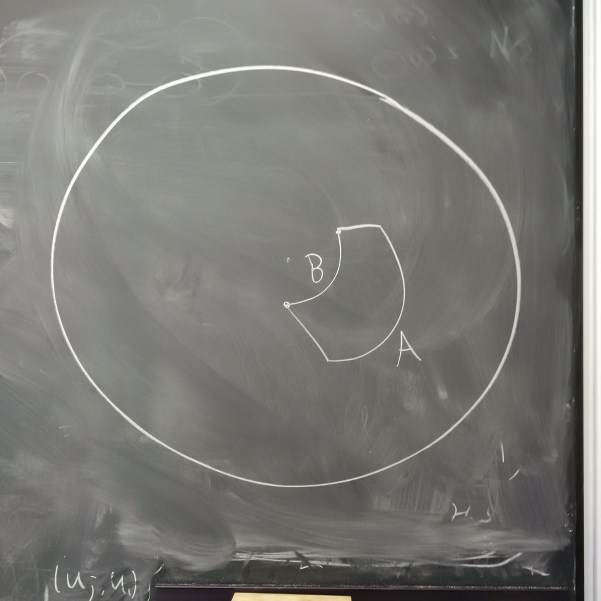
As usual, this is easier to visualize in space than in time. I ended up drawing a picture like this:

IMG_20160602_101423

Imagine person A and person B live on a circle. If person B stays the same distance from the center while person A goes out further, they can both travel the same angle around the circle and end up in the same place, but A will have traveled further, even ignoring the trips up and down.

What’s completely intuitive in space ends up quite a bit harder to visualize in time. But if you at least know what you’re trying to think about, that there’s bending involved, then it’s easier to avoid this guy’s kind of misunderstanding. Run into the wrong account, though, and even if it’s perfectly correct (this guy had heard some of Hawking’s popularization work on the subject), if it’s not emphasizing the right aspects you can come away with the wrong impression.

Misunderstandings are interesting because they reveal how people learn. They’re windows into different thought processes, into what happens when you only have partial evidence. And because of that, they’re one of the most fascinating parts of science popularization.

Source Your Common Sense

When I wrote that post on crackpots, one of my inspirations was a particularly annoying Twitter conversation. The guy I was talking to had convinced himself that general relativity was a mistake. He was especially pissed off by the fact that, in GR, energy is not always conserved. Screw Einstein, energy conservation is just common sense! Right?

Think a little bit about why you believe in energy conservation. Is it because you run into a lot of energy in your day-to-day life, and it’s always been conserved? Did you grow up around something that was obviously energy? Or maybe someone had to explain it to you?

Teacher Pointing at Map of World

Maybe you learned about it…from a physics teacher?

A lot of the time, things that seem obvious only got that way because you were taught them. “Energy” isn’t an intuitive concept, however much it’s misused that way. It’s something defined by physicists because it solves a particular role, a consequence of symmetries in nature. When you learn about energy conservation in school, that’s because it’s one of the simpler ways to explain a much bigger concept, so you shouldn’t be surprised if there are some inaccuracies. If you know where your “common sense” is coming from, you can anticipate when and how it might go awry.

Similarly, if, like one of the commenters on my crackpot post, you’re uncomfortable with countable and uncountable infinities, remember that infinity isn’t “common sense” either. It’s something you learned about in a math class, from a math teacher. And just like energy conservation, it’s a simplification of a more precise concept, with epsilons and deltas and all that jazz.

It’s not possible to teach all the nuances of every topic, so naturally most people will hear a partial story. What’s important is to recognize that you heard a partial story, and not enshrine it as “common sense” when the real story comes knocking.

Don’t physicists use common sense, though? What about “physical intuition”?

Physical intuition has a lot of mystique behind it, and is often described as what separates us from the mathematicians. As such, different people mean different things by it…but under no circumstances should it be confused with pure “common sense”. Physical intuition uses analogy and experience. It involves seeing a system and anticipating the sorts of things you can do with it, like playing a game and assuming there’ll be a save button. In order for these sorts of analogies to work, they generally aren’t built around everyday objects or experiences. Instead, they use physical systems that are “similar” to the one under scrutiny in important ways, while being better understood in others. Crucially, physical intuition involves working in context. It’s not just uncritical acceptance of what one would naively expect.

So when your common sense is tingling, see if you can provide a source. Is that source relevant, experience with a similar situation? Or is it in fact a half-remembered class from high school?

Starshot: The Right Kind of Longshot

On Tuesday, Yuri Milner and Stephen Hawking announced Starshot, a $100 million dollar research initiative. The goal is to lay the groundwork for a very ambitious, but surprisingly plausible project: sending probes to the nearest star, Alpha Centauri. Their idea is to have hundreds of ultra-light probes, each with a reflective sail a few meters in diameter. By aiming an extremely powerful laser at these sails, it should be possible to accelerate the probes up to around a fifth of the speed of light, enough to make the trip in twenty years. Here’s the most complete article I’ve found on the topic.

I can’t comment on the engineering side of the project. The impression I get is that nothing they’re proposing is known to be impossible, but there are a lot of “ifs” along the way that might scupper things. What I can comment on is the story.

Milner and Hawking have both put quite a bit of effort recently into what essentially amounts to telling stories. Milner’s Breakthrough Prizes involve giving awards of $3 million to prominent theoretical physicists (and, more recently, mathematicians). Quite a few of my fellow theorists have criticized these prizes, arguing that the money would be better spent in a grant program like that of the Simons Foundation. While that would likely be better for science, the Breakthrough Prize isn’t really about that. Instead, it’s about telling a story: a story in which progress in theoretical physics is exalted in a public, Nobel-sized way.

Similarly, Hawking’s occasional pronouncements about aliens or AI aren’t science per se, and the media has a tendency to talk about his contributions to ongoing scientific debates out of proportion to their importance. Both of these things, though, contribute to the story of Hawking: a mascot for physics, someone to carry Einstein’s role of the most recognizable genius in the world. Hawking Inc. is about a role as much as it is about a man.

In calling Hawking and Milner’s activity “stories”, I’m not dismissing them. Stories can be important. And the story told by Starshot is a particularly important one.

Cosmology isn’t just a scientific subject, it contributes to how people see themselves. Here I don’t just mean cosmology the field, but cosmology in the broader sense of our understanding of the universe and our place in it.

A while back, I read a book called The View from the Center of the Universe. The book starts by describing the worldviews of the ancients, cosmologies in which they really did think of themselves as the center of the universe. It then suggests that this played an important role: that this kind of view of the world, in which humans have a place in the cosmos, is important to how we view ourselves. The rest of the book then attempts to construct this sort of mythological understanding out of the modern cosmological picture, with some success.

One thing the book doesn’t discuss very much, though, is the future. We care about our place in the universe not just because we want to know where we came from, but because we want to have some idea of where we’re going. We want to contribute to a greater goal, to see ourselves making progress towards something important and vast and different. That’s why so many religions have not just cosmologies, but eschatologies, why people envision armageddons and raptures.

Starshot places the future in our sight in a way that few other things do. Humanity’s spread among the stars seems like something so far distant that nothing we do now could matter to it. What Starshot does is give us something concrete, a conceptual stepping-stone that can link people in to the broader narrative. Right now, people can work on advanced laser technology and optics, work on making smaller chips and lighter materials, work that would be useful and worth funding regardless of whether it was going to lead to Alpha Centauri. But because of Starshot, we can view that work as the near-term embodiment of humanity’s interstellar destiny.

That combination, bridging the gap between the distant future and our concrete present, is the kind of story people need right now. And so for once, I think Milner’s storytelling is doing exactly what it should.

GUTs vs ToEs: What Are We Unifying Here?

“Grand Unified Theory” and “Theory of Everything” may sound like meaningless grandiose titles, but they mean very different things.

In particular, Grand Unified Theory, or GUT, is a technical term, referring to a specific way to unify three of the fundamental interactions: electromagnetism, the weak force, and the strong force.

blausen_0817_smallintestine_anatomy

In contrast, guts unify the two fundamental intestines.

Those three forces are called Yang-Mills forces, and they can all be described in the same basic way. In particular, each has a strength (the coupling constant) and a mathematical structure that determines how it interacts with itself, called a group.

The core idea of a GUT, then, is pretty simple: to unite the three Yang-Mills forces, they need to have the same strength (the same coupling constant) and be part of the same group.

But wait! (You say, still annoyed at the pun in the above caption.) These forces don’t have the same strength at all! One of them’s strong, one of them’s weak, and one of them is electromagnetic!

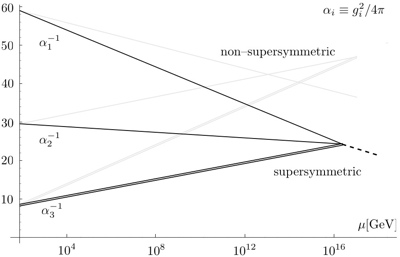
As it turns out, this isn’t as much of a problem as it seems. While the three Yang-Mills forces seem to have very different strengths on an everyday scale, that’s not true at very high energies. Let’s steal a plot from Sweden’s Royal Institute of Technology:
running

Why Sweden? Why not!

What’s going on in this plot?

Here, each \alpha represents the strength of a fundamental force. As the force gets stronger, \alpha gets bigger (and so \alpha^{-1} gets smaller). The variable on the x-axis is the energy scale. The grey lines represent a world without supersymmetry, while the black lines show the world in a supersymmetric model.

So based on this plot, it looks like the strengths of the fundamental forces change based on the energy scale. That’s true, but if you find that confusing there’s another, mathematically equivalent way to think about it.

You can think about each force as having some sort of ultimate strength, the strength it would have if the world weren’t quantum. Without quantum mechanics, each force would interact with particles in only the simplest of ways, corresponding to the simplest diagram here.

However, our world is quantum mechanical. Because of that, when we try to measure the strength of a force, we’re not really measuring its “ultimate strength”. Rather, we’re measuring it alongside a whole mess of other interactions, corresponding to the other diagrams in that post. These extra contributions mean that what looks like the strength of the force gets stronger or weaker depending on the energy of the particles involved.

(I’m sweeping several things under the rug here, including a few infinities and electroweak unification. But if you just want a general understanding of what’s going on, this should be a good starting point.)

If you look at the plot, you’ll see the forces meet up somewhere around 10^16 GeV. They miss each-other for the faint, non-supersymmetric lines, but they meet fairly cleanly for the supersymmetric ones.

So (at least if supersymmetry is true), making the Yang-Mills forces have the same strength is not so hard. Putting them in the same mathematical group is where things get trickier. This is because any group that contains the groups of the fundamental forces will be “bigger” than just the sum of those forces: it will contain “extra forces” that we haven’t observed yet, and these forces can do unexpected things.

In particular, the “extra forces” predicted by GUTs usually make protons unstable. As far as we can tell, protons are very long-lasting: if protons decayed too fast, we wouldn’t have stars. So if protons decay, they must do it only very rarely, detectable only with very precise experiments. These experiments are powerful enough to rule out most of the simplest GUTs. The more complicated GUTs still haven’t been ruled out, but it’s enough to make fewer people interested in GUTs as a research topic.

What about Theories of Everything, or ToEs?

While GUT is a technical term, ToE is very much not. Instead, it’s a phrase that journalists have latched onto because it sounds cool. As such, it doesn’t really have a clear definition. Usually it means uniting gravity with the other fundamental forces, but occasionally people use it to refer to a theory that also unifies the various Standard Model particles into some sort of “final theory”.

Gravity is very different from the other fundamental forces, different enough that it’s kind of silly to group them as “fundamental forces” in the first place. Thus, while GUT models are the kind of thing one can cook up and tinker with, any ToE has to be based on some novel insight, one that lets you express gravity and Yang-Mills forces as part of the same structure.

So far, string theory is the only such insight we have access to. This isn’t just me being arrogant: while there are other attempts at theories of quantum gravity, aside from some rather dubious claims none of them are even interested in unifying gravity with other forces.

This doesn’t mean that string theory is necessarily right. But it does mean that if you want a different “theory of everything”, telling physicists to go out and find a new one isn’t going to be very productive. “Find a theory of everything” is a hope, not a research program, especially if you want people to throw out the one structure we have that even looks like it can do the job.