Tag Archives: Higgs

Experiments Should Be Surprising, but Not Too Surprising

People are talking about colliders again.

This year, the European particle physics community is updating its shared plan for the future, the European Strategy for Particle Physics. A raft of proposals at the end of March stirred up a tail of public debate, focused on asking what sort of new particle collider should be built, and discussing potential reasons why.

That discussion, in turn, has got me thinking about experiments, and how they’re justified.

The purpose of experiments, and of science in general, is to learn something new. The more sure we are of something, the less reason there is to test it. Scientists don’t check whether the Sun rises every day. Like everyone else, they assume it will rise, and use that knowledge to learn other things.

You want your experiment to surprise you. But to design an experiment to surprise you, you run into a contradiction.

Suppose that every morning, you check whether the Sun rises. If it doesn’t, you will really be surprised! You’ll have made the discovery of the century! That’s a really exciting payoff, grant agencies should be lining up to pay for…

Well, is that actually likely to happen, though?

The same reasons it would be surprising if the Sun stopped rising are reasons why we shouldn’t expect the Sun to stop rising. A sunrise-checking observatory has incredibly high potential scientific reward…but an absurdly low chance of giving that reward.

Ok, so you can re-frame your experiment. You’re not hoping the Sun won’t rise, you’re observing the sunrise. You expect it to rise, almost guaranteed, so your experiment has an almost guaranteed payoff.

But what a small payoff! You saw exactly what you expected, there’s no science in that!

By either criterion, the “does the Sun rise” observatory is a stupid experiment. Real experiments operate in between the two extremes. They also mix motivations. Together, that leads to some interesting tensions.

What was the purpose of the Large Hadron Collider?

There were a few things physicists were pretty sure of, when they planned the LHC. Previous colliders had measured W bosons and Z bosons, and their properties made it clear that something was missing. If you could collide protons with enough energy, physicists were pretty sure you’d see the missing piece. Physicists had a reasonably plausible story for that missing piece, in the form of the Higgs boson. So physicists could be pretty sure they’d see something, and reasonably sure it would be the Higgs boson.

If physicists expected the Higgs boson, what was the point of the experiment?

First, physicists expected to see the Higgs boson, but they didn’t expect it to have the mass that it did. In fact, they didn’t know anything about the particle’s mass, besides that it should be low enough that the collider could produce it, and high enough that it hadn’t been detected before. The specific number? That was a surprise, and an almost-inevitable one. A rare creature, an almost-guaranteed scientific payoff.

I say almost, because there was a second point. The Higgs boson didn’t have to be there. In fact, it didn’t have to exist at all. There was a much bigger potential payoff, of noticing something very strange, something much more complicated than the straightforward theory most physicists had expected.

(Many people also argued for another almost-guaranteed payoff, and that got a lot more press. People talked about finding the origin of dark matter by discovering supersymmetric particles, which they argued was almost guaranteed due to a principle called naturalness. This is very important for understanding the history…but it’s an argument that many people feel has failed, and that isn’t showing up much anymore. So for this post, I’ll leave it to the side.)

This mix, of a guaranteed small surprise and the potential for a very large surprise, was a big part of what made the LHC make sense. The mix has changed a bit for people considering a new collider, and it’s making for a rougher conversation.

Like the LHC, most of the new collider proposals have a guaranteed payoff. The LHC could measure the mass of the Higgs, these new colliders will measure its “couplings”: how strongly it influences other particles and forces.

Unlike the LHC, though, this guarantee is not a guaranteed surprise. Before building the LHC, we did not know the mass of the Higgs, and we could not predict it. On the other hand, now we absolutely can predict the couplings of the Higgs. We have quite precise numbers, our expectation for what they should be based on a theory that so far has proven quite successful.

We aren’t certain, of course, just like physicists weren’t certain before. The Higgs boson might have many surprising properties, things that contradict our current best theory and usher in something new. These surprises could genuinely tell us something about some of the big questions, from the nature of dark matter to the universe’s balance of matter and antimatter to the stability of the laws of physics.

But of course, they also might not. We no longer have that rare creature, a guaranteed mild surprise, to hedge in case the big surprises fail. We have guaranteed observations, and experimenters will happily tell you about them…but no guaranteed surprises.

That’s a strange position to be in. And I’m not sure physicists have figured out what to do about it.

How Small Scales Can Matter for Large Scales

For a certain type of physicist, nothing matters more than finding the ultimate laws of nature for its tiniest building-blocks, the rules that govern quantum gravity and tell us where the other laws of physics come from. But because they know very little about those laws at this point, they can predict almost nothing about observations on the larger distance scales we can actually measure.

“Almost nothing” isn’t nothing, though. Theoretical physicists don’t know nature’s ultimate laws. But some things about them can be reasonably guessed. The ultimate laws should include a theory of quantum gravity. They should explain at least some of what we see in particle physics now, explaining why different particles have different masses in terms of a simpler theory. And they should “make sense”, respecting cause and effect, the laws of probability, and Einstein’s overall picture of space and time.

All of these are assumptions, of course. Further assumptions are needed to derive any testable consequences from them. But a few communities in theoretical physics are willing to take the plunge, and see what consequences their assumptions have.

First, there’s the Swampland. String theorists posit that the world has extra dimensions, which can be curled up in a variety of ways to hide from view, with different observable consequences depending on how the dimensions are curled up. This list of different observable consequences is referred to as the Landscape of possibilities. Based on that, some string theorists coined the term “Swampland” to represent an area outside the Landscape, containing observations that are incompatible with quantum gravity altogether, and tried to figure out what those observations would be.

In principle, the Swampland includes the work of all the other communities on this list, since a theory of quantum gravity ought to be consistent with other principles as well. In practice, people who use the term focus on consequences of gravity in particular. The earliest such ideas argued from thought experiments with black holes, finding results that seemed to demand that gravity be the weakest force for at least one type of particle. Later researchers would more frequently use string theory as an example, looking at what kinds of constructions people had been able to make in the Landscape to guess what might lie outside of it. They’ve used this to argue that dark energy might be temporary, and to try to figure out what traits new particles might have.

Second, I should mention naturalness. When talking about naturalness, people often use the analogy of a pen balanced on its tip. While possible in principle, it must have been set up almost perfectly, since any small imbalance would cause it to topple, and that perfection demands an explanation. Similarly, in particle physics, things like the mass of the Higgs boson and the strength of dark energy seem to be carefully balanced, so that a small change in how they were set up would lead to a much heavier Higgs boson or much stronger dark energy. The need for an explanation for the Higgs’ careful balance is why many physicists expected the Large Hadron Collider to discover additional new particles.

As I’ve argued before, this kind of argument rests on assumptions about the fundamental laws of physics. It assumes that the fundamental laws explain the mass of the Higgs, not merely by giving it an arbitrary number but by showing how that number comes from a non-arbitrary physical process. It also assumes that we understand well how physical processes like that work, and what kinds of numbers they can give. That’s why I think of naturalness as a type of argument, much like the Swampland, that uses the smallest scales to constrain larger ones.

Third is a host of constraints that usually go together: causality, unitarity, and positivity. Causality comes from cause and effect in a relativistic universe. Because two distant events can appear to happen in different orders depending on how fast you’re going, any way to send signals faster than light is also a way to send signals back in time, causing all of the paradoxes familiar from science fiction. Unitarity comes from quantum mechanics. If quantum calculations are supposed to give the probability of things happening, those probabilities should make sense as probabilities: for example, they should never go above one.

You might guess that almost any theory would satisfy these constraints. But if you extend a theory to the smallest scales, some theories that otherwise seem sensible end up failing this test. Actually linking things up takes other conjectures about the mathematical form theories can have, conjectures that seem more solid than the ones underlying Swampland and naturalness constraints but that still can’t be conclusively proven. If you trust the conjectures, you can derive restrictions, often called positivity constraints when they demand that some set of observations is positive. There has been a renaissance in this kind of research over the last few years, including arguments that certain speculative theories of gravity can’t actually work.

Lack of Recognition Is a Symptom, Not a Cause

Science is all about being first. Once a discovery has been made, discovering the same thing again is redundant. At best, you can improve the statistical evidence…but for a theorem or a concept, you don’t even have that. This is why we make such a big deal about priority: the first person to discover something did something very valuable. The second, no matter how much effort and insight went into their work, did not.

Because priority matters, for every big scientific discovery there is a priority dispute. Read about science’s greatest hits, and you’ll find people who were left in the wings despite their accomplishments, people who arguably found key ideas and key discoveries earlier than the people who ended up famous. That’s why the idea Peter Higgs is best known for, the Higgs mechanism,

“is therefore also called the Brout–Englert–Higgs mechanism, or Englert–Brout–Higgs–Guralnik–Hagen–Kibble mechanism, Anderson–Higgs mechanism,Anderson–Higgs–Kibble mechanism, Higgs–Kibble mechanism by Abdus Salam and ABEGHHK’tH mechanism (for Anderson, Brout, Englert, Guralnik, Hagen, Higgs, Kibble, and ‘t Hooft) by Peter Higgs.”

Those who don’t get the fame don’t get the rewards. The scientists who get less recognition than they deserve get fewer grants and worse positions, losing out on the career outcomes that the person famous for the discovery gets, even if the less-recognized scientist made the discovery first.

…at least, that’s the usual story.

You can start to see the problem when you notice a contradiction: if a discovery has already been made, what would bring someone to re-make it?

Sometimes, people actually “steal” discoveries, finding something that isn’t widely known and re-publishing it without acknowledging the author. More often, though, the re-discoverer genuinely didn’t know. That’s because, in the real world, we don’t all know about a discovery as soon as it’s made. It has to be communicated.

At minimum, this means you need enough time to finish ironing out the kinks of your idea, write up a paper, and disseminate it. In the days before the internet, dissemination might involve mailing pre-prints to universities across the ocean. It’s relatively easy, in such a world, for two people to get started discovering the same thing, write it up, and even publish it before they learn about the other person’s work.

Sometimes, though, something gets rediscovered long after the original paper should have been available. In those cases, the problem isn’t time, it’s reach. Maybe the original paper was written in a way that hid its implications. Maybe it was published in a way only accessible to a smaller community: either a smaller part of the world, like papers that were only available to researchers in the USSR, or a smaller research community. Maybe the time hadn’t come yet, and the whole reason why the result mattered had yet to really materialize.

For a result like that, a lack of citations isn’t really the problem. Rather than someone who struggles because their work is overlooked, these are people whose work is overlooked, in a sense, because they are struggling: because their work is having a smaller impact on the work of others. Acknowledging them later can do something, but it can’t change the fact that this was work published for a smaller community, yielding smaller rewards.

And ultimately, it isn’t just priority we care about, but impact. While the first European to make contact with the New World might have been Erik the Red, we don’t call the massive exchange of plants and animals between the Old and New World the “Red Exchange”. Erik the Red being “first” matters much less, historically speaking, than Columbus changing the world. Similarly, in science, being the first to discover something is meaningless if that discovery doesn’t change how other people do science, and the person who manages to cause that change is much more valuable than someone who does the same work but doesn’t manage the same reach.

Am I claiming that it’s fair when scientists get famous for other peoples’ discoveries? No, it’s definitely not fair. It’s not fair because most of the reasons one might have lesser reach aren’t under one’s control. Soviet scientists (for the most part) didn’t choose to be based in the USSR. People who make discoveries before they become relevant don’t choose the time in which they were born. And while you can get better at self-promotion with practice, there’s a limited extent to which often-reclusive scientists should be blamed for their lack of social skills.

What I am claiming is that addressing this isn’t a matter of scrupulously citing the “original” discoverer after the fact. That’s a patch, and a weak one. If we want to get science closer to the ideal, where each discovery only has to be made once, then we need to work to increase reach for everyone. That means finding ways to speed up publication, to let people quickly communicate preliminary ideas with a wide audience and change the incentives so people aren’t penalized when others take up those ideas. It means enabling conversations between different fields and sub-fields, building shared vocabulary and opportunities for dialogue. It means making a community that rewards in-person hand-shaking less and careful online documentation more, so that recognition isn’t limited to the people with the money to go to conferences and the social skills to schmooze their way through them. It means anonymity when possible, and openness when we can get away with it.

Lack of recognition and redundant effort are both bad, and they both stem from the same failures to communicate. Instead of fighting about who deserves fame, we should work to make sure that science is truly global and truly universal. We can aim for a future where no-one’s contribution goes unrecognized, and where anything that is known to one is known to all.

The Hidden Higgs

Peter Higgs, the theoretical physicist whose name graces the Higgs boson, died this week.

Peter Higgs, after the Higgs boson discovery was confirmed

This post isn’t an obituary: you can find plenty of those online, and I don’t have anything special to say that others haven’t. Reading the obituaries, you’ll notice they summarize Higgs’s contribution in different ways. Higgs was one of the people who proposed what today is known as the Higgs mechanism, the principle by which most (perhaps all) elementary particles gain their mass. He wasn’t the only one: Robert Brout and François Englert proposed essentially the same idea in a paper that was published two months earlier, in August 1964. Two other teams came up with the idea slightly later than that: Gerald Guralnik, Carl Richard Hagen, and Tom Kibble were published one month after Higgs, while Alexander Migdal and Alexander Polyakov found the idea independently in 1965 but couldn’t get it published till 1966.

Higgs did, however, do something that Brout and Englert didn’t. His paper doesn’t just propose a mechanism, involving a field which gives particles mass. It also proposes a particle one could discover as a result. Read the more detailed obituaries, and you’ll discover that this particle was not in the original paper: Higgs’s paper was rejected at first, and he added the discussion of the particle to make it more interesting.

At this point, I bet some of you are wondering what the big deal was. You’ve heard me say that particles are ripples in quantum fields. So shouldn’t we expect every field to have a particle?

Tell that to the other three Higgs bosons.

Electromagnetism has one type of charge, with two signs: plus, and minus. There are electrons, with negative charge, and their anti-particles, positrons, with positive charge.

Quarks have three types of charge, called colors: red, green, and blue. Each of these also has two “signs”: red and anti-red, green and anti-green, and blue and anti-blue. So for each type of quark (like an up quark), there are six different versions: red, green, and blue, and anti-quarks with anti-red, anti-green, and anti-blue.

Diagram of the colors of quarks

When we talk about quarks, we say that the force under which they are charged, the strong nuclear force, is an “SU(3)” force. The “S” and “U” there are shorthand for mathematical properties that are a bit too complicated to explain here, but the “(3)” is quite simple: it means there are three colors.

The Higgs boson’s primary role is to make the weak nuclear force weak, by making the particles that carry it from place to place massive. (That way, it takes too much energy for them to go anywhere, a feeling I think we can all relate to.) The weak nuclear force is an “SU(2)” force. So there should be two “colors” of particles that interact with the weak nuclear force…which includes Higgs bosons. For each, there should also be an anti-color, just like the quarks had anti-red, anti-green, and anti-blue. So we need two “colors” of Higgs bosons, and two “anti-colors”, for a total of four!

But the Higgs boson discovered at the LHC was a neutral particle. It didn’t have any electric charge, or any color. There was only one, not four. So what happened to the other three Higgs bosons?

The real answer is subtle, one of those physics things that’s tricky to concisely explain. But a partial answer is that they’re indistinguishable from the W and Z bosons.

Normally, the fundamental forces have transverse waves, with two polarizations. Light can wiggle along its path back and forth, or up and down, but it can’t wiggle forward and backward. A fundamental force with massive particles is different, because they can have longitudinal waves: they have an extra direction in which they can wiggle. There are two W bosons (plus and minus) and one Z boson, and they all get one more polarization when they become massive due to the Higgs.

That’s three new ways the W and Z bosons can wiggle. That’s the same number as the number of Higgs bosons that went away, and that’s no coincidence. We physicist like to say that the W and Z bosons “ate” the extra Higgs, which is evocative but may sound mysterious. Instead, you can think of it as the two wiggles being secretly the same, mixing together in a way that makes them impossible to tell apart.

The “count”, of how many wiggles exist, stays the same. You start with four Higgs wiggles, and two wiggles each for the precursors of the W+, W-, and Z bosons, giving ten. You end up with one Higgs wiggle, and three wiggles each for the W+, W-, and Z bosons, which still adds up to ten. But which fields match with which wiggles, and thus which particles we can detect, changes. It takes some thought to look at the whole system and figure out, for each field, what kind of particle you might find.

Higgs did that work. And now, we call it the Higgs boson.

What’s a Cosmic String?

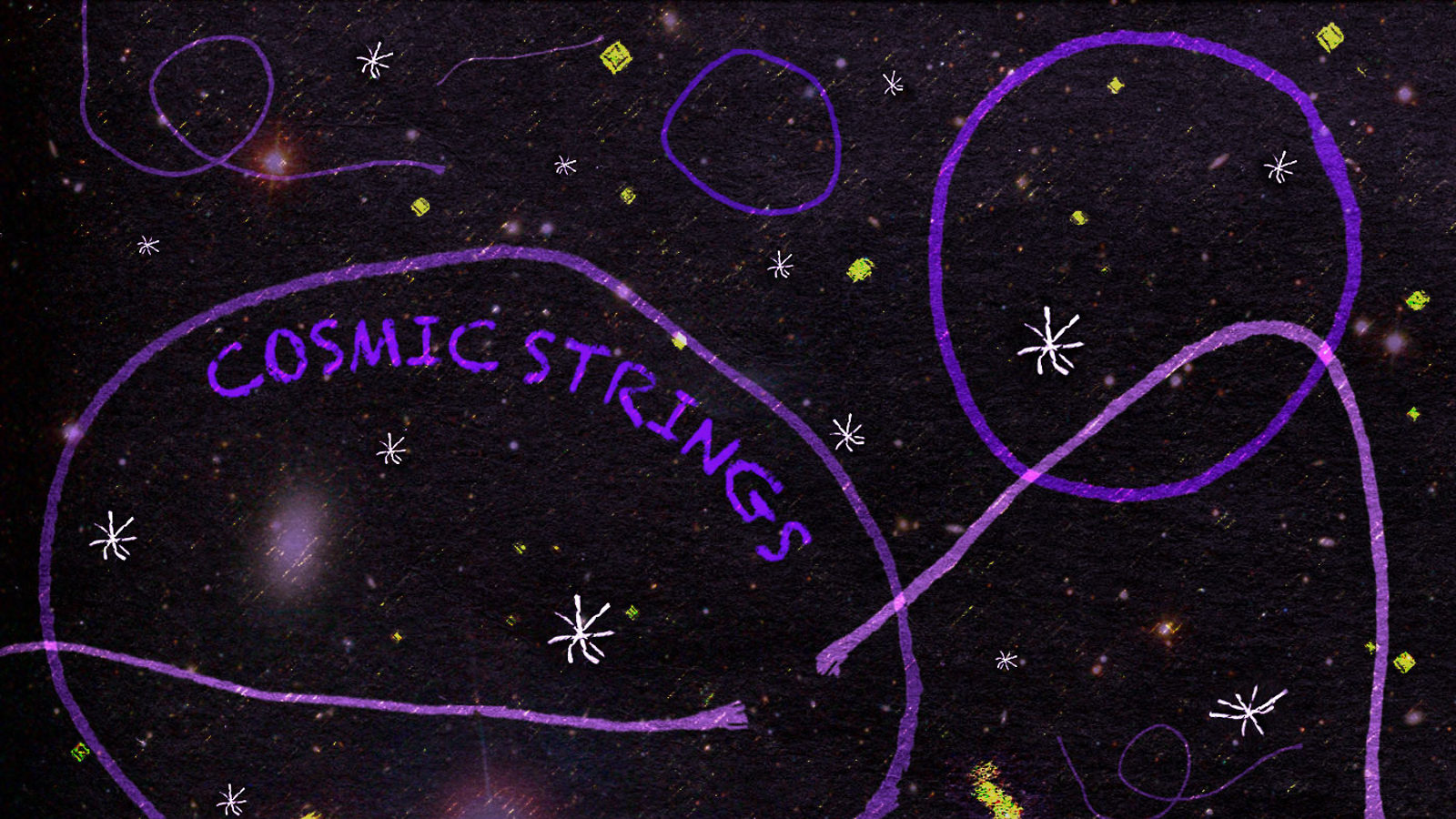
Nowadays, we have telescopes that detect not just light, but gravitational waves. We’ve already learned quite a bit about astrophysics from these telescopes. They observe ripples coming from colliding black holes, giving us a better idea of what kinds of black holes exist in the universe. But the coolest thing a gravitational wave telescope could discover is something that hasn’t been seen yet: a cosmic string.

This art is from an article in Symmetry magazine which is, as far as I can tell, not actually about cosmic strings.

You might have heard of cosmic strings, but unless you’re a physicist you probably don’t know much about them. They’re a prediction, coming from cosmology, of giant string-like objects floating out in space.

That might sound like it has something to do with string theory, but it doesn’t actually have to, you can have these things without any string theory at all. Instead, you might have heard that cosmic strings are some kind of “cracks” or “wrinkles” in space-time. Some articles describe this as like what happens when ice freezes, cracks forming as water settles into a crystal.

That description, in terms of ice forming cracks between crystals, is great…if you’re a physicist who already knows how ice forms cracks between crystals. If you’re not, I’m guessing reading those kinds of explanations isn’t helpful. I’m guessing you’re still wondering why there ought to be any giant strings floating in space.

The real explanation has to do with a type of mathematical gadget physicists use, called a scalar field. You can think of a scalar field as described by a number, like a temperature, that can vary in space and time. The field carries potential energy, and that energy depends on what the scalar field’s “number” is. Left alone, the field settles into a situation with as little potential energy as it can, like a ball rolling down a hill. That situation is one of the field’s default values, something we call a “vacuum” value. Changing the field away from its vacuum value can take a lot of energy. The Higgs boson is one example of a scalar field. Its vacuum value is the value it has in day to day life. In order to make a detectable Higgs boson at the Large Hadron Collider, they needed to change the field away from its vacuum value, and that took a lot of energy.

In the very early universe, almost back at the Big Bang, the world was famously in a hot dense state. That hot dense state meant that there was a lot of energy to go around, so scalar fields could vary far from their vacuum values, pretty much randomly. As the universe expanded and cooled, there was less and less energy available for these fields, and they started to settle down.

Now, the thing about these default, “vacuum” values of a scalar field is that there doesn’t have to be just one of them. Depending on what kind of mathematical function the field’s potential energy is, there could be several different possibilities each with equal energy.

Let’s imagine a simple example, of a field with two vacuum values: +1 and -1. As the universe cooled down, some parts of the universe would end up with that scalar field number equal to +1, and some to -1. But what happens in between?

The scalar field can’t just jump from -1 to +1, that’s not allowed in physics. It has to pass through 0 in between. But, unlike -1 and +1, 0 is not a vacuum value. When the scalar field number is equal to 0, the field has more energy than it does when it’s equal to -1 or +1. Usually, a lot more energy.

That means the region of scalar field number 0 can’t spread very far: the further it spreads, the more energy it takes to keep it that way. On the other hand, the region can’t vanish altogether: something needs to happen to transition between the numbers -1 and +1.

The thing that happens is called a domain wall. A domain wall is a thin sheet, as thin as it can physically be, where the scalar field doesn’t take its vacuum value. You can roughly think of it as made up of the scalar field, a churning zone of the kind of bosons the LHC was trying to detect.

This sheet still has a lot of energy, bound up in the unusual value of the scalar field, like an LHC collision in every proton-sized chunk. As such, like any object with a lot of energy, it has a gravitational field. For a domain wall, the effect of this gravity would be very very dramatic: so dramatic, that we’re pretty sure they’re incredibly rare. If they were at all common, we would have seen evidence of them long before now!

Ok, I’ve shown you a wall, that’s weird, sure. What does that have to do with cosmic strings?

The number representing a scalar field doesn’t have to be a real number: it can be imaginary instead, or even complex. Now I’d like you to imagine a field with vacuum values on the unit circle, in the complex plane. That means that +1 and -1 are still vacuum values, but so are e^{i \pi/2}, and e^{3 i \pi/2}, and everything else you can write as e^{i\theta}. However, 0 is still not a vacuum value. Neither is, for example, 2 e^{i\pi/3}.

With vacuum values like this, you can’t form domain walls. You can make a path between -1 and +1 that only goes through the unit circle, through e^{i \pi/2} for example. The field will be at its vacuum value throughout, taking no extra energy.

However, imagine the different regions form a circle. In the picture above, suppose that the blue area at the bottom is at vacuum value -1 and red is at +1. You might have e^{i \pi/2} in the green region, and e^{3 i \pi/2} in the purple region, covering the whole circle smoothly as you go around.

Now, think about what happens in the middle of the circle. On one side of the circle, you have -1. On the other, +1. (Or, on one side e^{i \pi/2}, on the other, e^{3 i \pi/2}). No matter what, different sides of the circle are not allowed to be next to each other, you can’t just jump between them. So in the very middle of the circle, something else has to happen.

Once again, that something else is a field that goes away from its vacuum value, that passes through 0. Once again, that takes a lot of energy, so it occupies as little space as possible. But now, that space isn’t a giant wall. Instead, it’s a squiggly line: a cosmic string.

Cosmic strings don’t have as dramatic a gravitational effect as domain walls. That means they might not be super-rare. There might be some we haven’t seen yet. And if we do see them, it could be because they wiggle space and time, making gravitational waves.

Cosmic strings don’t require string theory, they come from a much more basic gadget, scalar fields. We know there is one quite important scalar field, the Higgs field. The Higgs vacuum values aren’t like +1 and -1, or like the unit circle, though, so the Higgs by itself won’t make domain walls or cosmic strings. But there are a lot of proposals for scalar fields, things we haven’t discovered but that physicists think might answer lingering questions in particle physics, and some of those could have the right kind of vacuum values to give us cosmic strings. Thus, if we manage to detect cosmic strings, we could learn something about one of those lingering questions.

W is for Why???

Have you heard the news about the W boson?

The W boson is a fundamental particle, part of the Standard Model of particle physics. It is what we call a “force-carrying boson”, a particle related to the weak nuclear force in the same way photons are related to electromagnetism. Unlike photons, W bosons are “heavy”: they have a mass. We can’t usually predict masses of particles, but the W boson is a bit different, because its mass comes from the Higgs boson in a special way, one that ties it to the masses of other particles like the Z boson. The upshot is that if you know the mass of a few other particles, you can predict the mass of the W.

And according to a recent publication, that prediction is wrong. A team analyzed results from an old experiment called the Tevatron, the biggest predecessor of today’s Large Hadron Collider. They treated the data with groundbreaking care, mindbogglingly even taking into account the shape of the machine’s wires. And after all that analysis, they found that the W bosons detected by the Tevatron had a different mass than the mass predicted by the Standard Model.

How different? Here’s where precision comes in. In physics, we decide whether to trust a measurement with a statistical tool. We calculate how likely the measurement would be, if it was an accident. In this case: how likely it would be that, if the Standard Model was correct, the measurement would still come out this way? To discover a new particle, we require this chance to be about one in 3.5 million, or in our jargon, five sigma. That was the requirement for discovering the Higgs boson. This super-precise measurement of the W boson doesn’t have five sigma…it has seven sigma. That means, if we trust the analysis team, then a measurement like this could come accidentally out of the Standard Model only about one in a trillion times.

Ok, should we trust the analysis team?

If you want to know that, I’m the wrong physicist to ask. The right physicists are experimental particle physicists. They do analyses like that one, and they know what can go wrong. Everyone I’ve heard from in that field emphasized that this was a very careful group, who did a lot of things impressively right…but there is still room for mistakes. One pointed out that the new measurement isn’t just inconsistent with the Standard Model, but with many previous measurements too. Those measurements are less precise, but still precise enough that we should be a bit skeptical. Another went into more detail about specific clues as to what might have gone wrong.

If you can’t find an particle experimentalist, the next best choice is a particle phenomenologist. These are the people who try to make predictions for new experiments, who use theoretical physics to propose new models that future experiments can test. Here’s one giving a first impression, and discussing some ways to edit the Standard Model to agree with the new measurement. Here’s another discussing what to me is an even more interesting question: if we take these measurements seriously, both the new one and the old ones, then what do we believe?

I’m not an experimentalist or a phenomenologist. I’m an “amplitudeologist”. I work not on the data, or the predictions, but the calculational tools used to make those predictions, called “scattering amplitudes”. And that gives me a different view on the situation.

See in my field, precision is one of our biggest selling-points. If you want theoretical predictions to match precise experiments, you need our tricks to compute them. We believe (and argue to grant agencies) that this precision will be important: if a precise experiment and a precise prediction disagree, it could be the first clue to something truly new. New solid evidence of something beyond the Standard Model would revitalize all of particle physics, giving us a concrete goal and killing fruitless speculation.

This result shakes my faith in that a little. Probably, the analysis team got something wrong. Possibly, all previous analyses got something wrong. Either way, a lot of very careful smart people tried to estimate their precision, got very confident…and got it wrong.

(There’s one more alternative: maybe million-to-one chances really do crop up nine times out of ten.)

If some future analysis digs down deep in precision, and finds another deviation from the Standard Model, should we trust it? What if it’s measuring something new, and we don’t have the prior experiments to compare to?

(This would happen if we build a new even higher-energy collider. There are things the collider could measure, like the chance one Higgs boson splits into two, that we could not measure with any earlier machine. If we measured that, we couldn’t compare it to the Tevatron or the LHC, we’d have only the new collider to go on.)

Statistics are supposed to tell us whether to trust a result. Here, they’re not doing their job. And that creates the scary possibility that some anomaly shows up, some real deviation deep in the sigmas that hints at a whole new path for the field…and we just end up bickering about who screwed it up. Or the equally scary possibility that we find a seven-sigma signal of some amazing new physics, build decades of new theories on it…and it isn’t actually real.

We don’t just trust statistics. We also trust the things normal people trust. Do other teams find the same result? (I hope that they’re trying to get to this same precision here, and see what went wrong!) Does the result match other experiments? Does it make predictions, which then get tested in future experiments?

All of those are heuristics of course. Nothing can guarantee that we measure the truth. Each trick just corrects for some of our biases, some of the ways we make mistakes. We have to hope that’s good enough, that if there’s something to see we’ll see it, and if there’s nothing to see we won’t. Precision, my field’s raison d’être, can’t be enough to convince us by itself. But it can help.

Discovering New Elements, Discovering New Particles

In school, you learn that the world around you is made up of chemical elements. There’s oxygen and nitrogen in the air, hydrogen and oxygen in water, sodium and chlorine in salt, and carbon in all living things. Other elements are more rare. Often, that’s because they’re unstable, due to radioactivity, like the plutonium in a bomb or americium in a smoke detector. The heaviest elements are artificial, produced in tiny amounts by massive experiments. In 2002, the heaviest element yet was found at the Joint Institute for Nuclear Research near Moscow. It was later named Oganesson, after the scientist who figured out how to make these heavy elements, Yuri Oganessian. To keep track of the different elements, we organize them in the periodic table like this:

In that same school, you probably also learn that the elements aren’t quite so elementary. Unlike the atoms imagined by the ancient Greeks, our atoms are made of smaller parts: protons and neutrons, surrounded by a cloud of electrons. They’re what give the periodic table its periodic structure, the way it repeats from row to row, with each different element having a different number of protons.

If your school is a bit more daring, you also learn that protons and neutrons themselves aren’t elementary. Each one is made of smaller particles called quarks: a proton of two “up quarks” and one “down quark”, and a neutron of two “down” and one “up”. Up quarks, down quarks, and electrons are all what physicists call fundamental particles, and they make up everything you see around you. Just like the chemical elements, some fundamental particles are more obscure than others, and the heaviest ones are all very unstable, produced temporarily by particle collider experiments. The most recent particle to be discovered was in 2012, when the Large Hadron Collider near Geneva found the Higgs boson. The Higgs boson is named after Peter Higgs, one of those who predicted it back in the 60’s. All the fundamental particles we know are part of something called the Standard Model, which we sometimes organize in a table like this:

So far, these stories probably sound similar. The experiments might not even sound that different: the Moscow experiment shoots a beam of high-energy calcium atoms at a target of heavy radioactive elements, while the Geneva one shoots a beam of high-energy protons at another beam of high-energy protons. With all those high-energy beams, what’s the difference really?

In fact there is a big different between chemical elements and fundamental particles, and between the periodic table and the Standard Model. The latter are fundamental, the former are not.

When they made new chemical elements, scientists needed to start with a lot of protons and neutrons. That’s why they used calcium atoms in their beam, and even heavier elements as their target. We know that heavy elements are heavy because they contain more protons and neutrons, and we can use the arrangement of those protons and neutrons to try to predict their properties. That’s why, even though only five or six oganesson atoms have been detected, scientists have some idea what kind of material it would make. Oganesson is a noble gas, like helium, neon, and radon. But calculations predict it is actually a solid at room temperature. What’s more, it’s expected to be able to react with other elements, something the other noble gases are very reluctant to do.

The Standard Model has patterns, just like the chemical elements. Each matter particle is one of three “generations”, each heavier and more unstable: for example, electrons have heavier relatives called muons, and still heavier ones called tauons. But unlike with the elements, we don’t know where these patterns come from. We can’t explain them with smaller particles, like we could explain the elements with protons and neutrons. We think the Standard Model particles might actually be fundamental, not made of anything smaller.

That’s why when we make them, we don’t need a lot of other particles: just two protons, each made of three quarks, is enough. With that, we can make not just new arrangements of quarks, but new particles altogether. Some are even heavier than the protons we started with: the Higgs boson is more than a hundred times as heavy as a proton! We can do this because, in particle physics, mass isn’t conserved: mass is just another type of energy, and you can turn one type of energy into another.

Discovering new elements is hard work, but discovering new particles is on another level. It’s hard to calculate which elements are stable or unstable, and what their properties might be. But we know the rules, and with enough skill and time we could figure it out. In particle physics, we don’t know the rules. We have some good guesses, simple models to solve specific problems, and sometimes, like with the Higgs, we’re right. But despite making many more than five or six Higgs bosons, we still aren’t sure it has the properties we expect. We don’t know the rules. Even with skill and time, we can’t just calculate what to expect. We have to discover it.

Of Cows and Razors

Last week’s post came up on Reddit, where a commenter made a good point. I said that one of the mysteries of neutrinos is that they might not get their mass from the Higgs boson. This is true, but the commenter rightly points out it’s true of other particles too: electrons might not get their mass from the Higgs. We aren’t sure. The lighter quarks might not get their mass from the Higgs either.

When talking physics with the public, we usually say that electrons and quarks all get their mass from the Higgs. That’s how it works in our Standard Model, after all. But even though we’ve found the Higgs boson, we can’t be 100% sure that it functions the way our model says. That’s because there are aspects of the Higgs we haven’t been able to measure directly. We’ve measured how it affects the heaviest quark, the top quark, but measuring its interactions with other particles will require a bigger collider. Until we have those measurements, the possibility remains open that electrons and quarks get their mass another way. It would be a more complicated way: we know the Higgs does a lot of what the model says, so if it deviates in another way we’d have to add more details, maybe even more undiscovered particles. But it’s possible.

If I wanted to defend the idea that neutrinos are special here, I would point out that neutrino masses, unlike electron masses, are not part of the Standard Model. For electrons, we have a clear “default” way for them to get mass, and that default is in a meaningful way simpler than the alternatives. For neutrinos, every alternative is complicated in some fashion: either adding undiscovered particles, or unusual properties. If we were to invoke Occam’s Razor, the principle that we should always choose the simplest explanation, then for electrons and quarks there is a clear winner. Not so for neutrinos.

I’m not actually going to make this argument. That’s because I’m a bit wary of using Occam’s Razor when it comes to questions of fundamental physics. Occam’s Razor is a good principle to use, if you have a good idea of what’s “normal”. In physics, you don’t.

To illustrate, I’ll tell an old joke about cows and trains. Here’s the version from The Curious Incident of the Dog in the Night-Time:

There are three men on a train. One of them is an economist and one of them is a logician and one of them is a mathematician. And they have just crossed the border into Scotland (I don’t know why they are going to Scotland) and they see a brown cow standing in a field from the window of the train (and the cow is standing parallel to the train). And the economist says, ‘Look, the cows in Scotland are brown.’ And the logician says, ‘No. There are cows in Scotland of which at least one is brown.’ And the mathematician says, ‘No. There is at least one cow in Scotland, of which one side appears to be brown.’

One side of this cow appears to be very fluffy.

If we want to be as careful as possible, the mathematician’s answer is best. But we expect not to have to be so careful. Maybe the economist’s answer, that Scottish cows are brown, is too broad. But we could imagine an agronomist who states “There is a breed of cows in Scotland that is brown”. And I suggest we should find that pretty reasonable. Essentially, we’re using Occam’s Razor: if we want to explain seeing a brown half-cow from a train, the simplest explanation would be that it’s a member of a breed of cows that are brown. It would be less simple if the cow were unique, a brown mutant in a breed of black and white cows. It would be even less simple if only one side of the cow were brown, and the other were another color.

When we use Occam’s Razor in this way, we’re drawing from our experience of cows. Most of the cows we meet are members of some breed or other, with similar characteristics. We don’t meet many mutant cows, or half-colored cows, so we think of those options as less simple, and less likely.

But what kind of experience tells us which option is simpler for electrons, or neutrinos?

The Standard Model is a type of theory called a Quantum Field Theory. We have experience with other Quantum Field Theories: we use them to describe materials, metals and fluids and so forth. Still, it seems a bit odd to say that if something is typical of these materials, it should also be typical of the universe. As another physicists in my sub-field, Nima Arkani-Hamed, likes to say, “the universe is not a crappy metal!”

We could also draw on our experience from other theories in physics. This is a bit more productive, but has other problems. Our other theories are invariably incomplete, that’s why we come up with new theories in the first place…and with so few theories, compared to breeds of cows, it’s unclear that we really have a good basis for experience.

Physicists like to brag that we study the most fundamental laws of nature. Ordinarily, this doesn’t matter as much as we pretend: there’s a lot to discover in the rest of science too, after all. But here, it really makes a difference. Unlike other fields, we don’t know what’s “normal”, so we can’t really tell which theories are “simpler” than others. We can make aesthetic judgements, on the simplicity of the math or the number of fields or the quality of the stories we can tell. If we want to be principled and forego all of that, then we’re left on an abyss, a world of bare observations and parameter soup.

If a physicist looks out a train window, will they say that all the electrons they see get their mass from the Higgs? Maybe, still. But they should be careful about it.

Redefining Fields for Fun and Profit

When we study subatomic particles, particle physicists use a theory called Quantum Field Theory. But what is a quantum field?

Some people will describe a field in vague terms, and say it’s like a fluid that fills all of space, or a vibrating rubber sheet. These are all metaphors, and while they can be helpful, they can also be confusing. So let me avoid metaphors, and say something that may be just as confusing: a field is the answer to a question.

Suppose you’re interested in a particle, like an electron. There is an electron field that tells you, at each point, your chance of detecting one of those particles spinning in a particular way. Suppose you’re trying to measure a force, say electricity or magnetism. There is an electromagnetic field that tells you, at each point, what force you will measure.

Sometimes the question you’re asking has a very simple answer: just a single number, for each point and each time. An example of a question like that is the temperature: pick a city, pick a date, and the temperature there and then is just a number. In particle physics, the Higgs field answers a question like that: at each point, and each time, how “Higgs-y” is it there and then? You might have heard that the Higgs field gives other particles their mass: what this means is that the more “Higgs-y” it is somewhere, the higher these particles’ mass will be. The Higgs field is almost constant, because it’s very difficult to get it to change. That’s in some sense what the Large Hadron Collider did when they discovered the Higgs boson: pushed hard enough to cause a tiny, short-lived ripple in the Higgs field, a small area that was briefly more “Higgs-y” than average.

We like to think of some fields as fundamental, and others as composite. A proton is composite: it’s made up of quarks and gluons. Quarks and gluons, as far as we know, are fundamental: they’re not made up of anything else. More generally, since we’re thinking about fields as answers to questions, we can just as well ask more complicated, “composite” questions. For example, instead of “what is the temperature?”, we can ask “what is the temperature squared?” or “what is the temperature times the Higgs-y-ness?”.

But this raises a troubling point. When we single out a specific field, like the Higgs field, why are we sure that that field is the fundamental one? Why didn’t we start with “Higgs squared” instead? Or “Higgs plus Higgs squared”? Or something even weirder?

The inventor of the Higgs-squared field, Peter Higgs-squared

That kind of swap, from Higgs to Higgs squared, is called a field redefinition. In the math of quantum field theory, it’s something you’re perfectly allowed to do. Sometimes, it’s even a good idea. Other times, it can make your life quite complicated.

The reason why is that some fields are much simpler than others. Some are what we call free fields. Free fields don’t interact with anything else. They just move, rippling along in easy-to-calculate waves.

Redefine a free field, swapping it for some more complicated function, and you can easily screw up, and make it into an interacting field. An interacting field might interact with another field, like how electromagnetic fields move (and are moved by) electrons. It might also just interact with itself, a kind of feedback effect that makes any calculation we’d like to do much more difficult.

If we persevere with this perverse choice, and do the calculation anyway, we find a surprise. The final results we calculate, the real measurements people can do, are the same in both theories. The field redefinition changed how the theory appeared, quite dramatically…but it didn’t change the physics.

You might think the moral of the story is that you must always choose the right fundamental field. You might want to, but you can’t: not every field is secretly free. Some will be interacting fields, whatever you do. In that case, you can make one choice or another to simplify your life…but you can also just refuse to make a choice.

That’s something quite a few physicists do. Instead of looking at a theory and calling some fields fundamental and others composite, they treat every one of these fields, every different question they could ask, on the same footing. They then ask, for these fields, what one can measure about them. They can ask which fields travel at the speed of light, and which ones go slower, or which fields interact with which other fields, and how much. Field redefinitions will shuffle the fields around, but the patterns in the measurements will remain. So those, and not the fields, can be used to specify the theory. Instead of describing the world in terms of a few fundamental fields, they think about the world as a kind of field soup, characterized by how it shifts when you stir it with a spoon.

It’s not a perspective everyone takes. If you overhear physicists, sometimes they will talk about a theory with only a few fields, sometimes they will talk about many, and you might be hard-pressed to tell what they’re talking about. But if you keep in mind these two perspectives: either a few fundamental fields, or a “field soup”, you’ll understand them a little better.

Discovering the Rules, Discovering the Consequences

Two big physics experiments consistently make the news. The Large Hadron Collider, or LHC, and the Laser Interferometer Gravitational-Wave Observatory, or LIGO. One collides protons, the other watches colliding black holes and neutron stars. But while this may make the experiments sound quite similar, their goals couldn’t be more different.

The goal of the LHC, put simply, is to discover the rules that govern reality. Should the LHC find a new fundamental particle, it will tell us something we didn’t know about the laws of physics, a newly discovered fact that holds true everywhere in the universe. So far, it has discovered the Higgs boson, and while that particular rule was expected we didn’t know the details until they were tested. Now physicists hope to find something more, a deviation from the Standard Model that hints at a new law of nature altogether.

LIGO, in contrast, isn’t really for discovering the rules of the universe. Instead, it discovers the consequences of those rules, on a grand scale. Even if we knew the laws of physics completely, we can’t calculate everything from those first principles. We can simulate some things, and approximate others, but we need experiments to tweak those simulations and test those approximations. LIGO fills that role. We can try to estimate how common black holes are, and how large, but LIGO’s results were still a surprise, suggesting medium-sized black holes are more common than researchers expected. In the future, gravitational wave telescopes might discover more of these kinds of consequences, from the shape of neutron stars to the aftermath of cosmic inflation.

There are a few exceptions for both experiments. The LHC can also discover the consequences of the laws of physics, especially when those consequences are very difficult to calculate, finding complicated arrangements of known particles, like pentaquarks and glueballs. And it’s possible, though perhaps not likely, that LIGO could discover something about quantum gravity. Quantum gravity’s effects are expected to be so small that these experiments won’t see them, but some have speculated that an unusually large effect could be detected by a gravitational wave telescope.

As scientists, we want to know everything we can about everything we find. We want to know the basic laws that govern the universe, but we also want to know the consequences of those laws, the story of how our particular universe came to be the way it is today. And luckily, we have experiments for both.