Supersymmetry, to the Rescue!

Part Three of a Series on N=4 Super Yang-Mills Theory

This is the third in a series of articles that will explain N=4 super Yang-Mills theory. In this series I take that phrase apart bit by bit, explaining as I go. Because I’m perverse and out to confuse you, I started with the last bit here, and now I’m working my way up.

N=4 Super Yang-Mills Theory

Ah, supersymmetry…trendy, sexy, mysterious…an excuse to put “super” in front of words…it’s a grand subject.

If I’m going to manage to explain supersymmetry at all, then I need to explain spin. Luckily, you don’t need to know much about spin for this to work. While I could start telling you about how particles literally spin around like tops despite having a radius of zero, and how quantum mechanics restricts how fast they spin to a few particular values measured by Planck’s constant…all you really need to know is the following:

Spin is a way to categorize particles.

In particular, there are:
Spin 1: Yang-Mills fields are spin 1, carrying forces with a direction and strength.
Spin ½: This spin covers pretty much all of the particles you encounter in everyday matter: electrons, neutrons, and protons, as well as more exotic stuff like neutrinos. If you want to make large-scale, interesting structures like rocks or lifeforms you pretty much need spin ½ particles.
Spin 0: A spin zero field (also called a scalar) is a number, like a temperature, that can vary from place to place. The Higgs field is an example of a spin zero field, where the number is part of the mass of other particles, and the Higgs boson is a ripple in that field, like a cold snap would be for temperature.

While they aren’t important for this post, you can also have higher numbers for spin: gravity has spin 2, for example.

With this definition in hand, we can start talking about supersymmetry, which is also pretty straightforward if you ignore all of the actual details.

Supersymmetry is a relationship (or symmetry) between particles with spin X, and particles with spin X-½

For example, you could have a relationship between a spin 1 Yang-Mills field and a spin ½ matter particle, or between a spin ½ matter particle and a spin 0 scalar.

“Relationship” is a vague term here, much like it is in romance, and just like in romance you’d do well to clarify precisely what you mean by it. Here, it means something like the following: if you switch a particle for its “superpartner” (the other particle in the relationship) then the physics should remain the same. This has two important consequences: superpartners have the same mass as each-other and superpartners have the same interactions as each-other.

The second consequence means that if a particle has electric charge -1, its superpartner also has electric charge -1. If you’ve got gluons, each with a color and an anti-color, then their superpartners will also have both a color and an anti-color. Astute readers will have remembered that quarks just have a color or an anti-color, and realized the implication: quarks cannot be the superpartners of gluons.

Other, even more well-informed readers will be wondering about the first consequence. Such readers might have heard that the LHC is looking for superpartners, or that superpartners could explain dark matter, and that in either case superpartners have very high mass. How can this be if superpartners have to have the same mass as their partners among the regular particles?

The important point to make here is that our real world is not supersymmetric, even if superpartners are discovered at the LHC, because supersymmetry is broken. In physics, when a symmetry of any sort is broken it’s like a broken mirror: it no longer is the same on each side, but the two sides are still related in a systematic way. Broken supersymmetry means that particles that would be superpartners can have different masses, but they will still have the same interactions.

When people look for supersymmetry at the LHC, they’re looking for new particles with the same interactions as the old particles, but generally much higher mass. When I talk about supersymmetry, though, I’m talking about unbroken supersymmetry: pairs of particles with the same interactions and the same mass. And N=4 super Yang-Mills is full of them.

How full? N=4 full. And that’s next week’s topic.

Yang-Mills: Plays Well With Itself

Part Two of a Series on N=4 Super Yang-Mills Theory

This is the second in a series of articles that will explain N=4 super Yang-Mills theory. In this series I take that phrase apart bit by bit, explaining as I go. Because I’m perverse and out to confuse you, I started with the last bit here, and now I’m working my way up.

N=4 Super Yang-Mills Theory

So first these physicists expect us to accept a nonsense word like quark, and now they’re calling their theory Yang-Mills? What silly word are they going to foist on us next?

Umm…Yang and Mills are people.

Chen Ning Yang and Robert Mills were two physicists, famous for being very well treated by the Chinese government and for not being the father of nineteenth century Utilitarianism, respectively.

Has a wife 56 years younger than him

Did not design the Panopticon

In the 1950’s, Yang and Mills were faced with a problem: how to describe the strong nuclear force, the force that holds protons and neutrons in the nuclei of atoms together. At the time, the nature of this force was very mysterious. Nuclear experiments were uncovering new insight about the behavior of the strong force, but those experiments showed that the strong force didn’t behave like the well-understood force of electricity and magnetism. In particular, the strong force seemed to treat neutrons and protons in a related way, almost as if they were two sides of the same particle.

In 1954, Yang and Mills proposed a solution to this problem. In order to do so, they had to suggest something novel: a force that interacts with itself. To understand what that means and why that’s special, let’s discuss a bit about forces.

Each fundamental force can be thought of in terms of a field extending across space and time. The direction and strength of this field in each place determines which way the force pushes. When this field ripples, things that we observe as particles are created, the result of waves in the field. Particles of light, or photons, are waves in the field of the fundamental force of electricity and magnetism.

The electric force attracts charges with opposite sign, and repels charges when they have the same sign. Photons, however, have no charge, so they pass right through electric and magnetic fields. This is what I mean when I say that electricity and magnetism is a force that doesn’t interact with itself.

The strong force is different. Yang and Mills didn’t know this at the time, but we know now that the strong force acts on fundamental particles inside protons and neutrons called quarks, and that quarks come in three colors, unimaginatively named red, blue, and green, while their antiparticles are classified as antired, antiblue, or antigreen. Like all other forces, the strong force gives rise to a particle, in this case called a gluon. Unlike photons, gluons are not neutral! While they have no electric charge, they are affected by the strong force. Each gluon has a color and an anti-color: red/anti-green, blue/anti-red, etc. This means that while the strong force binds quarks together, it also binds itself together as well, keeping it from reaching outside of atoms and affecting the everyday world like electricity does.

Quarks and Gluons in a Proton

Yang and Mills’ description wasn’t perfect for the strong force (they had two types of charge rather than three) but it was fairly close to how the weak force worked, as other physicists realized in 1956. It was realized much later (in the 70’s) that a modification of Yang and Mills’ proposal worked for the strong force as well. In recognition of their insight, today the names Yang and Mills are attached to any force that interacts with itself.

A Yang-Mills theory, then, is a theory that contains a fundamental force that can interact with itself. This force generates particles (often called force-carrying bosons) which have something like charge or color with respect to the Yang-Mills force. If you remember the definition of a theory, you’ll see that we have everything we need: we have specified a particle (the force-carrying boson) and the ways in which it can interact (specifically, with itself).

Tune in next week when I explain the rest of the phrase, in a brief primer on the superheroic land of supersymmetry.

A Theorist’s Theory

Part One of a Series on N=4 Super Yang-Mills Theory

In my last post, I called Wikipedia’s explanation of N=4 super Yang-Mills theory only “half-decent”. It’s not particularly bad, though it could use more detail. What it isn’t, and what I wanted, was an explanation that would make sense to a general audience (i.e., you guys!).

Well, if you want something done right, you have to quote that cliché. Or, well, do it yourself.

This is the first in a series of articles that will explain N=4 super Yang-Mills theory. In this series I will take that phrase apart bit by bit, explaining as I go. And because I’m perverse and out to confuse you, I’ll start with the last bit and work my way up.

N=4 Super Yang-Mills Theory

Now as a relatively well-educated person, you may be grumbling at this point. “I know what a theory is!”

“A scientific theory is a well-substantiated explanation of some aspect of the natural world, based on a body of facts that have been repeatedly confirmed through observation and experiment.”

Ah. It appears you’ve been talking to the biologists again. This is exactly why we needed this post. Let’s have a chat.

To be clear, when a biologist says that something (evolution, say, or germ theory) is a theory, this is exactly what they mean. They are describing an idea that has been repeatedly tested and that actually describes the real world. Most other scientists work the same way: geologists (plate tectonics theory), chemists (molecular orbital theory), even most physicists (big bang theory). But this isn’t what theoretical physicists mean when they say theory. In contrast, most things that theorists call theories have no experimental evidence, and usually aren’t even meant to describe the real world.

Unlike the AAAS definition above, theoretical physicists don’t have a formal definition of their usage of theory. If we did, it might go something like this:

“A theory (in theoretical physics) consists of a list of quantum fields, their properties, and how they interact. These fields do not need to be ones that exist in the natural world, but they do have to be (relatively) mathematically consistent. To study a theory is then to consider the interactions of a specific list of quantum fields, without taking into account any other fields that might otherwise interfere.”

Note that there are ways to get around parts of this definition. The (2,0) theory is famously mysterious because we don’t know how to write down the interactions between its fields, but even there we have an implicit definition of how the fields interact built into the theory’s definition, and the challenge is to make that definition explicit. Other theories stretch the definition of a quantum field, or cover a range of different properties. Still, all of them fit the basic template: define some mathematical entities, and describe how they interact.

With that definition in hand, some of you are already asking the next question: “What are the quantum fields of N=4 super Yang-Mills? How do they interact?”

Tune in to the next installment to find out!

Why I Study a Theory That Isn’t “True”

I study a theory called N=4 super Yang-Mills. (There’s a half-decent explanation of the theory here. For now, just know that it involves a concept called supersymmetry, where forces and matter are very closely related.) When I mention this to people, sometimes they ask me if I’m expecting to see evidence for N=4 super Yang-Mills at the Large Hadron Collider. And if not there, when can we expect a test of the theory?

Never.

Never? Yep. N=4 super Yang-Mills will never be tested, because N=4 super Yang-Mills (sYM for short) is not “true”.

We know it’s not “true”, because it contains particles that don’t exist. Not just particles we might not have found yet, but particles that would make the universe a completely different and possibly unknowable place.

So if it isn’t true, why do I study it?

Let me give you an analogy. Remember back in 2008 when Sarah Palin made fun of funding “fruit fly research in France”?

Most people I talked to found that pretty ridiculous. After all, fruit flies are one of the most stereotypical research animals, second only to mice. And besides, hadn’t we all grown up knowing about how they were used to research HOX genes?

Wait, you didn’t know about that? Evidently, you weren’t raised by a biologist.

HOX genes are how your body knows what limbs go where. When HOX genes activate in an embryo, they send signals, telling cells where to grow arms and legs.

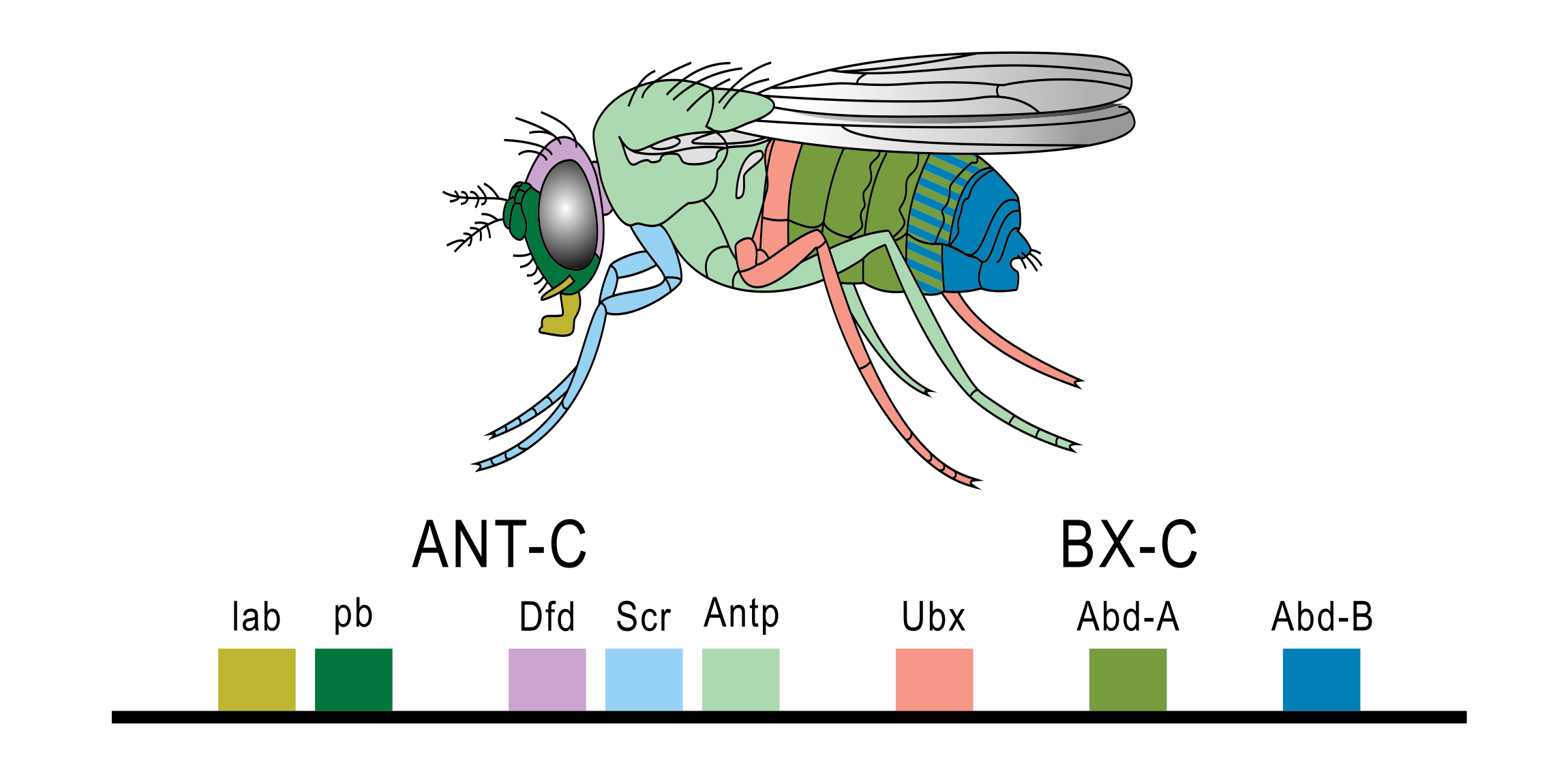
Much of HOX genes’ power was first discovered in fruit flies. With their relatively simple genetics, scientists were able to manipulate the HOX genes, creating crazy frankenflies like Antennapedia (literally: antenna-feet) here.

A fruity fly’s HOX genes, and the body parts they correspond to.

Old antenna-feet. Ain’t he a beauty?

It was only later, as the science got more sophisticated, that biologists began to track what HOX genes do in humans, making substantial progress in understanding debilitating mutations.

How is this related to N=4 super Yang-Mills? Well, just as fruit flies are simpler to study than humans, sYM is simpler to study than the whole mess of unconnected particles that exist in the real world. We can do calculations with sYM that would be out of reach in normal particle physics. As we do these calculations, we discover new patterns and new techniques. The hope is that, just like HOX genes, we will discover traits that still hold in the more complicated situation of the real world. We’re not quite there yet, but it’s getting close.


By the way, make sure to watch Big Bang Theory on Thursday (11/29, 8/7c on CBS). Turns out, Sheldon is working on this stuff too, and for those who have read arXiv:1210.7709, his diagrams should look quite familiar…

Who Am I?

I call myself a String Theorist, someone who describes the world in terms of subatomic lengths of string that move in ten dimensions (nine of space and one of time),

But in practice I’m more of a Particle Theorist, describing the world not in terms of short lengths of string but rather with particles that each occupy a single point in space,

More specifically, I’m an Amplitudeologist, part of a trendy new tribe including the likes of Zvi Bern, Lance Dixon, Nima Arkani-Hamed, John Joseph Carrasco (jjmc on twitter), and sometimes Sheldon Cooper,

In terms of my career, I’m a Graduate Student, less like a college student and more like an apprentice, learning not primarily through classes but rather through working to advance my advisor’s research,

And what do I work on? Things like this.