Hooray for Neutrinos!

Congratulations to Takaaki Kajita and Arthur McDonald, winners of this year’s Nobel Prize in Physics, as well as to the Super-Kamiokande and SNOLAB teams that made their work possible.

Congratulations!

Unlike last year’s Nobel, this is one I’ve been anticipating for quite some time. Kajita and McDonald discovered that neutrinos have mass, and that discovery remains our best hint that there is something out there beyond the Standard Model.

But I’m getting a bit ahead of myself.

Neutrinos are the lightest of the fundamental particles, and for a long time they were thought to be completely massless. Their name means “little neutral one”, and it’s probably the last time physicists used “-ino” to mean “little”. Neutrinos are “neutral” because they have no electrical charge. They also don’t interact with the strong nuclear force. Only the weak nuclear force has any effect on them. (Well, gravity does too, but very weakly.)

This makes it very difficult to detect neutrinos: you have to catch them interacting via the weak force, which is, well, weak. Originally, that meant they had to be inferred by their absence: missing energy in nuclear reactions carried away by “something”. Now, they can be detected, but it requires massive tanks of fluid, carefully watched for the telltale light of the rare interactions between neutrinos and ordinary matter. You wouldn’t notice if billions of neutrinos passed through you every second, like an unstoppable army of ghosts. And in fact, that’s exactly what happens!

Visualization of neutrinos from a popular documentary

In the 60’s, scientists began to use these giant tanks of fluid to detect neutrinos coming from the sun. An enormous amount of effort goes in to understanding the sun, and these days our models of it are pretty accurate, so it came as quite a shock when researchers observed only half the neutrinos they expected. It wasn’t until the work of Super-Kamiokande in 1998, and SNOLAB in 2001, that we knew the reason why.

As it turns out, neutrinos oscillate. Neutrinos are produced in what are called flavor states, which match up with the different types of leptons. There are electron-neutrinos, muon-neutrinos, and tau-neutrinos.

Radioactive processes usually produce electron-neutrinos, so those are the type that the sun produces. But on their way from the sun to the earth, these neutrinos “oscillate”: they switch between electron neutrinos and the other types! The older detectors, focused only on electron-neutrinos, couldn’t see this. SNOLAB’s big advantage was that it could detect the other types of neutrinos as well, and tell the difference between them, which allowed it to see that the “missing” neutrinos were really just turning into other flavors! Meanwhile, Super-Kamiokande measured neutrinos coming not from the sun, but from cosmic rays reacting with the upper atmosphere. Some of these neutrinos came from the sky above the detector, while others traveled all the way through the earth below it, from the atmosphere on the other side. By observing “missing” neutrinos coming from below but not from above, Super-Kamiokande confirmed that it wasn’t the sun’s fault that we were missing solar neutrinos, neutrinos just oscillate!

What does this oscillation have to do with neutrinos having mass, though?

Here things get a bit trickier. I’ve laid some of the groundwork in older posts. I’ve told you to think about mass as “energy we haven’t met yet”, as the energy something has when we leave it alone to itself. I’ve also mentioned that conservation laws come from symmetries of nature, that energy conservation is a result of symmetry in time.

This should make it a little more plausible when I say that when something has a specific mass, it doesn’t change. It can decay into other particles, or interact with other forces, but left alone, by itself, it won’t turn into something else. To be more specific, it doesn’t oscillate. A state with a fixed mass is symmetric in time.

The only way neutrinos can oscillate between flavor states, then, is if one flavor state is actually a combination (in quantum terms, a superposition) of different masses. The components with different masses move at different speeds, so at any point along their path you can be more or less likely to see certain masses of neutrinos. As the mix of masses changes, the flavor state changes, so neutrinos end up oscillating from electron-neutrino, to muon-neutrino, to tau-neutrino.

So because of neutrino oscillation, neutrinos have to have mass. But this presented a problem. Most fundamental particles get their mass from interacting with the Higgs field. But, as it turns out, neutrinos can’t interact with the Higgs field. This has to do with the fact that neutrinos are “chiral”, and only come in a “left-handed” orientation. Only if they had both types of “handedness” could they get their mass from the Higgs.

As-is, they have to get their mass another way, and that way has yet to be definitively shown. Whatever it ends up being, it will be beyond the current Standard Model. Maybe there actually are right-handed neutrinos, but they’re too massive, or interact too weakly, for them to have been discovered. Maybe neutrinos are Majorana particles, getting mass in a novel way that hasn’t been seen yet in the Standard Model.

Whatever we discover, neutrinos are currently our best evidence that something lies beyond the Standard Model. Naturalness may have philosophical problems, dark matter may be explained away by modified gravity…but if neutrinos have mass, there’s something we still have yet to discover. And that definitely seems worthy of a Nobel to me!

Hexagon Functions III: Now with More Symmetry

I’ve got a new paper up this week.

It’s a continuation of my previous work, understanding collisions involving six particles in my favorite theory, N=4 super Yang-Mills.

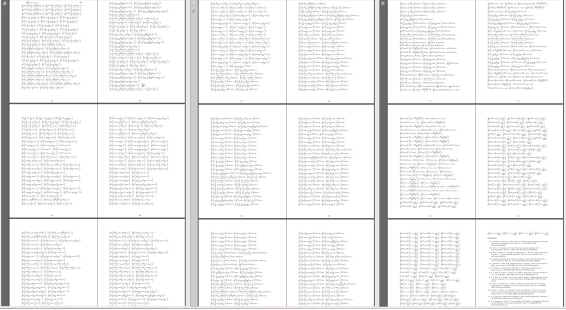
This time, we’re pushing up the complexity, going from three “loops” to four. In the past, I could have impressed you with the number of pages the formulas I’m calculating take up (eight hundred pages for the three-loop formula from that first Hexagon Functions paper). Now, though, I don’t have that number: putting my four-loop formula into a pdf-making program just crashes the program. Instead, I’ll have to impress you with file sizes: 2.6 MB for the three-loop formula, 96 MB for the four-loop one.

Calculating such a formula sounds like a pretty big task, and it was, the first time. But things got a lot simpler after a chat I had at Amplitudes.

We calculate these things using an ansatz, a guess for what the final answer should look like. The more vague our guess, the more parameters we need to fix, and the more work we have in general. If we can guess more precisely, we can start with fewer parameters and things are a lot easier.

Often, more precise guesses come from understanding the symmetries of the problem. If we can know that the final answer must be the same after making some change, we can rule out a lot of possibilities.

Sometimes, these symmetries are known features of the answer, things that someone proved had to be correct. Other times, though, they’re just observations, things that have been true in the past and might be true again.

We started out using an observation from three loops. That got us pretty far, but we still had a lot of work to do: 808 parameters, to be fixed by other means. Fixing them took months of work, and throughout we hoped that there was some deeper reason behind the symmetries we observed.

Finally, at Amplitudes, I ran into fellow amplitudeologist Simon Caron-Huot and asked him if he knew the source of our observed symmetry. In just a few days he was able to link it to supersymmetry, giving us justification for our jury rigged trick. However, we figured out that his explanation went further than any of us expected. In the end, rather than 808 parameters we only really needed to consider 34.

Thirty-four options to consider. Thirty-four possible contributions to a ~100 MB file. That might not sound like a big deal, but compared to eight hundred and eight it’s a huge deal. More symmetry means easier calculations, meaning we can go further. At this point going to the next step in complexity, to five loops rather than four, might be well within reach.

Bras and Kets, Trading off Instincts

Some physics notation is a joke, but that doesn’t mean it shouldn’t be taken seriously.

Take bras and kets. On the surface, as silly a physics name as any. If you want to find the probability that a state in quantum mechanics turns into another state, you write down a “bracket” between the two states:

\langle a | b\rangle

This leads, with typical physics logic, to the notation for the individual states: separate out the two parts, into a “bra” and a “ket”:

\langle a||b\rangle

It’s kind of a dumb joke, and it annoys the heck out of mathematicians. Not for the joke, of course, mathematicians probably have worse.

Mathematicians are annoyed when we use complicated, weird notation for something that looks like a simple, universal concept. Here, we’re essentially just taking inner products of vectors, something mathematicians have been doing in one form or another for centuries. Yet rather than use their time-tested notation we use our own silly setup.

There’s a method to the madness, though. Bras and kets are handy for our purposes because they allow us to leverage one of the most powerful instincts of programmers: the need to close parentheses.

In programming, various forms of parentheses and brackets allow you to isolate parts of code for different purposes. One set of lines might only activate under certain circumstances, another set of brackets might make text bold. But in essentially every language, you never want to leave an open parenthesis. Doing so is almost always a mistake, one that leaves the rest of your code open to whatever isolated region you were trying to create.

Open parentheses make programmers nervous, and that’s exactly what “bras” and “kets” are for. As it turns out, the states represented by “bras” and “kets” are in a certain sense un-measurable: the only things we can measure are the brackets between them. When people say that in quantum mechanics we can only predict probabilities, that’s a big part of what they mean: the states themselves mean nothing without being assembled into probability-calculating brackets.

This ends up making “bras” and “kets” very useful. If you’re calculating something in the real world and your formula ends up with a free “bra” or a “ket”, you know you’ve done something wrong. Only when all of your bras and kets are assembled into brackets will you have something physically meaningful. Since most physicists have done some programming, the programmer’s instinct to always close parentheses comes to the rescue, nagging until you turn your formula into something that can be measured.

So while our notation may be weird, it does serve a purpose: it makes our instincts fit the counter-intuitive world of quantum mechanics.

Scooped Is a Spectrum

I kind of got scooped recently.

I say kind of, because as I’ve been realizing being scooped isn’t quite the all-or-nothing thing you’d think it would be. Rather, being scooped is a spectrum.

Go ahead and scoop up a spectrum as you’re reading this.

By the way, I’m going to be a bit cagey about what exactly I got scooped on. As you’ll see, there are still a few things my collaborator and I need to figure out, and in the meantime I don’t want to put my foot in my mouth. Those of you who follow what’s going on in amplitudes might have some guesses. In case you’re worried, it has nothing to do with my work on Hexagon Functions.

When I heard about the paper that scooped us, my first reaction was to assume the project I’d been working on for a few weeks was now a dead end. When another group publishes the same thing you’ve been working on, and does it first, there doesn’t seem to be much you can do besides shake hands and move on.

As it turns out, though, things are a bit more complicated. The risk of publishing fast, after all, is making mistakes. In this case, it’s starting to look like a few of the obstructions that were holding us back weren’t solved by the other group, and in fact that they may have ignored those obstructions altogether in their rush to get something publishable.

This creates an interesting situation. It’s pretty clear the other group is beyond us in certain respects, they published first for a (good) reason. On the other hand, precisely because we’ve been slower, we’ve caught problems that it looks like the other group didn’t notice. Rather than rendering our work useless, this makes it that much more useful: complementing the other group’s work rather than competing with it.

Being scooped is a spectrum. If two groups are working on very similar things, then whoever publishes first usually wins. But if the work is different enough, then a whole range of roles opens up, from corrections and objections to extensions and completions. Being scooped doesn’t have to be the end of the world, in fact, it can be the beginning.

A Tale of Two CMB Measurements

While trying to decide what to blog about this week, I happened to run across this article by Matthew Francis on Ars Technica.

Apparently, researchers have managed to use Planck‘s measurement of the Cosmic Microwave Background to indirectly measure a more obscure phenomenon, the Cosmic Neutrino Background.

The Cosmic Microwave Background, or CMB is often described as the light of the Big Bang, dimmed and spread to the present day. More precisely, it’s the light released from the first time the universe became transparent. When electrons and protons joined to form the first atoms, light no longer spent all its time being absorbed and released by electrical charges, and was free to travel in a mostly-neutral universe.

This means that the CMB is less like a view of the Big Bang, and more like a screen separating us from it. Light and charged particles from before the CMB was formed will never be observable to us, because they would have been absorbed by the early universe. If we want to see beyond this screen, we need something with no electric charge.

That’s where the Cosmic Neutrino Background comes in. Much as the CMB consists of light from the first time the universe became transparent, the CNB consists of neutrinos from the first time the universe was cool enough for them to travel freely. Since this happened a bit before the universe was transparent to light, the CNB gives information about an earlier stage in the universe’s history.

Unfortunately, neutrinos are very difficult to detect, the low-energy ones left over from the CNB even more so. Rather than detecting the CNB directly, it has to be observed through its indirect effects on the CMB, and that’s exactly what these researchers did.

Now does all of this sound just a little bit familiar?

Gravitational waves are also hard to detect, hard enough that we haven’t directly detected any yet. They’re also electrically neutral, so they can also give us information from behind the screen of the CMB, letting us learn about the very early universe. And when the team at BICEP2 purported to measure these primordial gravitational waves indirectly, by measuring the CMB, the press went crazy about it.

This time, though? That Ars Technica article is the most prominent I could find. There’s nothing in major news outlets at all.

I don’t think that this is just a case of people learning from past mistakes. I also don’t think that BICEP2’s results were just that much more interesting: they were making a claim about cosmic inflation rather than just buttressing the standard Big Bang model, but (outside of certain contrarians here at Perimeter) inflation is not actually all that controversial. It really looks like hype is the main difference here, and that’s kind of sad. The difference between a big (premature) announcement that got me to write four distinct posts and an article I almost didn’t notice is just one of how the authors chose to make their work known.

Don’t Watch the Star, Watch the Crowd

I didn’t comment last week on Hawking’s proposed solution of the black hole firewall problem. The media buzz around it was a bit less rabid than the last time he weighed in on this topic, but there was still a lot more heat than light.

The impression I get from the experts is that Hawking’s proposal (this time made in collaboration with Andrew Strominger and Malcom Perry, the former of whom is famous for, among other things, figuring out how string theory can explain the entropy of black holes) resembles some earlier suggestions, with enough new elements to make it potentially interesting but potentially just confusing. It’s a development worth paying attention to for specialists, but it’s probably not the sort of long-awaited answer the media seems to be presenting it as.

This raises a question: how, as a non-specialist, are you supposed to tell the difference? Sure, you can just read blogs like mine, but I can’t report on everything.

I may have a pretty solid grounding in physics, but I know almost nothing about music. I definitely can’t tell what makes a song good. About the best I can do is see if I can dance to it, but that doesn’t seem to be a reliable indicator of quality music. Instead, my best bet is usually to watch the crowd.

Lasers may make this difficult.

Ask the star of a show if they’re doing good work, and they’re unlikely to be modest. Ask the average music fan, though, and you get a better idea. Watch music fans as a group, and you get even more information.

When a song starts playing everywhere you go, when people start pulling it out at parties and making their own imitations of it, then maybe it’s important. That might not mean it’s good, but it does mean it’s worth knowing about.

When Hawking or Strominger or Witten or anyone whose name you’ve heard of says they’ve solved the puzzle of the century, be cautious. If it really is worth your attention, chances are it won’t be the last you’ll hear about it. Other physicists will build off of it, discuss it, even spin off a new sub-field around it. If it’s worth it, you won’t have to trust what the stars of the physics world say: you’ll be able to listen to the crowd.

Romeo and Juliet, through a Wormhole

Perimeter is hosting this year’s Mathematica Summer School on Theoretical Physics. The school is a mix of lectures on a topic in physics (this year, the phenomenon of quantum entanglement) and tips and tricks for using the symbolic calculation program Mathematica.

Juan Maldacena is one of the lecturers, which gave me a chance to hear his Romeo and Juliet-based explanation of the properties of wormholes. While I’ve criticized some of Maldacena’s science popularization work in the past, this one is pretty solid, so I thought I’d share it with you guys.

You probably think of wormholes as “shortcuts” to travel between two widely separated places. As it turns out, this isn’t really accurate: while “normal” wormholes do connect distant locations, they don’t do it in a way that allows astronauts to travel between them, Interstellar-style. This can be illustrated with something called a Penrose diagram:

Static

Static “Greyish Black” Diagram

In the traditional Penrose diagram, time goes upward, while space goes from side to side. In order to measure both in the same units, we use the speed of light, so one year on the time axis corresponds to one light-year on the space axis. This means that if you’re traveling at a 45 degree line on the diagram, you’re going at the speed of light. Any lower angle is impossible, while any higher angle means you’re going slower.

If we start in “our universe” in the diagram, can we get to the “other universe”?

Pretty clearly, the answer is no. As long as we go slower than the speed of light, when we pass the event horizon of the wormhole we will end up, not in the “other universe”, but at the part of the diagram labeled Future Singularity, the singularity at the center of the black hole. Even going at the speed of light only keeps us orbiting the event horizon for all eternity, at best.

What use could such a wormhole be? Well, imagine you’re Romeo or Juliet.

Romeo has been banished from Verona, but he took one end of a wormhole with him, while the other end was left with Juliet. He can’t go through and visit her, she can’t go through and visit him. But if they’re already considering taking poison, there’s an easier way. If they both jump in to the wormhole, they’ll fall in to the singularity. Crucially, though, it’s the same singularity, so once they’re past the event horizon they can meet inside the black hole, spending some time together before the end.

Depicted here for more typical quantum protagonists, Alice and Bob.

This explains what wormholes really are: two black holes that share a center.

Why was Maldacena talking about this at a school on entanglement? Maldacena has recently conjectured that quantum entanglement and wormholes are two sides of the same phenomenon, that pairs of entangled particles are actually connected by wormholes. Crucially, these wormholes need to have the properties described above: you can’t use a pair of entangled particles to communicate information faster than light, and you can’t use a wormhole to travel faster than light. However, it is the “shared” singularity that ends up particularly useful, as it suggests a solution to the problem of black hole firewalls.

Firewalls were originally proposed as a way of getting around a particular paradox relating three states connected by quantum entanglement: a particle inside a black hole, radiation just outside the black hole, and radiation far away from the black hole. The way the paradox is set up, it appears that these three states must all be connected. As it turns out, though, this is prohibited by quantum mechanics, which only allows two states to be entangled at a time. The original solution proposed for this was a “firewall”, a situation in which anyone trying to observe all three states would “burn up” when crossing the event horizon, thus avoiding any observed contradiction. Maldacena’s conjecture suggests another way: if someone interacts with the far-away radiation, they have an effect on the black hole’s interior, because the two are connected by a wormhole! This ends up getting rid of the contradiction, allowing the observer to view the black hole and distant radiation as two different descriptions of the same state, and it depends crucially on the fact that a wormhole involves a shared singularity.

There’s still a lot of detail to be worked out, part of the reason why Maldacena presented this research here was to inspire more investigation from students. But it does seem encouraging that Romeo and Juliet might not have to face a wall of fire before being reunited.

The Theorist Exclusion Principle

There are a lot of people who think theoretical physics has gone off-track, though very few of them agree on exactly how. Some think that string theory as a whole is a waste of time, others that the field just needs to pay more attention to their preferred idea. Some think we aren’t paying enough attention to the big questions, or that we’re too focused on “safe” ideas like supersymmetry, even when they aren’t working out. Some think the field needs less focus on mathematics, while others think it needs even more.

Usually, people act on these opinions by writing strongly worded articles and blog posts. Sometimes, they have more power, and act with money, creating grants and prizes that only go to their preferred areas of research.

Let’s put the question of whether the field actually needs to change aside for the moment. Even if it does, I’m skeptical that this sort of thing will have any real effect. While grants and blogs may be very good at swaying experimentalists, theorists are likely to be harder to shift, due to what I’m going to call the Theorist Exclusion Principle.

The Pauli Exclusion Principle is a rule from quantum mechanics that states that two fermions (particles with half-integer spin) can’t occupy the same state. Fermions include electrons, quarks, protons…essentially, all the particles that make up matter. Many people learn about the Pauli Exclusion Principle first in a chemistry class, where it explains why electrons fall into different energy levels in atoms: once one energy level “fills up”, no more electrons can occupy the same state, and any additional electrons are “excluded” and must occupy a different energy level.

Those 1s electrons are such a clique!

In contrast, bosons (like photons, or the Higgs) can all occupy the same state. It’s what allows for things like lasers, and it’s why all the matter we’re used to is made out of fermions: because fermions can’t occupy the same state as each other, as you add more fermions the structures they form have to become more and more complicated.

Experimentalists are a little like bosons. While you can’t stuff two experimentalists into the same quantum state, you can get them working on very similar projects. They can form large collaborations, with each additional researcher making the experiment that much easier. They can replicate eachother’s work, making sure it was accurate. They can take some physical phenomenon and subject it to a battery of tests, so that someone is bound to learn something.

Theorists, on the other hand, are much more like fermions. In theory, there’s very little reason to work on something that someone else is already doing. Replication doesn’t mean very much: the purest theory involves mathematical proofs, where replication is essentially pointless. Theorists do form collaborations, but they don’t have the same need for armies of technicians and grad students that experimentalists do. With no physical objects to work on, there’s a limit to how much can be done pursuing one particular problem, and if there really are a lot of options they can be pursued by one person with a cluster.

Like fermions, then, theorists expand to fill the projects available. If an idea is viable, someone will probably work on it, and once they do, there isn’t much reason for someone else to do the same thing.

This makes theory a lot harder to influence than experiment. You can write the most beautiful thinkpiece possible to persuade theorists to study the deep questions of the universe, but if there aren’t any real calculations available nothing will change. Contrary to public perception, theoretical physicists aren’t paid to just sit around thinking all day: we calculate, compute, and publish, and if a topic doesn’t lend itself to that then we won’t get much mileage out of it. And no matter what you try to preferentially fund with grants, mostly you’ll just get people re-branding what they’re already doing, shifting a few superficial details to qualify.

Theorists won’t occupy the same states, so if you want to influence theorists you need to make sure there are open states where you’re trying to get them to go. Historically, theorists have shifted when new states have opened up: new data from experiment that needed a novel explanation, new mathematical concepts that opened up new types of calculations. You want there to be fewer string theorists, or more focus on the deep questions? Give us something concrete to do, and I guarantee you’ll get theorists flooding in.

Want to Open up Your Work? Try a Data Mine!

Have you heard of the Open Science movement?

The general idea is to make scientists’ work openly accessible, both to the general public and to other scientists. This doesn’t just include published results, but the raw data as well. The goal is to make it possible for anyone, in principle, to check the validity of important results.

I’m of the opinion that this sort of thing isn’t always feasible, but when it is it’s usually a great thing to do. And in my field, the best way to do this sort of thing is to build a data mine.

I’m thinking in particular of Blümlein, Broadhurst, and Vermaseren’s Multiple Zeta Value Data Mine. Multiple zeta values are the result of generalizing the Riemann Zeta Function, and evaluating it at one. They’re transcendental numbers, and there are complicated relations between them. Finding all those relations, even for a restricted subset of them, can be a significant task. Usually, there aren’t published programs for this sort of thing, like most things in physics we have to jury-rig up our own code. What makes the folks behind the multiple zeta value data mine unique is that when they had to do this, they didn’t just keep the code to themselves. Instead, they polished it up and put it online.

That’s the general principle behind building a data mine. By putting your tools online, you make them available to others, so other researchers can use them as a jumping-off point for their own work. This can speed up the field, bringing everyone up to the same starting point, and has the side benefit of gathering heaps of citations from people who use your tools.

My collaborators already have a site with some of the data from our research into hexagon functions. Originally, it was just a place to house extra-large files that couldn’t be included with the original paper. For our next paper, we’re planning on expanding it into a true data mine, and including enough technology for someone else to build off of our results.

Historic Montreal

I’m at a conference in Montreal this week, so it’s going to be a short post. The University of Montreal’s Centre de Recherches Mathématiques has been holding a program on the various hidden symmetries of N=4 super Yang-Mills since the beginning of the summer. This week is the amplitudes-focused part of the program, so they’ve brought in a bunch of amplitudes-folks from around the world, myself included.

It’s been great hanging out with fellow members of my sub-field, as always, both at the conference and at dinner afterwards. Over possibly too much wine I heard stories of the heady days of 2007, when James Drummond and Johannes Henn first discovered one of the most powerful symmetries of N=4 super Yang-Mills (a duality called dual conformal invariance) and Andrew Hodges showed off the power of a set of funky variables called twistors. It’s amazing to me how fast the field moves, sometimes: by the time I started doing amplitudes work in 2011 these ideas were the bedrock of the field. History operates on different scales, and in amplitudes a few decades have played host to an enormous amount of progress.

History in the real world can move surprisingly fast too. After seeing cathedrals in Zurich that date back to the medieval era, I was surprised when the majestic basilica overlooking Montreal turned out to be less than a century old.

In retrospect the light-up cross should have made it obvious.

In retrospect the light-up cross should have made it obvious.