There’s a shorter-term problem, though, that gets much less press, despite arguably being a bigger part of the field right now. In amplitudes, we take theories and turn them into predictions, order by order and loop by loop. And when we want to compare those predictions to the real world, in most cases the best we can do is two loops and five particles.
Five particles here counts the particles coming in and going out: if two gluons collide and become three gluons, we count that as five particles, two in plus three out. Loops, meanwhile, measure the complexity of the calculation, the number of closed paths you can draw in a Feynman diagram. If you use more loops, you expect more precision: you’re approximating nature step by step.
As a field we’re pretty good at one-loop calculations, enough to do them for pretty much any number of particles. As we try for more loops though, things rapidly get harder. Already for two loops, in many cases, we start struggling. We can do better if we dial down the number of particles: there are three-particle and two-particle calculations that get up to three, four, or even five loops. For more particles though, we can’t do as much. Thus the current state of the art, the field’s short term goal: two loops, five particles.
When you hear people like me talk about crazier calculations, we’ve usually got a trick up our sleeve. Often we’re looking at a much simpler theory, one that doesn’t describe the real world. For example, I like working with a planar theory, with lots of supersymmetry. Remove even one of those simplifications, and suddenly our life becomes a lot harder. Instead of seven loops and six particles, we getgenuinelyexcitedabout, well, two loops five particles.
Luckily, two loops five particles is also about as good as the experiments can measure. As the Large Hadron Collider gathers more data, it measures physics to higher and higher precision. Currently for five-particle processes, its precision is just starting to be comparable with two-loop calculations. The result has been a flurry of activity, applying everything from powerful numerical techniques to algebraic geometry to the problem, getting results that genuinely apply to the real world.
“Two loops, five particles” isn’t as cool of a slogan as “space-time is doomed”. It doesn’t get much, or any media attention. But, steadily and quietly, it’s become one of the hottest topics in the amplitudes field.
As a kid, I wanted to know everything. Eventually, I realized this was a little unrealistic. Doomed to know some things and not others, I picked physics as a kind of triage. Other fields I could learn as an outsider: not well enough to compete with the experts, but enough to at least appreciate what they were doing. After watching a few string theory documentaries, I realized this wasn’t the case for physics: if I was going to ever understand what those string theorists were up to, I would have to go to grad school in string theory.
Over time, this goal lost focus. I’ve become a very specialized creature, an “amplitudeologist”. I didn’t have time or energy for my old questions. In an irony that will surprise no-one, a career as a physicist doesn’t leave much time for curiosity about physics.
One of the great things about this blog is how you guys remind me of those old questions, bringing me out of my overspecialized comfort zone. In that spirit, in this post I’m going to list a few things in physics that I really want to understand better. The idea is to make a public commitment: within a year, I want to understand one of these topics at least well enough to write a decent blog post on it.
Wilsonian Quantum Field Theory:
When you first learn quantum field theory as a physicist, you learn how unsightly infinite results get covered up via an ad-hoc-looking process called renormalization. Eventually you learn a more modern perspective, that these infinite results show up because we’re ignorant of the complete theory at high energies. You learn that you can think of theories at a particular scale, and characterize them by what happens when you “zoom” in and out, in an approach codified by the physicist Kenneth Wilson.
While I understand the basics of Wilson’s approach, the courses I took in grad school skipped the deeper implications. This includes the idea of theories that are defined at all energies, “flowing” from an otherwise scale-invariant theory perturbed with extra pieces. Other physicists are much more comfortable thinking in these terms, and the topic is important for quite a few deep questions, including what it means to properly define a theory and where laws of nature “live”. If I’m going to have an informed opinion on any of those topics, I’ll need to go back and learn the Wilsonian approach properly.
Wormholes:
If you’re a fan of science fiction, you probably know that wormholes are the most realistic option for faster-than-light travel, something that is at least allowed by the equations of general relativity. “Most realistic” isn’t the same as “realistic”, though. Opening a wormhole and keeping it stable requires some kind of “exotic matter”, and that matter needs to violate a set of restrictions, called “energy conditions”, that normal matter obeys. Some of these energy conditions are just conjectures, some we even know how to violate, while others are proven to hold for certain types of theories. Some energy conditions don’t rule out wormholes, but instead restrict their usefulness: you can have non-traversable wormholes (basically, two inescapable black holes that happen to meet in the middle), or traversable wormholes where the distance through the wormhole is always longer than the distance outside.
I’ve seen a few talks on this topic, but I’m still confused about the big picture: which conditions have been proven, what assumptions were needed, and what do they all imply? I haven’t found a publicly-accessible account that covers everything. I owe it to myself as a kid, not to mention everyone who’s a kid now, to get a satisfactory answer.
Quantum Foundations:
Quantum Foundations is a field that many physicists think is a waste of time. It deals with the questions that troubled Einstein and Bohr, questions about what quantum mechanics really means, or why the rules of quantum mechanics are the way they are. These tend to be quite philosophical questions, where it’s hard to tell if people are making progress or just arguing in circles.
I’m more optimistic about philosophy than most physicists, at least when it’s pursued with enough analytic rigor. I’d like to at least understand the leading arguments for different interpretations, what the constraints on interpretations are and the main loopholes. That way, if I end up concluding the field is a waste of time at least I’d be making an informed decision.
You might notice a change on the site this week: the ads are gone!
When I started this blog back in 2012, it was just a class project. I didn’t want to spend money on it, so I chose WordPress.com’s free hosting option. A consequence of that option is that WordPress got to post ads. These were pretty mild to begin with, I think most of the early posts didn’t even have ads. It seemed like a reasonable deal.
Over the years, WordPress has quietly been adding more ads, and worse ones. I mostly hadn’t noticed: I use an adblocker. For those who don’t, though, the blog began to look increasingly unprofessional, plastered with the kind of shitty, borderline-scam ads that fill certain parts of the internet. Thanks to everyone who let me know this was happening, I don’t think I would have noticed otherwise. To clarify, I never made any money from these ads, all of the revenue went to WordPress.
As of this week I’ve switched the site to a paid hosting plan. The move is long overdue: the plan is actually pretty cheap, and is the sort of thing I could have easily afforded by myself. As it happens I don’t have to afford it by myself: the grant that funds me, a Marie Curie Individual Fellowship, also funds outreach activities. I already had a message thanking them on my About page, but somehow I hadn’t considered actually using their funding here.
The site’s new plan also comes with a free domain, so you can now reach this site with a new simpler address: 4gravitons.com. The old 4gravitons.wordpress.com address should still work as well, if there are any glitches please let me know!
Math and physics are different fields with different cultures. Some of those differences are obvious, others more subtle.
I recently remembered a subtle difference I noticed at the University of Waterloo. The math building there has “research rooms”, rooms intended for groups of mathematicians to collaborate. The idea is that you invite visitors to the department, reserve the room, and spend all day with them trying to iron out a proof or the like.
Theoretical physicists collaborate like this sometimes too, but in my experience physics institutes don’t typically have this kind of “research room”. Instead, they have “collaboration spaces”. Unlike a “research room”, you don’t reserve a “collaboration space”. Typically, they aren’t even rooms: they’re a set of blackboards in the coffee room, or a cluster of chairs in the corner between two hallways. They’re open spaces, designed so that passers-by can overhear the conversation and (potentially) join in.
That’s not to say physicists never shut themselves in a room for a day (or night) to work. But when they do, it’s not usually in a dedicated space. Instead, it’s in an office, or a commandeered conference room.
Waterloo’s “research rooms” and physics institutes’ “collaboration spaces” can be used for similar purposes. The difference is in what they encourage.
The point of a “collaboration space” is to start new collaborations. These spaces are open in order to take advantage of serendipity: if you’re getting coffee or walking down the hall, you might hear something interesting and spark something new, with people you hadn’t planned to collaborate with before. Institutes with “collaboration spaces” are trying to make new connections between researchers, to be the starting point for new ideas.
The point of a “research room” is to finish a collaboration. They’re for researchers who are already collaborating, who know they’re going to need a room and can reserve it in advance. They’re enclosed in order to shut out distractions, to make sure the collaborators can sit down and focus and get something done. Institutes with “research rooms” want to give their researchers space to complete projects when they might otherwise be too occupied with other things.
I’m curious if this difference is more widespread. Do math departments generally tend to have “research rooms” or “collaboration spaces”? Are there physics departments with “research rooms”? I suspect there is a real cultural difference here, in what each field thinks it needs to encourage.
There’s a picture we learn in high school. It’s not the whole story, certainly: philosophers of science have much more sophisticated notions. But for practicing scientists, it’s a picture that often sits in the back of our minds, informing what we do. Because of that, it’s worth examining in detail.
In the high school picture, scientific theories make predictions. Importantly, postdictions don’t count: if you “predict” something that already happened, it’s too easy to cheat and adjust your prediction. Also, your predictions must be different from those of other theories. If all you can do is explain the same results with different words you aren’t doing science, you’re doing “something else” (“metaphysics”, “religion”, “mathematics”…whatever the person you’re talking to wants to make fun of, but definitely not science).
Seems reasonable, right? Let’s try a thought experiment.
In the late 1950’s, the physics of protons and neutrons was still quite mysterious. They seemed to be part of a bewildering zoo of particles that no-one could properly explain. In the 60’s and 70’s the field started converging on the right explanation, from Gell-Mann’s eightfold way to the parton model to the full theory of quantum chromodynamics (QCD for short). Today we understand the theory well enough to package things into computer code: amplitudes programs like BlackHat for collisions of individual quarks, jet algorithms that describe how those quarks become signals in colliders, lattice QCD implemented on supercomputers for pretty much everything else.
Now imagine that you had a time machine, prodigious programming skills, and a grudge against 60’s era-physicists.
Suppose you wrote a computer program that combined the best of QCD in the modern world. BlackHat and more from the amplitudes side, the best jet algorithms and lattice QCD code, and more: a program that could reproduce any calculation in QCD that anyone can do today. Further, suppose you don’t care about silly things like making your code readable. Since I began the list above with BlackHat, we’ll call the combined box of different codes BlackBox.
Now suppose you went back in time, and told the bewildered scientists of the 50’s that nuclear physics was governed by a very complicated set of laws: the ones implemented in BlackBox.
Behold, your theory
Your “BlackBox theory” passes the high school test. Not only would it match all previous observations, it could make predictions for any experiment the scientists of the 50’s could devise. Up until the present day, your theory would match observations as well as…well as well as QCD does today.
(Let’s ignore for the moment that they didn’t have computers that could run this code in the 50’s. This is a thought experiment, we can fudge things a bit.)
Now suppose that one of those enterprising 60’s scientists, Gell-Mann or Feynman or the like, noticed a pattern. Maybe they got it from an experiment scattering electrons off of protons, maybe they saw it in BlackBox’s code. They notice that different parts of “BlackBox theory” run on related rules. Based on those rules, they suggest a deeper reality: protons are made of quarks!
But is this “quark theory” scientific?
“Quark theory” doesn’t make any new predictions. Anything you could predict with quarks, you could predict with BlackBox. According to the high school picture of science, for these 60’s scientists quarks wouldn’t be scientific: they would be “something else”, metaphysics or religion or mathematics.
And in practice? I doubt that many scientists would care.
“Quark theory” makes the same predictions as BlackBox theory, but I think most of us understand that it’s a better theory. It actually explains what’s going on. It takes different parts of BlackBox and unifies them into a simpler whole. And even without new predictions, that would be enough for the scientists in our thought experiment to accept it as science.
Why am I thinking about this? For two reasons:
First, I want to think about what happens when we get to a final theory, a “Theory of Everything”. It’s probably ridiculously arrogant to think we’re anywhere close to that yet, but nonetheless the question is on physicists’ minds more than it has been for most of history.
Right now, the Standard Model has many free parameters, numbers we can’t predict and must fix based on experiments. Suppose there are two options for a final theory: one that has a free parameter, and one that doesn’t. Once that one free parameter is fixed, both theories will match every test you could ever devise (they’re theories of everything, after all).
If we come up with both theories before testing that final parameter, then all is well. The theory with no free parameters will predict the result of that final experiment, the other theory won’t, so the theory without the extra parameter wins the high school test.
What if we do the experiment first, though?
If we do, then we’re in a strange situation. Our “prediction” of the one free parameter is now a “postdiction”. We’ve matched numbers, sure, but by the high school picture we aren’t doing science. Our theory, the same theory that was scientific if history went the other way, is now relegated to metaphysics/religion/mathematics.
I don’t know about you, but I’m uncomfortable with the idea that what is or is not science depends on historical chance. I don’t like the idea that we could be stuck with a theory that doesn’t explain everything, simply because our experimentalists were able to work a bit faster.
My second reason focuses on the here and now. You might think we have nothing like BlackBox on offer, no time travelers taunting us with poorly commented code. But we’ve always had the option of our own Black Box theory: experiment itself.
The Standard Model fixes some of its parameters from experimental results. You do a few experiments, and you can predict the results of all the others. But why stop there? Why not fix all of our parameters with experiments? Why not fix everything with experiments?
That’s the Black Box Theory of Everything. Each individual experiment you could possibly do gets its own parameter, describing the result of that experiment. You do the experiment, fix that parameter, then move on to the next experiment. Your theory will never be falsified, you will never be proven wrong. Sure, you never predict anything either, but that’s just an extreme case of what we have now, where the Standard Model can’t predict the mass of the Higgs.
What’s wrong with the Black Box Theory? (I trust we can all agree that it’s wrong.)
It’s not just that it can’t make predictions. You could make it a Black Box All But One Theory instead, that predicts one experiment and takes every other experiment as input. You could even make a Black Box Except the Standard Model Theory, that predicts everything we can predict now and just leaves out everything we’re still confused by.
The Black Box Theory is wrong because the high school picture of what counts as science is wrong. The high school picture is a useful guide, it’s a good rule of thumb, but it’s not the ultimate definition of science. And especially now, when we’re starting to ask questions about final theories and ultimate parameters, we can’t cling to the high school picture. We have to be willing to actually think, to listen to the philosophers and consider our own motivations, to figure out what, in the end, we actually mean by science.
Where even the physics institutes have their own little rainforests.
“Nonperturbative” means that most of the people at this conference don’t use the loop-by-loop approximation of Feynman diagrams. Instead, they try to calculate things that don’t require approximations, finding formulas that work even for theories where the forces involved are very strong. In practice this works best in what are called “conformal” theories, roughly speaking these are theories that look the same whichever “scale” you use. Sometimes these theories are “integrable”, theories that can be “solved” exactly with no approximation. Sometimes these theories can be “bootstrapped”, starting with a guess and seeing how various principles of physics constrain it, mapping out a kind of “space of allowed theories”. Both approaches, integrability and bootstrap, are present at this conference.
This isn’t quite my community, but there’s a fair bit of overlap. We care about many of the same theories, like N=4 super Yang-Mills. We care about tricks to do integrals better, or to constrain mathematical guesses better, and we can trade these kinds of tricks and give each other advice. And while my work is typically “perturbative”, I did have one nonperturbative result to talk about, one which turns out to be more closely related to the methods these folks use than I had appreciated.
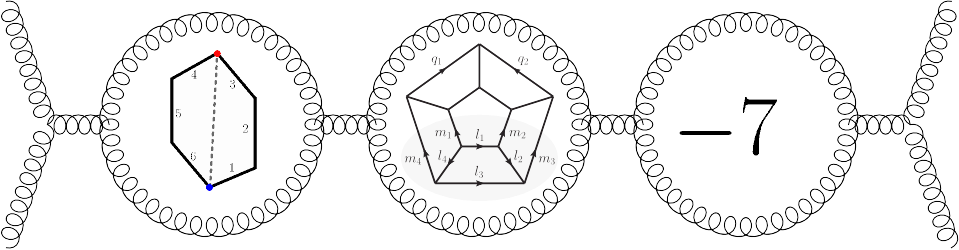
Now we’re up to seven loops for some types of particles, and six loops for the rest. In older blog posts I talked in megabytes: half a megabyte for three loops, 15 MB for four loops, 300 MB for five loops. I don’t have a number like that for six and seven loops: we don’t store the result in that way anymore, it just got too cumbersome. We have to store it in a simplified form, and even that takes 80 MB.
Some of what we learned has to do with the types of mathematical functions that we need: our “guess” for the result at each loop. We’ve honed that guess down a lot, and discovered some new simplifications along the way. I won’t tell that story here (except to hint that it has to do with “cosmic Galois theory”) because we haven’t published it yet. It will be out in a companion paper soon.
This paper focused on the next step, going from our guess to the correct six- and seven-loop answers. Here too there were surprises. For the last several loops, we’d observed a surprisingly nice pattern: different configurations of particles with different numbers of loops were related, in a way we didn’t know how to explain. The pattern stuck around at five loops, so we assumed it was the real deal, and guessed the new answer would obey it too.
Yes, in our field this counts as surprisingly nice
Usually when scientists tell this kind of story, the pattern works, it’s a breakthrough, everyone gets a Nobel prize, etc. This time? Nope!
The pattern failed. And it failed in a way that was surprisingly difficult to detect.
The way we calculate these things, we start with a guess and then add what we know. If we know something about how the particles behave at high energies, or when they get close together, we use that to pare down our guess, getting rid of pieces that don’t fit. We kept adding these pieces of information, and each time the pattern seemed ok. It was only when we got far enough into one of these approximations that we noticed a piece that didn’t fit.
That piece was a surprisingly stealthy mathematical function, one that hid from almost every test we could perform. There aren’t any functions like that at lower loops, so we never had to worry about this before. But now, in the rarefied land of six-loop calculations, they finally start to show up.
We have another pattern, like the old one but that isn’t broken yet. But at this point we’re cautious: things get strange as calculations get more complicated, and sometimes the nice simplifications we notice are just accidents. It’s always important to check.
Deep physics or six-loop accident? You decide!
This result was a long time coming. Coordinating a large project with such a widely spread collaboration is difficult, and sometimes frustrating. People get distracted by other projects, they have disagreements about what the paper should say, even scheduling Skype around everyone’s time zones is a challenge. I’m more than a little exhausted, but happy that the paper is out, and that we’re close to finishing the companion paper as well. It’s good to have results that we’ve been hinting at intalks finally out where the community can see them. Maybe they’ll notice something new!
The first day featured a two-part talk by Michael Green and Congkao Wen. They are looking at the corrections that string theory adds on top of theories of supergravity. These corrections are difficult to calculate directly from string theory, but one can figure out a lot about them from the kinds of symmetry and duality properties they need to have, using the mathematics of modular forms. While Michael’s talk introduced the topic with a discussion of older work, Congkao talked about their recent progress looking at this from an amplitudes perspective.
Francesca Ferrari’s talk on Tuesday also related to modular forms, while Oliver Schlotterer and Pierre Vanhove talked about a different corner of mathematics, single-valued polylogarithms. These single-valued polylogarithms are of interest to string theorists because they seem to connect two parts of string theory: the open strings that describe Yang-Mills forces and the closed strings that describe gravity. In particular, it looks like you can take a calculation in open string theory and just replace numbers and polylogarithms with their “single-valued counterparts” to get the same calculation in closed string theory. Interestingly, there is more than one way that mathematicians can define “single-valued counterparts”, but only one such definition, the one due to Francis Brown, seems to make this trick work. When I asked Pierre about this he quipped it was because “Francis Brown has good taste…either that, or String Theory has good taste.”
Wednesday saw several talks exploring interesting features of string theory. Nathan Berkovitz discussed his new paper, which makes a certain context of AdS/CFT (a duality between string theory in certain curved spaces and field theory on the boundary of those spaces) manifest particularly nicely. By writing string theory in five-dimensional AdS space in the right way, he can show that if the AdS space is small it will generate the same Feynman diagrams that one would use to do calculations in N=4 super Yang-Mills. In the afternoon, Sameer Murthy showed how localization techniques can be used in gravity theories, including to calculate the entropy of black holes in string theory, while Yvonne Geyer talked about how to combine the string theory-like CHY method for calculating amplitudes with supersymmetry, especially in higher dimensions where the relevant mathematics gets tricky.
Thursday ended up focused on field theory. Carlos Mafra was originally going to speak but he wasn’t feeling well, so instead I gave a talk about the “tardigrade” integrals I’ve been looking at. Zvi Bern talked about his work applying amplitudes techniques to make predictions for LIGO. This subject has advanced a lot in the last few years, and now Zvi and collaborators have finally done a calculation beyond what others had been able to do with older methods. They still have a way to go before they beat the traditional methods overall, but they’re off to a great start. Lance Dixon talked about two-loop five-particle non-planar amplitudes in N=4 super Yang-Mills and N=8 supergravity. These are quite a bit trickier than the planar amplitudes I’ve worked on with him in the past, in particular it’s not yet possible to do this just by guessing the answer without considering Feynman diagrams.
Today was the last day of the conference, and the emphasis was on number theory. David Broadhurst described some interesting contributions from physics to mathematics, in particular emphasizing information that the Weierstrass formulation of elliptic curves omits. Eric D’Hoker discussed how the concept of transcendentality, previously used in field theory, could be applied to string theory. A few of his speculations seemed a bit farfetched (in particular, his setup needs to treat certain rational numbers as if they were transcendental), but after his talk I’m a bit more optimistic that there could be something useful there.
On Pi Day, fans of the number pi gather to recite its digits and eat pies. It is the most famous of numerical holidays, but not the only one. Have you heard of the holidays for other famous numbers?
Tau Day: Celebrated on June 28. Observed by sitting around gloating about how much more rational one is than everyone else, then getting treated with high-energy tau leptons for terminal pedantry.
Canadian Modular Pi Day: Celebrated on February 3. Observed by confusing your American friends.
e Day: Celebrated on February 7. Observed in middle school classrooms, explaining the wonders of exponential functions and eating foods like eggs and eclairs. Once the students leave, drop tabs of ecstasy instead.
Golden Ratio Day: Celebrated on January 6. Rub crystals on pyramids and write vaguely threatening handwritten letters to every physicist you’ve heard of.
Euler Gamma Day: Celebrated on May 7 by dropping on the floor and twitching.
Riemann Zeta Daze: The first year, forget about it. The second, celebrate on January 6. The next year, January 2. After that, celebrate on New Year’s Day earlier and earlier in the morning each year until you can’t tell the difference any more.





 4 gravitons