On Pi Day, fans of the number pi gather to recite its digits and eat pies. It is the most famous of numerical holidays, but not the only one. Have you heard of the holidays for other famous numbers?
Tau Day: Celebrated on June 28. Observed by sitting around gloating about how much more rational one is than everyone else, then getting treated with high-energy tau leptons for terminal pedantry.
Canadian Modular Pi Day: Celebrated on February 3. Observed by confusing your American friends.
e Day: Celebrated on February 7. Observed in middle school classrooms, explaining the wonders of exponential functions and eating foods like eggs and eclairs. Once the students leave, drop tabs of ecstasy instead.
Golden Ratio Day: Celebrated on January 6. Rub crystals on pyramids and write vaguely threatening handwritten letters to every physicist you’ve heard of.
Euler Gamma Day: Celebrated on May 7 by dropping on the floor and twitching.
Riemann Zeta Daze: The first year, forget about it. The second, celebrate on January 6. The next year, January 2. After that, celebrate on New Year’s Day earlier and earlier in the morning each year until you can’t tell the difference any more.
It’s that time of year again! Time for me to dig in to my files and bring you yet anotherofmyoldphysicspoems.
Plagued with Divergences
“The whole scheme of local field theory is plagued with divergences”
Is divergence ever really unexpected?
If you asked a computer, what would it tell you?
You’d hear a whirring first, lungs and heart of the machine beating faster and faster.
And you’d dismiss it. You knew this wasn’t going to be an easy interaction. It doesn’t mean you’re going to diverge.
And perhaps it would try to warn you, write it there on the page. It might even notice, its built-in instincts telling you, by the book, “This will diverge.”
But instincts lie, and builders cheat. And it doesn’t mean you’re going to diverge.
Now, you do everything the slow way, Numerically. You need a different answer. Dismiss your instincts and force yourself through Piece by piece.
And now, you can’t stop hearing the whir The machine’s beating heart Even when it should be at rest
And step by step, it tries to minimize its errors And step by step, the errors grow
And exhausted, in the end, you see splashed across the screen Something bigger than it should ever have been.
But sometimes things feel big and strange. That’s just the way of the big wide world. And it doesn’t mean you’re going to diverge.
You could have seen the signs, Power-counted, seen what could overwhelm. And you could have regulated, with an epsilon of flexibility.
But this one, this time, was supposed to be Needed to be Physical Truth And truth doesn’t diverge
So you keep going, Wheezing breath and painstaking calculation, And every little thing blowing up
George Gamow was one of the “quantum kids” who got their start at the Niels Bohr Institute in the 30’s. He’s probably best known for the Alpher, Bethe, Gamow paper, which managed to combine one of the best sources of evidence we have for the Big Bang with a gratuitous Greek alphabet pun. He was the group jester in a lot of ways: the historians here have archives full of his cartoons and in-jokes.
Naturally, he also did science popularization.
I recently read two of Gamow’s science popularization books, “Mr Tompkins” and “Thirty Years That Shook Physics”. Reading them was a trip back in time, to when people thought about physics in surprisingly different ways.
“Mr. Tompkins” started as a series of articles in Discovery, a popular science magazine. They were published as a book in 1940, with a sequel in 1945 and an update in 1965. Apparently they were quite popular among a certain generation: the edition I’m reading has a foreword by Roger Penrose.
(As an aside: Gamow mentions that the editor of Discovery was C. P. Snow…that C. P. Snow?)
Mr Tompkins himself is a bank clerk who decides on a whim to go to a lecture on relativity. Unable to keep up, he falls asleep, and dreams of a world in which the speed of light is much slower than it is in our world. Bicyclists visibly redshift, and travelers lead much longer lives than those who stay at home. As the book goes on he meets the same professor again and again (eventually marrying his daughter) and sits through frequent lectures on physics, inevitably falling asleep and experiencing it first-hand: jungles where Planck’s constant is so large that tigers appear as probability clouds, micro-universes that expand and collapse in minutes, and electron societies kept strictly monogamous by “Father Paulini”.
The structure definitely feels dated, and not just because these days people don’t often go to physics lectures for fun. Gamow actually includes the full text of the lectures that send Mr Tompkins to sleep, and while they’re not quite boring enough to send the reader to sleep they are written on a higher level than the rest of the text, with more technical terms assumed. In the later additions to the book the “lecture” aspect grows: the last two chapters involve a dream of Dirac explaining antiparticles to a dolphin in basically the same way he would explain them to a human, and a discussion of mesons in a Japanese restaurant where the only fantastical element is a trio of geishas acting out pion exchange.
Some aspects of the physics will also feel strange to a modern audience. Gamow presents quantum mechanics in a way that I don’t think I’ve seen in a modern text: while modern treatments start with uncertainty and think of quantization as a consequence, Gamow starts with the idea that there is a minimum unit of action, and derives uncertainty from that. Some of the rest is simply limited by timing: quarks weren’t fully understood even by the 1965 printing, in 1945 they weren’t even a gleam in a theorist’s eye. Thus Tompkins’ professor says that protons and neutrons are really two states of the same particle and goes on to claim that “in my opinion, it is quite safe to bet your last dollar that the elementary particles of modern physics [electrons, protons/neutrons, and neutrinos] will live up to their name.” Neutrinos also have an amusing status: they hadn’t been detected when the earlier chapters were written, and they come across rather like some people write about dark matter today, as a silly theorist hypothesis that is all-too-conveniently impossible to observe.
“Thirty Years That Shook Physics”, published in 1966, is a more usual sort of popular science book, describing the history of the quantum revolution. While mostly focused on the scientific concepts, Gamow does spend some time on anecdotes about the people involved. If you’ve read much about the time period, you’ll probably recognize many of the anecdotes (for example, the Pauli Principle that a theorist can break experimental equipment just by walking in to the room, or Dirac’s “discovery” of purling), even the ones specific to Gamow have by now been spread far and wide.
Like Mr Tompkins, the level in this book is not particularly uniform. Gamow will spend a paragraph carefully defining an average, and then drop the word “electroscope” as if everyone should know what it is. The historical perspective taught me a few things I perhaps should have already known, but found surprising anyway. (The plum-pudding model was an actual mathematical model, and people calculated its consequences! Muons were originally thought to be mesons!)
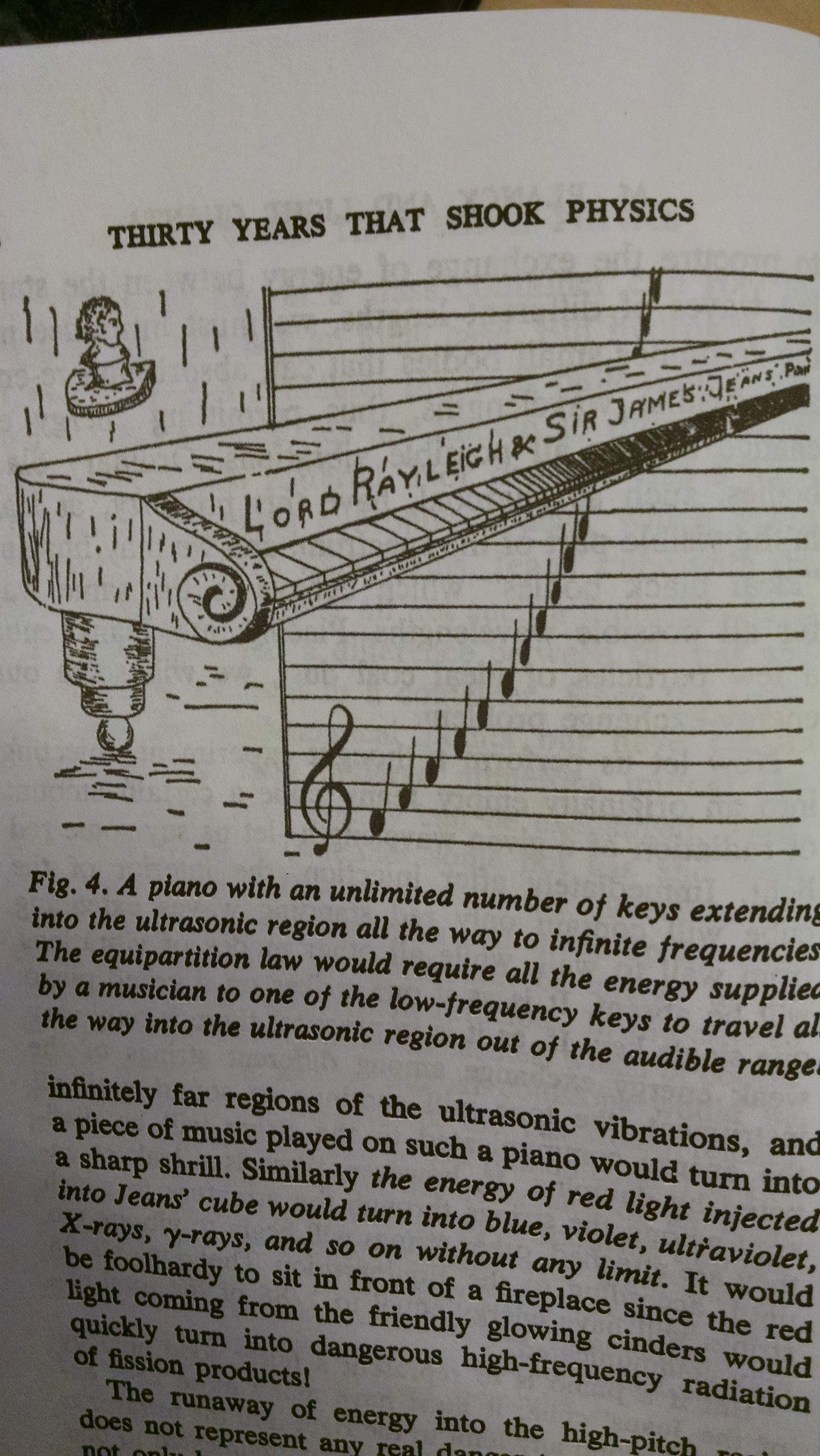
Both books are filled with Gamow’s whimsical illustrations, something he was very much known for. Apparently he liked to imitate other art styles as well, which is visible in the portraits of physicists at the front of each chapter.
Pictured: the electromagnetic spectrum as an infinite piano
1966 was late enough that this book doesn’t have the complacency of the earlier chapters in Mr Tompkins: Gamow knew that there were more particles than just electrons, nucleons, and neutrinos. It was still early enough, though, that the new particles were not fully understood. It’s interesting seeing how Gamow reacts to this: his expectation was that physics was on the cusp of another massive change, a new theory built on new fundamental principles. He speculates that there might be a minimum length scale (although oddly enough he didn’t expect it to be related to gravity).
It’s only natural that someone who lived through the dawn of quantum mechanics should expect a similar revolution to follow. Instead, the revolution of the late 60’s and early 70’s was in our understanding: not new laws of nature so much as new comprehension of just how much quantum field theory can actually do. I wonder if the generation who lived through that later revolution left it with the reverse expectation: that the next crisis should be solved in a similar way, that the world is quantum field theory (or close cousins, like string theory) all the way down and our goal should be to understand the capabilities of these theories as well as possible.
The final section of the book is well worth waiting for. In 1932, Gamow directed Bohr’s students in staging a play, the “Blegdamsvej Faust”. A parody of Faust, it features Bohr as god, Pauli as Mephistopheles, and Ehrenfest as the “erring Faust” (Gamow’s pun, not mine) that he tempts to sin with the promise of the neutrino, Gretchen. The piece, translated to English by Gamow’s wife Barbara, is filled with in-jokes on topics as obscure as Bohr’s habitual mistakes when speaking German. It’s gloriously weird and well worth a read. If you’ve ever seen someone do a revival performance, let me know!
I’m lazy this Newtonmas, so instead of writing a post of my own I’m going to recommend a few other people who do excellent work.
Quantum Frontiers is a shared blog updated by researchers connected to Caltech’s Institute for Quantum Information and Matter. While the whole blog is good, I’m going to be more specific and recommend the posts by Nicole Yunger Halpern. Nicole is really a great writer, and her posts are full of vivid imagery and fun analogies. If she’s not as well-known, it’s only because she lacks the attention-grabbing habit of getting into stupid arguments with other bloggers. Definitely worth a follow.
Recommending Slate Star Codex feels a bit strange, because it seems like everyone I’ve met who would enjoy the blog already reads it. It’s not a physics blog by any stretch, so it’s also an unusual recommendation to give here. Slate Star Codex writes about a wide variety of topics, and while the author isn’t an expert in most of them he does a lot more research than you or I would. If you’re interested in up-to-date meta-analyses on psychology, social science, and policy, pored over by someone with scrupulous intellectual honesty and an inexplicably large amount of time to indulge it, then Slate Star Codex is the blog for you.
I mentioned Piled Higher and Deeper a few weeks back, when I reviewed the author’s popular science book We Have No Idea. Piled Higher and Deeper is a webcomic about life in grad school. Humor is all about exaggeration, and it’s true that Piled Higher and Deeper exaggerates just how miserable and dysfunctional grad school can be…but not by as much as you’d think. I recommend that anyone considering grad school read Piled Higher and Deeper, and take it seriously. Grad school can really be like that, and if you don’t think you can deal with spending five or six years in the world of that comic you should take that into account.
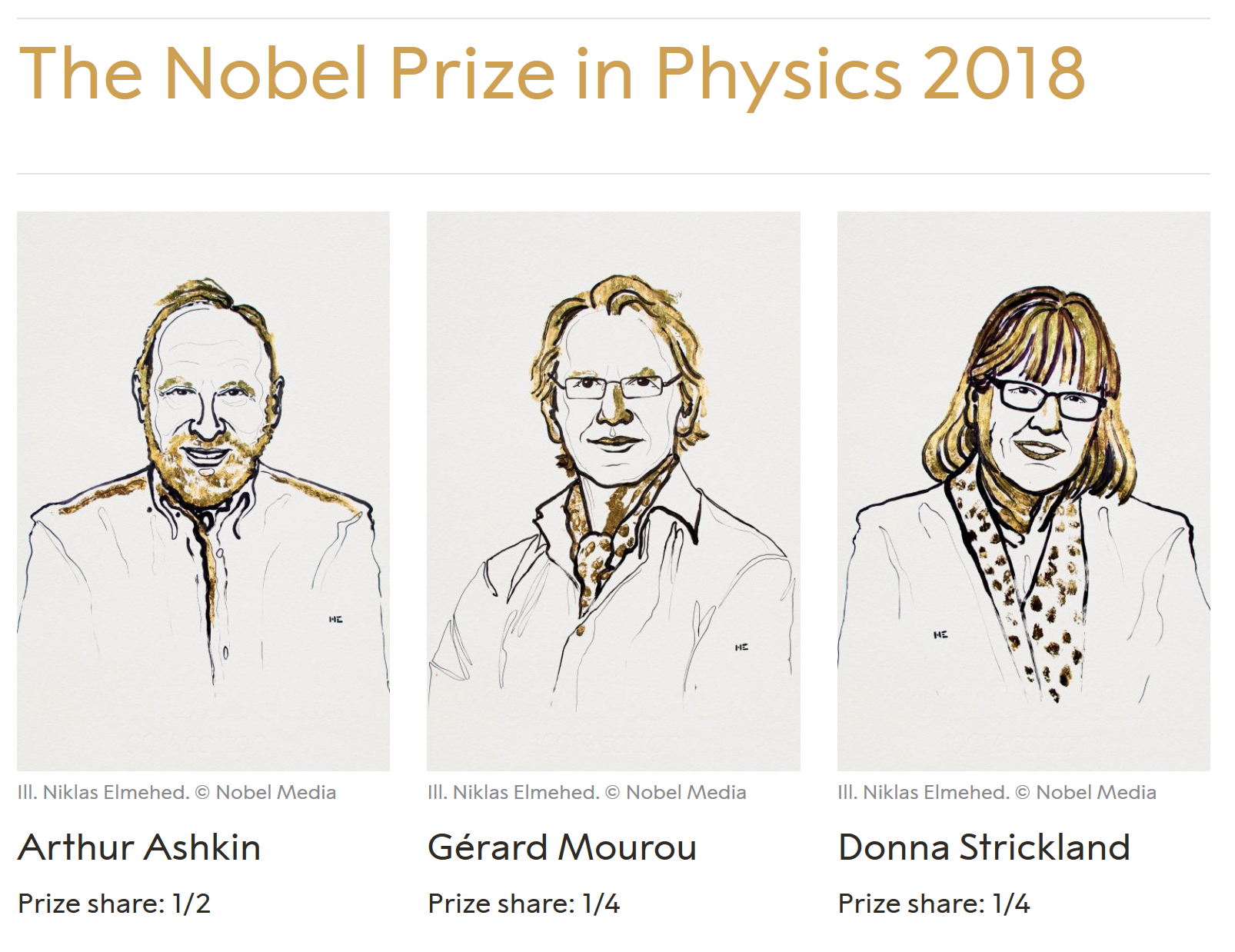
Some Nobel prizes recognize discoveries of the fundamental nature of reality. Others recognize the tools that make those discoveries possible.
Ashkin developed techniques that use lasers to hold small objects in place, culminating in “optical tweezers” that can pick up and move individual bacteria. Mourou and Strickland developed chirped pulse amplification, the current state of the art in extremely high-power lasers. Strickland is only the third woman to win the Nobel prize in physics, Ashkin at 96 is the oldest person to ever win the prize.
(As an aside, the phrase “optical tweezers” probably has you imagining two beams of laser light pinching a bacterium between them, like microscopic lightsabers. In fact, optical tweezers use a single beam, focused and bent so that if an object falls out of place it will gently roll back to the middle of the beam. Instead of tweezers, it’s really more like a tiny laser spoon.)
The Nobel announcement emphasizes practical applications, like eye surgery. It’s important to remember that these are research tools as well. I wouldn’t have recognized the names of Ashkin, Mourou, and Strickland, but I recognized atom trapping, optical tweezers, and ultrashort pulses. Hang around atomic physicists, or quantum computing experiments, and these words pop up again and again. These are essential tools that have given rise to whole subfields. LIGO won a Nobel based on the expectation that it would kick-start a vast new area of research. Ashkin, Mourou, and Strickland’s work already has.
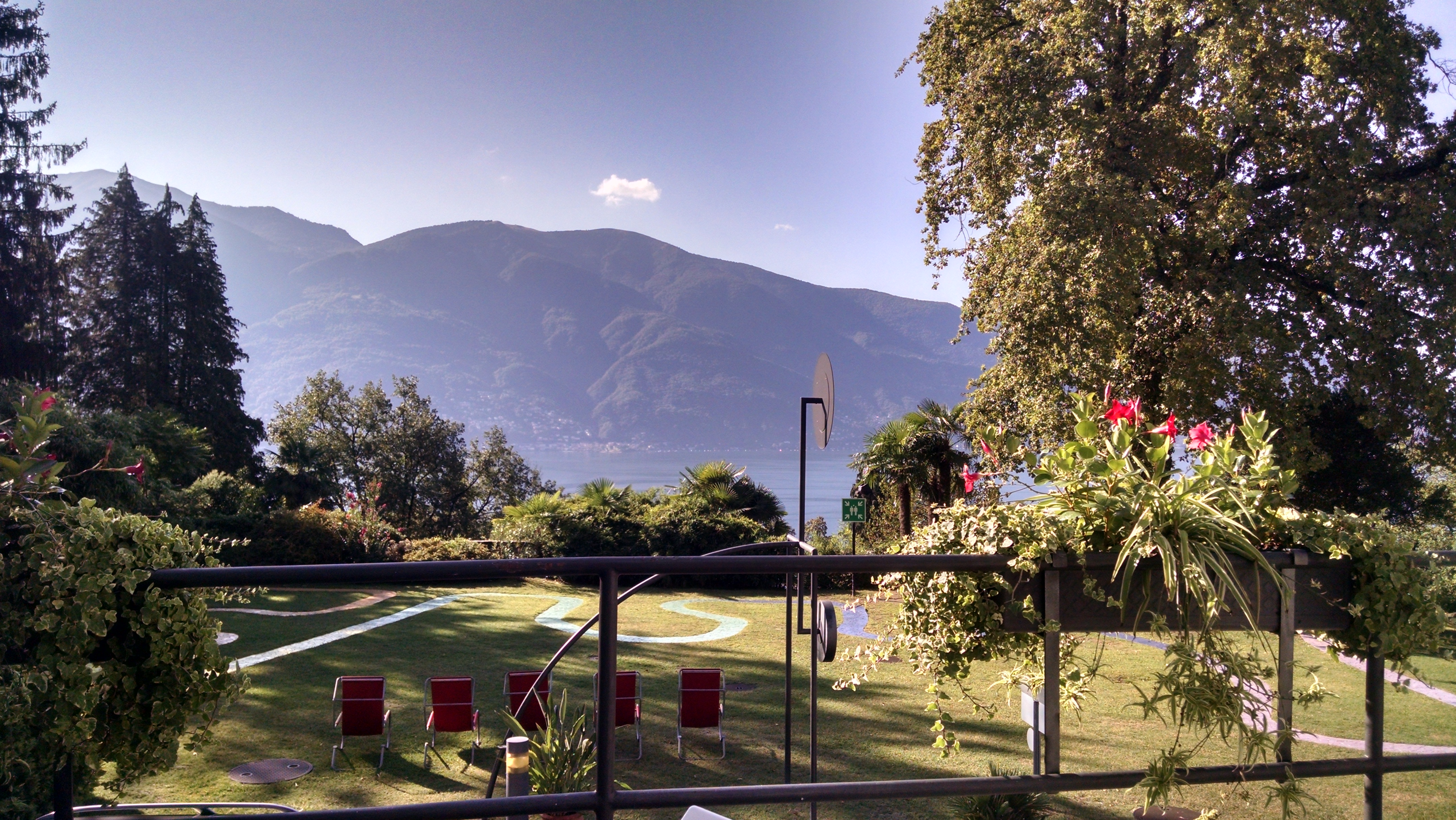
Perhaps the only place where the view rivals Les Houches
Elliptic integrals are the next frontier after polylogarithms, more complicated functions that can come out of Feynman diagrams starting at two loops. The community of physicists studying them is still quite small, and a large fraction of them are here at this conference. We’re at the historic Monte Verità conference center, and we’re not even a big enough group to use their full auditorium.
There has been an impressive amount of progress in understanding these integrals, even just in the last year. Watching the talks, it’s undeniable that our current understanding is powerful, broad…and incomplete. In many ways the mysteries of the field are clearing up beautifully, with many once confusingly disparate perspectives linked together. On the other hand, it feels like we’re still working with the wrong picture, and I suspect there’s still a major paradigm shift in the future. All in all, the perfect time to be working on elliptics!
I’ve complained before about how mathematicians name things. Mathematicans seem to have a knack for taking an ordinary bland word that’s almost indistinguishable from the other ordinary, bland words they’ve used before and assigning it an incredibly specific mathematical concept. Varieties and forms, motives and schemes, in each case you end up wishing they picked a word that was just a little more descriptive.
Sometimes, though, a word may seem completely out of place when it actually has a fairly reasonable explanation. Such is the case for the word “period“.
Suppose you want to classify numbers. You have the integers, and the rational numbers. A bigger class of numbers are “algebraic”, in that you can get them “from algebra”: more specifically, as solutions of polynomial equations with rational coefficients. Numbers that aren’t algebraic are “transcendental”, a popular example being .
Periods lie in between: a set that contains algebraic numbers, but also many of the transcendental numbers. They’re numbers you can get, not from algebra, but from calculus: they’re integrals over rational functions. These numbers were popularized by Kontsevich and Zagier, and they’ve led to a lot of fruitful inquiry in both math and physics.
But why the heck are they called periods?
Think about .
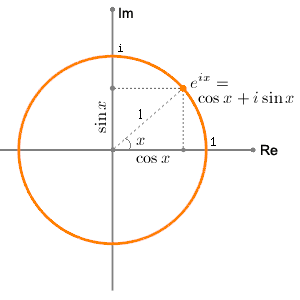
Or if you prefer, think about a circle
is a periodic function, with period . Take from to and the function repeats, you’ve traveled in a circle.
Thought of another way, is the volume of the circle. It’s the integral, around the circle, of . And that integral nicely matches Kontsevich and Zagier’s definition of a period.
The idea of a period, then, comes from generalizing this. What happens when you only go partway around the circle, to some point in the complex plane? Then you need to go to a point . So a logarithm can also be thought of as measuring the period of . And indeed, since a logarithm can be expressed as , they count as periods in the Kontsevich-Zagier sense.
And if you need to go beyond polylogarithms, when you can’t just go circle by circle?
Then you need to think about functions with two periods, like Weierstrass’s elliptic function. Just as you can think about as a circle, you can think of Weierstrass’s function in terms of a torus.
Obligatory donut joke here
The torus has two periods, corresponding to the two circles you can draw around it. The periods of Weierstrass’s function are transcendental numbers, and they fit Kontsevich and Zagier’s definition of periods. And if you take the inverse of Weierstrass’s function, you get an elliptic integral, just like taking the inverse of gives a logarithm.
So mathematicians, I apologize. Periods, at least, make sense.
Valentine’s Day was this week, so long-time readers shouldknowwhattoexpect. To continue this blog’s tradition, I’m posting another one of my old physics poems.
Winding Number One
When you feel twisted up inside, you may be told to step back
On Halloween I have a tradition of posts about spooky topics, whether traditional Halloween fare or things that spook physicists. This year it’s a little of both.
Mage: The Ascension is a role-playing game set in a world in which belief shapes reality. Players take the role of witches and warlocks, casting spells powered by their personal paradigms of belief. The game allows for pretty much any modern-day magic-user you could imagine, from Wiccans to martial artists.
Even stereotypical green witches, probably
Despite all the options, I was always more interested in the game’s villains, the witches’ opposites, the Technocracy.
The Technocracy answer an inevitable problem with any setting involving modern-day magic: why don’t people notice? If reality is powered by belief, why does no-one believe in magic?
In the Technocracy’s case, the answer is a vast conspiracy of mages with a scientific bent, manipulating public belief. Much like the witches and warlocks of Mage are a grab-bag of every occult belief system, the Technocracy combines every oppressive government conspiracy story you can imagine, all with the express purpose of suppressing the supernatural and maintaining scientific consensus.
This quote is from another game by the same publisher, but it captures the attitude of the Technocracy, and the magnitude of what is being claimed here:
Do not believe what the scientists tell you. The natural history we know is a lie, a falsehood sold to us by wicked old men who would make the world a dull gray prison and protect us from the dangers inherent to freedom. They would have you believe our planet to be a lonely starship, hurtling through the void of space, barren of magic and in need of a stern hand upon the rudder.
Close your mind to their deception. The time before our time was not a time of senseless natural struggle and reptilian rage, but a time of myth and sorcery. It was a time of legend, when heroes walked Creation and wielded the very power of the gods. It was a time before the world was bent, a time before the magic of Creation lessened, a time before the souls of men became the stunted, withered things they are today.
It can be a fun exercise to see how far doubt can take you, how much of the scientific consensus you can really be confident of and how much could be due to a conspiracy. Believing in the Technocracy would be the most extreme version of this, but Flat-Earthers come pretty close. Once you’re doubting whether the Earth is round, you have to imagine a truly absurd conspiracy to back it up.
On the other extreme, there are the kinds of conspiracies that barely take a conspiracy at all. Big experimental collaborations, like ATLAS and CMS at the LHC, keep a tight handle on what their members publish. (If you’re curious how much of one, here’s a talk by a law professor about, among other things, the Constitution of CMS. Yes, it has one!) An actual conspiracy would still be outed in about five minutes, but you could imagine something subtler, the experiment sticking to “safe” explanations and refusing to publish results that look too unusual, on the basis that they’re “probably” wrong. Worries about that sort of thing can make actual physicists spooked.
There’s an important dividing line with doubt: too much and you risk invoking a conspiracy more fantastical than the science you’re doubting in the first place. The Technocracy doesn’t just straddle that line, it hops past it off into the distance. Science is too vast, and too unpredictable, to be controlled by some shadowy conspiracy.
I’m bringing a box of textbooks with me to Denmark. Most of them are for work: a few Quantum Field Theory texts I might use, a Complex Analysis book for when I inevitably forget how to do contour integration.
One of the books, though, is just for fun.
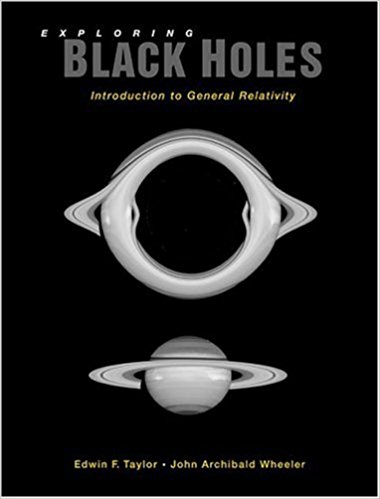
Exploring Black Holes is an introduction to general relativity for undergraduates. The book came out of a collaboration between Edwin F. Taylor, known for his contributions to physics teaching, and John Archibald Wheeler, who among a long list of achievements was responsible for popularizing the term “black hole”. The result is something quite unique: a general relativity course that requires no math more advanced than calculus, and no physics more advanced than special relativity.
It does this by starting, not with the full tensor-riddled glory of Einstein’s equations, but with specialized solutions to those equations, mostly the Schwarzschild solution that describes space around spherical objects (including planets, stars, and black holes). From there, it manages to introduce curved space in a way that is both intuitive and naturally grows out of what students learn about special relativity. It really is the kind of course a student can take right after their first physics course, and indeed as an undergrad that’s exactly what I did.
With just the Schwarzchild solution and its close relatives, you can already answer most of the questions young students have about general relativity. In a series of “projects”, the book explores the corrections GR demands of GPS satellites, the process of falling into a black hole, the famous measurement of the advance of the perihelion of mercury, the behavior of light in a strong gravitational field, and even a bit of cosmology. In the end the students won’t know the full power of the theory, but they’ll get a taste while building valuable physical intuition.
Still, I wouldn’t bring this book with me if it was just an excellent undergraduate textbook. Exploring Black Holes is a great introduction to general relativity, but it also has a hilarious not-so-hidden agenda: inspiring future astronauts to jump into black holes.
“Nowhere could life be simpler or more relaxed than in a free-float frame, such as an unpowered spaceship falling toward a black hole.” – pg. 2-31
The book is full of quotes like this. One of the book’s “projects” involves computing what happens to an astronaut who falls into a black hole. The book takes special care to have students calculate that “spaghettification”, the process by which the tidal forces of a black hole stretch infalling observers into spaghetti, is surprisingly completely painless: the amount of time you experience it is always less than the amount of time it takes light (and thus also pain) to go from your feet to your head, for any (sufficiently calm) black hole.
Why might Taylor and Wheeler want people of the future to jump into black holes? As the discussion on page B-3 of the book describes, the reason is on one level an epistemic one. As theorists, we’d like to reason about what lies inside the event horizon of black holes, but we face a problem: any direct test would be trapped inside, and we would never know the result, which some would argue makes such speculation unscientific. What Taylor and Wheeler point out is that it’s not quite true that no-one would know the results of such a test: if someone jumped into a black hole, they would be able to test our reasoning. If a whole scientific community jumped in, then the question of what is inside a black hole is from their perspective completely scientific.
Of course, I don’t think Taylor and Wheeler seriously thought their book would convince its readers to jump into black holes. For one, it’s unlikely anyone reading the book will get a chance. Still, I suspect that the idea that future generations might explore black holes gave Taylor and Wheeler some satisfaction, and a nice clean refutation of those who think physics inside the horizon is unscientific. Seeing as the result was an excellent textbook full of hilarious prose, I can’t complain.

 .
. .
.
 . Take
  from
from  to
to  . And that integral nicely matches Kontsevich and Zagier’s definition of a period.
 in the complex plane? Then you need to go to a point
  . So a logarithm can also be thought of as measuring the period of
  , they count as periods in the Kontsevich-Zagier sense.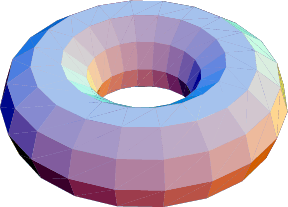

 4 gravitons