Category Archives: Misc

Textbook Review: Exploring Black Holes

I’m bringing a box of textbooks with me to Denmark. Most of them are for work: a few Quantum Field Theory texts I might use, a Complex Analysis book for when I inevitably forget how to do contour integration.

One of the books, though, is just for fun.
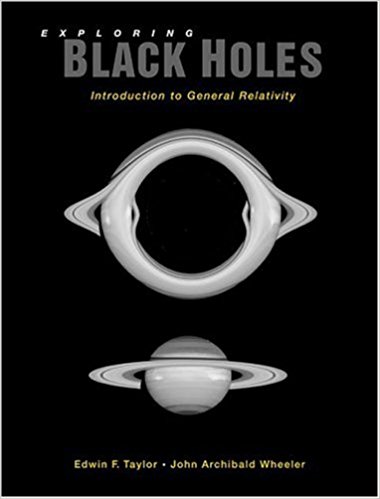
418jsvew76l-_sx378_bo1204203200_

Exploring Black Holes is an introduction to general relativity for undergraduates. The book came out of a collaboration between Edwin F. Taylor, known for his contributions to physics teaching, and John Archibald Wheeler, who among a long list of achievements was responsible for popularizing the term “black hole”. The result is something quite unique: a general relativity course that requires no math more advanced than calculus, and no physics more advanced than special relativity.

It does this by starting, not with the full tensor-riddled glory of Einstein’s equations, but with specialized solutions to those equations, mostly the Schwarzschild solution that describes space around spherical objects (including planets, stars, and black holes). From there, it manages to introduce curved space in a way that is both intuitive and naturally grows out of what students learn about special relativity. It really is the kind of course a student can take right after their first physics course, and indeed as an undergrad that’s exactly what I did.

With just the Schwarzchild solution and its close relatives, you can already answer most of the questions young students have about general relativity. In a series of “projects”, the book explores the corrections GR demands of GPS satellites, the process of falling into a black hole, the famous measurement of the advance of the perihelion of mercury, the behavior of light in a strong gravitational field, and even a bit of cosmology. In the end the students won’t know the full power of the theory, but they’ll get a taste while building valuable physical intuition.

Still, I wouldn’t bring this book with me if it was just an excellent undergraduate textbook. Exploring Black Holes is a great introduction to general relativity, but it also has a hilarious not-so-hidden agenda: inspiring future astronauts to jump into black holes.

“Nowhere could life be simpler or more relaxed than in a free-float frame, such as an unpowered spaceship falling toward a black hole.” – pg. 2-31

The book is full of quotes like this. One of the book’s “projects” involves computing what happens to an astronaut who falls into a black hole. The book takes special care to have students calculate that “spaghettification”, the process by which the tidal forces of a black hole stretch infalling observers into spaghetti, is surprisingly completely painless: the amount of time you experience it is always less than the amount of time it takes light (and thus also pain) to go from your feet to your head, for any (sufficiently calm) black hole.

Why might Taylor and Wheeler want people of the future to jump into black holes? As the discussion on page B-3 of the book describes, the reason is on one level an epistemic one. As theorists, we’d like to reason about what lies inside the event horizon of black holes, but we face a problem: any direct test would be trapped inside, and we would never know the result, which some would argue makes such speculation unscientific. What Taylor and Wheeler point out is that it’s not quite true that no-one would know the results of such a test: if someone jumped into a black hole, they would be able to test our reasoning. If a whole scientific community jumped in, then the question of what is inside a black hole is from their perspective completely scientific.

Of course, I don’t think Taylor and Wheeler seriously thought their book would convince its readers to jump into black holes. For one, it’s unlikely anyone reading the book will get a chance. Still, I suspect that the idea that future generations might explore black holes gave Taylor and Wheeler some satisfaction, and a nice clean refutation of those who think physics inside the horizon is unscientific. Seeing as the result was an excellent textbook full of hilarious prose, I can’t complain.
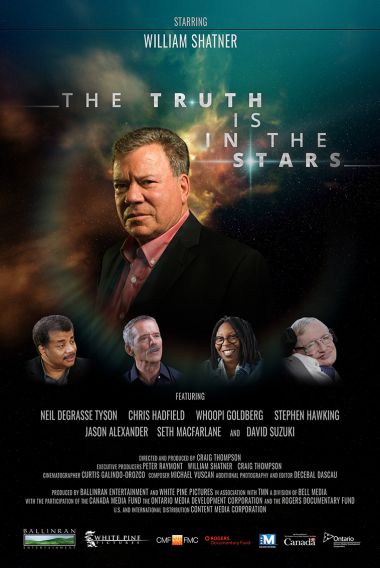
Movie Review: The Truth is in the Stars

Recently, Perimeter aired a showing of The Truth is in the Stars, a documentary about the influence of Star Trek on science and culture, with a panel discussion afterwards. The documentary follows William Shatner as he wanders around the world interviewing scientists and film industry people about how Star Trek inspired them. Along the way he learns a bit about physics, and collects questions to ask Steven Hawking at the end.

5834308d05e48__po__ipho__380_568

I’ll start with the good: the piece is cute. They managed to capture some fun interactions with the interviewees, there are good (if occasionally silly) visuals, and the whole thing seems fairly well edited. If you’re looking for an hour of Star Trek nostalgia and platitudes about physics, this is the documentary for you.

That said, it doesn’t go much beyond cute, and it dances between topics in a way that felt unsatisfying.

The piece has a heavy focus on Shatner, especially early on, beginning with a clumsily shoehorned-in visit to his ranch to hear his thoughts on horses. For a while, the interviews are all about him: his jokes, his awkward questions, his worries about getting old. He has a habit of asking the scientists he talks to whether “everything is connected”, which to the scientists’ credit is usually met by a deft change of subject. All of this fades somewhat as the movie progresses, though: whether by a trick of editing, or because after talking to so many scientists he begins to pick up some humility.

(Incidentally, I really ought to have a blog post debunking the whole “everything is connected” thing. The tricky part is that it involves so many different misunderstandings, from confusion around entanglement to the role of strings to “we are all star-stuff” that it’s hard to be comprehensive.)

Most of the scientific discussions are quite superficial, to the point that they’re more likely to confuse inexperienced viewers than to tell them something new (especially the people who hinted at dark energy-based technology…no, just no). While I don’t expect a documentary like this to cover the science in-depth, trying to touch on so many topics in this short a time mostly just fuels the “everything is connected” misunderstanding. One surprising element of the science coverage was the choice to have both Michio Kaku giving a passionate description of string theory and Neil Turok bluntly calling string theory “a mess”. While giving the public “both sides” like that isn’t unusual in other contexts, for some reason most science documentaries I’ve seen take one side or the other.

Of course, the point of the documentary isn’t really to teach science, it’s to show how Star Trek influenced science. Here too, though, the piece was disappointing. Most of the scientists interviewed could tell their usual story about the power of science fiction in their childhood, but didn’t have much to say about Star Trek specifically. It was the actors and producers who had the most to say about Star Trek, from Ben Stiller showing off his Gorn mask to Seth MacFarlane admiring the design of the Enterprise. The best of these was probably Whoopi Goldberg’s story of being inspired by Uhura, which has been covered better elsewhere (and might have been better as Mae Jemison’s similar story, which would at least have involved an astronaut rather than another actor). I did enjoy Neil deGrasse Tyson’s explanation of how as a kid he thought everything on Star Trek was plausible…except for the automatic doors.

Shatner’s meeting with Hawking is the finale, and is the documentary’s strongest section. Shatner is humbled, even devout, in Hawking’s presence, while Hawking seems to show genuine joy swapping jokes with Captain Kirk.

Overall, the piece felt more than a little disjointed. It’s not really about the science, but it didn’t have enough content to be really about Star Trek either. If it was “about” anything, it was Shatner’s journey: an aging actor getting to hang out and chat with interesting people around the world. If that sounds fun, you should watch it: but don’t expect much deeper than that.

Poll Results, and What’s Next

I’ll leave last week’s poll up a while longer as more votes trickle in, but the overall pattern (beyond “Zipflike“) is pretty clear.

From pretty early on, most requests were for more explanations of QFT, gravity, and string theory concepts, with amplitudes content a clear second. This is something I can definitely do more of: I haven’t had much inspiration for interesting pieces of this sort recently, but it’s something I can ramp up in future.

I suspect that many of the people voting for more QFT and more amplitudes content were also interested in something else, though: more physics news. Xezlec mentioned that with Résonaances and Of Particular Significance quiet, there’s an open niche for vaguely reasonable people blogging about physics.

The truth is, I didn’t think of adding a “more physics news” option to the poll. I’m not a great source of news: not being a phenomenologist, I don’t keep up with the latest experimental results, and since my sub-field is small and insular I’m not always aware of the latest thing Witten or Maldacena is working on.

For an example of the former: recently, various LHC teams presented results at the Moriond and Aspen conferences, with no new evidence of supersymmetry in the data they’ve gathered thus far. This triggered concessions on several bets about SUSY (including an amusingly awkward conversation about how to pay one of them).

And I only know about that because other bloggers talked about it.

So I’m not going to be a reliable source of physics news.

With that said, knowing there’s a sizable number of people interested in this kind of thing is helpful. I’ve definitely had times when I saw something I found interesting, but wasn’t sure if my audience would care. (For example, recently there’s been some substantial progress on the problem that gave this blog its name.) Now that I know some of you are interested, I’ll err on the side of posting about these kinds of things.

“What’s it like to be a physicist” and science popularization were both consistently third and fourth in the poll, switching back and forth as more votes came in. This tells me that while many of you want more technical content, there are still people interested in pieces aimed to a broader audience, so I won’t abandon those.

The other topics were fairly close together, with the more “news-y” ones (astrophysics/cosmology and criticism of bad science coverage) beating the less “news-y” ones. This also supports my guess that people were looking for a “more physics news” option. A few people even voted for “more arguments”, which was really more of a joke topic: getting into arguments with other bloggers tends to bring in readers, but it’s not something I ever plan to do intentionally.

So, what’s next? I’ll explain more quantum field theory, talk more about interesting progress in amplitudes, and mention news when I come across it, trusting you guys to find it interesting. I’ll keep up with the low-level stuff, and with trying to humanize physics, to get the public to understand what being a physicist is all about. And I’ll think about some of the specific suggestions you gave: I’m always looking for good post ideas.

New Poll: What Would You Like to See More Of?

It’s been a while since I last polled you guys. Back then, I was curious what sorts of backgrounds my readers had. In the end, roughly half of you had some serious background in high-energy physics, while the other half had seen some physics, but not a lot.

This time, I’d like to know what sort of content you want to see. WordPress tells me how well an individual post does, but there isn’t much of a pattern to my best-performing posts beyond the vagaries of whose attention they grab. That’s why I’m asking you what you want to see more of. I’ve split things into vague categories. Feel free to vote for as many as you like, and let me know in the comments if there’s something I missed.

The Way to a Mathematician’s Heart Is through a Pi

Want to win over a mathematician? Bake them a pi.

Of course, presentation counts. You can’t just pour a spew of digits.

1200px-pi_tau_digit_runs-svg

If you have to, at least season it with 9’s

Ideally, you’ve baked your pi at home, in a comfortable physical theory. You lay out a graph to give it structure, then wrap it in algebraic curves before baking under an integration.

(Sometimes you can skip this part. My mathematician will happily eat graphs and ignore the pi.)

At this point, if your motives are pure (or at least mixed Tate), you have your pi. To make it more interesting, be sure to pair with a well-aged Riemann zeta value. With the right preparation, you can achieve a truly cosmic pi.

whirled-pies-54

Fine, that last joke was a bit of a stretch. Hope you had a fun pi day!

Valentine’s Day Physics Poem 2017

It’s that time of year again! Valentine’s Day was this week, so to continue this blog’s tradition it’s time for me to post one of my physics poems. I wrote this back before I fully understood quantum field theory, so you’ll have to excuse any inaccuracies in the metaphor (at least on the physics side 😉 ).


Perturbation Theory II – Going in Loops


In order to interact, two particles must collide.

But a particle is a small thing, moving in its own circles, covering little space in its lonely life.

So we will never interact.


But particles emit bosons,

Tiny messengers of force,

Tendrils of interaction.

When these find us,

As they sometimes do,

We can interact.


But a boson is a small thing, moving in its own circles, covering little space in its lonely life.

So we will never interact.


But each boson has its own retinue,

Particles and their bosons in turn,

Spawned from its self-energy, uncertainty in its own nature,

Each, unobserved, with infinite possibilities.


And to compensate for these infinities

The charged nature of our naked selves

Must in turn be infinitely repressed.


So perhaps interaction would still be understandable

For those with simple repressions,

Matching constraints.


But we are not such people.

Complicated beings, we spin and twirl.

We hide our charge behind an infinity of possible terms,

So we can never know

If we will interact.


But perhaps we are not simply isolated points.

Perhaps we have extension,

Dimension,

Reach, beyond the confines of zero-dimensional selves.

And with that reach

Perhaps we can understand.

Perhaps

We can interact.

PSI Winter School 2017

It’s that time of year again! Perimeter Scholars International, Perimeter’s Master’s program in theoretical physics, is holding its Winter School up in Ontario’s copious backwoods.

img_20170125_161426

Ominous antlered snowmen included

Like last year, the students are spending mornings and evenings doing research supervised by PI grad students, postdocs, and faculty, and the afternoons on a variety of winter activities, including skiing and snowshoeing.

Last year, my group worked on the “POPE”, a proposal by Basso, Sever, and Vieira, and we ended up getting a paper out of it. This year, I’ve teamed up with Freddy Cachazo on a gravity-related project. We’ve got a group of enthusiastic students and are making decent progress, I’ll have more to say about it next week.

Have You Given Your Kids “The Talk”?

If you haven’t seen it yet, I recommend reading this delightful collaboration between Scott Aaronson (of Shtetl-Optimized) and Zach Weinersmith (of Saturday Morning Breakfast Cereal). As explanations of a concept beyond the standard popular accounts go, this one is pretty high quality, correcting some common misconceptions about quantum computing.

I especially liked the following exchange:

ontology

I’ve complained before about people trying to apply ontology to physics, and I think this gets at the root of one of my objections.

People tend to think that the world should be describable with words. From that perspective, mathematics is just a particular tool, a system we’ve created. If you look at the world in that way, mathematics looks unreasonably effective: it’s ability to describe the real world seems like a miraculous coincidence.

Mathematics isn’t just one tool though, or just one system. It’s all of them: not just numbers and equations, but knots and logic and everything else. Deep down, mathematics is just a collection of all the ways we’ve found to state things precisely.

Because of that, it shouldn’t surprise you that we “put complex numbers in our ontologies”. Complex numbers are just one way we’ve found to make precise statements about the world, one that comes in handy when talking about quantum mechanics. There doesn’t need to be a “correct” description in words: the math is already stating things as precisely as we know how.

That doesn’t mean that ontology is a useless project. It’s worthwhile to develop new ways of talking about things. I can understand the goal of building up a philosophical language powerful enough to describe the world in terms of words, and if such a language was successful it might well inspire us to ask new scientific questions.

But it’s crucial to remember that there’s real work to be done there. There’s no guarantee that the project will work, that words will end up sufficient. When you put aside our best tools to make precise statements, you’re handicapping yourself, making the problem harder than it needed to be. It’s your responsibility to make sure you’re getting something worthwhile out of it.

arXiv vs. snarXiv: Can You Tell the Difference?

Have you ever played arXiv vs snarXiv?

arXiv is a preprint repository: it’s where we physicists put our papers before they’re published to journals.

snarXiv is…well..sound it out.

A creation of David Simmons-Duffin, snarXiv randomly generates titles and abstracts out of trendy arXiv buzzwords. It’s designed so that the papers on it look almost plausible…until you take a closer look, anyway.

Hence the game, arXiv vs snarXiv. Given just the titles of two papers, can you figure out which one is real, and which is fake?

I played arXiv vs snarXiv for a bit today, waiting for some code to run. Out of twenty questions, I only got two wrong.

Sometimes, it was fairly clear which paper was fake because snarXiv overreached. By trying to pile on too many buzzwords, it ended up with a title that repeated itself, or didn’t quite work grammatically.

Other times, I had to use some actual physics knowledge. Usually, this meant noticing when a title tied together unrelated areas in an implausible way. When a title claims to tie obscure mathematical concepts from string theory to a concrete problem in astronomy, it’s pretty clearly snarXiv talking.

The toughest questions, including the ones I got wrong, were when snarXiv went for something subtle. For short enough titles, the telltale signs of snarXiv were suppressed. There just weren’t enough buzzwords for a mistake to show up. I’m not sure there’s a way to distinguish titles like that, even for people in the relevant sub-field.

How well do you do at arXiv vs snarXiv? Any tips?

Congratulations to Thouless, Haldane, and Kosterlitz!

I’m traveling this week in sunny California, so I don’t have time for a long post, but I thought I should mention that the 2016 Nobel Prize in Physics has been announced. Instead of going to LIGO, as many had expected, it went to David Thouless, Duncan Haldane, and Michael Kosterlitz. LIGO will have to wait for next year.

Thouless, Haldane, and Kosterlitz are condensed matter theorists. While particle physics studies the world at the smallest scales and astrophysics at the largest, condensed matter physics lives in between, explaining the properties of materials on an everyday scale. This can involve inventing new materials, or unusual states of matter, with superconductors being probably the most well-known to the public. Condensed matter gets a lot less press than particle physics, but it’s a much bigger field: overall, the majority of physicists study something under the condensed matter umbrella.

This year’s Nobel isn’t for a single discovery. Rather, it’s for methods developed over the years that introduced topology into condensed matter physics.

Topology often gets described in terms of coffee cups and donuts. In topology, two shapes are the same if you can smoothly change one into another, so a coffee cup and a donut are really the same shape.

mug_and_torus_morphMost explanations stop there, which makes it hard to see how topology could be useful for physics. The missing part is that topology studies not just which shapes can smoothly change into each other, but which things, in general, can change smoothly into each other.

That’s important, because in physics most changes are smooth. If two things can’t change smoothly into each other, something special needs to happen to bridge the gap between them.

There are a lot of different sorts of implications this can have. Topology means that some materials can be described by a number that’s conserved no matter what (smooth) changes occur, leading to experiments that see specific “levels” rather than a continuous range of outcomes. It means that certain physical setups can’t change smoothly into other ones, which protects those setups from changing: an idea people are investigating in the quest to build a quantum computer, where extremely delicate quantum states can be disrupted by even the slightest change.

Overall, topology has been enormously important in physics, and Thouless, Haldane, and Kosterlitz deserve a significant chunk of the credit for bringing it into the spotlight.