Monthly Archives: June 2023

Another Window on Gravitational Waves

If you follow astronomers on twitter, you may have heard some rumblings. For the last week or so, a few big collaborations have been hyping up an announcement of “something big”.

Those who knew who those collaborations were could guess the topic. Everyone else found out on Wednesday, when the alphabet soup of NANOGrav, EPTA, PPTA, CPTA, and InPTA announced detection of a gravitational wave background.

These guys

Who are these guys? And what have they found?

You’ll notice the letters “PTA” showing up again and again here. PTA doesn’t stand for Parent-Teacher Association, but for Pulsar Timing Array. Pulsar timing arrays keep track of pulsars, special neutron stars that spin around, shooting out jets of light. The ones studied by PTAs spin so regularly that we can use them as a kind of cosmic clock, counting time by when their beams hit our telescopes. They’re so regular that, if we see them vary, the best explanation isn’t that their spinning has changed: it’s that space-time itself has.

Because of that, we can use pulsar timing arrays to detect subtle shifts in space and time, ripples in the fabric of the universe caused by enormous gravitational waves. That’s what all these collaborations are for: the Indian Pulsar Timing Array (InPTA), the Chinese Pulsar Timing Array (CPTA), the Parkes Pulsar Timing Array (PPTA), the European Pulsar Timing Array (EPTA), and the North American Nanohertz Observatory for Gravitational Waves (NANOGrav).

For a nice explanation of what they saw, read this twitter thread by Katie Mack, who unlike me is actually an astronomer. NANOGrav, in typical North American fashion, is talking the loudest about it, but in this case they kind of deserve it. They have the most data, fifteen years of measurements, letting them make the clearest case that they are actually seeing evidence of gravitational waves. (And not, as an earlier measurement of theirs saw, Jupiter.)

We’ve seen evidence of gravitational waves before of course, most recently from the gravitational wave observatories LIGO and VIRGO. LIGO and VIRGO could pinpoint their results to colliding black holes and neutrons stars, estimating where they were and how massive. The pulsar timing arrays can’t quite do that yet, even with fifteen years of data. They expect that the waves they are seeing come from colliding black holes as well, but much larger ones: with pulsars spread over a galaxy, the effects they detect are from black holes big enough to be galactic cores. Rather than one at a time, they would see a chorus of many at once, a gravitational wave background (though not to be confused with a cosmic gravitational wave background: this would be from black holes close to the present day, not from the origin of the universe). If it is this background, then they’re seeing a bit more of the super-massive black holes than people expected. But for now, they’re not sure: they can show they’re seeing gravitational waves, but so far not much more.

With that in mind, it’s best to view the result, impressive as it is, as a proof of principle. Much as LIGO showed, not that gravitational waves exist at all, but that it is possible for us to detect them, these pulsar timing arrays have shown that it is possible to detect the gravitational wave background on these vast scales. As the different arrays pool their data and gather more, the technique will become more and more useful. We’ll start learning new things about the life-cycles of black holes and galaxies, about the shape of the universe, and maybe if we’re lucky some fundamental physics too. We’ve opened up a new window, making sure it’s bright enough we can see. Now we can sit back, and watch the universe.
Cabinet of Curiosities: The Deluxe Train Set

I’ve got a new paper out this week with Andrew McLeod. I’m thinking of it as another entry in this year’s “cabinet of curiosities”, interesting Feynman diagrams with unusual properties. Although this one might be hard to fit into a cabinet.

Over the past few years, I’ve been finding Feynman diagrams with interesting connections to Calabi-Yau manifolds, the spaces originally studied by string theorists to roll up their extra dimensions. With Andrew and other collaborators, I found an interesting family of these diagrams called traintracks, which involve higher-and-higher dimensional manifolds as they get longer and longer.

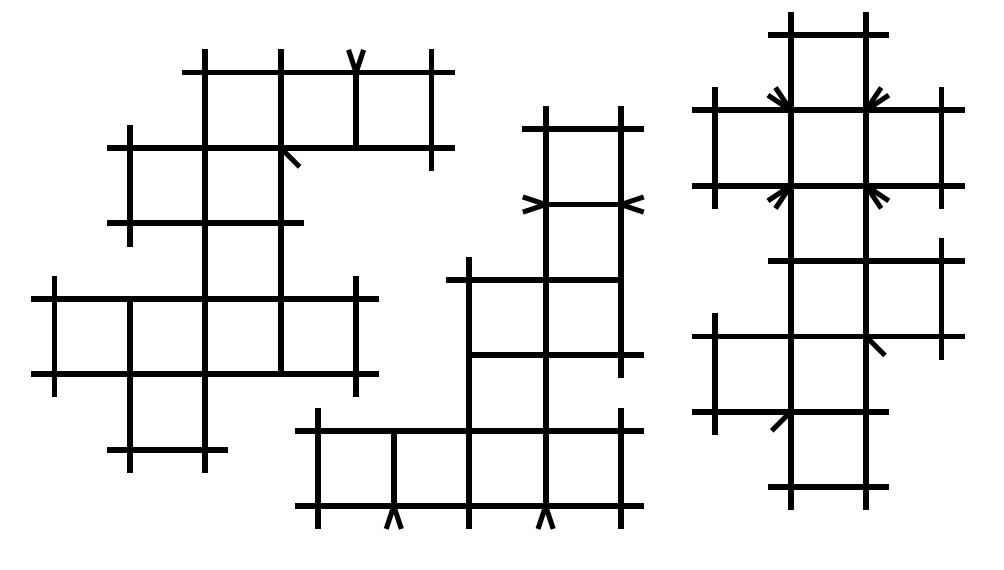
This time, we started hooking up our traintracks together.

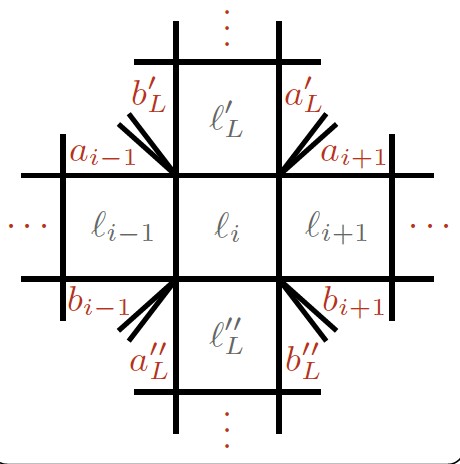
We call diagrams like these traintrack network diagrams, or traintrack networks for short. The original traintracks just went “one way”: one family, going higher in Calabi-Yau dimension the longer they got. These networks branch out, one traintrack leading to another and another.

In principle, these are much more complicated diagrams. But we find we can work with them in almost the same way. We can find the same “starting point” we had for the original traintracks, the set of integrals used to find the Calabi-Yau manifold. We’ve even got more reliable tricks, a method recently honed by some friends of ours that consistently find a Calabi-Yau manifold inside the original traintracks.

Surprisingly, though, this isn’t enough.

It works for one type of traintrack network, a so-called “cross diagram” like this:

But for other diagrams, if the network branches any more, the trick stops working. We still get an answer, but that answer is some more general space, not just a Calabi-Yau manifold.

That doesn’t mean that these general traintrack networks don’t involve Calabi-Yaus at all, mind you: it just means this method doesn’t tell us one way or the other. It’s also possible that simpler versions of these diagrams, involving fewer particles, will once again involve Calabi-Yaus. This is the case for some similar diagrams in two dimensions. But it’s starting to raise a question: how special are the Calabi-Yau related diagrams? How general do we expect them to be?

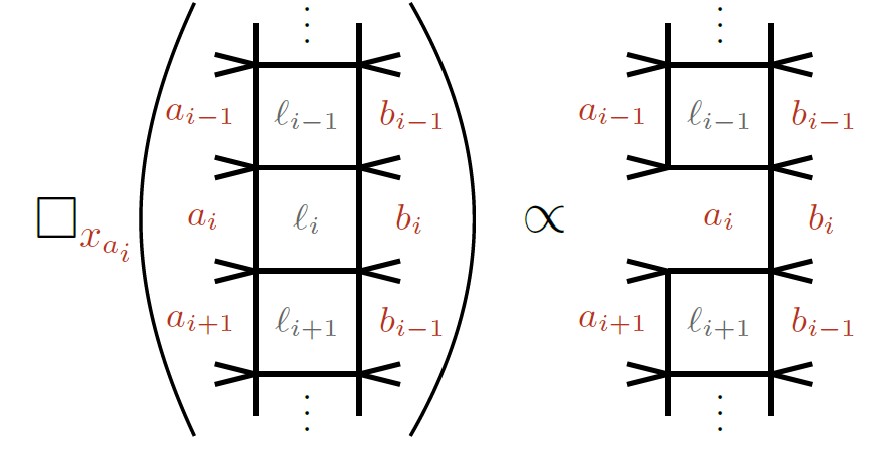
Another fun thing we noticed has to do with differential equations. There are equations that relate one diagram to another simpler one. We’ve used them in the past to build up “ladders” of diagrams, relating each picture to one with one of its boxes “deleted”. We noticed, playing with these traintrack networks, that these equations do a bit more than we thought. “Deleting” a box can make a traintrack short, but it can also chop a traintrack in half, leaving two “dangling” pieces, one on either side.

This reminded me of an important point, one we occasionally lose track of. The best-studied diagrams related to Calabi-Yaus are called “sunrise” diagrams. If you squish together a loop in one of those diagrams, the whole diagram squishes together, becoming much simpler. Because of that, we’re used to thinking of these as diagrams with a single “geometry”, one that shows up when you don’t “squish” anything.

Traintracks, and traintrack networks, are different. “Squishing” the diagram, or “deleting” a box, gives you a simpler diagram, but not much simpler. In particular, the new diagram will still contain traintracks, and traintrack networks. That means that we really should think of each traintrack network not just as one “top geometry”, but of a collection of geometries, different Calabi-Yaus that break into different combinations of Calabi-Yaus in different ways. It’s something we probably should have anticipated, but the form these networks take is a good reminder, one that points out that we still have a lot to do if we want to understand these diagrams.

Solutions and Solutions

The best misunderstandings are detective stories. You can notice when someone is confused, but digging up why can take some work. If you manage, though, you learn much more than just how to correct the misunderstanding. You learn something about the words you use, and the assumptions you make when using them.

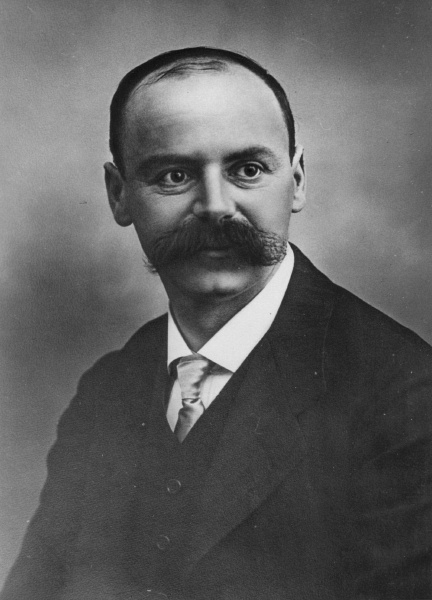
Recently, someone was telling me about a book they’d read on Karl Schwarzschild. Schwarzschild is famous for discovering the equations that describe black holes, based on Einstein’s theory of gravitation. To make the story more dramatic, he did so only shortly before dying from a disease he caught fighting in the first World War. But this person had the impression that Schwarzschild had done even more. According to this person, the book said that Schwarzschild had done something to prove Einstein’s theory, or to complete it.

Another Schwarzschild accomplishment: that mustache

At first, I thought the book this person had read was wrong. But after some investigation, I figured out what happened.

The book said that Schwarzschild had found the first exact solution to Einstein’s equations. That’s true, and as a physicist I know precisely what it means. But I now realize that the average person does not.

In school, the first equations you solve are algebraic, x+y=z. Some equations, like x^2=4, have solutions. Others, like x^2=-4, seem not to, until you learn about new types of numbers that solve them. Either way, you get used to equations being like a kind of puzzle, a question for which you need to find an answer.

If you’re thinking of equations like that, then it probably sounds like Schwarzschild “solved the puzzle”. If Schwarzschild found the first solution to Einstein’s equation, that means that Einstein did not. That makes it sound like Einstein’s work was incomplete, that he had asked the right question but didn’t yet know the right answer.

Einstein’s equations aren’t algebraic equations, though. They’re differential equations. Instead of equations for a variable, they’re equations for a mathematical function, a formula that, in this case, describes the curvature of space and time.

Scientists in many fields use differential equations, but they use them in different ways. If you’re a chemist or a biologist, it might be that you’re most used to differential equations with simple solutions, like sines, cosines, or exponentials. You learn how to solve these equations, and they feel a bit like the algebraic ones: you have a puzzle, and then you solve the puzzle.

Other fields, though, have tougher differential equations. If you’re a physicist or an engineer, you’ve likely met differential equations that you can’t treat in this way. If you’re dealing with fluid mechanics, or general relativity, or even just Newtonian gravity in an odd situation, you can’t usually solve the problem by writing down known functions like sines and cosines.

That doesn’t mean you can’t solve the problem at all, though!

Even if you can’t write down a solution to a differential equation with sines and cosines, a solution can still exist. (In some cases, we can even prove a solution exists!) It just won’t be written in terms of sines and cosines, or other functions you’ve learned in school. Instead, the solution will involve some strange functions, functions no-one has heard of before.

If you want, you can make up names for those functions. But unless you’re going to classify them in a useful way, there’s not much point. Instead, you work with these functions by approximation. You calculate them in a way that doesn’t give you the full answer, but that does let you estimate how close you are. That’s good enough to give you numbers, which in turn is good enough to compare to experiments. With just an approximate solution, like this, Einstein could check if his equations described the orbit of Mercury.

Once you know you can find these approximate solutions, you have a different perspective on equations. An equation isn’t just a mysterious puzzle. If you can approximate the solution, then you already know how to solve that puzzle. So we wouldn’t think of Einstein’s theory as incomplete because he was only able to find approximate solutions: for a theory as complicated as Einstein’s, that’s perfectly normal. Most of the time, that’s all we need.

But it’s still pretty cool when you don’t have to do this. Sometimes, we can not just approximate, but actually “write down” the solution, either using known functions or well-classified new ones. We call a solution like that an analytic solution, or an exact solution.

That’s what Schwarzschild managed. These kinds of exact solutions often only work in special situations, and Schwarzschild’s is no exception. His Schwarzschild solution works for matter in a special situation, arranged in a perfect sphere. If matter happened to be arranged in that way, then the shape of space and time would be exactly as Schwarzschild described it.

That’s actually pretty cool! Einstein’s equations are complicated enough that no-one was sure that there were any solutions like that, even in very special situations. Einstein expected it would be a long time until they could do anything except approximate solutions.

(If Schwarzschild’s solution only describes matter arranged in a perfect sphere, why do we think it describes real black holes? This took later work, by people like Roger Penrose, who figured out that matter compressed far enough will always find a solution like Schwarzschild’s.)

Schwarzschild intended to describe stars with his solution, or at least a kind of imaginary perfect star. What he found was indeed a good approximation to real stars, but also the possibility that a star shoved into a sufficiently small space would become something weird and new, something we would come to describe as a black hole. That’s a pretty impressive accomplishment, especially for someone on the front lines of World War One. And if you know the difference between an exact solution and an approximate one, you have some idea of what kind of accomplishment that is.

Reader Poll: Considering a Move to Substack

This blog is currently hosted on a site called WordPress.com. When I started the blog, I picked WordPress mostly just because it was easy and free. (Since then I started paying them money, both to remove ads and to get a custom domain, 4gravitons.com.)

Now, the blog is more popular, and you guys access it in a wide variety of ways. 333 of you are other users of WordPress.com: WordPress has a “Reader” tab that lets users follow other blogs through the site. (I use that tab to keep up with a few of the blogs in my Blogroll.) 258 of you instead get a weekly email: this is a service WordPress.com offers, letting people sign up by email to the blog. Others follow on social media: on Twitter, Facebook, and Tumblr.

(Are there other options? If someone’s figured out how to follow with an RSS feed, or wants me to change something so they can do that, let me know in the comments!)

Recently, I’ve gotten a bit annoyed with the emails WordPress sends out. The problem is that they don’t seem to handle images in a sensible way: I can scale an image to fit in a blog post, but in the email the image is always full-size, sometimes taking up the entire screen.

Last year, someone reached out to me from Substack.com, trying to recruit me to switch to their site. Substack is a (increasingly popular) blogging platform, focused on email newsletters. The whole site is built around the idea that posts are emailed to subscribers, with a simplified layout that makes that feasible and consistent. Like WordPress, they have a system where people can follow the blog through a Substack account, and the impression I get is that a lot of people use it, browsing topics they find interesting.

(Substack also has a system for paid subscribers. That isn’t mandatory, and partly due to recent events I’m not expecting to use it.)

Since Substack is built for emails, I’m guessing it would solve the issue I’ve been having with images. It would also let more people discover the blog via the Substack app. On the other hand, Substack allows a lot less customization. I wouldn’t be able to have the cute pull-down menus from the top of the blog, or the Feynman diagram background. I don’t think I could have the Tag cloud or the Categories filter.

Most importantly, though, I don’t want to lose long-term readers. I don’t know if some of you would have more trouble accessing Substack than WordPress, or if some really prefer to follow here.

One option is that I use both sites, at least for a bit. There are services built for cross-posting, that let a post on Substack automatically get posted on WordPress as well. I might do that temporarily (to make sure everyone has enough warning to transfer) or permanently (if there are people who really would never use Substack).

(I also might end up making an institutional web page with some of the useful educational guides, once I’ve got a permanent job. That could cover some features that Substack can’t.)

I wanted to do a couple polls, to get a feeling for your opinions. The first is a direct yes or no: do you prefer I stay at WordPress, prefer I switch to Substack, or don’t care either way. (For example, if you follow me via Facebook, you’ll get a link every week regardless.) The second poll asks about more detailed concerns, and you can pick as many entries as you want to give me a feeling for what matters to you. Please, if you read the blog at all regularly, fill out both polls: I want to know what you think!

Learning for a Living

It’s a question I’ve now heard several times, in different forms. People hear that I’ll be hired as a researcher at an institute of theoretical physics, and they ask, “what, exactly, are they paying you to research?”

The answer, with some caveats: “Whatever I want.”

When a company hires a researcher, they want to accomplish specific things: to improve their products, to make new ones, to cut down on fraud or out-think the competition. Some government labs are the same: if you work for NIST, for example, your work should contribute in some way to achieving more precise measurements and better standards for technology.

Other government labs, and universities, are different. They pursue basic research, research not on any specific application but on the general principles that govern the world. Researchers doing basic research are given a lot of freedom, and that freedom increases as their careers go on.

As a PhD student, a researcher is a kind of apprentice, working for their advisor. Even then, they have some independence: an advisor may suggest projects, but PhD students usually need to decide how to execute them on their own. In some fields, there can be even more freedom: in theoretical physics, it’s not unusual for the more independent students to collaborate with other people than just their advisor.

Postdocs, in turn, have even more freedom. In some fields they get hired to work on a specific project, but they tend to have more freedom as to how to execute it than a PhD student would. Other fields give them more or less free rein: in theoretical physics, a postdoc will have some guidance, but often will be free to work on whatever they find interesting.

Professors, and other long-term researchers, have the most freedom of all. Over the climb from PhD to postdoc to professor, researchers build judgement, demonstrating a track record for tackling worthwhile scientific problems. Universities, and institutes of basic research, trust that judgement. They hire for that judgement. They give their long-term researchers free reign to investigate whatever questions they think are valuable.

In practice, there are some restrictions. Usually, you’re supposed to research in a particular field: at an institute for theoretical physics, I should probably research theoretical physics. (But that can mean many things: one of my future colleagues studies the science of cities.) Further pressure comes from grant funding, money you need to hire other researchers or buy equipment that can come with restrictions attached. When you apply for a grant, you have to describe what you plan to do. (In practice, grant agencies are more flexible about this than you might expect, allowing all sorts of changes if you have a good reason…but you still can’t completely reinvent yourself.) Your colleagues themselves also have an impact: it’s much easier to work on something when you can walk down the hall and ask an expert when you get stuck. It’s why we seek out colleagues who care about the same big questions as we do.

Overall, though, research is one of the free-est professions there is. If you can get a job learning for a living, and do it well enough, then people will trust your judgement. They’ll set you free to ask your own questions, and seek your own answers.