
Monthly Archives: November 2020

A Taste of Normal

I grew up in the US. I’ve roamed over the years, but each year I’ve managed to come back around this time. My folks throw the kind of Thanksgiving you see in movies, a table overflowing with turkey and nine kinds of pie.

This year, obviously, is different. No travel, no big party. Still, I wanted to capture some of the feeling here in my cozy Copenhagen apartment. My wife and I baked mini-pies instead, a little feast just for us two.
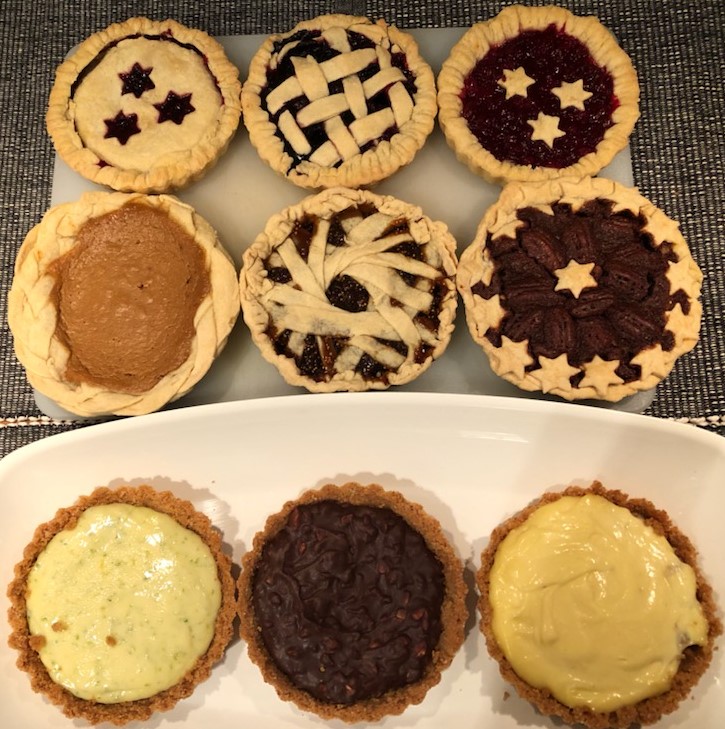
In these weird times, it’s good to have the occasional taste of normal, a dose of tradition to feel more at home. That doesn’t just apply to personal life, but to academic life as well.

One tradition among academics is the birthday conference. Often timed around a 60th birthday, birthday conferences are a way to celebrate the achievements of professors who have made major contributions to a field. There are talks by their students and close collaborators, filled with stories of the person being celebrated.

Last week was one such conference, in honor of one of the pioneers of my field, Dirk Kreimer. The conference was Zoom-based, and it was interesting to compare with the other Zoom conferences I’ve seen this year. One thing that impressed me was how they handled the “social side” of the conference. Instead of a Slack space like the other conferences, they used a platform called Gather. Gather gives people avatars on a 2D map, mocked up to look like an old-school RPG. Walk close to a group of people, and it lets you video chat with them. There are chairs and tables for private conversations, whiteboards to write on, and in this case even a birthday card to sign.

I didn’t get a chance to try Gather. My guess is it’s a bit worse than Slack for some kinds of discussion. Start a conversation in a Slack channel and people can tune in later from other time zones, each posting new insights and links to references. It’s a good way to hash out an idea.

But a birthday conference isn’t really about hashing out ideas. It’s about community and familiarity, celebrating people we care about. And for that purpose, Gather seems great. You want that little taste of normalcy, of walking across the room and seeing a familiar face, chatting with the folks you keep seeing year after year.

I’ve mused a bit about what it takes to do science when we can’t meet in person. Part of that is a question of efficiency: what does it take it get research done? But if we focus too much on that, we might forget the role of culture. Scientists are people, we form a community, and part of what we value is comfort and familiarity. Keeping that community alive means not just good research discussions, but traditions as well, ways of referencing things we’ve done to carry forward to new circumstances. We will keep changing, our practices will keep evolving. But if we want those changes to stick, we should tie them to the past too. We should keep giving people those comforting tastes of normal.

Science and Its Customers

In most jobs, you know who you’re working for.

A chef cooks food, and people eat it. A tailor makes clothes, and people wear them. An artist has an audience, an engineer has end users, a teacher has students. Someone out there benefits directly from what you do. Make them happy, and they’ll let you know. Piss them off, and they’ll stop hiring you.

Science benefits people too…but most of its benefits are long-term. The first person to magnetize a needle couldn’t have imagined worldwide electronic communication, and the scientists who uncovered quantum mechanics couldn’t have foreseen transistors, or personal computers. The world benefits just by having more expertise in it, more people who spend their lives understanding difficult things, and train others to understand difficult things. But those benefits aren’t easy to see for each individual scientist. As a scientist, you typically don’t know who your work will help, or how much. You might not know for years, or even decades, what impact your work will have. Even then, it will be difficult to tease out your contribution from the other scientists of your time.

We can’t ask the customers of the future to pay for the scientists of today. (At least, not straightforwardly.) In practice, scientists are paid by governments and foundations, groups trying on some level to make the future a better place. Instead of feedback from customers we get feedback from each other. If our ideas get other scientists excited, maybe they’ll matter down the road.

This is a risky thing to do, of course. Governments, foundations, and scientists can’t tell the future. They can try to act in the interests of future generations, but they might just act for themselves instead. Trying to plan ahead like this makes us prey to all the cognitive biases that flesh is heir to.

But we don’t really have an alternative. If we want to have a future at all, if we want a happier and more successful world, we need science. And if we want science, we can’t ask its real customers, the future generations, to choose whether to pay for it. We need to work for the smiles on our colleagues faces and the checks from government grant agencies. And we need to do it carefully enough that at the end of the day, we still make a positive difference.

Truth Doesn’t Have to Break the (Word) Budget

Imagine you saw this headline:

Scientists Say They’ve Found the Missing 40 Percent of the Universe’s Matter

It probably sounds like they’re talking about dark matter, right? And if scientists found dark matter, that could be a huge discovery: figuring out what dark matter is made of is one of the biggest outstanding mysteries in physics. Still, maybe that 40% number makes you a bit suspicious…

Now, read this headline instead:

Astronomers Have Finally Found Most of The Universe’s Missing Visible Matter

Visible matter! Ah, what a difference a single word makes!

These are two articles, the first from this year and the second from 2017, talking about the same thing. Leave out dark matter and dark energy, and the rest of the universe is made of ordinary protons, neutrons, and electrons. We sometimes call that “visible matter”, but that doesn’t mean it’s easy to spot. Much of it lingers in threads of gas and dust between galaxies, making it difficult to detect. These two articles are about astronomers who managed to detect this matter in different ways. But while the articles cover the same sort of matter, one headline is a lot more misleading.

Now, I know science writing is hard work. You can’t avoid misleading your readers, if only a little, because you can never include every detail. Introduce too many new words and you’ll use up your “vocabulary budget” and lose your audience. I also know that headlines get tweaked by editors at the last minute to maximize “clicks”, and that news that doesn’t get enough “clicks” dies out, replaced by news that does.

But that second headline? It’s shorter than the first. They were able to fit that crucial word “visible” in, without breaking the budget. And while I don’t have the data, I doubt the first headline was that much more viral. They could have afforded to get this right, if they wanted to.

Read each article further, and you see the same pattern. The 2020 article does mention visible matter in the first sentence at least, so they don’t screw that one up completely. But another important detail never gets mentioned.

See, you might be wondering, if one of these articles is from 2017 and the other is from 2020, how are they talking about the same thing? If astronomers found this matter already in 2017, how did they find it again in 2020?

There’s a key detail that the 2017 article mentions and the 2020 article leaves out. Here’s a quote from the 2017 article, emphasis mine:

We now have our first solid piece of evidence that this matter has been hiding in the delicate threads of cosmic webbing bridging neighbouring galaxies, right where the models predicted.

This “missing” matter was expected to exist, was predicted by models to exist. It just hadn’t been observed yet. In 2017, astronomers detected some of this matter indirectly, through its effect on the Cosmic Microwave Background. In 2020, they found it more directly, through X-rays shot out from the gases themselves.

Once again, the difference is just a short phrase. By saying “right where the models predicted”, the 2017 article clears up an important point, that this matter wasn’t a surprise. And all it took was five words.

These little words and phrases make a big difference. If you’re writing about science, you will always face misunderstandings. But if you’re careful and clever, you can clear up the most obvious ones. With just a few well-chosen words, you can have a much better piece.

Discovering the Rules, Discovering the Consequences

Two big physics experiments consistently make the news. The Large Hadron Collider, or LHC, and the Laser Interferometer Gravitational-Wave Observatory, or LIGO. One collides protons, the other watches colliding black holes and neutron stars. But while this may make the experiments sound quite similar, their goals couldn’t be more different.

The goal of the LHC, put simply, is to discover the rules that govern reality. Should the LHC find a new fundamental particle, it will tell us something we didn’t know about the laws of physics, a newly discovered fact that holds true everywhere in the universe. So far, it has discovered the Higgs boson, and while that particular rule was expected we didn’t know the details until they were tested. Now physicists hope to find something more, a deviation from the Standard Model that hints at a new law of nature altogether.

LIGO, in contrast, isn’t really for discovering the rules of the universe. Instead, it discovers the consequences of those rules, on a grand scale. Even if we knew the laws of physics completely, we can’t calculate everything from those first principles. We can simulate some things, and approximate others, but we need experiments to tweak those simulations and test those approximations. LIGO fills that role. We can try to estimate how common black holes are, and how large, but LIGO’s results were still a surprise, suggesting medium-sized black holes are more common than researchers expected. In the future, gravitational wave telescopes might discover more of these kinds of consequences, from the shape of neutron stars to the aftermath of cosmic inflation.

There are a few exceptions for both experiments. The LHC can also discover the consequences of the laws of physics, especially when those consequences are very difficult to calculate, finding complicated arrangements of known particles, like pentaquarks and glueballs. And it’s possible, though perhaps not likely, that LIGO could discover something about quantum gravity. Quantum gravity’s effects are expected to be so small that these experiments won’t see them, but some have speculated that an unusually large effect could be detected by a gravitational wave telescope.

As scientists, we want to know everything we can about everything we find. We want to know the basic laws that govern the universe, but we also want to know the consequences of those laws, the story of how our particular universe came to be the way it is today. And luckily, we have experiments for both.