Tag Archives: theoretical physics

Which String Theorists Are You Complaining About?

Do string theorists have an unfair advantage? Do they have an easier time getting hired, for example?

In one of the perennial arguments about this on Twitter, Martin Bauer posted a bar chart of faculty hires in the US by sub-field. The chart was compiled by Erich Poppitz from data in the US particle physics rumor mill, a website where people post information about who gets hired where for the US’s quite small number of permanent theoretical particle physics positions at research universities and national labs. The data covers 1994 to 2017, and shows one year, 1999, when there were more string theorists hired than all other topics put together. The years around then also had many string theorists hired, but the proportion starts falling around the mid 2000’s…around when Lee Smolin wrote a book, The Trouble With Physics, arguing that string theorists had strong-armed their way into academic dominance. After that, the percentage of string theorists falls, oscillating between a tenth and a quarter of total hires.

Judging from that, you get the feeling that string theory’s critics are treating a temporary hiring fad as if it was a permanent fact. The late 1990’s were a time of high-profile developments in string theory that excited a lot of people. Later, other hiring fads dominated, often driven by experiments: I remember when the US decided to prioritize neutrino experiments and neutrino theorists had a much easier time getting hired, and there seem to be similar pushes now with gravitational waves, quantum computing, and AI.

Thinking about the situation in this way, though, ignores what many of the critics have in mind. That’s because the “string” column on that bar chart is not necessarily what people think of when they think of string theory.

If you look at the categories on Poppitz’s bar chart, you’ll notice something odd. “String” its itself a category. Another category, “lattice”, refers to lattice QCD, a method to find the dynamics of quarks numerically. The third category, though, is a combination of three things “ph/th/cosm”.

“Cosm” here refers to cosmology, another sub-field. “Ph” and “th” though aren’t really sub-fields. Instead, they’re arXiv categories, sections of the website arXiv.org where physicists post papers before they submit them to journals. The “ph” category is used for phenomenology, the type of theoretical physics where people try to propose models of the real world and make testable predictions. The “th” category is for “formal theory”, papers where theoretical physicists study the kinds of theories they use in more generality and develop new calculation methods, with insights that over time filter into “ph” work.

“String”, on the other hand, is not an arXiv category. When string theorists write papers, they’ll put them into “th” or “ph” or another relevant category (for example “gr-qc”, for general relativity and quantum cosmology). This means that when Poppitz distinguishes “ph/th/cosm” from “string”, he’s being subjective, using his own judgement to decide who counts as a string theorist.

So who counts as a string theorist? The simplest thing to do would be to check if their work uses strings. Failing that, they could use other tools of string theory and its close relatives, like Calabi-Yau manifolds, M-branes, and holography.

That might be what Poppitz was doing, but if he was, he was probably missing a lot of the people critics of string theory complain about. He even misses many people who describe themselves as string theorists. In an old post of mine I go through the talks at Strings, string theory’s big yearly conference, giving them finer-grained categories. The majority don’t use anything uniquely stringy.

Instead, I think critics of string theory have two kinds of things in mind.

First, most of the people who made their reputations on string theory are still in academia, and still widely respected. Some of them still work on string theory topics, but many now work on other things. Because they’re still widely respected, their interests have a substantial influence on the field. When one of them starts looking at connections between theories of two-dimensional materials, you get a whole afternoon of talks at Strings about theories of two-dimensional materials. Working on those topics probably makes it a bit easier to get a job, but also, many of the people working on them are students of these highly respected people, who just because of that have an easier time getting a job. If you’re a critic of string theory who thinks the founders of the field led physics astray, then you probably think they’re still leading physics astray even if they aren’t currently working on string theory.

Second, for many other people in physics, string theorists are their colleagues and friends. They’ll make fun of trends that seem overhyped and under-thought, like research on the black hole information paradox or the swampland, or hopes that a slightly tweaked version of supersymmetry will show up soon at the LHC. But they’ll happily use ideas developed in string theory when they prove handy, using supersymmetric theories to test new calculation techniques, string theory’s extra dimensions to inspire and ground new ideas for dark matter, or the math of strings themselves as interesting shortcuts to particle physics calculations. String theory is available as reference to these people in a way that other quantum gravity proposals aren’t. That’s partly due to familiarity and shared language (I remember a talk at Perimeter where string theorists wanted to learn from practitioners from another area and the discussion got bogged down by how they were using the word “dimension”), but partly due to skepticism of the various alternate approaches. Most people have some idea in their heads of deep problems with various proposals: screwing up relativity, making nonsense out of quantum mechanics, or over-interpreting on limited evidence. The most commonly believed criticisms are usually wrong, with objections long-known to practitioners of the alternate approaches, and so those people tend to think they’re being treated unfairly. But the wrong criticisms are often simplified versions of correct criticisms, passed down by the few people who dig deeply into these topics, criticisms that the alternative approaches don’t have good answers to.

The end result is that while string theory itself isn’t dominant, a sort of “string friendliness” is. Most of the jobs aren’t going to string theorists in the literal sense. But the academic world string theorists created keeps turning. People still respect string theorists and the research directions they find interesting, and people are still happy to collaborate and discuss with string theorists. For research communities people are more skeptical of, it must feel very isolating, like the world is still being run by their opponents. But this isn’t the kind of hegemony that can be solved by a revolution. Thinking that string theory is a failed research program, and people focused on it should have a harder time getting hired, is one thing. Thinking that everyone who respects at least one former string theorist should have a harder time getting hired is a very different goal. And if what you’re complaining about is “string friendliness”, not actual string theorists, then that’s what you’re asking for.

The Nowhere String

Space and time seem as fundamental as anything can get. Philosophers like Immanuel Kant thought that they were inescapable, that we could not conceive of the world without space and time. But increasingly, physicists suspect that space and time are not as fundamental as they appear. When they try to construct a theory of quantum gravity, physicists find puzzles, paradoxes that suggest that space and time may just be approximations to a more fundamental underlying reality.

One piece of evidence that quantum gravity researchers point to are dualities. These are pairs of theories that seem to describe different situations, including with different numbers of dimensions, but that are secretly indistinguishable, connected by a “dictionary” that lets you interpret any observation in one world in terms of an equivalent observation in the other world. By itself, duality doesn’t mean that space and time aren’t fundamental: as I explained in a blog post a few years ago, it could still be that one “side” of the duality is a true description of space and time, and the other is just a mathematical illusion. To show definitively that space and time are not fundamental, you would want to find a situation where they “break down”, where you can go from a theory that has space and time to a theory that doesn’t. Ideally, you’d want a physical means of going between them: some kind of quantum field that, as it shifts, changes the world between space-time and not space-time.

What I didn’t know when I wrote that post was that physicists already knew about such a situation in 1993.

Back when I was in pre-school, famous string theorist Edward Witten was trying to understand something that others had described as a duality, and realized there was something more going on.

In string theory, particles are described by lengths of vibrating string. In practice, string theorists like to think about what it’s like to live on the string itself, seeing it vibrate. In that world, there are two dimensions, one space dimension back and forth along the string and one time dimension going into the future. To describe the vibrations of the string in that world, string theorists use the same kind of theory that people use to describe physics in our world: a quantum field theory. In string theory, you have a two-dimensional quantum field theory stuck “inside” a theory with more dimensions describing our world. You see that this world exists by seeing the kinds of vibrations your two-dimensional world can have, through a type of quantum field called a scalar field. With ten scalar fields, ten different ways you can push energy into your stringy world, you can infer that the world around you is a space-time with ten dimensions.

String theory has “extra” dimensions beyond the three of space and one of time we’re used to, and these extra dimensions can be curled up in various ways to hide them from view, often using a type of shape called a Calabi-Yau manifold. In the late 80’s and early 90’s, string theorists had found a similarity between the two-dimensional quantum field theories you get folding string theory around some of these Calabi-Yau manifolds and another type of two-dimensional quantum field theory related to theories used to describe superconductors. People called the two types of theories dual, but Witten figured out there was something more going on.

Witten described the two types of theories in the same framework, and showed that they weren’t two equivalent descriptions of the same world. Rather, they were two different ways one theory could behave.

The two behaviors were connected by something physical: the value of a quantum field called a modulus field. This field can be described by a number, and that number can be positive or negative.

When the modulus field is a large positive number, then the theory behaves like string theory twisted around a Calabi-Yau manifold. In particular, the scalar fields have many different values they can take, values that are smoothly related to each other. These values are nothing more or less than the position of the string in space and time. Because the scalars can take many values, the string can sit in many different places, and because the values are smoothly related to each other, the string can smoothly move from one place to another.

When the modulus field is a large negative number, then the theory is very different. What people thought of as the other side of the duality, a theory like the theories used to describe superconductors, is the theory that describes what happens when the modulus field is large and negative. In this theory, the scalars can no longer take many values. Instead, they have one option, one stable solution. That means that instead of there being many different places the string could sit, describing space, there are no different places, and thus no space. The string lives nowhere.

These are two very different situations, one with space and one without. And they’re connected by something physical. You could imagine manipulating the modulus field, using other fields to funnel energy into it, pushing it back and forth from a world with space to a world of nowhere. Much more than the examples I was aware of, this is a super-clear example of a model where space is not fundamental, but where it can be manipulated, existing or not existing based on physical changes.

We don’t know whether a model like this describes the real world. But it’s gratifying to know that it can be written down, that there is a picture, in full mathematical detail, of how this kind of thing works. Hopefully, it makes the idea that space and time are not fundamental sound a bit more reasonable.

Replacing Space-Time With the Space in Your Eyes

Nima Arkani-Hamed thinks space-time is doomed.

That doesn’t mean he thinks it’s about to be destroyed by a supervillain. Rather, Nima, like many physicists, thinks that space and time are just approximations to a deeper reality. In order to make sense of gravity in a quantum world, seemingly fundamental ideas, like that particles move through particular places at particular times, will probably need to become more flexible.

But while most people who think space-time is doomed research quantum gravity, Nima’s path is different. Nima has been studying scattering amplitudes, formulas used by particle physicists to predict how likely particles are to collide in particular ways. He has been trying to find ways to calculate these scattering amplitudes without referring directly to particles traveling through space and time. In the long run, the hope is that knowing how to do these calculations will help suggest new theories beyond particle physics, theories that can’t be described with space and time at all.

Ten years ago, Nima figured out how to do this in a particular theory, one that doesn’t describe the real world. For that theory he was able to find a new picture of how to calculate scattering amplitudes based on a combinatorical, geometric space with no reference to particles traveling through space-time. He gave this space the catchy name “the amplituhedron“. In the years since, he found a few other “hedra” describing different theories.

Now, he’s got a new approach. The new approach doesn’t have the same kind of catchy name: people sometimes call it surfaceology, or curve integral formalism. Like the amplituhedron, it involves concepts from combinatorics and geometry. It isn’t quite as “pure” as the amplituhedron: it uses a bit more from ordinary particle physics, and while it avoids specific paths in space-time it does care about the shape of those paths. Still, it has one big advantage: unlike the amplituhedron, Nima’s new approach looks like it can work for at least a few of the theories that actually describe the real world.

The amplituhedron was mysterious. Instead of space and time, it described the world in terms of a geometric space whose meaning was unclear. Nima’s new approach also describes the world in terms of a geometric space, but this space’s meaning is a lot more clear.

The space is called “kinematic space”. That probably still sounds mysterious. “Kinematic” in physics refers to motion. In the beginning of a physics class when you study velocity and acceleration before you’ve introduced a single force, you’re studying kinematics. In particle physics, kinematic refers to the motion of the particles you detect. If you see an electron going up and to the right at a tenth the speed of light, those are its kinematics.

Kinematic space, then, is the space of observations. By saying that his approach is based on ideas in kinematic space, what Nima is saying is that it describes colliding particles not based on what they might be doing before they’re detected, but on mathematics that asks questions only about facts about the particles that can be observed.

(For the experts: this isn’t quite true, because he still needs a concept of loop momenta. He’s getting the actual integrands from his approach, rather than the dual definition he got from the amplituhedron. But he does still have to integrate one way or another.)

Quantum mechanics famously has many interpretations. In my experience, Nima’s favorite interpretation is the one known as “shut up and calculate”. Instead of arguing about the nature of an indeterminately philosophical “real world”, Nima thinks quantum physics is a tool to calculate things people can observe in experiments, and that’s the part we should care about.

From a practical perspective, I agree with him. And I think if you have this perspective, then ultimately, kinematic space is where your theories have to live. Kinematic space is nothing more or less than the space of observations, the space defined by where things land in your detectors, or if you’re a human and not a collider, in your eyes. If you want to strip away all the speculation about the nature of reality, this is all that is left over. Any theory, of any reality, will have to be described in this way. So if you think reality might need a totally new weird theory, it makes sense to approach things like Nima does, and start with the one thing that will always remain: observations.

I Ain’t Afraid of No-Ghost Theorems

In honor of Halloween this week, let me say a bit about the spookiest term in physics: ghosts.

In particle physics, we talk about the universe in terms of quantum fields. There is an electron field for electrons, a gluon field for gluons, a Higgs field for Higgs bosons. The simplest fields, for the simplest particles, can be described in terms of just a single number at each point in space and time, a value describing how strong the field is. More complicated fields require more numbers.

Most of the fundamental forces have what we call vector fields. They’re called this because they are often described with vectors, lists of numbers that identify a direction in space and time. But these vectors actually contain too many numbers.

These extra numbers have to be tidied up in some way in order to describe vector fields in the real world, like the electromagnetic field or the gluon field of the strong nuclear force. There are a number of tricks, but the nicest is usually to add some extra particles called ghosts. Ghosts are designed to cancel out the extra numbers in a vector, leaving the right description for a vector field. They’re set up mathematically such that they can never be observed, they’re just a mathematical trick.

Mathematical tricks aren’t all that spooky (unless you’re scared of mathematics itself, anyway). But in physics, ghosts can take on a spookier role as well.

In order to do their job cancelling those numbers, ghosts need to function as a kind of opposite to a normal particle, a sort of undead particle. Normal particles have kinetic energy: as they go faster and faster, they have more and more energy. Said another way, it takes more and more energy to make them go faster. Ghosts have negative kinetic energy: the faster they go, the less energy they have.

If ghosts are just a mathematical trick, that’s fine, they’ll do their job and cancel out what they’re supposed to. But sometimes, physicists accidentally write down a theory where the ghosts aren’t just a trick cancelling something out, but real particles you could detect, without anything to hide them away.

In a theory where ghosts really exist, the universe stops making sense. The universe defaults to the lowest energy it can reach. If making a ghost particle go faster reduces its energy, then the universe will make ghost particles go faster and faster, and make more and more ghost particles, until everything is jam-packed with super-speedy ghosts unto infinity, never-ending because it’s always possible to reduce the energy by adding more ghosts.

The absence of ghosts, then, is a requirement for a sensible theory. People prove theorems showing that their new ideas don’t create ghosts. And if your theory does start seeing ghosts…well, that’s the spookiest omen of all: an omen that your theory is wrong.

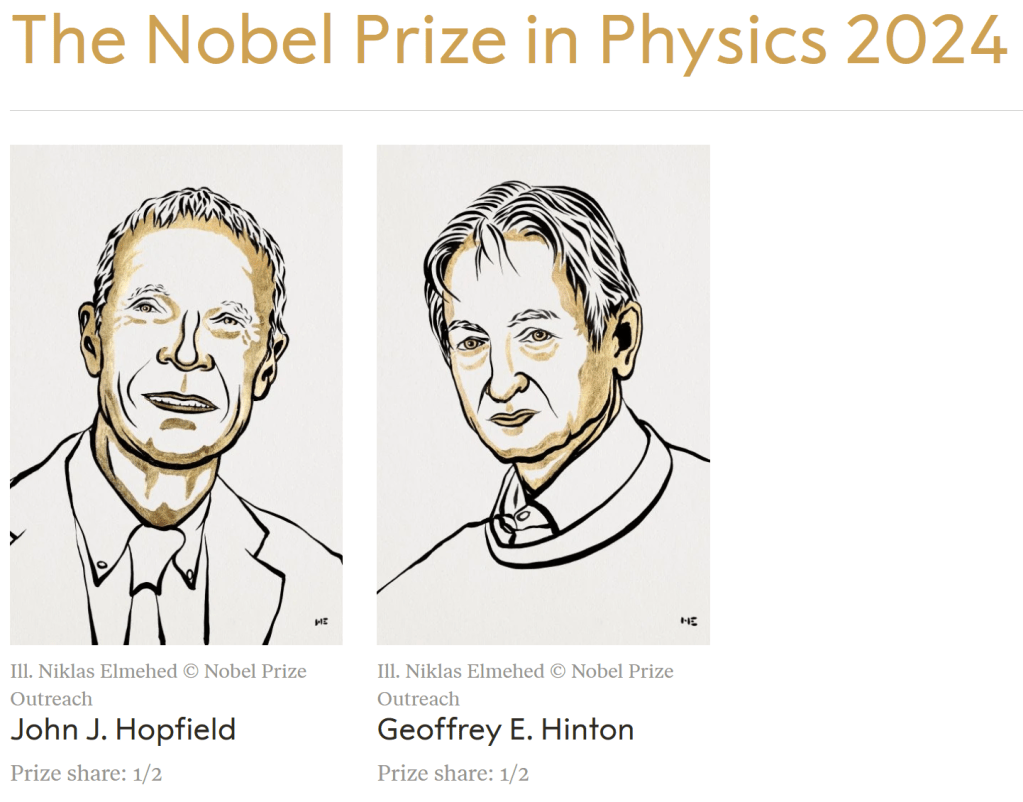
Congratulations to John Hopfield and Geoffrey Hinton!

The 2024 Physics Nobel Prize was announced this week, awarded to John Hopfield and Geoffrey Hinton for using physics to propose foundational ideas in the artificial neural networks used for machine learning.

If the picture above looks off-center, it’s because this is the first time since 2015 that the Physics Nobel has been given to two, rather than three, people. Since several past prizes bundled together disparate ideas in order to make a full group of three, it’s noteworthy that this year the committee decided that each of these people deserved 1/2 the prize amount, without trying to find one more person to water it down further.

Hopfield was trained as a physicist, working in the broad area known as “condensed matter physics”. Condensed matter physicists use physics to describe materials, from semiconductors to crystals to glass. Over the years, Hopfield started using this training less for the traditional subject matter of the field and more to study the properties of living systems. He moved from a position in the physics department of Princeton to chemistry and biology at Caltech. While at Caltech he started studying neuroscience and proposed what are now known as Hopfield networks as a model for how neurons store memory. Hopfield networks have very similar properties to a more traditional condensed matter system called a “spin glass”, and from what he knew about those systems Hopfield could make predictions for how his networks would behave. Those networks would go on to be a major inspiration for the artificial neural networks used for machine learning today.

Hinton was not trained as a physicist, and in fact has said that he didn’t pursue physics in school because the math was too hard! Instead, he got a bachelor’s degree in psychology, and a PhD in the at the time nascent field of artificial intelligence. In the 1980’s, shortly after Hopfield published his network, Hinton proposed a network inspired by a closely related area of physics, one that describes temperature in terms of the statistics of moving particles. His network, called a Boltzmann machine, would be modified and made more efficient over the years, eventually becoming a key part of how artificial neural networks are “trained”.

These people obviously did something impressive. Was it physics?

In 2014, the Nobel prize in physics was awarded to the people who developed blue LEDs. Some of these people were trained as physicists, some weren’t: Wikipedia describes them as engineers. At the time, I argued that this was fine, because these people were doing “something physicists are good at”, studying the properties of a physical system. Ultimately, the thing that ties together different areas of physics is training: physicists are the people who study under other physicists, and go on to collaborate with other physicists. That can evolve in unexpected directions, from more mathematical research to touching on biology and social science…but as long as the work benefits from being linked to physics departments and physics degrees, it makes sense to say it “counts as physics”.

By that logic, we can probably call Hopfield’s work physics. Hinton is more uncertain: his work was inspired by a physical system, but so are other ideas in computer science, like simulated annealing. Other ideas, like genetic algorithms, are inspired by biological systems: does that mean they count as biology?

Then there’s the question of the Nobel itself. If you want to get a Nobel in physics, it usually isn’t enough to transform the field. Your idea has to actually be tested against nature. Theoretical physics is its own discipline, with several ideas that have had an enormous influence on how people investigate new theories, ideas which have never gotten Nobels because the ideas were not intended, by themselves, to describe the real world. Hopfield networks and Boltzmann machines, similarly, do not exist as physical systems in the real world. They exist as computer simulations, and it is those computer simulations that are useful. But one can simulate many ideas in physics, and that doesn’t tend to be enough by itself to get a Nobel.

Ultimately, though, I don’t think this way of thinking about things is helpful. The Nobel isn’t capable of being “fair”, there’s no objective standard for Nobel-worthiness, and not much reason for there to be. The Nobel doesn’t determine which new research gets funded, nor does it incentivize anyone (except maybe Brian Keating). Instead, I think the best way of thinking about the Nobel these days is a bit like Disney.

When Disney was young, its movies had to stand or fall on their own merits. Now, with so many iconic movies in its history, Disney movies are received in the context of that history. Movies like Frozen or Moana aren’t just trying to be a good movie by themselves, they’re trying to be a Disney movie, with all that entails.

Similarly, when the Nobel was young, it was just another award, trying to reward things that Alfred Nobel might have thought deserved rewarding. Now, though, each Nobel prize is expected to be “Nobel-like”, an analogy between each laureate and the laureates of the past. When new people are given Nobels the committee is on some level consciously telling a story, saying that these people fit into the prize’s history.

This year, the Nobel committee clearly wanted to say something about AI. There is no Nobel prize for computer science, or even a Nobel prize for mathematics. (Hinton already has the Turing award, the most prestigious award in computer science.) So to say something about AI, the Nobel committee gave rewards in other fields. In addition to physics, this year’s chemistry award went in part to the people behind AlphaFold2, a machine learning tool to predict what shapes proteins fold into. For both prizes, the committee had a reasonable justification. AlphaFold2 genuinely is an amazing advance in the chemistry of proteins, a research tool like nothing that came before. And the work of Hopfield and Hinton did lead ideas in physics to have an enormous impact on the world, an impact that is worth recognizing. Ultimately, though, whether or not these people should have gotten the Nobel doesn’t depend on that justification. It’s an aesthetic decision, one that (unlike Disney’s baffling decision to make live-action remakes of their most famous movies) doesn’t even need to impress customers. It’s a question of whether the action is “Nobel-ish” enough, according to the tastes of the Nobel committee. The Nobel is essentially expensive fanfiction of itself.

And honestly? That’s fine. I don’t think there’s anything else they could be doing at this point.

The Bystander Effect for Reviewers

I probably came off last week as a bit of an extreme “journal abolitionist”. This week, I wanted to give a couple caveats.

First, as a commenter pointed out, the main journals we use in my field are run by nonprofits. Physical Review Letters, the journal where we publish five-page papers about flashy results, is run by the American Physical Society. The Journal of High-Energy Physics, where we publish almost everything else, is run by SISSA, the International School for Advanced Studies in Trieste. (SISSA does use Springer, a regular for-profit publisher, to do the actual publishing.)

The journals are also funded collectively, something I pointed out here before but might not have been obvious to readers of last week’s post. There is an agreement, SCOAP3, where research institutions band together to pay the journals. Authors don’t have to pay to publish, and individual libraries don’t have to pay for subscriptions.

And this is a lot better than the situation in other fields, yeah! Though I’d love to quantify how much. I haven’t been able to find a detailed breakdown, but SCOAP3 pays around 1200 EUR per article published. What I’d like to do (but not this week) is to compare this to what other fields pay, as well as to publishing that doesn’t have the same sort of trapped audience, and to online-only free journals like SciPost. (For example, publishing actual physical copies of journals at this point is sort of a vanity thing, so maybe we should compare costs to vanity publishers?)

Second, there’s reviewing itself. Even without traditional journals, one might still want to keep peer review.

What I wanted to understand last week was what peer review does right now, in my field. We read papers fresh off the arXiv, before they’ve gone through peer review. Authors aren’t forced to update the arXiv with the journal version of their paper, if they want another version, even if that version was rejected by the reviewers, then they’re free to do so, and most of us wouldn’t notice. And the sort of in-depth review that happens in peer review also happens without it. When we have journal clubs and nominate someone to present a recent paper, or when we try to build on a result or figure out why it contradicts something we thought we knew, we go through the same kind of in-depth reading that (in the best cases) reviewers do.

But I think I’ve hit upon something review does that those kinds of informal things don’t. It gets us to speak up about it.

I presented at a journal club recently. I read through a bombastic new paper, figured out what I thought was wrong with it, and explained it to my colleagues.

But did I reach out to the author? No, of course not, that would be weird.

Psychologists talk about the bystander effect. If someone collapses on the street, and you’re the only person nearby, you’ll help. If you’re one of many, you’ll wait and see if someone else helps instead.

I think there’s a bystander effect for correcting people. If someone makes a mistake and publishes something wrong, we’ll gripe about it to each other. But typically, we won’t feel like it’s our place to tell the author. We might get into a frustrating argument, there wouldn’t be much in it for us, and it might hurt our reputation if the author is well-liked.

(People do speak up when they have something to gain, of course. That’s why when you write a paper, most of the people emailing you won’t be criticizing the science: they’ll be telling you you need to cite them.)

Peer review changes the expectations. Suddenly, you’re expected to criticize, it’s your social role. And you’re typically anonymous, you don’t have to worry about the consequences. It becomes a lot easier to say what you really think.

(It also becomes quite easy to say lazy stupid things, of course. This is why I like setups like SciPost, where reviews are made public even when the reviewers are anonymous. It encourages people to put some effort in, and it means that others can see that a paper was rejected for bad reasons and put less stock in the rejection.)

I think any new structure we put in place should keep this feature. We need to preserve some way to designate someone a critic, to give someone a social role that lets them let loose and explain why someone else is wrong. And having these designated critics around does help my field. The good criticisms get implemented in the papers, the authors put the new versions up on arXiv. Reviewing papers for journals does make our science better…even if none of us read the journal itself.

HAMLET-Physics 2024

Back in January, I announced I was leaving France and leaving academia. Since then, it hasn’t made much sense for me to go to conferences, even the big conference of my sub-field or the conference I organized.

I did go to a conference this week, though. I had two excuses:

  1. The conference was here in Copenhagen, so no travel required.
  2. The conference was about machine learning.

HAMLET-Physics, or How to Apply Machine Learning to Experimental and Theoretical Physics, had the additional advantage of having an amusing acronym. Thanks to generous support by Carlsberg and the Danish Data Science Academy, they could back up their choice by taking everyone on a tour of Kronborg (better known in the English-speaking world as Elsinore).

This conference’s purpose was to bring together physicists who use machine learning, machine learning-ists who might have something useful to say to those physicists, and other physicists who don’t use machine learning yet but have a sneaking suspicion they might have to at some point. As a result, the conference was super-interdisciplinary, with talks by people addressing very different problems with very different methods.

Interdisciplinary conferences are tricky. It’s easy for the different groups of people to just talk past each other: everyone shows up, gives the same talk they always do, socializes with the same friends they always meet, then leaves.

There were a few talks that hit that mold, and were so technical only a few people understood. But most were better. The majority of the speakers did really well at presenting their work in a way that would be understandable and even exciting to people outside their field, while still having enough detail that we all learned something. I was particularly impressed by Thea Aarestad’s keynote talk on Tuesday, a really engaging view of how machine learning can be used under the extremely tight time constraints LHC experiments need to decide whether to record incoming data.

For the social aspect, the organizers had a cute/gimmicky/machine-learning-themed solution. Based on short descriptions and our public research profiles, they clustered attendees, plotting the connections between them. They then used ChatGPT to write conversation prompts between any two people on the basis of their shared interests. In practice, this turned out to be amusing but totally unnecessary. We were drawn to speak to each other not by conversation prompts, but by a drive to learn from each other. “Why do you do it that way?” was a powerful conversation-starter, as was “what’s the best way to do this?” Despite the different fields, the shared methodologies gave us strong reasons to talk, and meant that people were very rarely motivated to pick one of ChatGPT’s “suggestions”.

Overall, I got a better feeling for how machine learning is useful in physics (and am planning a post on that in future). I also got some fresh ideas for what to do myself, and a bit of a picture of what the future holds in store.

Beyond Elliptic Polylogarithms in Oaxaca

Arguably my biggest project over the last two years wasn’t a scientific paper, a journalistic article, or even a grant application. It was a conference.

Most of the time, when scientists organize a conference, they do it “at home”. Either they host the conference at their own university, or rent out a nearby event venue. There is an alternative, though. Scattered around the world, often in out-of-the way locations, are places dedicated to hosting scientific conferences. These places accept applications each year from scientists arguing that their conference would best serve the place’s scientific mission.

One of these places is the Banff International Research Station in Alberta, Canada. Since 2001, Banff has been hosting gatherings of mathematicians from around the world, letting them focus on their research in an idyllic Canadian ski resort.

If you don’t like skiing, though, Banff still has you covered! They have “affiliate centers” elsewhere, with one elsewhere in Canada, one in China, two on the way in India and Spain…and one, that particularly caught my interest, in Oaxaca, Mexico.

Back around this time of year in 2022, I started putting a proposal together for a conference at the Casa Mathemática Oaxaca. The idea would be a conference discussing the frontier of the field, how to express the strange mathematical functions that live in Feynman diagrams. I assembled a big team of co-organizers, five in total. At the time, I wasn’t sure whether I could find a permanent academic job, so I wanted to make sure there were enough people involved that they could run the conference without me.

Followers of the blog know I did end up finding that permanent job…only to give it up. In the end, I wasn’t able to make it to the conference. But my four co-organizers were (modulo some delays in the Houston airport). The conference was this week, with the last few talks happening over the next few hours.

I gave a short speech via Zoom at the beginning of the conference, a mix of welcome and goodbye. Since then I haven’t had the time to tune in to the talks, but they’re good folks and I suspect they’re having good discussions.

I do regret that, near the end, I wasn’t able to give the conference the focus it deserved. There were people we really hoped to have, but who couldn’t afford the travel. I’d hoped to find a source of funding that could support them, but the plan fell through. The week after Amplitudes 2024 was also a rough time to have a conference in this field, with many people who would have attended not able to go to both. (At least they weren’t the same week, thanks to some flexibility on the part of the Amplitudes organizers!)

Still, it’s nice to see something I’ve been working on for two years finally come to pass, to hopefully stir up conversations between different communities and give various researchers a taste of one of Mexico’s most beautiful places. I still haven’t been to Oaxaca yet, but I suspect I will eventually. Danish companies do give at minimum five weeks of holiday per year, so I should get a chance at some point.

(Not At) Amplitudes 2024 at the IAS

For over a decade, I studied scattering amplitudes, the formulas particle physicists use to find the probability that particles collide, or scatter, in different ways. I went to Amplitudes, the field’s big yearly conference, every year from 2015 to 2023.

This year is different. I’m on the way out of the field, looking for my next steps. Meanwhile, Amplitudes 2024 is going full speed ahead at the Institute for Advanced Study in Princeton.

With poster art that is, as the kids probably don’t say anymore, “on fleek”

The talks aren’t live-streamed this year, but they are posting slides, and they will be posting recordings. Since a few of my readers are interested in new amplitudes developments, I’ve been paging through the posted slides looking for interesting highlights. So far, I’ve only seen slides from the first few days: I will probably write about the later talks in a future post.

Each day of Amplitudes this year has two 45-minute “review talks”, one first thing in the morning and the other first thing after lunch. I put “review talks” in quotes because they vary a lot, between talks that try to introduce a topic for the rest of the conference to talks that mostly focus on the speaker’s own research. Lorenzo Tancredi’s talk was of the former type, an introduction to the many steps that go into making predictions for the LHC, with a focus on those topics where amplitudeologists have made progress. The talk opens with the type of motivation I’d been writing in grant and job applications over the last few years (we don’t know most of the properties of the Higgs yet! To measure them, we’ll need to calculate amplitudes with massive particles to high precision!), before moving into a review of the challenges and approaches in different steps of these calculations. While Tancredi apologizes in advance that the talk may be biased, I found it surprisingly complete: if you want to get an idea of the current state of the “LHC amplitudes pipeline”, his slides are a good place to start.

Tancredi’s talk serves as introduction for a variety of LHC-focused talks, some later that day and some later in the week. Federica Devoto discussed high-energy quarks while Chiara Signorile-Signorile and George Sterman showed advances in handling of low-energy particles. Xiaofeng Xu has a program that helps predict symbol letters, the building-blocks of scattering amplitudes that can be used to reconstruct or build up the whole thing, while Samuel Abreu talked about a tricky state-of-the-art case where Xu’s program misses part of the answer.

Later Monday morning veered away from the LHC to focus on more toy-model theories. Renata Kallosh’s talk in particular caught my attention. This blog is named after a long-standing question in amplitudes: will the four-graviton amplitude in N=8 supergravity diverge at seven loops in four dimensions? This seemingly arcane question is deep down a question about what is actually required for a successful theory of quantum gravity, and in particular whether some of the virtues of string theory can be captured by a simpler theory instead. Answering the question requires a prodigious calculation, and the more “loops” are involved the more difficult it is. Six years ago, the calculation got to five loops, and it hasn’t passed that mark since then. That five-loop calculation gave some reason for pessimism, a nice pattern at lower loops that stopped applying at five.

Kallosh thinks she has an idea of what to expect. She’s noticed a symmetry in supergravity, one that hadn’t previously been taken into account. She thinks that symmetry should keep N=8 supergravity from diverging on schedule…but only in exactly four dimensions. All of the lower-loop calculations in N=8 supergravity diverged in higher dimensions than four, and it seems like with this new symmetry she understands why. Her suggestion is to focus on other four-dimensional calculations. If seven loops is still too hard, then dialing back the amount of supersymmetry from N=8 to something lower should let her confirm her suspicions. Already a while back N=5 supergravity was found to diverge later than expected in four dimensions. She wants to know whether that pattern continues.

(Her backup slides also have a fun historical point: in dimensions greater than four, you can’t get elliptical planetary orbits. So four dimensions is special for our style of life.)

Other talks on Monday included a talk by Zahra Zahraee on progress towards “solving” the field’s favorite toy model, N=4 super Yang-Mills. Christian Copetti talked about the work I mentioned here, while Meta employee François Charlton’s “review talk” dealt with his work applying machine learning techniques to “translate” between questions in mathematics and their answers. In particular, he reported progress with my current boss Matthias Wilhelm and frequent collaborator and mentor Lance Dixon on using transformers to guess high-loop formulas in N=4 super Yang-Mills. They have an interesting proof of principle now, but it will probably still be a while until they can use the method to predict something beyond the state of the art.

In the meantime at least they have some hilarious AI-generated images

Tuesday’s review by Ian Moult was genuinely a review, but of a topic not otherwise covered at the conference, that of “detector observables”. The idea is that rather than talking about which individual particles are detected, one can ask questions that make more sense in terms of the experimental setup, like asking about the amounts of energy deposited in different detectors. This type of story has gone from an idle observation by theorists to a full research program, with theorists and experimentalists in active dialogue.

Natalia Toro brought up that, while we say each particle has a definite spin, that may not actually be the case. Particles with so-called “continuous spins” can masquerade as particles with a definite integer spin at lower energies. Toro and Schuster promoted this view of particles ten years ago, but now can make a bit more sense of it, including understanding how continuous-spin particles can interact.

The rest of Tuesday continued to be a bit of a grab-bag. Yael Shadmi talked about applying amplitudes techniques to Effective Field Theory calculations, while Franziska Porkert talked about a Feynman diagram involving two different elliptic curves. Interestingly (well, to me at least), the curves never appear “together”, you can represent the diagram as a sum of terms involving one curve and terms involving the other, much simpler than it could have been!

Tuesday afternoon’s review talk by Iain Stewart was one of those “guest from an adjacent field” talks, in this case from an approach called SCET, and at first glance didn’t seem to do much to reach out to the non-SCET people in the audience. Frequent past collaborator of mine Andrew McLeod showed off a new set of relations between singularities of amplitudes, found by digging in to the structure of the equations discovered by Landau that control this behavior. He and his collaborators are proposing a new way to keep track of these things involving “minimal cuts”, a clear pun on the “maximal cuts” that have been of great use to other parts of the community. Whether this has more or less staying power than “negative geometries” remains to be seen.

Closing Tuesday, Shruti Paranjape showed there was more to discover about the simplest amplitudes, called “tree amplitudes”. By asking why these amplitudes are sometimes equal to zero, she was able to draw a connection to the “double-copy” structure that links the theory of the strong force and the theory of gravity. Johannes Henn’s talk noticed an intriguing pattern. A while back, I had looked into under which circumstances amplitudes were positive. Henn found that “positive” is an understatement. In a certain region, the amplitudes we were looking at turn out to not just be positive, but also always decreasing, and also with second derivative always positive. In fact, the derivatives appear to alternate, always with one sign or the other as one takes more derivatives. Henn is calling this unusual property “completely monotonous”, and trying to figure out how widely it holds.

Wednesday had a more mathematical theme. Bernd Sturmfels began with a “review talk” that largely focused on his own work on the space of curves with marked points, including a surprising analogy between amplitudes and the likelihood functions one needs to minimize in machine learning. Lauren Williams was the other “actual mathematician” of the day, and covered her work on various topics related to the amplituhedron.

The remaining talks on Wednesday were not literally by mathematicians, but were “mathematically informed”. Carolina Figueiredo and Hayden Lee talked about work with Nima Arkani-Hamed on different projects. Figueiredo’s talk covered recent developments in the “curve integral formalism”, a recent step in Nima’s quest to geometrize everything in sight, this time in the context of more realistic theories. The talk, which like those Nima gives used tablet-written slides, described new insights one can gain from this picture, including new pictures of how more complicated amplitudes can be built up of simpler ones. If you want to understand the curve integral formalism further, I’d actually suggest instead looking at Mark Spradlin’s slides from later that day. The second part of Spradlin’s talk dealt with an area Figueiredo marked for future research, including fermions in the curve integral picture. I confess I’m still not entirely sure what the curve integral formalism is good for, but Spradlin’s talk gave me a better idea of what it’s doing. (The first part of his talk was on a different topic, exploring the space of string-like amplitudes to figure out which ones are actually consistent.)

Hayden Lee’s talk mentions the emergence of time, but the actual story is a bit more technical. Lee and collaborators are looking at cosmological correlators, observables like scattering amplitudes but for cosmology. Evaluating these is challenging with standard techniques, but can be approached with some novel diagram-based rules which let the results be described in terms of the measurable quantities at the end in a kind of “amplituhedron-esque” way.

Aidan Herderschee and Mariana Carrillo González had talks on Wednesday on ways of dealing with curved space. Herderschee talked about how various amplitudes techniques need to be changed to deal with amplitudes in anti-de-Sitter space, with difference equations replacing differential equations and sum-by-parts relations replacing integration-by-parts relations. Carrillo González looked at curved space through the lens of a special kind of toy model theory called a self-dual theory, which allowed her to do cosmology-related calculations using a double-copy technique.

Finally, Stephen Sharpe had the second review talk on Wednesday. This was another “outside guest” talk, a discussion from someone who does Lattice QCD about how they have been using their methods to calculate scattering amplitudes. They seem to count the number of particles a bit differently than we do, I’m curious whether this came up in the question session.

Gravity-Defying Theories

Universal gravitation was arguably Newton’s greatest discovery. Newton realized that the same laws could describe the orbits of the planets and the fall of objects on Earth, that bodies like the Moon can be fully understood only if you take into account both the Earth and the Sun’s gravity. In a Newtonian world, every mass attracts every other mass in a tiny, but detectable way.

Einstein, in turn, explained why. In Einstein’s general theory of relativity, gravity comes from the shape of space and time. Mass attracts mass, but energy affects gravity as well. Anything that can be measured has a gravitational effect, because the shape of space and time is nothing more than the rules by which we measure distances and times. So gravitation really is universal, and has to be universal.

…except when it isn’t.

It turns out, physicists can write down theories with some odd properties. Including theories where things are, in a certain sense, immune to gravity.

The story started with two mathematicians, Shiing-Shen Chern and Jim Simons. Chern and Simons weren’t trying to say anything in particular about physics. Instead, they cared about classifying different types of mathematical space. They found a formula that, when added up over one of these spaces, counted some interesting properties of that space. A bit more specifically, it told them about the space’s topology: rough details, like the number of holes in a donut, that stay the same even if the space is stretched or compressed. Their formula was called the Chern-Simons Form.

The physicist Albert Schwarz saw this Chern-Simons Form, and realized it could be interpreted another way. He looked at it as a formula describing a quantum field, like the electromagnetic field, describing how the field’s energy varied across space and time. He called the theory describing the field Chern-Simons Theory, and it was one of the first examples of what would come to be known as topological quantum field theories.

In a topological field theory, every question you might want to ask can be answered in a topological way. Write down the chance you observe the fields at particular strengths in particular places, and you’ll find that the answer you get only depends on the topology of the space the fields occupy. The answers are the same if the space is stretched or squished together. That means that nothing you ask depends on the details of how you measure things, that nothing depends on the detailed shape of space and time. Your theory is, in a certain sense, independent of gravity.

Others discovered more theories of this kind. Edward Witten found theories that at first looked like they depend on gravity, but where the gravity secretly “cancels out”, making the theory topological again. It turned out that there were many ways to “twist” string theory to get theories of this kind.

Our world is for the most part not described by a topological theory, gravity matters! (Though it can be a good approximation for describing certain materials.) These theories are most useful, though, in how they allow physicists and mathematicians to work together. Physicists don’t have a fully mathematically rigorous way of defining most of their theories, just a series of approximations and an overall picture that’s supposed to tie them together. For a topological theory, though, that overall picture has a rigorous mathematical meaning: it counts topological properties! As such, topological theories allow mathematicians to prove rigorous results about physical theories. It means they can take a theory of quantum fields or strings that has a particular property that physicists are curious about, and find a version of that property that they can study in fully mathematical rigorous detail. It’s been a boon both to mathematicians interested in topology, and to physicists who want to know more about their theories.

So while you won’t have antigravity boots any time soon, theories that defy gravity are still useful!