Tag Archives: theoretical physics

Hexagon Functions – or, what is my new paper about?

I’ve got a new paper up on arXiv this week.

(For those of you unfamiliar with it, arXiv.org is a website where physicists, mathematicians, and researchers in related fields post their papers before submitting them to journals. It’s a cultural quirk of physics that probably requires a post in its own right at some point. Anyway…)

What’s it about? Well, the paper is titled Hexagon functions and the three-loop remainder function. Let’s go through that and figure out what it means.

When the paper refers to hexagon functions, it’s referring to functions used to describe situations with six particles involved. An important point to clarify here is that when counting the number of “particles involved”, we add together both the particles that go in and the particles that go out. So if three particles arrive somewhere, interact with each other in some complicated way, and then those three particles leave, that’s a six-particle process. Similarly, if two particles collide and four particles emerge, that’s also a six-particle process. (If you find the idea of more particles coming out than went in confusing, read this post.) Hexagon functions, then, can describe either of those processes.

What, specifically, are these functions being used for? Well, they’re being used to find the three-loop remainder function of N=4 super Yang-Mills.

N=4 super Yang-Mills is my favorite theory. If you haven’t read my posts on the subject, I encourage you to do so.

N=4 super Yang-Mills is so nice because it is so symmetric, and because it takes part in so many dualities. These two traits ended up being enough for Zvi Bern, Lance Dixon, and Vladimir Smirnov to propose an ansatz for all amplitudes in N=4 super Yang-Mills, called the BDS ansatz. (Amplitudes are how we calculate the probability of events occurring: for example, the probability of that “two particles going to four particles” situation I talked about earlier.)

Unfortunately, their formula was incomplete. While it was possible to prove that the formula was true for four-particle and five-particle processes, for six or more particles the formula failed. As it turned out though, it failed in a predictable way. All that was needed to fix it was to add something called the remainder function, the remaining part of the formula beyond the BDS ansatz.

The task, then, was to compute this remainder function.

I’ve talked before about how in quantum field theory, we calculate probabilities through increasingly complicated diagrams, keeping track of the complexity by counting the number of loops. The remainder function had already been computed up to two loops by working out these diagrams, but three looked to be considerably more difficult.

Luckily, we (myself, Lance Dixon, James Drummond, and Jeffrey Pennington) had a trick up our sleeves.

Formulas in N=4 super Yang-Mills have a property called maximal transcendentality. I’ve talked about transcendentality before:  essentially, it’s a way of counting how many powers of pi and logarithms are in your equations. Maximal transcendentality means that every part of the formula has a fixed, maximum number for its degree of transcendentality. In the case of the remainder function, this is two times the number of loops. Thus, the two-loop remainder function has degree of transcendentality four, so it can have pi to the fourth power in it, while the three-loop remainder function (the one that we calculated) has degree of transcendentality six, so it can have pi to the sixth power.

Of course, it can have lots of other expressions as well, which brings us back to the hexagon functions. By classifying the sort of functions that can appear in these formulas at each level of transcendentality, we find the basic building blocks that can show up in the remainder function. All we have to do then is ask what combinations of building blocks are allowed: which ones make good physics sense, for example, or which ones allow our formula to agree with the predictions of other researchers.

As it turns out, once you apply all the restrictions there is only one possible way to put the building blocks together that gives you a functioning formula. By process of elimination, this formula must be the correct three-loop six-point remainder function. Every extra constraint then serves as a check that nothing went wrong and that the formula is sound. Without calculating a single Feynman diagram, we’ve gotten our result!

Just to give you an idea of how complicated this result is, in order to write the formula out fully would take 800 pages. We’ve got shorter ways to summarize it, but perhaps it would be better to give a picture. The formula depends on three variables, called u, v, and w. To show how the formula behaves when all three variables change, here’s a plot of the formula in the variables u and v, for a series of different values of w.

wstacksheaves

Without our various shortcuts to generate this formula, it would have taken an extraordinarily long amount of time. Luckily, N=4 super Yang-Mills’s nice properties save the day, and allow us to achieve what I hope you won’t mind me calling a truly impressive result.

Talks, and what they’re good for

It’s an ill-kept secret that basically everyone in academia is a specialist. Nobody is just a “physicist”, or just a “high energy theorist”, or even just a “string theorist”. Even when I describe myself as something as specific as an “amplitudeologist”, I’m still over-generalizing: there’s a lot of amplitudes work out there that I would be hard-pressed to understand, and even harder-pressed to reproduce.

In the end, each of us is only going to understand a small subset of the vastness of our subject. This is problematic when it comes to attending talks.

Rarely, we get to attend talks about something we completely understand. Generally, we’re the ones giving those talks. The rest of the time, even at conferences for people of our particular specialty, we’re going to miss some fraction of the content, either because we don’t understand it or because we don’t find it interesting.

The question then becomes, why attend the talk in the first place? Why spend an hour of your time when you’re not getting an hour’s worth of content?

There are a couple reasons, of varying levels of plausibility.

One is that it’s always nice to know what other subfields are doing. It lets one feel connected to one’s compatriots, and it helps one navigate one’s career. That said, it’s unclear whether going to talks is really the best way of doing this. If you just want to know what other people are doing, you can always just watch to see what they publish. That doesn’t take an hour, unless you’re really dedicated to wasting time.

A more important benefit is increasing levels of familiarity. These days, I can productively pay attention to the first quarter of a talk, half if it’s particularly good. When I first got to grad school, I’d probably tune out after the first five minutes. The more talks you see on a subject, the more of the talk makes sense, and the more you get out of it. That’s part of why even fairly specialized people who are further along in their careers can talk on a wide range of subjects: often, they’ve intentionally kept themselves aware of what’s going on in other subfields, going to talks, reading papers, and engaging in conversation. This is a valuable end goal, since there is some truth to the hype about the benefits of interdisciplinarity in providing unconventional solutions to problems. That said, this is a gradual process. The benefit of one individual talk is tiny, and it doesn’t seem worth an hour of time. Much like exercise, it’s the habit that provides the benefit, not any individual session.

So in the end, talks are almost always unsatisfying. But we keep going to them, because they make us better scientists.

Duality: Find out what it means to me

There’s a cute site out there called Why String Theory. Started by Oxford and the Royal Society, Why String Theory contains lots of concise and well-illustrated explanations of string theory, and it even wades into some of the more complex topics like AdS/CFT and string dualities in general. Their explanation of dualities is a nice introduction to why dualities matter in string theory, but I don’t think it does a very good job of explaining what a duality actually is or how one works. As your fearless host, I’m confident that I can do better.

Why String Theory defines dualities as when “different mathematical theories describe the same physics.” How does that work, though? In what sense are the theories different, if they describe the same thing? And if they describe the same thing, why do we need both of them?

1563px-face_or_vase_ata_01.svg_

You’ve probably seen the above image before, or one much like it. Look at it one way, and you see a goblet. Another, and you see two faces.

Now imagine that instead of a flat image, these are 3D objects, models you have in your house. You’ve got a goblet, and a pair of clay faces. You’re still pretty sure they fit together like they do in the image, though. Maybe they said they fit together on the packaging, maybe you stuck them together and it didn’t look like there were any gaps. Whatever the reason, you’re confident enough about this that you’re willing to assume it’s true.

Now suppose you want to figure out how long the noses on the faces are. In case you’ve never measured a human nose, I can let you know that it’s tricky. You could put a ruler along the nose, but it would be diagonal rather than straight, so you wouldn’t get an accurate measurement. Even putting the ruler beneath the nose doesn’t work for rounded noses like these.

That said, measuring the goblet is easy. You can run measuring tape around the neck of the goblet to find the circumference, and then calculate the diameter. And if you measure the goblet in this way, you also know how long the faces’ noses are.

You could go further, and build up a list of things you can measure on one object that tell you about the other one. The necks match up to the base of the goblet, the foreheads to the mouth, etc. It would be like a dictionary, translating between two languages: the language of measurements of the faces, and the language of measurements of the goblet.

That sort of “dictionary” is the essence of duality. When two theories have a duality (are dual to each other), you can make a “dictionary” to translate measurements in one theory to measurements in the other. That doesn’t mean, however, that the theories are clearly connected: like 3D models of the faces and the goblet, it may be that without looking at the particular “silhouette” defined by duality the two views are radically different. Rather than physical objects, the theories compare mathematical “objects”, so rather than physical obstructions like the solidity of noses we have to deal with mathematical ones, situations where one quantity or another is easier or harder to calculate depending on how the math is set up. For example, many dualities relate things that require calculations at very high loops to things that can be calculated with fewer loops (for an explanation of loops, check out this post).

As Why String Theory points out, one of the most prominent dualities is called AdS/CFT, and it relates N=4 super Yang-Mills (a Conformal Field Theory, or CFT) to string theory in something called Anti-de Sitter (AdS) space (tricky to describe, but essentially a world in which space is warped like a hyperbola). Another duality relates N=4 super Yang-Mills Feynman diagrams with n particles coming in from outside to diagrams with an n-sided shape and particles randomly coming in from the edges of the shape (these latter diagrams are called Wilson loops). In general N=4 super Yang-Mills is involved in many, many dualities, which is a big part of why it’s so dang cool.

Blackboards

As a college student, I already knew that theoretical physicists weren’t like how they were portrayed in movies. They didn’t wear lab coats, or have universally frizzy, unkempt white hair. I knew they didn’t have labs, or plot to take over the world. And I was pretty sure that they didn’t constantly use blackboards.

After all, blackboards are a teaching tool. They’re nice for getting equations up so that the guy way in the back can see them. But if you were actually doing a real calculation, surely you’d prefer paper, or a computer, or some other method that doesn’t involve an unkempt scrawl and a heap of loose white dust all over your clothing.

Right?

Right?

Over the last few years I’ve come to appreciate the value of blackboards. Blackboards actually can be used for calculations. You don’t want to use them all the time, but there are times when it’s useful to have a lot of room on a page, to be able to make notes and structure the board around concepts. More importantly, though, there is a third function that I didn’t even consider back in college. Between calculation and teaching, there is collaboration.

Go to a physics or math department, and you’ll find blackboards on the walls. You’ll find them not just in classrooms, but in offices, and occasionally in corridors. Go to a high-class physics location like the Perimeter Institute or the Simons Center, and they’ll brag to you about how many blackboards they have strewn around their common areas.

The purpose of these blackboards is to facilitate conversation. If you want to explain your work to someone else and you aren’t using a blog post, you need space to write in a way that you can both see what you’re doing. Blackboards are ideal for that sort of conversation, and as such are essential for collaboration and communication among scientists.

What about whiteboards? Well, whiteboards are just evil, obviously.

Achieving Transcendence: The Physicist Way

I wanted to shed some light on something I’ve been working on recently, but I realized that a little background was needed to explain some of the ideas. As such, this post is going to be a bit more math-y than usual, but I hope it’s educational!

Pi is special. Familiar to all through the area of a circle \pi r^2, pi is particularly interesting in that you cannot write an algebra equation made up of whole numbers whose solution is pi. While you can easily get fractions (3x=4 gives x=\frac{4}{3}) and even many irrational numbers (x^2=2 gives x=\sqrt{2}), pi is one of a set of numbers that it is impossible to get. These special numbers transcend other numbers, in that you cannot use more everyday numbers to get to them, and as such mathematicians call them transcendental numbers.

In addition to transcendental numbers, you can have transcendental functions. Transcendental functions are functions that can take in a normal number and produce a transcendental number. For example, you may be aware of the delightful equation below:

e^{i \pi}=-1

We can manipulate both sides of this equation by taking the natural logarithm, \ln, to find

i\pi=\ln(-1)

This tells us that the natural logarithm function can take a (negative) whole number (-1) and give us a transcendental number (pi). This means that the natural logarithm is a transcendental function.

There are many other transcendental functions. In addition to logarithms, there are a whole host of related functions called the polylogarithms, and even more generally the harmonic polylogarithms. All of these functions can take in whole numbers like -1 or 1 and give transcendental numbers.

Here physicists introduce a concept called degree of transcendentality, or transcendental weight, which we use to measure how transcendental a number or a function is. Pi (and functions that can give pi, like the natural logarithm) have transcendental weight one. Pi squared has transcendental weight two. Pi cubed (and another number called \zeta(3)) have transcendental weight three. And so on.

Note here that, according to mathematicians, there is no rigorous way that a number can be “more transcendental” than another number. In the case of some of these numbers, like \zeta(5), it hasn’t even been proven that the number is actually transcendental at all! However, physicists still use the concept of transcendental weight because it allows us to classify and manipulate a common and useful set of functions. This is an example of the differences in methods and standards between physicists and mathematicians, even when they are working on similar things.

In what way are these functions common and useful? Well it turns out that in N=4 super Yang-Mills many calculated results are not only made up of these polylogarithms, they have a particular (fixed) transcendental weight. In situations when we expect this to be true, we can use our knowledge to guess most, or even all, of the result without doing direct calculations. That’s immensely useful, and it’s a big part of what I’ve been doing recently.

Model-Hypothesis-Experiment: Sure, Just Not All the Same Person!

At some point, we were all taught how science works.

The scientific method gets described differently in different contexts, but it goes something like this:

First, a scientist proposes a model, a potential explanation for how something out in the world works. They then create a hypothesis, predicting some unobserved behavior that their model implies should exist. Finally, they perform an experiment, testing the hypothesis in the real world. Depending on the results of the experiment, the model is either supported or rejected, and the scientist begins again.

It’s a handy picture. At the very least, it’s a good way to fill time in an introductory science course before teaching the actual science.

But science is a big area. And just as no two sports have the same league setup, no two areas of science use the same method. While the central principles behind the method still hold (the idea that predictions need to be made before experiments are performed, the idea that in order to test a model you need to know something it implies that other models don’t, the idea that the question of whether a model actually describes the real world should be answered by actual experiments…), the way they are applied varies depending on the science in question.

In particular, in high-energy particle physics, we do roughly follow the steps of the method: we propose models, we form hypotheses, and we test them out with experiments. We just don’t expect the same person to do each step!

In high energy physics, models are the domain of Theorists. Occasionally referred to as “pure theorists” to distinguish them from the next category, theorists manipulate theories (some intended to describe the real world, some not). “Manipulate” here can mean anything from modifying the principles of the theory to see what works, to attempting to use the theory to calculate some quantity or another, to proving that the theory has particular properties. There’s quite a lot to do, and most of it can happen without ever interacting with the other areas.

Hypotheses, meanwhile, are the province of Phenomenologists. While theorists often study theories that don’t describe the real world, phenomenologists focus on theories that can be tested. A phenomenologist’s job is to take a theory (either proposed by a theorist or another phenomenologist) and calculate its consequences for experiments. As new data comes in, phenomenologists work to revise their theories, computing just how plausible the old proposals are given the new information. While phenomenologists often work closely with those in the next category, they also do large amounts of work internally, honing calculation techniques and looking through models to find explanations for odd behavior in the data.

That data comes, ultimately, from Experimentalists. Experimentalists run the experiments. With experiments as large as the Large Hadron Collider, they don’t actually build the machines in question. Rather, experimentalists decide how the machines are to be run, then work to analyze the data that emerges. Data from a particle collider or a neutrino detector isn’t neatly labeled by particle. Rather, it involves a vast set of statistics, energies and charges observed in a variety of detectors. An experimentalist takes this data and figures out what particles the detectors actually observed, and from that what sorts of particles were likely produced. Like the other areas, much of this process is self-contained. Rather than being concerned with one theory or another, experimentalists will generally look for general signals that could support a variety of theories (for example, leptoquarks).

If experimentalists don’t build the colliders, who does? That’s actually the job of an entirely different class of scientists, the Accelerator Physicists. Accelerator physicists not only build particle accelerators, they study how to improve them, with research just as self-contained as the other groups.

So yes, we build models, form hypotheses, and construct and perform experiments to test them. And we’ve got very specialized, talented people who focus on each step. That means a lot of internal discussion, and many papers published that only belong to one step or another. For our subfield, it’s the best way we’ve found to get science done.

In Defense of Pure Theory

I’d like to preface this by saying that this post will be a bit more controversial than usual. I have somewhat unconventional opinions about the nature and purpose of science, and what I say below shouldn’t be taken as representative of the field in general.

A bit more than a week ago, Not Even Wrong had a post on the Fundamental Physics Prize. Peter Woit is often…I’m going to say annoying…and this post was no exception.

The Fundamental Physics Prize, for those not in the know, is a fairly recently established prize for physicists, mostly theoretical physicists.  Clocking in at three million dollars, the prize is larger than the Nobel, and is currently the largest prize of its sort. Woit has several objections to the current choice of award recipient (Alexander Polyakov). I sympathize with some of these objections, in particular the snarky observation that a large number of the awardees are from Princeton’s Institute for Advanced Study. But there is one objection in particular that I feel the need to rebut, if only due to its wording: the gripe that “Viewers of the part I saw would have no idea that string theory is not tested, settled science.”

There are two problems with this statement. The first is something that Woit is likely aware of, but it probably isn’t obvious to everyone reading this. To be clear, the fact that a certain theory is not experimentally tested is not a barrier to its consideration for the Fundamental Physics Prize. Far from it, the purpose of the Fundamental Physics Prize is precisely to honor powerful insights in theoretical physics that have not yet been experimentally verified. The Fundamental Physics Prize was created, in part, to remedy what was perceived as unfairness in the awarding of the Nobel Prize, as the Nobel is only awarded to theorists after their theories have received experimental confirmation. Since the whole purpose of this prize is to honor theories that have not been experimentally tested, griping that the prizes are being awarded to untested theories is a bit like griping that Oscars aren’t awarded to scientists, or objecting that viewers of the Oscars would have no idea that the winners haven’t done anything especially amazing for humanity. If you’re watching the ceremony, you probably know what it’s for.

Has this been experimentally verified?

The other problem is a difference of philosophy. When Woit says that string theory is not “tested, settled science” he is implying that in order to be “settled science”, a theory must be tested, and while I can’t be sure of his intent I’m guessing he means tested experimentally. It is this latter implication I want to address: whether or not Woit is making it here, it serves to underscore an important point about the structure of physics as an institution.

Past readers will be aware that a theory can be valuable even if it doesn’t correspond to the real world because of what it can teach us about theories that do correspond to the real world. And while that is an important point, the point I’d like to make here is a bit more controversial. I would like to argue that pure theory, theory unconnected with experiment, can be important and valuable and “settled science” in and of itself.

First off, let’s talk about how such a theory can be science, and in particular how it can be physics. Plenty of people do work that doesn’t correspond to the experimentally accessible real world.  Mathematicians are the clearest example, but the point also arguably applies to fields like literary analysis. Physics is ostensibly supposed to be special, though: as part of science, we expect it to concern itself with the real world, otherwise one would argue that it is simply mathematics. However, as I have argued before, the difference between mathematics and physics is not one of subject matter, but of methods. This makes sense, provided you think of physics not as some sort of fixed school of thought, but as an institution. Physicists train new physicists, and as such physicists learn methods common to other physicists. That which physicists like to do, then, is physics, which means that physics is defined much more by the methods used to do it than by its object of study.

How can such a theory be settled, then? After all, if reality is out, what possible criteria could there be for deciding what is or is not a “good” theory?

The thing about physics as an institution is that physics is done by physicists, and physicists have careers. Over the course of those careers, those physicists need to publish papers, which need to catch the attention and approval of other physicists. They also need to have projects for grad students to do, so as to produce more physicists. Because of this, a “good” theory cannot be worked on alone. It has to be a theory with many implications, a theory that can be worked on and understood consistently by different people. It also needs to constrain further progress, to make sure that not just anyone can create novel results: this is what allows papers to catch the attention of other physicists! If you have all that, you have all of the relevant advantages of reality.

String theory has not been experimentally tested, but it meets all of these criteria. String theory has been a major force in theoretical physics for the past thirty years because it can fuel careers and lead to discussion in a way that nothing else on the table can. It has been tested mathematically in numerous ways, ways which demonstrate its robustness as a theory of quantum gravity. In this sense, string theory is a prime example of tested, settled science.

Ansatz: Progress by Guesswork

I’ve talked before about how hard traditional Quantum Field Theory is. Building things up step by step is slow and inefficient. And like any slow and inefficient process, there is a quicker way. An easier way. A…riskier way.

You guess.

Guess is such an ugly word, though…so let’s call it an ansatz.

Ansatz is a word of German origin. In German, it is part of various idiomatic expressions, where it can refer to an approach, an attempt, or a starting point. When physicists and mathematicians use the term ansatz, they mean a combination of all of these.

An ansatz is an approach in that it is a way of finding a solution to a problem without using more general, inefficient methods. Rather than approaching problems starting from the question, an ansatz approaches problems by starting with an answer, or rather, an attempt at an answer.

An ansatz is an attempt in that it serves as researcher’s best first guess at what the answer is, based on what they know about it. This knowledge can come from several sources. Sometimes, the question constrains the answer, ruling out some possibilities or restricting the output to a particular form. Usually, though, the attempt of an ansatz goes beyond this, incorporating the scientist’s experience as to what sorts of answers similar questions have had in the past, even if it isn’t understood yet why those sorts of answers are common. With information from both of these sources, a scientist comes up with a preliminary guess, or ansatz, as to answer to the problem at hand.

What if the answer is wrong, though? The key here is that an ansatz is only a starting point. Rather than being a full answer with all the details filled in, an ansatz generally leaves some parameters free. These free parameters represent unknowns, and it is up to further tests to fix their values and complete the answer. These tests can be experimental, but they can also be mathematical: often there are restrictions on possible answers that are difficult to apply when creating a first guess, but easier to apply when one has only a few parameters to fix. In order to avoid the risk of finding an ansatz that only works by coincidence, many more tests are done than there are parameters. That way, if the guess behind the ansatz is wrong, then some of the tests will give contradictory rules for the values of the parameters, and you’ll know that it’s time to go back and find a better guess.

In the end, this approach, using your first attempt as a starting point, should end up with only a few parameters free, ideally none at all. One way or another, you have figured out a lot about your question just by guessing the answer!

The use of ansatzes is quite common in theoretical physics. Some of the most interesting problem either can’t be solved or are tedious to solve through traditional means. The only way to make progress, to go beyond what everyone else can already do, is to notice a pattern, make a guess, and hope you get lucky. Well, not just a guess: an ansatz.

Nature Abhors a Constant

Why is a neutrino lighter than an electron? Why is the strong nuclear force so much stronger than the weak nuclear force, and why are both so much stronger than gravity? For that matter, why do any particles have the masses they do, or forces have the strengths they do?

To some people, these sorts of questions are meaningless. A scientist’s job is to find out the facts, to measure what the constants are. To ask why, though…why would you want to do that?

Maybe a sense of history?

See, physics has a history of taking what look like arbitrary facts (the orbits of the planets, the rate objects fall, the pattern of chemical elements) and finding out why they are that way. And there’s no reason not to expect this trend to continue.

The point can be made even more strongly: increasingly, it is becoming clear that nature abhors a constant.

To explain this, I first have to clarify what I mean by a constant. If you were asked to think of a constant, you’d probably think of the speed of light. The thing is, the speed of light is actually not the sort of constant I have in mind. The speed of light is three hundred million meters per second…but it’s also 671 million miles per hour, or one light year per year. Choose the right units, and the speed of light is just one. To go a bit further: the speed of light is merely an artifact of how we choose our units of distance and time, so it’s not a “real” constant at all!

So what would a “real” constant look like? Well, imagine if there were two fundamental speeds: a maximum, like the speed of light and a minimum, which nothing could go slower than. You could pick units so that one of the speeds was one, or so that the other was…but they couldn’t both be one at the same time. Their ratio stays the same, no matter what units you’re using. That’s the sign of a true constant. To say it another way: a “real” constant is dimensionless.

It is these “real” constants that nature so abhors, because whenever such a “real” constant appears to exist, it is likely to be due to a scalar field.

To remind readers, a scalar field is a type of quantum field consisting of a number that can vary through space. Temperature is an iconic illustration of a scalar field: at any given point you can define temperature by a number, and that number changes as you move from place to place.

Now constants, being constant, are not known for changing from place to place. Just because we don’t see mass or charge being different in different places, though, doesn’t mean they aren’t scalar fields.

To illustrate, imagine that you live far in the past, far enough that no-one knows that air has weight. Through careful experimentation, though, you can observe air pressure: everything is pressed upon in all directions by some mysterious force. Even if you don’t have access to mountains and therefore can’t see that air pressure varies by height, maybe you have begun to guess that air pressure is related to the weight of the air. You have a possible explanation for your constant pressure, in terms of a scalar pressure field. But how do you test your idea? Well, the big difference between a scalar and a constant is that a scalar can vary. Since there’s so much air above you, it’s hard to get air pressure to vary: you have to put enough energy in to the air to make it happen. More specifically, you vibrate the air: you create sound waves! By measuring how fast the sound waves go, you can test out your proposed number for the mass of the air, and if everything lines up right, you have successfully replaced a mysterious constant with a logical explanation.

This is almost exactly what happened with the Higgs. Scientists observed that particle masses seemed to be arbitrary numbers, and proposed a scalar field to explain them. (As a matter of fact, the masses involved actually cannot just be constants; the mathematics involved doesn’t allow it. They must be scalar fields). In order to test out the theory, we built the Large Hadron Collider, and used it to cause ripples in the seemingly constant masses, just like sound waves in air. In this case, those ripples were the Higgs particle, which served as evidence for the Higgs field just as sound waves serve as evidence for the mass of air.

And this sort of method keeps going. The Higgs explains mass in many cases, but it doesn’t explain the differences between particle masses, and it may be that new fields are needed to explain those. The same thing goes for the strengths of forces. Scalar fields are the most likely explanations for inflation, and in string theory scalars control the size and shape of the extra dimensions. So if you’ve got a mysterious constant, nature likely has a scalar field waiting in the wings to explain it.

So what do you actually do?

A few days ago, my sister asked me what I do at work. What do I actually do in order to do my job? What sort of tasks does it involve?

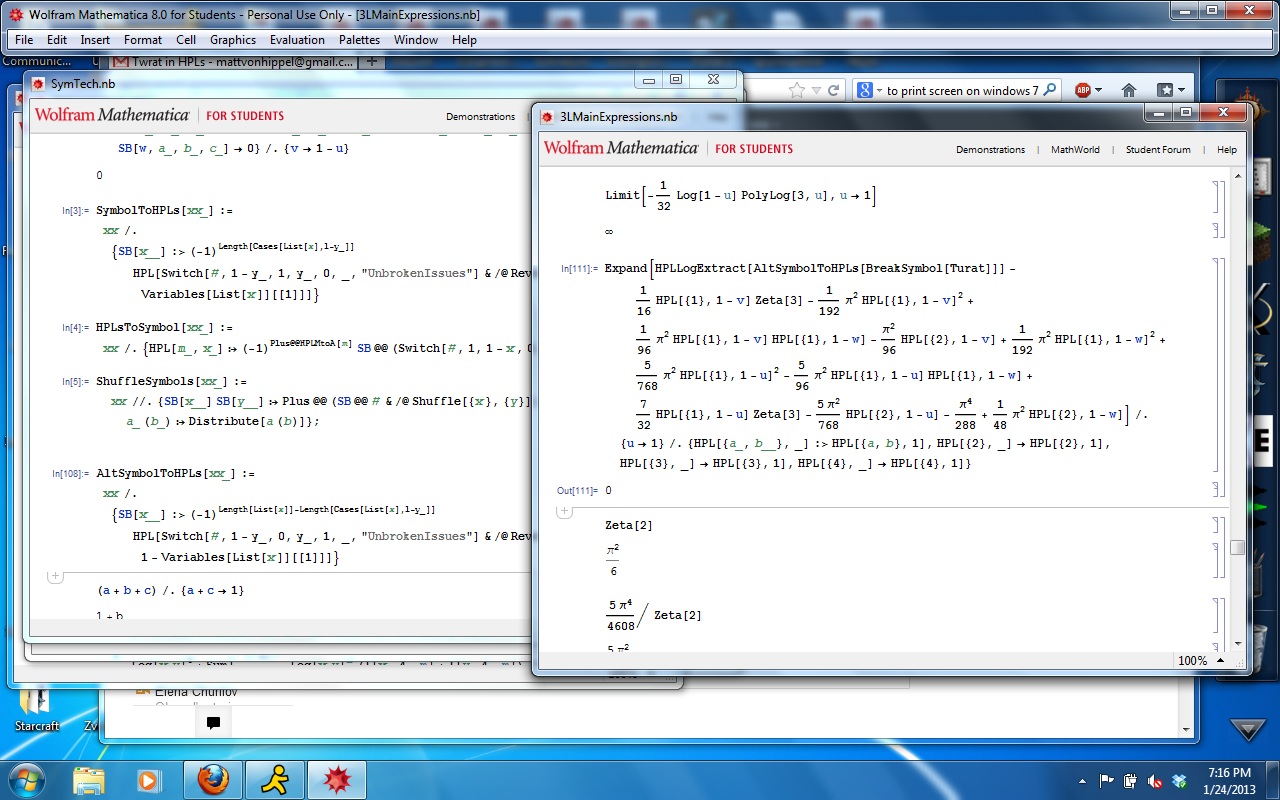
I answered by showing her this:

WhatIDo

Needless to say, that wasn’t very helpful, so I thought a bit and now I have a better answer.

Doing theoretical physics is basically like doing homework. In particular, it’s like doing difficult, interesting homework.

Think of the toughest homework assignment you’ve ever had to do. A homework assignment so tough, you and all your friends in the class worked together to finish it, and none of you were sure you were going to get it right.

Chances are, you handled the situation in one of two ways, depending on whether this was a group project, or an individual one.

Group Project:

This is what you do when you’re supposed to be in a group. Maybe you’re putting together a presentation, or building a rocket. Whatever you’re doing, you’ve got a lot of little tasks that need to get done in order to achieve your goals, so you parcel them out: each group member is assigned a specific task, and at the end everyone meets and puts it all together.

This sort of situation is common in theoretical physics as well, and it happens when different people have different skills to contribute. If one theorist is good at programming, while another understands a particular esoteric type of mathematics, then the math person will do the calculations and then give the results to the programming person, who makes a program to implement it.

Individual Project:

On the other hand, if everyone needs to submit their own work, you can’t very well just do part of it (not without cheating, anyway). Still, it’s not as if you’re doing this on your own. You do your own work to solve the problem, but you keep in contact with your classmates, and when you get stuck, you ask one of them for help.

This sort of situation happens in theoretical physics when everyone is relatively on the same page. Everyone works through the problem individually, doing the calculation and making their own programs, and whenever someone gets stuck, they talk to the others. Everyone periodically compares their results, which serves as a cross-check to make sure nobody made a mistake. The only difference from doing homework is that you and your collaborators write your own problems…which means, none of you know if there is a solution!

In both cases (group and individual), theoretical physics is a matter of doing calculations, writing programs, and thinking through thought experiments. Sometimes that means specific tasks as part of one huge project; sometimes it means working side by side on the same calculation. Either way, it all boils down to one thing: I’m someone who does homework for a living.