Tag Archives: theoretical physics

Starshot: The Right Kind of Longshot

On Tuesday, Yuri Milner and Stephen Hawking announced Starshot, a $100 million dollar research initiative. The goal is to lay the groundwork for a very ambitious, but surprisingly plausible project: sending probes to the nearest star, Alpha Centauri. Their idea is to have hundreds of ultra-light probes, each with a reflective sail a few meters in diameter. By aiming an extremely powerful laser at these sails, it should be possible to accelerate the probes up to around a fifth of the speed of light, enough to make the trip in twenty years. Here’s the most complete article I’ve found on the topic.

I can’t comment on the engineering side of the project. The impression I get is that nothing they’re proposing is known to be impossible, but there are a lot of “ifs” along the way that might scupper things. What I can comment on is the story.

Milner and Hawking have both put quite a bit of effort recently into what essentially amounts to telling stories. Milner’s Breakthrough Prizes involve giving awards of $3 million to prominent theoretical physicists (and, more recently, mathematicians). Quite a few of my fellow theorists have criticized these prizes, arguing that the money would be better spent in a grant program like that of the Simons Foundation. While that would likely be better for science, the Breakthrough Prize isn’t really about that. Instead, it’s about telling a story: a story in which progress in theoretical physics is exalted in a public, Nobel-sized way.

Similarly, Hawking’s occasional pronouncements about aliens or AI aren’t science per se, and the media has a tendency to talk about his contributions to ongoing scientific debates out of proportion to their importance. Both of these things, though, contribute to the story of Hawking: a mascot for physics, someone to carry Einstein’s role of the most recognizable genius in the world. Hawking Inc. is about a role as much as it is about a man.

In calling Hawking and Milner’s activity “stories”, I’m not dismissing them. Stories can be important. And the story told by Starshot is a particularly important one.

Cosmology isn’t just a scientific subject, it contributes to how people see themselves. Here I don’t just mean cosmology the field, but cosmology in the broader sense of our understanding of the universe and our place in it.

A while back, I read a book called The View from the Center of the Universe. The book starts by describing the worldviews of the ancients, cosmologies in which they really did think of themselves as the center of the universe. It then suggests that this played an important role: that this kind of view of the world, in which humans have a place in the cosmos, is important to how we view ourselves. The rest of the book then attempts to construct this sort of mythological understanding out of the modern cosmological picture, with some success.

One thing the book doesn’t discuss very much, though, is the future. We care about our place in the universe not just because we want to know where we came from, but because we want to have some idea of where we’re going. We want to contribute to a greater goal, to see ourselves making progress towards something important and vast and different. That’s why so many religions have not just cosmologies, but eschatologies, why people envision armageddons and raptures.

Starshot places the future in our sight in a way that few other things do. Humanity’s spread among the stars seems like something so far distant that nothing we do now could matter to it. What Starshot does is give us something concrete, a conceptual stepping-stone that can link people in to the broader narrative. Right now, people can work on advanced laser technology and optics, work on making smaller chips and lighter materials, work that would be useful and worth funding regardless of whether it was going to lead to Alpha Centauri. But because of Starshot, we can view that work as the near-term embodiment of humanity’s interstellar destiny.

That combination, bridging the gap between the distant future and our concrete present, is the kind of story people need right now. And so for once, I think Milner’s storytelling is doing exactly what it should.

GUTs vs ToEs: What Are We Unifying Here?

“Grand Unified Theory” and “Theory of Everything” may sound like meaningless grandiose titles, but they mean very different things.

In particular, Grand Unified Theory, or GUT, is a technical term, referring to a specific way to unify three of the fundamental interactions: electromagnetism, the weak force, and the strong force.

blausen_0817_smallintestine_anatomy

In contrast, guts unify the two fundamental intestines.

Those three forces are called Yang-Mills forces, and they can all be described in the same basic way. In particular, each has a strength (the coupling constant) and a mathematical structure that determines how it interacts with itself, called a group.

The core idea of a GUT, then, is pretty simple: to unite the three Yang-Mills forces, they need to have the same strength (the same coupling constant) and be part of the same group.

But wait! (You say, still annoyed at the pun in the above caption.) These forces don’t have the same strength at all! One of them’s strong, one of them’s weak, and one of them is electromagnetic!

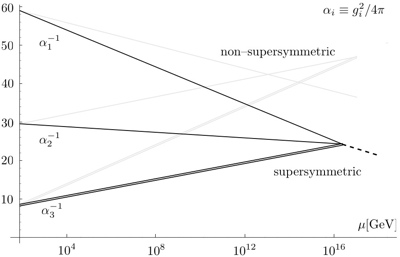
As it turns out, this isn’t as much of a problem as it seems. While the three Yang-Mills forces seem to have very different strengths on an everyday scale, that’s not true at very high energies. Let’s steal a plot from Sweden’s Royal Institute of Technology:

running

Why Sweden? Why not!

What’s going on in this plot?

Here, each \alpha represents the strength of a fundamental force. As the force gets stronger, \alpha gets bigger (and so \alpha^{-1} gets smaller). The variable on the x-axis is the energy scale. The grey lines represent a world without supersymmetry, while the black lines show the world in a supersymmetric model.

So based on this plot, it looks like the strengths of the fundamental forces change based on the energy scale. That’s true, but if you find that confusing there’s another, mathematically equivalent way to think about it.

You can think about each force as having some sort of ultimate strength, the strength it would have if the world weren’t quantum. Without quantum mechanics, each force would interact with particles in only the simplest of ways, corresponding to the simplest diagram here.

However, our world is quantum mechanical. Because of that, when we try to measure the strength of a force, we’re not really measuring its “ultimate strength”. Rather, we’re measuring it alongside a whole mess of other interactions, corresponding to the other diagrams in that post. These extra contributions mean that what looks like the strength of the force gets stronger or weaker depending on the energy of the particles involved.

(I’m sweeping several things under the rug here, including a few infinities and electroweak unification. But if you just want a general understanding of what’s going on, this should be a good starting point.)

If you look at the plot, you’ll see the forces meet up somewhere around 10^16 GeV. They miss each-other for the faint, non-supersymmetric lines, but they meet fairly cleanly for the supersymmetric ones.

So (at least if supersymmetry is true), making the Yang-Mills forces have the same strength is not so hard. Putting them in the same mathematical group is where things get trickier. This is because any group that contains the groups of the fundamental forces will be “bigger” than just the sum of those forces: it will contain “extra forces” that we haven’t observed yet, and these forces can do unexpected things.

In particular, the “extra forces” predicted by GUTs usually make protons unstable. As far as we can tell, protons are very long-lasting: if protons decayed too fast, we wouldn’t have stars. So if protons decay, they must do it only very rarely, detectable only with very precise experiments. These experiments are powerful enough to rule out most of the simplest GUTs. The more complicated GUTs still haven’t been ruled out, but it’s enough to make fewer people interested in GUTs as a research topic.

What about Theories of Everything, or ToEs?

While GUT is a technical term, ToE is very much not. Instead, it’s a phrase that journalists have latched onto because it sounds cool. As such, it doesn’t really have a clear definition. Usually it means uniting gravity with the other fundamental forces, but occasionally people use it to refer to a theory that also unifies the various Standard Model particles into some sort of “final theory”.

Gravity is very different from the other fundamental forces, different enough that it’s kind of silly to group them as “fundamental forces” in the first place. Thus, while GUT models are the kind of thing one can cook up and tinker with, any ToE has to be based on some novel insight, one that lets you express gravity and Yang-Mills forces as part of the same structure.

So far, string theory is the only such insight we have access to. This isn’t just me being arrogant: while there are other attempts at theories of quantum gravity, aside from some rather dubious claims none of them are even interested in unifying gravity with other forces.

This doesn’t mean that string theory is necessarily right. But it does mean that if you want a different “theory of everything”, telling physicists to go out and find a new one isn’t going to be very productive. “Find a theory of everything” is a hope, not a research program, especially if you want people to throw out the one structure we have that even looks like it can do the job.

Four Gravitons and Some Wildly Irresponsible Amplitudes Predictions

My post on the “physics of decimals” a couple of weeks back caught physics blogger Luboš Motl’s attention, with predictable results. Mostly, this led to a rather unproductive debate about semantics, but he did bring up one thing that I think deserves some further clarification.

In my post, I asked you to imagine asking a genie for the full consequences of quantum field theory. Short of genie-based magic, is this the sort of thing I think it’s at all possible to know?

robinwilliams_aladdin

A Candle of Invocation? Sure, why not.

In a word, no.

The world is messy, not the sort of thing that tends to be described by neat exact solutions. That’s why we use approximations, and it’s why physicists can’t just step in and solve biology or psychology by deriving everything from first principles.

That said, the nice thing about approximations is that there’s often room for improvement. Sometimes this is quantitative, literally pushing to the next order of decimals, while sometimes it’s qualitative, viewing problems from a new perspective and attacking them from a new approach.

I’d like to give you some idea of the sorts of improvements I think are possible. I’ll focus on scattering amplitudes, since they’re my field. In order to be precise, I’ll be using technical terms here without much explanation; if you’re curious about something specific go ahead and ask in the comments. Finally, there are no implied time-scales here: I’ll be rating things based on whether I think they’re likely to eventually be understood, not on how long it will take us to get there.

Let’s begin with the most likely category:

Probably going to happen:

Mathematicians characterize the set of n-point cluster polylogarithms whose collinear limits are well-defined (n-1)-point cluster polylogarithms.

The seven-loop N=8 supergravity integrand is found, and the coefficient of its potential divergence is evaluated.

The dual Amplituhedron is found.

A general procedure is described for re-summing the L-loop coefficient of the Pentagon OPE for any L into a polylogarithmic form, at least at six points.

We figure out what the heck is up with the MHV-NMHV relation we found here.

Likely to happen, but there may be unforeseen complications:

N=8 supergravity is found to be finite at seven loops.

A symbol bootstrap becomes workable for QCD amplitudes at two or three loops, perhaps involving Landau singularities.

Something like a symbol bootstrap becomes workable for elliptic integrals, though it may only pass a “physicist” level of rigor.

Analogues to all of the work up to the actual Amplituhedron itself are performed for non-planar N=4 super Yang-Mills.

Quite possible, but I’m likely overoptimistic:

The space of n-point cluster polylogarithms whose collinear limits are well-defined (n-1)-point cluster polylogarithms that also obey the first entry condition and some number of final entry conditions turns out to be well-constrained enough that some all-loop all-point statements can be made, at least for MHV.

The enhanced cancellations observed in supergravity theories are understood, and used to provide a strong argument that N=8 supergravity is perturbatively finite.

All-multiplicity analytic QCD results at two loops, for at least the simpler helicity configurations.

The volume of the dual Amplituhedron is characterized by mathematicians and the connection to cluster polylogarithms is fully explored.

A non-planar Amplituhedron is found.

Less likely, but if all of the above happens I would not be all that surprised:

A way is found to double-copy the non-planar Amplituhedron to get an N=8 supergravity Amplituhedron.

The enhanced cancellations in N=8 supergravity turn out to be something “deep”: perhaps they are derivable from string theory, or provide a novel constraint on quantum gravity theories.

Various all-loop statements about the polylogarithms present in N=4 are used to make more restricted all-loop statements about QCD.

The Pentagon OPE is re-summed for finite coupling, if not into known functions than into a form that admits good numerics and various analytic manipulations. Alternatively, the sorts of functions that the Pentagon OPE can sum to are characterized and a bootstrap procedure becomes viable for them.

Irresponsible speculations, suited to public talks or grant applications:

The N=8 Amplituhedron leads to some sort of reformulation of space-time in a way that solves various quantum gravity paradoxes.

The sorts of mathematical objects found in the finite-coupling resummation of the Pentagon OPE lead to a revival of the original analytic S-matrix program, now with an actual chance to succeed.

Extremely unlikely:

Analytic all-loop QCD results.

Magical genie land:

Analytic finite coupling QCD results.

Symbology 101

I work with functions called polylogarithms. There’s a whole field of techniques out there for manipulating these functions, and for better or worse people often refer to them as symbology.

My plan for this post is to give a general feel for how symbology works: what we know how to do, and why. It’s going to be a lot more technical than my usual posts, so the lay reader may want to skip this one. At the same time, I’m not planning to go through anything rigorously. If you want that sort of thing there are plenty of good papers on the subject, here’s one of mine that covers the basics. Rather, I’m going to draw what I hope is an illuminating sketch of what it is we do.

Still here? Let’s start with an easy question.

What’s a log?

balch_park_hollow_log

Ok, besides one of these.

For our purposes, a log is what happens when you integrate dx/x.

\log x=\int \frac{dx}{x}

 Schematically, a polylog is then what happens when you iterate these integrations:

G=\int \frac{dx_1}{x_1} \int \frac{dx_2}{x_2}\ldots

The simplest thing you can get from this is of course just a product of logs. The next most simple thing is one of the classical polylogarithms. But in general, this is a much wider class of functions, known as multiple, or Goncharov, polylogarithms.

The number of integrations is the transcendental weight. Naively, you’d expect an L-loop Feynman integral in four dimensions to give you something with transcendental weight 4L. In practice, that’s not the case: some of the momentum integrations end up just giving delta functions, so in the end an L-loop amplitude has transcendental weight 2L.

In most theories, you get a mix of functions: some with weight 2L, some with weight 2L-1, etc., all the way down to rational functions. N=4 super Yang-Mills is special: there, everything is at the maximum transcendental weight. In either case, though, being able to manipulate transcendental functions is very useful, and the symbol is one of the simplest ways to do so.

The core idea of the symbol is pretty easy to state, though it takes a bit more technology to state it rigorously. Essentially, we take our schematic polylog from above, and just list the logs:

\mathcal{S}(G)=\ldots\otimes x_2\otimes x_1

(Here I have switched the order in order to agree with standard conventions.)

What does that do? Well, it reminds us that these aren’t just some weird functions we don’t understand: they’re collections of logs, and we can treat them like collections of logs.

In particular, we can do this with logs,

\log (x y)=\log x+\log y

so we can do it with symbols as well:

x_1\otimes x y\otimes x_3=x_1\otimes x \otimes x_3+x_1\otimes y\otimes x_3

Similarly, we can always get rid of unwelcome exponents, like so:

\log (x^n)=n\log x

x_1\otimes x^n\otimes x_3=n( x_1\otimes x \otimes x_3)

This means that, in general, we can always factorize any polynomial or rational function that appears in a symbol. As such, we often express symbols in terms of some fixed symbol alphabet, a basis of rational functions that can be multiplied to get any symbol entry in the function we’re working with. In general, it’s a lot easier to calculate amplitudes when we know the symbol alphabet beforehand. For six-particle amplitudes in N=4 super Yang-Mills, the symbol alphabet contains just nine “letters”, which makes it particularly easy to work with.

That’s arguably the core of symbol methods. It’s how Spradlin and Volovich managed to get a seventeen-page expression down to two lines. Express a symbol in the right alphabet, and it tends to look a lot more simple. And once you know the right alphabet, it’s pretty straightforward to build an ansatz with it and constrain it until you get a candidate function for whatever you’re interested in.

There’s more technical detail I could give here: how to tell whether a symbol actually corresponds to a function, how to take limits and do series expansions and take derivatives and discontinuities…but I’m not sure whether anyone reading this would be interested.

As-is, I’ll just mention that the symbol is only part of the story. In particular, it’s a special case of something called a coproduct, which breaks up polylogarithms into various chunks. Break them down fully until each chunk is just an individual log, and you get the symbol. Break them into larger chunks, and you get other components of the coproduct, consisting of tensor products of polylogarithms with lower transcendental weight. These larger chunks mean we can capture as much of a function’s behavior as we like, while still taking advantage of these sorts of tricks. While in older papers you might have seen mention of “beyond-the-symbol” terms that the symbol couldn’t capture, this doesn’t tend to be a problem these days.

PSI Winter School

I’m at the Perimeter Scholars International Winter School this week. Perimeter Scholars International is Perimeter’s one-of-a-kind master’s program in theoretical physics, that jams the basics of theoretical physics into a one-year curriculum. We’ve got students from all over the world, including plenty of places that don’t get any snow at all. As such, it was decided that the students need to spend a week somewhere with even more snow than Waterloo: Musoka, Ontario.

IMG_20160127_152710

A place that occasionally manages to be this photogenic

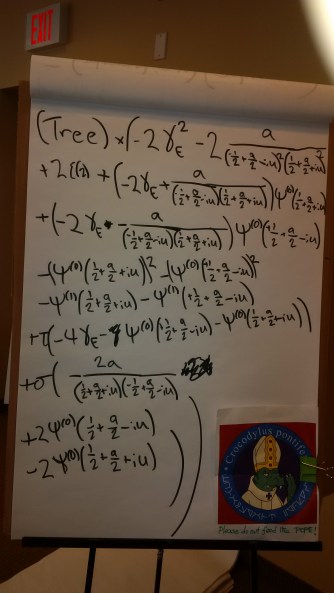
This isn’t really a break for them, though, which is where I come in. The students have been organized into groups, and each group is working on a project. My group’s project is related to the work of integrability master Pedro Vieira. He and his collaborators came up with a way to calculate scattering amplitudes in N=4 super Yang-Mills without the usual process of loop-by-loop approximations. However, this method comes at a price: a new approximation, this time to low energy. This approximation is step-by-step, like loops, but in a different direction. It’s called the Pentagon Operator Product Expansion, or POPE for short.

IMG_20160127_123210

Approach the POPE, and receive a blessing

What we’re trying to do is go back and add up all of the step-by-step terms in the approximation, to see if we can match to the old expansion in loops. One of Pedro’s students recently managed to do this for the first approximation (“tree” diagrams), and the group here at the Winter School is trying to use her (still unpublished) work as a jumping-off point to get to the first loop. Time will tell whether we’ll succeed…but we’re making progress, and the students are learning a lot.

Trust Your Notation as Far as You Can Prove It

Calculus contains one of the most famous examples of physicists doing something silly that irritates mathematicians. See, there are two different ways to write down a derivative, both dating back to the invention of calculus: Newton’s method, and Leibniz’s method.

Newton cared a lot about rigor (enough that he actually published his major physics results without calculus because he didn’t think calculus was rigorous enough, despite inventing it himself). His notation is direct and to the point: if you want to take the derivative of a function f of x, you write,

f'(x)

Leibniz cared a lot less about rigor, and a lot more about the scientific community. He wanted his notation to be useful and intuitive, to be the sort of thing that people would pick up and run with. To write a derivative in Leibniz notation, you write,

\frac{df}{dx}

This looks like a fraction. It’s really, really tempting to treat it like a fraction. And that’s the point: it’s to tell you that treating it like a fraction is often the right thing to do. In particular, you can do something like this,

y=\frac{df}{dx}

y dx=df

\int y dx=\int df

and what you did actually makes a certain amount of sense.

The tricky thing here is that it doesn’t always make sense. You can do these sorts of tricks up to a point, but you need to be aware that they really are just tricks. Take the notation too seriously, and you end up doing things you aren’t really allowed to do. It’s always important to stay aware of what you’re really doing.

There are a lot of examples of this kind of thing in physics. In quantum field theory, we use path integrals. These aren’t really integrals…but a lot of the time, we can treat them as such. Operators in quantum mechanics can be treated like numbers and multiplied…up to a point. A friend of mine was recently getting confused by operator product expansions, where similar issues crop up.

I’ve found two ways to clear up this kind of confusion. One is to unpack your notation: go back to the definitions, and make sure that what you’re doing really makes sense. This can be tedious, but you can be confident that you’re getting the right answer.

The other option is to stop treating your notation like the familiar thing it resembles, and start treating it like uncharted territory. You’re using this sort of notation to remind you of certain operations you can do, certain rules you need to follow. If you take those rules as basic, you can think about what you’re doing in terms of axioms rather than in terms of the suggestions made by your notation. Follow the right axioms, and you’ll stay within the bounds of what you’re actually allowed to do.

Either way, familiar-looking notation can help your intuition, making calculations more fluid. Just don’t trust it farther than you can prove it.

Amplitudes for the New Year

Ah, the new year, time of new year’s resolutions. While some people resolve to go to the gym or take up online dating, physicists resolve to finally get that paper out.

At least, that’s the impression I get, given the number of papers posted to arXiv in the last month. Since a lot of them were amplitudes-related, I figured I’d go over some highlights.

Everyone once in a while people ask me for the latest news on the amplituhedron. While I don’t know what Nima is working on right now, I can point to what others have been doing. Zvi Bern, Jaroslav Trnka, and collaborators have continued to make progress towards generalizing the amplituhedron to non-planar amplitudes. Meanwhile, a group in Europe has been working on solving an issue I’ve glossed over to some extent. While the amplituhedron is often described as calculating an amplitude as the volume of a geometrical object, in fact there is a somewhat more indirect procedure involved in going from the geometrical object to the amplitude. It would be much simpler if the amplitude was actually the volume of some (different) geometrical object, and that’s what these folks are working towards. Finally, Daniele Galloni has made progress on solving a technical issue: the amplituhedron gives a mathematical recipe for the amplitude, but it doesn’t tell you how to carry out that recipe, and Galloni provides an algorithm for part of this process.

With this new algorithm, is the amplituhedron finally as efficient as older methods? Typically, the way to show that is to do a calculation with the amplituhedron that wasn’t possible before. It doesn’t look like that’s happening soon though, as Jake Bourjaily and collaborators compute an eight-loop integrand using one of the more successful of the older methods. Their paper provides a good answer to the perennial question, “why more loops?” What they find is that some of the assumptions that people made at lower loops fail to hold at this high loop order, and it becomes increasingly important to keep track of exactly how far your symmetries can take you.

Back when I visited Brown, I talked to folks there about some ongoing work. Now that they’ve published, I can talk about it. A while back, Juan Maldacena resurrected an old technique of Landau’s to solve a problem in AdS/CFT. In that paper, he suggested that Landau’s trick might help prove some of the impressive simplifications in N=4 super Yang-Mills that underlie my work and the work of those at Brown. In their new paper, the Brown group finds that, while useful, Landau’s trick doesn’t seem to fully explain the simplicity they’ve discovered. To get a little partisan, I have to say that this was largely the result I expected, and that it felt a bit condescending for Maldacena to assume that an old trick like that from the Feynman diagram era could really be enough to explain one of the big discoveries of amplitudeology.

There was also a paper by Freddy Cachazo and collaborators on an interesting trick to extend their CHY string to one-loop, and one by Bo Feng and collaborators on an intriguing new method called Q-cuts that I will probably say more about in future, but I’ll sign off for now. I’ve got my own new years’ physics resolutions, and I ought to get back to work!

Who Needs Non-Empirical Confirmation?

I’ve figured out what was bugging me about Dawid’s workshop on non-empirical theory confirmation.

It’s not the concept itself that bothers me. While you might think of science as entirely based on observations of the real world, in practice we can’t test everything. Inevitably, we have to add in other sorts of evidence: judgments based on precedent, philosophical considerations, or sociological factors.

It’s Dawid’s examples that annoy me: string theory, inflation, and the multiverse. Misleading popularizations aside, none of these ideas involve non-empirical confirmation. In particular, string theory doesn’t need non-empirical confirmation, inflation doesn’t want it, and the multiverse, as of yet, doesn’t merit it.

In order for non-empirical confirmation to matter, it needs to affect how people do science. Public statements aren’t very relevant from a philosophy of science perspective; they ebb and flow based on how people promote themselves. Rather, we should care about what scientists assume in the course of their work. If people are basing new work on assumptions that haven’t been established experimentally, then we need to make sure their confidence isn’t misplaced.

String theory hasn’t been established experimentally…but it fails the other side of this test: almost no-one is assuming string theory is true.

I’ve talked before about theorists who study theories that aren’t true. String theory isn’t quite in that category, it’s still quite possible that it describes the real world. Nonetheless, for most string theorists, the distinction is irrelevant: string theory is a way to relate different quantum field theories together, and to formulate novel ones with interesting properties. That sort of research doesn’t rely on string theory being true, often it doesn’t directly involve strings at all. Rather, it relies on string theory’s mathematical abundance, its versatility and power as a lens to look at the world.

There are string theorists who are more directly interested in describing the world with string theory, though they’re a minority. They’re called String Phenomenologists. By itself, “phenomenologist” refers to particle physicists who try to propose theories that can be tested in the real world. “String phenomenology” is actually a bit misleading, since most string phenomenologists aren’t actually in the business of creating new testable theories. Rather, they try to reproduce some of the more common proposals of phenomenologists, like the MSSM, from within the framework of string theory. While string theory can reproduce many possible descriptions of the world (10^500 by some estimates), that doesn’t mean it covers every possible theory; making sure it can cover realistic options is an important, ongoing technical challenge. Beyond that, a minority within a minority of string phenomenologists actually try to make testable predictions, though often these are controversial.

None of these people need non-empirical confirmation. For the majority of string theorists, string theory doesn’t need to be “confirmed” at all. And for the minority who work on string phenomenology, empirical confirmation is still the order of the day, either directly from experiment or indirectly from the particle phenomenologists struggling to describe it.

What about inflation?

Cosmic inflation was proposed to solve an empirical problem, the surprising uniformity of the observed universe. Look through a few papers in the field, and you’ll notice that most are dedicated to finding empirical confirmation: they’re proposing observable effects on the cosmic microwave background, or on the distribution of large-scale structures in the universe. Cosmologists who study inflation aren’t claiming to be certain, and they aren’t rejecting experiment: overall, they don’t actually want non-empirical confirmation.

To be honest, though, I’m being a little unfair to Dawid here. The reason that string theory and inflation are in the name of his workshop aren’t because he thinks they independently use non-empirical confirmation. Rather, it’s because, if you view both as confirmed (and make a few other assumptions), then you’ve got a multiverse.

In this case, it’s again important to compare what people are doing in their actual work to what they’re saying in public. While a lot of people have made public claims about the existence of a multiverse, very few of them actually work on it. In fact, the two sets of people seem to be almost entirely disjoint.

People who make public statements about the multiverse tend to be older prominent physicists, often ones who’ve worked on supersymmetry as a solution to the naturalness problem. For them, the multiverse is essentially an excuse. Naturalness predicted new particles, we didn’t find new particles, so we need an excuse to have an “unnatural” universe, and for many people the multiverse is that excuse. As I’ve argued before, though, this excuse doesn’t have much of an impact on research. These people aren’t discouraged from coming up with new ideas because they believe in the multiverse, rather, they’re talking about the multiverse because they’re currently out of new ideas. Nima Arkani-Hamed is a pretty clear case of someone who has supported the multiverse in pieces like Particle Fever, but who also gets thoroughly excited about new ideas to rescue naturalness.

By contrast, there are many fewer people who actually work on the multiverse itself, and they’re usually less prominent. For the most part, they actually seem concerned with empirical confirmation, trying to hone tricks like anthropic reasoning to the point where they can actually make predictions about future experiments. It’s unclear whether this tiny group of people are on the right track…but what they’re doing definitely doesn’t seem like something that merits non-empirical confirmation, at least at this point.

It’s a shame that Dawid chose the focus he did for his workshop. Non-empirical theory confirmation is an interesting idea (albeit one almost certainly known to philosophy long before Dawid), and there are plenty of places in physics where it could use some examination. We seem to have come to our current interpretation of renormalization non-empirically, and while string theory itself doesn’t rely on non-empirical conformation many of its arguments with loop quantum gravity seem to rely on non-empirical considerations, in particular arguments about what is actually required for a proper theory of quantum gravity. But string theory, inflation, and the multiverse aren’t the examples he’s looking for.

The “Lies to Children” Model of Science Communication, and The “Amplitudes Are Weird” Model of Amplitudes

Let me tell you a secret.

Scattering amplitudes in N=4 super Yang-Mills don’t actually make sense.

Scattering amplitudes calculate the probability that particles “scatter”: coming in from far away, interacting in some fashion, and producing new particles that travel far away in turn. N=4 super Yang-Mills is my favorite theory to work with: a highly symmetric version of the theory that describes the strong nuclear force. In particular, N=4 super Yang-Mills has conformal symmetry: if you re-scale everything larger or smaller, you should end up with the same predictions.

You might already see the contradiction here: scattering amplitudes talk about particles coming in from very far away…but due to conformal symmetry, “far away” doesn’t mean anything, since we can always re-scale it until it’s not far away anymore!

So when I say that I study scattering amplitudes in N=4 super Yang-Mills, am I lying?

Well…yes. But it’s a useful type of lie.

There’s a concept in science writing called “lies to children”, first popularized in a fantasy novel.
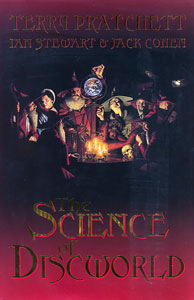
the-science-of-discworld-1

This one.

When you explain science to the public, it’s almost always impossible to explain everything accurately. So much background is needed to really understand most of modern science that conveying even a fraction of it would bore the average audience to tears. Instead, you need to simplify, to skip steps, and even (to be honest) to lie.

The important thing to realize here is that “lies to children” aren’t meant to mislead. Rather, they’re chosen in such a way that they give roughly the right impression, even as they leave important details out. When they told you in school that energy is always conserved, that was a lie: energy is a consequence of symmetry in time, and when that symmetry is broken energy doesn’t have to be conserved. But “energy is conserved” is a useful enough rule that lets you understand most of everyday life.

In this case, the “lie” that we’re calculating scattering amplitudes is fairly close to the truth. We’re using the same methods that people use to calculate scattering amplitudes in theories where they do make sense, like QCD. For a while, people thought these scattering amplitudes would have to be zero, since anything else “wouldn’t make sense”…but in practice, we found they were remarkably similar to scattering amplitudes in other theories. Now, we have more rigorous definitions for what we’re calculating that avoid this problem, involving objects called polygonal Wilson loops.

This illustrates another principle, one that hasn’t (yet) been popularized by a fantasy novel. I’d like to call it the “amplitudes are weird” principle. Time and again we amplitudes-folks will do a calculation that doesn’t really make sense, find unexpected structure, and go back to figure out what that structure actually means. It’s been one of the defining traits of the field, and we’ve got a pretty good track record with it.

A couple of weeks back, Lance Dixon gave an interview for the SLAC website, talking about his work on quantum gravity. This was immediately jumped on by Peter Woit and Lubos Motl as ammo for the long-simmering string wars. To one extent or another, both tried to read scientific arguments into the piece. This is in general a mistake: it is in the nature of a popularization piece to contain some volume of lies-to-children, and reading a piece aimed at a lower audience can be just as confusing as reading one aimed at a higher audience.

In the remainder of this post, I’ll try to explain what Lance was talking about in a slightly higher-level way. There will still be lies-to-children involved, this is a popularization blog after all. But I should be able to clear up a few misunderstandings. Lubos probably still won’t agree with the resulting argument, but it isn’t the self-evidently wrong one he seems to think it is.

Lance Dixon has done a lot of work on quantum gravity. Those of you who’ve read my old posts might remember that quantum gravity is not so difficult in principle: general relativity naturally leads you to particles called gravitons, which can be treated just like other particles. The catch is that the theory that you get by doing this fails to be predictive: one reason why is that you get an infinite number of erroneous infinite results, which have to be papered over with an infinite number of arbitrary constants.

Working with these non-predictive theories, however, can still yield interesting results. In the article, Lance mentions the work of Bern, Carrasco, and Johansson. BCJ (as they are abbreviated) have found that calculating a gravity amplitude often just amounts to calculating a (much easier to find) Yang-Mills amplitude, and then squaring the right parts. This was originally found in the context of string theory by another three-letter group, Kawai, Lewellen, and Tye (or KLT). In string theory, it’s particularly easy to see how this works, as it’s a basic feature of how string theory represents gravity. However, the string theory relations don’t tell the whole story: in particular, they only show that this squaring procedure makes sense on a classical level. Once quantum corrections come in, there’s no known reason why this squaring trick should continue to work in non-string theories, and yet so far it has. It would be great if we had a good argument why this trick should continue to work, a proof based on string theory or otherwise: for one, it would allow us to be much more confident that our hard work trying to apply this trick will pay off! But at the moment, this falls solidly under the “amplitudes are weird” principle.

Using this trick, BCJ and collaborators (frequently including Lance Dixon) have been calculating amplitudes in N=8 supergravity, a highly symmetric version of those naive, non-predictive gravity theories. For this particular, theory, the theory you “square” for the above trick is N=4 super Yang-Mills. N=4 super Yang-Mills is special for a number of reasons, but one is that the sorts of infinite results that lose you predictive power in most other quantum field theories never come up. Remarkably, the same appears to be true of N=8 supergravity. We’re still not sure, the relevant calculation is still a bit beyond what we’re capable of. But in example after example, N=8 supergravity seems to be behaving similarly to N=4 super Yang-Mills, and not like people would have predicted from its gravitational nature. Once again, amplitudes are weird, in a way that string theory helped us discover but by no means conclusively predicted.

If N=8 supergravity doesn’t lose predictive power in this way, does that mean it could describe our world?

In a word, no. I’m not claiming that, and Lance isn’t claiming that. N=8 supergravity simply doesn’t have the right sorts of freedom to give you something like the real world, no matter how you twist it. You need a broader toolset (string theory generally) to get something realistic. The reason why we’re interested in N=8 supergravity is not because it’s a candidate for a real-world theory of quantum gravity. Rather, it’s because it tells us something about where the sorts of dangerous infinities that appear in quantum gravity theories really come from.

That’s what’s going on in the more recent paper that Lance mentioned. There, they’re not working with a supersymmetric theory, but with the naive theory you’d get from just trying to do quantum gravity based on Einstein’s equations. What they found was that the infinity you get is in a certain sense arbitrary. You can’t get rid of it, but you can shift it around (infinity times some adjustable constant 😉 ) by changing the theory in ways that aren’t physically meaningful. What this suggests is that, in a sense that hadn’t been previously appreciated, the infinite results naive gravity theories give you are arbitrary.

The inevitable question, though, is why would anyone muck around with this sort of thing when they could just use string theory? String theory never has any of these extra infinities, that’s one of its most important selling points. If we already have a perfectly good theory of quantum gravity, why mess with wrong ones?

Here, Lance’s answer dips into lies-to-children territory. In particular, Lance brings up the landscape problem: the fact that there are 10^500 configurations of string theory that might loosely resemble our world, and no clear way to sift through them to make predictions about the one we actually live in.

This is a real problem, but I wouldn’t think of it as the primary motivation here. Rather, it gets at a story people have heard before while giving the feeling of a broader issue: that string theory feels excessive.

princess_diana_wedding_dress

Why does this have a Wikipedia article?

Think of string theory like an enormous piece of fabric, and quantum gravity like a dress. You can definitely wrap that fabric around, pin it in the right places, and get a dress. You can in fact get any number of dresses, elaborate trains and frilly togas and all sorts of things. You have to do something with the extra material, though, find some tricky but not impossible stitching that keeps it out of the way, and you have a fair number of choices of how to do this.

From this perspective, naive quantum gravity theories are things that don’t qualify as dresses at all, scarves and socks and so forth. You can try stretching them, but it’s going to be pretty obvious you’re not really wearing a dress.

What we amplitudes-folks are looking for is more like a pencil skirt. We’re trying to figure out the minimal theory that covers the divergences, the minimal dress that preserves modesty. It would be a dress that fits the form underneath it, so we need to understand that form: the infinities that quantum gravity “wants” to give rise to, and what it takes to cancel them out. A pencil skirt is still inconvenient, it’s hard to sit down for example, something that can be solved by adding extra material that allows it to bend more. Similarly, fixing these infinities is unlikely to be the full story, there are things called non-perturbative effects that probably won’t be cured. But finding the minimal pencil skirt is still going to tell us something that just pinning a vast stretch of fabric wouldn’t.

This is where “amplitudes are weird” comes in in full force. We’ve observed, repeatedly, that amplitudes in gravity theories have unexpected properties, traits that still aren’t straightforwardly explicable from the perspective of string theory. In our line of work, that’s usually a sign that we’re on the right track. If you’re a fan of the amplituhedron, the project here is along very similar lines: both are taking the results of plodding, not especially deep loop-by-loop calculations, observing novel simplifications, and asking the inevitable question: what does this mean?

That far-term perspective, looking off into the distance at possible insights about space and time, isn’t my style. (It isn’t usually Lance’s either.) But for the times that you want to tell that kind of story…well, this isn’t that outlandish of a story to tell. And unless your primary concern is whether a piece gives succor to the Woits of the world, it shouldn’t be an objectionable one.


Knowing Too Little, Knowing Too Much

(Commenter nueww has asked me to comment on the flurry of blog posts around an interview with Lance Dixon that recently went up on the SLAC website. I’m not going to comment on it until I have a chance to talk with Lance, beyond saying that this is a remarkable amount of attention paid to a fairly workaday organizational puff piece.)

I’ve been in Oregon this week, giving talks at Oregon State and at the University of Oregon. After my talk at Brown in front of some of the world’s top experts in my subfield, I’ve had to adapt quite a bit for these talks. Oregon State doesn’t have any particle theorists at all, while at the University of Oregon I gave a seminar for their Institute of Theoretical Science, which contains a mix of researchers ranging from particle theorists to theoretical chemists.

Guess which talk was harder to give?

If you guessed the UofO talk, you’re right. At Oregon State, I had a pretty good idea of everyone’s background. I knew these were people who would be pretty familiar with quantum mechanics, but probably wouldn’t have heard of Feynman diagrams. From that, I could build a strategy, and end up giving a pretty good talk.

At the University of Oregon, if I aimed for the particle physicists in the audience, I’d lose the chemists. So I should aim for the chemists, right?

That has its problems too. I’ve talked about some of them: the risk that the experts in your audience feel talked-down to, that you don’t cover the more important parts of your work. But there’s another problem, one that I noticed when I tried to prepare this talk: knowing too little can lead to misunderstandings, but so can knowing too much.

What would happen if I geared the talk completely to the chemists? Well, I’d end up being very vague about key details of what I did. And for the chemists, that would be fine: they’d get a flavor of what I do, and they’d understand not to read any more into it. People are pretty good at putting something in the “I don’t understand this completely” box, as long as it’s reasonably clearly labeled.

That vagueness, though, would be a disaster for the physicists in the audience. It’s not just that they wouldn’t get the full story: unless I was very careful, they’d end up actively misled. The same vague descriptions that the chemists would accept as “flavor”, the physicists would actively try to read for meaning. And with the relevant technical terms replaced with terms the chemists would recognize, they would end up with an understanding that would be actively wrong.

In the end, I ended up giving a talk mostly geared to the physicists, but with some background and vagueness to give the chemists some value. I don’t feel like I did as good of a job as I would like, and neither group really got as much out of the talk as I wanted them to. It’s tricky talking for a mixed audience, and it’s something I’m still learning how to do.