Tag Archives: string theory

Quick Post

I’m traveling this week, so I don’t have time for a long post. I am rather annoyed with Sabine Hossenfelder’s recent post about string theory, but I don’t have time to write much about it now.

(Broadly speaking, she dismisses string theory’s success in investigating quantum field theories as irrelevant to string theory’s dominance, but as far as I’ve seen the only part of string theory that has any “institutional dominance” at all is the “investigating quantum field theories” part, while string theorists who spend their time making statements about the real world are roughly as “marginalized” as non-string quantum gravity theorists. But I ought to gather some numbers before I really commit to arguing this.)

Particles Aren’t Vibrations (at Least, Not the Ones You Think)

You’ve probably heard this story before, likely from Brian Greene.

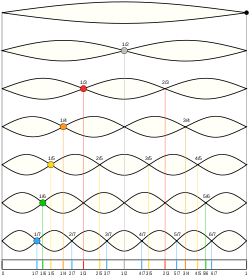
In string theory, the fundamental particles of nature are actually short lengths of string. These strings can vibrate, and like a string on a violin, that vibration is arranged into harmonics. The more energy in the string, the more complex the vibration. In string theory, each of these vibrations corresponds to a different particle, explaining how the zoo of particles we observe can come out of a single type of fundamental string.

250px-moodswingerscale-svg

Particles. Probably.

It’s a nice story. It’s even partly true. But it gives a completely wrong idea of where the particles we’re used to come from.

Making a string vibrate takes energy, and that energy is determined by the tension of the string. It’s a lot harder to wiggle a thick rubber band than a thin one, if you’re holding both tightly.

String theory’s strings are under a lot of tension, so it takes a lot of energy to make them vibrate. From our perspective, that energy looks like mass, so the more complicated harmonics on a string correspond to extremely massive particles, close to the Planck mass!

Those aren’t the particles you’re used to. They’re not electrons, they’re not dark matter. They’re particles we haven’t observed, and may never observe. They’re not how string theory explains the fundamental particles of nature.

So how does string theory go from one fundamental type of string to all of the particles in the universe, if not through these vibrations? As it turns out, there are several different ways it can happen, tricks that allow the lightest and simplest vibrations to give us all the particles we’ve observed.* I’ll describe a few.

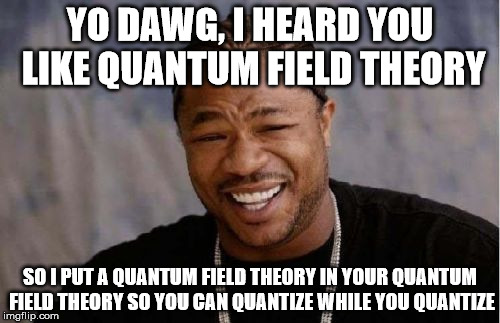
The first and most important trick here is supersymmetry. Supersymmetry relates different types of particles to each other. In string theory, it means that along with vibrations that go higher and higher, there are also low-energy vibrations that behave like different sorts of particles. In a sense, string theory sticks a quantum field theory inside another quantum field theory, in a way that would make Xzibit proud.

Even with supersymmetry, string theory doesn’t give rise to all of the right sorts of particles. You need something else, like compactifications or branes.

The strings of string theory live in ten dimensions, it’s the only place they’re mathematically consistent. Since our world looks four-dimensional, something has to happen to the other six dimensions. They have to be curled up, in a process called compactification. There are lots and lots (and lots) of ways to do this compactification, and different ways of curling up the extra dimensions give different places for strings to move. These new options make the strings look different in our four-dimensional world: a string curled around a donut hole looks very different from one that moves freely. Each new way the string can move or vibrate can give rise to a new particle.

Another option to introduce diversity in particles is to use branes. Branes (short for membranes) are surfaces that strings can end on. If two strings end on the same brane, those ends can meet up and interact. If they end on different branes though, then they can’t. By cleverly arranging branes, then, you can have different sets of strings that interact with each other in different ways, reproducing the different interactions of the particles we’re familiar with.

In string theory, the particles we’re used to aren’t just higher harmonics, or vibrations with more and more energy. They come from supersymmetry, from compactifications and from branes. The higher harmonics are still important: there are theorems that you can’t fix quantum gravity with a finite number of extra particles, so the infinite tower of vibrations allows string theory to exploit a key loophole. They just don’t happen to be how string theory gets the particles of the Standard Model. The idea that every particle is just a higher vibration is a common misconception, and I hope I’ve given you a better idea of how string theory actually works.


*But aren’t these lightest vibrations still close to the Planck mass? Nope! See the discussion with TE in the comments for details.

Those Wacky 60’s Physicists

The 60’s were a weird time in academia. Psychologists were busy experimenting with LSD, seeing if they could convince people to electrocute each other, and otherwise doing the sorts of shenanigans that ended up saddling them with Institutional Review Boards so that nowadays they can’t even hand out surveys without a ten page form attesting that it won’t have adverse effects on pregnant women.

We don’t have IRBs in theoretical physics. We didn’t get quite as wacky as the psychologists did. But the 60’s were still a time of utopian dreams and experimentation, even in physics. We may not have done unethical experiments on people…but we did have the Analytic S-Matrix Program.

The Analytic S-Matrix Program was an attempt to rebuild quantum field theory from the ground up. The “S” in S-Matrix stands for “scattering”: the S-Matrix is an enormous matrix that tells you, for each set of incoming particles, the probability that they scatter into some new set of outgoing particles. Normally, this gets calculated piece by piece with what are called Feynman diagrams. The goal of the Analytic S-Matrix program was a loftier one: to derive the S-Matrix from first principles, without building it out of quantum field theory pieces. Without Feynman diagrams’ reliance on space and time, people like  Geoffrey Chew, Stanley Mandelstam, Tullio Regge, and Lev Landau hoped to reach a deeper understanding of fundamental physics.

If this sounds familiar, it should. Amplitudeologists like me view the physicists of the Analytic S-Matrix Program as our spiritual ancestors. Like us, they tried to skip the mess of Feynman diagrams, looking for mathematical tricks and unexpected symmetries to show them the way forward.

Unfortunately, they didn’t have the tools we do now. They didn’t understand the mathematical functions they needed, nor did they have novel ways of writing down their results like the amplituhedron. Instead, they had to work with what they knew, which in practice usually meant going back to Feynman diagrams.

Paradoxically then, much of the lasting impact of the Analytic S-Matrix Program has been on how we understand the results of Feynman diagram calculations. Just as psychologists learn about the Milgram experiment in school, we learn about Mandelstam variables and Regge trajectories. Recently, we’ve been digging up old concepts from those days and finding new applications, like the recent work on Landau singularities, or some as-yet unpublished work I’ve been doing.

Of course, this post wouldn’t be complete without mentioning the Analytic S-Matrix Program’s most illustrious child, String Theory. Some of the mathematics cooked up by the physicists of the 60’s, while dead ends for the problems they were trying to solve, ended up revealing a whole new world of potential.

The physicists of the 60’s were overly optimistic. Nevertheless, their work opened up questions that are still worth asking today. Much as psychologists can’t ignore what they got up to in the 60’s, it’s important for physicists to be aware of our history. You never know what you might dig up.

0521523362cvr.qxd (Page 1)

And as Levar Burton would say, you don’t have to take my word for it.

GUTs vs ToEs: What Are We Unifying Here?

“Grand Unified Theory” and “Theory of Everything” may sound like meaningless grandiose titles, but they mean very different things.

In particular, Grand Unified Theory, or GUT, is a technical term, referring to a specific way to unify three of the fundamental interactions: electromagnetism, the weak force, and the strong force.

blausen_0817_smallintestine_anatomy

In contrast, guts unify the two fundamental intestines.

Those three forces are called Yang-Mills forces, and they can all be described in the same basic way. In particular, each has a strength (the coupling constant) and a mathematical structure that determines how it interacts with itself, called a group.

The core idea of a GUT, then, is pretty simple: to unite the three Yang-Mills forces, they need to have the same strength (the same coupling constant) and be part of the same group.

But wait! (You say, still annoyed at the pun in the above caption.) These forces don’t have the same strength at all! One of them’s strong, one of them’s weak, and one of them is electromagnetic!

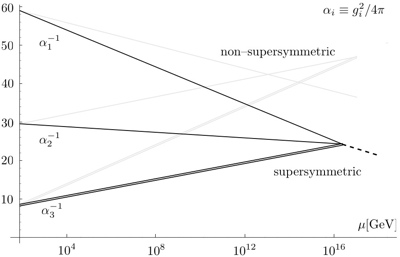
As it turns out, this isn’t as much of a problem as it seems. While the three Yang-Mills forces seem to have very different strengths on an everyday scale, that’s not true at very high energies. Let’s steal a plot from Sweden’s Royal Institute of Technology:

running

Why Sweden? Why not!

What’s going on in this plot?

Here, each \alpha represents the strength of a fundamental force. As the force gets stronger, \alpha gets bigger (and so \alpha^{-1} gets smaller). The variable on the x-axis is the energy scale. The grey lines represent a world without supersymmetry, while the black lines show the world in a supersymmetric model.

So based on this plot, it looks like the strengths of the fundamental forces change based on the energy scale. That’s true, but if you find that confusing there’s another, mathematically equivalent way to think about it.

You can think about each force as having some sort of ultimate strength, the strength it would have if the world weren’t quantum. Without quantum mechanics, each force would interact with particles in only the simplest of ways, corresponding to the simplest diagram here.

However, our world is quantum mechanical. Because of that, when we try to measure the strength of a force, we’re not really measuring its “ultimate strength”. Rather, we’re measuring it alongside a whole mess of other interactions, corresponding to the other diagrams in that post. These extra contributions mean that what looks like the strength of the force gets stronger or weaker depending on the energy of the particles involved.

(I’m sweeping several things under the rug here, including a few infinities and electroweak unification. But if you just want a general understanding of what’s going on, this should be a good starting point.)

If you look at the plot, you’ll see the forces meet up somewhere around 10^16 GeV. They miss each-other for the faint, non-supersymmetric lines, but they meet fairly cleanly for the supersymmetric ones.

So (at least if supersymmetry is true), making the Yang-Mills forces have the same strength is not so hard. Putting them in the same mathematical group is where things get trickier. This is because any group that contains the groups of the fundamental forces will be “bigger” than just the sum of those forces: it will contain “extra forces” that we haven’t observed yet, and these forces can do unexpected things.

In particular, the “extra forces” predicted by GUTs usually make protons unstable. As far as we can tell, protons are very long-lasting: if protons decayed too fast, we wouldn’t have stars. So if protons decay, they must do it only very rarely, detectable only with very precise experiments. These experiments are powerful enough to rule out most of the simplest GUTs. The more complicated GUTs still haven’t been ruled out, but it’s enough to make fewer people interested in GUTs as a research topic.

What about Theories of Everything, or ToEs?

While GUT is a technical term, ToE is very much not. Instead, it’s a phrase that journalists have latched onto because it sounds cool. As such, it doesn’t really have a clear definition. Usually it means uniting gravity with the other fundamental forces, but occasionally people use it to refer to a theory that also unifies the various Standard Model particles into some sort of “final theory”.

Gravity is very different from the other fundamental forces, different enough that it’s kind of silly to group them as “fundamental forces” in the first place. Thus, while GUT models are the kind of thing one can cook up and tinker with, any ToE has to be based on some novel insight, one that lets you express gravity and Yang-Mills forces as part of the same structure.

So far, string theory is the only such insight we have access to. This isn’t just me being arrogant: while there are other attempts at theories of quantum gravity, aside from some rather dubious claims none of them are even interested in unifying gravity with other forces.

This doesn’t mean that string theory is necessarily right. But it does mean that if you want a different “theory of everything”, telling physicists to go out and find a new one isn’t going to be very productive. “Find a theory of everything” is a hope, not a research program, especially if you want people to throw out the one structure we have that even looks like it can do the job.

Who Needs Non-Empirical Confirmation?

I’ve figured out what was bugging me about Dawid’s workshop on non-empirical theory confirmation.

It’s not the concept itself that bothers me. While you might think of science as entirely based on observations of the real world, in practice we can’t test everything. Inevitably, we have to add in other sorts of evidence: judgments based on precedent, philosophical considerations, or sociological factors.

It’s Dawid’s examples that annoy me: string theory, inflation, and the multiverse. Misleading popularizations aside, none of these ideas involve non-empirical confirmation. In particular, string theory doesn’t need non-empirical confirmation, inflation doesn’t want it, and the multiverse, as of yet, doesn’t merit it.

In order for non-empirical confirmation to matter, it needs to affect how people do science. Public statements aren’t very relevant from a philosophy of science perspective; they ebb and flow based on how people promote themselves. Rather, we should care about what scientists assume in the course of their work. If people are basing new work on assumptions that haven’t been established experimentally, then we need to make sure their confidence isn’t misplaced.

String theory hasn’t been established experimentally…but it fails the other side of this test: almost no-one is assuming string theory is true.

I’ve talked before about theorists who study theories that aren’t true. String theory isn’t quite in that category, it’s still quite possible that it describes the real world. Nonetheless, for most string theorists, the distinction is irrelevant: string theory is a way to relate different quantum field theories together, and to formulate novel ones with interesting properties. That sort of research doesn’t rely on string theory being true, often it doesn’t directly involve strings at all. Rather, it relies on string theory’s mathematical abundance, its versatility and power as a lens to look at the world.

There are string theorists who are more directly interested in describing the world with string theory, though they’re a minority. They’re called String Phenomenologists. By itself, “phenomenologist” refers to particle physicists who try to propose theories that can be tested in the real world. “String phenomenology” is actually a bit misleading, since most string phenomenologists aren’t actually in the business of creating new testable theories. Rather, they try to reproduce some of the more common proposals of phenomenologists, like the MSSM, from within the framework of string theory. While string theory can reproduce many possible descriptions of the world (10^500 by some estimates), that doesn’t mean it covers every possible theory; making sure it can cover realistic options is an important, ongoing technical challenge. Beyond that, a minority within a minority of string phenomenologists actually try to make testable predictions, though often these are controversial.

None of these people need non-empirical confirmation. For the majority of string theorists, string theory doesn’t need to be “confirmed” at all. And for the minority who work on string phenomenology, empirical confirmation is still the order of the day, either directly from experiment or indirectly from the particle phenomenologists struggling to describe it.

What about inflation?

Cosmic inflation was proposed to solve an empirical problem, the surprising uniformity of the observed universe. Look through a few papers in the field, and you’ll notice that most are dedicated to finding empirical confirmation: they’re proposing observable effects on the cosmic microwave background, or on the distribution of large-scale structures in the universe. Cosmologists who study inflation aren’t claiming to be certain, and they aren’t rejecting experiment: overall, they don’t actually want non-empirical confirmation.

To be honest, though, I’m being a little unfair to Dawid here. The reason that string theory and inflation are in the name of his workshop aren’t because he thinks they independently use non-empirical confirmation. Rather, it’s because, if you view both as confirmed (and make a few other assumptions), then you’ve got a multiverse.

In this case, it’s again important to compare what people are doing in their actual work to what they’re saying in public. While a lot of people have made public claims about the existence of a multiverse, very few of them actually work on it. In fact, the two sets of people seem to be almost entirely disjoint.

People who make public statements about the multiverse tend to be older prominent physicists, often ones who’ve worked on supersymmetry as a solution to the naturalness problem. For them, the multiverse is essentially an excuse. Naturalness predicted new particles, we didn’t find new particles, so we need an excuse to have an “unnatural” universe, and for many people the multiverse is that excuse. As I’ve argued before, though, this excuse doesn’t have much of an impact on research. These people aren’t discouraged from coming up with new ideas because they believe in the multiverse, rather, they’re talking about the multiverse because they’re currently out of new ideas. Nima Arkani-Hamed is a pretty clear case of someone who has supported the multiverse in pieces like Particle Fever, but who also gets thoroughly excited about new ideas to rescue naturalness.

By contrast, there are many fewer people who actually work on the multiverse itself, and they’re usually less prominent. For the most part, they actually seem concerned with empirical confirmation, trying to hone tricks like anthropic reasoning to the point where they can actually make predictions about future experiments. It’s unclear whether this tiny group of people are on the right track…but what they’re doing definitely doesn’t seem like something that merits non-empirical confirmation, at least at this point.

It’s a shame that Dawid chose the focus he did for his workshop. Non-empirical theory confirmation is an interesting idea (albeit one almost certainly known to philosophy long before Dawid), and there are plenty of places in physics where it could use some examination. We seem to have come to our current interpretation of renormalization non-empirically, and while string theory itself doesn’t rely on non-empirical conformation many of its arguments with loop quantum gravity seem to rely on non-empirical considerations, in particular arguments about what is actually required for a proper theory of quantum gravity. But string theory, inflation, and the multiverse aren’t the examples he’s looking for.

The “Lies to Children” Model of Science Communication, and The “Amplitudes Are Weird” Model of Amplitudes

Let me tell you a secret.

Scattering amplitudes in N=4 super Yang-Mills don’t actually make sense.

Scattering amplitudes calculate the probability that particles “scatter”: coming in from far away, interacting in some fashion, and producing new particles that travel far away in turn. N=4 super Yang-Mills is my favorite theory to work with: a highly symmetric version of the theory that describes the strong nuclear force. In particular, N=4 super Yang-Mills has conformal symmetry: if you re-scale everything larger or smaller, you should end up with the same predictions.

You might already see the contradiction here: scattering amplitudes talk about particles coming in from very far away…but due to conformal symmetry, “far away” doesn’t mean anything, since we can always re-scale it until it’s not far away anymore!

So when I say that I study scattering amplitudes in N=4 super Yang-Mills, am I lying?

Well…yes. But it’s a useful type of lie.

There’s a concept in science writing called “lies to children”, first popularized in a fantasy novel.
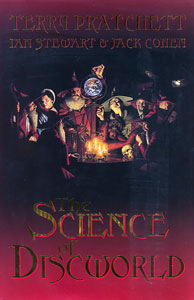
the-science-of-discworld-1

This one.

When you explain science to the public, it’s almost always impossible to explain everything accurately. So much background is needed to really understand most of modern science that conveying even a fraction of it would bore the average audience to tears. Instead, you need to simplify, to skip steps, and even (to be honest) to lie.

The important thing to realize here is that “lies to children” aren’t meant to mislead. Rather, they’re chosen in such a way that they give roughly the right impression, even as they leave important details out. When they told you in school that energy is always conserved, that was a lie: energy is a consequence of symmetry in time, and when that symmetry is broken energy doesn’t have to be conserved. But “energy is conserved” is a useful enough rule that lets you understand most of everyday life.

In this case, the “lie” that we’re calculating scattering amplitudes is fairly close to the truth. We’re using the same methods that people use to calculate scattering amplitudes in theories where they do make sense, like QCD. For a while, people thought these scattering amplitudes would have to be zero, since anything else “wouldn’t make sense”…but in practice, we found they were remarkably similar to scattering amplitudes in other theories. Now, we have more rigorous definitions for what we’re calculating that avoid this problem, involving objects called polygonal Wilson loops.

This illustrates another principle, one that hasn’t (yet) been popularized by a fantasy novel. I’d like to call it the “amplitudes are weird” principle. Time and again we amplitudes-folks will do a calculation that doesn’t really make sense, find unexpected structure, and go back to figure out what that structure actually means. It’s been one of the defining traits of the field, and we’ve got a pretty good track record with it.

A couple of weeks back, Lance Dixon gave an interview for the SLAC website, talking about his work on quantum gravity. This was immediately jumped on by Peter Woit and Lubos Motl as ammo for the long-simmering string wars. To one extent or another, both tried to read scientific arguments into the piece. This is in general a mistake: it is in the nature of a popularization piece to contain some volume of lies-to-children, and reading a piece aimed at a lower audience can be just as confusing as reading one aimed at a higher audience.

In the remainder of this post, I’ll try to explain what Lance was talking about in a slightly higher-level way. There will still be lies-to-children involved, this is a popularization blog after all. But I should be able to clear up a few misunderstandings. Lubos probably still won’t agree with the resulting argument, but it isn’t the self-evidently wrong one he seems to think it is.

Lance Dixon has done a lot of work on quantum gravity. Those of you who’ve read my old posts might remember that quantum gravity is not so difficult in principle: general relativity naturally leads you to particles called gravitons, which can be treated just like other particles. The catch is that the theory that you get by doing this fails to be predictive: one reason why is that you get an infinite number of erroneous infinite results, which have to be papered over with an infinite number of arbitrary constants.

Working with these non-predictive theories, however, can still yield interesting results. In the article, Lance mentions the work of Bern, Carrasco, and Johansson. BCJ (as they are abbreviated) have found that calculating a gravity amplitude often just amounts to calculating a (much easier to find) Yang-Mills amplitude, and then squaring the right parts. This was originally found in the context of string theory by another three-letter group, Kawai, Lewellen, and Tye (or KLT). In string theory, it’s particularly easy to see how this works, as it’s a basic feature of how string theory represents gravity. However, the string theory relations don’t tell the whole story: in particular, they only show that this squaring procedure makes sense on a classical level. Once quantum corrections come in, there’s no known reason why this squaring trick should continue to work in non-string theories, and yet so far it has. It would be great if we had a good argument why this trick should continue to work, a proof based on string theory or otherwise: for one, it would allow us to be much more confident that our hard work trying to apply this trick will pay off! But at the moment, this falls solidly under the “amplitudes are weird” principle.

Using this trick, BCJ and collaborators (frequently including Lance Dixon) have been calculating amplitudes in N=8 supergravity, a highly symmetric version of those naive, non-predictive gravity theories. For this particular, theory, the theory you “square” for the above trick is N=4 super Yang-Mills. N=4 super Yang-Mills is special for a number of reasons, but one is that the sorts of infinite results that lose you predictive power in most other quantum field theories never come up. Remarkably, the same appears to be true of N=8 supergravity. We’re still not sure, the relevant calculation is still a bit beyond what we’re capable of. But in example after example, N=8 supergravity seems to be behaving similarly to N=4 super Yang-Mills, and not like people would have predicted from its gravitational nature. Once again, amplitudes are weird, in a way that string theory helped us discover but by no means conclusively predicted.

If N=8 supergravity doesn’t lose predictive power in this way, does that mean it could describe our world?

In a word, no. I’m not claiming that, and Lance isn’t claiming that. N=8 supergravity simply doesn’t have the right sorts of freedom to give you something like the real world, no matter how you twist it. You need a broader toolset (string theory generally) to get something realistic. The reason why we’re interested in N=8 supergravity is not because it’s a candidate for a real-world theory of quantum gravity. Rather, it’s because it tells us something about where the sorts of dangerous infinities that appear in quantum gravity theories really come from.

That’s what’s going on in the more recent paper that Lance mentioned. There, they’re not working with a supersymmetric theory, but with the naive theory you’d get from just trying to do quantum gravity based on Einstein’s equations. What they found was that the infinity you get is in a certain sense arbitrary. You can’t get rid of it, but you can shift it around (infinity times some adjustable constant 😉 ) by changing the theory in ways that aren’t physically meaningful. What this suggests is that, in a sense that hadn’t been previously appreciated, the infinite results naive gravity theories give you are arbitrary.

The inevitable question, though, is why would anyone muck around with this sort of thing when they could just use string theory? String theory never has any of these extra infinities, that’s one of its most important selling points. If we already have a perfectly good theory of quantum gravity, why mess with wrong ones?

Here, Lance’s answer dips into lies-to-children territory. In particular, Lance brings up the landscape problem: the fact that there are 10^500 configurations of string theory that might loosely resemble our world, and no clear way to sift through them to make predictions about the one we actually live in.

This is a real problem, but I wouldn’t think of it as the primary motivation here. Rather, it gets at a story people have heard before while giving the feeling of a broader issue: that string theory feels excessive.

princess_diana_wedding_dress

Why does this have a Wikipedia article?

Think of string theory like an enormous piece of fabric, and quantum gravity like a dress. You can definitely wrap that fabric around, pin it in the right places, and get a dress. You can in fact get any number of dresses, elaborate trains and frilly togas and all sorts of things. You have to do something with the extra material, though, find some tricky but not impossible stitching that keeps it out of the way, and you have a fair number of choices of how to do this.

From this perspective, naive quantum gravity theories are things that don’t qualify as dresses at all, scarves and socks and so forth. You can try stretching them, but it’s going to be pretty obvious you’re not really wearing a dress.

What we amplitudes-folks are looking for is more like a pencil skirt. We’re trying to figure out the minimal theory that covers the divergences, the minimal dress that preserves modesty. It would be a dress that fits the form underneath it, so we need to understand that form: the infinities that quantum gravity “wants” to give rise to, and what it takes to cancel them out. A pencil skirt is still inconvenient, it’s hard to sit down for example, something that can be solved by adding extra material that allows it to bend more. Similarly, fixing these infinities is unlikely to be the full story, there are things called non-perturbative effects that probably won’t be cured. But finding the minimal pencil skirt is still going to tell us something that just pinning a vast stretch of fabric wouldn’t.

This is where “amplitudes are weird” comes in in full force. We’ve observed, repeatedly, that amplitudes in gravity theories have unexpected properties, traits that still aren’t straightforwardly explicable from the perspective of string theory. In our line of work, that’s usually a sign that we’re on the right track. If you’re a fan of the amplituhedron, the project here is along very similar lines: both are taking the results of plodding, not especially deep loop-by-loop calculations, observing novel simplifications, and asking the inevitable question: what does this mean?

That far-term perspective, looking off into the distance at possible insights about space and time, isn’t my style. (It isn’t usually Lance’s either.) But for the times that you want to tell that kind of story…well, this isn’t that outlandish of a story to tell. And unless your primary concern is whether a piece gives succor to the Woits of the world, it shouldn’t be an objectionable one.

Lewis Carroll, Anti-String Theorist?

You all know the real meaning of Alice in Wonderland, right?

No, I’m not talking about drugs, or darker things. I’m talking about math!

The 19th century was a time of great changes in mathematics, and Charles Dodgson, pen name Lewis Carroll, was opposed to almost all of it. A very traditional mathematician, Dodgson thought of Euclid’s Elements as the pinnacle of mathematical reasoning. Non-Euclidean geometry, symbolic algebra, complex numbers, all of these were viewed by Dodgson as nonsense, perverting students away from the study of Euclidean geometry and arithmetic, subjects that actually described the real world.

Scholars of Dodgson/Carroll’s writing have posited that the craziness of Wonderland was intended to parody the craziness Dodgson saw in mathematics. When Alice encounters the Caterpillar, she grows and shrinks non-uniformly as the Caterpillar advises her to “keep her temper”. “Temper” here refers not to anger, but to ratios between different parts: something preserved in Euclidean geometry but potentially violated by symbolic algebra. Similarly, the frantic rotations around the table by the Mad Hatter and his tea party are thought to represent imaginary numbers and quaternions, concepts used to understand rotation which had to postulate extra dimensions to do so.

Dodgson was on the wrong side of history, and today mathematics deals with even more abstract concepts. What amuses me, though, is how well Dodgson’s parodies match certain criticisms of string theory.

String theorists often study theories with two properties not found in the real world: conformal symmetry and supersymmetry.

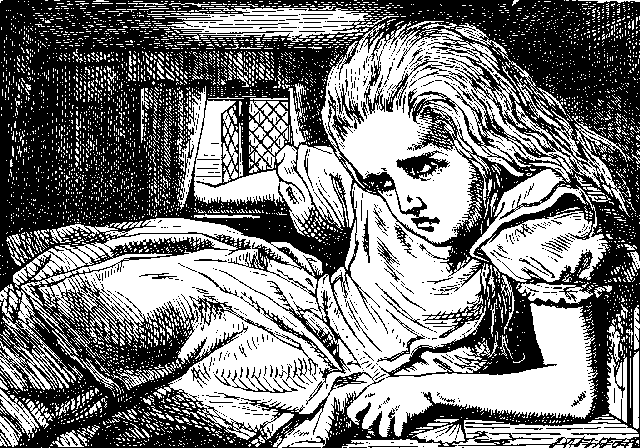
In a theory with conformal symmetry, distances aren’t fixed. Different parts of objects can grow and shrink different amounts, and the theory will still predict the same physical behavior. The only restriction is that angles need to be preserved: two lines that meet at a given angle must meet at the same angle after transformation. In other words, keep your temper.

Alice, undergoing a conformal transformation.

I’ve talked about supersymmetry before. A supersymmetric theory can be “turned” in certain ways, related to exchanging different types of particles. If you “turn” the theory twice in the same “direction”, you get back to where you started, sort of like how if you square the imaginary number i you get back to the real number -1. Supersymmetry sees a group of particles and declares that “it’s time to change places!”

I thought the string theory skeptics among my readers might find the parallels here amusing. With parody, if not always with science, the best work was often done long, long ago.

Yo Dawg, I Heard You Liked Quantum Field Theory so I Made You a String Theory

String theory may sound strange and exotic, with its extra dimensions and loops of string. Deep down, though, string theory is by far the most conservative attempt at a theory of quantum gravity. It just takes the tools of quantum field theory, and applies them all over again.

Picture a loop of string, traveling through space. From one moment to the next, the loop occupies a loop-shaped region. Now imagine joining all those regions together, forming a tunnel: the space swept out by the string over its entire existence. As the string joins other strings, merging and dividing, the result is a complicated surface. In string theory, we call this surface the worldsheet.

Yes, it looks like Yog-Sothoth. It always looks like Yog-Sothoth.

Imagine what it’s like to live on this two-dimensional surface. You don’t know where the string is in the space around it, because you can’t see off the surface. You can learn something about it, though, because making the worldsheet bend takes energy. I’ve talked about this kind of situation before, and the result is that your world contains a scalar field.

Living on the two-dimensional surface, then, you can describe your world with two-dimensional quantum field theory. Your two-dimensional theory, reinterpreted, then tells you the position of the string in higher-dimensional space. If we were just doing normal particle physics, we’d use quantum field theory to describe the particles. Now that we’ve replaced particles with strings, our quantum field theory describes things that are the result of another quantum field theory.

Xzibit would be proud.

If you understand this aspect of string theory, everything else makes a lot more sense. If you’re just imagining lengths of string, it’s hard to understand how strings can have supersymmetry. In these terms, though, it’s simple: instead of just scalar fields, supersymmetric strings also have fermions (fields with spin 1/2) as part of their two-dimensional quantum field theory.

It’s also deeply related to all those weird extra dimensions. As it turns out, two-dimensional quantum field theories are much more restricted than their cousins in our four (three space plus one time)-dimensional world. In order for a theory with only scalars (like the worldsheet of a moving loop of string) to make sense, there have to be twenty-six scalars. Each scalar is a direction in which the worldsheet can bend, so if you just have scalars you’re looking at a 26-dimensional world. Supersymmetry changes this calculation by adding fermions: with fermions and scalars, you need ten scalars to make your theory mathematically consistent, which is why superstring theory lives in ten dimensions.

This also gives you yet another way to think about branes. Strings come from two-dimensional quantum field theories, while branes come from quantum field theories in other dimensions.

Sticking a quantum field theory inside a quantum field theory is the most straightforward way to move forward. Fundamentally, it’s just using tools we already know work. That doesn’t mean it’s the right solution, or that it describes reality: that’s for the future to establish. But I hope I’ve made it a bit clearer why it’s by far the most popular option.

Got Branes on the Brain?

You’ve probably heard it said that string theory contains two types of strings: open, and closed. Closed strings are closed loops, like rubber bands. They give rise to gravity, and in superstring theories to supergravity. Open strings have loose ends, like a rubber band cut in half. They give us Yang-Mills forces, and super Yang-Mills for superstrings.

String theory has more than just strings, though. It also has branes.

Branes, short for membranes, are objects like strings but in other dimensions. The simplest to imagine is a two-dimensional membrane, like a sheet of paper. A three-dimensional membrane would fill all of 3D space, like an infinite cube of jello. Higher dimensional membranes also exist, up to string theory’s limit of nine spatial dimensions.

But you can keep imagining them as sheets of paper if you’d like.

So where did these branes come from? Why doesn’t string theory just have strings?

You might think we’re just trying to be as general as possible, including every possible dimension of object. Strangely enough, this isn’t actually what’s going on! As it turns out, branes can be in lower dimensions too: there are zero-dimensional branes that behave like particles, and one-dimensional branes that are similar to, but crucially not the same thing as, the strings we started out with! If we were just trying to get an object for every dimension we wouldn’t need one-dimensional branes, we’d already have strings!

(By the way, there are also “-1” dimensional branes, but that’s a somewhat more advanced topic.)

Instead, branes come from some strange properties of open strings.

I told you that the ends of open strings are “loose”, but that’s just loose language on my part. Mathematically, there are two options: the ends can be free to wander, or they can be fixed in place. If they’re free, they can move wherever they like with no resistance. If they’re fixed, any attempt to move them will just set them vibrating.

The thing is, you choose between these two options not just once, but once per dimension. You could have the end of the string free to move in two dimensions, but fixed in another, like a magnet was sticking it to some sort of 2D surface…like a brane.

Brane-worlds are dangerous places to live.

In mathematics, the fixed dimensions of end of the string are said to have Dirichlet boundary conditions, which is why this type of branes are called Dirichlet branes, or D-branes. In general, D-branes are things strings can end on. That’s why you can have D1-branes, that despite their string-like shape are different from actual strings: rather, they’re things strings can end on.

You might wonder whether we really need these things. Sure, they’re allowed mathematically, but is that really a good enough reason?

As it turns out, D-branes are not merely allowed in string theory, they are required, due to something called T-duality. I’ve talked about dualities before: they’re relationships between different theories that secretly compute the same thing. T-duality was one of the first-discovered dualities in string theory, and it involves relationships between strings wrapped around circular dimensions.

If a dimension is circular, then closed strings can either move around the circle, or wrap around it instead. As it turns out, a string moving around a small circle has the same energy as a string wrapped around a big circle, where here “small” and “big” are comparisons to the length of the string. It’s not just the energy, though: for every physical quantity, the two descriptions (big circle with strings traveling along it, small circle with strings wrapped around it) give the same answer: the two theories are dual.

If it works with closed strings, what about open strings?

Here something weird happens: if you perform the T-duality operation (switch between the small circle and the big one), then the ends of open strings switch from being free to being fixed! This means that even if we start out with no D-branes at all, our theory was equivalent to one with D-branes all along! No matter what we do, we can’t write down a theory that doesn’t have D-branes!

As it turns out, we could have seen this coming even without string theory, just by looking at (super)gravity.

Long before people saw astrophysical evidence for black holes, before they even figured out that stars could collapse, they worked out the black hole solution in general relativity. Without knowing anything about the sort of matter that could form a black hole, they could nevertheless calculate what space-time would look like around one.

In ten dimensional supergravity, you can do these same sorts of calculations. Instead of getting black holes, though, you get black branes. Rather than showing what space-time looks like around a high-mass point, they showed what it would look like around a higher dimensional, membrane-shaped object. And miraculously, they corresponded exactly to the D-branes that are supposed to be part of string theory!

So if we want string theory, or even supergravity, we’re stuck with D-branes. It’s a good thing we are, too, because D-branes are very useful. In the past, I’ve talked about how most of the fundamental forces of nature have multiple types of charge. One way for string theory to reproduce these multiple types of charge is with D-branes. If each open string is connected to two D-branes, it can behave like gluons, carrying a pair of charges. Since each end of the string is stuck to its respective brane, the charge corresponding to each brane must be conserved, just like charges in the real world.

D-branes aren’t one of the original assumptions of string theory, but they’re a large part of what makes string theory tick. M theory, string theory’s big brother, doesn’t have strings at all: just two- and five-dimensional branes. So be grateful for branes: they make the world a much more interesting place.

Science Never Forgets

I’ll just be doing a short post this week, I’ve been busy at a workshop on Flux Tubes here at Perimeter.

If you’ve ever heard someone tell the history of string theory, you’ve probably heard that it was first proposed not as a quantum theory of gravity, but as a way to describe the strong nuclear force. Colliders of the time had discovered particles, called mesons, that seemed to have a key role in the strong nuclear force that held protons and neutrons together. These mesons had an unusual property: the faster they spun, the higher their mass, following a very simple and regular pattern known as a Regge trajectory. Researchers found that they could predict this kind of behavior if, rather than particles, these mesons were short lengths of “string”, and with this discovery they invented string theory.

As it turned out, these early researchers were wrong. Mesons are not lengths of string, rather, they are pairs of quarks. The discovery of quarks explained how the strong force acted on protons and neutrons, each made of three quarks, and it also explained why mesons acted a bit like strings: in each meson, the two quarks are linked by a flux tube, a roughly cylindrical area filled with the gluons that carry the strong nuclear force. So rather than strings, mesons turned out to be more like bolas.

Leonin sold separately.

If you’ve heard this story before, you probably think it’s ancient history. We know about quarks and gluons now, and string theory has moved on to bigger and better things. You might be surprised to hear that at this week’s workshop, several presenters have been talking about modeling flux tubes between quarks in terms of string theory!

The thing is, science never forgets a good idea. String theory was superseded by quarks in describing the strong force, but it was only proposed in the first place because it matched the data fairly well. Now, with string theory-inspired techniques, people are calculating the first corrections to the string-like behavior of these flux tubes, comparing them with simulations of quarks and gluons, and finding surprisingly good agreement!

Science isn’t a linear story, where the past falls away to the shiny new theories of the future. It’s a marketplace. Some ideas are traded more widely, some less…but if a product works, even only sometimes, chances are someone out there will have a reason to buy it.