Tag Archives: quantum mechanics

Bras and Kets, Trading off Instincts

Some physics notation is a joke, but that doesn’t mean it shouldn’t be taken seriously.

Take bras and kets. On the surface, as silly a physics name as any. If you want to find the probability that a state in quantum mechanics turns into another state, you write down a “bracket” between the two states:

\langle a | b\rangle

This leads, with typical physics logic, to the notation for the individual states: separate out the two parts, into a “bra” and a “ket”:

\langle a||b\rangle

It’s kind of a dumb joke, and it annoys the heck out of mathematicians. Not for the joke, of course, mathematicians probably have worse.

Mathematicians are annoyed when we use complicated, weird notation for something that looks like a simple, universal concept. Here, we’re essentially just taking inner products of vectors, something mathematicians have been doing in one form or another for centuries. Yet rather than use their time-tested notation we use our own silly setup.

There’s a method to the madness, though. Bras and kets are handy for our purposes because they allow us to leverage one of the most powerful instincts of programmers: the need to close parentheses.

In programming, various forms of parentheses and brackets allow you to isolate parts of code for different purposes. One set of lines might only activate under certain circumstances, another set of brackets might make text bold. But in essentially every language, you never want to leave an open parenthesis. Doing so is almost always a mistake, one that leaves the rest of your code open to whatever isolated region you were trying to create.

Open parentheses make programmers nervous, and that’s exactly what “bras” and “kets” are for. As it turns out, the states represented by “bras” and “kets” are in a certain sense un-measurable: the only things we can measure are the brackets between them. When people say that in quantum mechanics we can only predict probabilities, that’s a big part of what they mean: the states themselves mean nothing without being assembled into probability-calculating brackets.

This ends up making “bras” and “kets” very useful. If you’re calculating something in the real world and your formula ends up with a free “bra” or a “ket”, you know you’ve done something wrong. Only when all of your bras and kets are assembled into brackets will you have something physically meaningful. Since most physicists have done some programming, the programmer’s instinct to always close parentheses comes to the rescue, nagging until you turn your formula into something that can be measured.

So while our notation may be weird, it does serve a purpose: it makes our instincts fit the counter-intuitive world of quantum mechanics.

Romeo and Juliet, through a Wormhole

Perimeter is hosting this year’s Mathematica Summer School on Theoretical Physics. The school is a mix of lectures on a topic in physics (this year, the phenomenon of quantum entanglement) and tips and tricks for using the symbolic calculation program Mathematica.

Juan Maldacena is one of the lecturers, which gave me a chance to hear his Romeo and Juliet-based explanation of the properties of wormholes. While I’ve criticized some of Maldacena’s science popularization work in the past, this one is pretty solid, so I thought I’d share it with you guys.

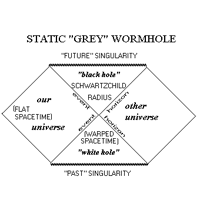
You probably think of wormholes as “shortcuts” to travel between two widely separated places. As it turns out, this isn’t really accurate: while “normal” wormholes do connect distant locations, they don’t do it in a way that allows astronauts to travel between them, Interstellar-style. This can be illustrated with something called a Penrose diagram:

Static

Static “Greyish Black” Diagram

In the traditional Penrose diagram, time goes upward, while space goes from side to side. In order to measure both in the same units, we use the speed of light, so one year on the time axis corresponds to one light-year on the space axis. This means that if you’re traveling at a 45 degree line on the diagram, you’re going at the speed of light. Any lower angle is impossible, while any higher angle means you’re going slower.

If we start in “our universe” in the diagram, can we get to the “other universe”?

Pretty clearly, the answer is no. As long as we go slower than the speed of light, when we pass the event horizon of the wormhole we will end up, not in the “other universe”, but at the part of the diagram labeled Future Singularity, the singularity at the center of the black hole. Even going at the speed of light only keeps us orbiting the event horizon for all eternity, at best.

What use could such a wormhole be? Well, imagine you’re Romeo or Juliet.

Romeo has been banished from Verona, but he took one end of a wormhole with him, while the other end was left with Juliet. He can’t go through and visit her, she can’t go through and visit him. But if they’re already considering taking poison, there’s an easier way. If they both jump in to the wormhole, they’ll fall in to the singularity. Crucially, though, it’s the same singularity, so once they’re past the event horizon they can meet inside the black hole, spending some time together before the end.

Depicted here for more typical quantum protagonists, Alice and Bob.

This explains what wormholes really are: two black holes that share a center.

Why was Maldacena talking about this at a school on entanglement? Maldacena has recently conjectured that quantum entanglement and wormholes are two sides of the same phenomenon, that pairs of entangled particles are actually connected by wormholes. Crucially, these wormholes need to have the properties described above: you can’t use a pair of entangled particles to communicate information faster than light, and you can’t use a wormhole to travel faster than light. However, it is the “shared” singularity that ends up particularly useful, as it suggests a solution to the problem of black hole firewalls.

Firewalls were originally proposed as a way of getting around a particular paradox relating three states connected by quantum entanglement: a particle inside a black hole, radiation just outside the black hole, and radiation far away from the black hole. The way the paradox is set up, it appears that these three states must all be connected. As it turns out, though, this is prohibited by quantum mechanics, which only allows two states to be entangled at a time. The original solution proposed for this was a “firewall”, a situation in which anyone trying to observe all three states would “burn up” when crossing the event horizon, thus avoiding any observed contradiction. Maldacena’s conjecture suggests another way: if someone interacts with the far-away radiation, they have an effect on the black hole’s interior, because the two are connected by a wormhole! This ends up getting rid of the contradiction, allowing the observer to view the black hole and distant radiation as two different descriptions of the same state, and it depends crucially on the fact that a wormhole involves a shared singularity.

There’s still a lot of detail to be worked out, part of the reason why Maldacena presented this research here was to inspire more investigation from students. But it does seem encouraging that Romeo and Juliet might not have to face a wall of fire before being reunited.

Valentine’s Day Physics Poem 2015

In the third installment of an ongoing tradition (wow, this blog is old enough to have traditions!), I present 2015’s Valentine’s Day Physics Poem. Like the others, I wrote this one a long time ago. I’ve polished it up a bit since.


Perturbation Theory


When you’ve been in a system a long time, your state tends to settle

Time-energy uncertainty

That unrigorous interloper

Means the longer you wait, the more fixed you are

And I’ve been stuck

In a comfy eigenstate

Since what I might as well call t=0.


Yesterday though,

Out of the ether

Like an electric field

New potential entered my Hamiltonian.


And my state was perturbed.


Just a small, delicate perturbation

And an infinite series scrolls out

Waves from waves from waves

It’s a new system now

With new, unrealized energy

And I might as well

Call yesterday

t=0.


Our old friend

Time-energy uncertainty

Tells me not to change,

Not to worry.

Soon, probability thins

The Hamiltonian pulls us back

And we all return

Closer and closer

To a fixed, settled, normal state.


This freedom

This uncertainty

This perturbation

Is limited by Planck’s constant

Is vanishingly small.


Yet rigor

        And happiness

                Demand I include it.

No, Hawking didn’t say that a particle collider could destroy the universe

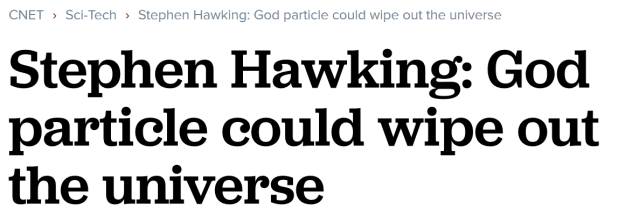
So apparently Hawking says that the Higgs could destroy the universe.

HawkingHiggs

I’ve covered this already, right? No need to say anything more?

Ok, fine, I’ll write a real blog post.

The Higgs is a scalar field: a number, sort of like temperature, that can vary across space and time. In the case of the Higgs this number determines the mass of almost every fundamental particle (the jury is still somewhat out on neutrinos). The Higgs doesn’t vary much at all, in fact it takes an enormous (Large Hadron Collider-sized) amount of energy to get it to wobble even a little bit. That is because the Higgs is in a very very stable state.

Hawking was pointing out that, given our current model of the Higgs, there’s actually another possible state for the Higgs to be in, one that’s even more stable (because it takes less energy, essentially). In that state, the number the Higgs corresponds to is much larger, so everything would be much more massive, with potentially catastrophic results. (Matt Strassler goes into some detail about the assumptions behind this.)

For those who have been following my blog for a while, you may find these “stable states” familiar. They’re vacua, different possible ways to set up “empty” space. In that post, I may have given the impression that there’s no way to change from one stable state, one “vacuum”, to another. In the case of the Higgs, the state it’s in is so stable that vast amounts of energy (again, a Large Hadron Collider-worth) only serve to create a small, unstable fluctuation, the Higgs boson, which vanishes in a fraction of a second.

And that would be the full story, were it not for a curious phenomenon called quantum tunneling.

If you’ve heard someone else describe quantum tunneling, you’ve probably heard that quantum particles placed on one side of a wall have a very small chance of being found later on the other side of the wall, as if they had tunneled there.

Using their incredibly tiny shovels.

However, quantum tunneling applies to much more than just walls. In general, a particle in an otherwise stable state (whether stable because there are walls keeping it in place, or for other reasons) can tunnel into another state, provided that the new state is “more stable” (has lower energy).

The chance of doing this is small, and it gets smaller the more “stable” the particle’s initial state is. Still, if you apply that logic to the Higgs, you realize there’s a very very very small chance that one day the Higgs could just “tunnel” away from its current stable state, destroying the universe as we know it in the process.

If that happened, everything we know would vanish at the speed of light, and we wouldn’t see it coming.

While that may sound scary, it’s also absurdly unlikely, to the extent that it probably won’t happen until the universe is many times older than it is now. It’s not the sort of thing anybody should worry about, at least on a personal level.

Is Hawking fear-mongering, then, by pointing this out? Hardly. He’s just explaining science. Pointing out the possibility that the Higgs could spontaneously change and end the universe is a great way to emphasize the sheer scale of physics, and it’s pretty common for science communicators to mention it. I seem to recall a section about it in Particle Fever, and Sean Carroll even argues that it’s a good thing, due to killing off spooky Boltzmann Brains.

What do particle colliders have to do with all this? Well, apart from quantum tunneling, just inputting enough energy in the right way can cause a transition from one stable state to another. Here “enough energy” means about a million times that produced by the Large Hadron Collider. As Hawking jokes, you’d need a particle collider the size of the Earth to get this effect. I don’t know whether he actually ran the numbers, but if anything I’d guess that a Large Earth Collider would actually be insufficient.

Either way, Hawking is just doing standard science popularization, which isn’t exactly newsworthy. Once again, “interpret something Hawking said in the most ridiculous way possible” seems to be the du jour replacement for good science writing.

Editors, Please Stop Misquoting Hawking

If you’ve been following science news recently, you’ve probably heard the apparently alarming news that Steven Hawking has turned his back on black holes, or that black holes can actually be escaped, or…how about I just show you some headlines:

FoxHawking

NatureHawking

YahooHawking

Now, Hawking didn’t actually say that black holes don’t exist, but while there are a few good pieces on the topic, in many cases the real message has gotten lost in the noise.

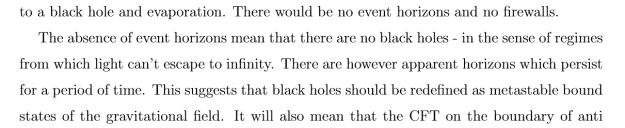
From Hawking’s paper:

ActualPaperHawking

What Hawking is proposing is that the “event horizon” around a black hole, rather than being an absolute permanent boundary from which nothing can escape, is a more temporary “apparent” horizon, the properties of which he goes on to describe in detail.

Why is he proposing this? It all has to do with the debate over black hole firewalls.

Starting with a paper by Polchinski and colleagues a year and a half ago, the black hole firewall paradox centers on contradictory predictions from general relativity and quantum mechanics. General relativity predicts that an astronaut falling past a black hole’s event horizon will notice nothing particularly odd about the surrounding space, but that once past the event horizon none of the “information” that specifies the astronaut’s properties can escape to the outside world. Quantum mechanics on the other hand predicts that information cannot be truly lost. The combination appears to suggest something radical, a “firewall” of high energy radiation around the event horizon carrying information from everything that fell into the black hole in the past, so powerful that it would burn our hypothetical astronaut to a crisp.

Since then, a wide variety of people have made one proposal or another, either attempting to avoid the seemingly preposterous firewall or to justify and further explain it. The reason the debate is so popular is because it touches on some of the fundamental principles of quantum mechanics.

Now, as I have pointed out before, I’m not a good person to ask about the fundamental principles of quantum mechanics. (Incidentally, I’d love it if some of the more quantum information or general relativity-focused bloggers would take a more substantial crack at this! Carroll, Preskill, anyone?) What I can talk about, though, is hype.

All of the headlines I listed take Hawking’s quote out of context, but not all of the articles do. The problem isn’t so much the journalists, as the editors.

One of an editor’s responsibilities is to take articles and give them titles that draw in readers. The editor wants a title that will get people excited, make them curious, and most importantly, get them to click. While a journalist won’t have any particular incentive to improve ad revenue, the same cannot be said for an editor. Thus, editors will often rephrase the title of an article in a way that makes the whole story seem more shocking.

Now that, in itself, isn’t a problem. I’ve used titles like that myself. The problem comes when the title isn’t just shocking, but misleading.

When I call astrophysics “impossible”, nobody is going to think I mean it literally. The title is petulant and ridiculous enough that no-one would take it at face value, but still odd enough to make people curious. By contrast, when you say that Hawking has “changed his mind” about black holes or said that “black holes do not exist”, there are people who will take that at face value as supporting their existing beliefs, as the Borowitz Report humorously points out. These people will go off thinking that Hawking really has given up on black holes. If the title confirms their beliefs enough, people might not even bother to read the article. Thus, by using an actively misleading title, you may actually be decreasing clicks!

It’s not that hard to write a title that’s both enough of a hook to draw people in and won’t mislead. Editors of the world, you’re well-trained writers, certainly much better than me. I’m sure you can manage it.

There really is some interesting news here, if people had bothered to look into it. The firewall debate has been going on for a year and a half, and while Hawking isn’t the universal genius the media occasionally depicts he’s still the world’s foremost expert on the quantum properties of black holes. Why did he take so long to weigh in? Is what he’s proposing even particularly new? I seem to remember people discussing eliminating the horizon in one way or another (even “naked” singularities) much earlier in the firewall debate…what makes Hawking’s proposal novel and different?

This is the sort of thing you can use to draw in interest, editors of the world. Don’t just write titles that cause ignorant people to roll their eyes and move on, instead, get people curious about what’s really going on in science! More ad revenue for you, more science awareness for us, sounds like a win-win!

Why a Quantum Field Theorist is the wrong person to ask about Quantum Mechanics

Quantum Mechanics is quite possibly the sexiest, most mysterious thing to come out of 20th century physics. Almost a century of evidence has confirmed that the world is fundamentally ambiguous and yet deeply predictable, that physics is best described probabilistically, and that however alien this seems the world wouldn’t work without it. Quantum Mechanics raises deep philosophical questions about the nature of reality, some of the most interesting of which are still unanswered to this day.

And I am (for the moment, at least) not the best person to ask about these questions. Because while I specialize in Quantum Field Theory, that actually means I pay very little attention to the paradoxes of Quantum Mechanics.

It all boils down to the way calculations in quantum field theory work. As I described in a previous post, quantum field theory involves adding up progressively more complicated Feynman Diagrams. There are methods that don’t involve Feynman Diagrams, but in one way or another they work on the same basic principle: to take quantum mechanics into account, add up all possible outcomes, either literally or through shortcuts.

That may sound profound, but in many ways it’s quite mundane. Yes, you’re adding up all possibilities, but each possibility is essentially a mundane possibility. There are a few caveats, but essentially each element you add in, each Feynman Diagram for example, looks roughly like the sort of thing you could get without quantum mechanics.

In a typical quantum field theory calculation, you don’t see the mysterious parts of quantum mechanics: you don’t see entanglement, or measurements collapsing the wavefunction, and you don’t have to think about whether reality is really real. Because of that, I’m not the best person to ask about quantum paradoxes, as I’ve got little more than an undergraduate’s knowledge of these things.

There are people whose work focuses much more on quantum paradoxes. Generally these people focus on systems closer to everyday experiments, atoms rather than more fundamental particles. Because the experimentalists they cooperate with have much more ability to manipulate the systems they study, they are able to probe much more intricate quantum properties. People interested in the possibility of a quantum computer are often at the forefront of this, so if you’ve got a question about a quantum paradox, don’t ask me, ask people like WLOG blog.

A final note: there are many people (often very experienced and elite researchers) who, though they might primarily be described as quantum field theorists, have weighed in on the subject of quantum paradoxes. If you’ve heard of the black hole firewall debate, that is a recent high-profile example of this. The important thing to remember is that these people are masters of many areas of physics. They have taken the time to study the foundations of quantum mechanics, and have broadened their horizons to the tools more commonly used in other subfields. So while your average grad student quantum field theorist won’t know an awful lot about quantum paradoxes, these guys do.

Valentine’s Day Physics Poem

In honor of Valentine’s Day, a physics-themed poem I wrote a few years ago, about unrequited love.

Measurement:


I once took a measurement

It was a simple, two-body problem,

Solvable. Not Poisson’s mess.

Two particles, drifting, perhaps entangled.

I wanted to know two things:

Position, and momentum:

Where they were, and where they might go.


I perturbed the system

Like a good scientist, I interacted, and observed,

Added input, caused change.

Then I knew their positions.

They became tightly entangled,

Bound together,

And there was no way of knowing

Any way they could change.


I should have remembered:

In quantum systems

The observer is always involved;

And a three-body problem

Has no solution.