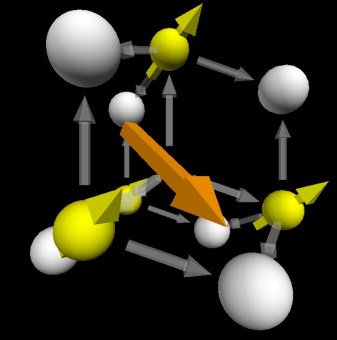
As I have mentioned before a theory in theoretical physics can be described as a list of quantum fields and the ways in which they interact. It turns out this is all you need to start drawing Feynman Diagrams.
Feynman Diagrams are tools physicists use to calculate the probability of things happening: radioactive particles decaying, protons colliding, electrons changing course in a magnetic field…basically anything small enough that quantum mechanics is important. Each Feynman Diagram depicts the paths that a group of particles take over time, interacting as they go. It’s important to remember, however, that Feynman Diagrams are not literally what’s going on: rather, they are tools for calculation.
To start making a Feynman Diagram, think about what you need present in order to start whatever process you’re investigating. For the examples given above, this means a radioactive particle, two protons, and an electron and a magnetic field, respectively. For each particle or field that you start out with, draw a line on the left of the diagram.
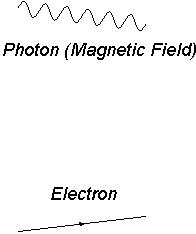
If you’re making a Feynman Diagram you’re looking for a probability of some particular outcome. Draw lines corresponding to the particles and fields in that outcome on the left of the diagram. For example, if you were looking at a radioactive decay, you’d want the new particles the original particle decayed into. For an electron moving in a magnetic field, you want the electron’s new path.
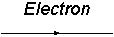
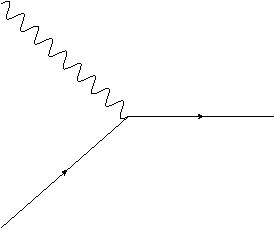
Now come the interactions. Each way that the particles and fields can interact is a potential way that lines can come together. For example, electrons are affected by the photons that make up electric and magnetic fields. Specifically, an electron can absorb a photon, changing its path. This gives us an interaction: an electron and a photon go in, and an electron comes out.
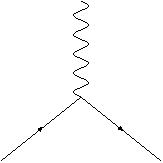
You’ve got the basic building blocks: particles as lines, and interactions where the lines come together. Now, just link them all up! Something like this:
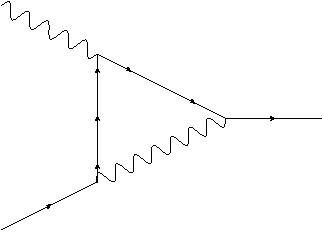
Then again, you could also do it like this:
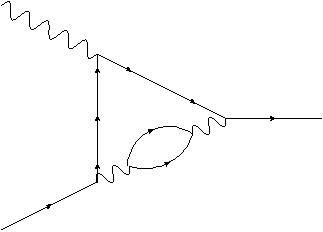
Or this:
Or this:
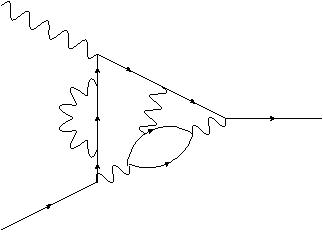
You get the idea. To use these diagrams, a physicist assigns a number to each line and each interaction, depending on various traits of the particles involved including their energy and angles of travel. For each diagram, all these numbers are multiplied together. Then, because in quantum mechanics every possible event has to be included, you add up all the numbers from all of the diagrams. Every single one.
Not just the simple diagram on the top, but also the more complicated one below it, and the one below that, and every way you could possibly link up all of the particles going in and coming out, each more and more complicated. An infinite list of diagrams. Only by adding all of those diagrams together can a physicist find the true, complete probability of a quantum event.
Adding an infinite set of increasingly complicated diagrams is tricky. By tricky, I mean nearly absolutely impossible and so insane in principle that mathematicians aren’t even sure that it has any real meaning.
Because of this, everything that physicists calculate is an approximation. This approximation is possible because each interaction multiplies the total for a diagram by a “small” number, which gets smaller the weaker the force involved, from around 1/2 for the strong nuclear force to about 1/12 for electricity and magnetism. If you limit the number of points of interaction, you limit the number of possible diagrams. For our example, limiting things to one point of interaction gives only the first diagram. If you allow up to three points, you get the second diagram, and so on. Each time you add two more interactions, your diagram gets another loop, and the contribution to the total is smaller, so that even just four loops with a force as weak as electricity and magnetism gets you all but a billionth of the total, which is about as accurate as the experiments are anyway.
What this means, though, is that we’re only at the very edge of a vast ocean of knowledge. We know the rules, the laws of physics if you will, but we can only tiptoe loop by loop towards the full formulas, sitting infinitely far away.
That, in essence, is what I work on. I look for patterns in the numbers, tricks in the calculation, ways to yank ourselves up by our bootstraps to higher and higher loops, and maybe, just maybe, for a shortcut up to infinity.
Because just because we know the rules, doesn’t mean we know how the game is played.
That’s Quantum Field Theory.