Tag Archives: PublicPerception

Science Is a Collection of Projects, Not a Collection of Beliefs

Read a textbook, and you’ll be confronted by a set of beliefs about the world.

(If it’s a half-decent textbook, it will give justifications for those beliefs, and they will be true, putting you well on the way to knowledge.)

The same is true of most science popularization. In either case, you’ll be instructed that a certain set of statements about the world (or about math, or anything else) are true.

If most of your experience with science comes from popularizations and textbooks, you might think that all of science is like this. In particular, you might think of scientific controversies as matters of contrasting beliefs. Some scientists “believe in” supersymmetry, some don’t. Some “believe in” string theory, some don’t. Some “believe in” a multiverse, some don’t.

In practice, though, only settled science takes the form of beliefs. The rest, science as it is actually practiced, is better understood as a collection of projects.

Scientists spend most of their time working on projects. (Well, or procrastinating in my case.) Those projects, not our beliefs about the world, are how we influence other scientists, because projects build off each other. Any time we successfully do a calculation or make a measurement, we’re opening up new calculations and measurements for others to do. We all need to keep working and publishing, so anything that gives people something concrete to do is going to be influential.

The beliefs that matter come later. They come once projects have been so successful, and so widespread, that their success itself is evidence for beliefs. They’re the beliefs that serve as foundational assumptions for future projects. If you’re going to worry that some scientists are behaving unscientifically, these are the sorts of beliefs you want to worry about. Even then, things are often constrained by viable projects: in many fields, you can’t have a textbook without problem sets.

Far too many people seem to miss this distinction. I’ve seen philosophers focus on scientists’ public statements instead of their projects when trying to understand the implications of their science. I’ve seen bloggers and journalists who mostly describe conflicts of beliefs, what scientists expect and hope to be true rather than what they actually work on.

Do scientists have beliefs about controversial topics? Absolutely. Do those beliefs influence what they work on? Sure. But only so far as there’s actually something there to work on.

That’s why you see quite a few high-profile physicists endorsing some form of multiverse, but barely any actual journal articles about it. The belief in a multiverse may or may not be true, but regardless, there just isn’t much that one can do with the idea right now, and it’s what scientists are doing, not what they believe, that constitutes the health of science.

Different fields seem to understand this to different extents. I’m reminded of a story I heard in grad school, of two dueling psychologists. One of them believed that conversation was inherently cooperative, and showed that, unless unusually stressed or busy, people would put in the effort to understand the other person’s perspective. The other believed that conversation was inherently egocentric, and showed that, the more you stressed or busy people are, the more they assume that everyone else has the same perspective they do.

Strip off the “beliefs”, and these two worked on the exact same thing, with the same results. With their beliefs included, though, they were bitter rivals who bristled if their grad students so much as mentioned the other scientist.

We need to avoid this kind of mistake. The skills we have, the kind of work we do, these are important, these are part of science. The way we talk about it to reporters, the ideas we champion when we debate, those are sidelines. They have some influence, dragging people one way or another. But they’re not what science is, because on the front lines, science is about projects, not beliefs.

Fun with Misunderstandings

Perimeter had its last Public Lecture of the season this week, with Mario Livio giving some highlights from his book Brilliant Blunders. The lecture should be accessible online, either here or on Perimeter’s YouTube page.

These lectures tend to attract a crowd of curious science-fans. To give them something to do while they’re waiting, a few local researchers walk around with T-shirts that say “Ask me, I’m a scientist!” Sometimes we get questions about the upcoming lecture, but more often people just ask us what they’re curious about.

Long-time readers will know that I find this one of the most fun parts of the job. In particular, there’s a unique challenge in figuring out just why someone asked a question. Often, there’s a hidden misunderstanding they haven’t recognized.

The fun thing about these misunderstandings is that they usually make sense, provided you’re working from the person in question’s sources. They heard a bit of this and a bit of that, and they come to the most reasonable conclusion they can given what’s available. For those of us who have heard a more complete story, this often leads to misunderstandings we would never have thought of, but that in retrospect are completely understandable.

One of the simpler ones I ran into was someone who was confused by people claiming that we were running out of water. How could there be a water shortage, he asked, if the Earth is basically a closed system? Where could the water go?

The answer is that when people are talking about a water shortage, they’re not talking about water itself running out. Rather, they’re talking about a lack of safe drinking water. Maybe the water is polluted, or stuck in the ocean without expensive desalinization. This seems like the sort of thing that would be extremely obvious, but if you just hear people complaining that water is running out without the right context then you might just not end up hearing that part of the story.

A more involved question had to do with time dilation in general relativity. The guy had heard that atomic clocks run faster if you’re higher up, and that this was because time itself runs faster in lower gravity.

Given that, he asked, what happens if someone travels to an area of low gravity and then comes back? If more time has passed for them, then they’d be in the future, so wouldn’t they be at the “wrong time” compared to other people? Would they even be able to interact with them?

This guy’s misunderstanding came from hearing what happens, but not why. While he got that time passes faster in lower gravity, he was still thinking of time as universal: there is some past, and some future, and if time passes faster for one person and slower for another that just means that one person is “skipping ahead” into the other person’s future.

What he was missing was the explanation that time dilation comes from space and time bending. Rather than “skipping ahead”, a person for whom time passes faster just experiences more time getting to the same place, because they’re traveling on a curved path through space-time.

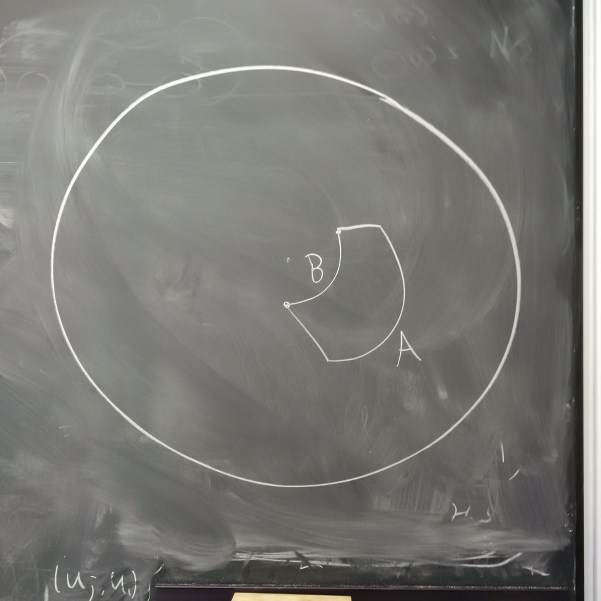
As usual, this is easier to visualize in space than in time. I ended up drawing a picture like this:

IMG_20160602_101423

Imagine person A and person B live on a circle. If person B stays the same distance from the center while person A goes out further, they can both travel the same angle around the circle and end up in the same place, but A will have traveled further, even ignoring the trips up and down.

What’s completely intuitive in space ends up quite a bit harder to visualize in time. But if you at least know what you’re trying to think about, that there’s bending involved, then it’s easier to avoid this guy’s kind of misunderstanding. Run into the wrong account, though, and even if it’s perfectly correct (this guy had heard some of Hawking’s popularization work on the subject), if it’s not emphasizing the right aspects you can come away with the wrong impression.

Misunderstandings are interesting because they reveal how people learn. They’re windows into different thought processes, into what happens when you only have partial evidence. And because of that, they’re one of the most fascinating parts of science popularization.

Source Your Common Sense

When I wrote that post on crackpots, one of my inspirations was a particularly annoying Twitter conversation. The guy I was talking to had convinced himself that general relativity was a mistake. He was especially pissed off by the fact that, in GR, energy is not always conserved. Screw Einstein, energy conservation is just common sense! Right?

Think a little bit about why you believe in energy conservation. Is it because you run into a lot of energy in your day-to-day life, and it’s always been conserved? Did you grow up around something that was obviously energy? Or maybe someone had to explain it to you?

Teacher Pointing at Map of World

Maybe you learned about it…from a physics teacher?

A lot of the time, things that seem obvious only got that way because you were taught them. “Energy” isn’t an intuitive concept, however much it’s misused that way. It’s something defined by physicists because it solves a particular role, a consequence of symmetries in nature. When you learn about energy conservation in school, that’s because it’s one of the simpler ways to explain a much bigger concept, so you shouldn’t be surprised if there are some inaccuracies. If you know where your “common sense” is coming from, you can anticipate when and how it might go awry.

Similarly, if, like one of the commenters on my crackpot post, you’re uncomfortable with countable and uncountable infinities, remember that infinity isn’t “common sense” either. It’s something you learned about in a math class, from a math teacher. And just like energy conservation, it’s a simplification of a more precise concept, with epsilons and deltas and all that jazz.

It’s not possible to teach all the nuances of every topic, so naturally most people will hear a partial story. What’s important is to recognize that you heard a partial story, and not enshrine it as “common sense” when the real story comes knocking.

Don’t physicists use common sense, though? What about “physical intuition”?

Physical intuition has a lot of mystique behind it, and is often described as what separates us from the mathematicians. As such, different people mean different things by it…but under no circumstances should it be confused with pure “common sense”. Physical intuition uses analogy and experience. It involves seeing a system and anticipating the sorts of things you can do with it, like playing a game and assuming there’ll be a save button. In order for these sorts of analogies to work, they generally aren’t built around everyday objects or experiences. Instead, they use physical systems that are “similar” to the one under scrutiny in important ways, while being better understood in others. Crucially, physical intuition involves working in context. It’s not just uncritical acceptance of what one would naively expect.

So when your common sense is tingling, see if you can provide a source. Is that source relevant, experience with a similar situation? Or is it in fact a half-remembered class from high school?

Starshot: The Right Kind of Longshot

On Tuesday, Yuri Milner and Stephen Hawking announced Starshot, a $100 million dollar research initiative. The goal is to lay the groundwork for a very ambitious, but surprisingly plausible project: sending probes to the nearest star, Alpha Centauri. Their idea is to have hundreds of ultra-light probes, each with a reflective sail a few meters in diameter. By aiming an extremely powerful laser at these sails, it should be possible to accelerate the probes up to around a fifth of the speed of light, enough to make the trip in twenty years. Here’s the most complete article I’ve found on the topic.

I can’t comment on the engineering side of the project. The impression I get is that nothing they’re proposing is known to be impossible, but there are a lot of “ifs” along the way that might scupper things. What I can comment on is the story.

Milner and Hawking have both put quite a bit of effort recently into what essentially amounts to telling stories. Milner’s Breakthrough Prizes involve giving awards of $3 million to prominent theoretical physicists (and, more recently, mathematicians). Quite a few of my fellow theorists have criticized these prizes, arguing that the money would be better spent in a grant program like that of the Simons Foundation. While that would likely be better for science, the Breakthrough Prize isn’t really about that. Instead, it’s about telling a story: a story in which progress in theoretical physics is exalted in a public, Nobel-sized way.

Similarly, Hawking’s occasional pronouncements about aliens or AI aren’t science per se, and the media has a tendency to talk about his contributions to ongoing scientific debates out of proportion to their importance. Both of these things, though, contribute to the story of Hawking: a mascot for physics, someone to carry Einstein’s role of the most recognizable genius in the world. Hawking Inc. is about a role as much as it is about a man.

In calling Hawking and Milner’s activity “stories”, I’m not dismissing them. Stories can be important. And the story told by Starshot is a particularly important one.

Cosmology isn’t just a scientific subject, it contributes to how people see themselves. Here I don’t just mean cosmology the field, but cosmology in the broader sense of our understanding of the universe and our place in it.

A while back, I read a book called The View from the Center of the Universe. The book starts by describing the worldviews of the ancients, cosmologies in which they really did think of themselves as the center of the universe. It then suggests that this played an important role: that this kind of view of the world, in which humans have a place in the cosmos, is important to how we view ourselves. The rest of the book then attempts to construct this sort of mythological understanding out of the modern cosmological picture, with some success.

One thing the book doesn’t discuss very much, though, is the future. We care about our place in the universe not just because we want to know where we came from, but because we want to have some idea of where we’re going. We want to contribute to a greater goal, to see ourselves making progress towards something important and vast and different. That’s why so many religions have not just cosmologies, but eschatologies, why people envision armageddons and raptures.

Starshot places the future in our sight in a way that few other things do. Humanity’s spread among the stars seems like something so far distant that nothing we do now could matter to it. What Starshot does is give us something concrete, a conceptual stepping-stone that can link people in to the broader narrative. Right now, people can work on advanced laser technology and optics, work on making smaller chips and lighter materials, work that would be useful and worth funding regardless of whether it was going to lead to Alpha Centauri. But because of Starshot, we can view that work as the near-term embodiment of humanity’s interstellar destiny.

That combination, bridging the gap between the distant future and our concrete present, is the kind of story people need right now. And so for once, I think Milner’s storytelling is doing exactly what it should.

GUTs vs ToEs: What Are We Unifying Here?

“Grand Unified Theory” and “Theory of Everything” may sound like meaningless grandiose titles, but they mean very different things.

In particular, Grand Unified Theory, or GUT, is a technical term, referring to a specific way to unify three of the fundamental interactions: electromagnetism, the weak force, and the strong force.

blausen_0817_smallintestine_anatomy

In contrast, guts unify the two fundamental intestines.

Those three forces are called Yang-Mills forces, and they can all be described in the same basic way. In particular, each has a strength (the coupling constant) and a mathematical structure that determines how it interacts with itself, called a group.

The core idea of a GUT, then, is pretty simple: to unite the three Yang-Mills forces, they need to have the same strength (the same coupling constant) and be part of the same group.

But wait! (You say, still annoyed at the pun in the above caption.) These forces don’t have the same strength at all! One of them’s strong, one of them’s weak, and one of them is electromagnetic!

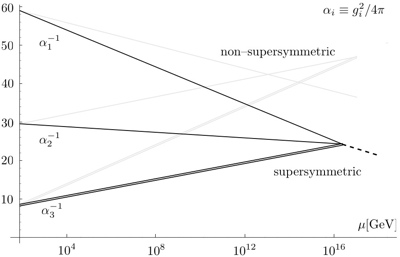
As it turns out, this isn’t as much of a problem as it seems. While the three Yang-Mills forces seem to have very different strengths on an everyday scale, that’s not true at very high energies. Let’s steal a plot from Sweden’s Royal Institute of Technology:

running

Why Sweden? Why not!

What’s going on in this plot?

Here, each \alpha represents the strength of a fundamental force. As the force gets stronger, \alpha gets bigger (and so \alpha^{-1} gets smaller). The variable on the x-axis is the energy scale. The grey lines represent a world without supersymmetry, while the black lines show the world in a supersymmetric model.

So based on this plot, it looks like the strengths of the fundamental forces change based on the energy scale. That’s true, but if you find that confusing there’s another, mathematically equivalent way to think about it.

You can think about each force as having some sort of ultimate strength, the strength it would have if the world weren’t quantum. Without quantum mechanics, each force would interact with particles in only the simplest of ways, corresponding to the simplest diagram here.

However, our world is quantum mechanical. Because of that, when we try to measure the strength of a force, we’re not really measuring its “ultimate strength”. Rather, we’re measuring it alongside a whole mess of other interactions, corresponding to the other diagrams in that post. These extra contributions mean that what looks like the strength of the force gets stronger or weaker depending on the energy of the particles involved.

(I’m sweeping several things under the rug here, including a few infinities and electroweak unification. But if you just want a general understanding of what’s going on, this should be a good starting point.)

If you look at the plot, you’ll see the forces meet up somewhere around 10^16 GeV. They miss each-other for the faint, non-supersymmetric lines, but they meet fairly cleanly for the supersymmetric ones.

So (at least if supersymmetry is true), making the Yang-Mills forces have the same strength is not so hard. Putting them in the same mathematical group is where things get trickier. This is because any group that contains the groups of the fundamental forces will be “bigger” than just the sum of those forces: it will contain “extra forces” that we haven’t observed yet, and these forces can do unexpected things.

In particular, the “extra forces” predicted by GUTs usually make protons unstable. As far as we can tell, protons are very long-lasting: if protons decayed too fast, we wouldn’t have stars. So if protons decay, they must do it only very rarely, detectable only with very precise experiments. These experiments are powerful enough to rule out most of the simplest GUTs. The more complicated GUTs still haven’t been ruled out, but it’s enough to make fewer people interested in GUTs as a research topic.

What about Theories of Everything, or ToEs?

While GUT is a technical term, ToE is very much not. Instead, it’s a phrase that journalists have latched onto because it sounds cool. As such, it doesn’t really have a clear definition. Usually it means uniting gravity with the other fundamental forces, but occasionally people use it to refer to a theory that also unifies the various Standard Model particles into some sort of “final theory”.

Gravity is very different from the other fundamental forces, different enough that it’s kind of silly to group them as “fundamental forces” in the first place. Thus, while GUT models are the kind of thing one can cook up and tinker with, any ToE has to be based on some novel insight, one that lets you express gravity and Yang-Mills forces as part of the same structure.

So far, string theory is the only such insight we have access to. This isn’t just me being arrogant: while there are other attempts at theories of quantum gravity, aside from some rather dubious claims none of them are even interested in unifying gravity with other forces.

This doesn’t mean that string theory is necessarily right. But it does mean that if you want a different “theory of everything”, telling physicists to go out and find a new one isn’t going to be very productive. “Find a theory of everything” is a hope, not a research program, especially if you want people to throw out the one structure we have that even looks like it can do the job.

In Defense of Lord Kelvin, Michelson, and the Physics of Decimals

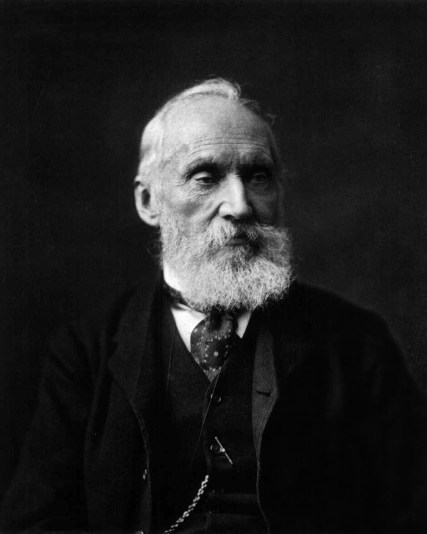
William Thompson, Lord Kelvin, was a towering genius of 19th century physics. He is often quoted as saying,

There is nothing new to be discovered in physics now. All that remains is more and more precise measurement.

lord_kelvin_photograph

Certainly sounds like something I would say!

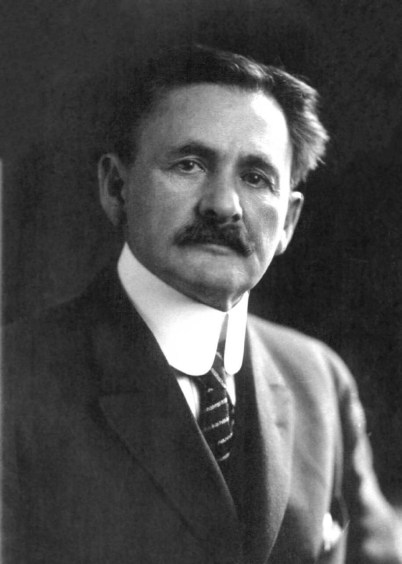
As it happens, he never actually said this. It’s a paraphrase of a quote from Albert Michelson, of the Michelson-Morley Experiment:

While it is never safe to affirm that the future of Physical Science has no marvels in store even more astonishing than those of the past, it seems probable that most of the grand underlying principles have been firmly established and that further advances are to be sought chiefly in the rigorous application of these principles to all the phenomena which come under our notice. It is here that the science of measurement shows its importance — where quantitative work is more to be desired than qualitative work. An eminent physicist remarked that the future truths of physical science are to be looked for in the sixth place of decimals.

albert_abraham_michelson2

Now that’s more like it!

In hindsight, this quote looks pretty silly. When Michelson said that “it seems probable that most of the grand underlying principles have been firmly established” he was leaving out special relativity, general relativity, and quantum mechanics. From our perspective, the grandest underlying principles had yet to be discovered!

And yet, I think we should give Michelson some slack.

Someone asked me on twitter recently what I would choose if given the opportunity to unravel one of the secrets of the universe. At the time, I went for the wishing-for-more-wishes answer: I’d ask for a procedure to discover all of the other secrets.

I was cheating, to some extent. But I do think that the biggest and most important mystery isn’t black holes or the big bang, isn’t asking what will replace space-time or what determines the constants in the Standard Model. The most critical, most important question in physics, rather, is to find the consequences of the principles we actually know!

We know our world is described fairly well by quantum field theory. We’ve tested it, not just to the sixth decimal place, but to the tenth. And while we suspect it’s not the full story, it should still describe the vast majority of our everyday world.

If we knew not just the underlying principles, but the full consequences of quantum field theory, we’d understand almost everything we care about. But we don’t. Instead, we’re forced to calculate with approximations. When those approximations break down, we fall back on experiment, trying to propose models that describe the data without precisely explaining it. This is true even for something as “simple” as the distribution of quarks inside a proton. Once you start trying to describe materials, or chemistry or biology, all bets are off.

This is what the vast majority of physics is about. Even more, it’s what the vast majority of science is about. And that’s true even back to Michelson’s day. Quantum mechanics and relativity were revelations…but there are still large corners of physics in which neither matters very much, and even larger parts of the more nebulous “physical science”.

New fundamental principles get a lot of press, but you shouldn’t discount the physics of “the sixth place of decimals”. Most of the big mysteries don’t ask us to challenge our fundamental paradigm: rather, they’re challenges to calculate or measure better, to get more precision out of rules we already know. If a genie gave me the solution to any of physics’ mysteries I’d choose to understand the full consequences of quantum field theory, or even of the physics of Michelson’s day, long before I’d look for the answer to a trendy question like quantum gravity.

You Go, LIGO!

Well folks, they did it. LIGO has detected gravitational waves!

FAQ:

What’s a gravitational wave?

Gravitational waves are ripples in space and time. As Einstein figured out a century ago, masses bend space and time, which causes gravity. Wiggle masses in the right way and you get a gravity wave, like a ripple on a pond.

Ok, but what is actually rippling? It’s some stuff, right? Dust or something?

In a word, no. Not everything has to be “stuff”. Energy isn’t “stuff”, and space-time isn’t either, but space-time is really what vibrates when a gravitational wave passes by. Distances themselves are changing, in a way that is described by the same math and physics as a ripple in a pond.

What’s LIGO?

LIGO is the Laser Interferometer Gravitational-Wave Observatory. In simple terms, it’s an observatory (or rather, a pair of observatories in Washington and Louisiana) that can detect gravitational waves. It does this using beams of laser light four kilometers long. Gravitational waves change the length of these beams when they pass through, causing small but measurable changes in the laser light observed.

Are there other gravitational wave observatories?

Not currently in operation. LIGO originally ran from 2002 to 2010, and during that time there were other gravitational wave observatories also in operation (VIRGO in Italy and GEO600 in Germany). All of them (including LIGO) failed to detect anything, and so LIGO and VIRGO were shut down in order for them to be upgraded to more sensitive, advanced versions. Advanced LIGO went into operation first, and made the detection. VIRGO is still under construction, as is KAGRA, a detector in Japan. There are also plans for a detector in India.

Other sorts of experiments can detect gravitational waves on different scales. eLISA is a planned space-based gravitational wave observatory, while Pulsar Timing Arrays could use distant neutron stars as an impromptu detector.

What did they detect? What could they detect?

The gravitational waves that LIGO detected came from a pair of black holes merging. In general, gravitational waves come from a pair of masses, or one mass with an uneven and rapidly changing shape. As such, LIGO and future detectors might be able to observe binary stars, supernovas, weird-shaped neutron stars, colliding galaxies…pretty much any astrophysical event involving large things moving comparatively fast.

What does this say about string theory?

Basically nothing. There are gravity waves in string theory, sure (and they play a fairly important role), but there were gravity waves in Einstein’s general relativity. As far as I’m aware, no-one at this point seriously thought that gravitational waves didn’t exist. Nothing that LIGO observed has any bearing on the quantum properties of gravity.

But what about cosmic strings? They mentioned those in the announcement!

Cosmic strings, despite the name, aren’t a unique prediction of string theory. They’re big, string-shaped wrinkles in space and time, possible results of the rapid expansion of space during cosmic inflation. You can think of them a bit like the cracks that form in an over-inflated balloon right before it bursts.

Cosmic strings, if they exist, should produce gravitational waves. This means that in the future we may have concrete evidence of whether or not they exist. This wouldn’t say all that much about string theory: while string theory does have its own explanations for cosmic strings, it’s unclear whether it actually has unique predictions about them. It would say a lot about cosmic inflation, though, and would presumably help distinguish it from proposed alternatives. So keep your eyes open: in the next few years, gravitational wave observatories may well have something important to say about the overall history of the universe.

Why is this discovery important, though? If we already knew that gravitational waves existed, why does discovering them matter?

LIGO didn’t discover that gravitational waves exist. LIGO discovered that we can detect them.

The existence of gravitational waves is no discovery. But the fact that we now have observatories sensitive enough to detect them is huge. It opens up a whole new type of astronomy: we can now observe the universe not just by the light it sheds (and neutrinos), but through a whole new lens. And every time we get another observational tool like this, we notice new things, things we couldn’t have seen without it. It’s the dawn of a new era in astronomy, and LIGO was right to announce it with all the pomp and circumstance they could muster.


My impressions from the announcement:

Speaking of pomp and circumstance, I was impressed by just how well put-together LIGO’s announcement was.

As the US presidential election heats up, I’ve seen a few articles about the various candidates’ (well, usually Trump’s) use of the language of political propaganda. The idea is that there are certain visual symbols at political events for which people have strong associations, whether with historical events or specific ideas or the like, and that using these symbols makes propaganda more powerful.

What I haven’t seen is much discussion of a language of scientific propaganda. Still, the overwhelming impression I got from LIGO’s announcement is that it was shaped by a master in the use of such a language. They tapped in to a wide variety of powerful images: from the documentary-style interviews at the beginning, to Weiss’s tweed jacket and handmade demos, to the American flag in the background, that tied LIGO’s result to the history of scientific accomplishment.

Perimeter’s presentations tend to have a slicker look, my friends at Stony Brook are probably better at avoiding jargon. But neither is quite as good at propaganda, at saying “we are part of history” and doing so without a hitch, as the folks at LIGO have shown themselves to be with this announcement.

I was also fairly impressed that they kept this under wraps for so long. While there were leaks, I don’t think many people had a complete grasp of what was going to be announced until the week before. Somehow, LIGO made sure a collaboration of thousands was able to (mostly) keep their mouths shut!

Beyond the organizational and stylistic notes, my main thought was “What’s next?” They’ve announced the detection of one event. I’ve heard others rattle off estimates, that they should be detecting anywhere from one black hole merger per year to a few hundred. Are we going to see more events soon, or should we settle into a long wait? Could they already have detected more, with the evidence buried in their data, to be revealed by careful analysis? (The waves from this black hole merger were clear enough for them to detect them in real-time, but more subtle events might not make things so easy!) Should we be seeing more events already, and does not seeing them tell us something important about the universe?

Most of the reason I delayed my post till this week was to see if anyone had an answer to these questions. So far, I haven’t seen one, besides the “one to a few hundred” estimate mentioned. As more people weigh in and more of LIGO’s run is analyzed, it will be interesting to see where that side of the story goes.

Who Needs Non-Empirical Confirmation?

I’ve figured out what was bugging me about Dawid’s workshop on non-empirical theory confirmation.

It’s not the concept itself that bothers me. While you might think of science as entirely based on observations of the real world, in practice we can’t test everything. Inevitably, we have to add in other sorts of evidence: judgments based on precedent, philosophical considerations, or sociological factors.

It’s Dawid’s examples that annoy me: string theory, inflation, and the multiverse. Misleading popularizations aside, none of these ideas involve non-empirical confirmation. In particular, string theory doesn’t need non-empirical confirmation, inflation doesn’t want it, and the multiverse, as of yet, doesn’t merit it.

In order for non-empirical confirmation to matter, it needs to affect how people do science. Public statements aren’t very relevant from a philosophy of science perspective; they ebb and flow based on how people promote themselves. Rather, we should care about what scientists assume in the course of their work. If people are basing new work on assumptions that haven’t been established experimentally, then we need to make sure their confidence isn’t misplaced.

String theory hasn’t been established experimentally…but it fails the other side of this test: almost no-one is assuming string theory is true.

I’ve talked before about theorists who study theories that aren’t true. String theory isn’t quite in that category, it’s still quite possible that it describes the real world. Nonetheless, for most string theorists, the distinction is irrelevant: string theory is a way to relate different quantum field theories together, and to formulate novel ones with interesting properties. That sort of research doesn’t rely on string theory being true, often it doesn’t directly involve strings at all. Rather, it relies on string theory’s mathematical abundance, its versatility and power as a lens to look at the world.

There are string theorists who are more directly interested in describing the world with string theory, though they’re a minority. They’re called String Phenomenologists. By itself, “phenomenologist” refers to particle physicists who try to propose theories that can be tested in the real world. “String phenomenology” is actually a bit misleading, since most string phenomenologists aren’t actually in the business of creating new testable theories. Rather, they try to reproduce some of the more common proposals of phenomenologists, like the MSSM, from within the framework of string theory. While string theory can reproduce many possible descriptions of the world (10^500 by some estimates), that doesn’t mean it covers every possible theory; making sure it can cover realistic options is an important, ongoing technical challenge. Beyond that, a minority within a minority of string phenomenologists actually try to make testable predictions, though often these are controversial.

None of these people need non-empirical confirmation. For the majority of string theorists, string theory doesn’t need to be “confirmed” at all. And for the minority who work on string phenomenology, empirical confirmation is still the order of the day, either directly from experiment or indirectly from the particle phenomenologists struggling to describe it.

What about inflation?

Cosmic inflation was proposed to solve an empirical problem, the surprising uniformity of the observed universe. Look through a few papers in the field, and you’ll notice that most are dedicated to finding empirical confirmation: they’re proposing observable effects on the cosmic microwave background, or on the distribution of large-scale structures in the universe. Cosmologists who study inflation aren’t claiming to be certain, and they aren’t rejecting experiment: overall, they don’t actually want non-empirical confirmation.

To be honest, though, I’m being a little unfair to Dawid here. The reason that string theory and inflation are in the name of his workshop aren’t because he thinks they independently use non-empirical confirmation. Rather, it’s because, if you view both as confirmed (and make a few other assumptions), then you’ve got a multiverse.

In this case, it’s again important to compare what people are doing in their actual work to what they’re saying in public. While a lot of people have made public claims about the existence of a multiverse, very few of them actually work on it. In fact, the two sets of people seem to be almost entirely disjoint.

People who make public statements about the multiverse tend to be older prominent physicists, often ones who’ve worked on supersymmetry as a solution to the naturalness problem. For them, the multiverse is essentially an excuse. Naturalness predicted new particles, we didn’t find new particles, so we need an excuse to have an “unnatural” universe, and for many people the multiverse is that excuse. As I’ve argued before, though, this excuse doesn’t have much of an impact on research. These people aren’t discouraged from coming up with new ideas because they believe in the multiverse, rather, they’re talking about the multiverse because they’re currently out of new ideas. Nima Arkani-Hamed is a pretty clear case of someone who has supported the multiverse in pieces like Particle Fever, but who also gets thoroughly excited about new ideas to rescue naturalness.

By contrast, there are many fewer people who actually work on the multiverse itself, and they’re usually less prominent. For the most part, they actually seem concerned with empirical confirmation, trying to hone tricks like anthropic reasoning to the point where they can actually make predictions about future experiments. It’s unclear whether this tiny group of people are on the right track…but what they’re doing definitely doesn’t seem like something that merits non-empirical confirmation, at least at this point.

It’s a shame that Dawid chose the focus he did for his workshop. Non-empirical theory confirmation is an interesting idea (albeit one almost certainly known to philosophy long before Dawid), and there are plenty of places in physics where it could use some examination. We seem to have come to our current interpretation of renormalization non-empirically, and while string theory itself doesn’t rely on non-empirical conformation many of its arguments with loop quantum gravity seem to rely on non-empirical considerations, in particular arguments about what is actually required for a proper theory of quantum gravity. But string theory, inflation, and the multiverse aren’t the examples he’s looking for.

The “Lies to Children” Model of Science Communication, and The “Amplitudes Are Weird” Model of Amplitudes

Let me tell you a secret.

Scattering amplitudes in N=4 super Yang-Mills don’t actually make sense.

Scattering amplitudes calculate the probability that particles “scatter”: coming in from far away, interacting in some fashion, and producing new particles that travel far away in turn. N=4 super Yang-Mills is my favorite theory to work with: a highly symmetric version of the theory that describes the strong nuclear force. In particular, N=4 super Yang-Mills has conformal symmetry: if you re-scale everything larger or smaller, you should end up with the same predictions.

You might already see the contradiction here: scattering amplitudes talk about particles coming in from very far away…but due to conformal symmetry, “far away” doesn’t mean anything, since we can always re-scale it until it’s not far away anymore!

So when I say that I study scattering amplitudes in N=4 super Yang-Mills, am I lying?

Well…yes. But it’s a useful type of lie.

There’s a concept in science writing called “lies to children”, first popularized in a fantasy novel.

the-science-of-discworld-1

This one.

When you explain science to the public, it’s almost always impossible to explain everything accurately. So much background is needed to really understand most of modern science that conveying even a fraction of it would bore the average audience to tears. Instead, you need to simplify, to skip steps, and even (to be honest) to lie.

The important thing to realize here is that “lies to children” aren’t meant to mislead. Rather, they’re chosen in such a way that they give roughly the right impression, even as they leave important details out. When they told you in school that energy is always conserved, that was a lie: energy is a consequence of symmetry in time, and when that symmetry is broken energy doesn’t have to be conserved. But “energy is conserved” is a useful enough rule that lets you understand most of everyday life.

In this case, the “lie” that we’re calculating scattering amplitudes is fairly close to the truth. We’re using the same methods that people use to calculate scattering amplitudes in theories where they do make sense, like QCD. For a while, people thought these scattering amplitudes would have to be zero, since anything else “wouldn’t make sense”…but in practice, we found they were remarkably similar to scattering amplitudes in other theories. Now, we have more rigorous definitions for what we’re calculating that avoid this problem, involving objects called polygonal Wilson loops.

This illustrates another principle, one that hasn’t (yet) been popularized by a fantasy novel. I’d like to call it the “amplitudes are weird” principle. Time and again we amplitudes-folks will do a calculation that doesn’t really make sense, find unexpected structure, and go back to figure out what that structure actually means. It’s been one of the defining traits of the field, and we’ve got a pretty good track record with it.

A couple of weeks back, Lance Dixon gave an interview for the SLAC website, talking about his work on quantum gravity. This was immediately jumped on by Peter Woit and Lubos Motl as ammo for the long-simmering string wars. To one extent or another, both tried to read scientific arguments into the piece. This is in general a mistake: it is in the nature of a popularization piece to contain some volume of lies-to-children, and reading a piece aimed at a lower audience can be just as confusing as reading one aimed at a higher audience.

In the remainder of this post, I’ll try to explain what Lance was talking about in a slightly higher-level way. There will still be lies-to-children involved, this is a popularization blog after all. But I should be able to clear up a few misunderstandings. Lubos probably still won’t agree with the resulting argument, but it isn’t the self-evidently wrong one he seems to think it is.

Lance Dixon has done a lot of work on quantum gravity. Those of you who’ve read my old posts might remember that quantum gravity is not so difficult in principle: general relativity naturally leads you to particles called gravitons, which can be treated just like other particles. The catch is that the theory that you get by doing this fails to be predictive: one reason why is that you get an infinite number of erroneous infinite results, which have to be papered over with an infinite number of arbitrary constants.

Working with these non-predictive theories, however, can still yield interesting results. In the article, Lance mentions the work of Bern, Carrasco, and Johansson. BCJ (as they are abbreviated) have found that calculating a gravity amplitude often just amounts to calculating a (much easier to find) Yang-Mills amplitude, and then squaring the right parts. This was originally found in the context of string theory by another three-letter group, Kawai, Lewellen, and Tye (or KLT). In string theory, it’s particularly easy to see how this works, as it’s a basic feature of how string theory represents gravity. However, the string theory relations don’t tell the whole story: in particular, they only show that this squaring procedure makes sense on a classical level. Once quantum corrections come in, there’s no known reason why this squaring trick should continue to work in non-string theories, and yet so far it has. It would be great if we had a good argument why this trick should continue to work, a proof based on string theory or otherwise: for one, it would allow us to be much more confident that our hard work trying to apply this trick will pay off! But at the moment, this falls solidly under the “amplitudes are weird” principle.

Using this trick, BCJ and collaborators (frequently including Lance Dixon) have been calculating amplitudes in N=8 supergravity, a highly symmetric version of those naive, non-predictive gravity theories. For this particular, theory, the theory you “square” for the above trick is N=4 super Yang-Mills. N=4 super Yang-Mills is special for a number of reasons, but one is that the sorts of infinite results that lose you predictive power in most other quantum field theories never come up. Remarkably, the same appears to be true of N=8 supergravity. We’re still not sure, the relevant calculation is still a bit beyond what we’re capable of. But in example after example, N=8 supergravity seems to be behaving similarly to N=4 super Yang-Mills, and not like people would have predicted from its gravitational nature. Once again, amplitudes are weird, in a way that string theory helped us discover but by no means conclusively predicted.

If N=8 supergravity doesn’t lose predictive power in this way, does that mean it could describe our world?

In a word, no. I’m not claiming that, and Lance isn’t claiming that. N=8 supergravity simply doesn’t have the right sorts of freedom to give you something like the real world, no matter how you twist it. You need a broader toolset (string theory generally) to get something realistic. The reason why we’re interested in N=8 supergravity is not because it’s a candidate for a real-world theory of quantum gravity. Rather, it’s because it tells us something about where the sorts of dangerous infinities that appear in quantum gravity theories really come from.

That’s what’s going on in the more recent paper that Lance mentioned. There, they’re not working with a supersymmetric theory, but with the naive theory you’d get from just trying to do quantum gravity based on Einstein’s equations. What they found was that the infinity you get is in a certain sense arbitrary. You can’t get rid of it, but you can shift it around (infinity times some adjustable constant 😉 ) by changing the theory in ways that aren’t physically meaningful. What this suggests is that, in a sense that hadn’t been previously appreciated, the infinite results naive gravity theories give you are arbitrary.

The inevitable question, though, is why would anyone muck around with this sort of thing when they could just use string theory? String theory never has any of these extra infinities, that’s one of its most important selling points. If we already have a perfectly good theory of quantum gravity, why mess with wrong ones?

Here, Lance’s answer dips into lies-to-children territory. In particular, Lance brings up the landscape problem: the fact that there are 10^500 configurations of string theory that might loosely resemble our world, and no clear way to sift through them to make predictions about the one we actually live in.

This is a real problem, but I wouldn’t think of it as the primary motivation here. Rather, it gets at a story people have heard before while giving the feeling of a broader issue: that string theory feels excessive.

princess_diana_wedding_dress

Why does this have a Wikipedia article?

Think of string theory like an enormous piece of fabric, and quantum gravity like a dress. You can definitely wrap that fabric around, pin it in the right places, and get a dress. You can in fact get any number of dresses, elaborate trains and frilly togas and all sorts of things. You have to do something with the extra material, though, find some tricky but not impossible stitching that keeps it out of the way, and you have a fair number of choices of how to do this.

From this perspective, naive quantum gravity theories are things that don’t qualify as dresses at all, scarves and socks and so forth. You can try stretching them, but it’s going to be pretty obvious you’re not really wearing a dress.

What we amplitudes-folks are looking for is more like a pencil skirt. We’re trying to figure out the minimal theory that covers the divergences, the minimal dress that preserves modesty. It would be a dress that fits the form underneath it, so we need to understand that form: the infinities that quantum gravity “wants” to give rise to, and what it takes to cancel them out. A pencil skirt is still inconvenient, it’s hard to sit down for example, something that can be solved by adding extra material that allows it to bend more. Similarly, fixing these infinities is unlikely to be the full story, there are things called non-perturbative effects that probably won’t be cured. But finding the minimal pencil skirt is still going to tell us something that just pinning a vast stretch of fabric wouldn’t.

This is where “amplitudes are weird” comes in in full force. We’ve observed, repeatedly, that amplitudes in gravity theories have unexpected properties, traits that still aren’t straightforwardly explicable from the perspective of string theory. In our line of work, that’s usually a sign that we’re on the right track. If you’re a fan of the amplituhedron, the project here is along very similar lines: both are taking the results of plodding, not especially deep loop-by-loop calculations, observing novel simplifications, and asking the inevitable question: what does this mean?

That far-term perspective, looking off into the distance at possible insights about space and time, isn’t my style. (It isn’t usually Lance’s either.) But for the times that you want to tell that kind of story…well, this isn’t that outlandish of a story to tell. And unless your primary concern is whether a piece gives succor to the Woits of the world, it shouldn’t be an objectionable one.

Pi in the Sky Science Journalism

You’ve probably seen it somewhere on your facebook feed, likely shared by a particularly wide-eyed friend: pi found hidden in the hydrogen atom!

FionaPi

ChoPi

OuellettePi

From the headlines, this sounds like some sort of kabbalistic nonsense, like finding the golden ratio in random pictures.

Read the actual articles, and the story is a bit more reasonable. The last two I linked above seem to be decent takes on it, they’re just saddled with ridiculous headlines. As usual, I blame the editors. This time, they’ve obscured an interesting point about the link between physics and mathematics.

So what does “pi found hidden in the hydrogen atom” actually mean?

It doesn’t mean that there’s some deep importance to the number pi in nature, beyond its relevance in mathematics in general. The reason that pi is showing up here isn’t especially deep.

It isn’t trivial either, though. I’ve seen a few people whose first response to this article was “of course they found pi in the hydrogen atom, hydrogen atoms are spherical!” That’s not what’s going on here. The connection isn’t about the shape of the hydrogen atom, it’s about one particular technique for estimating its energy.

Carl Hagen is a physicist at the University of Rochester who was teaching a quantum mechanics class in which he taught a well-known approximation technique called the variational principle. Specifically, he had his students apply this technique to the hydrogen atom. The nice thing about the hydrogen atom is that it’s one of the few atoms simple enough that it’s possible to find its energy levels exactly. The exact calculation can then be compared to the approximation.

What Hagen noticed was that this approximation was surprisingly good, especially for high energy states for which it wasn’t expected to be. In the end, working with Rochester math professor Tamar Friedmann, he figured out that the variational principle was making use of a particular identity between a type of mathematical functions, called Gamma functions, that are quite common in physics. Using those Gamma functions, the two researchers were able to re-derive what turned out to be a 17th century formula for pi, giving rise to a much cleaner proof for that formula than had been known previously.

So pi isn’t appearing here because “the hydrogen atom is a sphere”. It’s appearing because pi appears all over the place in physics, and because in general, the same sorts of structures appear again and again in mathematics.

Pi’s appearance in the hydrogen atom is thus not very special, regardless. What is a little bit special is the fact that, using the hydrogen atom, these folks were able to find a cleaner proof of an old approximation for pi, one that mathematicians hadn’t found before.

That, if anything, is the interesting part of this news story, but it’s also part of a broader trend, one in which physicists provide “physics proofs” for mathematical results. One of the more famous accomplishments of string theory is a class of “physics proofs” of this sort, using a principle called mirror symmetry.

The existence of  “physics proofs” doesn’t mean that mathematics is secretly constrained by the physical world. Rather, they’re a result of the fact that physicists are interested in different aspects of mathematics, and in general are a bit more reckless in using approximations that haven’t been mathematically vetted. A physicist can sometimes prove something in just a few lines that mathematicians would take many pages to prove, but usually they do this by invoking a structure that would take much longer for a mathematician to define. As physicists, we’re building on the shoulders of other physicists, using concepts that mathematicians usually don’t have much reason to bother with. That’s why it’s always interesting when we find something like the Amplituhedron, a clean mathematical concept hidden inside what would naively seem like a very messy construction. It’s also why “physics proofs” like this can happen: we’re dealing with things that mathematicians don’t naturally consider.

So please, ignore the pi-in-the-sky headlines. Some physicists found a trick, some mathematicians found it interesting, the hydrogen atom was (quite tangentially) involved…and no nonsense needs to be present.