Tag Archives: physics

What’s up with arXiv?

First of all, I wanted to take a moment to say that this is the one-year anniversary of this blog. I’ve been posting every week, (almost always) on Friday, since I first was motivated to start blogging back in November 2012. It’s been a fun ride, through ups and downs, Ars Technica and Amplituhedra, and I hope it’s been fun for you, the reader, as well!

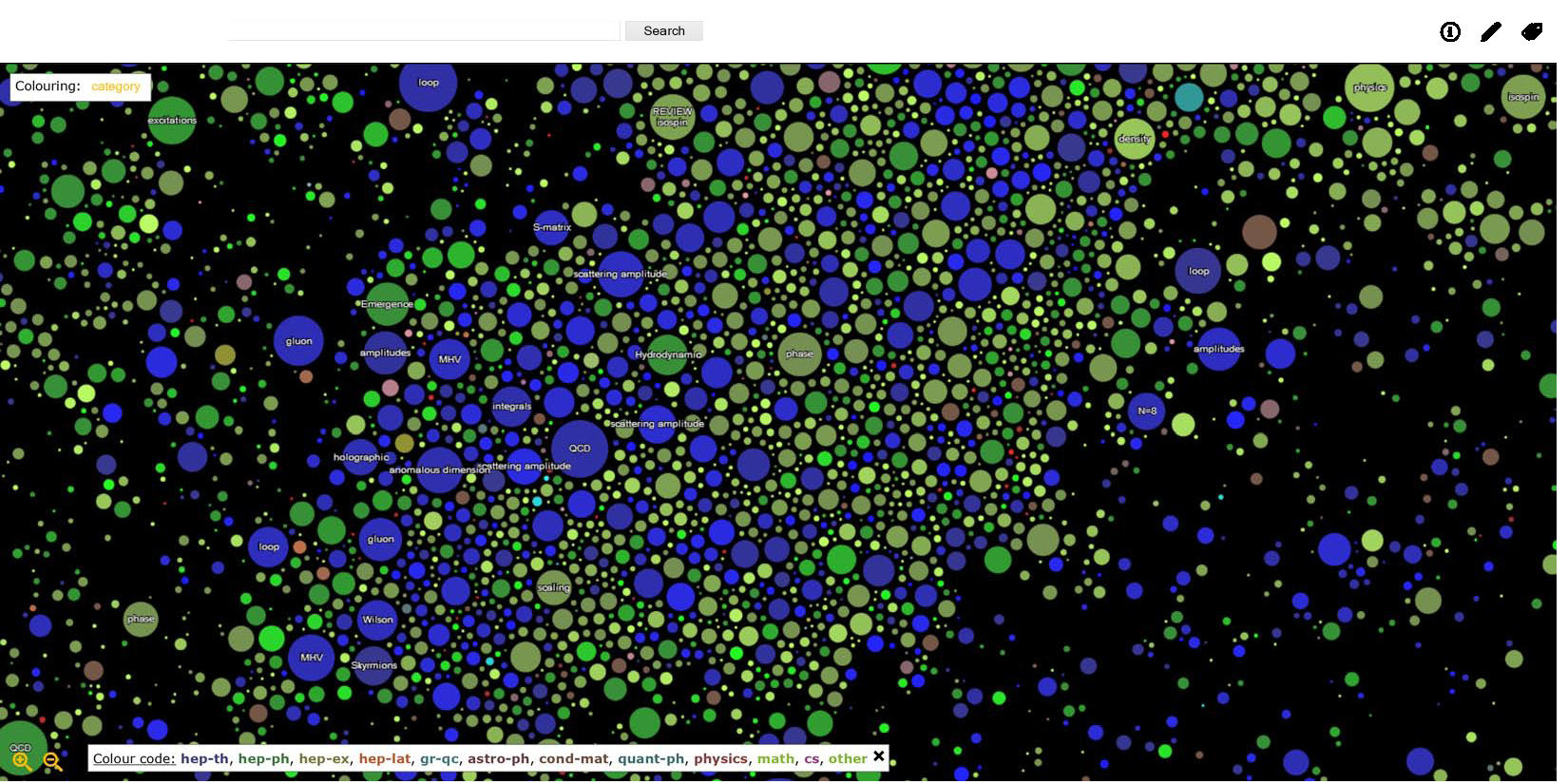
I’ve been giving links to arXiv since my very first post, but I haven’t gone into detail about what arXiv is. Since arXiv is a rather unique phenomenon, it could use a more full description.

arXivpic

The word arXiv is pronounced much like the normal word archive, just think of the capital X like a Greek letter Chi.

Much as the name would suggest, arXiv is an archive, specifically a preprint archive. A pre-print is in a sense a paper before it becomes a paper; more accurately, it is a scientific paper that has not yet been published in a journal. In the past, such preprints would be kept by individual universities, or passed between interested individuals. Now arXiv, for an increasing range of fields (first physics and mathematics, now also computer science, quantitative biology, quantitative finance, and statistics) puts all of the preprints in one easily accessible, free to access place.

Different fields have different conventions when it comes to using arXiv. As a theoretical physicist, I can only really speak to how we use the system.

When theoretical physicists write a paper, it is often not immediately clear which journal we should submit it to. Different journals have different standards, and a paper that will gather more interest can be published in a more prestigious journal. In order to gauge how much interest a paper will raise, most theoretical physicists will put their papers up on arXiv as preprints first, letting them sit there for a few months to drum up attention and get feedback before formally submitting the paper to a journal.

The arXiv isn’t just for preprints, though. Once a paper is published in a journal, a copy of the paper remains on arXiv. Often, the copy on arXiv will be updated when the paper is updated, changed to the journal’s preferred format and labeled with the correct journal reference. So arXiv, ultimately, contains almost all of the papers published in theoretical physics in the last decade or two, all free to read.

But it’s not just papers! The digital format of arXiv makes it much easier to post other files alongside a paper, so that many people upload not just their results, but the computer code they used to generate them, or their raw data in long files. You can also post papers too long or unwieldy to publish in a journal, making arXiv an excellent dropping-off point for information in whatever format you think is best.

We stand at the edge of a new age of freely accessible science. As more and more disciplines start to use arXiv and similar services, we’ll have more flexibility to get more information to more people, while still keeping the advantage of peer review for publication in actual journals. It’s going to be very interesting to see where things go from here.

New Guide, Taking Suggestions

Hello readers!

Some of you have probably read the guide to N=4 super Yang-Mills theory linked at the top of my blog’s home page. A few of you even discovered this blog via the guide.

I’m thinking about doing another series of posts, like those, explaining a different theory. I’d like to get an idea of which theory you guys are most interested in seeing described. Whichever I choose, it will be largely along the same lines as the N=4 posts, so focused less on technical details and more on presenting something that a layman can understand.

Here are some of the options I’m considering:

  • N=8 Supergravity: Very broadly speaking, this is gravity’s equivalent of N=4 super Yang-Mills. It’s connected to N=4 in a variety of interesting ways, and it’s something I’d like to work more with at some point.
  • The (2,0) Theory: This was the motivation behind my first paper. It’s harder to explain than some of the other theories because it doesn’t have an easy analogy with the particles of the real world. It’s also even harder to work with, to the point that saying something rigorous about it is often worthy of a paper on its own.
  • String Theory/M Theory: This is a big topic, and there are many sites out there already that cover aspects of it. What I might try to do is look for an angle of approach that others haven’t covered, and try to explain some slightly more technical aspects of the situation in a popularly approachable way.

I could also give a more detailed description of some method from amplitudeology, like generalized unitarity or symbology.

Finally, I could always just keep posting like I have been doing. But this seems like a good time to add to my site’s utility. So what do you think? What should I talk about?

Dammit Jim, I’m a Physicist not a Graphic Designer!

Over the last week I’ve been working with a few co-authors to get a paper ready for publication. For my part, this has mostly meant making plots of our data. (Yes, theorists have data! It’s the result of calculations, not observations, but it’s still data!)

As it turns out, making the actual plots is only the first and easiest step. We have a huge number of data points, which means the plots ended up being very large files. To fix this I had to smooth out the files so they don’t include every point, a process called rasterizing the images. I also needed to make sure that the labels of the plots matched the fonts in the paper, and that the images in the paper were of the right file type to be included, which in turn meant understanding the sort of information retained by each type of image file. I had to learn which image files include transparency and which don’t, which include fonts as text and which use images, and which fonts were included in each program I used. By the end, I learned more about graphic design than I ever intended to.

In a company, this sort of job would be given to a graphic designer on-staff, or a hired expert. In academia, however, we don’t have the resources for that sort of thing, so we have to become experts in the nitty-gritty details of how to get our work in publishable form.

As it turns out, this is part of a wider pattern in academia. Any given project doesn’t have a large staff of specialists or a budget for outside firms, so everyone involved has to become competent at tasks that a business would parcel out to experts. This is why a large part of work in physics isn’t really physics per se; rather, we theorists often spend much of our time programming, while experimentalists often have to build and repair their experimental apparatus. The end result is that much of what we do is jury-rigged together, with an amateur understanding of most of the side disciplines involved. Things work, but they aren’t as efficient or as slick as they could be if assembled by a real expert. On the other hand, it makes things much cheaper, and it’s a big contributor to the uncanny ability of physicists to know about other peoples’ disciplines.

Hawking vs. Witten: A Primer

Have you seen the episode of Star Trek where Data plays poker with Stephen Hawking? How about the times he appeared on Futurama or the Simpsons? Or the absurd number of times he has come up in one way or another on The Big Bang Theory?

Stephen Hawking is probably the most recognizable theoretical physicist to laymen. Wheelchair-bound and speaking through a voice synthesizer, Hawking presents a very distinct image, while his work on black holes and the big bang, along with his popular treatments of science in books like A Brief History of Time, has made him synonymous in the public’s mind with genius.

He is not, however, the most recognizable theoretical physicist when talking to physicists. If Sheldon from The Big Bang Theory were a real string theorist he wouldn’t be obsessed with Hawking. He might, however, be obsessed with Edward Witten.

Edward Witten is tall and has an awkwardly high voice (for a sample, listen to the clip here). He’s also smart, smart enough to dabble in basically every subfield of theoretical physics and manage to make important contributions while doing so. He has a knack for digging up ideas from old papers and dredging out the solution to current questions of interest.

And far more than Hawking, he represents a clear target for parody, at least when that parody is crafted by physicists and mathematicians. Abstruse Goose has a nice take on his role in theoretical physics, while his collaboration with another physicist named Seiberg on what came to be known as Seiberg-Witten theory gave rise to the cyber-Witten pun.

If you would look into the mouth of physics-parody madness, let this link be your guide…

So why hasn’t this guy appeared on Futurama? (After all, his dog does!)

Witten is famous among theorists, but he hasn’t done as much as Hawking to endear himself to the general public. He hasn’t written popular science books, and he almost never gives public talks. So when a well-researched show like The Big Bang Theory wants to mention a famous physicist, they go to Hawking, not to Witten, because people know about him. And unless Witten starts interfacing more with the public (or blog posts like this become more common), that’s not about to change.

Physics and its (Ridiculously One-Sided) Search for a Nemesis

Maybe it’s arrogance, or insecurity. Maybe it’s due to viewing themselves as the arbiters of good and bad science. Perhaps it’s just because, secretly, every physicist dreams of being a supervillain.

Physicists have a rivalry, you see. Whether you want to call it an archenemy, a nemesis, or even a kismesis, there is another field of study that physicists find so antithetical to everything they believe in that it crops up in their darkest and most shameful dreams.

What field of study? Well, pretty much all of them, actually.

Won’t you be my Kismesis?

Chemistry

A professor of mine once expressed the following sentiment:

“I have such respect for chemists. They accomplish so many things, while having no idea what they are doing!”

Disturbingly enough, he actually meant this as a compliment. Physicists’ relationship with chemists is a bit like a sibling rivalry. “Oh, isn’t that cute! He’s just playing with chemicals. Little guy doesn’t know anything about atoms, and yet he’s just sluggin’ away…wait, why is it working? What? How did you…I mean, I could have done that. Sure.”

Biology

They study all that weird, squishy stuff. They get to do better mad science. And somehow they get way more funding than us, probably because the government puts “improving lives” over “more particles”. Luckily, we have a solution to the problem.

Mathematics

Saturday Morning Breakfast Cereal has a pretty good take on this. Mathematicians are rigorous…too rigorous. They never let us have any fun, even when it’s totally fine, and everyone thinks they’re better than us. Well they’re not! Neener neener.

Computer Science

I already covered math, didn’t I?

Engineering

Think about how mathematicians think about physicists, and you’ll know how physicists think about engineers. They mangle our formulas, ignoring our pristine general cases for silly criteria like “ease of use” and “describing the everyday world”. Just lazy!

Philosophy

What do these guys even study? I mean, what’s the point of metaphysics? We’ve covered that, it’s called physics! And why do they keep asking what quantum mechanics means?

These guys have an annoying habit of pointing out moral issues with things like nuclear power plants and worry entirely too much about world-destroying black holes. They’re also our top competition for GRE scores.

Economics

So, what do you guys use real analysis for again? Pretending to be math-based science doesn’t make you rigorous, guys.

Psychology

We point out that surveys probably don’t measure anything, and that you can’t take the average of “agree” and “strongly agree”. Plus, if you’re a science, where is your F=ma?

They point out that we don’t actually know anything about how psychology research actually works, and that we seem to think that all psychologists are Freud. Then they ask us to look at just how fuzzy the plots we get from colliders actually are.

The argument escalates from there, often ending with frenzied makeout sessions.

Geology?  Astronomy?

Hey, we want a nemesis, but we’re not that desperate.eyH

A physicist by any other trade

Physicists have a tendency to stick their noses in other peoples’ work. We’ve conquered Wall Street (and maybe ruined it), studied communication networks and neural networks, and in a surprising number of cases turned from the study of death to the study of life. Pretty much everyone in physics knows someone who left physics to work on something more interesting, or better-funded, or just straight-up more lucrative. Occasionally, they even remember their roots.

What about the reverse, though? Where are the stories of people in other fields taking up physics?

Aside from a few very early-career examples, that just doesn’t happen. You might say that’s just because physics is hard, but that would be discounting the challenges present in other fields. A better point is that physics is hard, and old.

 Physics is arguably the oldest science, with only a few fields like mathematics and astronomy having claim to an older pedigree. A freshman physics student spends their first semester studying ideas that would have been recognizable three hundred years ago.

Of course, the same (and more) could be said about philosophy. The difference is that in physics, we teach ideas from three hundred years ago because we need them to teach ideas from two hundred years ago. And the ideas from two hundred years ago are only there so we can fill them in with information from a hundred years ago. The purpose of an education in physics, in a sense, is to catch students up with the last three hundred years of work in as concise a manner as possible.

Naturally, this leads to a lot of shortcuts, and over the years an enormous amount of notational cruft has built up around the field, to the point where nothing can be understood without understanding the last three hundred years. In a field where just getting students used to the built-up lingo takes an entire undergraduate education, it’s borderline impossible to just pick it up in the middle and expect to make progress.

Of course, this only explains why people who were trained in other fields don’t take up physics mid-career. What about physicists who go over to other fields? Do they ever come back?

I can’t think of any examples, but I can’t think of a good reason either. Maybe it’s hard to get back in to physics after you’ve been gone for a while. Maybe other fields are just so fun, or physics so miserable, no-one ever wants to come back. We shall never know.

There’s something about Symmetry…

Physicists talk a lot about symmetry. Listen to an article about string theory and you might get the idea that symmetry is some sort of mysterious, mystical principle of beauty, inexplicable to the common man or woman.

Well, if it was inexplicable, I wouldn’t be blogging about it, now would I?

Symmetry in physics is dead simple. At the same time, it’s a bit misleading.

When you think of symmetry, you probably think of objects: symmetric faces, symmetric snowflakes, symmetric sculptures. Symmetry in physics can be about objects, but it can also be about places: symmetry is the idea that if you do an experiment from a different point of view, you should get the same results. In a way, this is what makes all of physics possible: two people in two different parts of the world can do the same experiment, but because of symmetry they can compare results and agree on how the world works.

Of course, if that was all there was to symmetry then it would hardly have the mystical reputation it does. The exciting, beautiful, and above all useful thing about symmetry is that, whenever there is a symmetry, there is a conservation law.

A conservation law is a law of physics that states that some quantity is conserved, that is, cannot be created or destroyed, but merely changed from one form to another. Energy is the classic example: you can’t create energy out of nothing, but you can turn the potential energy of gravity on top of a hill into the kinetic energy of a rolling ball, or the chemical energy of coal into the electrical energy in your power lines.

The fact that every symmetry creates a conservation law is not obvious. Proving it in general and describing how it works required a major breakthrough in mathematics. It was worked out by Emmy Noether, one of the greatest minds of her time, which given that her time included Einstein says rather a lot. Noether struggled for most of her life with the male-dominated establishment of academia, and spent many years teaching unpaid and under the names of male faculty, forbidden from being a professor because of her gender.

Why must women always be banished to the Noether regions of physics?

Noether’s proof is remarkable, but if you’re not familiar with the mathematics it won’t mean much to you. If you want to get a feel for the connection between symmetries and conservation laws, you need to go back a bit further. For the best example, we need to go all the way back to the dawn of physics.

Christiaan Huygens was a contemporary of Isaac Newton, and like Noether he was arguably as smart as if not smarter than his more famous colleague. Huygens could be described as the first theoretical physicist. Long before Newton first wrote his three laws of motion, Huygens used thought experiments to prove deep facts about physics, and he did it using symmetry.

In one of Huygens’ thought experiments, two men face each other, one standing on a boat and the other on the bank of a river. The men grab onto each other’s hands, and dangle a ball on a string from each pair of hands. In this way, it is impossible to tell which man is moving each ball.

Stop hitting yourself!

From the man on the bank’s perspective, he moves the two balls together at the same speed, which happens to be the same speed as the river. The balls are the same size, so as far as he can see they should have the same speed afterwards as well.

On the other hand, the man in the boat thinks that he’s only moving one ball. Since the man on the bank is moving one of the balls along at the same speed as the river, from the man on the boat’s perspective that ball is just staying still, while the other ball is moving with twice the speed of the river. If the man on the bank sees the balls bounce off of each other at equal speed, then the man on the boat will see the moving ball stop, and the ball that was staying still start to move with the same speed as the original ball. From what he could see, a moving ball hit a ball at rest, and transferred its entire momentum to the new ball.

Using arguments like these, Huygens developed the idea of conservation of momentum, the idea of a number related to an object’s mass and speed that can never be created or destroyed, only transferred from one object to another. And he did it using symmetry. At heart, his arguments showed that momentum, the mysterious “quantity of motion”, was merely a natural consequence of the fact that two people can look at a situation in two different ways. And it is that fact, and the power that fact has to explain the world, that makes physicists so obsessed with symmetry.

Why a Quantum Field Theorist is the wrong person to ask about Quantum Mechanics

Quantum Mechanics is quite possibly the sexiest, most mysterious thing to come out of 20th century physics. Almost a century of evidence has confirmed that the world is fundamentally ambiguous and yet deeply predictable, that physics is best described probabilistically, and that however alien this seems the world wouldn’t work without it. Quantum Mechanics raises deep philosophical questions about the nature of reality, some of the most interesting of which are still unanswered to this day.

And I am (for the moment, at least) not the best person to ask about these questions. Because while I specialize in Quantum Field Theory, that actually means I pay very little attention to the paradoxes of Quantum Mechanics.

It all boils down to the way calculations in quantum field theory work. As I described in a previous post, quantum field theory involves adding up progressively more complicated Feynman Diagrams. There are methods that don’t involve Feynman Diagrams, but in one way or another they work on the same basic principle: to take quantum mechanics into account, add up all possible outcomes, either literally or through shortcuts.

That may sound profound, but in many ways it’s quite mundane. Yes, you’re adding up all possibilities, but each possibility is essentially a mundane possibility. There are a few caveats, but essentially each element you add in, each Feynman Diagram for example, looks roughly like the sort of thing you could get without quantum mechanics.

In a typical quantum field theory calculation, you don’t see the mysterious parts of quantum mechanics: you don’t see entanglement, or measurements collapsing the wavefunction, and you don’t have to think about whether reality is really real. Because of that, I’m not the best person to ask about quantum paradoxes, as I’ve got little more than an undergraduate’s knowledge of these things.

There are people whose work focuses much more on quantum paradoxes. Generally these people focus on systems closer to everyday experiments, atoms rather than more fundamental particles. Because the experimentalists they cooperate with have much more ability to manipulate the systems they study, they are able to probe much more intricate quantum properties. People interested in the possibility of a quantum computer are often at the forefront of this, so if you’ve got a question about a quantum paradox, don’t ask me, ask people like WLOG blog.

A final note: there are many people (often very experienced and elite researchers) who, though they might primarily be described as quantum field theorists, have weighed in on the subject of quantum paradoxes. If you’ve heard of the black hole firewall debate, that is a recent high-profile example of this. The important thing to remember is that these people are masters of many areas of physics. They have taken the time to study the foundations of quantum mechanics, and have broadened their horizons to the tools more commonly used in other subfields. So while your average grad student quantum field theorist won’t know an awful lot about quantum paradoxes, these guys do.

Black Holes and a Superluminal River of Glass

If I told you that scientists have been able to make black holes in their labs for years, you probably either wouldn’t believe me, or would suddenly get exceptionally paranoid. Turns out it’s true, provided you understand a little bit about black holes.

A black hole is, at its most basic, an object that light cannot escape. That’s why it’s “black”: it absorbs all colors of light. That’s really, deep down, all you need in order to have a black hole.

Black holes out in space, as you are likely aware, are the result of collapsed stars. Gather enough mass into a small enough space and, according to general relativity, space and time begin to bend. Bend space and time enough and the paths that light would follow curve in on themselves, until inside the event horizon (the “point of no return”) the only way light can go is down, into the center of the black hole.

That’s not the only way to get a “point of no return” though. Imagine flying a glider above a fast-moving river. If the plane is slower than the river, then any object placed in the river is like a “point of no return”:  once the object passes you, you can never fly back and find it again.

Of course, trying to apply this to light runs into a difficulty: you can have a river faster than a plane, but it’s pretty hard to have a river faster than light. You might even say it’s impossible: nothing can travel faster than light, after all, right?

The idea that nothing can travel faster than light is actually a common misconception, held because it makes a better buzzword than the truth: nothing can travel faster than light in a vacuum. Light in a vacuum goes straight to its target, the fastest thing in the universe. But light in a substance, moving through air or water or glass, gets deflected: it runs into atoms, gets absorbed, gets released, and overall moves slower. So in order to make a black hole, all we need is some substance moving faster than light moves in that substance: a superluminal river of glass.

(By the way, is that not an amazingly evocative phrase? Sounds like the title of a Gibson novel.)

Now it turns out that literally making glass move faster than light moves inside it is still well beyond modern science. But scientists can get around that. Instead of making the glass move, they  make the properties of the glass change, using lasers to alter the glass so that the altered area moves faster than the light around it. With this sort of setup, they can test all sorts of theoretical black hole properties up close, in the comfort of a university basement.

That’s just one example of how to create an artificial black hole. There are several others, and all of them rely on various ingenious manipulations of the properties of matter. You live in a world in which artificial black holes are routine and diverse. Inspiring, no?

Wormholes and Donut Holes

I’ve heard people claim that in order to understand wormholes, you need to understand five-dimensional space.

Well that’s just silly.

A wormhole is often described as a hole in space-time. It can be imagined as a black hole where instead of getting crushed when you fall in to the center, you emerge somewhere else (or even some-when else: wormholes are possibly the only way to get time travel). They’re a staple of science fiction, even if they aren’t always portrayed accurately.

Probably not what a wormhole looks like

How does this work? Well like many things in physics, it’s helpful to imagine it with fewer dimensions first:

Suppose that you live on the surface of a donut. You can’t get up off the surface; you’re stuck to its gooey sugary coating. All you can do is slide around it.

It’s a simple life

Let’s say that one day you’re sitting on the pink side of the donut, near the center. Your friend lives on the non-frosted side, and you want to go see her. You could go all the way back to the outside edge of the donut, around the side, and down to the bottom, but you’re tired and the frosting is sticky. Luckily, you can use your futuristic pastry technology, the donut hole! Instead of going around the outside, you dive in through the inside hole, getting to your friend’s house much faster.

That’s really all a wormhole is. Instead of living on a two-dimensional donut surface, you live in a world with three space dimensions and one time dimension. A wormhole is still just like a donut hole: a shortcut, made possible by space being a non-obvious shape.

Now earlier I said that you don’t need to understand five-dimensional space to understand wormholes, and that’s true. Yes, real donuts exist in three dimensions…but if you live on the surface only, you only see two: inward versus outward, and around the center. It’s like a 2D video game with a limited map: the world looks flat, but if you go up past the top edge you find yourself on the bottom. Going from the top edge directly to the bottom is easier than going all the way down the screen: it’s just the same as a wormhole. You don’t need extra dimensions to have wormholes, just rules: when you go up far enough, you come back down. Go to the center of the wormhole, and come out the other side. And as one finds in physics, it’s the rules, not naïve intuitions, that determine how the world works. Just like a video game.