Tag Archives: physics

Energy Is That Which Is Conserved

In school, kids learn about different types of energy. They learn about solar energy and wind energy, nuclear energy and chemical energy, electrical energy and mechanical energy, and potential energy and kinetic energy. They learn that energy is conserved, that it can never be created or destroyed, but only change form. They learn that energy makes things happen, that you can use energy to do work, that energy is different from matter.

Some, between good teaching and good students, manage to impose order on the jumble of concepts and terms. Others end up envisioning the whole story a bit like Pokemon, with different types of some shared “stuff”.

Energy isn’t “stuff”, though. So what is it? What relates all these different types of things?

Energy is something which is conserved.

The mathematician Emmy Noether showed that, when the laws of physics are symmetrical, they come with a conserved quantity. For example, because the laws of the physics are the same from place to place, momentum is conserved. Similarly, because the laws of physics are the same from one time to another, Noether’s theorem states that there must be some quantity related to time, some number we can calculate, that is conserved, even as other things change. We call that number energy.

If energy is that simple, why are there all those types?

Energy is a number we can calculate. It’s a number we can calculate for different things. If you have a detailed description of how something in physics works, you can use that description to calculate that thing’s energy. In school, you memorize formulas like \frac{1}{2}m v^2 and m g h. These are all formulas that, with a bit more knowledge, you could calculate. They are the things that, for a something that meets the conditions, are conserved. They are things that, according to Noether’s theorem, stay the same.

Because of this, you shouldn’t think of energy as a substance, or a fuel. Energy is something we can do: we physicists, and we students of physics. We can take a physical system, and see what about it ought to be conserved. Energy is an action, a calculation, a conceptual tool that can be used to make predictions.

Most things are, in the end.

Reminder to Physics Popularizers: “Discover” Is a Technical Term

When a word has both an everyday meaning and a technical meaning, it can cause no end of confusion.

I’ve written about this before using one of the most common examples, the word “model”, which means something quite different in the phrases “large language model”, “animal model for Alzheimer’s” and “model train”. And I’ve written about running into this kind of confusion at the beginning of my PhD, with the word “effective”.

But there is one example I see crop up again and again, even with otherwise skilled science communicators. It’s the word “discover”.

“Discover”, in physics, has a technical meaning. It’s a first-ever observation of something, with an associated standard of evidence. In this sense, the LHC discovered the Higgs boson in 2012, and LIGO discovered gravitational waves in 2015. And there are discoveries we can anticipate, like the cosmic neutrino background.

But of course, “discover” has a meaning in everyday English, too.

You probably think I’m going to say that “discover”, in everyday English, doesn’t have the same statistical standards it does in physics. That’s true of course, but it’s also pretty obvious, I don’t think it’s confusing anybody.

Rather, there is a much more important difference that physicists often forget: in everyday English, a discovery is a surprise.

“Discover”, a word arguably popularized by Columbus’s discovery of the Americas, is used pretty much exclusively to refer to learning about something you did not know about yet. It can be minor, like discovering a stick of gum you forgot, or dramatic, like discovering you’ve been transformed into a giant insect.

Now, as a scientist, you might say that everything that hasn’t yet been observed is unknown, ready for discovery. We didn’t know that the Higgs boson existed before the LHC, and we don’t know yet that there is a cosmic neutrino background.

But just because we don’t know something in a technical sense, doesn’t mean it’s surprising. And if something isn’t surprising at all, then in everyday, colloquial English, people don’t call it a discovery. You don’t “discover” that the store has milk today, even if they sometimes run out. You don’t “discover” that a movie is fun, if you went because you heard reviews claim it would be, even if the reviews might have been wrong. You don’t “discover” something you already expect.

At best, maybe you could “discover” something controversial. If you expect to find a lost city of gold, and everyone says you’re crazy, then fine, you can discover the lost city of gold. But if everyone agrees that there is probably a lost city of gold there? Then in everyday English, it would be very strange to say that you were the one who discovered it.

With this in mind, the way physicists use the word “discover” can cause a lot of confusion. It can make people think, as with gravitational waves, that a “discovery” is something totally new, that we weren’t pretty confident before LIGO that gravitational waves exist. And it can make people get jaded, and think physicists are overhyping, talking about “discovering” this or that particle physics fact because an experiment once again did exactly what it was expected to.

My recommendation? If you’re writing for the general public, use other words. The LHC “decisively detected” the Higgs boson. We expect to see “direct evidence” of the cosmic neutrino background. “Discover” has baggage, and should be used with care.

Valentine’s Day Physics Poem 2025

Today is Valentine’s Day, so it’s time for the blog’s yearly tradition of posting a poem. This one is inspired by that one Robert Wilson quote.

The physicist was called 
before the big wide world and asked,
Why?

This commitment
This drive
This dream

(and as Nature is a woman, so let her be)

How does she defend?
How does she serve your interests,
home and abroad
(which may be one and the same)?

The physicist stood
before the big wide world
alone but not alone

and answered

She makes me worth defending.

A realist defends to defend
Lives to live
Survives to survive
And devours to devour
It’s dour
Mere existence
The law of “better mine than yours”

Instead, the physicist spoke of the painters,
the sculptors,
…and the poets
He spoke of dignity and honor and love and worth
Of seeing a twinkling many-faceted thing
past the curve of the road
and a future to be shared.

Physics Gets Easier, Then Harder

Some people have stories about an inspiring teacher who introduced them to their life’s passion. My story is different: I became a physicist due to a famously bad teacher.

My high school was, in general, a good place to learn science, but physics was the exception. The teacher at the time had a bad reputation, and while I don’t remember exactly why I do remember his students didn’t end up learning much physics. My parents were aware of the problem, and aware that physics was something I might have a real talent for. I was already going to take math at the university, having passed calculus at the high school the year before, taking advantage of a program that let advanced high school students take free university classes. Why not take physics at the university too?

This ended up giving me a huge head-start, letting me skip ahead to the fun stuff when I started my Bachelor’s degree two years later. But in retrospect, I’m realizing it helped me even more. Skipping high-school physics didn’t just let me move ahead: it also let me avoid a class that is in many ways more difficult than university physics.

High school physics is a mess of mind-numbing formulas. How is velocity related to time, or acceleration to displacement? What’s the current generated by a changing magnetic field, or the magnetic field generated by a current? Students learn a pile of apparently different procedures to calculate things that they usually don’t particularly care about.

Once you know some math, though, you learn that most of these formulas are related. Integration and differentiation turn the mess of formulas about acceleration and velocity into a few simple definitions. Understand vectors, and instead of a stack of different rules about magnets and circuits you can learn Maxwell’s equations, which show how all of those seemingly arbitrary rules fit together in one reasonable package.

This doesn’t just happen when you go from high school physics to first-year university physics. The pattern keeps going.

In a textbook, you might see four equations to represent what Maxwell found. But once you’ve learned special relativity and some special notation, they combine into something much simpler. Instead of having to keep track of forces in diagrams, you can write down a Lagrangian and get the laws of motion with a reliable procedure. Instead of a mess of creation and annihilation operators, you can use a path integral. The more physics you learn, the more seemingly different ideas get unified, the less you have to memorize and the more just makes sense. The more physics you study, the easier it gets.

Until, that is, it doesn’t anymore. A physics education is meant to catch you up to the state of the art, and it does. But while the physics along the way has been cleaned up, the state of the art has not. We don’t yet have a unified set of physical laws, or even a unified way to do physics. Doing real research means once again learning the details: quantum computing algorithms or Monte Carlo simulation strategies, statistical tools or integrable models, atomic lattices or topological field theories.

Most of the confusions along the way were research problems in their own day. Electricity and magnetism were understood and unified piece by piece, one phenomenon after another before Maxwell linked them all together, before Lorentz and Poincaré and Einstein linked them further still. Once a student might have had to learn a mess of particles with names like J/Psi, now they need just six types of quarks.

So if you’re a student now, don’t despair. Physics will get easier, things will make more sense. And if you keep pursuing it, eventually, it will stop making sense once again.

Newtonmas and the Gift of a Physics Background

This week, people all over the world celebrated the birth of someone whose universally attractive ideas spread around the globe. I’m talking, of course about Isaac Newton.

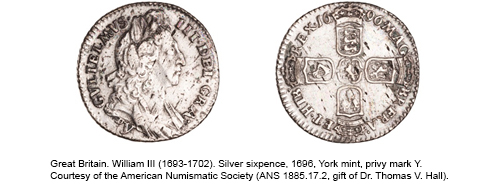
For Newtonmas this year, I’ve been pondering another aspect of Newton’s life. There’s a story you might have heard that physicists can do basically anything, with many people going from a career in physics to a job in a variety of other industries. It’s something I’ve been trying to make happen for myself. In a sense, this story goes back to the very beginning, when Newton quit his academic job to work at the Royal Mint.

On the surface, there are a lot of parallels. At the Mint, a big part of Newton’s job was to combat counterfeiting and “clipping”, where people would carve small bits of silver off of coins. This is absolutely a type of job ex-physicists do today, at least in broad strokes. Working as Data Scientists for financial institutions, people look for patterns in transactions that give evidence of fraud.

Digging deeper, though, the analogy falls apart a bit. Newton didn’t apply any cunning statistical techniques to hunt down counterfeiters. Instead, the stories that get told about his work there are basically detective stories. He hung out in bars to catch counterfeiter gossip and interviewed counterfeiters in prison, not exactly the kind of thing you’d hire a physicist to do these days. The rest of the role was administrative: setting up new mint locations and getting people to work overtime to replace the country’s currency. Newton’s role at the mint was less like an ex-physicist going into Data Science and more like Steven Chu as Secretary of Energy: someone with a prestigious academic career appointed to a prestigious government role.

If you’re looking for a patron saint of physicists who went to industry, Newton’s contemporary Robert Hooke may be a better bet. Unlike many other scientists of the era, Hooke wasn’t independently wealthy, and for a while he was kept quite busy working for the Royal Society. But a bit later he had another, larger source of income: working as a surveyor and architect, where he designed several of London’s iconic buildings. While Newton’s work at the Mint drew on his experience as a person of power and influence, working as an architect drew much more on skills directly linked to Hooke’s work as a scientist: understanding the interplay of forces in quantitative detail.

While Newton and Hooke’s time was an era of polymaths, in some sense the breadth of skills imparted by a physics education has grown. Physicists learn statistics (which barely existed in Newton’s time) programming (which did not exist at all) and a wider range of mathematical and physical models. Having a physics background isn’t the ideal way to go into industry (that would be having an industry background). But for those of us making the jump, it’s still a Newtonmas gift to be grateful for.

Congratulations to Pierre Agostini, Ferenc Krausz and Anne L’Huillier!

The 2023 Physics Nobel Prize was announced this week, awarded to Pierre Agostini, Ferenc Krausz and Anne L’Huillier for figuring out how to generate extremely fast (hundreds of attoseconds) pulses of light.

Some physicists try to figure out the laws of physics themselves, or the behavior of big photogenic physical systems like stars and galaxies. Those people tend to get a lot of press, but most physicists don’t do that kind of work. Instead, most physicists try to accomplish new things with old physical laws: taking light, electrons, and atoms and doing things nobody thought possible. While that may sound like engineering, the work these physicists do lies beyond the bounds of what engineers are comfortable with: there’s too much uncertainty, too little precedent, and the applications are still far away. The work is done with the goal of pushing our capabilities as far as we can, accomplishing new things and worrying later about what they’re good for.

(Somehow, they still tend to be good for something, often valuable things. Knowing things pays off!)

Anne L’Huillier began the story in 1987, shining infrared lasers through noble gases and seeing the gas emit unexpected new frequencies. As physicists built on that discovery, it went from an academic observation to a more and more useful tool, until in 2001 Pierre Agostini and Ferenc Krausz, with different techniques both based on the same knowledge, managed to produce pulses of light only a few hundred attoseconds long.

(“Atto” is one of the SI prefixes. They go milli, micro, nano, pico, femto, atto. Notice that “nano” is in the middle there: an attosecond is as much smaller than a nanosecond as a nanosecond is from an ordinary second.)

This is cool just from the point of view of “humans doing difficult things”, but it’s also useful. Electrons move on attosecond time-scales. If you can send pulses of light at attosecond speed, you’ve got a camera fast enough to capture how electrons move in real time. You can figure out how they traverse electronics, or how they slosh back and forth in biological molecules.

This year’s prize has an extra point of interest for me, as both Anne L’Huillier and Pierre Agostini did their prize-winning work at CEA Paris-Saclay, where I just started work last month. Their groups would eventually evolve into something called Attolab, I walk by their building every day on the way to lunch.

Why You Might Want to Inspire Kids to Be Physicists (And What Movies You’d Make as a Result)

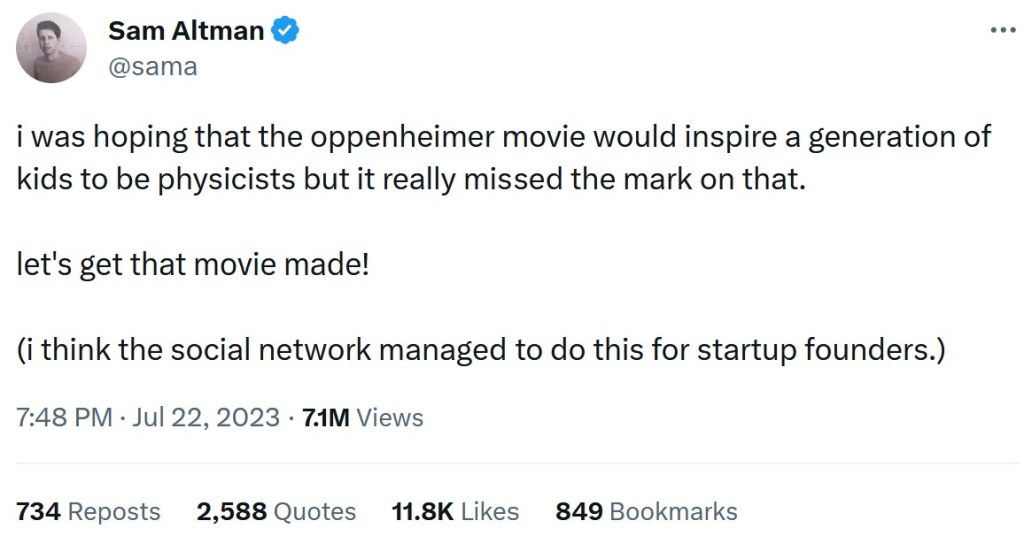
Since the new Oppenheimer biopic came out, people have been making fun of this tweet by Sam Altman:

Expecting a movie about someone building an immensely destructive weapon, watching it plunge the world into paranoia, then getting mercilessly hounded about it to be an inspiration seems…a bit unrealistic? But everyone has already made that point. What I found more interesting was a blog post a couple days ago by science blogger Chad Orzel. Orzel asks, suppose you did want to make a movie inspiring kids to go into physics: how would you do it? I commented on his post with my own take on the question, then realized it might be nice as a post here.

If you want to inspire kids to go into physics with a movie, what do you do? Well, you can start by asking, why do you want kids to go into physics? Why do you want more physicists?

Maybe you believe that more physicists are needed to understand the fundamental laws of the universe. The quest of fundamental physics may be worthwhile in its own right, or may be important because understanding the universe gives us more tools to manipulate it. You might even think of Oppenheimer’s story in that way: because physicists understood the nature of the atom, they could apply that knowledge to change the world, racing to use it to defeat the Nazis and later convinced to continue to avoid a brutal invasion of Japan. (Whether the bomb was actually necessary to do this is still, of course, quite controversial.)

If that’s why you want more kids to be physicists, then you want a story like that. You could riff off of Ashoke Sen’s idea that physics may be essential to save humanity. The laws of physics appear to be unstable, such that at some point the world will shift and a “bubble”, expanding at the speed of light, will rewrite the rules in a way that would destroy all life as we know it. The only way to escape would be to travel faster than light, something that is possible because the universe itself expands at those speeds. By scattering “generation ships” in different directions, we could ensure that some of humanity would survive any such “bubble”: but only if we got the physics right.

A movie based on that idea could look a bit like the movie Cloud Atlas, with connected characters spanning multiple time periods. Scientists in the modern day investigate the expanding universe, making plans that refugees in a future generation ship must carry out. If you want to inspire kids with the idea that physics could save the world, you could get a lot of mileage out of a story that could actually be true.

On the other hand, maybe you don’t care so much about fundamental physics. Maybe you want more physicists because they’re good at solving a variety of problems. They help to invent new materials, to measure things precisely, to predict the weather, change computation, and even contribute to medicine. Maybe you want to tell a story about that.

(Maybe you even want these kids to go farther afield, and study physics without actually becoming physicists. Sam Altman is not a physicist, and I’ve heard he’s not very interested in directing his philanthropic money to increasing the number of jobs for physicists. On the other hand, the AI industry where he is a central player does hire a lot of ex-physicists.)

The problem, as Orzel points out, is that those stories aren’t really stories about physicists. They’re stories about engineering and technology, and a variety of other scientists, because a wide variety of people contribute to these problems. In order to tell a story that inspires people to be physicists, you need a story that highlights something unique that they bring to the table.

Orzel gets close to what I think of as the solution, by bringing up The Social Network. Altman was also mocked for saying that The Social Network motivated kids to found startups: the startup founders in that movie are not exactly depicted as good people. But in reality, it appears that the movie did motivate people to found startups. Stories about badass amoral jerks are engaging, and it’s easy to fantasize about having that kind of power and ability. There’s a reason that The Imitation Game depicted Alan Turing, a man known for his gentle kindness, as brusque and arrogant.

If you want to tell a story about physicists, it’s actually pretty easy, because physicists can be quite arrogant! There is a stereotype of physicists walking into another field, deciding they know everything they need to know, and lecturing the experts about how they should be doing their jobs. This really does happen, and sometimes it’s exactly as dumb as it sounds…but sometimes the physicists are right! Orzel brings up Feynman’s role in figuring out how the Challenger space shuttle blew up, an example of precisely this kind of success.

So if you want kids to grow up to be generalist physicists, people who solve all sorts of problems for all sorts of people, you need to tell them a story like that. One with a Sherlock-esque physicist who runs around showing how much smarter they are than everyone else. You need to make a plot where they physicist waves around “physicist tools”, like dimensional analysis, Fermi estimates, and thermodynamics, and uses them to uncover a mystery, showing a bunch of engineers or biologists just how much cooler they are.

If you do that, you probably could inspire some kids to become physicists. You’ll need a new movie to inspire them to be engineers or biologists, though!

Whatever Happened to the Nonsense Merchants?

I was recently reminded that Michio Kaku exists.

In the past, Michio Kaku made important contributions to string theory, but he’s best known for what could charitably be called science popularization. He’s an excited promoter of physics and technology, but that excitement often strays into inaccuracy. Pretty much every time I’ve heard him mentioned, it’s for some wildly overenthusiastic statement about physics that, rather than just being simplified for a general audience, is generally flat-out wrong, conflating a bunch of different developments in a way that makes zero actual sense.

Michio Kaku isn’t unique in this. There’s a whole industry in making nonsense statements about science, overenthusiastic books and videos hinting at science fiction or mysticism. Deepak Chopra is a famous figure from deeper on this spectrum, known for peddling loosely quantum-flavored spirituality.

There was a time I was worried about this kind of thing. Super-popular misinformation is the bogeyman of the science popularizer, the worry that for every nice, careful explanation we give, someone else will give a hundred explanations that are way more exciting and total baloney. Somehow, though, I hear less and less from these people over time, and thus worry less and less about them.

Should I be worried more? I’m not sure.

Are these people less popular than they used to be? Is that why I’m hearing less about them? Possibly, but I’d guess not. Michio Kaku has eight hundred thousand twitter followers. Deepak Chopra has three million. On the other hand, the usually-careful Brian Greene has a million followers, and Neil deGrasse Tyson, where the worst I’ve heard is that he can be superficial, has fourteen million.

(But then in practice, I’m more likely to reflect on content with even smaller audiences.)

If misinformation is this popular, shouldn’t I be doing more to combat it?

Popular misinformation is also going to be popular among critics. For every big-time nonsense merchant, there are dozens of people breaking down and debunking every false statement they say, every piece of hype they release. Often, these people will end up saying the same kinds of things over and over again.

If I can be useful, I don’t think it will be by saying the same thing over and over again. I come up with new metaphors, new descriptions, new explanations. I clarify things others haven’t clarified, I clear up misinformation others haven’t addressed. That feels more useful to me, especially in a world where others are already countering the big problems. I write, and writing lasts, and can be used again and again when needed. I don’t need to keep up with the Kakus and Chopras of the world to do that.

(Which doesn’t imply I’ll never address anything one of those people says…but if I do, it will be because I have something new to say back!)

Talking and Teaching

Someone recently shared with me an article written by David Mermin in 1992 about physics talks. Some aspects are dated (our slides are no longer sheets of plastic, and I don’t think anyone writing an article like that today would feel the need to put it in the mouth of a fictional professor (which is a shame honestly)), but most of it still holds true. I particularly recognized the self-doubt of being a young physicist sitting in a talk and thinking “I’m supposed to enjoy this?”

Mermin’s basic point is to keep things as light as possible. You want to convey motivation more than content, and background more than your own contributions. Slides should be sparse, both because people won’t be able to see everything but also because people can get frustrated “reading ahead” of what you say.

Mermin’s suggestion that people read from a prepared text was probably good advice for him, but maybe not for others. It can be good if you can write like he does, but I don’t think most people’s writing is that much better than what they say in talks (you can judge this by reading peoples’ papers!) Some are much clearer speaking impromptu. I agree with him that in practice people end up just reading from their slides, which indeed is bad, but reading from a normal physics paper isn’t any better.

I also don’t completely agree with him about the value of speech over text. Yes, putting text on your slides means people can read ahead (unless you hide some of the text, which is easier to do these days than in the days of overhead transparencies). But just saying things means that if someone’s attention lapses for just a moment, they’ll be lost. Unless you repeat yourself a lot (good practice in any case), you should avoid just saying anything you need your audience to remember, and make sure they can read it somewhere if they need it as well.

That said, “if they need it” is doing a lot of work here, and this is where I agree again with Mermin. Fundamentally, you don’t need to convey everything you think you do. (I don’t usually need to convey everything I think I do!) It’s a lesson I’ve been learning this year from pedagogy courses, a message they try to instill in everyone who teaches at the university. If you want to really convey something well, then you just can’t convey that much. You need to focus, pick a few things and try to get them across, and structure the rest of what you say to reinforce those things. When teaching, or when speaking, less is more.

At the Bohr Centennial

One hundred years ago, Niels Bohr received his Nobel prize. One hundred and one years ago, the Niels Bohr Institute opened its doors (it would have been one hundred and two, but pandemics are inconvenient things).

This year, also partly delayed by a pandemic, the Niels Bohr Institute is celebrating.

Using the fanciest hall the university has.

We’ve had a three-day conference, packed with Nobel prizewinners, people who don’t feel out of place among Nobel prizewinners, and for one morning’s ceremony the crown prince of Denmark. There were last-minute cancellations but also last-minute additions, including a moving speech by two Ukrainian PhD students. I don’t talk politics on this blog, so I won’t say much more about it (and you shouldn’t in the comments either, there are better venues), but I will say that was the only time I’ve seen a standing ovation at a scientific conference.

The other talks ran from reminiscences (Glashow struggled to get to the stage, but his talk was witty, even quoting Peter Woit apparently to try to rile David Gross in the front row (next to the Ukranian PhD students who must have found it very awkward)) to classic colloquium style talks (really interesting crisply described puzzles from astrochemistry to biophysics) to a few more “conference-ey” talks (t’Hooft, unfortunately). It’s been fun, but also exhausting, and as such that’s all I’m writing this week.